Determiners for Introducing New vs Known Information

 Here we how English uses a, an, and the to mark new and given information, tracks references across text and dialogue, signals topic changes with determiners, and includes examples and practice identifying new versus known elements.
- How English marks new and given information
- Using a/an to introduce new nouns
- Using the to refer back to previously mentioned items
- Tracking reference through paragraphs and dialogues
- Signalling topic shifts with determiners
- Examples from narrative and academic writing
- Practice: identify new vs known elements in a text
When sharing ideas in English, selecting the correct small words before nouns—such as articles like "a," "an," or "the"—is crucial for clear communication. These words signal to your listener whether you are introducing something new or referring to something already mentioned, which helps avoid confusion. Mastering these subtle choices not only improves your clarity but also makes your speech and writing sound more natural and fluent, ensuring your message is understood as you intend.
How English marks new and given information
English uses a variety of linguistic cues to distinguish between information that’s already familiar to the listener (given) and details that are being introduced for the first time (new). Most notably, this distinction is reflected in the use of determiners, word order, and intonation.
Definite vs. Indefinite Reference
One of the clearest ways English signals whether something is new or already known is through definite and indefinite articles, as well as demonstratives and possessives. Here’s how these forms typically work:
- a/an: Used when mentioning something for the first time, marking it as new (e.g., "I saw a cat.").
- the: Refers to something already mentioned or assumed to be known (e.g., "The cat ran away.").
- this/that: Can introduce new information (especially "this") or refer back to something specific ("that" often signals shared knowledge).
- my/your/his/her: These possessives typically mark information as given or accessible, since the possessor is understood.
Typical Patterns and Examples
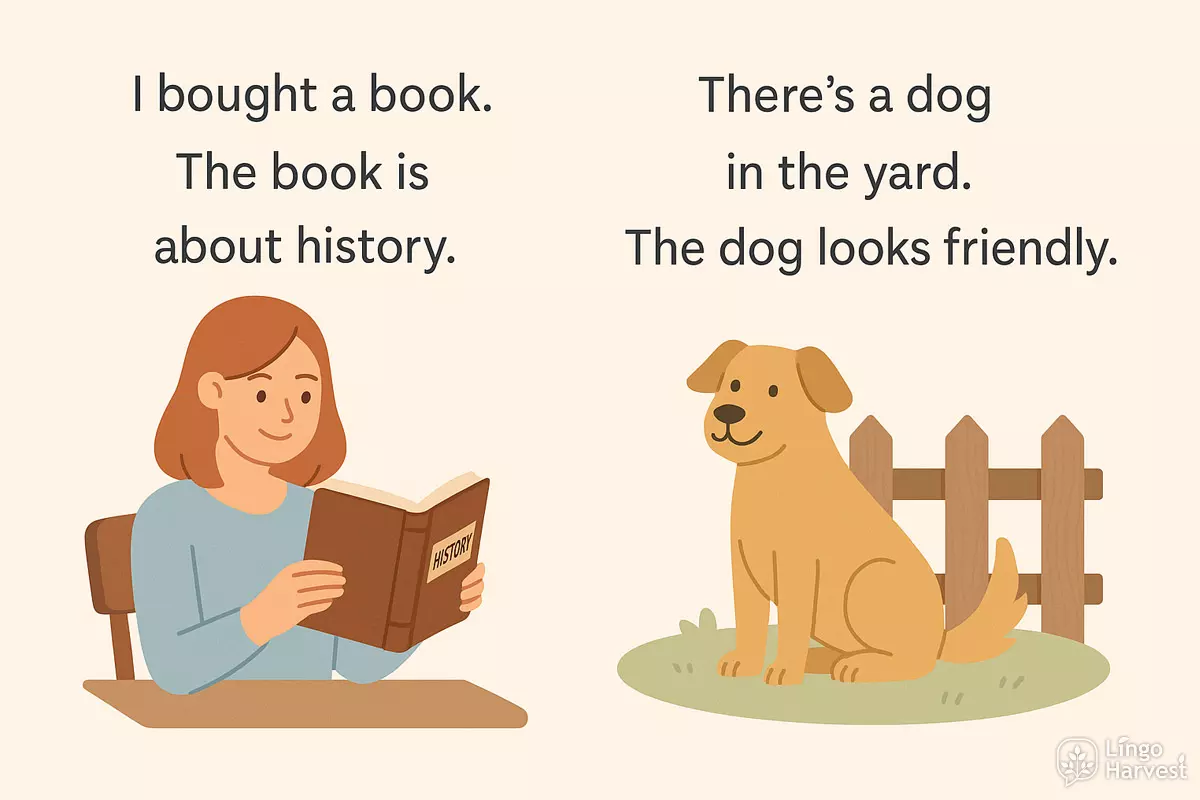
Speakers often introduce a new entity with an indefinite article, then refer to it with a definite article or pronoun in subsequent mentions. Here are some sample patterns:
- I bought a book. The book is about history.
- There’s a dog in the yard. The dog looks friendly.
- Have you met my friend? She’s from Canada.
- This is a problem. The problem needs to be solved.
- We visited a museum. That museum was amazing.
- I have a question. The question is important.
- He found an answer. The answer surprised him.
- I saw a movie last night. The movie was exciting.
- She bought some apples. The apples were fresh.
- We found a solution. The solution worked well.
Word Order and Emphasis
The position of information within a sentence also helps indicate its status. Known information often comes at the beginning, while new details are introduced later:
- Given-first: As for the book, I finished it yesterday.
- New-last: I finished it yesterday, the book you lent me.
Comparison of Determiners
To clarify how different determiners signal whether information is new or established, here’s a structured overview:
| Determiner | Typical Use | Information Status | Example |
|---|---|---|---|
| a/an | First mention, non-specific | New | I saw a bird. |
| the | Known, specific, or previously mentioned | Given | The bird was singing. |
| this/that | Specific, can be new or given | Either (context-dependent) | This idea is new. / That book we discussed... |
| my/your/his/etc. | Possessive, usually accessible | Given | My car is outside. |
Intonation and Stress
Beyond grammar, speakers often use prosody to mark information status. New details are frequently stressed or spoken with rising intonation, while familiar items are less prominent in speech. In summary, English relies on a combination of determiners, sentence structure, and prosodic cues to help listeners track what’s being introduced and what’s already part of the conversation. This system aids clarity and coherence in both writing and speaking.
Using a/an to introduce new nouns
When we mention something for the first time, we often use “a” or “an” to signal that our listener or reader doesn’t know which specific thing we mean yet. These articles help us introduce something new into the conversation or text, making it clear that the noun is not previously identified or known.
Introducing an unknown or unspecified item
“A” is used before words that start with a consonant sound, while “an” is used before words that start with a vowel sound. The choice is about pronunciation, not spelling. For example: “a cat,” “an apple,” “a university” (because “university” starts with a ‘ju:’ sound).
- a book (any book, not a specific one)
- an idea (one idea, not yet defined)
- a dog (not a particular dog)
- an hour (because the ‘h’ is silent: ‘our’)
- a unicorn (starts with a ‘ju:’ sound)
- an umbrella (begins with a vowel sound)
- a car (no particular car yet)
- an orange (any orange, not a specific one)
- a teacher (not yet introduced in the conversation)
- an elephant (first mention)
- a problem (not specified yet)
- an opportunity (first reference)
Contrast: First vs. subsequent mentions
After introducing something with “a” or “an,” we usually switch to “the” when referring to it again, because it has become known in the context. For instance: “I saw a movie last night. The movie was exciting.”
| First Mention | Subsequent Mention |
|---|---|
| a girl walked in | the girl sat down |
| an old house stood on the hill | the house looked abandoned |
| a story was told | the story was fascinating |
| an idea occurred to me | the idea changed everything |
Summary of key points
- Use “a” or “an” to talk about something for the first time or when it’s not specific.
- The choice between “a” and “an” depends on the starting sound of the next word.
- Switch to “the” when the item becomes familiar or previously mentioned.
- This distinction helps listeners or readers track what is new and what is already known in communication.
Using the to refer back to previously mentioned items
When a noun has already been introduced in conversation or writing, English speakers typically use "the" to indicate that both the speaker and listener now share knowledge of this item. This definite article signals that we are talking about something specific, not just any example of a thing. Recognizing when to switch from "a/an" to "the" is essential for clear and natural communication.
How "the" signals shared knowledge
After mentioning a noun for the first time, usually with "a" or "an," subsequent references to the same noun use "the." This usage helps listeners or readers keep track of which item is being discussed, especially in more complex texts or conversations. For instance:
- First mention: I saw a cat in the garden.
- Second mention: The cat was chasing a butterfly.
Here, "the cat" refers back to the cat already introduced.
Common patterns for referencing known information
There are several typical situations where "the" is used to refer back to something mentioned earlier:
- Objects already identified: I bought a book. The book is about history.
- With modifiers: She met a famous actor. The actor was very friendly.
- With superlatives: This is the best pizza I’ve ever had.
- With unique context: We went to a party. The food was delicious.
- After specifying: There was a storm last night. The storm caused a power outage.
- Referencing part of a previously mentioned group: I saw some birds. The smallest bird was blue.
- Using pronouns or phrases to clarify: She adopted a dog. The animal was rescued from a shelter.
- With ordinal numbers: I bought two shirts. The second shirt didn’t fit.
- In instructions: Open a file. Then click the button at the top.
- With implied context: I went to a restaurant. The menu had many options.
Contrasting "a/an" and "the" in reference
It's important to notice the shift from introducing something as new (with "a/an") to treating it as known (with "the"). This transition helps your listener or reader follow your meaning. Below is a comparison to illustrate this difference:
| First Mention (New Information) | Subsequent Mention (Known Information) |
|---|---|
| I saw a dog in the park. | The dog was playing with a ball. |
| She bought a laptop yesterday. | The laptop is very fast. |
| We visited a museum on Sunday. | The museum had a great exhibition. |
| He found a wallet on the street. | The wallet contained some cash. |
| They watched a movie last night. | The movie was a comedy. |
Tips for effective use
- Always use "the" when both you and your audience know which item you are talking about.
- Switch to "the" after the first mention, unless you are introducing a new or different example.
- Use context clues or previous sentences to decide if "the" is appropriate.
- Remember, "the" can also refer to unique things (the sun, the president) even if not previously mentioned, but for previously mentioned items, it always signals shared reference.
Understanding how to use "the" for referring back to previously discussed nouns will make your English sound more natural and easier to follow. This pattern is a key part of connecting ideas clearly in both speech and writing.
Tracking reference through paragraphs and dialogues
Managing references to people, objects, or ideas as a text or conversation unfolds is crucial for clarity. Readers and listeners rely on cues—often determiners—to identify whether something is being mentioned for the first time or has already been introduced. This process ensures smooth communication and prevents confusion about what is being discussed.
Maintaining clarity across sentences
Writers and speakers introduce new entities with indefinite determiners (like "a," "an," or "some") and refer back to known entities with definite ones (such as "the," "this," or "those"). As paragraphs progress, the choice of determiner signals whether an item is new or familiar, helping the audience track what is being referenced.

- A cat sat on the mat. (first mention)
- The cat looked comfortable. (already mentioned)
- I met some people at the conference. (new, plural)
- Those people gave great advice. (specific, known)
- She bought a book. (introduction)
- This book is fascinating. (referring back)
- Another example shows the pattern. (additional, not previously mentioned)
- That example was especially clear. (previously introduced)
- He saw an owl. Later, the owl flew away. (first and subsequent mention)
- We received some emails. These emails need urgent attention. (plural, transitioning from new to known)
Dialogue: Shifting reference in conversation
In spoken exchanges, participants often introduce and re-identify topics rapidly. Effective use of determiners helps listeners keep track of what is being discussed, even as the subject changes or returns.
- “Did you see a movie last night?”
- “Yes, the movie was amazing.”
- “I have an idea.” “Tell me the idea!”
- “Let’s try another approach.” “Why did that approach fail?”
Comparison of determiner use in context
| Situation | Determiner Example |
|---|---|
| Introducing something new | a, an, some, another |
| Referring to something known | the, this, that, these, those |
| Switching from new to known | a → the, some → these/those |
| Clarifying which one | this, that, these, those (with pointing or context) |
Being attentive to how references are introduced and maintained helps prevent ambiguity. Whether writing or speaking, choosing the right determiner ensures that the audience can follow the thread of information, even as new topics are introduced or old ones revisited.
Signalling topic shifts with determiners
When a conversation or text moves from one subject to another, determiners play a key role in marking this transition. The choice between articles like "a/an," "the," demonstratives, or possessives can subtly guide a reader or listener’s attention, helping them recognize when new topics are introduced or familiar ones are revisited.
Introducing new topics
Writers and speakers often use indefinite articles ("a," "an") to signal something is being mentioned for the first time. This acts as a cue that information is new and potentially important for understanding what follows. For example, saying "I saw a cat in the garden" indicates the cat hasn't been discussed before.
- a/an – signals a new entity: "She bought a book."
- some – introduces plural or uncountable nouns: "He brought some snacks."
- another – adds a new instance: "Let's try another approach."
- one – singles out a new entity: "One day, a stranger arrived."
Returning to known information
Definite articles and certain demonstratives indicate that the subject has already been introduced or is assumed to be shared knowledge. This helps maintain coherence and signals to the audience that the topic is ongoing or being referred back to.
- the – refers to something previously mentioned: "The book was interesting."
- this/that – highlights a specific known item: "This idea could work."
- these/those – for plural known items: "Those cookies were delicious."
- my/your/his/her/our/their – indicates possession and known context: "Her suggestion was helpful."
Comparing determiners for topic management
| Determiner | Typical Use for Topic Shift | Example |
|---|---|---|
| a/an | Introducing a new subject or item | "I met a musician at the event." |
| the | Referring to a previously mentioned or known topic | "The musician played beautifully." |
| this/that | Emphasizing or reintroducing a specific known item | "This story is my favorite." |
| some | Introducing new, unspecified plural/uncountable items | "She brought some ideas to discuss." |
| my/your/etc. | Highlighting possession and shared context | "Our meeting starts at noon." |
Practical tips for signalling shifts
To clarify when you’re moving to a new topic or returning to a previous one, pay attention to your choice of determiners. Indefinite forms usually mark something as unfamiliar, while definite and demonstrative forms help anchor the conversation or text to an existing thread. Using these cues effectively increases clarity and helps your audience follow changes in focus without confusion.
Examples from narrative and academic writing
Writers choose determiners carefully to signal whether information is new or already familiar to readers. In storytelling, an author might introduce a character with "a" or "an" ("A tall man entered the room"), but refer to the same character later with "the" ("The man sat down"). Academic texts also rely on this distinction to guide the reader through complex arguments and ideas.
Patterns in Storytelling
Narratives often start with indefinite articles when mentioning something or someone for the first time. As the story progresses, definite articles help the audience track previously mentioned elements. Consider these examples:
- A cat climbed the tree. The cat looked frightened.
- She found a book on the shelf. The book was dusty.
- There was a loud noise outside. The noise startled everyone.
- He met a stranger at the station. The stranger smiled.
- They saw a rainbow after the storm. The rainbow faded quickly.
Academic Writing: Introducing Concepts and Referring Back
In research papers or essays, determiners help distinguish between introducing a new term or referring to an established one. For instance:
- A recent study explores this phenomenon. The study provides new insights.
- This paper proposes a model for language acquisition. The model is based on empirical data.
- Participants completed a questionnaire. The questionnaire included demographic items.
- The theory assumes the existence of an underlying structure (known information).
- Researchers used an algorithm. The algorithm was tested for accuracy.
Comparing Determiner Usage: New vs. Known Information
| Context | Typical Determiner Choice |
|---|---|
| Introducing a person, object, or idea for the first time | a, an, some (indefinite) |
| Referring back to something already mentioned | the, this, these (definite/demonstrative) |
| Talking about something unique or universally known | the (definite) |
| Generalizing about a group or class | zero article, all, every |
Writers in both creative and academic contexts use determiners as subtle cues for managing information flow. Understanding these patterns can help readers follow the logic of an argument or the development of a story with greater ease.
Practice: identify new vs known elements in a text
Understanding how determiners signal whether information is new or already known is essential for clear communication. Let’s explore how to spot these differences in real sentences, and practice distinguishing between them.
Spotting New vs Known Information: Guided Examples
Read the sentences below. For each underlined noun phrase, decide if it introduces something new or refers to something familiar in the context. Pay attention to the determiners: articles like a/an, the, and demonstratives such as this, those.
- I saw a cat in the garden.
- The cat was chasing a bird.
- The bird flew into the tree near the fence.
- Later, that cat sat under the tree for hours.
- Have you met my neighbor? She is very friendly.
- Yesterday, I bought some books from the bookstore.
- These books are for my class.
- I lost my keys in the kitchen.
- There is a problem we need to discuss.
- The problem is quite urgent.
Show answers
- 1. "a cat" – New
- 2. "the cat" – Known; "a bird" – New
- 3. "the bird" – Known; "the tree" – New (first mention, but with "the" because it is specific in context)
- 4. "that cat" – Known (specific, previously mentioned); "the tree" – Known
- 5. "my neighbor" – New (first mention); "she" – Known (refers back to neighbor)
- 6. "some books" – New; "the bookstore" – Known or assumed known (shared knowledge)
- 7. "these books" – Known (just mentioned)
- 8. "my keys" – Known (possessive, assumed known); "the kitchen" – Known or shared context
- 9. "a problem" – New
- 10. "the problem" – Known (refers to previous sentence)
Common Determiners for New vs Known Elements
Here’s a quick reference list of determiners and phrases commonly used to signal new or known information. This can help you quickly identify the status of a noun phrase in a text.
- New information: a, an, some, another, any, one (as in "one day"), each, many, several, a certain, a type of
- Known information: the, this, that, these, those, my/your/his/her/our/their, such, the aforementioned, aforementioned, said, the same, the other
Extended Exercise: Identify and Explain
For each sentence below, underline the noun phrase and briefly explain why it is new or known in context.
- She opened a window to let in some air.
- The window was stuck, so she pushed harder.
- We visited the museum last weekend.
- There was a beautiful painting near the entrance.
- The painting was by a famous artist.
- I bought a jacket yesterday.
- The jacket was quite expensive.
- She adopted a small dog from the shelter.
- The dog quickly became part of the family.
- He noticed a strange noise outside.
Show answers
- "a window" – New (first mention, indefinite article)
- "the window" – Known (already introduced)
- "the museum" – Known/shared knowledge or contextually specific
- "a beautiful painting" – New (first mention, indefinite article)
- "the painting" – Known (just introduced in previous sentence)
- "a jacket" – New (first mention, indefinite article)
- "the jacket" – Known (already mentioned)
- "a small dog" – New (first mention, indefinite article)
- "the dog" – Known (already introduced)
- "a strange noise" – New (first mention, indefinite article)
Quick Tips for Identifying Information Status
- Indefinite articles (a/an) usually introduce something new.
- Definite articles (the) and demonstratives (this, that) often refer to something already mentioned or known.
- Possessives (my, your, their) typically indicate known information, at least to the speaker or listener.
- Context matters: sometimes "the" is used for unique or contextually specific items, even if not previously mentioned.