English Pronouns Explained by CEFR Level from A1 to C2

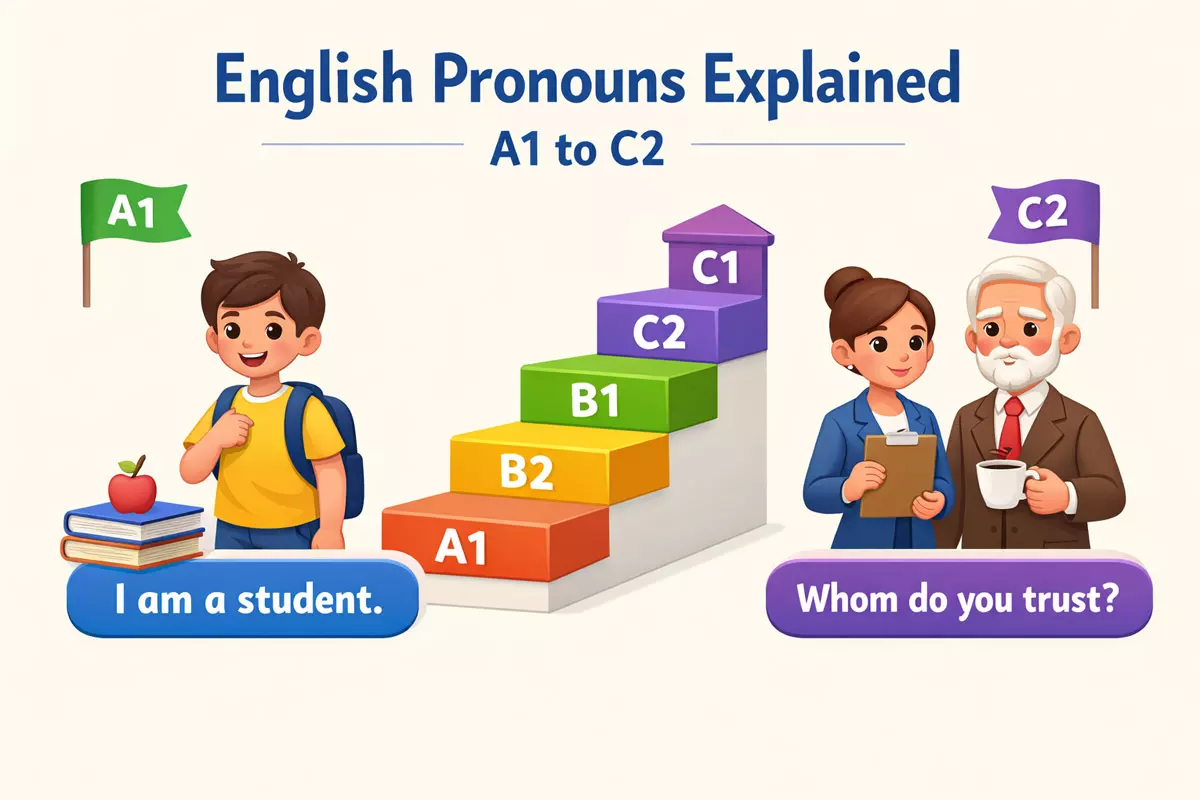 The article outlines how English pronoun learning evolves across CEFR levels, details typical mistakes and main learning goals at each stage, and explains how to use CEFR for targeted grammar study, including a summary table of pronoun progression.
Are you wondering how pronouns change as your English improves? This article explains how pronoun usage develops from beginner to advanced levels, highlighting the key differences and tips for mastering them at each stage. By understanding how pronouns function and become more complex as your language skills grow, you can use them more accurately and confidently throughout your English learning journey.
Why CEFR levels matter for pronoun learning
Understanding how English pronouns are taught and learned across CEFR levels helps both teachers and students focus on what’s most useful at each stage. The CEFR (Common European Framework of Reference for Languages) breaks language skills into bands from A1 (beginner) to C2 (proficient), and this gradual progression matches how pronoun knowledge builds up in real communication. By aligning pronoun study with these levels, learners avoid being overwhelmed by advanced forms too early or missing out on essential structures at higher stages.
Progressive development of pronoun knowledge
At beginner levels, learners first encounter basic subject pronouns (I, you, he, she, it, we, they) and simple possessives. As they move up, they add object pronouns, reflexive forms, and more abstract or formal pronouns. Advanced learners are expected to handle relative, indefinite, and emphatic pronouns, as well as subtleties like gender-neutral choices and formal/informal distinctions.
| CEFR Level | Pronoun Focus | Typical Examples |
|---|---|---|
| A1 | Basic subject & possessive pronouns | I, you, he, she, it, we, they, my, your |
| A2 | Object & reflexive pronouns | me, him, us, myself, herself |
| B1–B2 | Relative & indefinite pronouns | who, which, that, someone, anybody |
| C1–C2 | Emphatic, formal, & nuanced forms | oneself, whoever, each other, themselves (singular) |
Why staged learning is effective
When pronoun instruction is matched to the learner’s current stage, it feels more manageable and relevant. Early focus on a small set of forms means beginners can use English right away. Gradually, new pronouns and more complex patterns are introduced as students’ grammar and vocabulary grow. This staged approach prevents confusion and builds confidence.
- Reduces overload by introducing forms in context
- Allows for practice and consolidation before advancing
- Supports effective communication at each level
- Encourages noticing differences (e.g., “he” vs. “himself”, “someone” vs. “anyone”)
- Helps teachers plan lessons that match learner needs
Key pronoun types by level
Here is a list of pronoun categories and example forms typically introduced at different stages:
- Subject pronouns: I, you, he, she, it, we, they
- Object pronouns: me, him, her, us, them
- Possessive adjectives: my, your, his, her, our, their
- Possessive pronouns: mine, yours, theirs
- Reflexive pronouns: myself, yourself, themselves
- Relative pronouns: who, which, that, whose
- Indefinite pronouns: someone, anyone, everything, nothing
- Emphatic pronouns: myself, yourself (for emphasis)
- Reciprocal pronouns: each other, one another
- Gender-neutral/modern forms: they (singular), themselves (singular)
In summary, connecting pronoun learning to CEFR stages ensures that language development is logical, systematic, and closely tied to real-life English use. This approach gives learners the confidence and clarity to master pronouns step by step.
Pronoun Use Across CEFR Levels: Correct vs Incorrect
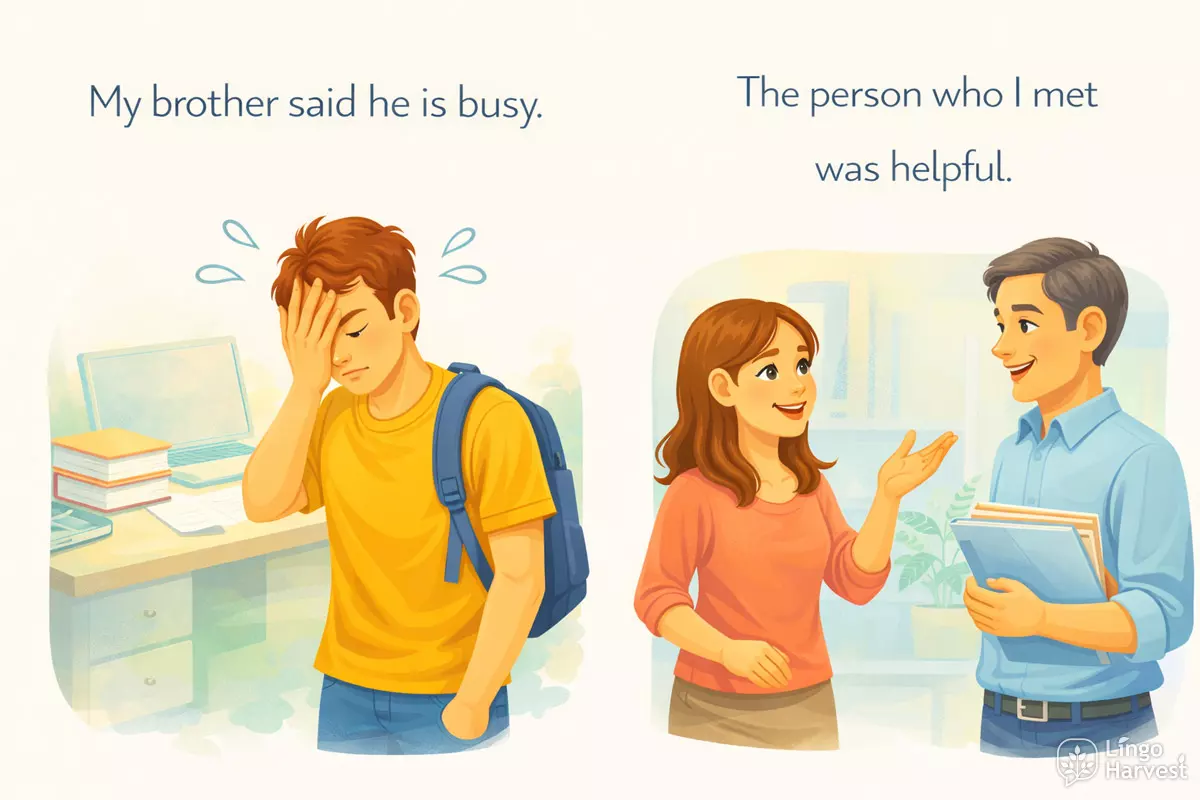
The examples below show how pronoun usage should match the learner’s CEFR level. Each pair contrasts a problematic sentence with a clearer, level-appropriate version.
- A1 level ❌: *My brother said himself is busy.* ✅ Correct: *My brother said he is busy.*
- A2 level ❌: *She explained me the problem.* ✅ Correct: *She explained the problem to me.*
- B1 level ❌: *The person which I met was helpful.* ✅ Correct: *The person who I met was helpful.*
- B1–B2 level ❌: *Someone didn’t bring nothing.* ✅ Correct: *Someone didn’t bring anything.*
- B2 level ❌: *The report, that I relied on, was outdated.* ✅ Correct: *The report on which I relied was outdated.*
- C1 level ❌: *Everyone should prepare hisself.* ✅ Correct: *Everyone should prepare themselves.*
- C1–C2 level ❌: *The manager blamed myself for the mistake.* ✅ Correct: *The manager blamed himself for the mistake.*
- C2 level ❌: *The applicant to that we spoke impressed us.* ✅ Correct: *The applicant to whom we spoke impressed us.*
Pronoun focus at A1–A2 levels
At the A1 and A2 stages, learners encounter the most common English pronouns. These early levels target personal pronouns, possessive forms, and simple demonstratives. Students are expected to recognize and use words like I, you, he, she, and it in basic sentences. Understanding who or what a pronoun refers to is essential for effective communication, especially in simple conversations and classroom instructions.
Core pronoun types and their uses
Beginning learners primarily work with a small set of pronouns. These help them talk about themselves, other people, and nearby objects. Grammatical accuracy is important, but at this stage, focus is on meaning and context.
- Personal subject pronouns: I, you, he, she, it, we, they
- Personal object pronouns: me, you, him, her, it, us, them
- Possessive adjectives: my, your, his, her, its, our, their
- Possessive pronouns: mine, yours, his, hers, ours, theirs
- Demonstrative pronouns: this, that, these, those
Examples of pronouns in simple sentences
- I am Anna.
- She is my teacher.
- Can you help me?
- We are friends.
- This is my book.
- Is that your bag?
- The dog is hers.
- Give it to him.
- They are at school.
- These are my keys.
Common challenges for beginners
New learners often mix up subject and object forms, or forget to match pronouns with the right noun. For example, using he instead of him, or confusing his and he. Demonstratives like this and these can also cause confusion, especially when talking about singular and plural items.
| Subject Pronoun | Object Pronoun | Possessive Adjective | Possessive Pronoun |
|---|---|---|---|
| I | me | my | mine |
| you | you | your | yours |
| he | him | his | his |
| she | her | her | hers |
| it | it | its | ❌ (not used) |
| we | us | our | ours |
| they | them | their | theirs |
Tips for practice
- Match pronouns to the people or things they refer to in short dialogues.
- Substitute nouns with pronouns to avoid repetition.
- Use simple sentence patterns and swap out pronouns for variety.
- Practice with real-life objects: "This is my pen. That is yours."
- Listen and repeat sentences with different pronouns for fluency.
At these proficiency levels, mastering fundamental pronoun forms builds confidence and lays the groundwork for more complex structures in later stages.
Expanding usage and nuance at B1–B2
At the B1 and B2 levels, English learners move beyond simple subject and object pronouns to master more varied pronoun forms and subtler meanings. This stage introduces greater flexibility in referring to people, objects, and ideas, and provides tools for clearer, more natural communication. Learners are expected to use pronouns confidently and choose the most contextually appropriate option.
Developing Range: Pronoun Types and Contexts
At this intermediate stage, students encounter a wider array of pronoun types, including reflexive, possessive, demonstrative, relative, and indefinite pronouns. Each type has its own usage rules and typical errors to watch for. Understanding these distinctions enables richer expression and avoids ambiguity in both speaking and writing.
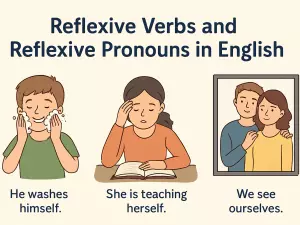
- Reflexive pronouns: myself, yourself, herself, himself, itself, ourselves, yourselves, themselves
- Possessive pronouns: mine, yours, his, hers, its, ours, theirs
- Demonstrative pronouns: this, that, these, those
- Relative pronouns: who, whom, whose, which, that
- Indefinite pronouns: someone, anyone, everyone, no one, something, anything, everything, nothing
- Emphatic use: “He himself fixed it.”
- Pronoun reference: avoiding ambiguity (“When Anna met Sara, she smiled.” Who smiled?)
- Gender-neutral pronouns: singular “they” (“Someone left their bag.”)
- Omission and repetition: avoiding unnecessary pronoun repetition
- Contextual selection: choosing between “that” and “which” in relative clauses
- Using “one/ones”: “I’d like the red one.”
- Each other/one another: “They help each other.”
- Distributive pronouns: each, every, either, neither
- Negative pronouns: nobody, none, nothing
- Quantifiers as pronouns: some, any, much, many, few, several
- Dummy pronouns: “It is raining.” / “There is a book on the table.”
Common Challenges and Subtle Differences
Intermediate learners often grapple with distinctions that are less obvious at beginner levels. For instance, choosing between “who” and “whom,” or between “that” and “which,” can be confusing. Similarly, knowing when to use “one” versus repeating a noun, or how to avoid unclear references, becomes increasingly important.
| Pronoun Type | Typical B1–B2 Usage Example | Common Mistake |
|---|---|---|
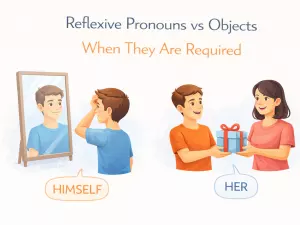
| Reflexive | She made herself a sandwich. | She made her a sandwich. ❌ |
| Demonstrative | I prefer those. | I prefer these (when referring to far objects). ❌ |
| Relative | The book that I read was interesting. | The book what I read was interesting. ❌ |
| Indefinite | Someone called you. | Somebody called yous. ❌ |
| Possessive | This bag is mine. | This bag is my. ❌ |
Building Flexibility and Clarity
Mastering intermediate pronoun use means not only knowing the forms, but also understanding how they add precision or avoid repetition. At B1–B2, students should be able to select the right pronoun for each situation, use gender-neutral forms when needed, and structure sentences for clarity. This skill set is essential for progressing to more advanced English where subtle distinctions and style become increasingly important.
Advanced precision at C1–C2
At the highest levels of English proficiency, learners use pronouns with subtlety and flexibility, adapting them for clarity, cohesion, and nuance. This stage goes beyond correct forms; it’s about choosing the most precise reference, shifting perspective, and manipulating pronouns for rhetorical effect or stylistic variety.
Mastery of Reference and Ambiguity
C1 and C2 users handle complex reference situations, resolving or intentionally exploiting ambiguity. For instance, they can navigate sentences where multiple antecedents exist, selecting pronouns that avoid confusion or add layers of meaning. These speakers can also employ "it" and "there" for abstract reference, or use "one" for generality.
- Switching between "he or she," "they," or "one" for inclusivity or formality
- Using "which," "who," "whom," "whose" to clarify or condense information
- Employing "it" for abstract subjects ("It is clear that…")
- Dropping pronouns for stylistic effect in informal contexts
- Choosing "this," "that," "these," "those" to refer back to whole clauses or arguments
- Using reflexives for emphasis ("I myself disagree") or to indicate actions done for one’s own benefit
- Recognizing and using gender-neutral pronouns ("they," "ze") when appropriate
- Manipulating pronouns in reported speech to reflect shifts in perspective
- Using "each other" and "one another" correctly in nuanced situations
- Employing possessive pronouns to indicate shared or divided ownership ("his and her opinions" vs. "their opinions")
- Distinguishing between restrictive and non-restrictive relative clauses ("who" vs. "which" in context)
- Using "such" and "so" as pronouns for previously mentioned ideas
Comparison of Pronoun Choices in Complex Contexts
| Context | Example Pronoun Use |
|---|---|
| Abstract Reference | It seems everyone is ready. There appears to be a problem. |
| Ambiguous Antecedents | John told Mark he was late. (Who is "he"? C1/C2 users clarify or rephrase.) |
| Generic Statements | One should always check one’s work. |
| Gender-neutral Reference | If a student loses their card, they must report it. |
| Emphatic/Reflexive | I myself completed the project. She did it herself. |
Strategic Pronoun Use for Style and Cohesion
At this level, speakers and writers use pronouns not just for grammatical accuracy but to guide their audience, manage information flow, and achieve stylistic goals. Pronoun reference is adjusted for register, audience, and genre—academic, formal, or creative.
- Varying pronouns to avoid repetition: "The committee discussed the plan. They agreed unanimously."
- Using demonstratives to refer to previous sentences or sections: "The results were inconclusive. This suggests further study is needed."
- Ellipsis and substitution for conciseness: "Some prefer tea; others, coffee."
- Switching perspectives for effect: moving between first, second, and third person as needed
Such advanced command of pronouns supports clarity, variety, and sophistication in both spoken and written English.
Typical errors by CEFR level
Understanding where learners often go wrong with English pronouns can help teachers target instruction and help students notice their own habits. Misuse and confusion are common at every stage, but the type and frequency of mistakes change as proficiency increases.
A1–A2: Early stages
Beginners usually struggle with basic personal pronouns and possessives. Common slip-ups include:
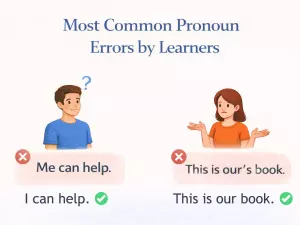
- Using subject pronouns for objects (e.g., “Give to I” instead of “Give to me”)
- Mixing up he and she
- Dropping pronouns altogether (“Is my book” instead of “It is my book”)
- Confusing his and her for possessives
- Inserting unnecessary pronouns (“She she is my friend”)
- Using it for people, or he/she for animals and things
- Overusing this and that for all references
- Replacing pronouns with nouns (“The Peter is here”)
A1–A2 Pronoun Errors: Incorrect vs Correct

The examples below show common pronoun mistakes at early CEFR levels and how to correct them.
- ❌ Give this to I. → ✅ Give this to me.
- ❌ My sister is here. He is very tired. → ✅ My sister is here. She is very tired.
- ❌ Is my book on the table. → ✅ It is my book on the table.
- ❌ Anna lost his keys yesterday. → ✅ Anna lost her keys yesterday.
- ❌ She she is my best friend. → ✅ She is my best friend.
- ❌ The dog is cute. He likes milk. → ✅ The dog is cute. It likes milk.
- ❌ This is my brother. That is my brother too. → ✅ This is my brother. He is my brother too.
- ❌ The Peter is at home now. → ✅ Peter is at home now.
B1–B2: Intermediate levels
At this level, learners attempt more complex structures and encounter different pitfalls:
- Incorrect reflexive pronouns (“He did it hisself” instead of “himself”)
- Confusing each other and one another
- Using who and which incorrectly in relative clauses
- Ambiguity in pronoun reference (“John told Bob he was late” – unclear who “he” is)
- Omitting pronouns in embedded clauses
- Overusing they as a generic pronoun in formal contexts
- Problems with demonstratives: these vs. those
- Confusing some and any in questions and negatives
B1–B2 Pronoun Errors: Incorrect vs Correct
At intermediate levels, learners often know the rules but struggle to apply them consistently in more complex sentences.
- ❌ He fixed the problem hisself. → ✅ He fixed the problem himself.
- ❌ The two teams congratulated one another after the match. → ✅ The two teams congratulated each other after the match.
- ❌ The movie which I met yesterday was interesting. → ✅ The person who I met yesterday was interesting.
- ❌ John told Bob he was late. → ✅ John told Bob that Bob was late.
- ❌ She said was ready to leave. → ✅ She said she was ready to leave.
- ❌ If anyone calls, tell them they must wait. → ✅ If anyone calls, tell that person they must wait.
- ❌ These are the shoes I bought last year, and these are cheaper. → ✅ These are the shoes I bought last year, and those are cheaper.
- ❌ Do you have some questions about the task? → ✅ Do you have any questions about the task?
C1–C2: Advanced proficiency
At higher proficiency, errors become more subtle and often relate to style or register:
- Misplacing or omitting pronouns for stylistic effect (sometimes not appropriate)
- Complex reference ambiguity in long sentences
- Inappropriate use of singular they in formal writing
- Occasional slip-ups with indefinite pronouns in abstract contexts (“Everyone must bring their own” vs. “his or her own”)
- Confusion over “whose” as a relative pronoun for things
- Over-correction: avoiding split infinitives with pronouns in awkward ways
- Register errors: using informal pronouns in formal text
- Unnatural repetition or avoidance of pronouns for cohesion
C1–C2 Pronoun Pitfalls: Style and Precision
At advanced levels, pronoun errors are rarely grammatical. More often, they affect clarity, register, or stylistic balance in formal and academic English.
- ❌ Completed the analysis and submitted the report on time. → ✅ The researcher completed the analysis and submitted the report on time.
- ❌ The committee informed the manager that after reviewing the proposal, they would revise it, which caused confusion. → ✅ After reviewing the proposal, the committee informed the manager that the committee would revise it.
- ❌ Every applicant must submit their résumé by Friday. → ✅ Every applicant must submit his or her résumé by Friday.
- ❌ The company revised its policy, whose impact was significant. → ✅ The company revised its policy, the impact of which was significant.
- ❌ She decided to carefully explain it to him. → ✅ She decided to explain it carefully to him.
- ❌ The findings show that you should reconsider your approach. → ✅ The findings show that the approach should be reconsidered.
- ❌ The author refers to the system again and again instead of using it for cohesion. → ✅ The author refers to the system once and then uses it for cohesion.
- ❌ The professor stated the professor’s opinion clearly, avoiding pronouns entirely. → ✅ The professor stated his opinion clearly.
| Level | Typical Pronoun Errors |
|---|---|
| A1–A2 | Mixing up subject/object forms, gender confusion, missing pronouns, overusing demonstratives |
| B1–B2 | Incorrect reflexives, unclear references, relative pronoun mistakes, demonstrative confusion |
| C1–C2 | Ambiguous reference, register/style errors, subtle indefinite pronoun misuse |
Recognizing these patterns makes it easier to anticipate challenges and support learners as they move from basic to sophisticated use of English pronouns.
Learning priorities at each stage
As learners progress through the CEFR levels, the types of English pronouns they need to master—and the complexity of their usage—change significantly. At the beginning, focus is on basic forms and functions. With each subsequent stage, students deepen their understanding, learn to distinguish nuances, and integrate more advanced structures in their speech and writing.
A1–A2: Foundations and Everyday Use
Entry-level learners start by recognizing, using, and understanding the most common pronouns. These are essential for forming basic sentences and participating in simple conversations.
- Personal subject pronouns: I, you, he, she, it, we, they
- Object pronouns: me, you, him, her, it, us, them
- Possessive adjectives: my, your, his, her, its, our, their
- Possessive pronouns: mine, yours, his, hers, ours, theirs
- Demonstratives: this, that, these, those
- Simple use in questions and answers ("Who is he?" "It is mine.")
B1–B2: Expanding Range and Accuracy
At the intermediate stages, students broaden their repertoire. They learn how to use pronouns for clarity and cohesion, and handle more varied sentence structures.
- Reflexive pronouns: myself, yourself, himself, herself, itself, ourselves, yourselves, themselves
- Relative pronouns: who, which, that, whose, whom
- Indefinite pronouns: someone, anyone, everyone, no one, something, anything, everything, nothing, etc.
- Reciprocal pronouns: each other, one another
- Distinguishing between subject and object forms in complex sentences
- Using pronouns to avoid repetition
C1–C2: Nuance, Style, and Precision
Advanced users refine their command by focusing on subtle differences and stylistic choices. At this point, accurate and flexible pronoun use is critical for both formal and informal contexts.
- Advanced relative pronouns and clauses (e.g., "the reason why," "the person to whom")
- Emphatic pronouns for emphasis and contrast
- Distributive pronouns: each, every, either, neither
- Complex indefinite forms: whoever, whichever, whatever
- Using pronouns in abstract and hypothetical contexts
- Pronoun reference and ambiguity avoidance
- Gender-neutral and inclusive language ("they" as singular, etc.)
| CEFR Level | Key Pronoun Skills | Typical Examples |
|---|---|---|
| A1–A2 | Identify and use basic personal, object, and possessive pronouns; simple demonstratives | "She is my friend." "That is yours." |
| B1–B2 | Apply reflexive, relative, and indefinite pronouns; maintain clarity in longer sentences | "They helped themselves." "The book that you gave me is on the table." |
| C1–C2 | Master complex and nuanced forms; avoid ambiguity; use inclusive and stylistic options | "Anyone who wishes to join may do so." "Each must bring their own lunch." |
Prioritizing the right pronoun forms and functions at each level helps learners communicate naturally and effectively. As proficiency grows, learners should pay attention to subtle distinctions, register, and the impact of pronoun choice on meaning and style.
Using CEFR to plan study paths
Understanding how CEFR levels break down English pronouns helps learners and teachers create more effective and realistic study plans. Each stage in the CEFR framework corresponds to specific pronoun skills, so mapping progress to these levels can clarify what to focus on next and avoid gaps in knowledge.
Building Pronoun Skills Step by Step
One of the main benefits of using CEFR as a guide is that it sequences pronoun learning from simple to complex. For example, a beginner (A1) should master basic subject pronouns like "I," "you," and "he," while an advanced student (C1/C2) might work on relative pronouns in complex clauses.
- A1: Subject pronouns ("I", "she"), simple object pronouns ("me", "him")
- A2: Possessive adjectives ("my", "their"), demonstratives ("this", "those")
- B1: Reflexive pronouns ("myself", "themselves"), basic indefinite pronouns ("someone", "anyone")
- B2: Relative pronouns ("who", "which", "that"), more indefinite pronouns ("each", "none")
- C1: Advanced relative clauses, pronoun substitution, "one(s)" as pronouns
- C2: Subtle distinctions ("whom", "whose"), complex referencing, abstract pronoun use
Setting Goals for Each Level
Identifying which pronouns are typical at each proficiency step makes it easier to set clear, achievable goals. For instance, a B2 learner who struggles with relative clauses can prioritize mastering "that" and "which" in restrictive and non-restrictive sentences, while a C2 learner might refine the use of "whom" in formal contexts.
Comparing Pronoun Progression
The table below shows how certain pronoun types are introduced and developed across four major CEFR bands. This overview supports both learners and instructors in tracking what to review, reinforce, or introduce next.
| CEFR Level | Pronoun Focus |
|---|---|
| A1/A2 | Subject, object, basic possessive, demonstrative |
| B1 | Reflexive, more possessive, basic indefinite |
| B2 | Relative, advanced indefinite, reciprocal |
| C1/C2 | Complex relative, formal/abstract, substitution, nuanced forms |
Tips for Personalized Study Planning
- Assess current strengths: Which pronouns are used correctly and naturally?
- Pinpoint weak spots: Are there gaps, such as missing reflexives or confusion with "whose"?
- Set micro-goals: Choose one or two pronoun types to focus on each week.
- Use real-life examples: Practice pronouns in context, not just in isolation.
- Review and recycle: Revisit earlier pronoun forms periodically to maintain accuracy.
By aligning pronoun learning targets with the CEFR framework, both self-learners and classroom students can make steady, logical progress. This approach ensures that no key area is skipped, and every stage builds a stronger foundation for clear, confident English.
Summary table of pronoun progression
Understanding how English pronouns develop from beginner to advanced levels can help learners track their progress and identify what to focus on next. This overview highlights which pronoun types are typically introduced at each CEFR stage, along with examples to clarify their use.
Key stages and pronoun types by CEFR level
At the earliest levels, learners start with basic personal pronouns. As proficiency increases, more complex forms such as reflexive and indefinite pronouns are introduced. The following table outlines the main pronoun types and the typical CEFR level at which they are mastered, along with sample words or phrases for each.
| CEFR Level | Main Pronoun Types & Examples |
|---|---|
| A1 | Personal: I, you, he, she, it, we, they Possessive adjectives: my, your, his, her |
| A2 | Possessive pronouns: mine, yours, hers Demonstratives: this, that, these, those |
| B1 | Reflexive: myself, themselves Indefinite: someone, anybody, everything |
| B2 | Relative: who, which, that, whose Reciprocal: each other, one another |
| C1 | Advanced indefinite forms: whichever, whoever Emphatic: myself (for emphasis) |
| C2 | Complex relative and indefinite structures: all of whom, none of which Substitution pronouns: one, ones, such |
Common progression patterns
- Beginners focus on subject and object forms before moving to possessive and demonstrative pronouns.
- At intermediate levels, students add reflexive and indefinite types, enabling more nuanced expression.
- Upper-intermediate and advanced learners use relative and reciprocal pronouns to link ideas and clarify relationships.
- Proficiency stages bring comfort with abstract, emphatic, and substitution pronouns, often used in formal or literary contexts.
Examples of pronoun use across levels
- A1: She is my friend. It is a cat.
- A2: This is yours. That is mine.
- B1: They helped themselves. Does anyone know?
- B2: The book that I read was interesting. They respect each other.
- C1: Whoever arrives first wins. I myself did the work.
- C2: None of which surprised the audience. Such are the rules.
By reviewing how pronoun usage expands with each CEFR level, learners and teachers can better plan lessons and self-study routines, ensuring a comprehensive grasp of English pronouns as proficiency grows.
Exercises 1: Pronouns by CEFR Level
Choose the most appropriate pronoun form for each sentence based on the CEFR level indicated.
- (A1) ___ am ready to start the lesson. (I / myself)
- (A2) This book is ___, not yours. (mine / my)
- (B1) She blamed ___ for the mistake. (herself / her)
- (B1) Does ___ know the answer? (anyone / someone)
- (B2) The person ___ called you left a message. (who / which)
- (B2) They have known ___ for many years. (each other / themselves)
- (C1) ___ finishes first will receive a prize. (Whoever / Whom)
- (C1) I repaired the device ___. (myself / me)
- (C2) The committee members, all of ___ agreed, signed the report. (whom / which)
- (C2) There are several solutions, none of ___ is perfect. (which / whom)
Show answers
- I
- mine
- herself
- anyone
- who
- each other
- Whoever
- myself
- whom
- which
Exercises 2: Correct or Improve the Pronoun Use
Each sentence contains unclear, incorrect, or non-optimal pronoun usage. Rewrite it to make the meaning clear and grammatically appropriate.
- When she spoke to her, she said she was late.
- The report that I relied on was outdated, which caused problems.
- Everyone should prepare hisself before the exam.
- The manager blamed myself for the delay.
- Someone didn’t bring nothing to the meeting.
- The colleague with who I worked moved abroad.
- After reading the article, it made me change my opinion.
- The team congratulated themselves on winning each other.
- The decision to that we agreed was announced yesterday.
- They said they would contact them if they needed them.
Show answers
- When Anna spoke to Maria, Anna said she was late.
- The report on which I relied was outdated and caused problems.
- Everyone should prepare himself or herself before the exam.
- The manager blamed himself for the delay.
- No one brought anything to the meeting.
- The colleague with whom I worked moved abroad.
- After reading the article, I changed my opinion.
- The team congratulated itself on the victory.
- The decision to which we agreed was announced yesterday.
- The managers said they would contact the employees if the employees needed help.