Politeness Strategies with Modal Verbs in American English

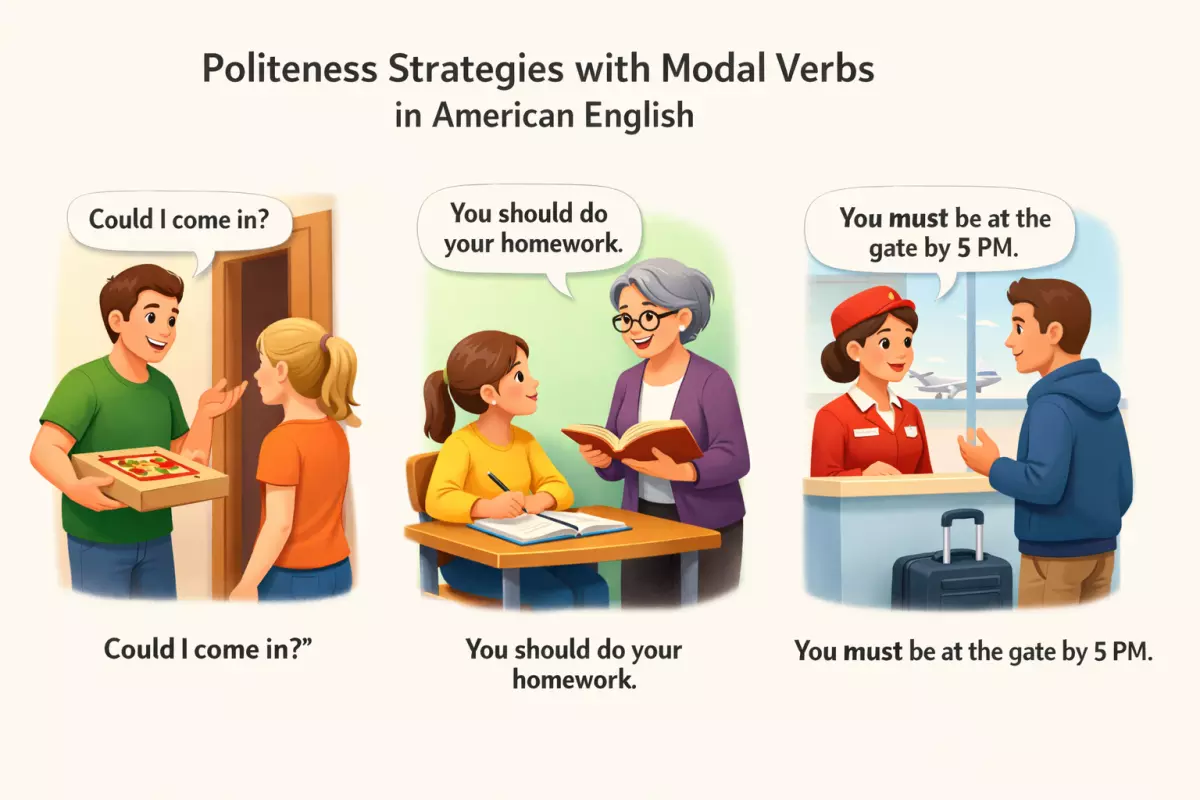 This article explains why modal verbs matter for polite communication, which ones soften requests or suggestions, and examples with could, would, and might. It also covers how tone, context, and American conversation affect modal choice, plus exercises rewriting direct statements politely.
- Why modal verbs play a key role in polite communication
- Modal verbs commonly used to soften requests or suggestions
- Examples of polite expressions using could, would, and might
- How tone and social context influence modal choice
- Situations where modal verbs reduce the directness of statements
- How American conversational style uses modal verbs to sound respectful
- Exercises and practice activities rewriting statements with polite modal forms
In American English, speakers often use modal verbs to sound polite and considerate when asking, offering, or disagreeing. Small choices like could, would, or might can soften a request, show respect, and give the other person room to say no. This guide explains how these forms work in everyday situations at work, in class, and with strangers, helping you match your tone to your meaning and avoid sounding too direct.
Why modal verbs play a key role in polite communication
Modal verbs help speakers manage social distance, reduce pressure, and show respect without sounding vague. In American English, they are a core tool for turning direct commands into requests, offering choices, and signaling that the listener’s time and preferences matter.
What modals do in polite requests
- Soften the force of an instruction by framing it as a possibility: “Could you…” instead of “Do this.”
- Give the listener an “out” (a graceful way to refuse): “Would you be able to…” implies that “no” is acceptable.
- Show deference by avoiding assumptions: “May I…” asks permission rather than taking it.
- Reduce urgency when appropriate: “Could you send it when you get a chance?”
- Make suggestions feel collaborative: “We could…” invites discussion rather than issuing a decision.
- Signal tentativeness to avoid sounding absolute: “It might be better to…”
- Align with professional norms where indirectness is expected (emails, service encounters, workplace conversations).
Common modal patterns that sound polite
- Could you + base verb: “Could you review this?”
- Would you + base verb: “Would you open the window?”
- Would you mind + -ing: “Would you mind waiting a moment?”
- Could you possibly + base verb: “Could you possibly resend that file?” (adds extra softening)
- Would it be possible to + base verb: “Would it be possible to meet Thursday?”
- May I + base verb: “May I ask a quick question?”
- Could I + base verb: “Could I borrow your charger?” (common, friendly)
- Can I + base verb: “Can I get a receipt?” (often fine in casual/service contexts)
- Would it be okay if + clause: “Would it be okay if I joined a little late?”
- Could you + base verb + please: “Could you please sign here?” (place “please” after the modal or near the end)
- Would you + base verb + when you have a moment: “Would you reply when you have a moment?”
- Might + base verb for suggestions: “You might want to double-check the date.”
- Could + base verb for options: “We could move it to next week.”
- Should + base verb (careful: can sound directive): “You should email support.” → often softened as “You might want to…”
Politeness depends on choice of modal and context
- “Could” and “would” are the default polite workhorses for requests because they feel less demanding than “can” and “will.”
- “May” sounds more formal and permission-focused; it fits customer service, formal meetings, and respectful introductions.
- “Can” is common and not automatically rude, but it can sound brisk in high-stakes or hierarchical situations; “could” is safer when you want extra tact.
- “Will” often feels like a directive (“Will you…”) unless the relationship is close or the tone is clearly friendly; “would” usually lands softer.
- Extra softeners (possibly, by any chance, a moment, when you can) increase politeness, but too many can sound overly apologetic or indirect.
Accuracy points that affect politeness
- Use the base verb after a modal: ✅ “Could you help me?” ❌ “Could you helps me?”
- Match “Would you mind” with -ing: ✅ “Would you mind sending it?” ❌ “Would you mind to send it?”
- Answer “Would you mind…?” carefully: “No” means “I don’t mind” (agreement). If clarity matters, respond with “Sure” / “Of course” / “Not at all.”
- Keep requests specific: a polite modal plus a clear action (“Could you email the updated version by 3?”) sounds more respectful than a vague request.
Modal verbs commonly used to soften requests or suggestions
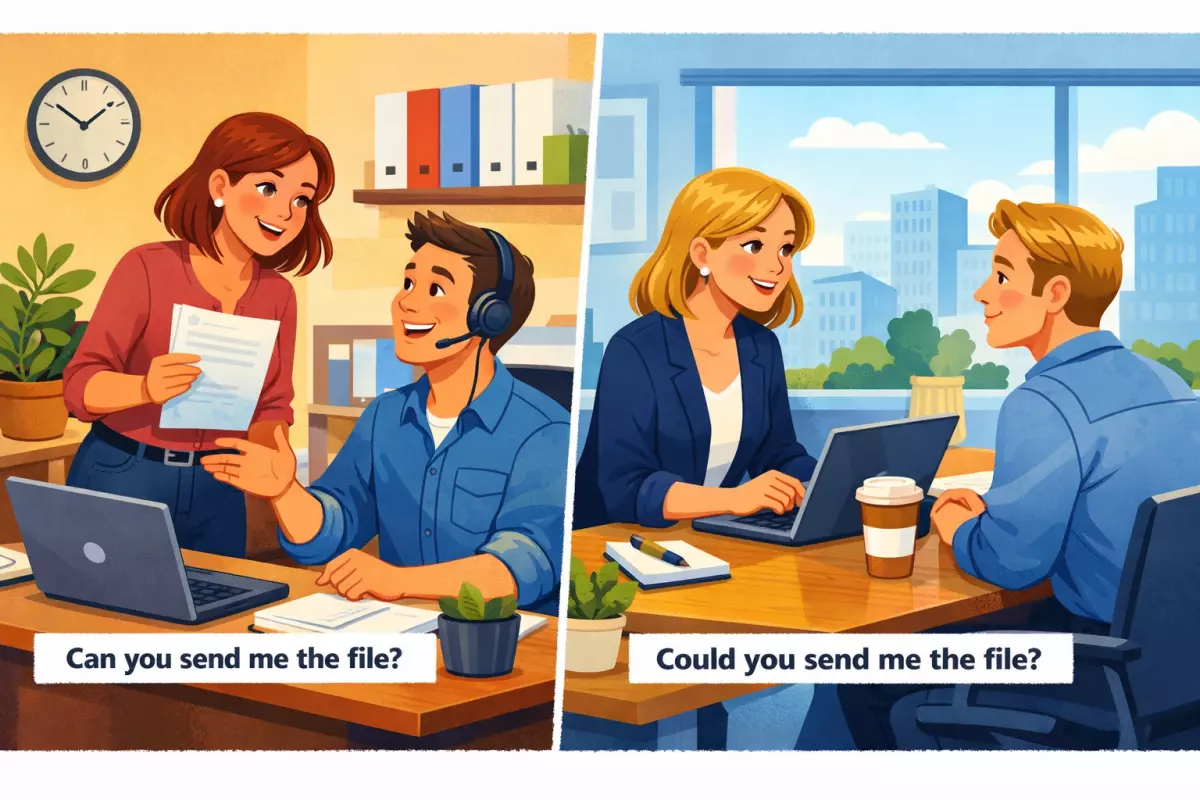
In American English, speakers often rely on modals to reduce directness, show respect for the other person’s time, and leave room to say no. The most common patterns combine a modal with a polite opener (like “please,” “just,” or “a quick”) and a short, clear request.
-
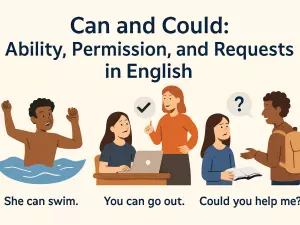
Can / Could (ability framed as permission)
Typical use: everyday requests; “could” usually sounds more tentative than “can.”
- Pattern: Can/Could you + base verb…?
- Examples: “Can you send me the file?” / “Could you send me the file when you get a chance?”
- Softening add-ons: “when you have a minute,” “real quick,” “if you don’t mind.”
- Common pitfall: ❌ “Could you to send…” ✅ “Could you send…”
-
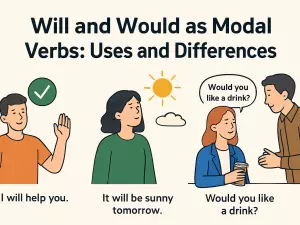
Would (preference and willingness)
Typical use: polite requests and offers; often used to avoid sounding like an order.
- Pattern: Would you + base verb…?
- Examples: “Would you review this paragraph?” / “Would you mind closing the door?”
- Useful variants: “Would it be possible to…?” “Would you be able to…?”
-
Would you mind…? (asking about inconvenience)
Typical use: extra-polished requests, especially with small favors.
- Pattern: Would you mind + -ing…?
- Examples: “Would you mind forwarding that email?” “Would you mind waiting a moment?”
- Answer expectation: A “no” often means agreement (“No, not at all.”).
- Common pitfall: ❌ “Would you mind to forward…?” ✅ “Would you mind forwarding…?”
-
May / Might (formal permission and extra tentativeness)
Typical use: “may” is more formal; “might” can sound very cautious or indirect.
- Pattern: May/Might I + base verb…?
- Examples: “May I ask a question?” / “Might I suggest a different approach?”
- When it fits: meetings, customer-facing roles, or when you want to sound especially deferential.
-
Should (gentle advice and recommendations)
Typical use: suggestions that still carry guidance; can feel strong without softeners.
- Pattern: You should + base verb… (often softened with hedges)
- Examples: “You should probably back up your files.” / “We should maybe reschedule.”
- Softening add-ons: “maybe,” “probably,” “it might help to…,” “you might want to…”
-
Could (suggesting options rather than directing)
Typical use: collaborative problem-solving; frames an idea as one possibility.
- Pattern: We/You could + base verb…
- Examples: “We could start with the easiest tasks.” / “You could try restarting the app.”
- Effect: leaves room for alternatives and reduces pressure to agree.
-
Will / Would (requests in service and routine contexts)
Typical use: “will” is common for straightforward needs; “would” is softer and more formal.
- Pattern: Will/Would you + base verb…?
- Examples: “Will you sign here?” / “Would you sign here, please?”
- Tip: add “please” or a reason to avoid sounding abrupt: “Will you sign here so we can process it?”
-
Can I / Could I / May I (asking to do something)
Typical use: requesting permission; “could I” often sounds more considerate than “can I.”
- Pattern: Can/Could/May I + base verb…?
- Examples: “Can I leave a bit early?” / “Could I follow up tomorrow?” / “May I come in?”
- Softening add-ons: “if that’s okay,” “if it works for you,” “when you have time.”
-
Combining modals with common softeners (high-frequency patterns)
Small wording choices often matter as much as the modal itself. These combinations are widely used because they keep the request clear while reducing force.
- Reason first: “Could you take a look when you have a minute? I’m not sure about the last step.”
- Time buffer: “Can you send it by end of day?” → “Could you send it by end of day, if possible?”
- Minimizer: “Could you just confirm the address?”
- Option framing: “We could meet Monday, or we could push it to Tuesday.”
- Permission check: “May I ask one more thing before we wrap up?”
- Polite closing: “Would you mind sharing the notes? Thanks.”
- Less pressure: “Could you let me know whenever you get a chance?”
- Team tone: “Should we take five minutes to review the agenda?”
- Reduced certainty: “Might we consider a shorter timeline?”
- Clear but courteous: “Would you please resend that attachment?”
Choosing between these forms is mostly about how much distance you want: “can” and “will” are direct and common, while “could,” “would,” and “might” add tentativeness. Adding a brief reason, a flexible time phrase, or an option (“if possible”) often makes the request sound more cooperative without changing the core message.
Examples of polite expressions using could, would, and might
In American English, these modal verbs soften requests, offers, and suggestions by adding distance and choice. The patterns below show how speakers reduce pressure, sound respectful, and keep the interaction cooperative.
Common patterns and example sentences
- Could you + base verb (polite request): “Could you open the window?”
- Could you possibly + base verb (extra softening): “Could you possibly email that to me?”
- Could I + base verb (asking permission): “Could I leave a little early today?”
- Could we + base verb (collaborative request): “Could we meet for 15 minutes after lunch?”
- Would you + base verb (polite request, slightly more direct than “could” in some contexts): “Would you close the door?”
- Would you mind + -ing (very common polite form): “Would you mind waiting a moment?”
- Would you mind if + past tense (asking permission indirectly): “Would you mind if I sat here?”
- Would it be possible to + base verb (formal, low-pressure request): “Would it be possible to reschedule?”
- Would it be okay if + past tense (checking comfort/permission): “Would it be okay if we started a bit earlier?”
- I would appreciate it if + past tense (formal, careful tone): “I would appreciate it if you sent the report by Friday.”
- Would you like + noun / to + verb (offer/invitation): “Would you like some water?” / “Would you like to join us?”
- Might I + base verb (very formal permission request): “Might I ask a quick question?”
- Might you + base verb (formal, gentle request): “Might you send me the updated file?”
- You might want to + base verb (soft suggestion/advice): “You might want to double-check the address.”
- We might + base verb (tentative plan/suggestion): “We might try a different approach.”
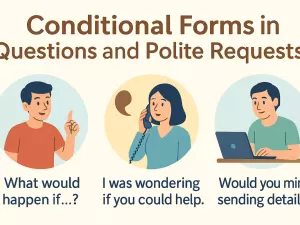
- I was wondering if + past tense (classic indirect request): “I was wondering if you could help me for a minute.”
Usage notes that affect politeness
- Past forms signal distance, not past time: In “Would you mind if I sat here?”, the past tense makes the request less forceful.
- “Could” often implies ability, but functions as a polite request: “Could you call me later?” usually means “Please call me later,” not a literal ability question.
- “Would you mind…?” expects a “no” for agreement: ✅ “No, not at all.” ❌ “Yes, sure” (can sound like you do mind, depending on context).
- Add-ons soften further: words like “possibly,” “a bit,” “when you have a chance,” and “if you don’t mind” reduce pressure.
- Choose “might” for extra tentativeness: “Might I…” and “You might want to…” sound more cautious than comparable “could/would” options.
How tone and social context influence modal choice
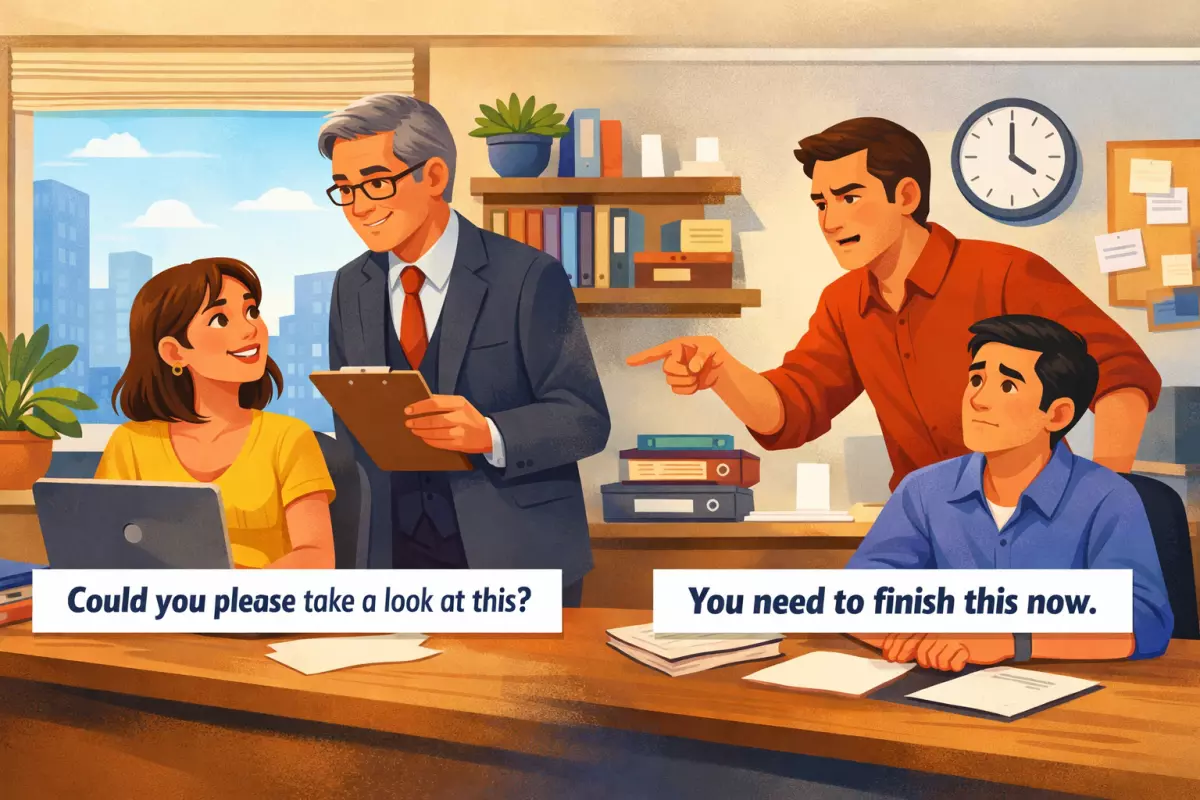
Modal verbs signal more than ability or possibility; they also communicate stance, respect, and how much pressure you’re putting on the other person. In American English, small shifts (can → could, will → would) often soften a request, while stronger forms (must, need to) raise urgency and authority.
Key variables that shape which modal sounds appropriate
- Power difference: When the listener has higher status (a supervisor, client, professor), speakers often choose softer modals (could, would, might) to reduce imposition.
- Social distance: With strangers or new acquaintances, indirect modals (would you, could you) tend to sound more respectful than direct ones (can you, will you).
- Urgency and stakes: Time pressure or safety concerns can justify firmer modals (need to, have to, must), even in otherwise polite settings.
- Rights and obligations: If a rule, policy, or job duty is involved, obligation modals (have to, need to, must) sound less personal because the “source” is external.
- Emotional temperature: When a conversation is tense, softer modals and hedges (might, could, would) help keep requests from sounding like demands.
- Setting formality: Meetings, emails, and customer service contexts typically favor could/would; casual talk among friends tolerates can/will more easily.
- Relationship goals: If you want collaboration, modals that invite choice (could, might) work better than modals that close options (must).
- Clarity needs: In instructions, too much softening can create ambiguity; speakers may use will/need to for clear next steps while keeping a courteous tone elsewhere.
Common modal choices by situation (with usage patterns)
- Can: Neutral and direct for everyday requests among equals. “Can you send me the file?”
- Could: Politer, less forceful; good default for requests to someone you don’t know well. “Could you send me the file?”
- Will: Direct about willingness; can sound brisk in requests. “Will you call me back today?”
- Would: More tactful than will; common in service and professional talk. “Would you call me back today?”
- May: Formal permission; can sound stiff in casual American speech. “May I leave early?”
- Might: Very soft, tentative; useful when you want to avoid pressure. “Might you have a moment to review this?”
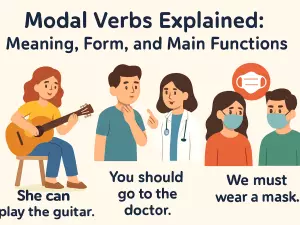
- Should: Advice or expectation; can imply judgment if overused. “You should email them today.”
- Need to: Strong necessity, often practical; less harsh than must. “We need to reschedule.”
- Have to: Obligation tied to circumstances or rules; can feel firm but not necessarily rude. “I have to submit this by noon.”
- Must: Highest pressure; best for rules, safety, or non-negotiables. “You must wear a badge in this area.”
- Can I / Could I: Requests for permission; could I is the safer polite option with strangers. “Could I ask a quick question?”
- Would you mind + -ing: Polite, indirect; typically expects “no” as agreement. ✅ “Would you mind closing the door?” ❌ “Would you mind to close the door?”
- Could you possibly: Extra softening for bigger favors; avoid stacking too many softeners in urgent contexts. “Could you possibly cover my shift?”
- Would it be possible to…: Formal and low-pressure; common in email. “Would it be possible to move the meeting?”
- Do you think you could…: Collaborative framing; useful when asking for effort or time. “Do you think you could review this today?”
How tone changes with small modal shifts
- Direct → softened: “Can you…?” → “Could you…?” (less like an order, more like a favor)
- Expectation → option: “You should…” → “You might want to…” (less judgment, more suggestion)
- Command → policy-based requirement: “You must…” → “You have to…” (often sounds less personal, more procedural)
- Pressure → collaboration: “You need to…” → “We’ll need to…” (shares responsibility and reduces blame)
- Blunt → tactful in email: “Will you send…?” → “Would you be able to send…?” (adds room for constraints)
In practice, American English politeness often comes from choosing a modal that matches the relationship and the moment: softer forms for requests and sensitive topics, firmer forms for safety, deadlines, and clear responsibilities. The most natural-sounding choice is usually the one that fits both the social roles and the amount of imposition in the request.
Situations where modal verbs reduce the directness of statements
In American English, modals often soften a message by turning a blunt statement into a suggestion, a possibility, or a request for cooperation. This is especially useful when the speaker needs something, is giving negative feedback, or is addressing someone with equal or higher status.
When asking for action (requests and favors)
Modals make requests sound less like commands by presenting the action as optional or negotiable. A common pattern is a modal + base verb, often with a question form.
- Could you send me the updated file by noon?
- Would you mind checking the numbers one more time?
- Can you help me carry these boxes?
- Could we meet a bit earlier tomorrow?
- Would you be able to cover my shift on Friday?
- May I ask you a quick question?
- Could you please speak a little more slowly?
- Would it be possible to reschedule?
- Can we pause here for a second?
- ✅ Could you take a look at this? → ❌ Take a look at this.
When giving advice without sounding pushy
Instead of telling someone what to do, modals frame advice as a recommendation. This reduces pressure and leaves room for the listener’s decision.
- You might want to back up your files before updating.
- You could try restarting the app first.
- We may need to adjust the timeline.
- You should probably email the client to confirm.
- It would help to add one more example.
- You might consider asking for clarification in writing.
- We could move this section to the end for clarity.
- You may want to double-check the address.
- It might be better to wait until Monday.
- You could also loop in the support team.
When refusing, disagreeing, or setting boundaries
Modals help speakers say “no” or express disagreement without sounding harsh. They often appear with softeners like “I’m not sure,” “I don’t think,” or “that might be difficult.”
- I can’t commit to that deadline right now.
- I wouldn’t be able to join the call today.
- That might be difficult given the budget.
- We may not have enough data to decide yet.
- I might be misunderstanding, but the numbers don’t match.
- I would prefer to keep this in writing.
- We could do that, but it would delay the launch.
- I can do Friday, but I can’t do Thursday.
- I wouldn’t recommend sharing that publicly.
- We might need to revisit this after the review.
When making criticism or corrections less blunt
Using modals allows feedback to sound collaborative rather than accusatory. A frequent pattern is “could” for improvement and “might” for tentative observations.
- This section could be clearer with a shorter intro.
- You might have missed a step in the setup.
- We could tighten the wording in the second paragraph.
- That chart might be hard to read on mobile.
- The email could sound more friendly with a greeting.
- We may want to verify these figures before sending.
- The conclusion could use a stronger final sentence.
- This example might confuse readers who are new to the topic.
- We could add a quick definition here.
- The tone might come across as too direct in that line.
When proposing plans and negotiating decisions
In meetings and teamwork, modals reduce the force of proposals and make it easier for others to accept, modify, or reject an idea. This supports turn-taking and consensus.
- We could start with a short recap, then take questions.
- We might move the deadline to next Wednesday.
- Could we prioritize the bug fixes first?
- We may need to bring in another reviewer.
- We should probably confirm the scope before estimating.
- Would it make sense to split this into two tasks?
- We could try a smaller pilot before a full rollout.
- Can we agree on the main goal for this sprint?
- We might be able to finish early if we simplify the design.
- Would you be open to an alternative approach?
How American conversational style uses modal verbs to sound respectful
In everyday U.S. English, speakers often soften requests, suggestions, and disagreements by choosing modal verbs that leave the other person room to say no. This approach sounds cooperative rather than demanding because the grammar signals possibility, willingness, or preference instead of obligation.
Common patterns Americans use with modals
- Could you…? for polite requests (more indirect than “Can you…?”): “Could you email me the file when you get a chance?”
- Would you…? for service-style or formal requests: “Would you mind sending that again?”
- Can you…? for friendly, everyday requests (often polite with the right tone): “Can you help me for a minute?”
- Would it be possible to…? for extra-soft requests in professional settings: “Would it be possible to move our meeting to Thursday?”
- Could we…? to propose a joint action (shared responsibility): “Could we talk about the timeline?”
- Can we…? to check agreement before acting: “Can we pause here and confirm the numbers?”
- May I…? for permission in more formal contexts: “May I ask a quick question?”
- Could I…? for permission with a casual, polite tone: “Could I borrow your charger?”
- Would it be okay if…? to acknowledge the listener’s control: “Would it be okay if I joined a few minutes late?”
- Would you be able to…? to reduce pressure and recognize constraints: “Would you be able to review this today?”
- I was wondering if you could… for very indirect requests (common in email and office talk): “I was wondering if you could take a look.”
- Do you think you could…? to make a request feel like a question, not a command: “Do you think you could cover the front desk at 3?”
- I might / I may to soften statements and avoid sounding absolute: “I might be able to finish by Friday.”
- We should to suggest a plan while keeping it collaborative: “We should double-check the address.”
- You might want to… to give advice gently (less direct than “You should”): “You might want to save a copy first.”
- We could… to offer options rather than a single directive: “We could start with the easiest items.”
- That could work to show openness without full commitment: “That could work; what time were you thinking?”
How modals reduce pressure (and why it sounds respectful)
- They frame actions as optional. “Could you…” implies the listener has a choice, which lowers the force of the request.
- They shift from obligation to willingness. “Would you…” focuses on the other person’s readiness, not your authority.
- They create space for negotiation. “We could…” and “might” invite alternatives and follow-up questions.
- They avoid sounding like orders. Compare: ✅ “Could you send it today?” ❌ “Send it today.”
Typical add-ons that pair with modals in American English
- Time softeners: “when you have a chance,” “whenever you can,” “at your convenience.”
- Small politeness markers: “please” (often mid-sentence), “thanks,” “I appreciate it.”
- Reason + modal: “Could you resend it? I’m not seeing the attachment.”
- Option language: “Could you…, or would tomorrow be better?”
Choosing the right modal for the situation
- Use “could” when you want a neutral, widely polite request that doesn’t sound pushy.
- Use “would” when you want to emphasize willingness or courtesy, especially with strangers or clients.
- Use “can” for quick, friendly requests with people you know, or when the context already signals politeness.
- Use “might” and “could” to offer suggestions without sounding like you’re correcting someone.
- Be careful with “must” and “have to.” These express strong necessity and can sound abrupt unless the context clearly requires it (rules, safety, deadlines).
Exercises and practice activities rewriting statements with polite modal forms
Rewrite each direct statement so it sounds more courteous in American English. Focus on these patterns: modal + base verb (can/could/would), question forms (Could you…?), softeners (please, just, a bit), and indirect phrasing (I was wondering if…). Keep the meaning the same unless the prompt asks you to adjust urgency.
1) Quick rewrites: turn commands into polite requests
- Close the door.
- Send me the file today.
- Move your bag.
- Explain that again.
- Wait here.
- Call me when you arrive.
- Turn down the music.
- Give me a minute.
- Stop interrupting.
- Tell me your decision.
- Reschedule the meeting.
- Check this for errors.
Show answers
- Could you close the door, please?
- Could you send me the file today, please?
- Would you mind moving your bag?
- Could you explain that again?
- Could you wait here for a moment, please?
- Could you call me when you arrive?
- Could you turn down the music a bit, please?
- Could you give me a minute?
- Would you mind not interrupting?
- Could you let me know your decision?
- Could we reschedule the meeting?
- Could you check this for errors?
2) Choose the right modal: match the situation
Rewrite each line using the modal in parentheses. Keep the tone natural for everyday U.S. workplace or social situations.
- Open the window. (could)
- Tell me your name. (may)
- Help me with this box. (can)
- Repeat that. (would)
- Let me leave early today. (might)
- Give me your phone. (could)
- Take a look at this. (would)
- Use your computer for a minute. (may)
- Answer this email. (could)
- Meet at 3 instead of 2. (might)
Show answers
- Could you open the window, please?
- May I have your name, please?
- Can you help me with this box?
- Would you repeat that, please?
- I might need to leave a little early today—would that be okay?
- Could I borrow your phone for a moment?
- Would you take a look at this when you have a chance?
- May I use your computer for a minute?
- Could you answer this email when you get a chance?
- We might need to meet at 3 instead of 2—would that work for you?
3) Soften “You need to…” and “I want…” statements
Replace the direct wording with a more tactful structure. Useful options include: could for gentle suggestions, would for requests, and “I was wondering if…” for extra softness.
- You need to be on time.
- I want you to email the client.
- You should fix this today.
- I need an answer right now.
- You have to lower your voice.
- I want a refund.
- You should stop doing that.
- I need you to sign this.
Show answers
- Could you please make sure you’re on time?
- Could you email the client when you have a moment?
- Could you fix this today, if possible?
- Could you get back to me as soon as you can?
- Could you lower your voice a bit, please?
- Could I get a refund, please?
- Would you mind not doing that?
- Could you sign this, please?
4) Make refusals and disagreements polite (without sounding vague)
Rewrite each sentence to keep the boundary clear while reducing harshness. Use modal language like “I can’t,” “I wouldn’t be able to,” “could we,” and “might.”
- No, that’s wrong.
- I can’t meet today. Tomorrow only.
- That won’t work.
- Stop asking me.
- I’m not doing that.
- You’re being too loud.
Show answers
- I’m not sure that’s right—could we double-check?
- I wouldn’t be able to meet today. Could we do tomorrow instead?
- That might be tough on my end—could we try a different option?
- I can’t commit to that right now—could you check back later?
- I wouldn’t be able to do that, but I could help with a different part.
- Could you keep it down a bit, please?
5) Pattern practice: build three levels of politeness
For each prompt, write three versions: (1) direct, (2) polite, (3) extra polite. Use these frames as needed: “Can you…?”, “Could you…?”, “Would you mind…?”, “I was wondering if you could…”.
- Ask a coworker to review your draft.
- Ask a roommate to wash the dishes.
- Ask a stranger to move so you can pass.
- Ask your manager for a day off.
- Ask a friend to lower their music.
Show answers
- Direct: Review my draft.
Polite: Can you review my draft?
Extra polite: I was wondering if you could review my draft when you have a chance. - Direct: Wash the dishes.
Polite: Could you wash the dishes, please?
Extra polite: Would you mind washing the dishes when you have a moment? - Direct: Move.
Polite: Excuse me, could you move a bit?
Extra polite: Sorry—could you please move a little so I can get by? - Direct: I’m taking Friday off.
Polite: Can I take Friday off?
Extra polite: Would it be possible for me to take Friday off? - Direct: Turn it down.
Polite: Could you turn it down a bit?
Extra polite: Would you mind turning it down a little? I’m trying to concentrate.
- ✅ Useful upgrade: “Do this.” → “Could you do this, please?”
- ✅ For sensitive requests, add a reason briefly: “Could you keep it down a bit? I’m on a call.”
- ❌ Avoid over-softening when clarity matters: too many hedges can sound uncertain (“Maybe you could possibly…”).
- ✅ When requesting permission, prefer “May I…?” or “Could I…?” over “Can I…?” in more formal settings.