How to Make Polite Requests Using Modal Verbs in English

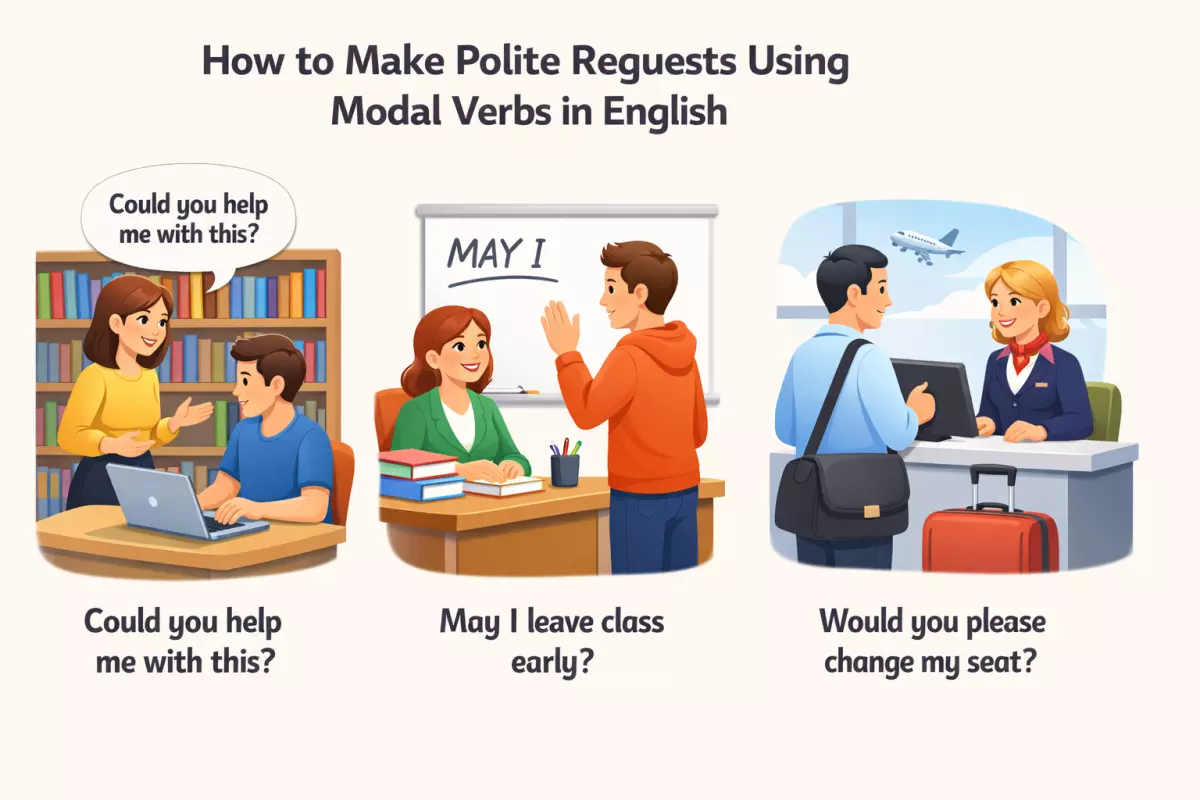 Here we modal verbs for polite requests, showing how can, could, and would signal different politeness levels, plus key sentence patterns and softeners like please or possibly. Youll get daily examples, context tips from native speakers, common learner errors, and practice exercises.
- Modal verbs commonly used to make polite requests
- How could, would, and can express different levels of politeness
- Sentence patterns for asking someone to do something
- How words like please or possibly soften a request
- Examples of polite requests in daily conversation
- How native speakers adjust requests depending on context
- Typical learner errors when forming modal requests
- Exercises and practice tasks on making polite requests with modals
Sounding polite when you ask for something often depends on your choice of helping verbs such as can, could, would, and might. These small words soften your tone at work, in shops, or with friends, helping others feel respected and more willing to assist. This article explains how to choose the best option for different situations and adjust your wording to fit the relationship and level of formality.
Modal verbs commonly used to make polite requests
English requests often become softer and more respectful when you choose the right modal verb and pair it with a clear action (open, send, help, explain). The modal you select signals how direct you want to be, how formal the situation is, and whether you are asking about ability, permission, willingness, or possibility.
-
Can
Use can for everyday, friendly requests. It is direct but not rude in most casual contexts.
- Pattern: Can + subject + base verb … ? (Can you check this?)
- Examples: Can you help me with this form? / Can you speak a bit more slowly?
- Tip: Add “please” or a softener for extra politeness: Can you email me the file, please?
-
Could
Could is a common step up in politeness. It often sounds less demanding than can, especially with strangers or at work.
- Pattern: Could + subject + base verb … ? (Could you send it today?)
- Examples: Could you repeat that, please? / Could you hold the door for a moment?
- Note: It can refer to “ability” in form, but in requests it usually signals courtesy.
-
May
May is more formal and is often used to ask permission, especially in service, academic, or official settings.
- Pattern (permission): May I + base verb … ? (May I ask a question?)
- Examples: May I come in? / May I use your phone for a moment?
- Common pairing: May I … ? is typically more natural than May you … ? for requests.
-
Might
Might can make a request very tentative. It is useful when you want to sound especially careful or when you expect the person may say no.
- Pattern: Might + subject + base verb … ? (Might I suggest … ?)
- Examples: Might I ask for an extension? / Might you be able to check one detail?
- Best for: formal, delicate, or high-stakes situations.
-
Would
Would focuses on willingness and is widely used for polite requests, invitations, and offers. It often sounds smoother than can.
- Pattern: Would + subject + base verb … ? (Would you explain that?)
- Examples: Would you mind waiting a minute? / Would you please forward this to the team?
- Useful add-on: Would you mind + -ing … ? (Would you mind closing the window?)
-
Will
Will can be polite, but it is usually more direct than would. It fits well when the request is routine or when you need a clear yes/no response.
- Pattern: Will + subject + base verb … ? (Will you call me back?)
- Examples: Will you let me know by Friday? / Will you pass the salt, please?
- Tip: Use “please” to keep it friendly in professional contexts.
-
Would like (to)
Would like is not a modal verb by itself, but it is a very common polite structure built with would. It is useful when you want to sound measured and professional.
- Pattern: I would like + noun / to + verb … (I’d like to request …)
- Examples: I’d like to ask for your feedback. / We’d like to schedule a short meeting.
- Formality: often appropriate in emails and customer service.
-
Common request frames that work with many modals
These frames help you sound polite by adding distance, choice, or a reason. They can be combined with can/could/would and similar forms.
- Could you + base verb, please?
- Would you + base verb, please?
- Could you possibly + base verb … ?
- Would you be able to + base verb … ?
- Could I + base verb … ? (asking permission)
- May I + base verb … ? (more formal permission)
- Would you mind + -ing … ?
- Do you think you could + base verb … ?
- Is there any chance you could + base verb … ?
- I was wondering if you could + base verb …
- I was hoping you could + base verb …
- When you have a moment, could you + base verb … ?
- If it’s not too much trouble, could you + base verb … ?
- Could you + base verb … when you get a chance?
- Would it be possible to + base verb … ?
-
Accuracy reminders (common learner issues)
- ✅ Could you help me? ❌ Could you to help me? (use the base verb after modals)
- ✅ Would you mind opening the window? ❌ Would you mind to open the window? (use -ing after “mind”)
- ✅ May I leave early? ❌ May I to leave early? (no “to” after the modal)
- ✅ Can you tell me where it is? ❌ Can you tell me where is it? (use statement word order in embedded questions)
How could, would, and can express different levels of politeness
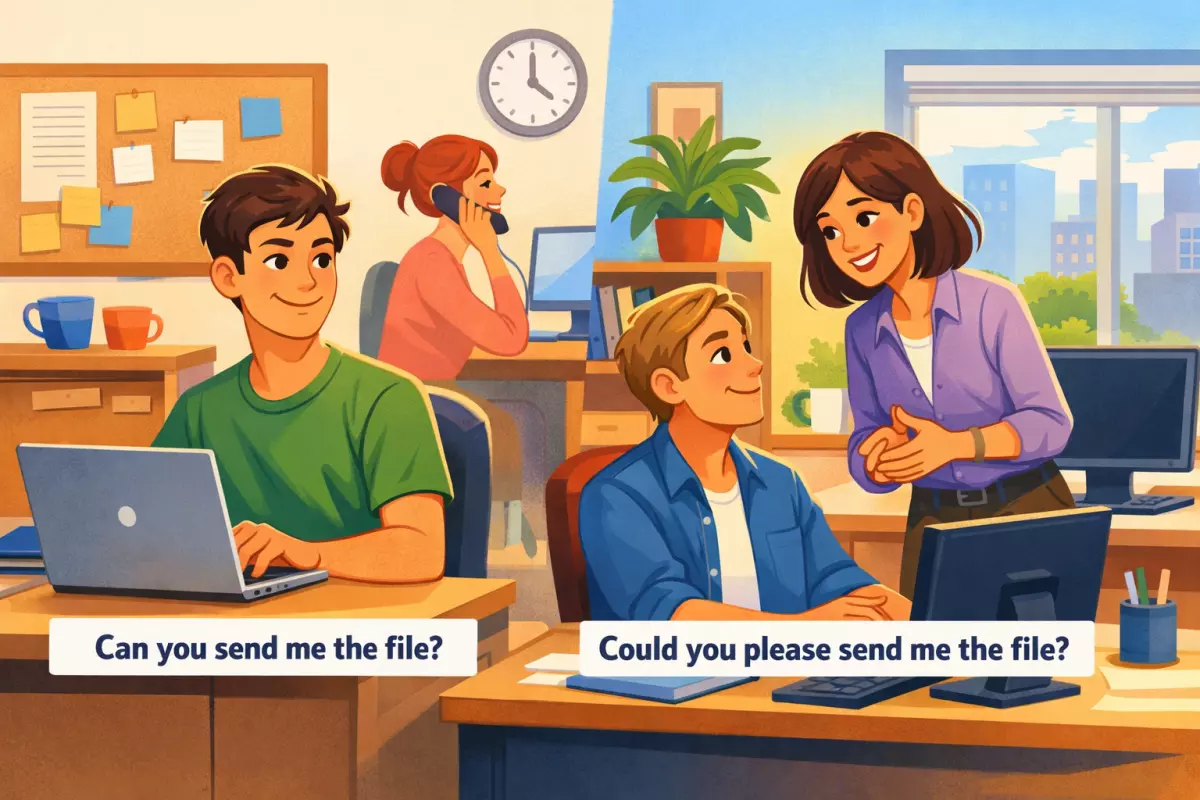
In requests, modal verbs help you control how direct you sound. Can is usually the most straightforward, could is softer and more tentative, and would often sounds the most considerate because it frames the request as the listener’s willingness or preference.
| Modal | Typical tone | Common use | Example request |
|---|---|---|---|
| can | Direct, neutral | Everyday situations; when you don’t need extra formality | Can you send me the file? |
| could | Polite, less forceful | When you want to sound respectful or avoid pressure | Could you send me the file? |
| would | Very polite, considerate | Service contexts, workplace requests, or when asking for a favor | Would you send me the file? |
| would you mind + -ing | Extra polite, indirect | When you want to be especially tactful | Would you mind sending me the file? |
Core patterns to copy
These structures are common because they are clear and easy to adjust. Keep the modal near the start, and use please carefully (it can help, but too much can sound stiff).
- Can you + base verb: Can you check this number?
- Could you + base verb: Could you check this number?
- Would you + base verb: Would you check this number?
- Can I + base verb (asking permission): Can I leave a bit early?
- Could I + base verb (more polite permission): Could I leave a bit early?
- Would it be possible to + base verb: Would it be possible to reschedule?
- Would you mind + -ing: Would you mind rescheduling?
- Could you please + base verb: Could you please clarify step 2?
- Would you be able to + base verb: Would you be able to join the call?
- Could you possibly + base verb (adds softness): Could you possibly take a look?
- Would you happen to + base verb (very gentle): Would you happen to have a charger?
- Can you + base verb + for me: Can you print this for me?
Choosing the right modal for the situation
- Use can when the relationship is close or the context is routine: Can you open the window?
- Use could when you want to reduce pressure or sound more respectful: Could you open the window?
- Use would when you’re asking for a favor, speaking to a customer/client, or aiming for a more formal tone: Would you open the window?
- Prefer could/would when the request might inconvenience the listener: Could you stay a few minutes longer?
- Prefer can for quick, practical coordination: Can you meet me at 3?
Common mistakes and quick fixes
- ❌ Could you to send it? → ✅ Could you send it?
- ❌ Would you sending it? → ✅ Would you send it?
- ❌ Would you mind to send it? → ✅ Would you mind sending it?
- ❌ Can you please to help? → ✅ Can you please help?
- ❌ Could you help me? (but said with an order-like tone) → ✅ Add a reason or option: Could you help me when you have a moment?
Sentence patterns for asking someone to do something
When you ask another person to take an action, English often relies on modal verbs plus a clear verb phrase. The modal you choose signals how direct, formal, or tentative the request is, while small additions (like “please,” softeners, or time phrases) make the wording smoother.
Core request frames (modal + base verb)
- Could you + base verb…? “Could you open the window?”
- Would you + base verb…? “Would you email me the file?”
- Can you + base verb…? “Can you help me for a minute?”
- Will you + base verb…? “Will you call me when you arrive?”
- Would you mind + -ing…? “Would you mind waiting here?”
- Could you please + base verb…? “Could you please speak a little slower?”
- Would you please + base verb…? “Would you please sign here?”
- Can you please + base verb…? “Can you please turn the music down?”
Request frames using “possibly,” “maybe,” and other softeners
- Could you possibly + base verb…? “Could you possibly check this number?”
- Could you maybe + base verb…? “Could you maybe move your bag?”
- Would you be able to + base verb…? “Would you be able to join the meeting?”
- Would it be possible to + base verb…? “Would it be possible to reschedule?”
- Could I ask you to + base verb…? “Could I ask you to review this?”
- I was wondering if you could + base verb… “I was wondering if you could explain that again.”
Patterns for permission-based requests (asking to do something)
- May I + base verb…? “May I come in?”
- Could I + base verb…? “Could I borrow your pen?”
- Can I + base verb…? “Can I use your phone?”
- Would it be okay if I + past simple…? “Would it be okay if I left early?”
- Do you mind if I + present simple…? “Do you mind if I sit here?”
Useful add-ons: time, reason, and options
- Add a time phrase: “Could you send it by 3 p.m.?”
- Add a reason (brief): “Could you lower your voice so I can hear the call?”
- Offer a choice: “Could you call me now or after lunch?”
- Make it easier to say yes: “Could you review just the first page?”
- Use “please” naturally: “Could you please hold the door?” (mid-sentence often sounds smoother than at the end)
Common form notes (to avoid awkward grammar)
- ✅ Could you help me? → modal + base verb
- ❌ Could you to help me? (do not use “to” after the modal)
- ✅ Would you mind opening the window? → “mind” + -ing
- ❌ Would you mind to open the window? (use -ing, not “to”)
- ✅ Do you mind if I sit here? → “mind if” + clause
- ✅ Would it be okay if I left early? → “okay if” often uses past simple for politeness
How words like please or possibly soften a request
Small “softening” words change the tone of a request without changing its basic meaning. They make the listener feel less pressured by adding politeness, giving options, or showing that you understand the request may be inconvenient. These words are especially common with modal verbs such as could, would, can, and may.
Where to place softeners in a modal request
Position affects how natural the sentence sounds. In many cases, the softener can move, but one placement will feel more typical in everyday English.
- At the end (very common with “please”): “Could you open the window, please?”
- After the subject (common with adverbs): “Could you possibly send it today?”
- At the beginning (sets a polite frame): “Please could you hold the line?”
- As a short add-on (adds flexibility): “Could you email me the file, if you can.”
- In a follow-up clause (reduces pressure): “Could you help me with this, when you have a moment?”
Common softening words and what they signal
- please → direct politeness; works best with simple requests: “Could you help me, please?”
- possibly → acknowledges it may be difficult: “Could you possibly stay a bit longer?”
- perhaps → gentle suggestion; slightly formal: “Could you perhaps check the figures?”
- maybe → informal softener; often sounds friendly: “Could you maybe text me later?”
- just → makes the request feel smaller (use carefully): “Could you just sign here?”
- a bit / a little → reduces the perceived effort: “Could you speak a little more slowly?”
- for a moment / for a second → suggests it won’t take long: “Could I speak to you for a moment?”
- when you have time → removes urgency: “Could you review this when you have time?”
- when you get a chance → similar to “when you have time,” common at work: “Could you call me when you get a chance?”
- if you don’t mind → checks comfort and consent: “Could you move over, if you don’t mind?”
- if it’s not too much trouble → shows awareness of effort: “Could you print this, if it’s not too much trouble?”
- if that’s okay → gives the listener an easy way to refuse: “Could we meet at 3, if that’s okay?”
- if possible → clearly offers an “out”: “Could you finish by Friday, if possible?”
- by any chance → makes the request feel less demanding: “Could you, by any chance, lend me a pen?”
- I was wondering if... → indirect and polite, common in emails: “I was wondering if you could send the agenda.”
- would you mind + -ing → polite formula for requests: “Would you mind closing the door?”
Useful patterns with modals
- “Could you possibly + verb...?”: “Could you possibly resend the attachment?”
- “Would you mind + -ing...?”: “Would you mind waiting here for a minute?”
- “Could I + verb..., please?”: “Could I leave a little early, please?”
- “Could you + verb..., when you have a moment?”: “Could you look at this when you have a moment?”
- “Would it be possible to + verb...?”: “Would it be possible to move the meeting?”
- “Could you + verb..., if possible?”: “Could you reply today, if possible?”
Common pitfalls to avoid
- ❌ Overusing “just” in sensitive contexts (it can sound minimizing): “Could you just calm down?” → better: “Could you please lower your voice?”
- ❌ Stacking too many softeners in one sentence (can sound unnatural): “Could you possibly maybe just...” → choose one or two.
- ❌ Using “please” with a harsh tone or command-like wording: “Please send it now.” → better with a modal: “Could you send it now, please?”
Examples of polite requests in daily conversation
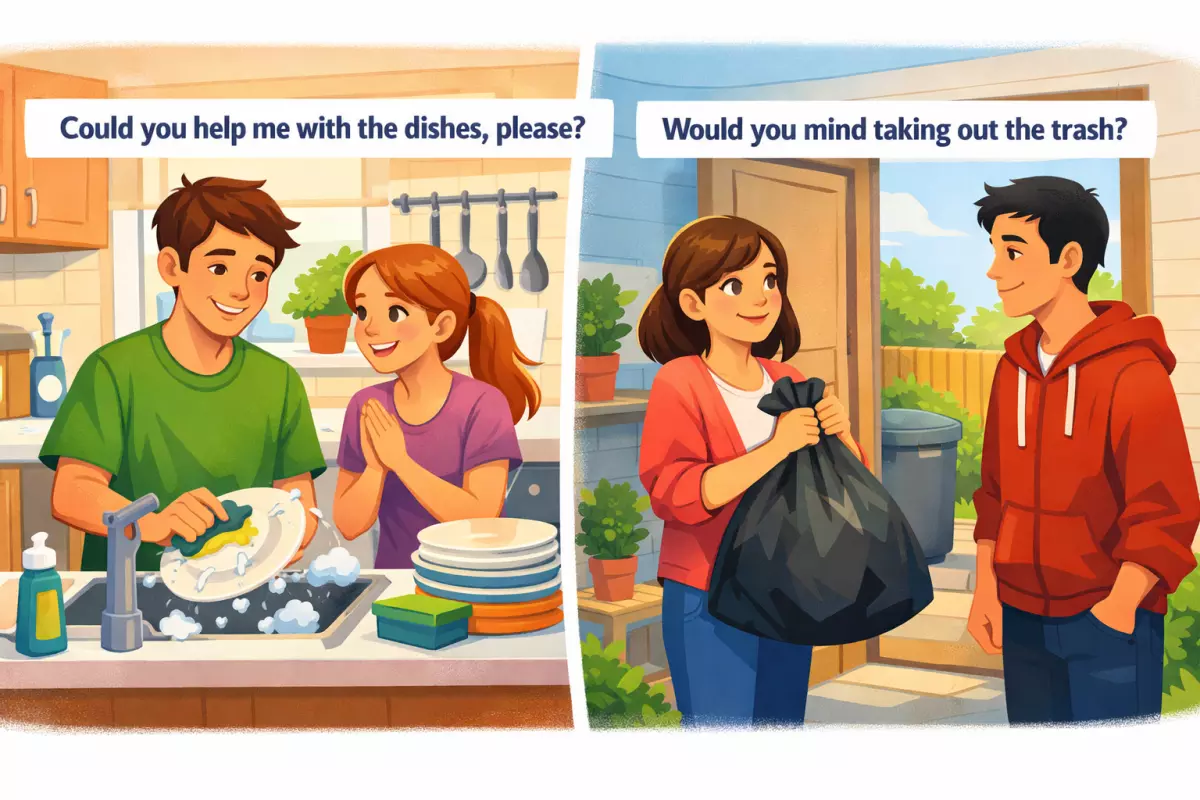
Modal verbs help you ask for help, permission, or information without sounding demanding. In daily interactions, the most common patterns are Could you...?, Would you...?, Can you...?, and May I...?. Adding softeners like please, just, a bit, or a short reason often makes the request feel more considerate.
Everyday situations and natural request patterns
- At home (help with chores): Could you help me with the dishes, please?
- At home (small favor): Would you mind taking out the trash?
- At home (turning something down): Could you turn the music down a little?
- With friends (borrowing): Could I borrow your charger for a minute?
- With friends (making plans): Could we meet a bit later?
- At work (requesting assistance): Could you give me a hand with this report?
- At work (asking for time): Could I have a few more minutes to finish this?
- At work (requesting clarification): Could you clarify what you mean by “final version”?
- At work (requesting a change): Would it be possible to move the meeting to Friday?
- Customer service (in a store): Could you tell me where the restrooms are?
- Customer service (trying something): Could I try this on, please?
- Customer service (problem-solving): Could you check if you have this in a different size?
- Restaurants (ordering politely): Could we have the menu, please?
- Restaurants (requesting an item): Could I get some water, please?
- Restaurants (asking for the bill): Could we have the check when you have a moment?
- Public places (asking a stranger): Could you tell me how to get to the station?
- Public places (small practical help): Could you hold the door for a second?
- Phone/email (polite action request): Could you send that file when you have a chance?
Quick usage notes (what these forms usually signal)
- Could you...? often sounds more tentative and polite than Can you...? in many contexts.
- Would you...? is common for favors and actions, especially when you want to sound considerate.
- Would you mind + -ing...? is polite, but it expects a “no” to mean agreement: ✅ Would you mind opening the window? → No, not at all.
- May I...? is more formal for permission: May I leave a little early today?
- Could I...? is a neutral, everyday way to ask permission: Could I use your phone?
- Softening add-ons reduce pressure: “please,” “when you have a moment,” “a bit,” “just,” or a brief reason (if it helps).
How native speakers adjust requests depending on context
Native speakers choose modal verbs based on how much they want to soften the request, how much authority they have, and how much effort they’re asking for. They also adjust wording with small “politeness moves” (like adding a reason, using a question form, or acknowledging inconvenience) to match the situation.
Common context factors and the modal patterns they trigger
- Power difference (boss/customer/teacher vs. friend): More power distance usually means more indirect forms. “Could you…?” and “Would you…?” are safer than “Can you…?” in formal relationships.
- Size of the favor: The bigger the request (time, money, effort), the more likely speakers are to use “could/would” plus softeners: “Could you possibly…?” “Would you mind…?”
- Urgency: When time matters, speakers may be direct but still polite: “Could you do this now, please?” They often add a brief reason to reduce bluntness.
- Imposition (interrupting, asking someone to change plans): Higher imposition invites extra cushioning: “I hate to ask, but could you…?” or “Would it be possible to…?”
- Setting (workplace, service, home): Work and service contexts favor conventional polite formulas (“Could I…?”, “May I…?”). At home, “can” is common and not necessarily rude.
- Relationship closeness: With close friends, “Can you…?” may sound normal and efficient. With strangers, “Could you…?” reduces the risk of sounding demanding.
- Medium (email/text vs. face-to-face): Writing often needs clearer politeness markers because tone is harder to read. “Could you please…” and a short greeting/thanks are common.
- Responsibility and roles: If the task is clearly someone’s job, speakers may use simpler forms: “Could you send that over?” If it’s outside their role, they soften more: “Would you be able to…?”
- Certainty about permission: If permission is unclear, “May I…?” or “Could I…?” sounds more careful than “Can I…?”
- Need to offer an easy “no”: When refusal is acceptable, speakers choose language that leaves space: “Would you be able to…?” “If you have time, could you…?”
Politeness moves native speakers add around modal verbs
- Use question form instead of an imperative: ✅ “Could you open the window?” ❌ “Open the window.”
- Add “please” carefully: “Please” often sounds natural mid-sentence (“Could you please…?”). Overusing it can sound tense or impatient.
- Use “possibly” or “by any chance” for extra softness: “Could you possibly send it today?” “Could you, by any chance, help me with this?”
- Acknowledge the effort: “I know you’re busy, but could you…?”
- Give a brief reason (without over-explaining): “Could you reply today? I need to confirm the booking.”
- Make it conditional: “If you have a minute, could you…?”
- Offer options: “Could you send it today or tomorrow morning?”
- Use “Would you mind…?” for sensitive requests: “Would you mind turning the music down?” (Typically followed by -ing: “mind + verb-ing”.)
- Use “Would it be possible to…?” for formal or high-imposition requests: “Would it be possible to reschedule?”
- Soften refusals and constraints while still requesting: “Could you send the file as a PDF? My system can’t open the other format.”
- End with appreciation: “Thanks” or “I really appreciate it” often appears after the request, especially in messages.
- Use “just” to minimize the request (when appropriate): “Could you just sign here?” (Useful for small steps; avoid it if the task is actually big.)
- Use “wonder” to sound less forceful: “I was wondering if you could help me.”
- Choose “can” for quick, low-stakes asks: “Can you pass the salt?” In many everyday situations, this is polite enough.
Quick pattern choices that sound natural
- Low imposition, informal: “Can you…?” / “Can I…?”
- Neutral and broadly polite: “Could you…?” / “Could I…?”
- Warm, cooperative tone: “Would you…?” / “Would you be able to…?”
- More formal permission: “May I…?”
- Extra soft for bigger favors: “Would it be possible to…?” / “I was wondering if you could…”
Typical learner errors when forming modal requests
Many problems with polite requests come from mixing up modal grammar, choosing a form that sounds too direct for the situation, or adding extra words that native speakers do not use. The patterns below highlight frequent mistakes and show what to use instead.
Common grammar and form mistakes
- ❌ Using “to” after a modal: “Can you to help me?” → ✅ “Can you help me?”
- ❌ Using -ing after a modal: “Could you helping me?” → ✅ “Could you help me?”
- ❌ Wrong word order in questions: “You can help me?” → ✅ “Can you help me?”
- ❌ Double modals (standard English): “Could you can send it?” → ✅ “Could you send it?”
- ❌ Adding “do” with a modal: “Do you could open the window?” → ✅ “Could you open the window?”
- ❌ Using “will” + base form incorrectly in a request: “Will you to check this?” → ✅ “Will you check this?”
- ❌ Confusing request vs. ability: “Can you pass the salt?” is fine as a request, but learners sometimes avoid it because they think it only asks about ability. Use it confidently in everyday contexts.
- ❌ Overusing “may” with “to”: “May I to ask a question?” → ✅ “May I ask a question?”
- ❌ Wrong negative forms: “Couldn’t you help me?” can sound like criticism. If you mean a polite request, prefer “Could you help me?” or “Could you possibly help me?”
- ❌ Forgetting the subject: “Could open the door?” → ✅ “Could you open the door?”
Politeness level mismatches
- ❌ Using “Can you…?” in very formal situations where “Could you…?” or “Would you…?” fits better: “Can you review the contract today?” → “Could you review the contract today?”
- ❌ Using “Would you…?” for permission: “Would I leave early?” → ✅ “May I leave early?” / “Could I leave early?”
- ❌ Using “must” to request (often sounds like an order): “You must send it today.” → “Could you send it today?” / “Please send it today.”
- ❌ Using “I want…” as a request (too direct): “I want you to help me.” → “Could you help me?” / “Would you mind helping me?”
- ❌ Over-softening until it becomes unclear: “If it’s not too much trouble, I was wondering if maybe you could possibly…” → keep one softener: “Could you possibly…?”
- ❌ Using “Please” with an impatient tone marker: “Please can you…” may sound pushy in some contexts. Prefer “Could you please…?” or place “please” at the end: “Could you help me, please?”
Pattern confusion with “would you mind…?”
- ❌ Wrong verb form after “mind”: “Would you mind to open the window?” → ✅ “Would you mind opening the window?”
- ❌ Answering “Would you mind…?” incorrectly: “Yes” can be confusing because “Yes, I mind” means “No, I won’t.” Clear replies: ✅ “Not at all.” / “Sure.” / “Of course.”
- ❌ Using it for urgent requests: it can sound overly indirect when time is critical. In urgent situations, “Could you open the window now, please?” is clearer.
Time and tense misunderstandings
- ❌ Thinking “could” only refers to the past: in requests, “could” often signals politeness, not past time. “Could you help me?” is a present request.
- ❌ Using “would” for past ability: “When I was a child, I would swim.” (habit) is different from “Could you swim?” (ability). For requests, “Would you…?” is about willingness: “Would you send me the file?”
- ❌ Mixing future time markers awkwardly: “Could you tomorrow send it?” → ✅ “Could you send it tomorrow?”
When choosing a modal request form, keep the structure simple (modal + subject + base verb) and adjust politeness with the modal choice and one suitable softener (for example, “please” or “possibly”), rather than stacking multiple hedges.
Exercises and practice tasks on making polite requests with modals
Use the tasks below to practice choosing the right modal, adding softeners (like please, could you, would you mind), and matching formality to the situation. Focus on these patterns: Could you + base verb, Would you + base verb, Can you + base verb, Would you mind + -ing, and Could I / May I + base verb for asking permission.
1) Choose the best modal for the context
- You’re asking a stranger for directions (more formal). ______ you tell me how to get to the station?
- You’re asking a close friend (casual). ______ you send me the photo?
- You’re asking your manager for permission. ______ I leave 10 minutes early today?
- You’re asking a colleague for help (neutral-polite). ______ you take a look at this email?
- You’re asking a guest in your home (polite offer/request). ______ you like to take a seat?
- You want to borrow someone’s charger (polite). ______ I borrow your charger for a minute?
- You’re making a request that takes effort (extra polite). ______ you mind waiting a moment?
- You’re asking someone to lower their voice in a library (polite but direct). ______ you keep your voice down, please?
Show answers
- Could
- Can
- May / Could
- Could
- Would
- Could / May
- Would
- Could
2) Rewrite to sound more polite (keep the meaning)
Rewrite each sentence using a modal request pattern. Keep it natural for everyday English.
- Give me a minute.
- Open the window.
- Tell me your last name.
- Move your bag.
- I need you to reply today.
- Let me use your phone.
- Explain that again.
- Stop talking.
Show answers
- Could you give me a minute, please?
- Could you open the window, please?
- Could you tell me your last name, please?
- Would you mind moving your bag?
- Could you reply today, please?
- Could I use your phone for a moment, please?
- Could you explain that again, please?
- Could you stop talking, please?
3) Fix the grammar: modal form and request structure
Each sentence has a common error (wrong verb form, wrong structure, or an unnatural mix). Rewrite it correctly.
- Could you to help me with this?
- Would you mind to close the door?
- May you tell me your email address?
- Can I to borrow your pen?
- Would you like pass me the salt?
- Could you please closing the window?
- Would you mind if you open the file?
- Could I borrowing your laptop for an hour?
- Can you telling me what time it is?
- Would you mind if I to sit here?
Show answers
- Could you help me with this?
- Would you mind closing the door?
- Could you tell me your email address?
- Can I borrow your pen?
- Would you like to pass me the salt?
- Could you please close the window?
- Would you mind opening the file?
- Could I borrow your laptop for an hour?
- Can you tell me what time it is?
- Would you mind if I sit here?
4) Add softeners to reduce pressure
Add one suitable softener to each request. Choose what fits best: please, just, a moment, when you have a chance, if you don’t mind, if it’s not too much trouble, possibly, by any chance.
- Could you send me the updated file ______?
- Would you mind speaking a bit more slowly ______?
- Could I ask you a question ______?
- Can you check this link ______?
- Could you wait ______?
- Would you mind if I sat here ______?
- Could you help me carry this box ______?
- May I use the restroom ______?
Show answers
- when you have a chance / please
- if you don’t mind / please
- for a moment / possibly
- by any chance / please
- a moment / just a moment
- if you don’t mind
- if it’s not too much trouble
- please
5) Build requests from prompts (choose a pattern)
Turn each prompt into a complete sentence. Use a modal and the correct verb form.
- (you / forward / email / me)
- (I / open / window?)
- (you / not / park / here)
- (you / repeat / that)
- (I / take / tomorrow off?)
- (you / fill out / this form)
- (you / lower / the volume)
- (I / sit / next to you?)
- (you / help / me / with this report)
- (you / mind / wait / a minute)
Show answers
- Could you forward that email to me, please?
- Could I open the window?
- Could you please not park here?
- Could you repeat that, please?
- May I take tomorrow off?
- Could you fill out this form, please?
- Would you mind lowering the volume?
- Could I sit next to you?
- Could you help me with this report, please?
- Would you mind waiting a minute?
6) Quick pattern checklist (self-correction)
- Could/Can/Would + base verb: “Could you check this?” (not “to check”)
- Would you mind + -ing: “Would you mind closing the door?”
- Would you mind if + past (polite): “Would you mind if I sat here?”
- Could/May I + base verb for permission: “May I leave early?”
- Use please naturally (often end position): “Could you send it today, please?”
- For refusals, keep it polite: “I’m sorry, I can’t right now.” (avoid blunt “No.”)
- If the request is big, add a softener: “Could you help me, when you have a chance?”
- When correcting someone, prefer a request over an order: ✅ “Could you keep it down?” ❌ “Be quiet.”