Noun-Based Cohesion Using Repetition, Reference, Substitution

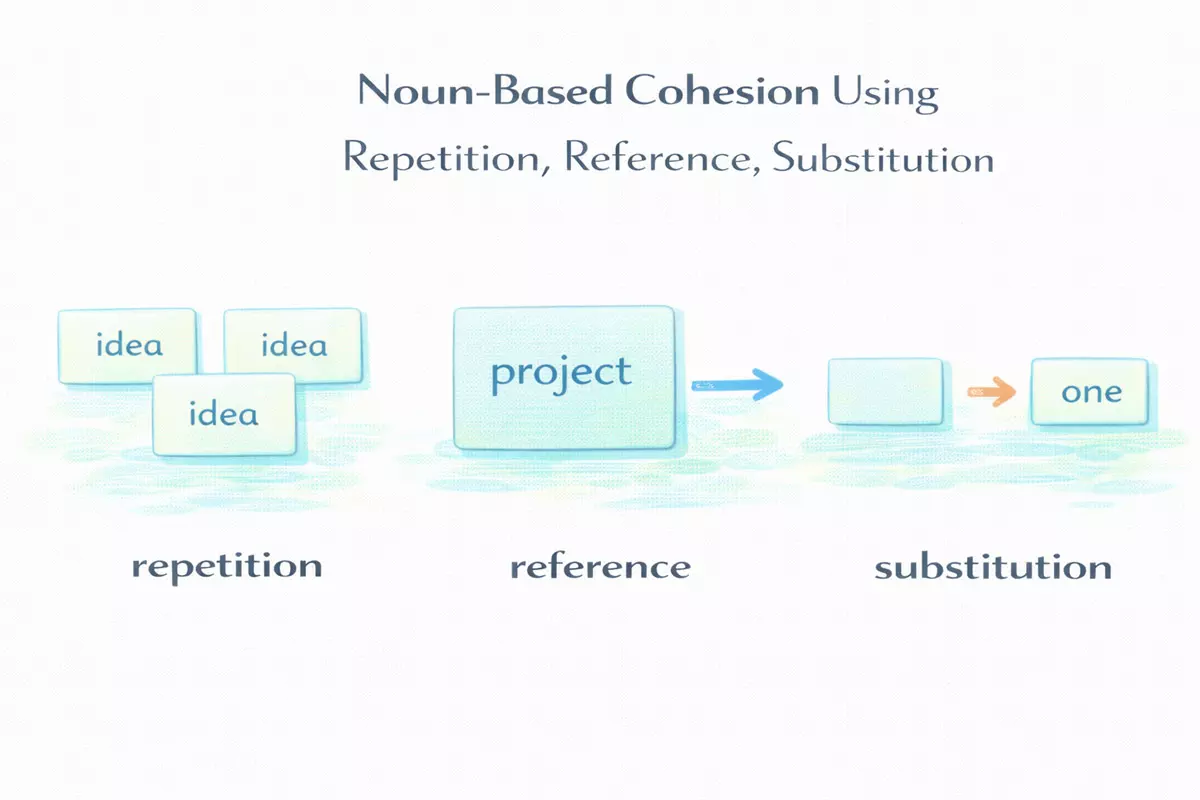 This article explains noun-based cohesion in writing. It covers repeating key nouns, using reference and shell nouns, balancing repetition and variation, common learner problems, and offers practice to improve paragraph cohesion using noun reference.
- What noun-based cohesion means in writing
- Repetition of key nouns for text consistency
- Using reference nouns to maintain topic flow
- Substitution with general and shell nouns
- Balancing repetition and variation for clarity
- Typical learner problems with weak textual cohesion
- Practice: improve paragraph cohesion using noun reference
Understanding how nouns link ideas—whether by repetition, allusion, or substitution—is crucial for creating clear and cohesive writing. By using these techniques, writers can subtly connect sentences, making the flow of information smooth and logical. This not only helps readers follow the progression of ideas but also strengthens the overall unity of the text. Mastering these skills allows writers to craft passages that are both engaging and easy to understand, ultimately enhancing the effectiveness of their communication.
What noun-based cohesion means in writing
Writers achieve logical flow in texts by connecting ideas, and nouns play a central role in this process. Noun-based cohesion refers to the way writers use nouns and noun phrases—through repetition, reference, and substitution—to tie sentences and paragraphs together. Rather than relying solely on pronouns or conjunctions, authors often repeat or refer back to key nouns, helping readers follow arguments and information more easily.
Why nouns matter for cohesion
Nouns act as anchors in a text, giving readers something concrete to track as they move from one sentence or idea to the next. When important nouns are repeated, replaced with synonyms, or referred to indirectly, the reader can connect the dots and understand the relationships between statements. This technique reduces ambiguity and keeps the writing focused.
- Repetition: Using the same noun multiple times to emphasize its importance or maintain continuity.
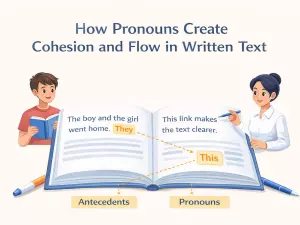
- Reference: Referring back to a previously mentioned noun using pronouns, definite articles, or descriptive phrases.
- Substitution: Replacing a noun with a synonym or a related expression to avoid monotony while preserving meaning.
Common patterns of noun-based cohesion

Writers have various options for creating cohesion through nouns. Here are some practical examples:
- Repeating a key term: The committee met yesterday. The committee decided on new policies.
- Using synonyms: The project was ambitious. This initiative required extensive planning.
- Employing pronouns: The proposal was controversial. It sparked much debate.
- Descriptive reference: The volcano erupted. This natural disaster caused widespread damage.
- Generalization: Dogs are loyal pets. These animals are known for their companionship.
- Using definite articles: A solution was suggested. The solution addressed most concerns.
- Ellipsis/substitution: Some students passed the exam; others did not (students implied).
- Superordinate term: Apples and oranges are nutritious. These fruits are popular worldwide.
- Nominalization: He decided to resign. This decision shocked his colleagues.
- Paraphrase: The ancient manuscript was discovered. The old text revealed new insights.
Benefits of noun-based connections
Using nouns deliberately to link ideas leads to clearer, more readable writing. Readers can identify the main topics easily, and the text feels unified. This strategy is especially helpful in academic, technical, and formal writing, where clarity and precision are essential.
Repetition of key nouns for text consistency
Maintaining coherence in writing often relies on the strategic reuse of important nouns. By echoing specific nouns throughout a text, writers help readers follow the main ideas and ensure that each part of the content feels connected. This technique supports both clarity and unity, especially in longer passages where the reader may otherwise lose track of the subject.
Why repeat nouns?
When a writer deliberately uses the same noun at key points, it anchors the discussion and reinforces the topic in the reader’s mind. This is especially useful in academic, technical, or instructional writing, where precision is important. Repetition of significant terms avoids ambiguity that can arise from overusing pronouns or vague references.
Common patterns for noun repetition
- Restating the main topic at the start of each paragraph
- Returning to the central noun after examples or digressions
- Using the noun in both the introduction and conclusion
- Pairing the repeated noun with different adjectives to add nuance
- Introducing synonyms or related forms after initial repetition
- Combining repetition with reference words like "this" or "that"
- Echoing the noun in questions and answers within the text
- Summarizing with the noun at transition points
- Reiterating the noun in topic sentences for emphasis
- Employing noun repetition in definitions and explanations
- Clarifying complex ideas by repeating the term in varied contexts
- Linking sections with the same key term to guide the reader
Benefits and drawbacks
Repeating crucial nouns helps readers identify what the text is about and makes the writing feel more organized. However, excessive repetition can sound monotonous. To avoid this, writers often mix in synonyms or use pronouns judiciously. Balancing repetition with variety keeps the text engaging while maintaining cohesion.
Examples of noun repetition in context
Here are some sentences that show how repeating the main noun can build consistency:
- The project requires careful planning. Without a clear outline, the project may face delays.
- Effective communication fosters teamwork. When communication breaks down, misunderstandings arise.
- Quality research underpins scientific progress. Researchers rely on research to test their hypotheses.
In summary, using the same meaningful nouns at key points in a text ties ideas together and offers readers a clear path through the material. This technique is fundamental to building strong, cohesive writing in both educational and professional contexts.
Using reference nouns to maintain topic flow
Reference nouns play an important role in creating cohesion throughout a text. Instead of repeating the same noun over and over, writers often use words like this issue, such a problem, these factors, or the process to refer back to previously mentioned ideas. This not only prevents unnecessary repetition but also helps readers track the main subject as the discussion evolves.
What are reference nouns?
Reference nouns are general nouns that point back to an earlier idea or chunk of information, often with help from determiners (this, that, such, etc.). They act as "bridges," connecting sentences and paragraphs, and keeping the reader oriented. Common examples include issue, approach, aspect, phenomenon, method, case, trend, result, event, and challenge.
How reference nouns support logical connections
When a text introduces a complex idea, using a reference noun allows the writer to discuss it further without restating the entire concept. For instance, after describing a new policy, the author might write, "This measure will have significant effects." Here, measure refers back to the previously described policy, ensuring continuity.
- This trend → This trend is shaping how young people choose their careers.
- Such a development → Such a development could change the future of the industry.
- These circumstances → These circumstances make long-term planning difficult.
- The situation → The situation requires immediate attention from the government.
- That argument → That argument is not supported by any credible evidence.
- The phenomenon → The phenomenon has been observed in several recent studies.
- This approach → This approach offers a more efficient way to solve the problem.
- These findings → These findings highlight a need for further research.
- That outcome → That outcome was unexpected and confused many experts.
- The proposal → The proposal received strong support from the committee.
- These results → These results confirm the accuracy of the original theory.
- Such factors → Such factors must be considered when analysing the data.
- That perspective → That perspective helps explain cultural differences.
- This problem → This problem affects millions of people worldwide.
- These methods → These methods are commonly used in scientific experiments.
- The solution → The solution turned out to be simpler than expected.
- Such evidence → Such evidence proves the reliability of the findings.
- This concept → This concept is difficult for beginners to understand.
- The process → The process involves collecting, sorting, and analysing information.
- These challenges → These challenges require cooperation between all departments.
Tips for effective use
To use reference nouns effectively, make sure each one clearly connects to its antecedent. Ambiguous references can confuse readers, especially if multiple nouns or ideas appear close together. Vary the types of reference nouns to match the topic and avoid monotony. Finally, balance reference nouns with occasional repetition of the original term to maintain clarity.
By skillfully weaving reference nouns into your writing, you help readers follow the thread of your discussion, making your text more coherent and easier to understand.
Substitution with general and shell nouns
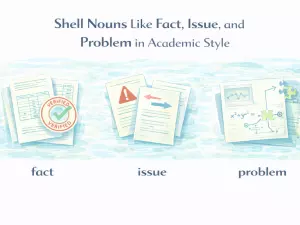
Writers often use broad or abstract nouns to avoid unnecessary repetition and to keep their text cohesive. These words—sometimes called “general” or “shell” nouns—stand in for previously mentioned ideas, actions, or entities, letting the reader connect information without restating details. This technique is especially useful for summarizing, referring back, or anticipating concepts without crowding sentences with repeated terms.
How general and shell nouns work

Instead of repeating a specific noun, a more abstract term can substitute for an earlier reference. For example, after discussing a proposal, a writer might say “this suggestion” or “the matter” to refer back to it. Such nouns act as containers or placeholders, and their meaning depends on context. Common examples include:
- issue – The main issue here is the lack of communication between teams.
- situation – The situation became more complex after new data was released.
- fact – The fact remains that we need more funding to continue.
- event – The event attracted thousands of visitors from around the world.
- thing – The thing I admire most about her is her determination.
- idea – His idea to redesign the website saved a lot of time.
- approach – This approach might help reduce production costs.
- reason – The reason for his absence was a family emergency.
- process – The process of approval can take several weeks.
- method – This method works well for analysing large amounts of data.
- point – His point was clear: we need to improve our customer service.
- question – The question remains whether the plan will succeed.
- problem – The problem is that demand is growing faster than supply.
- case – In this case, teamwork is essential to reach the goal.
- aspect – One important aspect of learning is regular practice.
- development – This development marks a new chapter in medical research.
- phenomenon – The phenomenon has been studied by scientists for years.
- change – The change in climate patterns worries many experts.
- result – The result was better than anyone expected.
- outcome – The outcome of the trial will influence future policies.
Comparing general and specific noun substitution
Writers choose between repeating precise nouns and using abstract substitutes based on clarity and cohesion. The table below contrasts these approaches in context:
| Specific Noun | General/Shell Noun Substitute |
|---|---|
| The proposal was detailed. The proposal received approval. | The proposal was detailed. This idea received approval. |
| They discussed the policy. The policy was controversial. | They discussed the policy. The issue was controversial. |
| We completed the experiment. The experiment yielded results. | We completed the experiment. This process yielded results. |
| She described the findings. The findings surprised everyone. | She described the findings. This outcome surprised everyone. |
| He raised a question. The question was difficult. | He raised a question. The matter was difficult. |
When to use general or shell nouns
Use these substitutes when you want to refer back to complex ideas without repeating details, or to group several points under a single heading for discussion. However, overusing them can lead to vagueness, so balance is key. Look for moments when a summary or a more abstract reference helps the reader follow your argument, but return to specifics as needed for clarity.
Recognizing effective substitution
Skilled writers vary their use of abstract and concrete nouns to create smooth transitions and maintain reader engagement. Substitution using general or shell nouns is most effective when the referent is clear from context and when it helps to integrate information across sentences or paragraphs.
Balancing repetition and variation for clarity
Effective writing relies on the skillful use of both repeated nouns and alternative forms to help readers follow ideas without monotony. Using the same noun phrase can help anchor the reader, but too much repetition becomes tedious or distracts from the message. On the other hand, excessive variation through synonyms or substitutes might create ambiguity or force the reader to work harder to track the subject.
When to Repeat and When to Vary
Writers should repeat a noun when it is crucial for the reader to clearly identify the subject, especially in dense or technical contexts. However, after the referent is established, switching to pronouns, synonyms, or descriptive phrases can make the text more engaging and natural. The key is to ensure cohesion without sacrificing readability.
- Repeat the main noun for emphasis or to avoid confusion.
- Use pronouns to maintain flow after the noun's identity is clear.
- Replace with synonyms to avoid monotony when the context is unmistakable.
- Employ descriptive substitutes to add detail or variety.
- Alternate forms cautiously, ensuring the reader never loses track of the subject.
- Check each substitution for clarity, especially in complex sentences.
- Balance between precision and stylistic variation.
- Monitor for accidental ambiguity when switching terms.
- Use parallel structure when referencing multiple related nouns.
- Return to the original noun if the sentence introduces new information or potential confusion.
Common Pitfalls and Solutions
Writers sometimes overuse pronouns or synonyms, causing confusion. Conversely, repeating the same noun in every sentence can feel robotic. To avoid these issues, consider the following strategies:
- Alternate between repetition and reference, but always with reader comprehension in mind.
- Vary sentence structure to reduce the need for repetitive nouns.
- Read passages aloud to detect awkward or unclear referents.
Examples: Repetition vs. Variation
Below is a comparison of approaches using repetition, pronoun reference, and substitution for noun-based cohesion. Notice how each method impacts clarity and flow.
| Approach | Example |
|---|---|
| Direct Repetition | The project was successful. The project met all its goals. |
| Pronoun Reference | The project was successful. It met all its goals. |
| Synonym/Substitution | The project was successful. This initiative met all its goals. |
| Descriptive Substitute | The project was successful. The team’s effort met all its goals. |
Ultimately, clear communication depends on the thoughtful interplay of reiteration and alternative expressions. By considering the needs of the reader and the context, writers can achieve both cohesion and readability.
Typical learner problems with weak textual cohesion
When students struggle to create smooth connections between sentences, their writing often feels disjointed and hard to follow. This is especially common when learners are unsure how to use nouns for linking ideas, such as through repetition, reference, or substitution. The result is writing that may confuse readers, even if each sentence is correct on its own.
Common issues with noun-based linking
Writers who lack cohesive devices frequently make these mistakes:
- Repeating the same noun too often, making the text sound monotonous
- Switching to unrelated nouns without clear reference, causing confusion
- Failing to use pronouns or demonstratives to refer back to earlier nouns
- Omitting substitution words, leading to unnecessary repetition
- Leaving out clear subjects or objects, so readers lose track of what is being discussed
- Using vague references like “this” or “it” without specifying what they mean
- Mixing up singular and plural references, disrupting the logical flow
- Introducing new nouns abruptly, without linking to previous information
- Forgetting to clarify who or what is being referred to after several sentences
- Overusing synonyms without making the connection to the original noun obvious
- Making substitutions that are too distant from the original noun, so the link is lost
- Confusing the reader with ambiguous references (e.g., “he” or “they” when several people are mentioned)
- Using different terms for the same idea without signaling the relationship
- Neglecting to repeat or refer to the main topic in longer paragraphs
- Failing to use summary nouns (like “issue” or “situation”) to group previous details
Repetition, reference, and substitution errors
Learners often face difficulty selecting the right cohesive device for the context. For example, they may repeat a noun unnecessarily instead of using a pronoun, or substitute a word incorrectly, leading to awkward or unclear sentences.
| Weak Example | Improved Example |
|---|---|
| The dog ran. The dog barked. The dog jumped. | The dog ran. It barked and jumped. |
| Students finished the test. The students left the room. The students were happy. | After finishing the test, the students left the room, happy with their results. |
| The computer is new. This thing is fast. The machine is useful. | The new computer is fast and very useful. |
| Anna lost her keys. She looked for Anna’s keys everywhere. | Anna lost her keys. She looked for them everywhere. |
Why these problems matter
Poorly connected sentences can make even well-researched essays appear unprofessional. Readers may have to work harder to understand the message, and important ideas might be overlooked. Learning how to use noun-based cohesion effectively—through careful repetition, clear reference, and appropriate substitution—helps writers guide readers smoothly from one idea to the next.
Practice: improve paragraph cohesion using noun reference
Building cohesion within a paragraph often relies on how nouns are repeated, referenced, or substituted. Effective use of noun reference connects ideas and makes writing smoother for the reader. Below, explore a range of exercises and strategies designed to help you strengthen connections between sentences using these techniques.
Identifying Noun References
Noun reference includes repeating a noun, using pronouns, or employing synonyms to point back to something already mentioned. This practice helps avoid unnecessary repetition while keeping the subject clear. Review the sentences below and identify which word is being referenced:
- Maria bought a new laptop. She uses it for her design projects.
- The museum was closed for renovations. This disappointed the tourists.
- Climate change affects many regions. The phenomenon is a global concern.
Show answers
- “it” refers to “a new laptop”
- “This” refers to “The museum was closed for renovations”
- “The phenomenon” refers to “Climate change”
Practice: Improve Paragraph Flow
Below are short paragraphs with weak cohesion. Revise each by adding or replacing noun references to create stronger links between ideas.
-
Original: The conference was held in Berlin. Many experts attended. The experts shared their research.
Rewrite this to improve the flow using noun reference.
-
Original: The recipe requires eggs, flour, and milk. You should mix them before adding sugar.
Identify all noun references and explain their function.
Show answers
- Improved: The conference was held in Berlin, where many experts attended and shared their research.
- “Them” refers to “eggs, flour, and milk.” It avoids repeating the list and keeps the paragraph concise.
Common Patterns for Noun-Based Cohesion
Writers use a variety of methods to maintain topic focus and clarity. Here are some useful patterns:
- Repeating the main noun (e.g., “The river is wide. The river floods every spring.”)
- Using pronouns (he, she, it, they, this, that)
- Employing synonyms or near-synonyms (“the city” → “the metropolis”)
- Using general nouns (“this issue,” “such a problem”)
- Substitution with “one/ones” (“the red car” → “the blue one”)
- Ellipsis (omitting repeated information: “I prefer tea; she, coffee.”)
- Demonstratives (“this,” “these,” “that,” “those”)
- Descriptive phrases (“the scientist,” “the researcher” instead of names)
- Nominalization (“decide” → “the decision”)
- Summary nouns (“event,” “fact,” “situation”)
- Reference to previous sentences as a whole (“This resulted in…”)
- Relative clauses (“The book that I read was fascinating.”)
Quick Check: Cohesive Devices in Context
Select the most cohesive option to fill the blank in each sentence:
- Anna finished her project. ____ was proud of her work.
- The weather changed suddenly. ____ surprised everyone at the picnic.
- Our school won the prize. The ____ was announced at the assembly.
- Tom lost his wallet. ____ ruined his whole day.
- The team worked very hard. ____ paid off in the final match.
- Lisa made a mistake. ____ taught her an important lesson.
- The lights went out. ____ caused panic in the building.
- Sarah passed her exam. ____ made her parents very happy.
- The company expanded this year. ____ increased profits greatly.
- The concert was cancelled. ____ disappointed many fans.
Show answers
- She
- This
- news/result/victory
- This/That
- This/That/The effort
- This/That/The mistake
- This/That/The event
- This/That/This achievement
- This/That/The change
- This/That/The cancellation
Practice with noun reference is essential for developing paragraphs that flow logically and clearly. By mastering these techniques, you can ensure that your writing is both cohesive and reader-friendly.