Nouns in IELTS and TOEFL Writing for High Score Performance

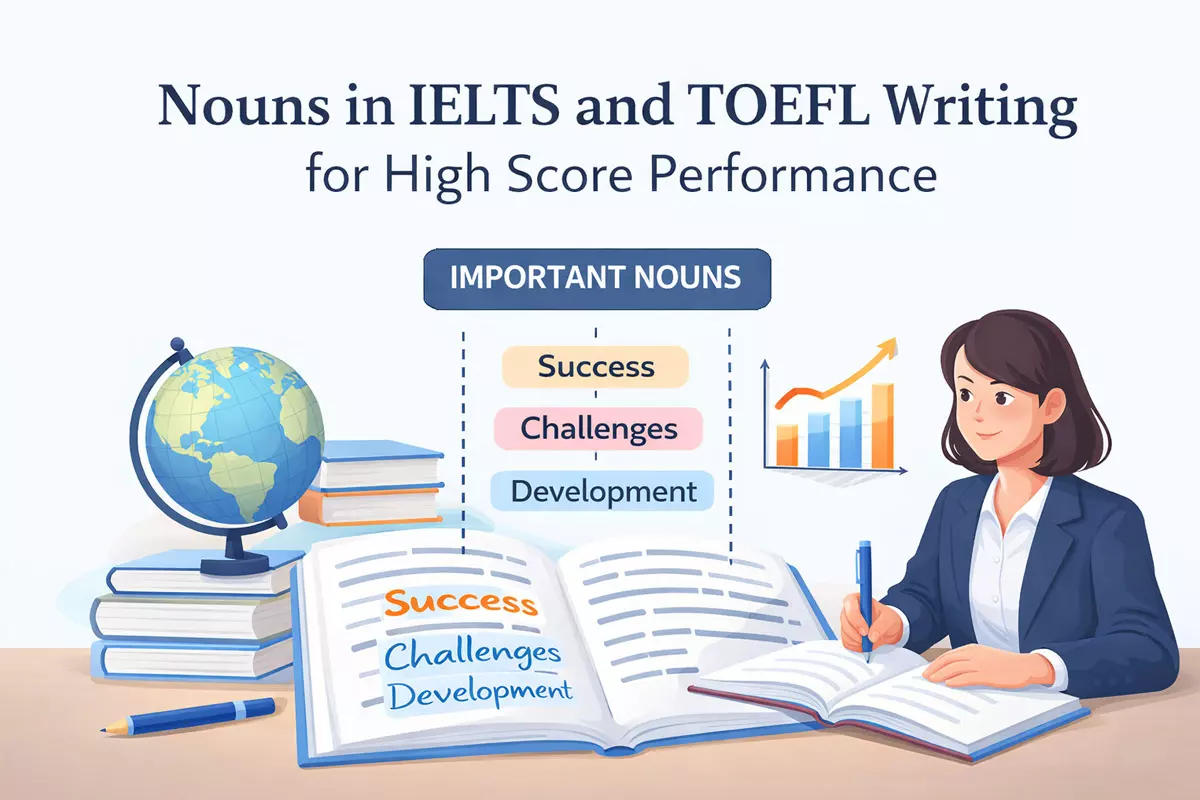 This article explains why varying your nouns is essential for exam success, outlines key academic and abstract noun types, covers accurate article and countability use, and warns about common noun mistakes that often lower scores. It also includes a practice exercise.
- Importance of noun variety for task achievement
- Academic noun categories for exam essays
- Abstract and process nouns for argument development
- Correct article and countability use in exam writing
- Avoiding repetition through noun variation
- Typical scoring deductions linked to noun errors
- Practice: improve an exam-style paragraph using stronger nouns
Mastering the use of precise naming words is essential for success in major English exams, as it allows you to express your ideas clearly and accurately in academic essays. By carefully selecting and varying these terms, you demonstrate a strong command of language, which can impress examiners and significantly improve your overall performance. Developing this skill not only helps you avoid repetition but also ensures your arguments are specific and well-supported, ultimately increasing your chances of achieving top marks.
Importance of noun variety for task achievement
Using a wide range of nouns is a crucial aspect of high-scoring IELTS and TOEFL writing. Examiners look for diversity in vocabulary, and the flexibility to choose precise or nuanced nouns can directly impact how well you address the requirements of each task. Overusing basic words or repeating the same noun throughout an essay often signals a limited vocabulary, which may lower your score in the Lexical Resource or Vocabulary Use criteria.
How diverse nouns boost your writing
- Clarifies meaning: Specific nouns eliminate ambiguity and make arguments clearer.
- Demonstrates lexical range: Using synonyms, abstract and concrete nouns shows command of English.
- Supports coherence: Varying nouns helps avoid monotony and keeps the reader engaged.
- Addresses task requirements: Different tasks (e.g., describing a process, expressing opinion, analyzing data) call for different noun types.
Common pitfalls of limited noun usage
- Repeating the same word (e.g., "problem" in every sentence)
- Using vague nouns (e.g., "thing," "stuff") rather than precise terms
- Failing to distinguish between countable and uncountable nouns
- Not using nominalizations when appropriate (e.g., "development" instead of "develop")
Examples: Expanding noun variety

Here are ways to replace basic or overused nouns with more varied and precise alternatives:
| Vague Noun | More Precise Alternatives | Example Sentence |
|---|---|---|
| problem | issue, challenge, obstacle, complication, dilemma | This issue has significantly slowed the project’s progress. |
| people | individuals, citizens, residents, participants, consumers | The participants completed an online survey about their habits. |
| solution | remedy, resolution, approach, strategy, intervention | The strategy reduced energy consumption by 20%. |
| information | data, details, evidence, statistics, findings | The data support the main argument of the article. |
| change | transformation, alteration, shift, modification, adjustment | This shift in policy affected thousands of workers. |
| effect | impact, consequence, outcome, result, implication | The impact of the new law was felt immediately. |
| development | progress, advancement, expansion, growth, evolution | This advancement has improved access to healthcare. |
| increase | rise, surge, escalation, growth, upturn | The rise in temperature is a serious concern. |
| government | authorities, administration, policymakers, officials, regime | The authorities introduced new regulations on emissions. |
| environment | surroundings, ecosystem, habitat, setting, context | This ecosystem supports a wide range of species. |
| technology | innovation, device, application, advancement, tool | The innovation has transformed how students learn. |
| education | schooling, instruction, curriculum, training, learning | The curriculum focuses on critical thinking skills. |
| job | occupation, profession, position, role, employment | This position requires strong analytical skills. |
| money | funds, capital, resources, income, revenue | The funds were allocated to support local schools. |
Impact on IELTS & TOEFL scoring
Both IELTS and TOEFL rubrics reward candidates who demonstrate a broad vocabulary. Noun variety is especially important for Task Achievement (IELTS) or Development, Organization, and Language Use (TOEFL). Examiners expect to see appropriate nouns that fit the context and purpose of each task. For example, describing a graph requires data-related nouns, while an opinion essay may call for more abstract or argumentative terms.
| Task Type | Recommended Noun Types | Sample Nouns |
|---|---|---|
| Describing Data/Graphs | Quantities, trends, categories | percentage, increase, decline, category, segment |
| Opinion Essays | Abstract, evaluative, thematic | belief, consequence, benefit, drawback, principle |
| Problem/Solution | Issues, actions, outcomes | challenge, intervention, result, obstacle, remedy |
| Process Descriptions | Stages, components, materials | stage, component, substance, phase, item |
| Personal Experience | Feelings, events, experiences | experience, event, memory, reaction, response |
Practice: Identify and upgrade basic nouns
Replace the underlined basic nouns in the following sentences with more precise or varied alternatives:
- The problem of pollution is increasing in many cities.
- Many people believe that education is important.
- This change will affect the company’s future.
- The effect of technology can be seen everywhere.
Show answers
- The issue/challenge of pollution is increasing in many cities.
- Many individuals/citizens/residents believe that education is important.
- This transformation/adjustment/shift will affect the company’s future.
- The impact/consequence/result of technology can be seen everywhere.
In summary, the ability to use a variety of nouns effectively is essential for demonstrating language proficiency and fully meeting the requirements of IELTS or TOEFL writing tasks. Practice identifying opportunities to diversify your noun usage for more precise, engaging, and high-scoring essays.
Academic noun categories for exam essays
When preparing for IELTS and TOEFL writing tasks, understanding the main types of nouns commonly used in academic essays can help you present your ideas more clearly and formally. Different noun categories serve distinct functions, from introducing abstract concepts to supporting arguments with concrete evidence.
Abstract vs. Concrete Nouns
Academic writing often requires a mix of abstract and concrete nouns. Abstract nouns (like "freedom" or "innovation") are used to discuss ideas, qualities, or conditions, while concrete nouns ("data," "experiment") refer to physical objects or observable phenomena. Balancing both types strengthens your argument and demonstrates linguistic flexibility.
- Abstract: development, improvement, influence, significance, efficiency, responsibility, diversity, equality, sustainability, motivation
- Concrete: device, policy, survey, population, resource, curriculum, technology, document, laboratory, procedure
Countable and Uncountable Academic Nouns
Recognizing whether a noun is countable or uncountable is crucial for grammatical accuracy. For example, "information" is uncountable (not "informations"), while "method" is countable.
- Countable: solution, factor, result, participant, method
- Uncountable: research, knowledge, evidence, progress, advice
Key Categories for Essay Structure
Writers use specific noun types to fulfill particular essay functions. Here are some of the most common:
| Noun Category | Typical Examples |
|---|---|
| Process/Phenomenon | globalization, urbanization, migration, adaptation, automation |
| Concept/Idea | justice, autonomy, innovation, sustainability, equity |
| Agent/Actor | government, individual, institution, community, authority |
| Measure/Result | outcome, impact, trend, indicator, proportion |
Nominalization in Academic Writing
Turning verbs and adjectives into nouns (nominalization) is a frequent feature in formal essays. It helps to condense ideas and create a more academic tone. For example, "analyze" becomes "analysis," and "efficient" becomes "efficiency." Overusing this, however, can make writing dense, so balance is key.
Useful Academic Nouns for High-Scoring Essays
Expanding your range of academic nouns can help you express arguments precisely. Here are some high-utility options for exam essays:
- assumption
- consequence
- challenge
- criteria
- debate
- framework
- impact
- limitation
- perspective
- policy
- priority
- requirement
- strategy
- variable
- trend
- justification
- implication
- significance
- alternative
- evidence
Selecting the right categories and forms of nouns helps you construct logical, academically appropriate arguments. This approach not only boosts clarity but also demonstrates a strong command of academic English, both of which are rewarded in IELTS and TOEFL writing assessments.
Abstract and process nouns for argument development
To write strong essays in IELTS and TOEFL, mastering the use of abstract and process nouns is crucial. These nouns help you discuss broad concepts, trends, and actions without overusing verbs or repeating yourself. They make your arguments sound more academic and analytical, which examiners value.
Understanding Abstract and Process Nouns
Abstract nouns refer to ideas, qualities, or states rather than concrete objects. Process nouns, on the other hand, describe actions or events as entities. Both play a key role in constructing formal arguments, allowing you to generalize, summarize, and link points smoothly.
- Abstract nouns: freedom, poverty, equality, education, development, improvement, responsibility, impact, effectiveness, significance, knowledge, progress, access, influence, innovation, justice, safety, diversity, efficiency, sustainability
- Process nouns: migration, consumption, production, implementation, regulation, globalization, adaptation, negotiation, transition, evaluation, investment, expansion, reduction, allocation, transformation, participation, integration, automation, distribution, preservation
Why Use Abstract and Process Nouns?
Using these forms makes your writing more concise and cohesive. For example, instead of repeating verbs like "people migrate" or "companies produce," you can use "migration" and "production" to discuss trends or consequences. This also enables you to vary sentence structure and avoid monotony.
| Verb-based Expression | Noun-based Alternative |
|---|---|
| People are becoming healthier | The improvement in health |
| Companies invest in technology | Investment in technology |
| Governments regulate pollution | Regulation of pollution |
| Society changes rapidly | Rapid transformation of society |
| Communities participate in projects | Participation of communities |
| People reduce waste | Waste reduction |
Tips for Effective Use
- Balance noun-based and verb-based sentences for a natural flow.
- Combine abstract nouns with modifiers (e.g., "significant improvement") for precision.
- Use process nouns to summarize complex actions or trends.
- Avoid overloading sentences with too many abstract nouns, which can make writing vague.
In summary, incorporating a range of abstract and process nouns helps you develop more sophisticated arguments, present information analytically, and achieve a higher level of formality in your academic essays. This approach is essential for standing out in IELTS and TOEFL writing tasks.
Correct article and countability use in exam writing
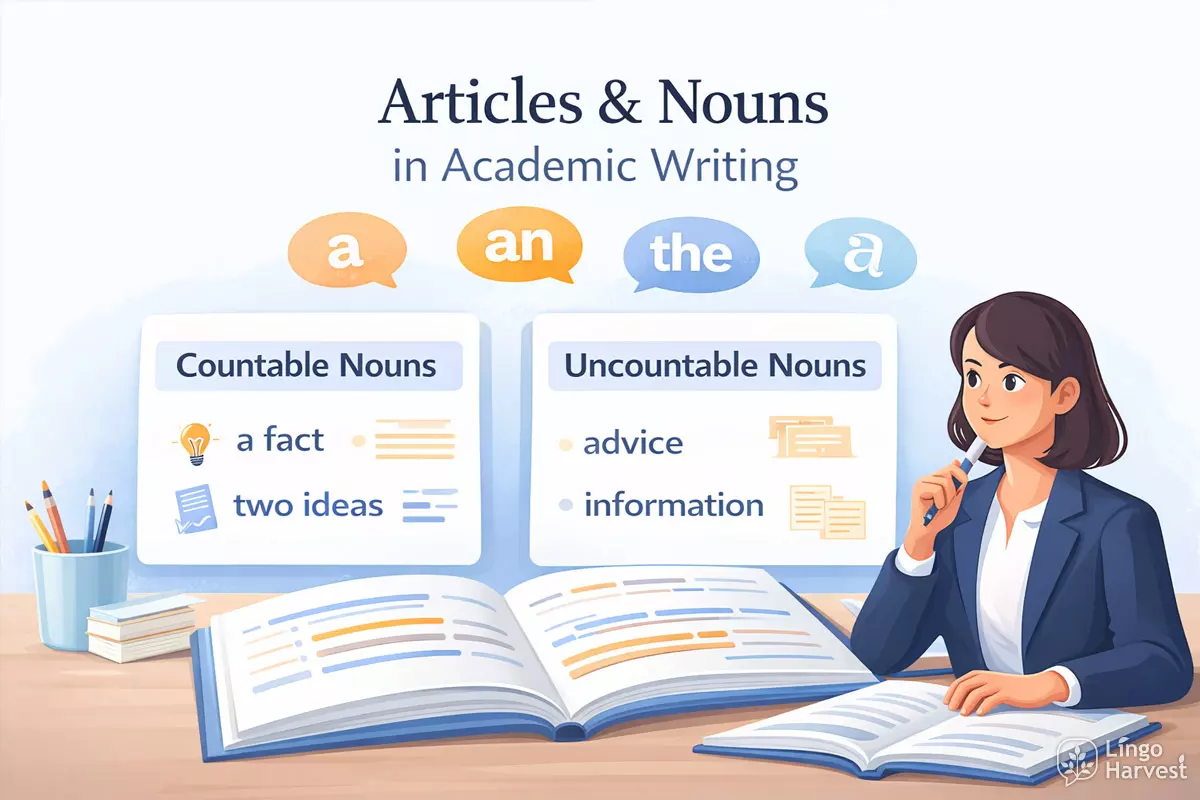
Grammatical accuracy with articles and noun countability can significantly influence your score in IELTS and TOEFL writing tasks. Examiners notice errors with “a,” “an,” “the,” and when students misclassify countable and uncountable nouns. These mistakes often disrupt clarity and academic tone, which are key for high marks.
Understanding articles and their usage
Articles help specify whether you are talking about something specific or general. “A” and “an” are indefinite articles, used for non-specific, singular countable nouns. “The” is definite and refers to specific items or groups.
- a/an: Use before singular, countable nouns when mentioning something for the first time (e.g., “a solution”, “an idea”).
- the: Use when the noun is already known, unique, or specified (e.g., “the environment”, “the main cause”).
- No article: For plural or uncountable nouns when speaking generally (e.g., “Water is essential”, “Cars cause pollution”).
Countable vs. uncountable nouns
Countable nouns can be made plural and used with numbers (“two reasons”, “three advantages”), while uncountable nouns refer to substances or abstract concepts that cannot be counted (“information”, “advice”). Mixing these up leads to awkward or incorrect sentences.
| Noun | Countable? | Correct usage |
|---|---|---|
| Advice | No | Some advice, much advice, a piece of advice ❌an advice |
| Experience | Both | Much experience (general), an experience / experiences (specific events) |
| Research | No | Research, some research, a piece of research ❌a research |
| Benefit | Yes | A benefit, benefits, many benefits |
| Information | No | Information, some information ❌an information |
| Fact | Yes | A fact, facts, several facts |
| Progress | No | Progress, much progress ❌a progress |
| Job | Yes | A job, jobs |
| Work | No | Work, much work, a piece of work ❌a work |
| Suggestion | Yes | A suggestion, suggestions |
Common article and countability mistakes
Writers frequently make errors such as using “an information” or omitting “the” when it is required. Here are some frequent issues to avoid:
- Using “a/an” with uncountable nouns (❌ “a research” → ✅ “research”)
- Leaving out “the” before unique nouns (❌ “Earth is…” → ✅ “The Earth is…”)
- Placing “the” before general plural or uncountable nouns unnecessarily (❌ “the pollution is a problem” when speaking generally → ✅ “Pollution is a problem”)
- Confusing “experience” (general) with “an experience” (specific incident)
Tips for exam writing
- Check if a noun is countable or uncountable before adding an article.
- For general statements, avoid “the” unless the noun is unique or previously mentioned.
- Remember that many academic nouns (e.g., “evidence”, “research”, “advice”) are uncountable.
- Practice paraphrasing to avoid repeating the same noun forms and articles.
- Read model essays and note how articles and noun forms are used.
Mastering these points will make your writing clearer and more accurate, helping you achieve a higher score in your English proficiency exams.
Avoiding repetition through noun variation
Repeating the same noun multiple times in IELTS or TOEFL essays can make your writing sound monotonous and less sophisticated. Examiners value lexical resource, and one way to demonstrate this is by skillfully varying the nouns you use. Not only does this show a broader vocabulary, but it also keeps your writing clear and engaging for the reader.
Why noun variation matters in academic writing
Using a range of related nouns helps you avoid redundancy and demonstrates your ability to paraphrase, which is a key assessment criterion. For instance, instead of repeating "problem" in every sentence, you might alternate with "issue," "challenge," or "difficulty," depending on context. This flexibility suggests a higher language proficiency.
Strategies for diversifying nouns
Consider the following approaches to keep your writing dynamic:
- Use synonyms: Replace a common noun with an appropriate alternative that fits the context.
- Employ general and specific terms: Alternate between broader and more detailed nouns.
- Apply abstract and concrete nouns: Switch between tangible and intangible forms for variety.
- Utilize paraphrasing: Express the same idea in a different way using related nouns.
- Integrate pronouns and noun phrases: When suitable, use "this," "these issues," or "such factors" to refer back to earlier nouns.
Commonly repeated nouns and alternatives
Writers often overuse certain nouns in academic essays. The table below provides stronger alternatives that help vary vocabulary and improve academic style:
| Common Noun | Recommended Alternatives |
|---|---|
| Problem | Issue, challenge, obstacle, difficulty, complication, concern, setback |
| Solution | Remedy, answer, resolution, approach, strategy, method, measure |
| People | Individuals, citizens, residents, population, public, society, community, participants |
| Advantage | Benefit, merit, upside, strength, asset, positive aspect |
| Disadvantage | Drawback, downside, limitation, weakness, negative aspect, shortcoming |
| Effect | Impact, consequence, result, outcome, repercussion, influence |
| Reason | Cause, factor, basis, rationale, motivation, justification |
| Development | Progress, advancement, growth, evolution, improvement, expansion |
| Change | Shift, transformation, modification, alteration, adjustment, transition |
| Technology | Innovation, device, tool, machine, advancement, equipment |
Tips for effective noun variation
- Check for repeated nouns during editing and replace where appropriate.
- Ensure the synonym matches the context and meaning.
- Keep your writing natural—do not force uncommon words if they sound awkward.
- Maintain coherence by ensuring the reader can follow your references.
By thoughtfully varying your nouns, you not only avoid repetition but also demonstrate a mature command of academic English—an essential factor for achieving a high score in IELTS and TOEFL writing tasks.
Typical scoring deductions linked to noun errors
Accurate use of nouns is essential for achieving high marks in IELTS and TOEFL writing tasks. Examiners look for precision, variety, and correctness in noun usage. When mistakes occur, they can lead to lower scores in areas such as grammar, lexical resource, and clarity of communication. Below, you’ll find a breakdown of the most common noun-related missteps and how they impact your writing band or score.
Common noun mistakes that affect scores
- Incorrect singular/plural forms (e.g., "informations" instead of "information")
- Omitted articles with countable nouns (e.g., "She has cat" instead of "She has a cat")
- Unnecessary articles with uncountable nouns (e.g., "the advice" when it should be "advice" in a general sense)
- Confusing countable and uncountable nouns (e.g., "many furniture" instead of "much furniture")
- Wrong noun forms (e.g., "beautify" instead of "beauty")
- Misused possessive forms (e.g., "peoples opinions" instead of "people's opinions")
- Incorrect noun-verb agreement (e.g., "The data is" when "The data are" is required in formal contexts)
- Inconsistent use of abstract nouns (e.g., "happinesses" instead of "happiness")
- Improper noun collocations (e.g., "do a mistake" instead of "make a mistake")
- Mixing proper and common nouns improperly (e.g., "the London" instead of "London")
- Unclear noun reference, leading to ambiguity (e.g., "It improved the process, which helped it")
- Redundant noun repetition (e.g., "The car, the car is fast")
- Incorrect capitalization of proper nouns (e.g., "paris" instead of "Paris")
- Using adjectives as nouns incorrectly (e.g., "the poors" instead of "the poor")
How noun errors impact your writing score
Grammatical accuracy is directly assessed in both IELTS and TOEFL. Frequent or serious noun errors can signal a lack of control over basic English structures, which may cap your score in key criteria. Even occasional mistakes can limit your ability to achieve the highest bands or levels, especially if they disrupt the flow or meaning of your response.
| Error Type | Possible Score Impact |
|---|---|
| Frequent plural/singular mistakes | Band capped at 5 or lower for grammar on IELTS; marked as "frequent errors" on TOEFL |
| Consistent article misuse | Lexical resource and accuracy scores reduced; clarity suffers |
| Confused countable/uncountable usage | Lowered coherence; affects both grammar and vocabulary scores |
| Unclear or ambiguous noun reference | Logical flow penalized; coherence and cohesion band reduced |
| Improper noun collocations | Marked as awkward phrasing; vocabulary and clarity scores drop |
Minimizing risk of noun-related penalties
To avoid unnecessary deductions, proofread your writing for the errors listed above. Practice distinguishing between countable and uncountable nouns, review common collocations, and always check for correct article use. Mastery of noun forms and functions can make a significant difference in your overall writing performance.
Practice: improve an exam-style paragraph using stronger nouns
Upgrading the nouns in your writing can instantly make your arguments more precise and persuasive, especially for academic tasks such as IELTS or TOEFL essays. Below, you’ll find a sample exam-style paragraph written in a basic style, followed by a task to revise it using more specific and powerful nouns. This practice will help you notice where weak or general words can be replaced with terms that are both accurate and impressive.
Original Paragraph Sample
Many people think that technology is good. It helps people in life and makes things easier. Some people do not like technology and think it is bad for jobs. There are different ideas about this topic.
Task: Strengthen the Nouns
Rewrite the paragraph above by replacing vague nouns (like "people," "things," "life," "ideas," "topic") with more specific or academic nouns. Try to add detail and precision where possible.
- Identify at least five general nouns in the paragraph and suggest a stronger alternative for each.
- Rewrite the entire paragraph using your improved nouns. Focus on making the writing more formal and academic.
Useful Strong Nouns for Academic Writing
- Individuals → individuals within modern communities
- Advancements → technological advancements in industry
- Innovations → groundbreaking innovations in science
- Society → contemporary society as a whole
- Employment opportunities → expanding employment opportunities for graduates
- Automation → increasing automation across manufacturing sectors
- Productivity → higher productivity within global markets
- Opponents → opponents of this policy argue that...
- Supporters → supporters claim that the reform will...
- Debate → the ongoing debate among researchers
- Implications → long-term implications for future generations
- Perspective → from an economic perspective
- Progress → measurable progress in medical research
- Workforce → the modern workforce in developed countries
- Consequences → unintended consequences for public welfare
- Benefits → significant benefits to the national economy
- Drawbacks → potential drawbacks of large-scale investment
- Sector → the rapidly expanding technology sector
- Development → sustainable development in urban areas
- Impact → the substantial impact on environmental stability
Comparison: Weak vs. Strong Nouns
| Weak/General Noun | Stronger/Specific Noun |
|---|---|
| People | Individuals / Citizens |
| Things | Tasks / Devices / Processes |
| Life | Daily routines / Quality of life |
| Ideas | Perspectives / Arguments |
| Topic | Issue / Subject / Debate |
| Jobs | Employment / Occupations |
| Technology | Technological advancements / Digital innovation |
Now, Try It Yourself
Apply your revised nouns to the original paragraph and see how much more academic and engaging your writing becomes. When you’re ready, check your answer below.
Show answers
- Sample improved paragraph:
Many individuals argue that technological advancements contribute significantly to society by enhancing daily routines and increasing productivity. However, some opponents claim that innovation negatively affects employment opportunities by reducing the demand for manual labor. There is an ongoing debate regarding the impact of technology on the modern workforce. - Example noun substitutions:
- People → Individuals / Citizens
- Things → Tasks / Processes
- Life → Daily routines / Quality of life
- Ideas → Perspectives / Arguments
- Topic → Issue / Debate