Topic Nouns in Essay Structure and Coherent Writing

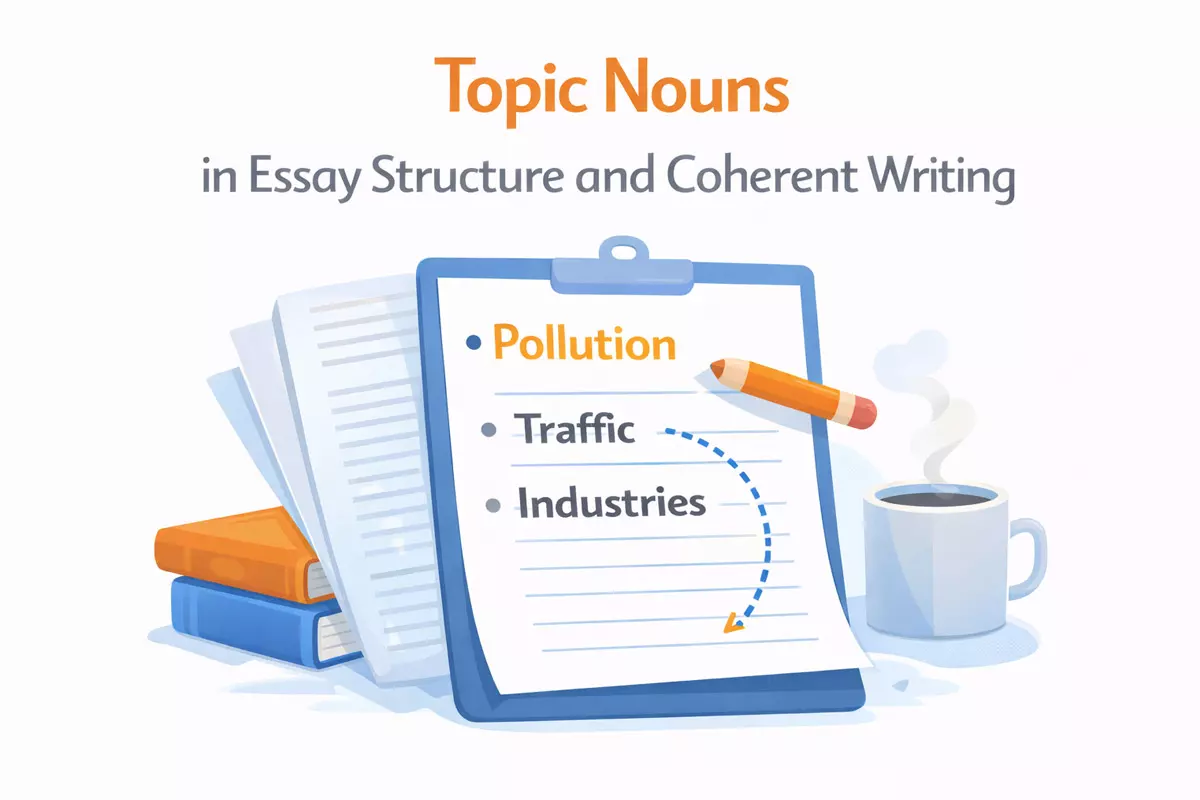 Here we how topic nouns organize essay structure, clarify thesis and topic sentences, link sections with repeated references, and maintain focus. It also discusses common mistakes and offers practice in rebuilding essay logic using topic nouns.
- Role of topic nouns in essay structure
- Using topic nouns in thesis and topic sentences
- Connecting essay sections with repeated noun reference
- Avoiding topic drift with consistent noun control
- Topic nouns in introductions and conclusions
- Typical mistakes in topic noun reuse
- Practice: rebuild essay logic using topic nouns
Writing a clear and logical essay depends largely on how well you introduce and develop main ideas within each paragraph. By using central subject words thoughtfully, you can guide readers through your argument in a way that keeps your writing focused and coherent. This approach not only makes your essay easier to understand but also strengthens the overall flow of your ideas, helping readers connect each point as they progress through your work. Consistent use of subject words ensures that your argument remains unified and supports your thesis throughout the essay.
Role of topic nouns in essay structure
Topic nouns are central to organizing academic writing. These specific nouns—such as problem, solution, evidence, or consequence—anchor sentences and paragraphs, making it easier for readers to follow the logical flow of ideas. By consistently referring back to key concepts with topic nouns, writers create a thread that connects each part of their essay.
How topic nouns guide paragraph development
Using recurring subject nouns at the beginning of sentences helps to maintain focus within paragraphs. This technique clarifies what each section is about and signals shifts in argument or analysis. For example, starting several sentences with research, study, or findings reminds the reader that the paragraph discusses scholarly evidence, not opinions or background.
- Argument → The argument presented in the article was strongly supported by data.
- Evidence → The researcher provided clear evidence to support the claim.
- Analysis → The analysis revealed a significant correlation between the variables.
- Reason → One major reason for the decline was poor management.
- Result → The result confirmed the initial hypothesis.
- Challenge → The project faced a major challenge during implementation.
- Solution → The proposed solution reduced operational costs by 20%.
- Implication → The implication of this study is relevant to future policy decisions.
- Example → The author included an example to illustrate the concept.
- Perspective → Each perspective contributed to a deeper understanding of the issue.
- Trend → The trend shows increasing use of renewable energy worldwide.
- Purpose → The purpose of this research is to improve treatment outcomes.
- Method → The study used a mixed-method approach to gather data.
- Observation → The observation confirmed changes in student behavior.
- Context → The context of the discussion is essential for accurate interpretation.
- Factor → Weather was a major factor affecting crop production.
- Issue → The issue remains unresolved due to lack of agreement.
- Outcome → The outcome demonstrated significant improvement in results.
- Approach → This approach encourages collaboration across departments.
- Benefit → One benefit of online learning is increased accessibility.
Supporting coherence and transitions
Strategic use of central nouns makes transitions smoother. Instead of vague pronouns or repetition, using a specific noun ties sentences together. For instance, a writer might use challenge to introduce a problem, then refer to solution in the next paragraph, making the shift explicit. This pattern helps maintain clarity, especially in longer essays.
Comparison: Topic nouns vs. vague references
| Specific Topic Noun | Vague Reference |
|---|---|
| The analysis reveals several patterns in the data. | This shows several patterns in the data. |
| The solution addresses the issue directly. | It addresses the issue directly. |
| This approach improves efficiency. | This improves efficiency. |
| The evidence supports the claim. | That supports the claim. |
In summary, topic nouns play a crucial part in structuring essays and ensuring that readers can easily track the development of ideas. By deliberately choosing clear, relevant nouns, writers strengthen the overall coherence and readability of their work.
Using topic nouns in thesis and topic sentences
Clarity in academic writing often depends on how well the reader can follow the main ideas of each paragraph. One practical technique is to choose precise nouns—known as topic nouns—to anchor both thesis statements and topic sentences. These nouns act as conceptual signposts, allowing readers to anticipate what each section will address. When crafting a thesis, selecting a focused topic noun helps define the scope of the essay and signals the central theme. For instance, using “technology,” “education,” or “environmental policy” in a thesis statement narrows the essay’s direction and makes the argument easier to follow. Similarly, in topic sentences, these nouns maintain coherence by referring back to the main subject, creating a logical thread throughout the text.
How topic nouns shape thesis statements
A well-chosen noun in the thesis statement establishes a clear subject. Consider these examples:
- Education reform requires innovative teaching methods to address diverse learning needs.
- Social media influences public opinion through rapid information sharing.
- Renewable energy offers sustainable solutions to climate change.
In each case, the bolded noun sets the stage for specific arguments and evidence.
Role in topic sentences
Each paragraph’s opening sentence should echo the essay’s core noun, reinforcing unity. For example:
- Education policies must adapt to technological advancements.
- Social media platforms can both inform and mislead users.
- Renewable energy adoption faces economic and political hurdles.
These sentences keep the reader oriented and link back to the thesis.
Common topic nouns for academic writing

Writers often use a range of nouns to focus their arguments. Here is a list of frequently used topic nouns that can help structure clear and coherent essays:
- Culture → Culture shapes how people communicate and solve problems.
- Technology → Technology has transformed the way students access information.
- Education → Education plays a key role in reducing inequality.
- Policy → Policy changes can influence national economic growth.
- Health → Health should be treated as a fundamental human right.
- Environment → Environment protection is essential for future generations.
- Justice → Justice ensures that all citizens receive fair treatment.
- Community → Community support programs help families in crisis.
- Economy → Economy recovery depends on strong consumer confidence.
- Innovation → Innovation drives progress in science and technology.
- Media → Media influences public opinion and political decisions.
- Tradition → Tradition connects people to their cultural heritage.
- Leadership → Leadership skills are critical for organizational success.
- Equality → Equality must be protected through fair legal systems.
- Identity → Identity is shaped by language, culture, and beliefs.
- Migration → Migration has reshaped population patterns worldwide.
- Security → Security concerns affect international relations and trade.
- Resource → Resource management is essential for sustainable development.
- Participation → Participation in local elections strengthens democracy.
- Development → Development requires investment in education and infrastructure.
Comparison: Weak vs. strong use of topic nouns
Below is a table contrasting less effective and more effective uses of topic nouns in thesis and topic sentences:
| ❌ Weak Example | ✅ Strong Example |
|---|---|
| There are many problems today. | Urbanization challenges affect modern cities. |
| This is an important issue. | Healthcare accessibility remains a critical concern. |
| Some people have different views. | Immigration policies generate diverse perspectives. |
| Things have changed a lot recently. | Technological innovation has transformed communication. |
By using concrete nouns to guide both thesis and topic sentences, writers create a clear, cohesive structure. This approach enhances readability and ensures that each paragraph contributes directly to the essay’s overall argument.
Connecting essay sections with repeated noun reference
Effective academic writing often relies on the strategic repetition of key nouns to maintain coherence between different parts of an essay. By referring back to earlier subjects or concepts using the same noun or closely related forms, writers create clear links that help readers follow the argument as it develops. This approach is particularly useful for connecting paragraphs or sections that discuss related themes or evidence.
Why repeated noun reference matters
Using consistent nouns throughout an essay anchors the discussion and prevents confusion. When a writer introduces a topic noun in the introduction, repeating it (or a synonym) in subsequent sections makes it clear that the discussion is focused and unified. This technique also helps avoid vague pronouns, which can lead to ambiguity, especially in longer texts with multiple subjects.
Practical strategies for noun repetition
- Restate the main subject: Begin new sections by echoing the central noun from previous passages.
- Use synonyms judiciously: Alternate between the original noun and its synonyms to maintain interest without sacrificing clarity.
- Employ noun phrases: Expand the noun with modifiers for specificity (e.g., “environmental policy” instead of just “policy”).
- Reference previous arguments: Link back to earlier points by repeating the key term related to your thesis.
- Avoid overusing pronouns: Replace “this” or “it” with the noun itself where clarity is needed.
- Signal transitions: Use repeated nouns at the start of paragraphs to guide the reader through your logic.
- Summarize with topic nouns: Conclude sections by restating the central noun, reinforcing the essay’s focus.
- Combine nouns with linking words: Phrases like “This phenomenon,” “Such methods,” or “These challenges” can clarify connections.
- Vary noun forms: Use singular, plural, and adjectival forms to suit the context while maintaining reference.
- Highlight contrasts: Repeat the noun when introducing a contrasting idea or alternative perspective.
- Employ parallel structures: Align repeated nouns in similar sentence positions for rhythmic cohesion.
- Clarify with appositives: Add descriptive phrases after the noun to specify meaning and maintain flow.
Common pitfalls when repeating nouns
- ❌ Mechanical repetition: Overusing the same noun without variation can make writing monotonous.
- ❌ Ambiguous reference: Using pronouns or vague nouns without clear antecedents confuses the reader.
- ❌ Neglecting transitions: Failing to restate key nouns at section changes can disrupt essay coherence.
Examples of repeated noun reference for cohesion
Consider how the following noun repetition patterns can connect essay sections smoothly:
- “Globalization has affected many industries. In the manufacturing sector, globalization has led to increased competition.”
- “The study reveals several trends. These trends highlight the need for further research.”
- “Climate change poses significant risks. Addressing these risks requires coordinated policy efforts.”
- “The policy outlined in the introduction is controversial. This policy has both supporters and critics.”
Comparing noun repetition and pronoun use
| Approach | Effect on Essay Cohesion |
|---|---|
| Repeated noun reference | Clarifies connections between sections; helps readers track main ideas without ambiguity. |
| Pronoun substitution | Can be efficient but may cause confusion if the referent is not immediately clear, especially with complex topics. |
| Synonym variation | Maintains reader interest and avoids monotony, but excessive variation can dilute focus if not managed carefully. |
| Omitting reference | Risks losing coherence; readers may not see how new sections relate to earlier content. |
Mastering the use of repeated nouns and related reference techniques is essential for writers who want their essays to flow logically and persuasively. With practice, these strategies become a natural part of constructing clear, connected academic prose.
Avoiding topic drift with consistent noun control
Staying on track in academic writing often depends on how well you manage the nouns that drive each paragraph. If the main subject shifts unexpectedly, readers can quickly lose sight of your argument. By selecting and repeating clear topic nouns throughout your essay, you help maintain unity and coherence.
Why topic nouns matter for focus
Topic nouns act as anchors for paragraphs and sections. When you introduce a new idea, the noun you choose signals what will be discussed. If you start with “climate change” and then switch mid-paragraph to “government policy” without a clear link, your writing can feel disjointed. Using consistent reference nouns ensures each part of your essay directly supports your thesis.
Common causes of topic drift
Writers often veer off course by:
- Introducing new nouns without connecting them to the main subject
- Switching between related but distinct topics (e.g., “education” to “school funding”)
- Using vague pronouns (“it,” “this,” “they”) that have unclear antecedents
- Letting examples or anecdotes overtake the main noun focus
Practical strategies for noun consistency
- Begin each paragraph with a clear, relevant topic noun
- Repeat or closely paraphrase the main noun throughout the paragraph
- Use synonyms carefully, ensuring they refer to the same concept
- Check transitions between sentences for shifts in the main noun
- Reserve pronouns for when the noun is unmistakably clear
- Summarize sections using the central noun to reinforce the theme
- Ask: “Does this sentence still relate to my core subject?”
- Edit for noun drift during revision, not just for grammar
- Use parallel structure to keep noun forms consistent (e.g., “development,” “growth,” “progress”)
- Highlight your topic nouns during proofreading to spot inconsistencies
Examples of noun control in action

Consider these before-and-after sentence pairs:
- Weak: “The policy was introduced in 1999. This change affected many people.”
Improved: “The new policy, introduced in 1999, affected many citizens.” - Weak: “Technology is advancing rapidly. This has led to new teaching methods.”
Improved: “Advancements in technology have led to innovative teaching methods.” - Weak: “Urbanization increases pollution. Cities also face infrastructure issues.”
Improved: “Urbanization increases pollution and creates infrastructure challenges for cities.”
Patterns for maintaining noun focus
Writers can use specific patterns to maintain clarity:
- Repeat the topic noun at the start of each major sentence
- Introduce synonyms only after establishing the core noun
- Use demonstratives (“this trend,” “these changes”) tied to a clear noun
- Link new concepts back to the main noun (“This policy, for example, …”)
- Restate the topic noun in concluding sentences for emphasis
Signals of noun inconsistency
Watch for these warning signs:
- Paragraphs that feel disjointed or lack a clear subject
- Sentences where the main noun is missing or replaced without explanation
- Readers asking, “What is this paragraph about?”
With deliberate noun control, you keep your argument organized and help the reader follow your logic. This methodical approach minimizes confusion and strengthens the overall impact of your writing.
Topic nouns in introductions and conclusions
When starting or ending an essay, the choice of nouns can shape clarity and flow. In opening paragraphs, selecting broad yet precise nouns helps readers identify the subject and scope of the discussion right away. Similarly, in final paragraphs, these nouns tie ideas together, reinforcing the main message and providing a sense of closure.
How topic nouns guide reader expectations
Writers often use specific nouns to introduce key themes or concepts. These anchor the reader and signal what will be discussed. In conclusions, repeating or rephrasing these core terms reminds the reader of the essay’s trajectory and core arguments.
- Issue – signals a problem or debate
- Development – highlights processes or changes
- Challenge – introduces obstacles or difficulties
- Solution – points to answers or recommendations
- Trend – suggests ongoing or emerging patterns
- Factor – indicates contributing elements
- Impact – focuses on effects or results
- Approach – refers to methods or strategies
- Perspective – presents a viewpoint or angle
- Implication – hints at consequences or meaning
- Context – establishes background or setting
- Significance – points to importance or value
- Aspect – breaks down parts of a topic
- Argument – identifies a position or claim
- Role – describes function or influence
- Evidence – signals support or justification
- Outcome – summarizes results or conclusions
- Objective – states purpose or aim
- Theme – unifies discussion points
- Policy – relates to rules or guidelines
Variation between introductions and conclusions
Writers often adjust their noun choices to fit the paragraph’s purpose. In opening lines, broader nouns set the stage, while in closing paragraphs, more specific or evaluative nouns help synthesize information and emphasize findings. This subtle shift in vocabulary supports logical progression and cohesion throughout the essay.
| Common Introduction Nouns | Typical Conclusion Nouns |
|---|---|
| Background Issue Trend Context |
Implication Outcome Significance Summary |
| Purpose Objective Development Aspect |
Impact Recommendation Conclusion Perspective |
Choosing and repeating key nouns strategically in introductory and concluding sections helps maintain a clear focus and strengthens the essay’s coherence. Readers benefit from this consistency, as it allows them to follow the argument’s progression and understand its resolution.
Typical mistakes in topic noun reuse
Writers often struggle with maintaining clarity and cohesion when they try to reintroduce key nouns throughout an essay. One common issue is relying too heavily on the same word or phrase, which can make the writing sound repetitive or mechanical. On the other hand, switching between unrelated or overly vague terms can confuse readers about what is actually being discussed.
Common pitfalls to watch for
- Using the exact same noun repeatedly without variation
- Switching to pronouns too soon, creating ambiguity
- Introducing synonyms that are not precise equivalents, causing topic drift
- Forgetting to restate the central noun after a long interval
- Substituting with overly broad terms (e.g., “this” or “it”) without clear reference
- Reusing a noun in a new paragraph without context, assuming reader recall
- Misaligning modifiers, so the reused noun refers to a subtly different idea
- Overusing abstract nouns, making arguments harder to follow
- Failing to adjust the noun phrase for new information or focus
- Neglecting parallel structure in lists or sequences
- Mixing singular and plural forms inconsistently
- Employing jargon or technical terms without explanation
- Letting topic nouns become buried in overly complex sentences
- Overusing passive voice, which hides the main subject
- Switching between general and specific terms without clear signaling
- Allowing noun reference to become circular or self-referential
Examples: Ineffective vs. Effective Reuse
| ❌ Poor Practice | ✅ Improved Approach |
|---|---|
| Climate change is a serious issue. Climate change affects many people. Climate change is discussed globally. | Climate change is a serious issue. This environmental challenge affects many people and is discussed globally. |
| The policy was controversial. It was not clear. This made it hard to understand. | The policy was controversial because its language was unclear, making the intent difficult to understand. |
| Technology is evolving. These changes are important. The topic is widely debated. | Technology is evolving rapidly. Such advancements are important and widely debated in society. |
| Education helps people. The system benefits children. It is important. | Education helps people. This system benefits children in particular, highlighting its importance for future generations. |
How to avoid these mistakes
Writers can improve cohesion by alternating between precise repetition and thoughtful rephrasing. Restate the main subject when necessary, but introduce variety through modifiers, synonyms, or related phrases. Always consider whether each reference is clear and whether the reader can easily follow the thread of argument. With practice, careful noun reuse will support both clarity and flow in academic writing.
Practice: rebuild essay logic using topic nouns
Clear organization in essays often depends on how well you use nouns referring to central ideas—sometimes called "topic nouns." These words, like “problem,” “solution,” or “issue,” help readers follow your reasoning as you connect sentences and paragraphs. Practicing with these can boost the flow of your writing and clarify your argument.
Identifying and Using Topic Nouns
Start by spotting repeated or core concepts across a text. These are often expressed as nouns that encapsulate the subject of a paragraph or section. Carefully using these terms at the beginnings of sentences or paragraphs helps maintain a logical thread and avoids vague pronoun references.
- Argument → The argument presented in the article challenges traditional views.
- Evidence → Strong evidence supports the researchers’ conclusion.
- Analysis → The analysis identifies significant differences between the groups.
- Perspective → Each perspective offers a unique interpretation of the event.
- Controversy → The new law sparked controversy across the country.
- Development → The development of new vaccines has accelerated rapidly.
- Implication → The implication of this finding affects future studies.
- Challenge → Limited funding remains a major challenge for the project.
- Strategy → Their strategy focuses on improving long-term efficiency.
- Outcome → The outcome confirmed the effectiveness of the treatment.
- Trend → The trend indicates a rise in online learning enrollment.
- Factor → Weather was a decisive factor in the final result.
- Context → Understanding the context is necessary for accurate analysis.
- Result → The result clearly supports the original hypothesis.
- Approach → This approach encourages deeper student engagement.
- Assumption → The assumption that all students learn the same way is flawed.
- Interpretation → The interpretation of data requires careful judgment.
- Limitation → A major limitation of the study was the small sample size.
- Justification → The justification for this decision is well supported.
- Consequence → The consequence of ignoring the warning could be severe.
Rebuilding Paragraph Logic
When revising, try to replace vague references ("this," "it," "such") with clear topic nouns. This makes connections explicit and strengthens cohesion. For example, instead of writing “This is problematic,” specify: “This trend is problematic.”
Exercise: Improve Coherence
Rewrite the following sentences by introducing or repeating suitable topic nouns to clarify the logical connections:
- It is increasing every year. This worries many experts.
- They disagree about the solution. This makes it difficult to proceed.
- This has several benefits. It also presents new challenges.
- Some believe this is unfair. Others see it as necessary.
- It affects millions of people. This raises serious concerns.
- They are debating the proposal. This delays any progress.
- It has improved over time. This encourages further research.
- They supported the plan. This surprised many observers.
- It failed to achieve results. This caused disappointment.
- They are studying the causes. This could change future policy.
Show answers
- The problem is increasing every year. This trend worries many experts.
- They disagree about the solution. This disagreement makes it difficult to proceed.
- This approach has several benefits. The strategy also presents new challenges.
- Some believe this policy is unfair. Others see the measure as necessary.
- It affects millions of people. This impact raises serious concerns.
- They are debating the proposal. This debate delays any progress.
- It has improved over time. This development encourages further research.
- They supported the plan. This support surprised many observers.
- It failed to achieve results. This failure caused disappointment.
- They are studying the causes. This research could change future policy.
Common Pitfalls and How to Avoid Them
Writers sometimes rely on pronouns or abstract words, which can make arguments unclear. Using explicit nouns for each step in your reasoning adds clarity. Remember to vary your terms—don’t repeat the same noun in every sentence; use related words when appropriate.
Table: Connecting Sentences with Topic Nouns
| Before (Vague Reference) | After (Clear Topic Noun) |
|---|---|
| This is controversial. | This policy is controversial. |
| It has several drawbacks. | The proposal has several drawbacks. |
| This leads to confusion. | This assumption leads to confusion. |
| They support it. | They support the initiative. |
| It affects everyone. | The change affects everyone. |
| This could be improved. | This method could be improved. |
Practicing these strategies with topic nouns will help you construct paragraphs that guide the reader smoothly from one idea to the next, making your writing more persuasive and precise.