How Pronouns Create Cohesion and Flow in Written Text

 This article explains text cohesion in writing, focusing on how pronouns link sentences and ideas. It covers managing references, balancing repetition, fixing cohesion problems, and editing techniques, with a practice section on revising paragraphs.
- What text cohesion means in writing
- How pronouns connect sentences and ideas
- Managing reference across paragraphs
- Balancing repetition and pronoun use
- Pronoun chains and reader guidance
- Common cohesion problems caused by pronouns
- Editing techniques to improve flow
- Practice: revise a paragraph for better cohesion
Creating smooth, connected writing relies heavily on the use of pronouns and other linguistic tools that replace nouns and link ideas within and between sentences. By incorporating these elements, writers can avoid repetitive language, making their prose flow more naturally and read more cohesively. This subtle technique not only enhances readability but also guides the reader through complex thoughts without confusion. Effective use of such words is key to transforming disjointed passages into unified, engaging writing that holds the reader’s attention throughout.
What text cohesion means in writing
Cohesion in writing refers to how sentences and ideas are linked together to create a sense of unity and smooth progression. When a piece of text is cohesive, each part connects logically to the next, helping readers follow the argument or narrative without confusion. This is achieved through various linguistic devices—such as pronouns, conjunctions, and repetition of key terms—that tie sentences and paragraphs together.
How does cohesion work in written text?
Writers use cohesive devices to guide readers from one idea to another. These devices act like bridges, signaling relationships between sentences or sections. For example, pronouns can refer back to earlier nouns, while conjunctions link clauses and indicate cause, contrast, or sequence. The repetition of important words or phrases can also reinforce connections, ensuring the text feels unified.
- Pronouns (he, she, it, they, this, those)
- Conjunctions (and, but, because, although, so)
- Transitional phrases (for example, in addition, on the other hand)
- Repetition of key terms
- Synonyms and related vocabulary
- Reference words (such, former, latter)
- Ellipsis (omitting repeated information)
- Substitution (using words like "one," "do," or "so")
- Consistent verb tense
- Parallel sentence structures
Why does cohesion matter?
A cohesive text helps readers understand the writer’s intended message without getting lost or needing to reread. It makes arguments more persuasive, stories more engaging, and explanations clearer. When cohesion is lacking, writing can feel disjointed or abrupt, making it hard for readers to see the connections between ideas.
Common cohesion devices and their effects
| Cohesion Device | Effect in Text |
|---|---|
| Personal Pronouns | Refer back to nouns, avoiding repetition and creating smooth links. |
| Conjunctions | Show relationships between ideas (addition, contrast, reason). |
| Repetition | Reinforces main topics, helping readers track the subject. |
| Substitution | Prevents redundancy by replacing repeated words with alternatives. |
| Ellipsis | Omits obvious information, making sentences concise but connected. |
Overall, cohesion is essential for writing that flows naturally and keeps readers engaged. Mastering these techniques allows writers to present their ideas with clarity and impact.
How pronouns connect sentences and ideas
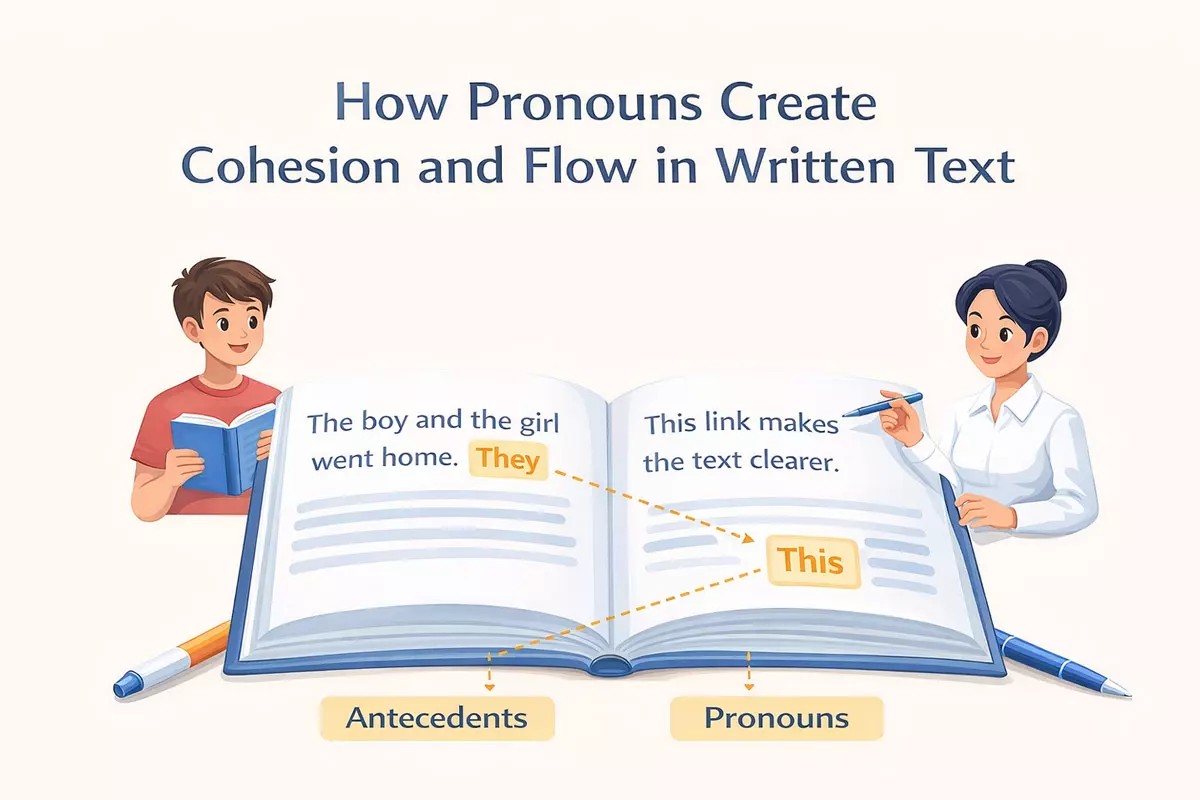
Pronouns act as linguistic bridges, linking information from previous sentences to new ideas and preventing awkward repetition. When a noun or concept has been introduced, using a pronoun to refer back to it helps maintain continuity and keeps the reader engaged without confusion or monotony. This subtle referencing allows writers to weave sentences together smoothly, guiding readers through the text with minimal friction.
Establishing Reference Points

Effective use of pronouns depends on clear antecedents—the words or phrases they stand in for. When a reader can easily identify what "she," "it," or "they" refers to, understanding flows naturally from one sentence to the next. If the connection is ambiguous, meaning and cohesion suffer, which can interrupt the reader’s comprehension.
- Maria finished her report. She emailed it to the team.
- The laptop was expensive. It stopped working after a week.
- Tom and Jenna went hiking. They enjoyed the view from the summit.
Types of Pronouns and Their Linking Roles
Different categories of pronouns serve various functions in maintaining coherence between sentences. Here’s a breakdown:
| Pronoun Type | Function in Text |
|---|---|
| Personal Pronouns (he, she, it, they) |
Refer back to people or things previously mentioned |
| Demonstrative Pronouns (this, that, these, those) |
Point to specific ideas or objects, often summarizing or highlighting |
| Relative Pronouns (who, which, that) |
Introduce clauses that provide more detail about a noun |
| Possessive Pronouns (his, her, their, its) |
Show ownership or association, connecting entities and their attributes |
Examples of Pronouns Creating Flow
- The car wouldn’t start. This frustrated everyone.
- He found an old photograph, which brought back memories.
- The children played in the park. Their laughter echoed across the field.
- We met the author, who signed our books.
- The solution was complex. It required further explanation.
- There were several options. Those seemed most promising.
- I love novels that surprise me. They are the most memorable.
- The museum displayed ancient artifacts. These fascinated visitors.
- She has a new job, which she enjoys a lot.
- The students completed the project. Their teamwork was impressive.
By using pronouns to refer back, summarize, or clarify, writers can make their ideas flow together seamlessly. This not only reduces repetition but also helps readers track relationships between concepts, making the text more readable and unified.
Managing reference across paragraphs
Effective use of pronouns is essential for guiding readers smoothly from one paragraph to the next. When writers carefully track who or what each pronoun refers to, they help maintain clarity and prevent confusion. This process is particularly important in longer texts, where readers may need reminders about the main subjects or ideas as they move through different sections.
How pronouns link ideas between paragraphs
Pronouns like he, she, they, this, and those can act as bridges, connecting information presented earlier with new developments. However, ambiguity can arise if the referent isn’t clear—especially after a paragraph break. To avoid this, writers often repeat a key noun before reintroducing a pronoun, or use demonstratives (such as these or that) to point specifically to previous statements.
Common strategies for clear reference
- Restating a noun before using a pronoun in a new paragraph
- Using demonstrative pronouns to refer to entire ideas or actions (e.g., This shows...)
- Varying pronouns to match shifts in focus (switching from he to they if the subject changes)
- Placing the pronoun close to its antecedent, especially after a break
- Introducing pronouns with clarifying phrases (e.g., These results, Such behavior)
- Avoiding ambiguous pronoun use when multiple subjects have been introduced
- Using repetition sparingly to reinforce key concepts without sounding redundant
- Employing parallel structure to keep reference predictable
- Checking for consistency in gender and number, especially across several paragraphs
- Reviewing transitions to ensure that every pronoun clearly points to its intended referent
Examples of pronoun reference across paragraphs
Consider these illustrative cases, where pronouns either support or undermine cohesion:
| Example | Effect |
|---|---|
| Maria finished the report. She sent it to her manager. | Clear reference: She refers to Maria; it refers to the report. |
| The committee discussed the proposal. They decided to revise it. | Unclear without context: They might refer to the committee or another group; it could be ambiguous if several proposals were mentioned. |
| The experiment yielded surprising results. These suggest a new direction for research. | Demonstrative pronoun These links directly back to results, aiding cohesion. |
| Several policies were introduced. This was controversial. | Vague: This could refer to any one policy, the act of introducing them, or something else. |
Tips for strengthening cohesion
Writers can enhance flow by reviewing each paragraph transition and asking: Is the pronoun’s antecedent unmistakable? If not, a brief noun phrase or a demonstrative can clarify the connection. Reading the text aloud or having someone else review it often reveals unclear references that disrupt the reader’s progress.
Balancing repetition and pronoun use
Effective writing often involves finding the right mix between repeating nouns and using pronouns. Overusing a noun can make text sound redundant, but relying too heavily on pronouns may confuse readers if it’s unclear what each pronoun refers to. Striking a balance is essential for clarity and flow.
Why both repetition and pronouns matter
Repeating a key noun occasionally helps reinforce meaning, especially when several entities are present or when returning to a previous topic after a long passage. Pronouns, on the other hand, help avoid awkward repetition and keep sentences concise. Good writers alternate between the two, depending on context and the reader’s need for clarity.
Common pitfalls to avoid
- Ambiguity: Using a pronoun before its noun has been introduced, leading to confusion.
- Over-repetition: Repeating the main noun in every sentence, which can become monotonous.
- Pronoun overload: Using several pronouns in succession without clear antecedents.
- Switching referents: Changing what a pronoun refers to mid-paragraph without making it clear.
Tips for mixing nouns and pronouns
- Use a noun at the start of a new section or after a long gap.
- Switch to pronouns once the noun is clearly established.
- Repeat the noun if another subject is introduced, to avoid confusion.
- Vary sentence structure to keep the text engaging.
- Read your writing aloud to spot unclear pronoun references.
- When in doubt, clarify with the noun.
- Use pronouns to connect ideas smoothly between sentences.
- Monitor paragraphs with multiple people or things; clarify as needed.
- Alternate between the noun and pronoun for emphasis and flow.
- Check for consistency, especially in longer texts.
Examples: Repetition vs. Pronoun Use
| Repetitive Noun Use | Balanced with Pronouns |
|---|---|
| Maria picked up Maria’s book because Maria wanted to read. | Maria picked up her book because she wanted to read. |
| The dog chased the cat. The dog barked at the cat. | The dog chased the cat and barked at it. |
| When the teacher entered the classroom, the teacher greeted the students. | When the teacher entered the classroom, she greeted the students. |
| After the rain stopped, the children went outside. The children played in the mud. | After the rain stopped, the children went outside and played in the mud. |
Key takeaways
- Alternate between nouns and pronouns to keep writing clear and engaging.
- Be mindful of your reader’s perspective—clarity should always come first.
- Review your work to spot both excessive repetition and unclear pronoun references.
Pronoun chains and reader guidance
When readers move through a text, they rely on careful use of pronouns to maintain clarity and coherence. Linking words like "he," "she," "it," "they," or "this" help identify which person or object is being discussed, reducing unnecessary repetition and streamlining the narrative. These connections, often referred to as pronoun chains, create clear reference paths so readers can easily follow the subject from one sentence to the next.
How pronoun chains work

A pronoun chain is established when a pronoun refers back to a noun or noun phrase mentioned earlier. As the passage progresses, each subsequent pronoun in the chain continues to point to the original referent, or occasionally shifts to a new one. This technique allows writers to avoid restating names or concepts, making writing less cumbersome and more engaging.
- Maria found her keys. She was relieved.
- The committee reached its decision. It was unanimous.
- The dog barked loudly. Then it ran outside.
- Our neighbors built a garden. They water it daily.
- The solution was complex. This surprised everyone.
- Jack and Jill climbed the hill. They were tired afterward.
- The book is fascinating. I can’t put it down.
- The students finished the project. They celebrated.
- The cake was delicious. Everyone wanted more of it.
- My phone was missing. I found it under the couch.
Guiding the reader with reference clarity
Effective use of pronouns helps readers track who or what is being discussed, but overuse or unclear references can lead to confusion. Writers need to ensure that each pronoun clearly points to a specific antecedent and that chains do not become tangled, especially in longer or more complex texts. Common pitfalls include ambiguous pronouns, such as using "it" when multiple possible antecedents exist, or shifting from one referent to another without clear signals. To keep readers oriented, introduce each new subject with a noun before switching to pronouns, and break up long chains with clarifying phrases if needed.
Comparison of clear and unclear pronoun reference
| Unclear Example | Clear Example |
|---|---|
| Jane gave Sara her book. | Jane gave her book to Sara. |
| The vase fell on the table and broke it. | The vase fell onto the table and broke the vase. |
| After the tour, they told the guide he was helpful. | After the tour, the visitors told the guide he was helpful. |
| When the dog chased the cat, it ran up a tree. | When the dog chased the cat, the cat ran up a tree. |
Tips for strong reference chains
- Introduce each main subject with a clear noun before using pronouns.
- Keep pronoun references close to their antecedents.
- Use specific nouns again if there is any risk of confusion.
- Vary pronoun forms to match number and gender with the original noun.
- Break up long stretches of pronouns with clarifying repetition if needed.
- Check each pronoun’s reference by reading the sentence aloud.
- Revise sentences where multiple possible antecedents exist.
By consciously building these reference chains and monitoring their clarity, writers can help readers move smoothly through the text without losing track of the narrative or argument. Thoughtful pronoun use is a subtle but powerful tool for creating logical flow and cohesion in writing.
Common cohesion problems caused by pronouns
When pronouns are used carelessly, they can disrupt the logical flow of a text and confuse the reader. These disruptions often occur when there is ambiguity about what a pronoun is referencing, or when the reader has to work too hard to connect ideas. Below, you'll find some of the most frequent pitfalls that writers encounter with pronouns and their impact on textual cohesion.
Ambiguous Reference
One of the most frequent issues is unclear pronoun reference. If a pronoun could refer to more than one noun previously mentioned, readers may struggle to understand the intended meaning. For example, in the sentence "When John met Dave, he was excited," it's not clear who "he" refers to.
Pronoun-Antecedent Distance
When too many words or sentences separate a pronoun from its antecedent, readers may forget what or whom the pronoun refers to. This weakens the connection between ideas and can force readers to backtrack.
Inconsistent Pronoun Use
Switching between different pronouns for the same referent, or shifting between singular and plural forms, can jar the reader. Consistency is key for maintaining a smooth narrative thread.
Unnecessary Pronouns
Overusing pronouns, especially when the referent is not clear or already obvious, can clutter writing. Sometimes, simply repeating the noun improves clarity and flow.
Pronoun Agreement Errors
Errors in agreement—such as using a plural pronoun for a singular noun—interrupt textual cohesion. These mistakes can distract readers and reduce the professionalism of the writing.
Common Problem Patterns
Here are several patterns that often cause confusion or disrupt the reading experience:
- Vague "it" or "this" with unclear referents
- Multiple nouns before a pronoun, creating ambiguity
- Switching between "he/she" and "they" for the same person
- Using "they" for a singular noun without clear context
- Overuse of "it" to refer to abstract ideas
- Long gaps between noun and pronoun
- Changing pronoun perspective (e.g., from "we" to "you")
- Using pronouns before introducing the noun
- Referencing entire previous sentences with "this" or "that" without clarification
- Misplaced pronouns causing modifier errors
- Introducing new pronouns without clear antecedents
- Inconsistent gendered pronouns
- Elliptical constructions where the subject is unclear
- Nonstandard or informal pronoun use in formal writing
- Shifting from third-person to first-person pronouns mid-paragraph
Examples of Ambiguous and Clear Pronoun Use
| Problematic Example | Improved Example |
|---|---|
| Sarah gave Anna her book. | Sarah gave her book to Anna. |
| The dog chased the cat, but it was too fast. | The dog chased the cat, but the cat was too fast. |
| Alex told Jordan that he would win. | Alex told Jordan, "You will win." |
| When the lamp fell on the table, it broke. | The lamp broke when it fell on the table. |
Careful attention to pronoun reference, agreement, and placement helps ensure that writing is easy to follow and that ideas are clearly connected. Recognizing and avoiding these common pitfalls can significantly improve the cohesion and flow of your text.
Editing techniques to improve flow
Refining how pronouns are used can make a piece of writing much smoother and more readable. When revising a draft, it’s important to look for opportunities to clarify references, eliminate ambiguity, and ensure that the text’s structure leads readers effortlessly from one idea to the next. Focusing on these aspects during the editing stage can significantly enhance overall cohesion.
Strategies for Revising Pronoun Use
- Identify unclear antecedents: Make sure each pronoun clearly refers to a specific noun. If there’s any doubt about what “it,” “they,” or “this” means, rewrite the sentence for clarity.
- Balance repetition and variety: Repeating a noun too often can sound awkward, but relying on pronouns without enough context may confuse the reader. Alternate between nouns and pronouns thoughtfully.
- Check for pronoun agreement: Ensure pronouns match their antecedents in number and gender. Mismatches can disrupt the reader’s understanding.
- Streamline sentence structure: If several pronouns appear in a single sentence, consider splitting it or rephrasing to avoid confusion.
- Maintain consistent point of view: Jumping between “he,” “she,” “they,” or “you” can jar readers. Choose a perspective and stick with it unless there’s a clear reason to change.
- Replace vague pronouns: Words like “this,” “that,” or “it” can be ambiguous. Add a noun after these pronouns (“this idea,” “that process”) when needed.
- Eliminate unnecessary pronouns: Sometimes, sentences contain extra pronouns that add nothing. Remove them for a cleaner flow.
- Vary pronoun placement: Starting every sentence with a pronoun can sound repetitive. Rearranging clauses or using different structures can help.
- Read aloud: Listening to how pronouns connect ideas can reveal awkwardness or confusion that isn’t obvious when reading silently.
- Use parallel structure: When listing multiple actions or ideas, consistent pronoun use helps maintain rhythm and clarity.
Common Pronoun Pitfalls and Fixes
| Issue | Improved Example |
|---|---|
| Unclear reference (“He told him he was late.”) |
“Alex told Brian he was late.” (Now it’s clear who was late.) |
| Pronoun disagreement (“Each student must bring their pencil.”) |
“All students must bring their pencils.” or “Each student must bring his or her pencil.” |
| Overuse of pronouns (“She picked up her bag. She opened it. She took out her keys.”) |
“She picked up her bag, opened it, and took out her keys.” |
| Vague demonstratives (“This is important.”) |
“This step is important.” |
When reviewing a text, paying attention to these details ensures that pronouns serve their purpose—making connections clear, reducing unnecessary repetition, and helping readers follow the thread of the argument or narrative. Careful editing for pronoun use can make the difference between choppy writing and a polished, cohesive whole.
Practice: revise a paragraph for better cohesion
Cohesion in writing is often achieved by using pronouns to connect sentences and clarify relationships between ideas. Sometimes, paragraphs lack flow because they repeat the same nouns or fail to use referential words, making the text sound choppy or disconnected. This exercise focuses on improving unity by replacing repetitive nouns with appropriate pronouns, ensuring that each sentence relates clearly to the previous one.
Original Paragraph
Maria wanted to bake a cake. Maria gathered flour, sugar, and eggs. Maria realized that Maria was out of butter. Maria went to the store to buy butter. Maria returned home to finish the cake.
Task: Improve the Flow
- Identify the repeated nouns that could be replaced with pronouns.
- Revise the paragraph so that sentences are linked smoothly using pronouns.
- Ensure each pronoun clearly refers to the correct noun (avoiding ambiguity).
Common Pronouns for Cohesion
- he, she, they
- him, her, them
- his, her, their
- it, its, this, that
- which, who, whose
- these, those
- one, ones
- each, both
- such
- another
- some, any
- none
- everyone, someone
- himself, herself, themselves
- where, when
Before and After Comparison
| Original | Revised |
|---|---|
| Maria wanted to bake a cake. Maria gathered flour, sugar, and eggs. Maria realized that Maria was out of butter. Maria went to the store to buy butter. Maria returned home to finish the cake. | Maria wanted to bake a cake. She gathered flour, sugar, and eggs, but realized she was out of butter. So, she went to the store to buy some. Then, she returned home to finish the cake. |
Try It Yourself
Rewrite the following paragraph so that it uses pronouns to create better flow:
The dog chased the ball. The dog caught the ball. The dog dropped the ball and waited for the owner to throw the ball again.
Show answers
- The dog chased the ball. It caught it, then dropped it and waited for the owner to throw it again.
- The dog chased the ball, caught it, dropped it, and waited for the owner to throw it again.
Checklist for Revising Cohesion
- Replace repeated nouns with pronouns where appropriate.
- Check that each pronoun’s reference is clear.
- Vary sentence structure to avoid monotony.
- Use linking words (such as “then,” “so,” “because,” “after that”) for smoother transitions.
- Read the paragraph aloud to ensure it flows naturally.
By practicing these steps, you can make your writing more connected and reader-friendly, using pronouns to weave sentences into a unified whole.