Adding Time Words to Sentences: When, Today, Tomorrow

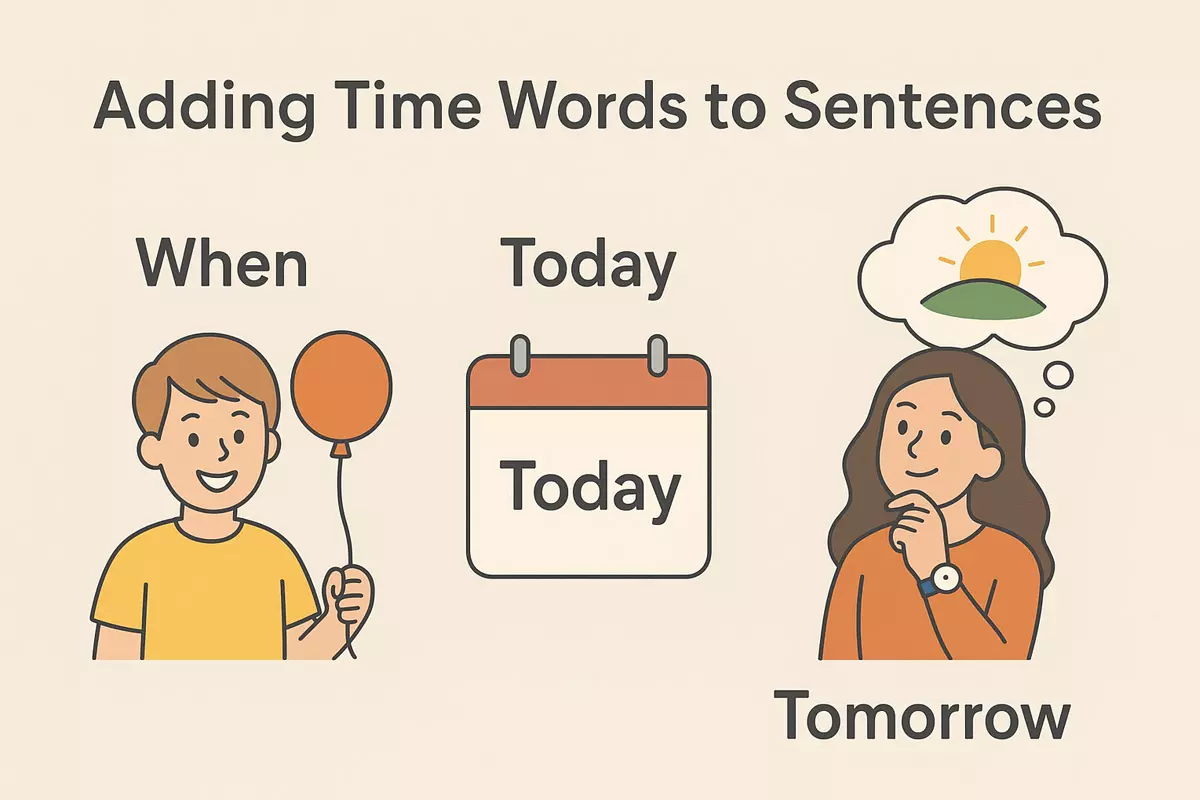 Here we common time words in English, explains where to place them in sentences, and presents typical time expressions. It also includes practice exercises for adding time phrases to improve sentence clarity.
Learning to use time-related words such as yesterday, soon, or tonight can make your sentences clearer and more engaging by providing important context. This article offers straightforward strategies for expressing when events occur, allowing you to communicate your ideas more effectively and helping your listeners or readers understand the timing of your actions or plans. By mastering these simple techniques, you can enhance your writing and speaking, making your messages both precise and easy to follow.
Common Time Words in English
Understanding how to talk about time is essential for clear communication. English offers a wide range of words and phrases to indicate when something happens, helping us describe past, present, and future events with more precision. These expressions are frequently used in everyday conversation, instructions, and storytelling.
Frequent Time Expressions
Some time words refer to specific moments, while others express general periods or frequency. Here are some of the most widely used:
- yesterday
- today
- tomorrow
- now
- soon
- later
- last week
- next year
- in the morning
- at night
- this afternoon
- every day
- often
- sometimes
- never
- already
- still
- just
- recently
- yet
Types of Time Words
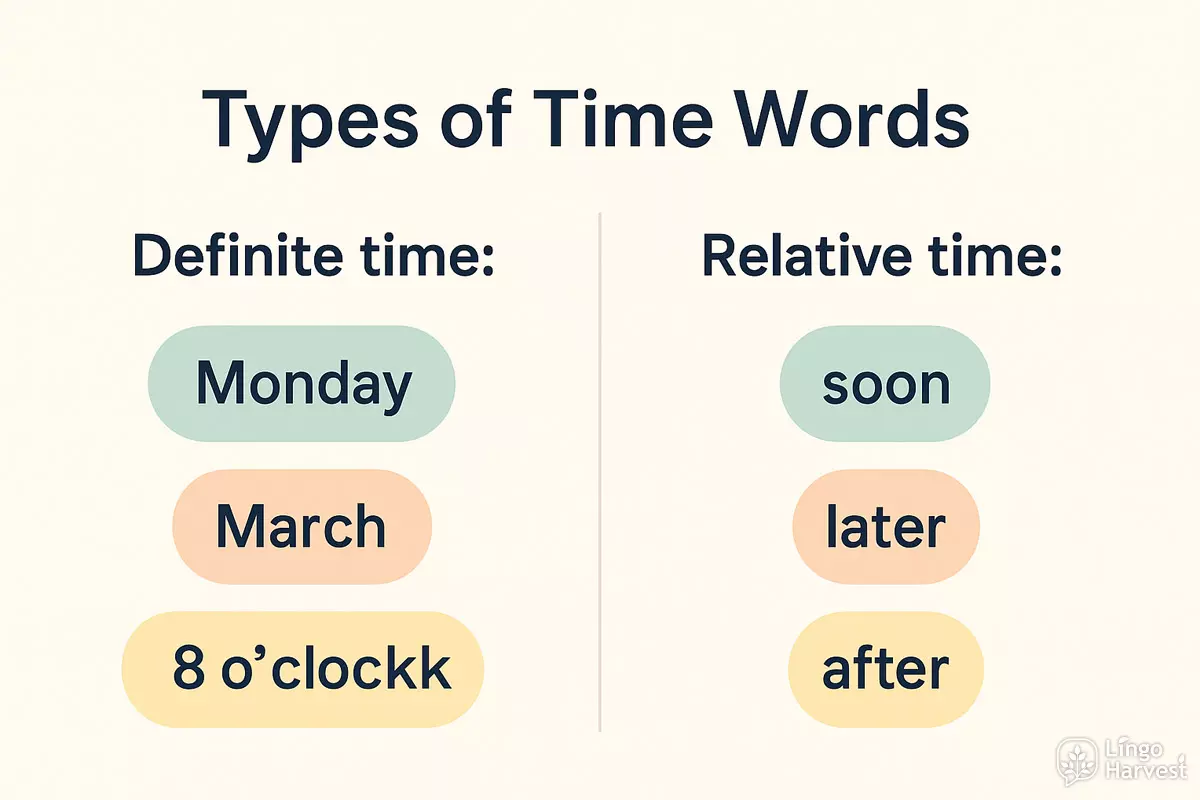
Time-related vocabulary can be grouped based on how they are used:
- Definite time: "Monday," "March," "8 o’clock"
- Relative time: "soon," "later," "before," "after"
- Frequency: "always," "often," "rarely," "never"
Time Words by Tense
Some expressions are closely tied to certain verb tenses. Here is a comparison of typical words for each time frame:
| Past | Present | Future |
|---|---|---|
| yesterday | now | tomorrow |
| last night | today | next week |
| ago | currently | soon |
| in 2005 | at the moment | in two days |
| earlier | still | later |
How Time Words Fit in Sentences
Time expressions can appear at the start, middle, or end of a sentence. For example: “Tomorrow, I will study.” or “I will study tomorrow.” The position often depends on emphasis and style, but the meaning remains clear.
Where to Place Time Words
Understanding the correct position of time expressions like "when," "today," or "tomorrow" helps your sentences sound natural and clear. In English, these words can appear at different points within a sentence, but their placement can subtly affect the emphasis or clarity of your message.
Common Positions for Time Expressions
Most often, time words are placed at the beginning or end of a sentence. Placing them at the start often highlights the time, while putting them at the end usually sounds more neutral or conversational. Here are some typical patterns:
- At the beginning: Tomorrow, I will visit my friend.
- At the end: I will visit my friend tomorrow.
- After the subject (less common): I tomorrow will visit my friend. ❌ (Not natural in most cases)
Examples of Time Words in Sentences
The following examples show where these expressions usually fit best:
- We will meet today.
- When are you leaving?
- I finished my homework yesterday.
- Next week, the exam will take place.
- She called this morning.
- They are traveling on Friday.
- He will return in an hour.
- Last month, I started a new job.
- The meeting starts at 3 PM.
- We will see each other soon.
- After lunch, we can go for a walk.
- I will call you later.
Front or End? What to Consider
Choosing between the beginning or end of a sentence often depends on what you want to emphasize. Starting with a time word draws attention to when something happens, while placing it at the end keeps the focus on the action. For short and common time phrases, the end position is most frequent in everyday speech.
Comparing Placement: Examples
| Time Word at the Start | Time Word at the End |
|---|---|
| Today, I will study English. | I will study English today. |
| Tomorrow, we have a meeting. | We have a meeting tomorrow. |
| Yesterday, she called me. | She called me yesterday. |
| Next week, classes begin. | Classes begin next week. |
| After dinner, we went for a walk. | We went for a walk after dinner. |
Tips for Natural Usage
- For questions, time words often come at the end: Are you leaving tomorrow?
- For emphasis, start with the time phrase: This evening, we celebrate.
- Avoid putting time words between the subject and verb.
- In longer sentences, place time phrases where they are easiest to understand, usually at the start or end.
By paying attention to these patterns, your use of time expressions will feel more fluent and natural in English conversation and writing.
At the Beginning or End of a Sentence
Placing time words like "when," "today," or "tomorrow" in different parts of a sentence can subtly shift the focus or style of your message. In English, these temporal expressions are flexible; you can usually put them at the start or finish without changing the core meaning.
However, the choice can affect emphasis or clarity. For example, starting with a time word often highlights when something happens: Tomorrow, I will visit the museum. Ending with the time element can make it less prominent: I will visit the museum tomorrow. This flexibility allows you to vary your sentence structure for smoother writing or speaking.
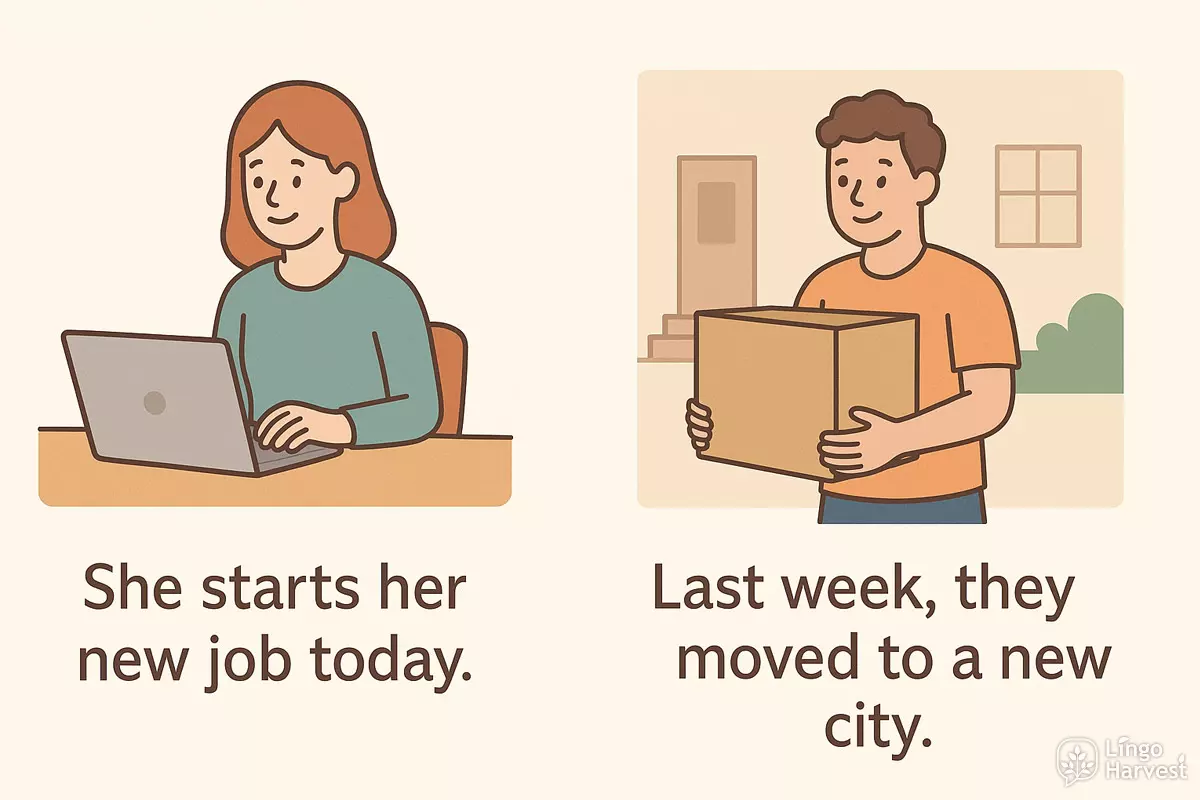
Notice how these choices work with common time words:
- Yesterday, we finished the project.
- We finished the project yesterday.
- Today, she starts her new job.
- She starts her new job today.
- Last week, they moved to a new city.
- They moved to a new city last week.
- In the morning, I go for a run.
- I go for a run in the morning.
- Next year, we plan to travel abroad.
- We plan to travel abroad next year.
- On Monday, the meeting will begin at 9.
- The meeting will begin at 9 on Monday.
- Every evening, she reads a book.
- She reads a book every evening.
- After lunch, he takes a walk.
- He takes a walk after lunch.
When to Choose the Beginning or the End?
Starting with a time phrase is common in storytelling, instructions, or when you want to set the scene. Ending with it is natural in conversation or when the time is less important than the action. Both positions are grammatically correct, so you can choose based on what you want to emphasize.
Quick Comparison
| Time Word First | Time Word Last |
|---|---|
| Tomorrow, I have an exam. | I have an exam tomorrow. |
| Last night, we watched a movie. | We watched a movie last night. |
| Every morning, he drinks coffee. | He drinks coffee every morning. |
| Next week, the course begins. | The course begins next week. |
| In April, flowers bloom. | Flowers bloom in April. |
Varying the placement of temporal expressions keeps your writing lively and clear. Try both options to see which sounds best for your message or context.
Common Expressions with Time
When talking about daily activities, plans, or routines, English speakers often use set phrases that include time references. These help to clarify when something happens, making communication clearer and more precise. Below you'll find useful time-related phrases and typical ways to incorporate them into sentences.
Frequently Used Time Words and Phrases
- yesterday
- the day before yesterday
- today
- tonight
- tomorrow
- the day after tomorrow
- now
- soon
- later
- this morning
- this afternoon
- this evening
- last night
- next week
- last week
- in an hour
- at the moment
- by noon
- in the past
- in the future
Examples of Time Phrases in Sentences
To see how these expressions work in context, here are some sample sentences:
- I will call you tomorrow.
- She finished her homework last night.
- We are meeting this afternoon.
- He left an hour ago.
- Are you free now?
- They will arrive soon.
Comparing Time Words: Past, Present, and Future
| Past | Present | Future |
|---|---|---|
| yesterday | today | tomorrow |
| last night | now | soon |
| last week | at the moment | next week |
| the day before yesterday | this morning | the day after tomorrow |
Understanding how to use these time expressions makes it easier to describe events and plans with accuracy. Practice adding them to your own sentences to improve clarity and fluency.
Practice: Add Time Phrases to Sentences
Understanding how to use time words like when, today, and tomorrow helps make your sentences clearer and more precise. Let's try adding these expressions to simple statements to show exactly when something happens.
Exercise 1: Complete the Sentences
Read each sentence. Decide which time phrase (when, today, tomorrow) makes the sentence more specific. Add the phrase in the correct place.
- I will call you ________.
- She is going to the park ________.
- We eat dinner together ________ we get home.
- He will finish his homework ________.
- They visit their grandmother ________.
Show answers
- I will call you tomorrow.
- She is going to the park today.
- We eat dinner together when we get home.
- He will finish his homework today.
- They visit their grandmother when they have time.
Common Time Words and How to Use Them
Here are some typical time phrases and how they fit into sentences. Notice their position and effect on meaning.
- Today: I am studying English today.
- Tomorrow: We will play football tomorrow.
- When: Call me when you arrive.
- Yesterday: She finished her book yesterday.
- Now: Please start your work now.
- Later: I will help you later.
- Soon: The movie starts soon.
- This morning: He went jogging this morning.
- Every day: They walk their dog every day.
- At night: The stars are bright at night.
- After school: We play basketball after school.
- Before dinner: She does her homework before dinner.
- Next week: I have a test next week.
- In the evening: We watch TV in the evening.
- On Monday: My class starts on Monday.
Exercise 2: Make Your Own Sentences
Choose a time phrase from the list above and write your own sentence. Try to use a different phrase for each new sentence. For example:
- Tomorrow: I will visit my friend tomorrow.
- After school: I read books after school.
Show answers
- Answers may vary. Sample sentences:
- I am going shopping today.
- She will call you later.
- We eat dinner at night.
- He studies every day.
- They will travel next week.
Quick Reference: Time Phrases and Placement
| Time Phrase | Example Sentence |
|---|---|
| Today | I have a meeting today. |
| Tomorrow | He will travel tomorrow. |
| When | Call me when you arrive. |
| After school | She plays soccer after school. |
| Every day | They study every day. |
| At night | We read stories at night. |
Using a variety of time expressions helps your sentences tell a clearer story. Practice adding these phrases until it feels natural!