Using Quantifiers with Time and Money Expressions

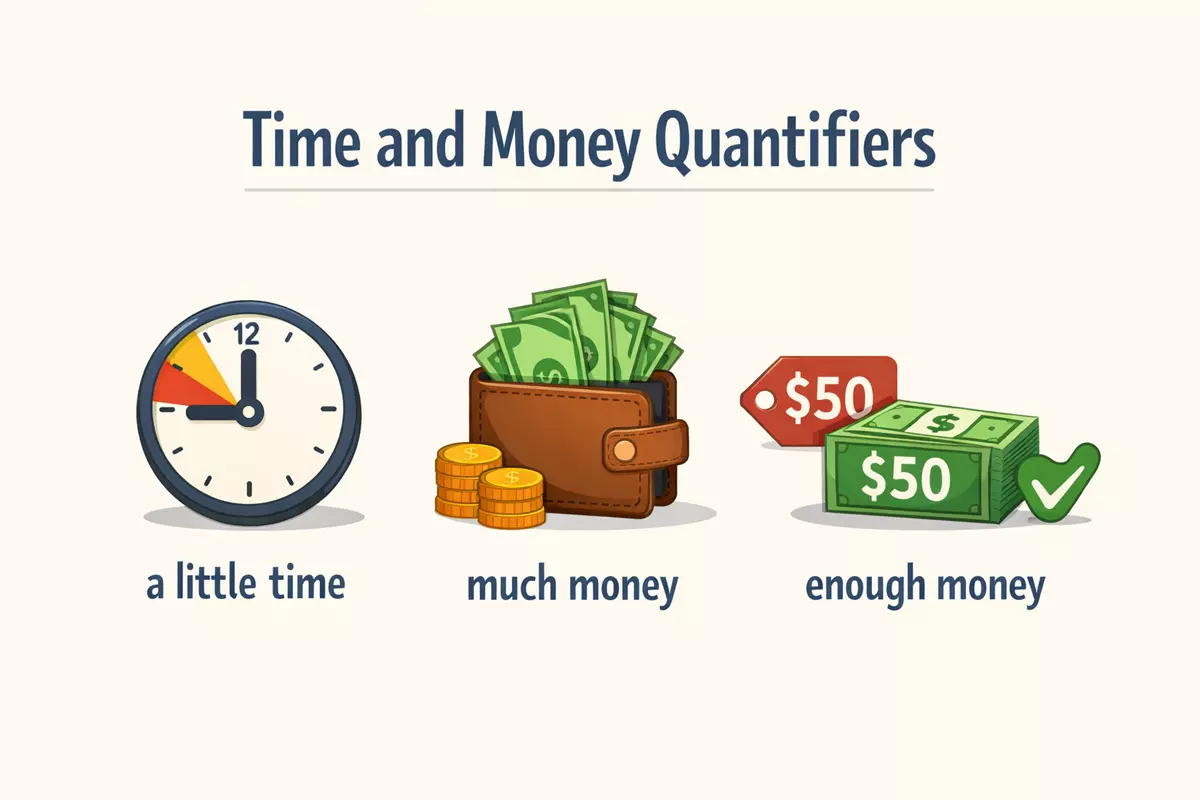 Here we when time and money are countable or uncountable, which quantifiers to use with each, how to distinguish between duration and frequency, common learner mistakes, and includes real-life examples and practice exercises.
- How time and money behave as countable or uncountable
- Common quantifiers used with time expressions
- Quantifiers used with prices and amounts of money
- Difference between duration and frequency
- Typical sentence patterns in everyday usage
- Common learner mistakes with time and money
- Examples from real-life situations
- Practice: choosing the correct quantifier
Learning to pair quantity words with time and money terms can greatly improve your English fluency and accuracy. For example, using phrases like a few hours, several days, a little cash, or many expenses helps you communicate more clearly and naturally. Understanding which expressions fit best with time periods or financial amounts not only makes your speech sound more native but also reduces misunderstandings. This article explains how to select the most appropriate quantity words for hours, days, cash, and expenses in everyday conversations.
How time and money behave as countable or uncountable
Understanding whether to treat time and money as countable or uncountable can be confusing, since both can appear in different forms depending on context. In English, both are usually considered uncountable nouns when talking about the general concept. This means words like much or little are used, not many or few. However, when referring to specific units (like hours, minutes, dollars, or coins), they become countable, and you can use quantifiers like many or a few.
Uncountable Usage: General Amounts
When talking about time or money in a broad or abstract sense, treat them as uncountable. For example, you might say, "Do you have much time?" or "There isn't much money left." In these cases, you can't count "time" or "money" directly, so you use quantifiers suited for uncountable nouns.
- How much time do we need?
- She doesn't have much money.
- We spent a little time at the park.
- There's not enough money to buy that.
Countable Usage: Specific Units

Time and money become countable when you refer to specific units. Here, you can count hours, minutes, days, dollars, coins, or bills. This allows you to use quantifiers such as many or a few and numbers directly.
- He worked for three hours.
- We have a few minutes left.
- She gave me five dollars.
- There are several coins in the jar.
Comparing Quantifiers with Time and Money
Choosing the right quantifier depends on whether you’re talking about the general concept or specific units. Here’s a comparison of common quantifiers with typical time and money expressions:
| Uncountable Usage | Countable Usage |
|---|---|
| much time, little time, enough time | many hours, a few minutes, several days |
| much money, little money, enough money | many dollars, a few coins, several bills |
| not much time left | a few hours remaining |
| not enough money | several coins in the wallet |
Common Mistakes and Tips
- Don’t use many or few with uncountable forms: ❌ "many time" or "few money" are incorrect.
- Use much or little for uncountable references: ✅ "much time," "little money."
- When referring to units, always use plural: "hours," "dollars," "minutes," "coins."
- Remember, context decides the form—think about whether you’re talking about the concept or individual pieces.
In summary, time and money shift between countable and uncountable depending on whether you mean the overall idea or specific measurable units. Knowing this helps you choose the right quantifiers and avoid common mistakes in everyday English.
Common quantifiers used with time expressions
When talking about durations, frequencies, or amounts of time, English speakers use a range of quantifiers to give more precise information. These quantifiers help us express whether we mean a lot, a little, or a specific amount of time. Some are used for general estimates, while others are for exact measurements.
General quantifiers for time
Certain words often appear with time-related phrases to indicate an approximate or relative amount. Here are some of the most typical options:
- Much (e.g., much time, much longer)
- Little (e.g., little time, a little while)
- Some (e.g., some minutes, some time ago)
- Any (e.g., any time, any minute now)
- No (e.g., no time, no moment to lose)
- Enough (e.g., enough time, enough hours)
- Several (e.g., several days, several hours)
- A few (e.g., a few minutes, a few seconds)
- A lot of (e.g., a lot of time, a lot of hours)
- Plenty of (e.g., plenty of time)
- Most (e.g., most of the day, most years)
- All (e.g., all day, all night, all week)
- Each (e.g., each hour, each day)
- Every (e.g., every minute, every morning)
- One (e.g., one moment, one hour)
Exercises: Choose the Correct Time Quantifier
- I don’t have _____ time to explain everything now.
- We waited for _____ minutes before the bus arrived.
- She spends _____ time studying in the evening.
- There is _____ time left, so we need to hurry.
- He checks his phone _____ hour.
- I need _____ more minutes to finish this task.
- They worked on the project _____ day last week.
- Do you have _____ time to talk later?
- We had _____ of time to prepare for the exam.
- The baby wakes up _____ night.
Show answers
- much
- a few
- a lot of
- little
- each
- a few
- every
- any
- plenty of
- every
Comparing quantifiers: frequency vs. duration
Some quantifiers are better suited for talking about how often something happens, while others are used for the length of time. The table below compares some common choices:
| Quantifiers for Frequency | Quantifiers for Duration |
|---|---|
| Every (day, week, month) | All (day, night, year) |
| Once (a week, per month) | A few (minutes, hours) |
| Twice (a year, per day) | Several (days, months) |
| Many times | Much (time, longer) |
| Occasionally | Little (time, while) |
| Rarely | Some (time, period) |
Tips for using quantifiers with time
- Use much and little with uncountable time nouns (e.g., time, patience).
- Many and few go with countable time periods (e.g., days, weeks).
- For emphasis, try a lot of or plenty of to show abundance.
- With regular intervals, every and each are common choices.
Knowing how different quantifiers work with time expressions helps you communicate time-related information more clearly and naturally.
Quantifiers used with prices and amounts of money
When talking about money, certain quantifiers are especially common and useful for expressing amounts, ranges, and generalizations. These words help clarify whether you mean a small or large quantity, an exact figure, or an estimate. Choosing the right quantifier can make your meaning much clearer, whether you’re discussing prices, budgets, or spending habits.
Common quantifiers for money amounts
People often use quantifiers to talk about how much something costs or how much money they have, need, or spend. Here are some typical words and phrases that work well in these contexts:
- a lot of: She spent a lot of money on her vacation.
- some: He has some cash in his wallet.
- much: There isn’t much money left in the account.
- little: We have little money to spend this month.
- a little: I have a little money for coffee.
- enough: Do you have enough money for the tickets?
- plenty of: There’s plenty of money for the trip.
- no: They have no money to spare.
- most: Most of my salary goes to rent.
- all: She spent all her money on books.
- several (for multiple payments or bills): Several payments are due this week.
- a couple of: I have a couple of dollars left.
- hundreds/thousands/millions of: They raised thousands of dollars for charity.
- only: I have only five dollars.
- just: It costs just two euros.
- about: The shoes cost about fifty pounds.
- almost: We spent almost all our cash.
- more/less: I want to spend less money this year.
- any: Do you have any change?
- each: The tickets are ten dollars each.
Quantifiers in price comparisons
When comparing prices or talking about changes in amounts, certain quantifiers help you be more specific or general:
- more than: This phone costs more than 800 dollars.
- less than: The meal was less than 20 euros.
- at least: You need at least 100 dollars to enter.
- up to: You can spend up to 500 yen per person.
- around: The gift costs around 30 pounds.
- exactly: I have exactly 10 dollars.
- approximately: The repairs cost approximately 200 euros.
Examples of quantifiers with money
| Quantifier | Example Sentence |
|---|---|
| a lot of | They spent a lot of money on the wedding. |
| little | We have little money left. |
| more than | The laptop costs more than $1000. |
| about | The concert ticket is about 25 euros. |
| no | He has no cash with him. |
| enough | Do we have enough money for dessert? |
| hundreds of | They donated hundreds of dollars. |
| just | I have just a few coins. |
These quantifiers help you communicate amounts of money more precisely and naturally in everyday conversation. Using them well can make financial discussions clearer and more accurate, whether you’re sharing exact prices or giving rough estimates.
Difference between duration and frequency
When using quantifiers with time and money, it’s important to distinguish between how long something lasts and how often it occurs. These two concepts—duration and frequency—help us describe our experiences and habits more precisely. Understanding the distinction allows you to choose the right quantifiers and time expressions for each situation.
What is Duration?
Duration refers to the amount of time an activity continues. It answers the question, "How long?" For example, if you study for three hours or work all day, you are talking about the length of time spent on an activity. Duration is usually expressed with quantifiers like for (for two weeks), all (all night), or throughout (throughout the summer).
- for an hour → We talked for an hour.
- all week → I was busy all week.
- the entire month → She worked from home the entire month.
- throughout the evening → He felt tired throughout the evening.
- for several minutes → The phone rang for several minutes.
- the whole day → It rained the whole day.
- for two decades → They lived abroad for two decades.
- for a short time → He stayed there for a short time.
- for a few seconds → The screen froze for a few seconds.
- for much of the year → It is warm here for much of the year.
What is Frequency?
Frequency focuses on how often an event happens within a period. It answers "How many times?" or "How frequently?" For instance, if you travel twice a year or eat out every weekend, you are describing the recurrence of an action. Quantifiers for frequency include every (every Monday), once (once a month), several times (several times a year), and rarely.
- every day → I exercise every day.
- once a week → We meet once a week.
- three times a month → She visits her parents three times a month.
- twice daily → He checks his email twice daily.
- rarely → I rarely eat fast food.
- often → They often travel for work.
- from time to time → We talk from time to time.
- hardly ever → He hardly ever watches TV.
- frequently → This error occurs frequently.
- occasionally → I occasionally work late.
- every other day → She runs every other day.
- sometimes → I sometimes forget my keys.
Comparing Duration and Frequency
It’s easy to confuse these two, especially when similar quantifiers are used. Here’s a side-by-side comparison to clarify their use in sentences:
| Duration Example | Frequency Example |
|---|---|
| She worked for six hours. | She works six times a week. |
| He stayed all night. | He stays overnight every Friday. |
| They waited for a few minutes. | They wait a few times each month. |
| I slept throughout the afternoon. | I nap every afternoon. |
Choosing the right quantifier depends on whether you’re describing the length of time (duration) or the number of times something happens (frequency). This distinction is essential for clear, accurate communication, especially when talking about schedules, routines, or spending habits.
Typical sentence patterns in everyday usage
When talking about time and money, English speakers commonly use quantifiers to express amounts, frequency, or distribution. These expressions help clarify whether we are discussing a little, a lot, or a specific quantity of time or money. Understanding how these patterns work can make conversations more natural and precise.
Common ways to use quantifiers with time and money

- There isn’t much time left before the meeting.
- She spends a lot of money on books.
- Do you have any change for the bus?
- He saves a little money each month.
- We wasted several hours in traffic.
- How much time do we need for this project?
- I don’t have enough money to buy lunch.
- She has plenty of time to finish her work.
- They earn a good deal of money every year.
- Is there any time left for questions?
- He lost all his money at the casino.
- Only a few minutes remain before the deadline.
- They spent most of their money on rent.
- Do you have some time to talk?
- She borrowed a small amount of money from her friend.
- I need a couple of hours to finish this.
Typical sentence structures
Patterns often follow a simple subject + verb + quantifier + time/money noun structure. Here are some typical forms you’ll encounter:
- Subject + verb + quantifier + time/money (e.g., "I have little time.")
- Subject + verb + quantifier + of + time/money (e.g., "He spent a lot of money.")
- Is/Are there + quantifier + time/money? (e.g., "Is there any money left?")
- Subject + verb + enough + time/money (e.g., "She doesn’t have enough time.")
- Subject + verb + too much/too little + time/money (e.g., "We spent too much money.")
Comparing quantifier usage
| Quantifier | Example with Time | Example with Money |
|---|---|---|
| Much | We don’t have much time. | He doesn’t have much money. |
| Many | Many hours were wasted. | Many dollars were spent. |
| Some | She needs some time. | I borrowed some money. |
| Enough | Do we have enough time? | Do you have enough money? |
| Little/A little | There’s a little time left. | He saved a little money. |
| All | All the time was wasted. | I spent all my money. |
Mastering these sentence patterns allows for more natural and clear communication, especially when discussing schedules, deadlines, budgets, or purchases. Try using a variety of quantifiers to express different amounts and make your speech or writing more precise.
Common learner mistakes with time and money
When using quantifiers with time and money, learners often make predictable errors. Mixing up countable and uncountable forms, confusing prepositions, or using the wrong quantifier for the context are typical issues. These mistakes can make sentences sound unnatural or even change the intended meaning.
Mixing quantifiers: much, many, and a lot of
Choosing the right quantifier is essential. Much is used with uncountable nouns like "money" or "time," while many matches countable nouns. However, "money" and "time" are both uncountable, so "many money" and "many time" are incorrect. "A lot of" works for both uncountable and countable nouns, but it’s less formal.
- ❌ How many money do you have?
- ✅ How much money do you have?
- ❌ She doesn’t have many time.
- ✅ She doesn’t have much time.
- ✅ We spent a lot of money.
Confusing expressions for quantities
Some expressions are only correct with either time or money, not both. For example, "a few" is used with countable nouns, but "money" and "time" are not countable in general usage.
- ❌ I have a few money.
- ✅ I have a little money.
- ❌ They spent a few time.
- ✅ They spent a little time.
Incorrect use of numbers and quantifiers
People sometimes combine numbers and quantifiers incorrectly, or use quantifiers where numbers are better, especially when talking about specific amounts.
- ❌ He waited much hours.
- ✅ He waited many hours.
- ❌ I have much 50 dollars.
- ✅ I have 50 dollars.
Preposition mix-ups with time and money
Prepositions can easily be confused in these expressions, especially when translating from another language. It’s important to use the right ones to convey the intended meaning.
- ❌ I spent in two hours.
- ✅ I spent two hours.
- ❌ She paid with 20 dollars.
- ✅ She paid 20 dollars.
Summary: Common incorrect and correct forms
| Incorrect Form | Correct Form |
|---|---|
| How many money do you have? | How much money do you have? |
| I have a few money. | I have a little money. |
| He waited much hours. | He waited many hours. |
| They spent a few time. | They spent a little time. |
| She doesn’t have many time. | She doesn’t have much time. |
| I have much 50 dollars. | I have 50 dollars. |
| I spent in two hours. | I spent two hours. |
| She paid with 20 dollars. | She paid 20 dollars. |
Awareness of these typical pitfalls helps learners use quantifiers with time and money more naturally and accurately in English.
Examples from real-life situations
Understanding how quantifiers work with expressions of time and money can make everyday communication clearer and more accurate. People often need to talk about how much time they have, how long something takes, or how much money is available or spent. Below are practical scenarios and sample sentences that show how these quantifiers are used in various contexts.
Common ways to express amounts of time
- Much time: “I don’t have much time before my next meeting.”
- A little time: “Let’s grab coffee if you have a little time.”
- Plenty of time: “There’s plenty of time to finish the project.”
- Some time: “Can we talk for some time after lunch?”
- No time: “Sorry, I have no time to chat right now.”
- Enough time: “Do we have enough time to catch the train?”
- Not enough time: “There’s not enough time to do everything today.”
- Lots of time: “We’ve got lots of time before the movie starts.”
- Too much time: “He spent too much time on social media.”
- Very little time: “She finished her homework in very little time.”
Practical phrases for money amounts
- Much money: “We don’t have much money left for the trip.”
- A lot of money: “She earned a lot of money last year.”
- Some money: “I saved some money for emergencies.”
- Little money: “They had little money but were very happy.”
- No money: “I have no money in my wallet.”
- Enough money: “Do you have enough money to pay the bill?”
- Not enough money: “There’s not enough money to buy both gifts.”
- Too much money: “He spent too much money on gadgets.”
- Plenty of money: “She has plenty of money for the vacation.”
- Very little money: “Students often have very little money to spare.”
Comparing quantifiers with time and money
| Expression | Example Sentence |
|---|---|
| Much | “Do you have much time/money left?” |
| Little | “We have little time/money for mistakes.” |
| Enough | “Is there enough time/money for dessert?” |
| Too much | “He wasted too much time/money on that.” |
| Plenty of | “There’s plenty of time/money for everyone.” |
Quick tips for daily use
- Use much and little mostly in negative sentences and questions: “Do you have much time?”
- Enough signals sufficiency: “We have enough money.”
- Too much warns of excess: “Too much time was wasted.”
- Plenty of and a lot of both show abundance, but plenty of often sounds more positive.
By noticing these patterns in everyday conversations, you can choose the right quantifier for both time and money, making your communication more precise and natural.
Practice: choosing the correct quantifier
Understanding which quantifier fits best with time and money expressions can be challenging. Let’s apply what you’ve learned by working through some guided exercises. Read each sentence carefully and select the most appropriate quantifier for the blank. Consider whether the expression is countable or uncountable, and whether you are emphasizing a large or small amount.
Choose the right quantifier
Fill in each blank with one of these quantifiers: much, many, a lot of, few, little, some, any, no.
- I don’t have ________ time to finish this project tonight.
- There are ________ coins in my wallet, but not enough for a coffee.
- We spent ________ money during our trip to Paris.
- Do you have ________ minutes to talk?
- She has ________ patience when waiting in long lines.
- There isn’t ________ cash left in the register.
- He has ________ appointments scheduled for next week.
- How ________ hours did you work last month?
- They have ________ savings for emergencies.
- We have ________ bills to pay this month.
Show answers
- much
- few
- a lot of
- any
- little
- no
- many
- many
- some
- a lot of
Common quantifiers with time and money: overview
Here's a summary of which quantifiers typically go with singular (uncountable) or plural (countable) nouns relating to time and money.
| Quantifier | Used With | Example |
|---|---|---|
| much | Uncountable | much time, much money |
| many | Countable (plural) | many hours, many coins |
| a lot of | Both | a lot of cash, a lot of bills |
| few/little | few = countable; little = uncountable | few minutes, little time |
| some/any | Both | some time, any money |
| no | Both | no change, no hours |
Try it yourself: create your own
Now, write three sentences about your own schedule or finances using at least three different quantifiers from the list above. Think about whether you’re talking about a large or small amount, and if the noun is countable or not.
Show answers
- Examples: "I have little free time during the week." / "There are many bills to pay this month." / "She doesn’t have much cash on hand."
Practicing with different quantifiers helps you use English more naturally when talking about time and money. Review these patterns and try to notice them in everyday conversations.