Past Perfect Verbs: Sequence of Actions in the Past

 This article explains the past perfect tense, how to form it, and when to use it for showing event sequences. It contrasts past perfect with past simple, covers time expressions, common mistakes, narrative uses, and includes practice exercises.
Understanding how to describe events that occurred before other moments in history is essential for clear communication. By mastering verb forms that indicate a completed action prior to another, such as the past perfect tense, we can tell stories and explain sequences more precisely. This skill allows us to clarify the order of events, avoid confusion, and provide a more detailed and accurate account of past experiences, whether in writing or conversation. Developing this ability enhances both storytelling and comprehension in English.
What the past perfect tense is
The past perfect tense is a verb form used to show that one action in the past happened before another action in the past. It is especially helpful for clarifying the order of events, so your meaning is clear even when the timeline isn’t obvious from context. This tense is formed by combining “had” with the past participle of the main verb (for example: “had eaten,” “had finished,” “had gone”).
How the past perfect tense works
Imagine you are telling a story about yesterday and want to make it clear which thing happened first. The past perfect lets you highlight that sequence. Instead of just saying two things happened in the past, you can specify which one was completed before the other began.
- “She had left before the party started.” (leaving happened first)
- “We had already eaten when he arrived.” (eating happened first)
- “By the time I called, they had gone home.” (going home happened first)
- “He had finished his homework before dinner.” (finishing homework happened first)
- “They had never seen the ocean until last summer.” (not seeing the ocean was true up to last summer)
- “After she had cleaned the room, she went for a walk.” (cleaning finished before walking)
- “The train had left when we reached the station.” (train departure happened first)
- “I realized I had forgotten my keys.” (forgetting happened before realizing)
- “He had studied French before he moved to Paris.” (studying happened first)
- “We had not met before that day.” (not meeting was true up to that day)
Forming the past perfect tense
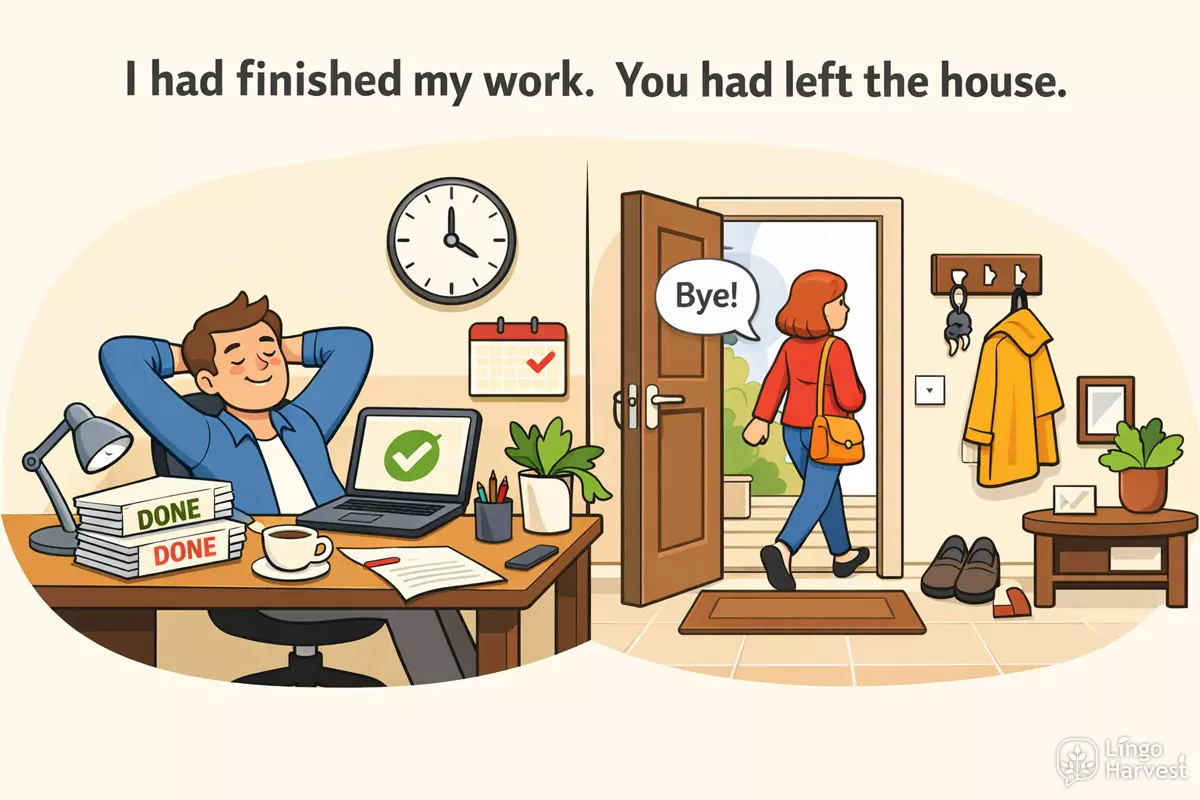
To use this tense, follow a simple structure: Subject + had + past participle. The auxiliary verb “had” stays the same for all subjects (I, you, he, she, it, we, they).
| Subject | Past Perfect Example |
|---|---|
| I | I had finished my work. |
| You | You had left the house. |
| He/She/It | She had cooked dinner. |
| We | We had seen the movie. |
| They | They had arrived early. |
When to use the past perfect
Writers and speakers use this tense when they need to make the timeline of events unmistakable, especially in stories or explanations. It’s common in sentences that use words like “before,” “after,” “when,” and “by the time.” If there’s only one event in the past, the simple past is usually enough; but when two or more past actions are connected, the past perfect helps show which came first.
Forming the past perfect correctly
To express an action completed before another event in the past, English uses the past perfect tense. The structure is clear: combine the auxiliary verb "had" with the past participle of the main verb. This formula is the same for all subjects, making it one of the more straightforward English verb forms to use.
Basic structure and word order
The standard arrangement is: subject + had + past participle (+ rest of sentence). Unlike other tenses, "had" doesn’t change for “he,” “she,” or “it.” The past participle varies depending on whether the verb is regular or irregular. Here are some typical examples:
- She had finished her homework before dinner.
- They had left when we arrived.
- I had seen that movie already.
- We had never visited Paris until last year.
- He had broken his leg before the trip.
- The cat had eaten by the time I got home.
- My friends had called before I woke up.
- You had forgotten your keys again.
- The train had departed when we reached the station.
- We had packed our bags the night before.
Negative and question forms
To create negative sentences, simply add "not" after "had": subject + had not (hadn't) + past participle. For questions, invert "had" and the subject: Had + subject + past participle?
- She hadn’t finished her homework.
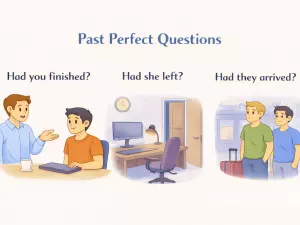
- Had they left before you arrived?
- We hadn’t heard the news.
- Had you ever been there before?
Regular vs. irregular past participles
The past participle form is crucial for accuracy. Regular verbs end with “-ed,” while irregular verbs have unique forms that must be memorized. Here’s a comparison:
| Base Verb | Past Participle | Example (Past Simple) |
|---|---|---|
| work | worked | She worked late yesterday. |
| play | played | They played tennis last weekend. |
| go | gone | He went home early. |
| see | seen | I saw her at the station. |
| eat | eaten | We ate before the movie. |
| write | written | She wrote a long email. |
| break | broken | He broke his phone. |
| choose | chosen | They chose the cheaper option. |
| take | taken | She took a taxi. |
| make | made | I made a mistake. |
| do | done | He did his homework. |
| give | given | They gave me directions. |
| find | found | We found the right address. |
| buy | bought | She bought a new laptop. |
| bring | brought | He brought his passport. |
| think | thought | I thought about it carefully. |
Common mistakes to avoid
- ❌ Using "have" instead of "had" for past events: Incorrect: She have finished.
- ❌ Forgetting the past participle: Incorrect: He had go.
- ❌ Mixing up past simple and past perfect: Incorrect: When I arrived, he left. (Should be: he had left.)
Remember, the past perfect is a valuable tool for clarifying the sequence of events in the past and preventing confusion about what happened first.
Using past perfect for sequence of events
When describing actions that happened at different times in the past, English speakers use the past perfect tense to make the order of events clear. This tense helps readers or listeners understand which action happened first, especially when the timeline might otherwise be confusing.
The past perfect is formed with had + past participle. It’s especially useful when a sentence contains two or more past actions, and you want to show that one was completed before the other started. For example: "She had finished her homework before dinner began." Here, the homework was done earlier, and the past perfect signals this sequence.
Why sequence matters
Establishing a clear sequence is essential in storytelling, instructions, and recounting experiences. Without the past perfect, listeners might misunderstand the order of events. By using this tense, you avoid ambiguity and help your audience follow the narrative.
Common patterns showing sequence
- After he had left, the phone rang.
- They had already eaten when we arrived.
- She had never seen the movie before last night.
- By the time I got there, the train had departed.
- We had finished the project before the deadline.
- He had forgotten her name until she reminded him.
- Once I had read the instructions, I started the test.
- The sun had set before we found our campsite.
- I had heard the news before you told me.
- She had cleaned the house when the guests arrived.
- We had lived in Paris before moving to Rome.
- He had lost his keys and couldn’t open the door.
- After they had argued, they stopped talking.
- By the time class started, I had finished my coffee.
- They hadn’t met before the conference.
- She had studied French before her trip to France.
- We had planned everything before the event.
- He had written the report before the meeting.
- I had never tasted sushi until last week.
- She had packed her bags before the taxi arrived.
Comparing simple past and past perfect in context
| Simple Past | Past Perfect |
|---|---|
| He left the office. | He had left the office before the meeting started. |
| She ate breakfast. | She had already eaten when I arrived. |
| We saw the movie. | We had seen the movie before it was popular. |
| They met at the party. | They had met before the party. |
| I finished my work. | I had finished my work before lunchtime. |
In summary, the past perfect tense provides clarity when recounting multiple actions in the past. By signaling which action came first, you guide your audience through the timeline and avoid confusion.
Past perfect vs past simple
Understanding when to use the past perfect tense and when to use the past simple is essential for describing sequences of events in the past. The two forms often appear together, but they serve different purposes. The past perfect clarifies that one action was completed before another past action, while the past simple simply reports a finished action in the past.
How these tenses differ in use
The past perfect is used to show that one event happened before another in the past. The past simple describes actions that occurred at a specific point in the past, without reference to any other event. If two actions happened in sequence, the earlier event is often expressed with the past perfect, and the later event with the past simple.
| When to use past perfect | When to use past simple |
|---|---|
| To show an action happened before another past action | To describe an action that happened at a definite past time |
| For background information in a story or narrative | For main events in a sequence |
| To clarify cause and effect between two past events | For single, completed actions in the past |
| With time expressions like “already,” “by the time,” “after,” “before” | With time expressions such as “yesterday,” “last week,” “in 2000” |
Examples for comparison
- She had finished her homework before she went out.
- By the time we arrived, the movie had started.
- He had never visited London until he moved there.
- I lost my keys yesterday. (No sequence, just a past event.)
- They had left when we got to the station.
- She ate dinner at 7 PM. (Simple, completed action.)
- After he had called her, he went to bed.
- We watched a movie last night.
- The train had departed before we arrived.
- I read the book last summer.
Choosing between these tenses depends on whether you need to highlight the order of events. If the order is clear from context or time expressions, the past simple alone might suffice. However, when the sequence is important or could be confusing, the past perfect helps clarify which event came first.
Time expressions with past perfect
When describing two or more events that happened before a certain point in the past, English speakers often rely on specific words or phrases to show the relationship between those actions. These expressions help clarify which action occurred first and which came later, making the sequence clear for the listener or reader.
Common phrases and words to indicate sequence
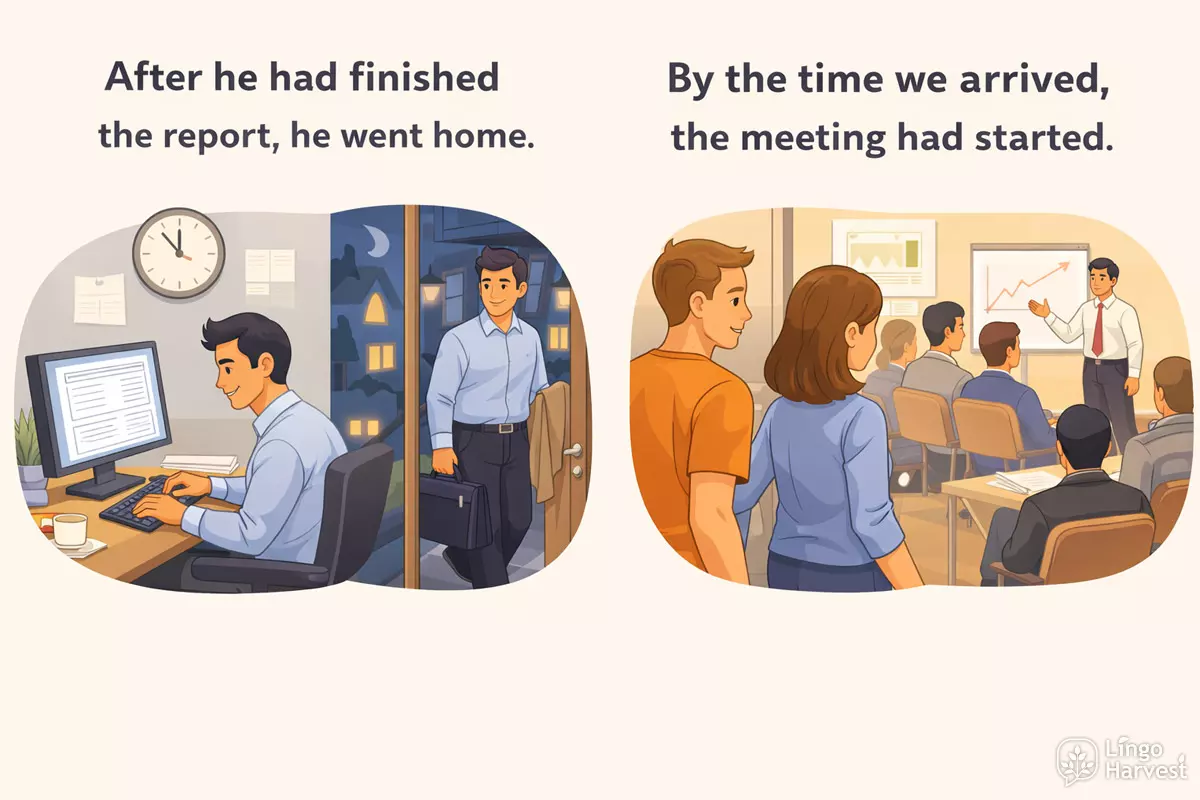
Writers and speakers often use particular adverbs, conjunctions, and prepositional phrases to signal that one event was completed before another. Here are some of the most frequently used options:
- before → She had left before I arrived.
- after → After he had finished the report, he went home.
- by the time → By the time we arrived, the meeting had started.
- when → When I got there, she had already left.
- already → He had already eaten when we called him.
- just → She had just finished speaking when the phone rang.
- never → I had never seen such a reaction before.
- until → He hadn’t realized the truth until she explained it.
- as soon as → As soon as they had signed the contract, the project began.
- once → Once she had understood the rules, the task became easier.
- by then → By then, everyone had left the building.
- by the end of → By the end of the day, he had completed all the tasks.
- no sooner … than → No sooner had she arrived than the meeting started.
- not yet → He hadn’t finished the work yet when the manager called.
- ever → It was the best decision he had ever made.
- up to that point → Up to that point, she had believed the story.
- afterwards → Afterwards, they realized they had made a mistake.
These time markers can appear at the beginning, middle, or end of a sentence, depending on the focus and structure.
How these expressions work in context
Pairing these time signals with the past perfect tense emphasizes which action was finished first. For example:
- She had finished dinner before he arrived.
- By the time the movie started, we had found our seats.
- He had never seen snow until he visited Canada.
- After they had left, it started to rain.
Comparison: Past perfect vs. simple past with time expressions
When using these time markers, the choice between past perfect and simple past depends on whether you need to stress the order of events. The table below contrasts how these expressions can be used with each tense:
| Time Expression | Past Perfect Example | Simple Past Example |
|---|---|---|
| before | I had eaten before they arrived. | I ate before they arrived. |
| after | She left after she had finished her work. | She left after she finished her work. |
| by the time | By the time we got there, the film had started. | By the time we got there, the film started. |
| when | When I arrived, they had left. | When I arrived, they left. |
As shown above, both tenses can sometimes be used with the same phrase, but the past perfect more clearly expresses that one event was completed before another began. Choosing the right tense and time marker helps avoid confusion and makes your writing or speech more precise.
Typical mistakes and misunderstandings
Learners often struggle with the correct use of past perfect forms, especially when describing past events in sequence. Misunderstandings usually arise from confusion between the past simple and the past perfect, or from uncertainty about when the past perfect is truly necessary. Below, you'll find some of the most common pitfalls and misconceptions, with practical examples to clarify each one.
Confusing Past Simple and Past Perfect
People frequently use the past simple where the past perfect should be used, especially when narrating two actions that happened at different times in the past. The past perfect is needed to show which action happened first.
- Incorrect: She left before I arrived.
- Correct: She left before I had arrived.
Unnecessary Use of Past Perfect
Sometimes, writers use the past perfect even when both actions happened in clear chronological order, or when there is no risk of ambiguity. This can make sentences sound awkward or overly complicated.
- Incorrect: Yesterday I had gone to the store and bought some bread.
- Correct: Yesterday I went to the store and bought some bread.
Omitting the Past Perfect When Needed
A common error is to leave out the past perfect tense, which can make the sequence of events unclear to the reader or listener.
- Incorrect: When he arrived, the movie started.
- Correct: When he arrived, the movie had started.
Incorrect Word Order and Form
Mistakes also occur with word order, especially in negatives and questions, or when using irregular past participles.
- Incorrect: They hadn’t saw the film before.
- Correct: They hadn’t seen the film before.
- Incorrect: Had you went to the party?
- Correct: Had you gone to the party?
Summary Table: Past Simple vs. Past Perfect
| Past Simple | Past Perfect |
|---|---|
| I finished my homework. | I had finished my homework before dinner. |
| She left the house. | She had left the house when I called. |
| They arrived late. | They had arrived late, so they missed the show. |
| We ate lunch. | We had eaten lunch by the time he arrived. |
Quick Checklist of Other Frequent Errors
- Using “had” with present participles (e.g., had going instead of had gone).
- Forgetting “had” altogether (e.g., He finished when I arrived instead of He had finished when I arrived).
- Overusing past perfect in stories where chronological order is already clear.
- Mixing past perfect with present or future tenses in the same sentence.
- Incorrect use in reported speech (e.g., She said she had saw instead of had seen).
- Confusing past perfect with past perfect continuous (e.g., had worked vs. had been working).
- Not matching the subject with the correct form of “had.”
- Using the past perfect for single, isolated actions where it is not required.
- Relying on time markers like “before” and “after” without checking if the tense is appropriate.
- Translating directly from another language, which might not use an equivalent tense.
Being aware of these common errors will help you use the past perfect more accurately, ensuring your descriptions of sequences in the past are both clear and natural.
Past perfect in narratives and stories
Writers often use the past perfect tense to clarify the order of events when telling stories about the past. This helps readers or listeners understand which actions happened first, especially when several past events are involved. The past perfect sets the background for new actions, marking what was already completed before something else occurred.
Why use past perfect in storytelling?
When recounting events, it's easy for sequences to become confusing. The past perfect solves this by signaling that an action was fully finished before the main event in the narrative. This is especially useful in flashbacks, explanations, or when revealing causes behind later outcomes.
- She had left before the party started. (Her departure happened first.)
- They had eaten dinner when the guests arrived. (Dinner was finished before guests came.)
- He couldn’t find his keys because he had forgotten them at work.
- After the rain had stopped, we went outside.
- By the time I called, she had already gone to bed.
- We had never seen such a beautiful sunset before that day.
- She realized she had met him somewhere before.
- They had finished the test before the bell rang.
- He had just left when the phone rang.
- The film had ended by the time we arrived at the cinema.
- She couldn’t answer because she hadn’t heard the question.
- We had planned the trip long before we bought our tickets.
- After they had cleaned the house, they relaxed.
- He had never tried sushi until that night.
- When I woke up, the snow had covered everything.
Comparing past perfect with simple past
The difference between the simple past and past perfect is all about timing. The past perfect always refers to the earlier action, while the simple past describes the later action.
| Earlier Action (Past Perfect) | Later Action (Simple Past) |
|---|---|
| She had finished her homework | before she went out to play |
| We had locked the door | when we left the house |
| He had read the book | before he wrote the review |
| They had packed their bags | before the taxi arrived |
In summary, using past perfect in stories and narratives adds clarity, making it easier for readers or listeners to follow the timeline of events. It helps distinguish what was already done from what happened next, creating a smoother and more engaging storytelling experience.
Practice exercises on past perfect verbs
Understanding how to use the past perfect tense can help clarify the order of events in past narratives. Try the following exercises to build your confidence in identifying and forming this tense.
Rewrite the sentences
Change each pair of sentences below into one sentence using the past perfect tense to show which action happened first.
- Maria left the house. The rain started.
- We ate dinner. The guests arrived.
- He finished the report. He submitted it to his boss.
- The students completed the test. The teacher collected the papers.
- She called her friend. She found her phone.
- They booked the tickets. The prices went up.
- He saved the file. The computer crashed.
- She packed her bags. The taxi arrived.
- We discussed the plan. The meeting ended.
- He fixed the mistake. The client noticed the problem.
Show answers
- Maria had left the house before the rain started.
- We had eaten dinner when the guests arrived.
- He had finished the report before he submitted it to his boss.
- The students had completed the test when the teacher collected the papers.
- She had found her phone before she called her friend.
- They had booked the tickets before the prices went up.
- He had saved the file before the computer crashed.
- She had packed her bags when the taxi arrived.
- We had discussed the plan before the meeting ended.
- He had fixed the mistake before the client noticed the problem.
Choose the correct form
Select the best option to complete each sentence.
- By the time I got to the station, the train (left / had left).
- She (had never seen / never saw) the ocean before her trip.
- After he (had finished / finished) his homework, he watched TV.
- They (had already eaten / already ate) when we arrived.
- The movie (had started / started) before we reached the cinema.
- When I called her, she (had gone / went) to bed.
- He realized he (had lost / lost) his wallet.
- We noticed that someone (had opened / opened) the window.
- She was tired because she (had worked / worked) all night.
- They arrived after the concert (had ended / ended).
Show answers
- had left
- had never seen
- had finished
- had already eaten
- had started
- had gone
- had lost
- had opened
- had worked
- had ended
Identify the sequence of actions
Read the following actions and decide which happened first. Use the past perfect for the first action and simple past for the second.
- finish lunch / go for a walk
- read the instructions / assemble the bookshelf
- lock the door / leave the house
- fall asleep / the alarm rang
- save the document / close the program
- pay the bill / leave the restaurant
- check the address / send the letter
- charge the phone / leave the house
- book the hotel / travel abroad
- repair the bike / ride it
Show answers
- After we had finished lunch, we went for a walk.
- She assembled the bookshelf after she had read the instructions.
- He had locked the door before he left the house.
- He had fallen asleep when the alarm rang.
- She had saved the document before she closed the program.
- They had paid the bill before they left the restaurant.
- He had checked the address before he sent the letter.
- She had charged her phone before she left the house.
- They had booked the hotel before they traveled abroad.
- He had repaired the bike before he rode it.
Forming the past perfect: structure comparison
The table below summarizes how to form affirmative, negative, and question sentences in the past perfect tense:
| Sentence Type | Example |
|---|---|
| Affirmative | She had finished her work. |
| Negative | They had not seen the movie. |
| Question | Had you eaten breakfast? |
| Short Answer | Yes, I had. / No, I hadn’t. |
Practice using these forms in your own sentences to reinforce your understanding of how the past perfect tense shows the relationship between two actions in the past.