Using Reported Speech in Past Narratives and Stories

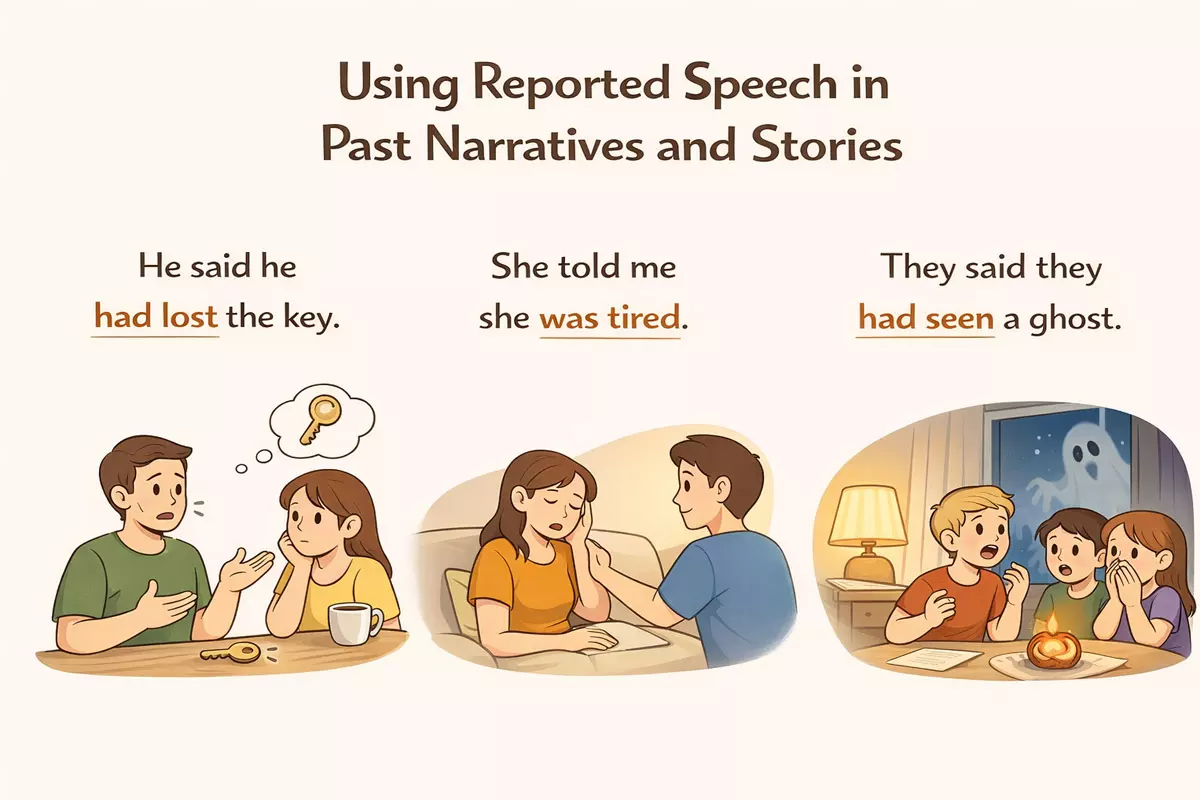 Here we how reported speech is used in narratives, the importance of tense consistency, and how to shift perspective when recounting past events.
Capturing what others have said is a crucial skill for bringing stories and past events to life, as it allows writers to add realism, depth, and clarity to their narratives. By thoughtfully incorporating the words and perspectives of real people, writers can create more engaging and authentic storytelling. This approach not only helps readers connect emotionally with the characters and situations but also provides context and credibility to the events being described, making the overall narrative more compelling and believable.
Role of reported speech in narratives
Reported speech serves as a key storytelling device, allowing authors and speakers to present what characters or real people said without quoting them directly. This technique helps writers move beyond direct quotes, making their stories smoother and more flexible. By using indirect speech, storytellers can summarize conversations, reveal thoughts, and maintain narrative pace without interrupting the flow with lengthy dialogue.
Another important function is to give context or background information. When recounting past events, narrators often need to describe what was said, promised, or believed at a particular moment. Indirect speech enables this, letting the narrator shape the perspective and focus on what matters most to the plot or the listener’s understanding.
Why storytellers use reported speech
- Summarizes long conversations or multiple statements efficiently
- Allows for subtle shifts in point of view and voice
- Conveys characters’ feelings or intentions without quoting every word
- Helps manage pacing, especially in action-heavy scenes
- Provides distance between the narrator and the events described
- Enables the blending of narration and character perspective
- Facilitates transitions between scenes or time periods
- Helps avoid repetitive use of direct quotations
- Can clarify meaning or summarize unclear speech
- Supports the use of past tense and narrative sequence
Direct vs. reported speech: a comparison
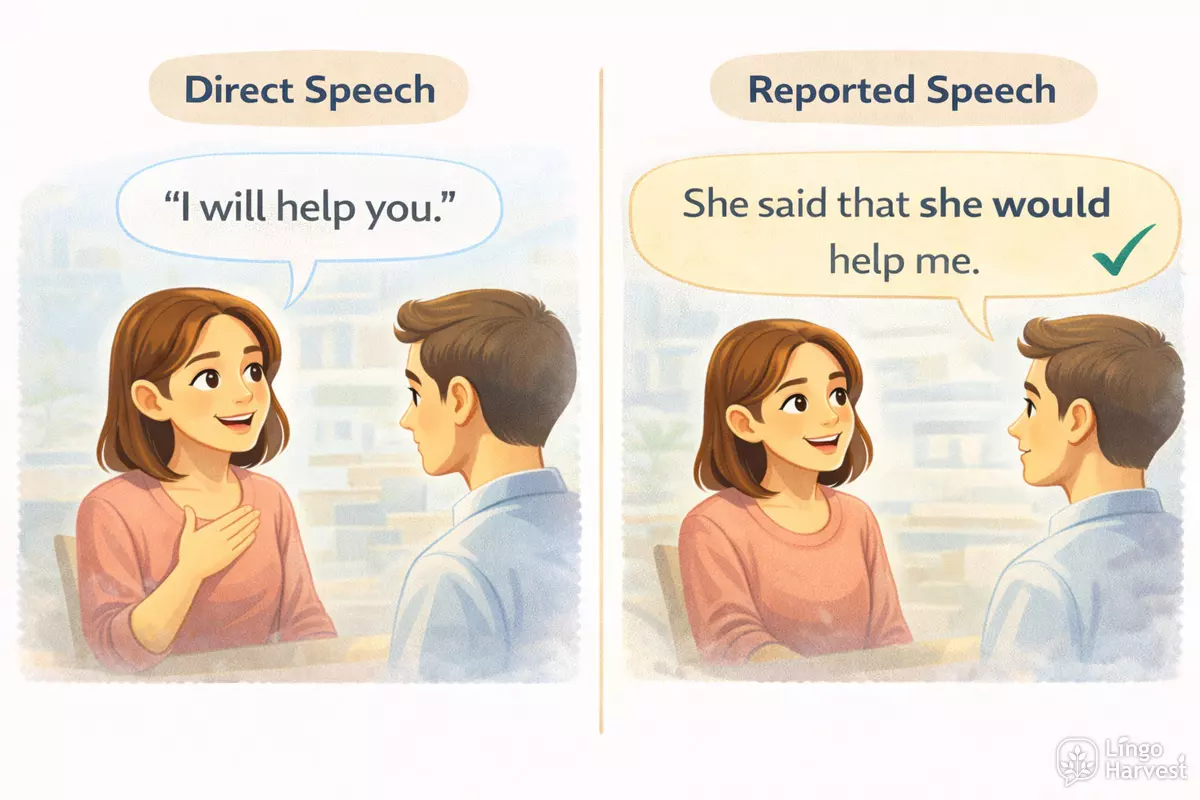
| Direct Speech | Reported Speech |
|---|---|
| “I will help you,” she said. | She said that she would help me. |
| “Where are you going?” he asked. | He asked where I was going. |
| “I can’t find my keys,” Tom said. | Tom said that he couldn’t find his keys. |
| “Don’t be late,” Mom warned. | Mom warned me not to be late. |
Using indirect forms in storytelling brings flexibility and control, shaping the reader’s or listener’s perception of events. It also allows the narrator to filter, interpret, or even question what was said, which can add depth and nuance to the story. This technique is especially valuable in past narratives, where reconstructing and interpreting events is often more important than reproducing exact words.
Maintaining tense consistency in stories
When telling stories, especially those set in the past, it’s important to keep verb tenses steady to avoid confusing your reader. Shifts in tense can disrupt the flow and make the sequence of events unclear. Most narratives use the past tense as their base, which helps the reader follow the action as something that has already occurred. This becomes even more crucial when reported speech is introduced, since the reporting verb and the reported clause often need to match the chosen timeline.
Common pitfalls in tense use
Writers sometimes slip between past and present tenses, especially when switching between narration and dialogue or reported speech. Here are a few common mistakes:
- Describing an ongoing action in the present while the rest of the story is in the past.
- Reporting speech using the wrong tense, such as: “He said he is tired,” instead of “He said he was tired.”
- Using past perfect unnecessarily, which can make sentences awkward or overly complex.
Strategies for keeping tenses consistent
- Settle on a primary tense for your narrative (usually simple past).
- When using reported speech, backshift tenses as needed (present → past, past → past perfect).
- Check each sentence for tense alignment, especially after editing dialogue or inserting new scenes.
- Use past continuous or past perfect only when the sequence of events requires it.
- Reserve present tense for universal truths or immediate commentary, not for ongoing story action.
How reported speech tenses change in stories
When you report what someone said in a story, the verb tense often shifts back to reflect the time difference. Here’s a reference table of typical changes when converting direct speech to reported speech in narrative past:
| Direct Speech | Reported Speech in Past Narratives |
|---|---|
| “I am tired.” | He said he was tired. |
| “She will come.” | He said she would come. |
| “We have finished.” | They said they had finished. |
| “I saw the movie.” | She said she had seen the movie. |
| “They are playing.” | He said they were playing. |
| “You can stay.” | She said I could stay. |
| “We must go.” | He said they had to go. |
| “I will help.” | She said she would help. |
Quick tips for editing your narrative
- Read your story aloud to spot tense shifts.
- Highlight verbs to check for consistency.
- Make a timeline of events to guide tense choices.
- Remember that internal thoughts or universal facts can sometimes remain in present tense.
By carefully tracking verb forms and reported speech, you ensure your storytelling is clear, professional, and easy to follow.
Shifting perspective in past reporting
When recounting past events using reported speech, the narrator often needs to adjust both the speaker’s original words and the surrounding context. This process involves more than simply changing verb tenses; it requires a careful shift in perspective to match the new narrative voice and time frame. The main task is to help readers understand who said what, when, and in what circumstances, all while maintaining clarity and flow in the storytelling.
Understanding Perspective Changes
Adapting another person’s words into a past narrative means you must consider how references—like pronouns, time expressions, and place—change when retold from a different viewpoint. For example, what was “today” in direct speech becomes “that day” in reported speech, and “I” may become “he” or “she.” These shifts anchor the reported statement in the correct narrative setting and help avoid confusion.
Common Shifts in Reported Speech
- Verb tense moves back (present → past, past simple → past perfect).
- Pronouns shift to match the new speaker (“I” → “he/she”).
- Time expressions update (“now” → “then”, “yesterday” → “the previous day”).
- Place words adapt (“here” → “there”).
- Modal verbs may change (“will” → “would”, “can” → “could”).
- Requests and commands are often reported with “asked” or “told.”
- Questions shift from question word order to statement order.
- Possessives adjust to fit the new subject (“my” → “his/her”).
- Interjections and exclamations are typically omitted or softened.
- Direct quotes are replaced by indirect structures (“She said, ‘I’m tired.’” → “She said that she was tired.”).
Examples of Perspective Shifts
| Direct Speech | Reported Speech |
|---|---|
| I am leaving now. | He said that he was leaving then. |
| We will call you tomorrow. | They promised they would call me the next day. |
| Did you see my book here? | She asked if I had seen her book there. |
| “I can help,” said John. | John said that he could help. |
| “Close the door,” she said. | She told him to close the door. |
| “Why are you late?” | He asked why I was late. |
Key Considerations for Narrative Consistency
Maintaining consistency in perspective is essential for clear storytelling. Always check that pronouns, verb forms, and references to time or place match the narrative situation. If multiple characters are involved, clarify who is speaking and to whom. These adjustments not only help readers follow the plot but also preserve the authenticity of each character’s voice within the broader story.
Combining narration and reported speech
Writers often blend storytelling with indirect speech to make past events more vivid and believable. This mix allows the reader to experience both the unfolding action and the perspectives or words of characters. Using indirect speech, writers can relay what someone said without interrupting the narrative flow with direct quotations. This approach is especially useful in stories set in the past, where shifting between what happened and what was said helps to create a seamless reading experience.
How to smoothly integrate indirect speech into narratives
To keep the story engaging, it’s helpful to alternate between narration (describing actions, settings, and events) and reported speech (conveying what characters said or thought). Here are some strategies for effective integration:
- Use time markers and sequencing words to show when speech occurs in relation to events (e.g. "Later that evening, she explained...").
- Vary reporting verbs to reflect mood and intent: said, asked, remarked, insisted, admitted, suggested, warned, promised, confessed, replied, thought, murmured, complained, declared, explained, mentioned, whispered, noted, recalled.
- Keep tense consistency: typically, narration is in the past simple or past continuous, while reported speech uses the appropriate backshift (e.g., “He said he was tired”).
- Include character reactions after reported speech to maintain narrative momentum.
- Limit the number of reporting clauses (“he said,” “she told him”) to avoid repetition and keep the story flowing.
Examples: Narration and indirect speech in context
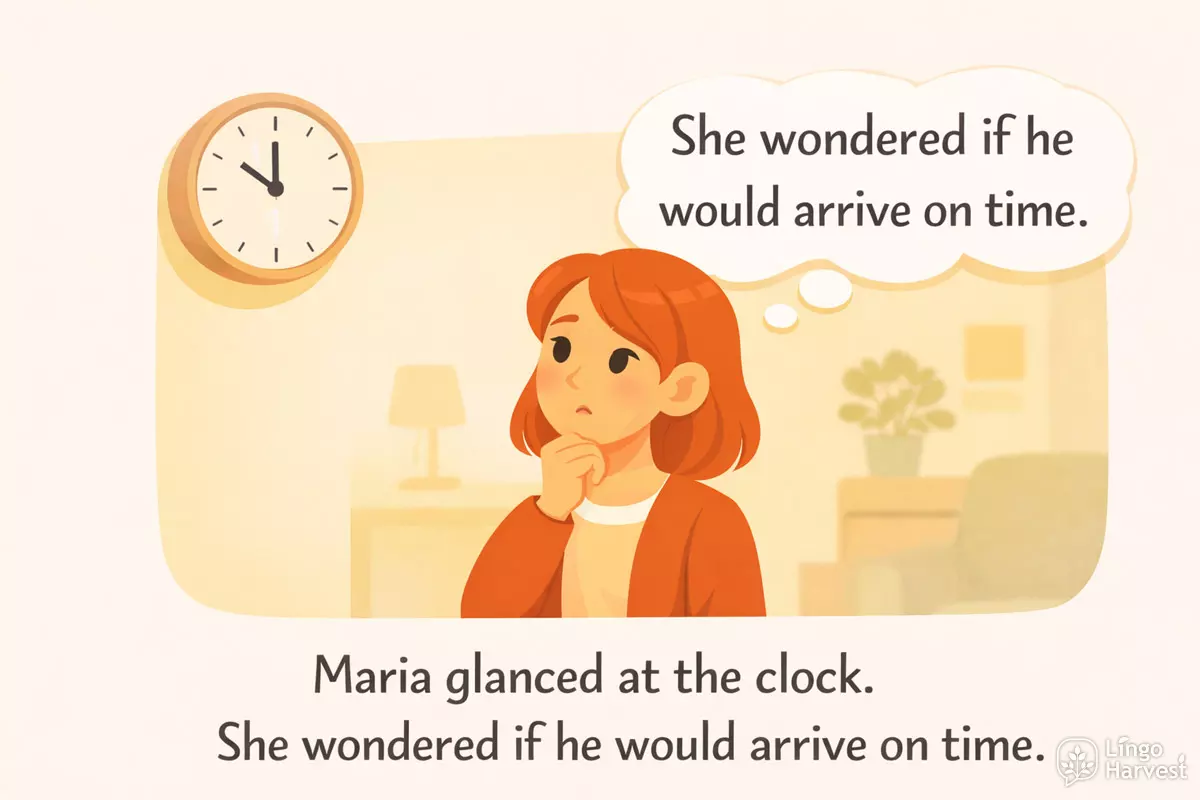
Let’s look at some expanded examples combining action and indirect speech. Notice how the narrative moves between describing events and reporting what characters said or thought:
- Maria glanced at the clock. She wondered if he would arrive on time.
- The teacher entered the room quietly and reminded the students that the exam would start in ten minutes.
- After dinner, Tom admitted he had forgotten their anniversary.
- They walked through the park, and Anna mentioned that she used to come here as a child.
- James promised he would help with the move next weekend.
- As the rain started, Sarah complained that she hadn’t brought an umbrella.
- He explained that the meeting had been postponed.
- The guide warned the tourists that the path could be slippery.
- She whispered to her friend that she felt nervous about the presentation.
- Paul recalled that his grandmother always made apple pie on Sundays.
Comparing narrative and indirect speech forms
| Narrative Example | Reported Speech Example |
|---|---|
| Lucy entered the room and smiled. | She said she was happy to see everyone. |
| The coach gathered the team before the game. | He told them they needed to focus and play as a unit. |
| After the announcement, everyone looked surprised. | Many admitted they hadn't expected the news. |
| Mark checked his phone as he left the office. | He remembered that he had promised to call his sister. |
By thoughtfully blending narration with indirect speech, writers can present character voices and inner thoughts without breaking the flow of the story. This technique makes past narratives richer and more dynamic, allowing readers to follow both events and perspectives with ease.
Clarity and flow in storytelling
When using reported speech in past narratives, maintaining a smooth and understandable story is essential. Switching between direct and reported speech can disrupt the rhythm if not handled with care. Writers should guide readers clearly through shifts in perspective, especially when recounting what different characters have said in the past.
Reported Speech and Narrative Structure
Reported speech often summarizes or paraphrases what was originally said, which can condense dialogue and help the story progress without lengthy quotations. This technique can make reading easier, but only if the reporting verbs and time references are used consistently. In stories, clarity comes from correctly signaling who is speaking and when the events occurred.
- Use reporting verbs (said, told, explained, wondered) to introduce reported speech.
- Keep verb tenses consistent with the narrative’s time frame.
- Use pronouns carefully to avoid confusion about who is speaking or being referred to.
- Place time markers (“the day before,” “earlier that morning”) to orient the reader.
- Break up long passages of reported speech to maintain reader engagement.
- Alternate between action and speech to keep the narrative dynamic.
- Start new paragraphs when the speaker or perspective changes.
- Clarify any shifts from direct to indirect speech, especially in conversations involving multiple people.
- Summarize routine or less important exchanges to keep the story focused.
- Reserve direct quotations for emotionally significant or pivotal moments.
Comparing Direct and Reported Speech in Narratives
Writers often choose between direct and reported speech depending on the effect they want to create. Direct speech can make scenes vivid and immediate, while reported speech is useful for summarizing and maintaining pace. The table below shows how the same message can be expressed differently, affecting the flow and tone of the narrative.
| Direct Speech Example | Reported Speech Example |
|---|---|
| "I can't believe you did that," she exclaimed. | She exclaimed that she couldn't believe he had done that. |
| "Where are we going now?" Tom asked. | Tom asked where they were going next. |
| "I'll see you tomorrow," he promised. | He promised that he would see her the next day. |
| "Did you finish your homework?" the teacher asked. | The teacher asked if he had finished his homework. |
Tips for Smoother Transitions
Good storytelling relies on seamless transitions between narration and reported dialogue. Here are some strategies for smoother integration:
- Use transition phrases such as “Later, she explained that…” or “According to him…”
- Vary sentence length to avoid monotony when summarizing speech.
- Check for ambiguity in pronouns or time references after converting direct speech to reported speech.
- Read passages aloud to detect awkward phrasing or unclear shifts.
- Balance narrative summary with moments of direct speech for emotional impact.
By using reported speech thoughtfully, writers can create narratives that are both clear and engaging, guiding readers through past events without losing the thread of the story.
Typical narrative errors
Writers often encounter specific pitfalls when incorporating reported speech into stories set in the past. These issues can disrupt the flow, confuse readers, or lead to inaccuracies in the narrative timeline. Recognizing these challenges is the first step toward improving narrative clarity and cohesion.
Common mistakes with reported speech
- Incorrect tense backshifting: Failing to adjust verb tense properly after a reporting verb in the past (e.g., using present simple instead of past simple).
- Mixing direct and indirect speech inconsistently: Switching between styles without clear purpose, which can make the story feel disjointed.
- Omitting necessary pronoun changes: Leaving pronouns unchanged can cause confusion about who is speaking or being referred to.
- Neglecting time and place reference changes: Not updating words like "today" to "that day," or "here" to "there," resulting in temporal or spatial ambiguity.
- Overusing “said” without variation: Repetitive use of the same reporting verb can make the narrative monotonous.
- Forgetting punctuation rules: Misplacing commas, periods, or quotation marks when switching between direct and indirect speech.
- Using the wrong reporting verb: Selecting a verb that doesn’t fit the context or the speaker’s intention (e.g., using “asked” for statements).
- Failing to signal reported speech: Omitting reporting clauses or indicators, which can leave the reader unsure if a passage is narrative or speech.
- Maintaining present-tense narrative with past-tense reported speech: Creating confusing temporal shifts for the reader.
- Ignoring sequence of tenses: Not keeping verb forms logically consistent within and across sentences.
- Neglecting the listener’s perspective: Failing to adapt references (such as “this” vs. “that”) to fit the context of the narrator’s or listener’s viewpoint.
- Using overly literal translations: Translating reported speech word-for-word from another language, which may not follow English conventions.
Examples of tense shifts in reported speech
One of the most frequent sources of confusion is tense agreement. The following table shows how verb tenses typically change when converting direct speech to reported speech in past narratives:
| Direct Speech | Reported Speech |
|---|---|
| "I am tired," she said. | She said she was tired. |
| "We will go tomorrow," he explained. | He explained that they would go the next day. |
| "They have finished," Tom announced. | Tom announced that they had finished. |
| "You can start now," the teacher told us. | The teacher told us we could start then. |
| "I saw her here," Mark said. | Mark said he had seen her there. |
| "I’m working late tonight," Julia said. | Julia said she was working late that night. |
| "I have never tried sushi," he admitted. | He admitted that he had never tried sushi. |
| "We are meeting at noon," they said. | They said they were meeting at noon. |
| "I can’t hear you," she said. | She said she couldn’t hear me. |
| "I may be late," he warned. | He warned that he might be late. |
How to avoid these pitfalls
- Double-check tense shifts after every reporting verb.
- Revise pronouns and time/place references for clarity.
- Vary reporting verbs to maintain reader interest.
- Read your narrative aloud to catch awkward transitions or ambiguous speech.
- Ask someone else to review your story for confusing speech attributions.
By being mindful of these missteps and reviewing your writing for tense and reference consistency, you can ensure your use of reported speech enhances rather than hinders your past narratives.
Homework: Narration + Reported Speech in Past Narratives
This homework helps you practice blending narration with reported speech in a natural, story-like way. Focus on smooth transitions, clear time markers, and accurate backshifting. As you rewrite, watch your pronouns and time/place words so the reader always knows who is speaking and when the speech happened.
Exercise 1. Combine narration with reported speech (write one smooth paragraph for each item)
- Use the details to write a short narrative (2–3 sentences) with reported speech:
Scene: A delayed train at night.
Speech: "The train will be here in ten minutes," the conductor said.
Reaction: The passengers looked impatient. - Write a short narrative (2–3 sentences) with reported speech:
Scene: A team meeting in an office.
Speech: "We can’t share these figures yet," the manager said.
Reaction: Someone started taking notes quickly. - Write a short narrative (2–3 sentences) with reported speech:
Scene: A café after an argument.
Speech: "I didn’t mean to offend you," she said.
Reaction: He stayed silent for a moment. - Write a short narrative (2–3 sentences) with reported speech:
Scene: A classroom before an exam.
Speech: "You may begin now," the teacher said.
Reaction: Chairs scraped the floor as everyone opened their papers. - Write a short narrative (2–3 sentences) with reported speech:
Scene: A stormy morning.
Speech: "The roads are getting dangerous," the driver said.
Reaction: The radio crackled with updates. - Write a short narrative (2–3 sentences) with reported speech:
Scene: A hospital waiting room.
Speech: "I have been waiting for two hours," he said.
Reaction: The receptionist avoided eye contact. - Write a short narrative (2–3 sentences) with reported speech:
Scene: A phone call during a power outage.
Speech: "I can’t see anything in here," she said.
Reaction: A flashlight beam moved across the wall. - Write a short narrative (2–3 sentences) with reported speech:
Scene: A museum tour.
Speech: "This painting was found in the 1920s," the guide said.
Reaction: A visitor leaned closer to read the label. - Write a short narrative (2–3 sentences) with reported speech:
Scene: A rehearsal backstage.
Speech: "I might forget the opening line," he whispered.
Reaction: Someone squeezed his shoulder reassuringly. - Write a short narrative (2–3 sentences) with reported speech:
Scene: An airport announcement.
Speech: "Your gate has changed," the staff member said.
Reaction: People grabbed their bags and hurried away.
Show answers
- It was late, and the platform lights flickered in the wind. The conductor said that the train would be there in ten minutes, but the passengers looked impatient as they checked their phones.
- The manager stepped in and lowered his voice. He said that they couldn’t share those figures yet, and someone immediately started taking notes as the room went quiet.
- After the argument, the café felt louder than usual. She said that she hadn’t meant to offend him, and he stayed silent for a moment before turning his cup slowly in his hands.
- The teacher handed out the papers and scanned the room. She said that we might begin then, and chairs scraped the floor as everyone opened their exams.
- The rain hit the windshield in heavy bursts. The driver said that the roads were getting dangerous, and the radio crackled with updates from areas ahead.
- The waiting room smelled faintly of disinfectant. He said that he had been waiting for two hours, and the receptionist avoided eye contact as she flipped through a stack of forms.
- The lights went out without warning, and the apartment fell silent. She said that she couldn’t see anything in there, and a flashlight beam moved across the wall in shaky circles.
- The group slowed down near the display case. The guide said that the painting had been found in the 1920s, and a visitor leaned closer to read the label.
- Backstage, he kept rubbing his palms on his jacket. He whispered that he might forget the opening line, and someone squeezed his shoulder reassuringly before the curtain rose.
- The announcement echoed through the terminal. The staff member said that our gate had changed, and people grabbed their bags and hurried away.
Exercise 2. Fix narrative errors (tense, pronouns, time markers, and structure)
- Spot and correct the error:
Tom asked where are we going next. - Spot and correct the error:
She told me that I go outside and wait. - Spot and correct the error:
He said he will call me tomorrow. - Spot and correct the error:
Anna said that she is leaving then. - Spot and correct the error:
They asked did I finish the application. - Spot and correct the error:
He warned me don’t touch the wires. - Spot and correct the error:
She said that she had seen him here yesterday. - Spot and correct the error:
Maria asked me if I can stay longer. - Spot and correct the error:
He said that the meeting starts at nine yesterday. - Spot and correct the error:
The guide said us that we should be quiet.
Show answers
- Tom asked where we were going next.
- She told me to go outside and wait.
- He said he would call me the next day.
- Anna said that she was leaving then.
- They asked if I had finished the application.
- He warned me not to touch the wires.
- She said that she had seen him there the day before.
- Maria asked me if I could stay longer.
- He said that the meeting started at nine the day before.
- The guide told us that we should be quiet.