Conditionals and Verb Forms Explained

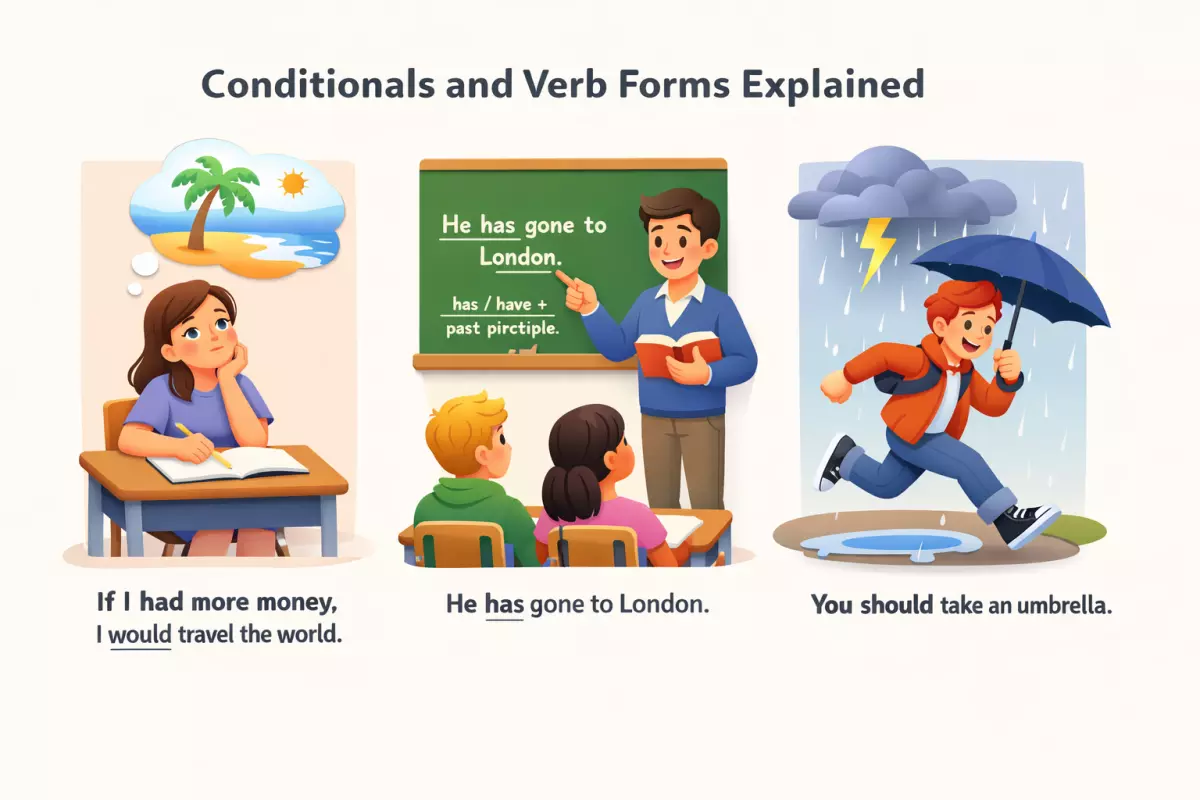 This article explains what conditionals express in English, covers zero and first verb forms, second and unreal present, third and unreal past, and mixed conditionals. It also flags common if and would mistakes, shows how to choose by meaning, and ends with homework practice tasks.
- What conditionals express in English
- Zero and first conditional verb forms
- Second conditional and unreal present forms
- Third conditional and unreal past forms
- Mixed conditionals and typical meanings
- Common mistakes with if and would
- Choosing the right conditional by meaning
- Homework: conditional sentence practice tasks
In everyday English, if-sentences and the verb tenses that follow them can change your meaning instantly. We use these patterns to talk about facts, future plans, advice, and unreal situations, from making promises to imagining different choices. When you notice how the verb time matches the speaker’s purpose, you stop guessing and start sounding clear and natural.
What conditionals express in English
Conditional sentences let speakers connect a situation (the if-clause) with a result (the main clause). They are used to show how one event depends on another, to predict outcomes, to imagine alternatives, and to comment on causes and consequences in a controlled, patterned way.
Common meanings conditionals communicate
- Real cause-and-effect in general: habits, rules, and facts. (If you heat ice, it melts.)
- Real future possibility: a likely condition and its expected result. (If it rains, we’ll stay in.)
- Plans and arrangements: what will happen when a condition is met. (If you finish early, call me.)
- Warnings and threats: consequences used to influence behavior. (If you touch that, you’ll get burned.)
- Offers and promises: results presented as a commitment. (If you need help, I’ll come.)
- Instructions and procedures: step-by-step conditions. (If the light is red, wait.)
- Negotiation and bargaining: conditional agreement. (If you lower the price, I’ll buy it.)
- Polite requests: softer, less direct phrasing. (If you have a moment, could you sign this?)
- Advice and recommendations: suggested actions and outcomes. (If you’re tired, you should rest.)
- Hypothetical present/future: imagined situations that are not real now. (If I had more time, I’d travel.)
- Unreal past / regret: different past conditions and different results. (If I’d known, I would have told you.)
- Criticism and blame: pointing to a missed condition. (If you’d listened, we wouldn’t be lost.)
- Speculation about causes: guessing why something happened. (If she left early, she might have felt sick.)
- Exceptions and limitations: stating boundaries. (If it’s not urgent, wait until tomorrow.)
- General concessions: “even if” meaning the result stays the same. (Even if it’s expensive, I’ll buy it.)
- Minimum requirements: “as long as / provided that” meaning one condition is enough. (You can go as long as you text me.)
How English signals these meanings (patterns to notice)
- Condition + result structure: an if-clause sets the condition; the main clause gives the consequence.
- Time and reality are separated: past verb forms can signal distance/unreality, not past time. (If I were you, …)
- Modal verbs shape the result: will (expected), would (hypothetical), can/could (ability/possibility), may/might (uncertainty), should (advice).
- Imperatives are common in results: especially for instructions. (If you see John, tell him.)
- Either clause can come first: If-clause first often adds emphasis on the condition; result first can sound more direct. (We’ll leave if the meeting ends early.)
- Some condition words change the nuance: unless (negative condition), in case (precaution), even if (concession), provided (that) (requirement).
Typical usage pitfalls (form and meaning)
- Using “will” in the if-clause for predictions: ✅ If it rains, we’ll cancel. ❌ If it will rain, we’ll cancel. (Exception: “will” can appear for willingness or insistence: If you will wait, I’ll check.)
- Confusing unreal “past” forms with real past time: If I had time (unreal now) vs. If I had time yesterday (real past context).
- Mixing time frames without meaning: Mixed conditionals are possible, but the time shift should be intentional. (If I had studied, I would have a better job now.)
- Forgetting that conditionals can be indirect: “If you don’t mind…” often functions as politeness rather than a literal condition.
Zero and first conditional verb forms
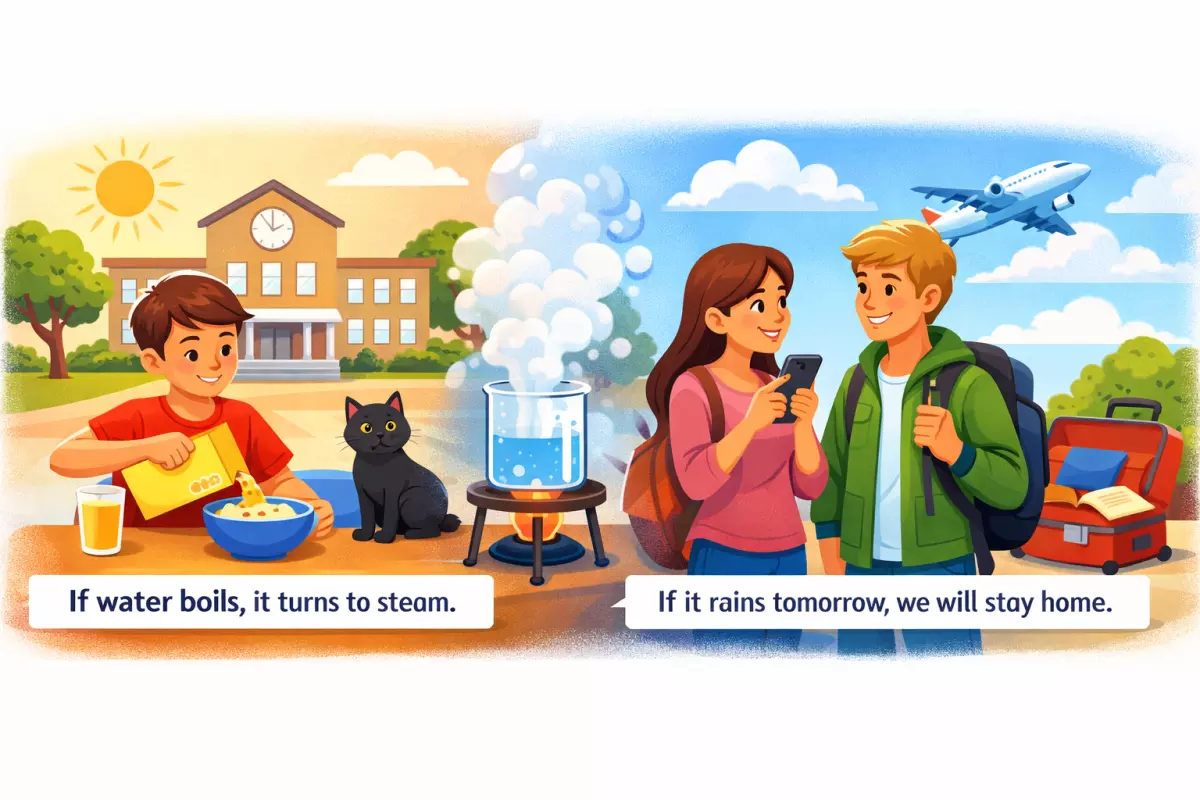
These two conditional patterns use different tense choices to show different meanings. One is for things that are generally true (habits, rules, scientific facts), and the other is for real future possibilities and likely results.
| Conditional type | If-clause (condition) | Main clause (result) | Typical meaning |
|---|---|---|---|
| Zero conditional | Present simple | Present simple | General truth, routine, rule |
| First conditional | Present simple | Will + base verb | Real future possibility, likely outcome |
| First conditional (common variants) | Present simple | Modal / imperative / going to | Advice, instructions, plans, predictions |
| Either (with “when” for certainty) | Present simple | Present simple or will + base verb | Time clause; often more certain than “if” |
Zero conditional: form and usage
Use present simple + present simple when the result is automatic or always true under the same conditions. This pattern is common in instructions, policies, and explanations of how things work.
- If you heat ice, it melts.
- If water reaches 100°C, it boils.
- If I don’t sleep enough, I feel tired the next day.
- If you press this button, the machine stops.
- If students arrive late, the teacher marks them absent.
- If the dog hears the door, it barks.
- If you mix red and blue, you get purple.
- If people eat too fast, they often get indigestion.
- If the battery is low, the phone shows a warning.
- If it rains heavily, the river floods.
In this structure, “if” can often be replaced by “when” because the speaker treats the condition as something that happens regularly or predictably.
First conditional: form and usage
Use present simple in the if-clause and a future form in the main clause to talk about a realistic future situation and its probable result. The key point is that the condition is possible, not guaranteed.
- If it rains tomorrow, we’ll stay home.
- If you finish early, you’ll have time to review.
- If she calls tonight, I’ll tell her the news.
- If they don’t leave soon, they’ll miss the train.
- If I see him at work, I’ll ask about the schedule.
- If the price goes up again, fewer people will buy it.
- If you don’t back up your files, you might lose everything.
- If you feel sick, don’t go to school.
- If he’s late again, I’m going to speak to him.
- If we get a discount, we can afford the upgrade.
Common verb-form pitfalls (and fixes)
- ❌ If it will rain, we’ll cancel. → ✅ If it rains, we’ll cancel. (Use present simple in the if-clause.)
- ❌ If you will press this key, it starts. → ✅ If you press this key, it starts. (General rule: present simple + present simple.)
- ❌ If I see him tomorrow, I tell him. → ✅ If I see him tomorrow, I will tell him. (Future result needs a future form.)
- ❌ If you are going to study, you pass. → ✅ If you study, you pass. (Use the zero conditional for general results.)
- ✅ If you should need help, call me. (More formal; “should” can soften the condition.)
Word order is flexible: you can start with the if-clause or the result clause. When the if-clause comes first, use a comma; when it comes second, a comma is usually not needed.
Second conditional and unreal present forms
Use this pattern to talk about imaginary or unlikely situations in the present (or general time) and their results. It often expresses advice, wishes, hypothetical choices, or situations that are not true now.
Core pattern and meaning
- Form: If + past simple, would + base verb.
- Meaning: the condition is unreal, unlikely, or contrary to the present situation.
- Time reference: the verb looks “past,” but the meaning is present or general (not past time).
- Comma: use a comma when the if-clause comes first: If I had time, I would help. No comma when the result comes first: I would help if I had time.
Unreal present verb choices (including “were”)
- Use past simple in the if-clause for most verbs: If she lived closer, she would visit more.
- With be, many speakers use were for all subjects in formal or careful English: If I were you, I would wait.
- In everyday speech, was is common with I/he/she/it, but it can sound less formal: If I was late, I would call.
- Fixed advice expression: If I were you, I’d... is the standard form in writing and many exams.
Common variations you will see
- If + past simple, could + base verb (ability/possibility): If we had a car, we could drive there.
- If + past simple, might + base verb (weaker possibility): If he asked, I might say yes.
- If + past simple, would + be + -ing (hypothetical ongoing situation): If I worked from home, I would be saving time.
- Negative forms are normal in either clause: If it didn’t rain so much, we would go out more.
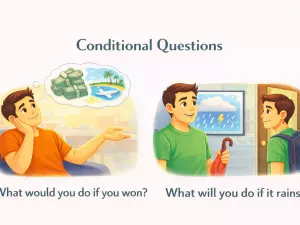
- Questions often target the result clause: What would you do if you won more free time?
Examples by typical use
- Advice: If I were you, I would talk to your manager.
- Dreaming/imagining: If I lived by the sea, I would swim every morning.
- Unlikely condition: If he knew the answer, he would tell us.
- Polite suggestion: If you had a minute, would you check this?
- Preference: If we started earlier, we would avoid traffic.
- Hypothetical ability: If she spoke Spanish, she could apply for that role.
- Weaker possibility: If they offered a discount, I might buy it.
- Contrary to fact now: If I didn’t have work tonight, I would join you.
- General hypothetical rule: If people recycled more, cities would be cleaner.
- Imaginary identity/status: If he were the boss, he would change the schedule.
- Hypothetical habit: If we had more space, we would host dinner parties.
- Conditional question: Would you move if you got a better offer?
Frequent errors and quick fixes
- ❌ If I will have time, I would help. → ✅ If I had time, I would help.
- ❌ If I would know, I would tell you. → ✅ If I knew, I would tell you.
- ❌ If she was you, she would... → ✅ If she were you, she would...
- ❌ If we would leave earlier, we would arrive on time. → ✅ If we left earlier, we would arrive on time.
Third conditional and unreal past forms
Use this pattern to talk about a past situation that did not happen and its imagined past result. The meaning is retrospective: you are looking back and describing an alternative history, often to explain regret, criticism, relief, or a lesson learned.
Core pattern and meaning
- Form: If + past perfect (had + past participle), would/could/might + have + past participle.
- Time reference: Both clauses refer to the past, but the situation is unreal (contrary to fact).
- Typical uses: regret (missed chances), blame (avoidable mistakes), praise (good decisions), speculation (unknown causes), and explanation (why something turned out a certain way).
Common variations (modals, negatives, and emphasis)
- Modal choice changes the meaning: “would have” (expected result), “could have” (ability/possibility), “might have” (uncertain possibility).
- Negative forms are frequent: If I hadn’t forgotten my passport, we wouldn’t have missed the flight.
- Either clause can be negative: If she had studied, she would have passed. / If she had studied, she wouldn’t have failed.
- Inversion for formal style (no if): Had I known, I would have called earlier.
- “If only” for strong regret: If only I had listened to your advice.
- “Even if” for contrast: Even if we had left earlier, we might have arrived late because of the storm.
- “But for / If it hadn’t been for” to highlight a single cause: But for your help, I would have given up.
- Reduced result clause in context: If you’d told me, I’d have helped.
Examples (expanded set)
- If I had set an alarm, I would have woken up on time.
- If they had taken the earlier train, they could have avoided the delay.
- If she had checked the address, she wouldn’t have gone to the wrong building.
- If we had brought cash, we might have paid the parking fee.
- Had you asked sooner, I would have had time to review your draft.
- If he hadn’t lied, the situation wouldn’t have escalated.
- If I had known about the meeting, I would have joined.
- If you had backed up the files, you could have restored everything.
- If the doctor had seen him earlier, they might have caught it sooner.
- If we had followed the map, we wouldn’t have gotten lost.
- If she had saved more, she could have traveled longer.
- If I hadn’t been so impatient, I wouldn’t have sent that message.
- If they had worn helmets, the injuries might have been less serious.
- If you had explained the rules, I wouldn’t have made that mistake.
- If the team had practiced more, they might have won.
- If I had remembered your birthday, I would have bought a gift.
Unreal past forms beyond conditionals
- Wish about the past: I wish I had taken that job. (I didn’t take it.)
- Regret with “should have”: I should have apologized earlier. (I didn’t, and it was a mistake.)
- Criticism with “could have”: You could have told me. (You didn’t, but it was possible.)
- Surprise with “would never have”: I would never have guessed he was a chef.
- Preference with “would rather” (past): I’d rather you hadn’t said that.
- As if / as though (past perfect for earlier unreal past): He acted as if he had never met us.
Frequent errors to avoid
- ❌ If I would have known, I would have called. → ✅ If I had known, I would have called.
- ❌ If she had studied, she would passed. → ✅ If she had studied, she would have passed.
- ❌ If we have left earlier, we would have arrived on time. → ✅ If we had left earlier, we would have arrived on time.
- ❌ If he didn’t forget, we wouldn’t have missed it. → ✅ If he hadn’t forgotten, we wouldn’t have missed it.
Mixed conditionals and typical meanings
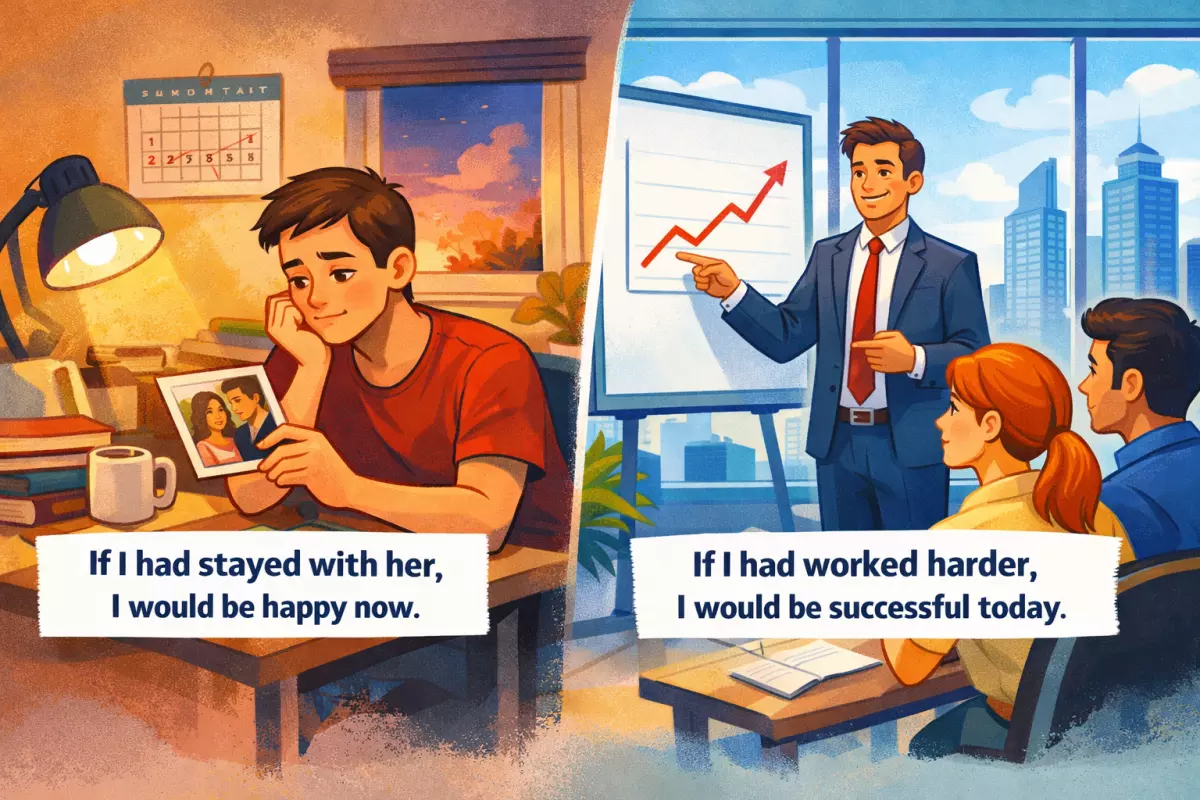
Mixed conditional patterns combine time references: one clause points to an unreal past situation, while the other clause describes a present result (or a present situation with a past result). They are used when the “cause” and the “effect” do not sit in the same time frame.
Core idea: match the time, not the label
Choose verb forms based on what time you mean in each clause. The if-clause usually states the unreal condition, and the main clause states the consequence. In mixed forms, one clause uses a past unreal form (past perfect), while the other uses a present unreal form (would + base verb, or sometimes could/might).
| Meaning (time relationship) | Typical form | Example |
|---|---|---|
| Past condition → present result | If + past perfect, would/could/might + base verb | If I had studied medicine, I would work in a hospital now. |
| Past condition → present state (often feelings/ability) | If + past perfect, would + base verb (be/know/have) | If she had taken that job, she would be happier today. |
| Present condition → past result | If + past simple, would/could/might + have + past participle | If I were more careful, I wouldn’t have made that mistake yesterday. |
| Present situation → past outcome (missed chance due to a current limitation) | If + past simple (were), could + have + past participle | If I were taller, I could have reached the shelf without help. |
Typical meanings and when they sound natural
- Past decision, present life: Use this when a past choice clearly shapes today. “If we had moved earlier, we would live closer to my parents now.”
- Past event, present condition: Often used for health, relationships, confidence, or status. “If he had slept more last week, he would feel better today.”
- Past mistake, present limitation: Common with “still,” “now,” and “these days.” “If I had saved more, I wouldn’t worry about money now.”
- Present personality, past consequence: Useful when a current trait explains a past outcome. “If she were more patient, she wouldn’t have argued with the client.”
- Present rule/requirement, past result: “If the policy were clearer, we wouldn’t have had so many complaints.”
- Present ability, past missed opportunity: “If I could speak Japanese, I could have handled that meeting.”
- Present circumstance, past problem: “If we had more staff, we wouldn’t have delayed the shipment.”
- Past cause, present certainty/opinion: “If they had checked the data, they would know the answer now.”
- Past cause, present relationship: “If you had told me the truth, I would trust you now.”
- Present condition, past safety/risk: “If the road were wider, the accident might not have happened.”
- Past training, present skill: “If I had practiced more, I could play confidently now.”
- Present health, past action: “If I were healthier, I would have joined the hike last weekend.”
Form reminders and common pitfalls
- Use past perfect in the if-clause for unreal past conditions: “If I had known …” (not “If I knew” when the condition is clearly past).
- Use would + base verb for an unreal present result: “I would be … now” (not “would have been” if the result is about today).
- Use would have + past participle for an unreal past result: “I would have called yesterday” (not “would call” if the consequence is in the past).
- Keep time markers consistent with meaning: “now/today/these days” usually point to a present result; “yesterday/last week/at the time” point to a past result.
- “If I were …” is the standard unreal form for present conditions (especially in writing): “If I were you, I would…”
- Modal choice changes the meaning: would (expected result), could (ability/possibility), might (uncertainty).
- Correct contrast: ✅ “If I had left earlier, I would be on time now.” ❌ “If I had left earlier, I would have been on time now.” (the second suggests the “on time” result is fully in the past).
Common mistakes with if and would
Errors with conditional sentences often come from mixing the verb form in the if-clause with the wrong verb form in the result clause. A reliable approach is to choose the time meaning first (real now, unreal now, unreal past, future possibility), then match the standard pattern.
Frequent pattern problems (and how to fix them)
- ❌ Using would in the if-clause (when it is not a special “willingness/politeness” meaning):
❌ If it would rain, we will stay home. → ✅ If it rains, we will stay home. - ❌ Mixing 1st and 2nd conditional forms:
❌ If I will see her, I would tell her. → ✅ If I see her, I will tell her. / ✅ If I saw her, I would tell her. - ❌ Using “will” after if for general future meaning (use present simple instead):
❌ If he will arrive late, call me. → ✅ If he arrives late, call me. - ❌ Using present simple for unreal situations:
❌ If I have more time, I would travel more. → ✅ If I had more time, I would travel more. - ❌ Using “would” + base verb for past regret (needs “would have” + past participle):
❌ If I had known, I would go. → ✅ If I had known, I would have gone. - ❌ Using “had” (past perfect) when the meaning is present unreal:
❌ If I had a car, I would drive to work. → ✅ If I had a car, I would drive to work. (Correct)
But: ❌ If I had been taller, I would buy this jacket. → ✅ If I were taller, I would buy this jacket. - ❌ Confusing “was” and “were” in formal/unreal conditionals:
✅ If I were you, I would apologize. (common in advice; “was” is also used informally) - ❌ Forgetting that “if” can be omitted only with inversion (formal):
❌ Had I known, I would have told you. (This is correct, but only because of inversion.)
❌ Had I knew, I would have told you. → ✅ Had I known, I would have told you. - ❌ Using “would” in both clauses by default:
❌ If you would study more, you would pass. → ✅ If you studied more, you would pass. - ❌ Using “would” when you mean a fact or routine:
❌ If water reaches 100°C, it would boil. → ✅ If water reaches 100°C, it boils. - ❌ Wrong tense after “if” in reported speech (backshift may apply):
❌ She asked if I would am ready. → ✅ She asked if I was ready. / ✅ She asked whether I was ready. - ❌ Using “would” instead of “could” for ability:
❌ If I had more time, I would finish it today. (possible, but focuses on choice/decision)
✅ If I had more time, I could finish it today. (focuses on ability/possibility) - ❌ Misplacing “only” and changing the meaning:
❌ If I only had listened, I would have avoided it. → ✅ If I had only listened, I would have avoided it. - ❌ Using “unless” with a negative verb (double negative meaning):
❌ Unless you don’t hurry, we’ll miss the train. → ✅ Unless you hurry, we’ll miss the train. - ❌ Confusing “if” (condition) with “when” (certainty):
✅ If it rains tomorrow, we’ll cancel. (not certain)
✅ When it rains in winter, the roads get slippery. (general truth) - ❌ Not matching time reference in mixed conditionals (possible, but must be logical):
❌ If I had studied medicine, I would be a doctor yesterday. → ✅ If I had studied medicine, I would be a doctor now.
When “would” in the if-clause is acceptable
- Willingness / refusal: If you would just listen, we could solve this quickly. (meaning “if you are willing to listen”)
- Polite requests: If you would sign here, please. (common in formal service contexts)
- Annoying repeated behavior (often with “always”): If he would always leave the door open, the house got cold. (literary/older style; many speakers prefer “kept”)
As a final check, test your sentence by replacing the if-clause with a time label: “real future possibility” usually takes present simple after if, while “unreal now” takes past simple, and “unreal past” takes past perfect. Then choose the result clause: will/can/may for real possibilities, would/could/might for unreal ones, and would have/could have/might have for past regrets.
Choosing the right conditional by meaning
Pick the conditional form based on two decisions: (1) how real the condition is (certain, possible, unlikely, unreal), and (2) which time you mean (general truth, present/future, past). Once the meaning is clear, the verb forms follow predictable patterns.
Match meaning to the usual verb pattern
- General truths and habits (always true):
Use zero conditional: If + present, present.
✅ If you heat ice, it melts. → scientific fact / routine result - Real future possibility (likely outcome):
Use first conditional: If + present, will/can/may + base verb.
✅ If it rains, we’ll stay inside. - Advice, rules, instructions (expected result):
Still If + present, but the main clause often uses imperative or modals like should.
✅ If you feel sick, call a doctor.
✅ If you’re unsure, you should ask. - Unreal or unlikely present/future (imagined situation):
Use second conditional: If + past simple, would/could/might + base verb.
✅ If I had more time, I would travel more. - Regrets and alternative past outcomes (unreal past):
Use third conditional: If + past perfect, would/could/might have + past participle.
✅ If we had left earlier, we would have caught the train. - Mixed time (past condition, present result):
Use a mixed conditional: If + past perfect, would + base verb for a present consequence.
✅ If I had studied medicine, I would work in a hospital now. - Mixed time (present condition, past result):
Use If + past simple, would have + past participle for a past consequence caused by a present situation.
✅ If I weren’t so shy, I would have spoken up at the meeting.
Common meaning “signals” that help you choose
- “Always/whenever/every time” often points to a general rule: If + present, present.
✅ Whenever I drink coffee late, I can’t sleep. - “Probably/definitely/there’s a good chance” suggests a real future: If + present, will.
✅ If you practice daily, you’ll improve quickly. - “Maybe/it’s possible” can still be first conditional, often with may/might.
✅ If they arrive early, we might start sooner. - “In case” is preparation, not a condition-result chain.
✅ Take an umbrella in case it rains. ❌ Take an umbrella if it will rain. - “What if…?” introduces imagined scenarios; the verb form depends on time.
✅ What if we miss the bus? (real possibility)
✅ What if I moved abroad? (imagined) - “If only…” expresses regret or wish: often second or third conditional meaning.
✅ If only I knew the answer.
✅ If only we had booked earlier. - Polite requests often use second-conditional forms to sound softer.
✅ If you could send it today, that would help. - Warnings/threats usually use first conditional for real consequences.
✅ If you touch that wire, you’ll get a shock. - Hypothetical planning often uses second conditional to explore options.
✅ If we rented a car, we could visit more places. - Blame and hindsight often use third conditional.
✅ If you had told me, I would have helped.
High-frequency form choices (with quick corrections)
- Use present after “if” for real future:
✅ If she comes, we’ll start. ❌ If she will come, we’ll start. - Use “were” for formal hypothetical meaning (all subjects):
✅ If I were you, I’d apologize. (common in advice) - Don’t confuse “would” in the if-clause with the main result:
✅ If I had the money, I would buy it.
❌ If I would have the money, I buy it. - Use “would” in the if-clause mainly for willingness/insistence (special meaning):
✅ If you would listen for a moment, I can explain. (willingness)
✅ If he would keep interrupting, I left. (annoying repeated behavior) - Choose modals to match meaning, not just the conditional number:
✅ If you finish early, you can leave. (permission)
✅ If I had seen it, I might have bought it. (uncertainty) - Remember that “unless” means “if not”:
✅ Unless you hurry, you’ll miss the train. → If you don’t hurry… - Use “provided (that)/as long as” for strict conditions:
✅ You can borrow it as long as you return it tomorrow.
Homework: conditional sentence practice tasks
These activities focus on choosing the correct verb forms, matching meaning to structure, and avoiding common pattern errors (especially tense shifts and modal misuse). Complete each set in order: start with form selection, then move to rewriting and mixed conditionals.
1) Choose the correct verb forms
- If she (has / had) more time, she would volunteer on weekends.
- If you heat ice, it (melts / would melt).
- If I (see / saw) him tomorrow, I’ll tell him the news.
- If they had left earlier, they (catch / would have caught) the train.
- If you (don’t / didn’t) interrupt, people can finish their point.
- If I were you, I (don’t / wouldn’t) mention that topic.
- If she (had studied / studied) harder, she would be more confident now.
- If we (hadn’t missed / didn’t miss) the turn, we wouldn’t be lost.
- If he (is / were) more careful, he wouldn’t make so many mistakes.
- If you (have / had) any questions later, email me.
Show answers
- had
- melts
- see
- would have caught
- don’t
- wouldn’t
- had studied
- hadn’t missed
- were
- have
2) Complete the conditional sentences (write the missing clause)
- If I had known about the meeting, __________________________.
- __________________________, I’ll call you right away.
- If water reaches 100°C, __________________________.
- If she weren’t so busy, __________________________.
- __________________________, we would have finished on time.
- If you had told me earlier, __________________________.
- If I get a day off next week, __________________________.
- If he had taken the medicine, __________________________.
Show answers
- …I would have gone (or: …I would have joined).
- If anything changes / If you need help
- …it boils.
- …she would come with us.
- If we had started earlier / If the files had been ready
- …I could have helped / …I would have planned differently.
- …I’ll visit my grandparents / …I’m going to rest.
- …he would have felt better.
3) Rewrite to change the conditional type (keep the meaning as close as possible)
- Original (real future): If it rains tomorrow, we’ll stay home. → Rewrite as an unreal present (hypothetical): __________________________.
- Original (unreal present): If I had more money, I would buy a better laptop. → Rewrite as a real future possibility: __________________________.
- Original (past regret): If she had set an alarm, she wouldn’t have been late. → Rewrite using “unless”: __________________________.
- Original (general truth): If you mix red and blue, you get purple. → Rewrite using “when” (same meaning): __________________________.
- Original (unreal present): If he were taller, he could reach the shelf. → Rewrite using “should” in the if-clause (keep it formal): __________________________.
- Original (past): If we had checked the address, we wouldn’t have gotten lost. → Rewrite as a mixed conditional (past cause, present result): __________________________.
Show answers
- If it rained tomorrow, we would stay home.
- If I have enough money, I’ll buy a better laptop.
- Unless she had set an alarm, she would have been late. (or: She wouldn’t have been late unless she had set an alarm.)
- When you mix red and blue, you get purple.
- Should he be taller, he could reach the shelf.
- If we had checked the address, we wouldn’t be lost now.
4) Error correction: fix the verb forms (one or more errors per sentence)
- If I will see her, I would tell her.
- If he would study more, he will pass.
- If you would have called me, I will have come.
- If I was you, I won’t do that.
- If they didn’t miss the bus, they wouldn’t have been late.
- If she had enough sleep, she wouldn’t have been so tired yesterday.
- If you heat water to 100°C, it would boil.
- If we would leave now, we arrive on time.
- If I had known, I would help you yesterday.
- If he doesn’t apologize, I would be upset.
Show answers
- If I see her, I will tell her. (or: If I saw her, I would tell her.)
- If he studies more, he will pass. (or: If he studied more, he would pass.)
- If you had called me, I would have come.
- If I were you, I wouldn’t do that.
- If they hadn’t missed the bus, they wouldn’t have been late.
- If she had had enough sleep, she wouldn’t have been so tired yesterday.
- If you heat water to 100°C, it boils.
- If we leave now, we will arrive on time. (or: If we left now, we would arrive on time.)
- If I had known, I would have helped you yesterday.
- If he doesn’t apologize, I will be upset. (or: If he didn’t apologize, I would be upset.)
5) Mixed conditionals: choose the best ending
Pick the ending (A, B, or C) that matches the time reference. Focus on whether the cause is in the past or present, and whether the result is in the present or past.
- If I had taken that job in 2020, I __________ now.
- A) will live abroad
- B) would be living abroad
- C) would have lived abroad
- If she weren’t so disorganized, she __________ her passport yesterday.
- A) wouldn’t have lost
- B) won’t lose
- C) didn’t lose
- If they had listened to the instructions, they __________ in trouble right now.
- A) wouldn’t be
- B) won’t be
- C) wouldn’t have been
- If he weren’t afraid of flying, he __________ with us last week.
- A) would travel
- B) would have traveled
- C) will have traveled
Show answers
- B
- A
- A
- B
6) Production task: write your own sentences using these patterns
- Write 2 examples of a zero conditional (facts/habits): If + present, present.
- Write 2 examples of a first conditional (real future): If + present, will/can/may + base verb.
- Write 2 examples of a second conditional (hypothetical present/future): If + past, would/could + base verb.
- Write 2 examples of a third conditional (past regret): If + past perfect, would/could have + past participle.
- Write 2 examples of a mixed conditional (past cause, present result): If + past perfect, would + base verb.
- Write 2 examples using inversion (formal): Should + subject + base verb, … / Had + subject + past participle, …
- Write 2 examples using alternatives: unless, as long as, provided that, in case.