Country, Nationality, and Language Nouns in Usage

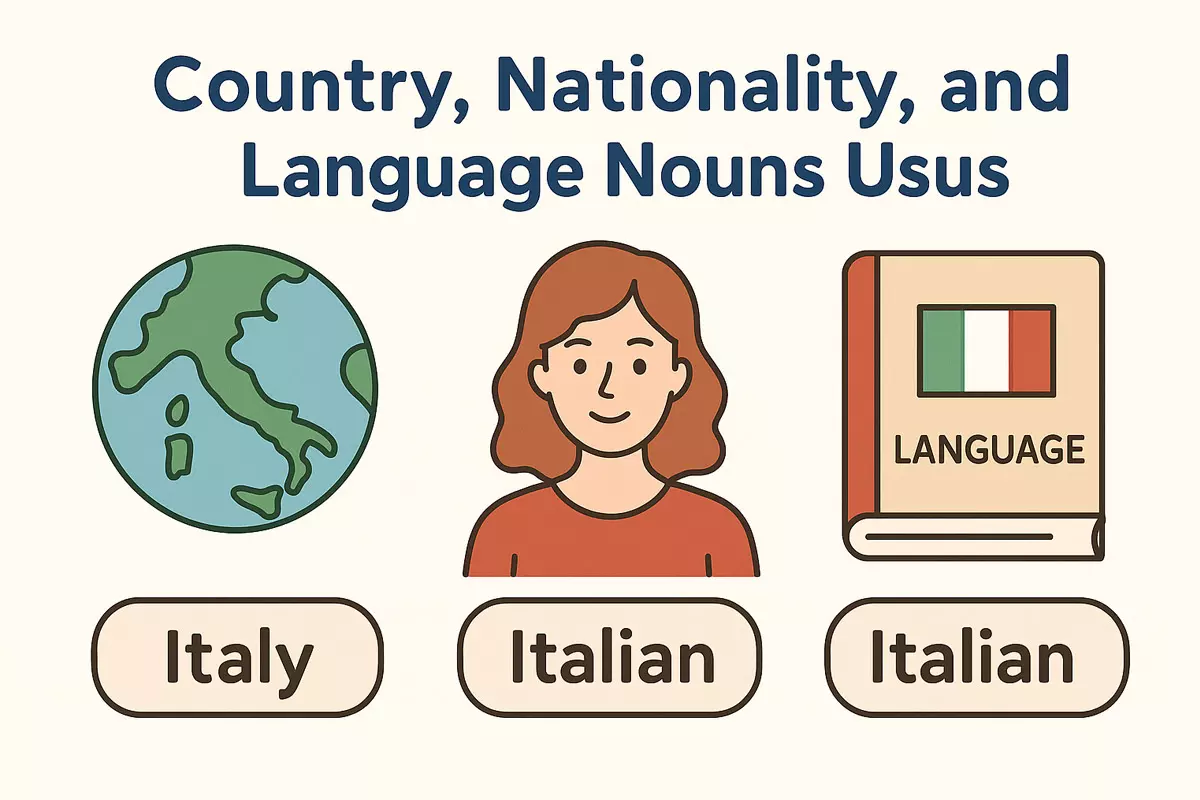 Here we the differences between country, nationality, and language nouns, how to form nationality terms, and when to use each. It also explains article and plural use, highlights common errors, and offers practice choosing correct forms.
- Difference between country, nationality, and language nouns
- Forming nationality nouns from country names
- Language names vs nationality names in usage
- Articles with country and nationality nouns
- Plural forms of nationality and people-group nouns
- Common learner errors with country-related nouns
- Practice: choose correct country, nationality, and language forms
Navigating how we refer to places, people, and languages can be surprisingly tricky in English, as the distinctions between country names, adjectives for nationality, and language terms are often subtle but important. Using the correct forms not only helps us express ourselves more accurately but also shows respect for different cultures and identities. For example, someone from Spain is Spanish and speaks Spanish, while a person from Brazil is Brazilian and speaks Portuguese. Paying attention to these details allows for clearer and more thoughtful communication in both casual and formal contexts.
Difference between country, nationality, and language nouns
Understanding how to distinguish between words for places, peoples, and languages is essential for clear communication. Each category—country, nationality, and language—serves a unique function in sentences and often has different word forms or spelling patterns. Misusing these terms can lead to confusion or even offense, so it helps to see how they work in practice.
What sets these terms apart?
Country nouns refer to geographical entities or sovereign states. Nationality nouns describe the people who come from those places or their identity. Language nouns name the speech or writing systems associated with a country or group. For example:
- Country: France, Japan, Brazil
- Nationality: French, Japanese, Brazilian
- Language: French, Japanese, Portuguese
Common patterns and differences
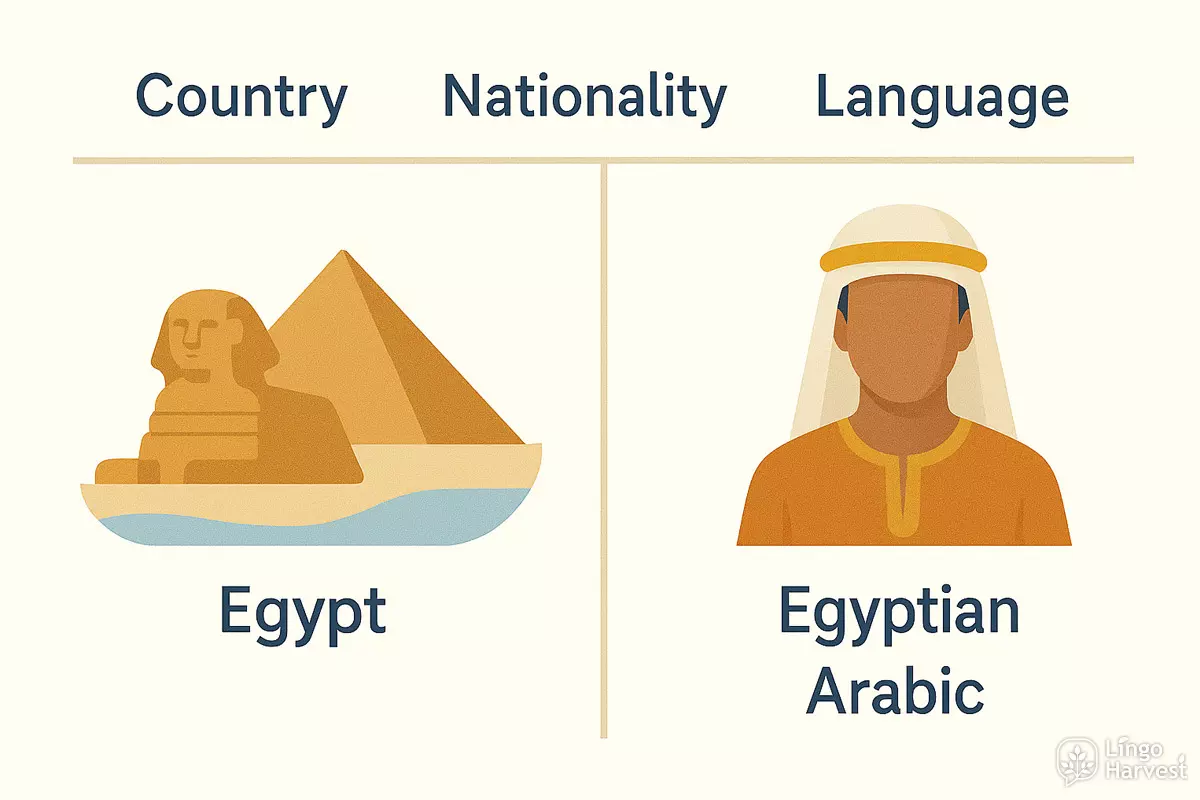
Sometimes, nationality and language nouns look the same (e.g., “Spanish” for both people and the language), but in other cases, all three forms are distinct (“Germany”, “German”, “German”). Below is a table showing several examples to illustrate these differences:
| Country | Nationality | Language |
|---|---|---|
| Italy | Italian | Italian |
| Russia | Russian | Russian |
| China | Chinese | Chinese |
| Netherlands | Dutch | Dutch |
| Switzerland | Swiss | German / French / Italian |
| Turkey | Turkish | Turkish |
| Egypt | Egyptian | Arabic |
| Greece | Greek | Greek |
| Brazil | Brazilian | Portuguese |
| United Kingdom | British | English |
| Poland | Polish | Polish |
| Spain | Spanish | Spanish |
Usage notes
Remember that country nouns are usually used with “in” or “from” (e.g., “She lives in Canada”). Nationality nouns can serve as adjectives or as nouns (e.g., “He is Canadian,” “the Canadians”). Language nouns are most often used after “speak,” “write,” or “learn” (e.g., “They speak Russian”). Some countries have more than one official language, and not all nationalities match the language spoken (for instance, Swiss people might speak German, French, or Italian).
Summary
In summary, knowing the distinctions between these categories helps you express ideas about place, identity, and communication more accurately. It’s worth memorizing the forms for countries you talk about often, as patterns are not always predictable.
Forming nationality nouns from country names
Understanding how to convert country names into words that identify people from those countries is an essential part of English vocabulary. These terms, often called demonyms, can be used to describe individuals, groups, or sometimes even things associated with a particular nation. The process isn’t always straightforward, as English relies on various suffixes, irregular forms, and historical influences.
Common suffixes for nationality nouns
Most English demonyms are formed by adding a typical ending to the country’s name. The most frequent suffixes include -an, -ian, -ese, -i, and -ish. However, some nationalities are entirely unique and do not follow a clear pattern. Here’s a breakdown of common endings:
- -an: Canada → Canadian, Mexico → Mexican
- -ian: Russia → Russian, Brazil → Brazilian
- -ese: Japan → Japanese, Vietnam → Vietnamese
- -i: Pakistan → Pakistani, Iraq → Iraqi
- -ish: Spain → Spanish, England → English
Irregular and unique forms
Some nationality terms don’t use standard suffixes and instead have unique or irregular forms. For example, people from France are called French, not “Francian” or “Franchese.” Similarly, the term for someone from the Netherlands is Dutch. These forms often come from older versions of English or borrowings from other languages.
Examples of country names and their nationality nouns
Below is a table illustrating a range of country names alongside their corresponding nationality terms. This comparison highlights both regular patterns and notable exceptions.
| Country | Nationality Noun |
|---|---|
| Argentina | Argentine / Argentinian |
| China | Chinese |
| Egypt | Egyptian |
| France | French |
| Germany | German |
| Greece | Greek |
| Hungary | Hungarian |
| India | Indian |
| Italy | Italian |
| Japan | Japanese |
| Morocco | Moroccan |
| Netherlands | Dutch |
| Norway | Norwegian |
| Poland | Polish |
| Portugal | Portuguese |
| Russia | Russian |
| Sweden | Swede / Swedish |
| Thailand | Thai |
| Turkey | Turk / Turkish |
| United States | American |
Noteworthy points and usage tips
When learning or using these terms, watch for exceptions and pluralization rules. Some demonyms are both singular and plural (e.g., “the Japanese”), while others change form (“a Swede,” “the Swedes”). Pay attention to context, as some forms may be more formal or informal. If in doubt, consult a reliable dictionary to confirm the correct word for people from any specific country.
Language names vs nationality names in usage
In everyday communication, people often confuse the names for languages with the terms for nationalities. While both relate to countries, their usage in English follows clear patterns. Typically, the nationality word refers to a person’s origin or citizenship, while the language term refers to the method of communication. It’s important to use the right form, especially in formal settings or academic writing.
When to use the language name
Use the language name when talking about what someone speaks, writes, understands, or studies. For example, “She speaks German,” not “She speaks Germanian.” Also, language names are not usually used with articles (“the,” “a,” “an”) except in certain idiomatic expressions.
When to use the nationality word
Nationality terms describe a person’s country of origin or citizenship. They are used as nouns (“He is a Canadian”) or adjectives (“French cuisine”). These words are not typically used to describe the language someone speaks. For example, “He is a Spaniard,” but “He speaks Spanish.”
Common distinctions: Language vs. nationality
Here is a comparison of how language and nationality terms differ in form and usage for several countries:
| Country | Nationality (person/adj.) | Language | Example Sentences |
|---|---|---|---|
| Germany | German | German | He is German. She speaks German. |
| Spain | Spanish / Spaniard | Spanish | They are Spanish. He is a Spaniard. We study Spanish. |
| Russia | Russian | Russian | She is Russian. They write in Russian. |
| Brazil | Brazilian | Portuguese | He is Brazilian. She speaks Portuguese. |
| China | Chinese | Chinese / Mandarin | She is Chinese. They speak Mandarin. |
| Greece | Greek | Greek | He is Greek. She reads Greek. |
| Japan | Japanese | Japanese | She is Japanese. He writes in Japanese. |
| Turkey | Turkish | Turkish | They are Turkish. She studies Turkish. |
| France | French | French | He is French. They speak French. |
| Egypt | Egyptian | Arabic | She is Egyptian. They speak Arabic. |
| United Kingdom | British / English, Scottish, Welsh | English | He is British. She speaks English. |
| Italy | Italian | Italian | He is Italian. She learns Italian. |
Typical mistakes
- ❌ Incorrect: “He speaks Canadian.” → Correct: “He speaks English/French.”
- ❌ Incorrect: “She is a Portuguese.” → Correct: “She is Portuguese.”
- ❌ Incorrect: “They write in Egyptian.” → Correct: “They write in Arabic.”
Remember, using the right term clarifies meaning and avoids confusion. If in doubt, check which form is standard for describing a person versus the language they use. This distinction is especially important with countries where the nationality and language words differ significantly.
Articles with country and nationality nouns
Understanding when to use articles with names of countries, nationalities, and related nouns can be tricky in English. Generally, countries are used without an article, but there are notable exceptions. The presence or absence of an article often depends on grammar patterns, historical reasons, or whether the noun is singular, plural, or modified by an adjective.
When not to use an article
- Most single-word country names do not require an article: France, Brazil, Japan.
- Nationalities as adjectives or nouns are typically article-free: She is Italian. / Italians are friendly.
- Languages are used without articles: He speaks Russian.
When to use "the" with country or nationality nouns
Some country names and nationality terms require "the," especially for plural or descriptive forms. This often applies to:
- Countries with plural names: the Netherlands, the Philippines, the United States.
- Countries with "republic," "kingdom," or similar: the United Kingdom, the Czech Republic, the United Arab Emirates.
- National groups in the plural: the French, the Chinese (when referring to people as a group).
Common patterns and tricky cases
| Form | Example |
|---|---|
| Single-word country (no article) | I visited Italy last year. |
| Plural country name ("the" required) | She moved to the Netherlands. |
| Country with "Republic"/"Kingdom" ("the" required) | He is from the United Kingdom. |
| Nationality as adjective (no article) | My friend is Brazilian. |
| Nationality as plural group ("the" + plural) | The Germans are known for their engineering. |
| Language (no article) | They study Spanish at school. |
Quick reference: article usage
- ✅ No article: Canada, Egyptian, Hindi
- ✅ Use "the": the Bahamas, the Swiss (as a group), the United States
- ❌ Avoid "the" with: languages, most single-word countries, adjectives for nationality
In summary, article usage with country and nationality terms depends on the specific structure of the noun. When in doubt, check if the name is plural or contains words like "republic," as these almost always take "the." For languages and single-word countries, articles are generally omitted.
Plural forms of nationality and people-group nouns
Understanding how to form plurals for words describing nationalities and groups of people is essential for accurate and natural English. These terms don't always follow standard pluralization patterns, and some have unique or irregular forms.
Standard and irregular plural formations
Most nationality words ending in -an, -ian, or -ese have specific pluralization rules. For example, "American" becomes "Americans" in the plural, simply adding an "s." However, words like "Japanese" or "Chinese" are both singular and plural without change. Similarly, some group names, such as "the French" or "the Swiss," use the same form for both singular and plural references.
Common patterns and exceptions
Certain endings and forms are worth noting, as they often signal how to create the plural:
- -an/-ian: Add "s" (e.g., Brazilian → Brazilians, Russian → Russians).
- -ese: No change (e.g., Vietnamese → Vietnamese, Portuguese → Portuguese).
- -ch/-sh (used for groups): Often add "the" (e.g., the French, the Dutch).
- Irregular forms: Some are unique (e.g., person from Greece: Greek → Greeks; person from Israel: Israeli → Israelis).
- Collective nouns: Some groups use a plural form only in context (e.g., "the British" refers to the people collectively).
Plural forms by word ending
| Singular Form | Plural Form | Notes/Examples |
|---|---|---|
| American | Americans | Regular "-s" ending |
| Chinese | Chinese | No change in plural |
| French | the French | Used with "the" for group |
| Russian | Russians | Regular "-s" ending |
| Swiss | the Swiss | Same form, used with "the" |
| Israeli | Israelis | Irregular "-i" to "-is" |
| Portuguese | Portuguese | No plural change |
| Greek | Greeks | Standard "-s" ending |
| Turk | Turks | Standard "-s" ending |
| Dutch | the Dutch | Collective, unchanged |
Usage tips
When referring to the people of a nation as a group, it is common to use "the" before the nationality ("the Italians," "the Swiss"). Some demonyms double as adjectives and nouns, so context is important. Remember that for words like "Japanese," "Chinese," or "Swiss," the form does not change but still refers to multiple people. For other terms, adding "s" is the norm. Understanding these patterns helps avoid errors and ensures your writing sounds natural when talking about groups from different countries.
Common learner errors with country-related nouns
Learners of English often struggle with distinguishing between nouns for countries, nationalities, and languages. This confusion can lead to incorrect sentences, especially when choosing which form to use for people, languages, or places. Recognizing these mix-ups is essential for clear communication.
Mixing up country, nationality, and language forms
One frequent issue is using the wrong word form when referring to a person, language, or the country itself. For example, saying "He speaks Frenchman" instead of "He speaks French," or "She is from Germany nationality" instead of "She is German." These mistakes can make sentences sound unnatural or confusing.
Examples of incorrect and correct usage
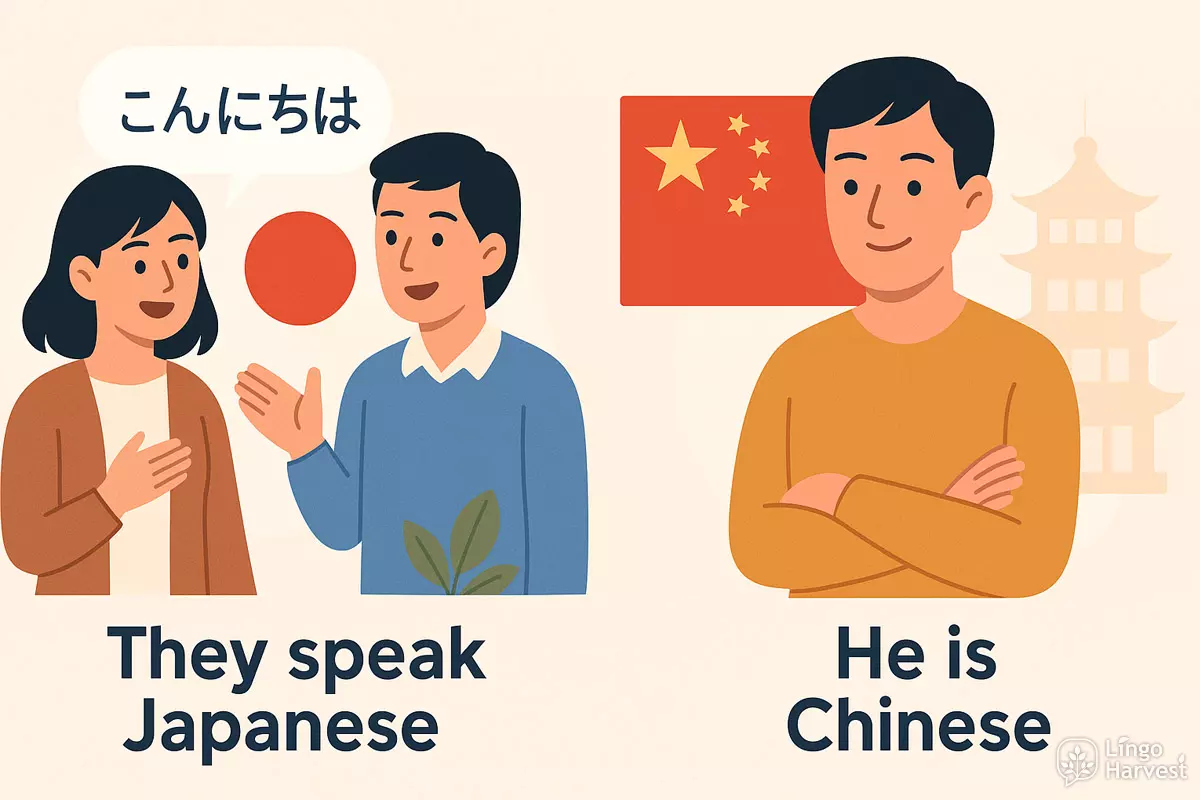
Below are some common mistakes and their correct forms. Pay attention to how the noun changes depending on whether you’re talking about a country, its people, or the language.
- ❌ She speaks Spain. → ✅ She speaks Spanish.
- ❌ He is a France. → ✅ He is French.
- ❌ I like Italian food from Italy nationality. → ✅ I like Italian food from Italy.
- ❌ They speak Japan. → ✅ They speak Japanese.
- ❌ She is Russia. → ✅ She is Russian.
- ❌ He is a China. → ✅ He is Chinese.
- ❌ Are you from Britain nationality? → ✅ Are you British?
- ❌ She speaks Germany. → ✅ She speaks German.
- ❌ He is an America. → ✅ He is American.
- ❌ Do you speak Turkey? → ✅ Do you speak Turkish?
- ❌ I met a Canada. → ✅ I met a Canadian.
- ❌ She is a Brazil. → ✅ She is Brazilian.
- ❌ He speaks Greece. → ✅ He speaks Greek.
- ❌ They are Egypt. → ✅ They are Egyptian.
- ❌ Is he a Poland? → ✅ Is he Polish?
- ❌ She is Sweden. → ✅ She is Swedish.
Plurals and collective forms
Another source of error is using country adjectives as plural nouns for groups of people. For example, saying "the Frenchs" instead of "the French" or "the Germans" for "German people." Some demonyms are always plural, while others look like adjectives but refer to people collectively.
| Country | Correct form for people (plural) | Incorrect |
|---|---|---|
| France | the French | the Frenchs |
| China | the Chinese | the Chineses |
| Germany | the Germans | the Germanys |
| Japan | the Japanese | the Japaneses |
| Russia | the Russians | the Russias |
| Spain | the Spanish | the Spanishs |
| Greece | the Greeks | the Greece |
| Turkey | the Turks | the Turkeys |
Summary tips
To avoid these pitfalls, remember:
- Use the country name for places ("France is beautiful").
- The nationality adjective describes people ("She is French").
- The language form is for what people speak ("He speaks French").
- Beware of irregular plural forms for groups ("the Chinese," not "the Chineses").
Mastering these distinctions will help you sound more natural and confident when talking about countries, nationalities, and languages.
Practice: choose correct country, nationality, and language forms
Understanding the differences between country names, nationalities, and languages is essential for clear and accurate communication. Below you'll find a variety of exercises to help reinforce correct usage in context, along with some common patterns and exceptions.
Task 1: Match the correct form
Choose the correct word (country, nationality, or language) to complete each sentence:
- She is from _________. She is _________. She speaks _________. (France)
- They are _________. They live in _________. They speak _________. (Japan)
- He comes from _________. He is _________. He speaks _________. (Brazil)
- We are _________. We speak _________. We come from _________. (Germany)
- Maria is _________. Her country is _________. She speaks _________. (Russia)
- He is from _________. He is _________. He speaks _________. (Italy)
- They are _________. They come from _________. They speak _________. (Spain)
- She is _________. She lives in _________. She speaks _________. (China)
- We are _________. Our country is _________. We speak _________. (Mexico)
- He comes from _________. He is _________. He speaks _________. (Canada)
Show answers
- France, French, French
- Japanese, Japan, Japanese
- Brazil, Brazilian, Portuguese
- German, German, Germany
- Russian, Russia, Russian
- Italy, Italian, Italian
- Spanish, Spain, Spanish
- Chinese, China, Chinese
- Mexican, Mexico, Spanish
- Canada, Canadian, English
Task 2: Identify the type
Decide if each word is a country, a nationality, or a language:
- Spain
- Swedish
- Canada
- Italian
- Arabic
- China
- Turkish
- Poland
- Hindi
- Mexican
Show answers
- Spain – country
- Swedish – nationality/language
- Canada – country
- Italian – nationality/language
- Arabic – language
- China – country
- Turkish – nationality/language
- Poland – country
- Hindi – language
- Mexican – nationality
Common Patterns and Irregularities
Some country, nationality, and language forms are regular, while others have unique patterns. Review the table below for a comparative overview:
| Country | Nationality | Language | Example Sentence |
|---|---|---|---|
| Italy | Italian | Italian | He is Italian. He speaks Italian. |
| Egypt | Egyptian | Arabic | She is Egyptian. She speaks Arabic. |
| United Kingdom | British | English | They are British. They speak English. |
| Netherlands | Dutch | Dutch | He is Dutch. He speaks Dutch. |
| China | Chinese | Chinese (Mandarin) | She is Chinese. She speaks Mandarin. |
| Sweden | Swedish | Swedish | He is Swedish. He speaks Swedish. |
| Greece | Greek | Greek | She is Greek. She speaks Greek. |
| Turkey | Turkish | Turkish | He is Turkish. He speaks Turkish. |
| Brazil | Brazilian | Portuguese | They are Brazilian. They speak Portuguese. |
| Russia | Russian | Russian | He is Russian. He speaks Russian. |
Task 3: Choose the correct word
Select the appropriate country, nationality, or language to fill in the blank.
- My friend is ________ (from Spain). She speaks ________.
- Ahmed is ________ (from Egypt). He speaks ________.
- We are ________ (from Canada). We speak ________ and ________.
- Anna is ________ (from Poland). She is ________.
- They are ________ (from the Netherlands). Their language is ________.
- He is ________ (from Italy). He speaks ________.
- She is ________ (from Japan). She speaks ________.
- They are ________ (from Brazil). They speak ________.
- We are ________ (from Germany). We speak ________.
- He is ________ (from Mexico). He speaks ________.
Show answers
- Spanish, Spanish
- Egyptian, Arabic
- Canadian, English, French
- Polish, Polish
- Dutch, Dutch
- Italian, Italian
- Japanese, Japanese
- Brazilian, Portuguese
- German, German
- Mexican, Spanish
These activities help you distinguish between country names, nationalities, and languages in practical contexts. Pay attention to irregular forms and exceptions, especially for countries where the language name differs from the nationality.