English Stress Pattern Calculator for Words and Sentences

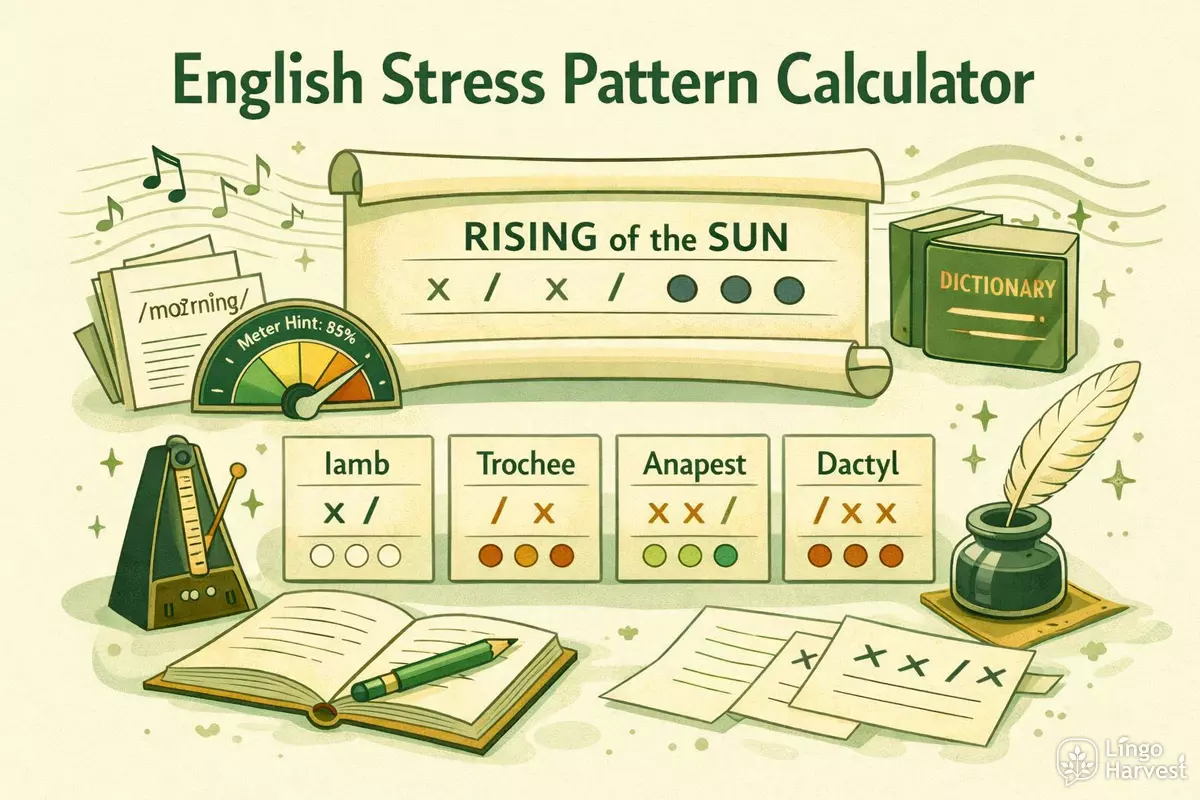 This English Stress Pattern Calculator shows how strong and weak syllables form rhythm inside sentences, verses, poems, and lyrics. It uses CMU dictionary data to analyse word stress, detect clashes, estimate meter types, and highlight rhythm issues line by line. Great for writers and learners.
- What this stress calculator does
- How stress is detected and calculated
- English meter patterns and rhythm hints
- Understanding strong–weak stress symbols
- Line breakdown table and colour codes
- Dictionary coverage and accuracy notes
- Tips for poets, teachers, and writers
- FAQ about the Stress Pattern Calculator
What this stress calculator does
The English Stress Pattern Calculator analyses any pasted English text and shows how syllable stress is distributed across words and lines. It reveals where strong and weak syllables fall, highlights rhythm clashes, suggests possible meter types, and provides visual beat mapping.
Unlike simple syllable counters, this tool builds a detailed rhythmic structure: it separates text into lines or sentences, measures syllable counts, marks stress with x/ symbols, and displays a beat pattern under each unit. This helps writers, poets, lyricists, and learners understand whether their text sounds natural or rhythmically unbalanced.
The calculator is designed to assist with poetry editing, speech preparation, pronunciation practice, and stylistic rhythm shaping. If you are aiming for musical English rhythm, this tool gives immediate structural feedback.
How stress is detected and calculated
The system runs a two-layer analysis. First, it searches the CMU dictionary to extract official stress patterns, syllable counts, and primary stress positions. If a word exists in the database, its true stress pattern is displayed with high accuracy.
If a word is not in the dictionary, the tool switches to a heuristic model. It estimates syllables using vowel-cluster patterns and predicts stress positions based on English suffix rules (for example, -tion, -ic, -graphy). Function words are automatically treated as weak to reflect natural spoken English rhythm.
| Analysis stage | What happens | Example output |
|---|---|---|
| Dictionary match | Exact stress & syllables pulled from CMU data | morning → / x (2 syllables) |
| Heuristic fallback | Rule-based estimate if word not found | raindrops → / x (2 syllables) |
| Function-word adjustment | Grammar words forced into weak stress | to / the / a → always x |
| Beat construction | Every syllable becomes x or / | x / x / x / |
English meter patterns and rhythm hints
In traditional English poetry, rhythm is organised into repeating patterns of weak and strong syllables called meter. The most common patterns are iambs, trochees, anapests, and dactyls. Each pattern has its own “heartbeat” that you can feel when you read a line aloud.
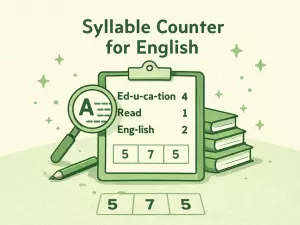
Want to check syllable counts before analysing rhythm? Try our English Syllable Counter with a 5–7–5 Poetry Mode for haiku validation.
The Stress Pattern Calculator analyses your line of text, builds a sequence of weak (x) and strong (/) syllables, and then compares this pattern to ideal metrical templates. It does not force your text into one meter, but instead shows which pattern is the best match and how strong that match is in percentage form.
| Meter type | Pattern (weak / strong) | Typical feel of the line | Simple example |
|---|---|---|---|
| Iamb | x / | Rising, natural, close to everyday English | to DAY, a WALK |
| Trochee | / x | Falling, firm, slightly heavier at the start | TAble, MORning |
| Anapest | x x / | Flowing, rolling, good for movement and travel | in the DARK, on the ROAD |
| Dactyl | / x x | Strong opening followed by two lighter beats | EL e phant, BEAU ti ful |
If your line matches one pattern quite well (for example, iambic with a high score), the calculator will show that in the “Meter hint” field. If the match is low, your text is likely closer to free verse or prose, which is also perfectly normal for many types of writing.
Understanding strong–weak stress symbols
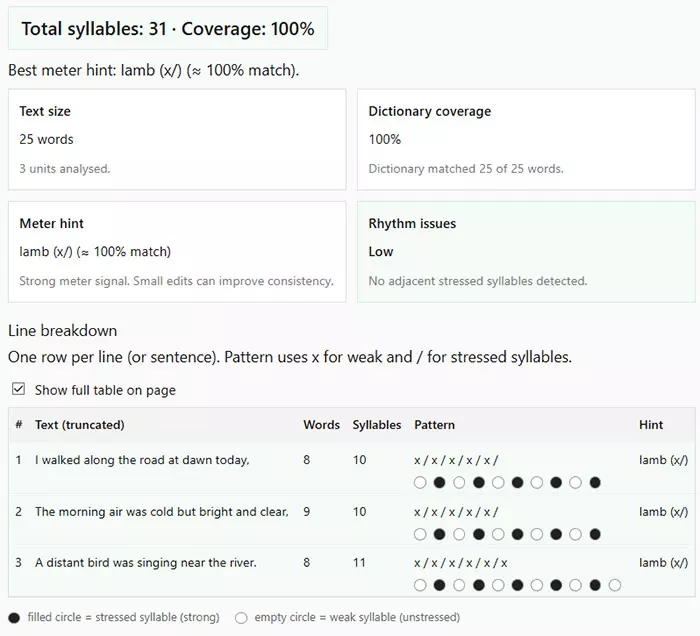
The calculator uses two core symbols to represent stress: x for a weak syllable and / for a stressed syllable. Together they form a visual map of your line, for example: x / x / x /. This pattern shows how the rhythm moves between light and strong beats.
Below each line in the detailed table, you also see a small row of circles: filled circles for strong syllables and empty ones for weak syllables. This makes it easier to read the pattern at a glance without focusing on every symbol.
- x (weak) — usually function words or unstressed syllables inside a longer word.
- / (strong) — the syllables you naturally emphasise when speaking.
- Clusters of / — indicate possible stress clashes that can make the line heavier.
When you compare different versions of a line, you can see how small changes in wording shift the x / pattern. This helps you smooth out pronunciation, control rhythm in poems and lyrics, and avoid unintentionally heavy or flat-sounding sentences.
Line breakdown table and colour codes
The calculator generates a detailed breakdown table for every line or sentence you paste. Each row shows truncated text, total words, total syllables, the stress pattern, and a meter hint. Rows are colour-coded to help you instantly see rhythm quality.
Green rows mark lines with strong meter consistency and no stress clashes. Yellow rows mark lines that are mostly smooth but contain minor irregularities. Red rows highlight lines where rhythm breaks down or where multiple strong syllables collide.
| Colour code | Meaning | Typical reason |
|---|---|---|
| Green | Strong rhythm match | Clear meter, no clash (/ /) pairs |
| Yellow | Moderate rhythm | One clash or mixed syllable balance |
| Red | Irregular rhythm | Multiple clashes, weak meter signal |
This visual feedback helps users understand the rhythmic structure line by line rather than relying on intuition alone. For poets and editors, this removes guesswork and speeds up rewriting decisions.
Dictionary coverage and accuracy notes
The calculator uses a CMU-based dictionary system to pull stress patterns and syllable counts for recognised English words. These entries come from academic phonetic notation and reflect standard American pronunciation.
If a word is not in the dictionary, the tool switches to heuristic logic: vowel clustering, suffix analysis, and algorithmic stress prediction. This hybrid approach keeps accuracy high without blocking uncommon or invented words used in creative writing.
| Word type | Dictionary success rate | Example |
|---|---|---|
| Common vocabulary | Very high | river, morning, silence |
| Specialised terms | High | linguistic, photographic |
| Invented/poetic words | Estimated stress only | moonlightish, starbounder |
Because stress differs by accent and region, the output should be read as a guide, not a strict rulebook. For most learners and writers, the calculator gives reliable stress maps that match everyday English rhythm.
Tips for poets, teachers, and writers
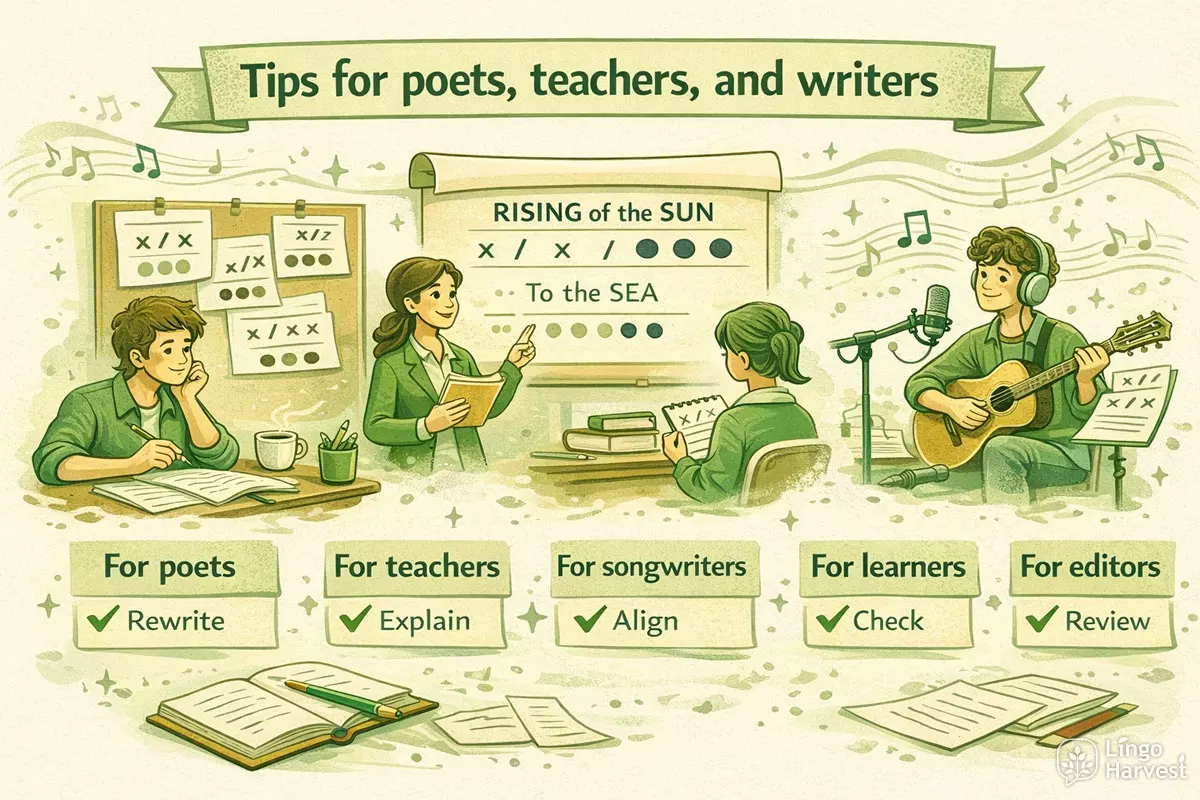
This calculator becomes most useful when treated as a drafting and editing assistant rather than a final judgement tool. Writers can experiment with word choice, restructure lines, and instantly see how stress patterns shift. Teachers may use it to demonstrate pronunciation and meter visually to students. Poets and lyricists can refine rhythm to match a target meter or musical beat.
- For poets: Compare multiple rewrites of a line to reduce clashes and move closer to an iambic or trochaic flow.
- For teachers: Present rhythm visually, helping students understand why some words are stressed and others reduced.
- For songwriters: Align stressed syllables with melody beats to produce smoother vocal phrasing.
- For learners: Paste short sentences and check which syllables need emphasis when speaking aloud.
- For editors: Check text sections for accidental heavy rhythm patterns that make reading uncomfortable.
The more versions you test, the more you will understand how English rhythm reacts to small changes such as switching adjectives, removing filler words, or adjusting sentence length.
FAQ about the Stress Pattern Calculator
1. Does the calculator show perfect stress?
Not always. It reflects standard American dictionary stress, but real-world pronunciation varies by accent, context, and speaker intention. Treat the results as a high-level map rather than an exact phonetic recording.
2. Why do weak function words always appear as “x”?
English reduces function words in natural speech. Marking them as weak by default creates a more realistic meter pattern and prevents false rhythm spikes in verse and prose.
3. Can the tool analyse song lyrics?
Yes. Lyrics can be pasted in using line breaks, and the output will highlight stress structure and clashes, helping align lyrics with music beats.
4. Why do some lines show a low meter score?
Poetry and prose are often mixed forms. If your text uses free rhythm, the calculator won’t force a match—so a low score simply means the line does not follow a repeating metrical pattern, which is common in modern writing.
5. Does the calculator support long texts?
Yes, up to 5,000 words. However, browsing the table may be easier if you analyse in smaller sections when working with poetry drafts or manuscripts.