Prepositions in English Song Lyrics: Usage Patterns and Meaning

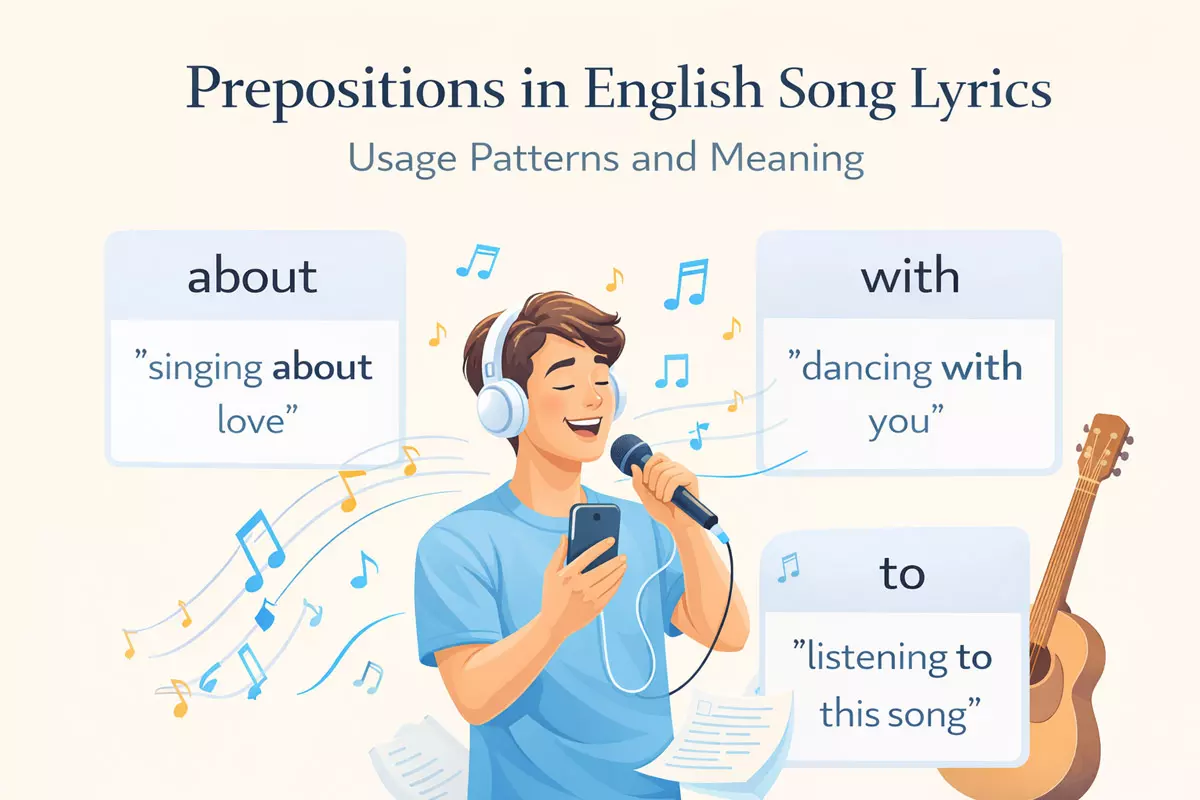 The article examines how song lyrics use non-standard prepositions for rhythm, rhyme, and regional style, explores reductions and metaphors, discusses dropped prepositions, narrative effects, and provides activities to distinguish artistic choices from standard grammar.
- The Poetic License: Analyzing non-standard prepositional use for rhythm and rhyme
- Dialectal Markers: Identifying AAVE and regional preposition patterns in Blues, Jazz, and Hip-Hop
- Informal Reductions: Understanding 'outta', 'offa', and 'gonna' in the context of prepositional phrases
- Metaphorical Mapping: How 'under', 'over', and 'through' symbolize emotional journeys in lyrics
- Ellipsis in Verse: Dropped prepositions and their effect on musical phrasing and urgency
- Narrative Perspective: Prepositions as tools for establishing the 'I-Thou' relationship in songs
- Activity: Dissecting lyrical excerpts to differentiate between artistic choice and standard grammar
English songs use small words like in, on, and with not only to shape rhythm, but also to create emotional depth and subtle meaning. Whether in heartfelt ballads or catchy pop anthems, these connectors play a key role in how lyrics flow and how listeners interpret the message. By examining how these words appear in different songs, we can discover unexpected patterns and better understand the nuanced ways in which language influences both the mood and the storytelling of popular music.
The Poetic License: Analyzing non-standard prepositional use for rhythm and rhyme
Songwriters often bend grammatical conventions, especially with prepositions, to fit a melody or achieve a desired rhyme. This creative manipulation isn't random—it's a deliberate stylistic choice that shapes the song's mood and memorability. In English lyrics, prepositions may be added, omitted, or swapped, resulting in lines that sound more natural in context, even if they defy standard grammar.
Common Patterns of Prepositional Flexibility
Writers and performers frequently play with prepositions to suit the rhythm and rhyme scheme. Some typical deviations include:
- Dropping prepositions for brevity or meter (e.g., “Walking the street” instead of “Walking on the street”)
- Adding extra prepositions for emphasis or rhythm (“Out on the town” instead of “Out in town”)
- Using non-standard combinations (“Dreaming about of you”)
- Reversing expected order (“The place where I’m at” instead of “The place where I am”)
- Substituting one preposition for another (“In the night” vs. “At night”)
- Ending lines with prepositions to maintain rhyme (“That’s the one I’m thinking of”)
- Omitting prepositions in phrasal verbs (“Turn the lights” instead of “Turn on the lights”)
- Inserting archaic or poetic forms (“Upon a midnight dreary”)
- Preferring informal speech (“By my side” instead of “Beside me”)
- Splitting prepositional phrases for effect (“Down the road I go”)
- Using prepositions for internal rhyme (“All around the town”)
- Stacking prepositions for emphasis (“Up above the world so high”)
- Changing standard collocations (“Waiting on a friend” instead of “Waiting for a friend”)
- Repetition for musicality (“Over and over and over again”)
- Preposition doubling (“From out of nowhere”)
When Rhythm Trumps Grammar
The demands of melody and rhyme often outweigh grammatical correctness in lyrics. In many cases, non-standard uses are more memorable or emotionally resonant. For example, the phrase “Where are you at?” adds an extra syllable, smoothing the line into the rhythm, even though it’s not strictly “correct.”
Examples: Standard vs. Lyric Prepositional Choices
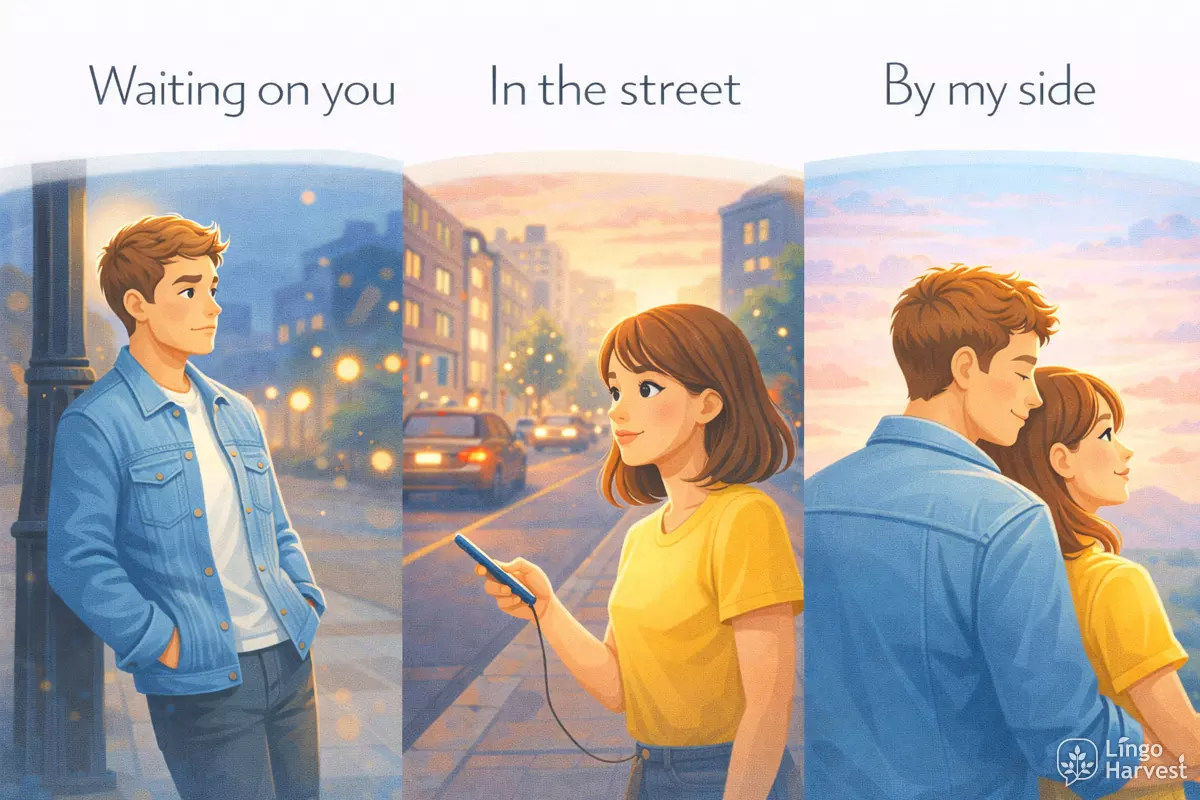
Below is a comparison of standard grammatical forms and their altered versions found in popular songs. These variations highlight how flexibility with prepositions can enhance musicality:
| Standard Form | Lyric Adaptation |
|---|---|
| Waiting for you | Waiting on you |
| On the street | In the street |
| Beside me | By my side |
| At night | In the night |
| Thinking of you | Thinking about you |
| Turn on the lights | Turn the lights |
| From nowhere | From out of nowhere |
| Over and over | Over and over again |
| Upon the table | On the table |
| Where are you? | Where are you at? |
Why Listeners Accept Non-Standard Usage
Listeners rarely object to these deviations; instead, they may find them more relatable or catchy. The context of music allows for a suspension of grammatical rules, prioritizing emotion, rhythm, and memorability. This freedom gives songwriters a powerful tool to connect with audiences, even when the language strays from the textbook norm.
Dialectal Markers: Identifying AAVE and regional preposition patterns in Blues, Jazz, and Hip-Hop
Exploring the language of Blues, Jazz, and Hip-Hop lyrics reveals distinctive preposition usage that reflects both African American Vernacular English (AAVE) and various regional dialects. These styles often bend or break standard English conventions, creating unique grammatical patterns that communicate identity, emotion, and cultural context.
AAVE Prepositional Patterns in Song Lyrics
AAVE, commonly heard in Hip-Hop and Blues, frequently features preposition choices and omissions that differ from standard English. Recognizing these patterns helps listeners and readers appreciate the authenticity and narrative style of the genre. Common AAVE-influenced prepositional usages include:
- Use of "for" instead of "to" (e.g., "I'm finna go for get it")
- Dropping prepositions entirely ("He goin’ school" instead of "He is going to school")
- Substituting "on" for "at" or "in" ("She on the club" rather than "She’s at the club")
- Using "up" for emphasis ("Turn up," "Wake up on Monday")
- Employing "out" for completion ("Work it out," "Figure it out")
- Replacing "with" for "by" ("Done with my own hands")
- Frequent omission after motion verbs ("Come see me," "Go get it")
- Using "off" for departure ("Get off the block," "Jump off the porch")
- Mixing "from" where "of" is standard ("One from the best," instead of "One of the best")
- Using "over" for "about" ("Worrying over nothing")
Regional Flavor: Southern, West Coast, and Urban Variations
Not all prepositional quirks in lyrics come from AAVE; regional dialects also leave their mark. Southern Blues and Jazz might use "down" and "out" in idiomatic ways, while West Coast Hip-Hop sometimes features "by" and "with" in local senses. These choices can signal a song's geographic roots as much as its cultural ones.
| Preposition Pattern | Typical Context/Example |
|---|---|
| Omission of "to" | “Goin’ (to) church Sunday morning” |
| “on” for location | “She live on Main Street” (vs. “in” or “at”) |
| “down” for direction | “Headin’ down the road” (Southern Blues/Jazz) |
| “with” for accompaniment or method | “Rollin’ with my crew” / “Fix it with love” |
| “for” as purpose or intent | “Singin’ for my people” |
| “out” for resolution | “Working it out” |
| “by” to indicate proximity | “By the corner store” (West Coast) |
| “off” to signal departure | “Jumped off the stage” |
Why These Patterns Matter
Understanding these grammatical markers deepens our grasp of how songwriters use language to convey authenticity, solidarity, and place. Prepositional choices can highlight social background, musical tradition, and regional pride, making them a powerful tool for both meaning and identity in music.
Informal Reductions: Understanding 'outta', 'offa', and 'gonna' in the context of prepositional phrases
When listening to English songs, you’ll often notice singers using shortened forms of words, especially in prepositional phrases. These reductions, like “outta” (out of), “offa” (off of), and “gonna” (going to), make lyrics sound more natural and conversational. They're not just stylistic choices; these forms reflect how people actually speak in casual settings, which is why they appear so frequently in pop, hip-hop, and rock music.
Why Are Reductions So Common in Lyrics?
Songwriters use informal contractions to fit the rhythm and mood of the music. These forms also help create a relaxed, relatable feeling and can convey emotion more directly. In everyday spoken English, similar reductions happen naturally, so these song lyrics mirror real-life usage.
Common Informal Reductions with Prepositions in Songs
Here are some of the most frequent reductions you’ll encounter in lyrics, especially in prepositional contexts:
- outta – out of (“I’m outta time”)
- offa – off of (“Get offa my cloud”)
- gonna – going to (“I’m gonna love you”)
- wanna – want to (“I wanna dance”)
- gotta – got to (“You gotta believe”)
- kinda – kind of (“It’s kinda funny”)
- sorta – sort of (“I’m sorta tired”)
- lotta – lot of (“Got a lotta love”)
- coulda – could have (“I coulda been someone”)
- woulda – would have (“You woulda liked it”)
- shoulda – should have (“I shoulda known”)
- lemme – let me (“Lemme see”)
- gimme – give me (“Gimme shelter”)
- ain’t – am not / is not / are not (“Ain’t no sunshine”)
How These Reductions Affect Prepositional Meaning
Using “outta” instead of “out of” doesn’t change the meaning, but it does shift the register to something more informal and immediate. The same is true for “offa” and “gonna”—they keep the original sense but sound more relaxed, which can affect how listeners interpret the mood or attitude in a song.
Examples from Song Lyrics
You’ll find these reductions in countless songs. For instance:
- “I’m outta my head” (Fastball – “Out of My Head”)
- “Get offa my cloud” (The Rolling Stones – “Get Off of My Cloud”)
- “I’m gonna make a change” (Michael Jackson – “Man in the Mirror”)
- “You wanna be starting something” (Michael Jackson – “Wanna Be Startin’ Somethin’”)
Comparison of Standard and Reduced Forms
| Standard Form | Reduced Form (Lyrics) |
|---|---|
| out of | outta |
| off of | offa |
| going to | gonna |
| want to | wanna |
| got to | gotta |
| kind of | kinda |
| sort of | sorta |
| lot of | lotta |
| could have | coulda |
| would have | woulda |
| should have | shoulda |
Takeaway for Learners
Recognizing these informal reductions helps listeners understand lyrics more easily and gives insight into natural, everyday English. While these forms are great for casual conversation and music, remember to use the standard forms in formal writing or professional contexts. For language learners, paying attention to these patterns can make both listening and speaking feel more authentic.
Metaphorical Mapping: How 'under', 'over', and 'through' symbolize emotional journeys in lyrics
Songwriters frequently use spatial prepositions to depict emotional states and transitions. Words like 'under', 'over', and 'through' carry meanings beyond their literal sense, serving as metaphors for psychological experiences in English lyrics. These prepositions help listeners visualize feelings, struggles, and growth, transforming abstract emotions into vivid journeys.
Symbolic Uses of 'Under', 'Over', and 'Through'
- 'Under' often signals pressure, burden, or being overwhelmed (e.g., "under pressure").
- 'Over' tends to represent overcoming difficulties, moving past obstacles, or achieving resolution ("I'm over you").
- 'Through' suggests enduring hardship, persistence, or making it to the other side of a challenge ("going through changes").
Common Metaphorical Expressions in Lyrics
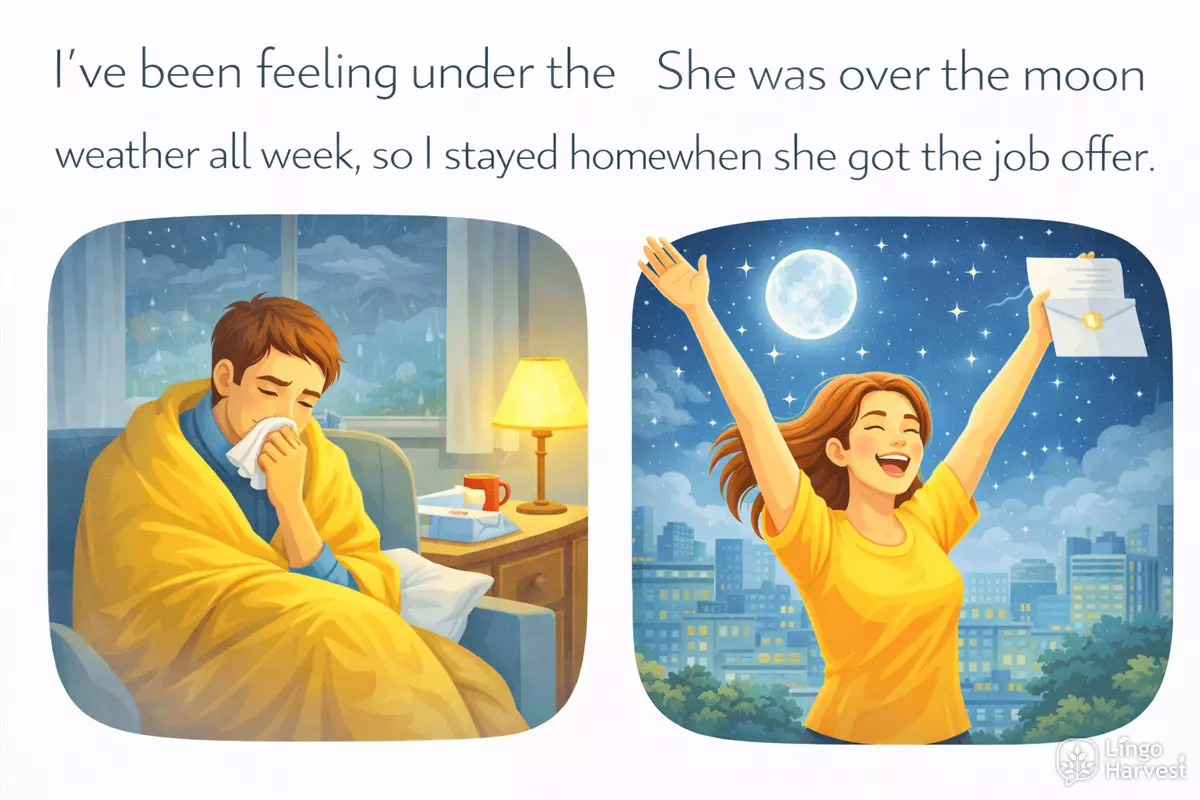
- Under the weather → I’ve been feeling under the weather all week, so I stayed home.
- Over the moon → She was over the moon when she got the job offer.
- Through the fire → The team stayed united through the fire and rebuilt everything.
- Under your spell → From the first meeting, he seemed completely under her spell.
- Over and out → After confirming the instructions, the pilot said, “Over and out.”
- Through thick and thin → They supported each other through thick and thin.
- Under my skin → That comment really got under my skin.
- Over the edge → The constant pressure pushed him over the edge.
- Through the storm → The captain guided the ship safely through the storm.
- Under control → The situation is difficult, but it’s under control.
- Over my head → The technical explanation went completely over my head.
- Through the night → The nurses worked through the night to care for patients.
- Under lock and key → The confidential files are kept under lock and key.
- Over the rainbow → The song describes a dreamlike place over the rainbow.
- Through your eyes → I tried to see the situation through his eyes.
- Under the surface → Under the surface, there were deeper problems.
- Over the line → His remarks crossed the line and went over the line.
- Through the pain → She kept training through the pain to reach her goal.
Comparing Emotional Connotations
| Preposition | Typical Emotional Imagery | Example Lyric Usage |
|---|---|---|
| Under | Feeling trapped, weighed down, or suppressed | "I'm under pressure" / "Under your spell" |
| Over | Moving past something, achieving freedom, or emotional distance | "I'm over you" / "Over the rainbow" |
| Through | Enduring a process, surviving hardship, or transformation | "Through the fire" / "Through the storm" |
Why These Prepositions Resonate in Songwriting
Listeners relate to spatial metaphors because they offer a tangible way to process complex feelings. When a lyric describes going 'through' pain or being 'under' stress, it creates a shared emotional landscape. These expressions bridge the gap between the songwriter's personal journey and the listener's own experiences, making the lyrics more impactful and memorable.
Ellipsis in Verse: Dropped prepositions and their effect on musical phrasing and urgency
Songwriters often leave out prepositions in lyrics to achieve a punchier, more immediate sound. This stylistic choice, known as ellipsis, isn’t just about fitting words into a rhythm—it can shape the emotional intensity and pace of a song. Omitting function words like prepositions can create a sense of urgency or intimacy, allowing the listener to fill in the gaps. This technique also mirrors everyday spoken English, especially in informal or colloquial speech, giving lyrics a more authentic, relatable quality.
How Dropping Prepositions Changes Musical Flow
Leaving out prepositions can tighten phrasing, fitting more meaning into fewer syllables. In fast-paced genres like pop or hip-hop, this economy of language helps maintain momentum. For slower ballads, omission may draw attention to key words or emotions, making each line more direct. The rhythm and melody often dictate where ellipsis feels natural or jarring, so writers use it thoughtfully to enhance musicality.
Common Patterns of Ellipsis in Song Lyrics
Writers use a variety of patterns when omitting prepositions. Some of the most frequent include:
- Leaving out “to” in expressions of movement (e.g., “Go bed” instead of “Go to bed”)
- Dropping “for” in intentions (e.g., “Wait you” instead of “Wait for you”)
- Omitting “on” in time phrases (e.g., “See you Monday” rather than “See you on Monday”)
- Skipping “of” in partitive phrases (e.g., “Piece cake” instead of “Piece of cake”)
- Removing “in/at” with locations (e.g., “Home alone” vs. “At home alone”)
- Leaving out “with” in company (e.g., “Dance me” for “Dance with me”)
- Omitting “about” after verbs (e.g., “Think you” vs. “Think about you”)
- Dropping “by” in passive (e.g., “Loved you” for “Loved by you”)
- Skipping “from” in origins (e.g., “Came nowhere” vs. “Came from nowhere”)
- Leaving out “over” in transitions (e.g., “Get it (over) with”)
- Omitting “after” or “before” in sequencing (e.g., “Come dinner” for “Come after dinner”)
- Dropping “through” in process (e.g., “Been this before” vs. “Been through this before”)
- Removing “into” with transformation (e.g., “Turn gold” for “Turn into gold”)
- Skipping “under” or “above” in position (e.g., “Under pressure” may become “Pressure”)
- Leaving out “as” in comparisons (e.g., “Free bird” vs. “As free as a bird”)
- Omitting “by” in means (e.g., “Travel train” for “Travel by train”)
- Dropping “to” in indirect objects (e.g., “Give me reason”)
- Leaving out “at” in targets (e.g., “Look me”)
- Removing “for” in purpose (e.g., “Made loving you”)
- Skipping “with” in instruments (e.g., “Paint words” instead of “Paint with words”)
Why Songwriters Use Ellipsis
The choice to drop prepositions is rarely random. Writers often do it to:
- Convey immediacy or emotional urgency
- Match the rhythm or meter of the melody
- Imitate natural speech or dialect
- Highlight key emotions or ideas by stripping away non-essential words
- Create ambiguity or poetic effect, letting listeners interpret meaning
Impact on Listener Perception
When lyrics omit prepositions, listeners may experience a stronger sense of connection or intensity. The phrasing can feel raw, authentic, or even rebellious. While this can enhance the song’s power, it may also introduce ambiguity, making interpretation more personal. Ellipsis in lyrics is one of many tools that shape how songs feel and how their stories are told.
Narrative Perspective: Prepositions as tools for establishing the 'I-Thou' relationship in songs
Song lyrics frequently use prepositions to frame the emotional space between the singer (the “I”) and the listener or addressee (the “Thou”). These small words help define the context in which two parties interact, whether through intimacy, distance, conflict, or longing. By shaping how the speaker and listener relate, prepositions become essential in expressing perspective and emotional nuance in music.
Connecting the Speaker and the Addressee
In English songs, prepositions often act as bridges or barriers between characters. For example, “with” and “beside” evoke togetherness, while “without” or “between” can suggest separation or obstacles. The choice of prepositions can dramatically alter the perceived closeness or distance, subtly influencing the listener’s interpretation of the relationship.
- With you – togetherness, unity
- For you – purpose, devotion
- To you – direction, address
- From you – separation, origin
- Without you – absence, loss
- By your side – support, partnership
- Between us – barrier, shared space
- Over you – dominance, care
- Under your spell – influence, submission
- About you – focus, concern
- Against you – conflict, opposition
- Near you – proximity, longing
- Inside of you – intimacy, depth
- After you – pursuit, sequence
- Before you – anticipation, chronology
- Through you – experience, mediation
- Upon you – suddenness, impact
- Around you – orbit, attention
- Beyond you – transcendence, distance
- Within you – internal state, closeness
Patterns and Functions in Popular Lyrics
Prepositions are often used to reinforce the narrative perspective in a song, making the relationship between the narrator and the addressee more vivid. For instance, “for you” in a chorus can emphasize sacrifice or dedication, while “without you” highlights loss or emptiness. The frequent repetition of such phrases in choruses and hooks helps anchor the emotional message.
Comparing Expressive Effects
The impact of prepositional choice is clear when comparing similar lines with different prepositions. Consider how “singing to you” versus “singing for you” shifts the focus from direct communication to a gesture of devotion. Below is a comparison of common prepositional phrases and their emotional connotations in lyrics:
| Prepositional Phrase | Emotional/Relational Effect |
|---|---|
| With you | Closeness, partnership |
| Without you | Longing, absence |
| For you | Dedication, purpose |
| Against you | Conflict, opposition |
| To you | Communication, address |
| From you | Distance, separation |
| Near you | Desire, proximity |
| Between us | Shared experience, sometimes barrier |
Songwriters rely on these subtle linguistic tools to shape the listener’s sense of relationship. By carefully selecting prepositions, lyrics can suggest intimacy, alienation, or anything in between, making them powerful devices for conveying narrative perspective.
Activity: Dissecting lyrical excerpts to differentiate between artistic choice and standard grammar
Examining English song lyrics offers a unique window into how prepositions are used creatively, often bending or breaking standard grammar rules for artistic effect. In this section, you'll engage with real song lines, identifying where prepositions follow conventional patterns and where they serve a stylistic or rhythmic purpose instead.
Spotting Artistic vs. Standard Preposition Usage
Many lyricists play with language, sometimes omitting prepositions, using unexpected ones, or rearranging sentence order. To develop an ear for these differences, consider the following examples. Which use prepositions according to standard grammar, and which are more about style or sound?
- "I’m on the top of the world, looking down on creation" (The Carpenters)
- "Ain’t no mountain high enough, ain’t no valley low enough, ain’t no river wide enough to keep me from getting to you" (Marvin Gaye & Tammi Terrell)
- "All you need is love, love is all you need" (The Beatles)
- "I can’t get no satisfaction" (The Rolling Stones)
- "With or without you" (U2)
- "Born to run" (Bruce Springsteen)
- "Under pressure" (Queen & David Bowie)
- "Dancing in the dark" (Bruce Springsteen)
- "Take a sad song and make it better" (The Beatles)
- "I’m gonna stand by you" (Rachel Platten)
- "Rolling in the deep" (Adele)
- "Walking on sunshine" (Katrina & The Waves)
- "Let it be" (The Beatles)
- "Knocking on heaven’s door" (Bob Dylan)
- "Cry me a river" (Justin Timberlake)
- "Set fire to the rain" (Adele)
- "Livin’ on a prayer" (Bon Jovi)
- "Out of the blue" (Electric Light Orchestra)
- "Come as you are" (Nirvana)
- "Over the rainbow" (Judy Garland)
Practice: Analyze and Decide
Read each excerpt above. For every line, ask yourself:
- Is the preposition (if any) used in a typical, grammatically standard way?
- Does the structure break from standard grammar for artistic or rhythmic reasons?
- How does the use (or omission) of a preposition affect the lyric’s meaning or emotional impact?
Comparing Standard vs. Artistic Preposition Use
Below is a comparison of standard grammatical forms and their creative counterparts in song lyrics:
| Standard Grammar | Lyric Example (Artistic/Creative) |
|---|---|
| "I can't get any satisfaction." | "I can’t get no satisfaction." ❌ (double negative for emphasis) |
| "Living on hope." | "Livin’ on a prayer." (colloquial, dropped 'g', idiom) |
| "Knocking at heaven’s door." | "Knocking on heaven’s door." (choice of preposition for rhythm/sound) |
| "Dancing in the darkness." | "Dancing in the dark." (shortened phrase for meter) |
| "Set fire to the rain." | "Set fire to the rain." (poetic, metaphorical use of preposition) |
Mini-Quiz: Artistic vs. Standard Usage
Decide whether each lyric below uses prepositions in a standard grammatical way (✅) or as an artistic choice (❌):
- "With or without you"
- "Rolling in the deep"
- "Cry me a river"
- "Over the rainbow"
- "Born to run"
- "Under pressure"
- "Against the odds"
- "In the end"
- "On top of the world"
- "Out of the blue"
Show answers
- ✅ (Standard use of with / without to express inclusion or exclusion.)
- ⚠️ Idiomatic / Song title — not for grammar analysis. (Poetic, non-literal use; not a rule-based in + noun construction.)
- ⚠️ Idiomatic / Song title — not for grammar analysis. (Fixed idiom using a double-object verb; not a prepositional structure.)
- ✅ (Over the rainbow is a well-formed and common prepositional phrase.)
- ✅ (Standard infinitive construction using to + verb.)
- ✅ (Under pressure is a fixed prepositional phrase expressing stress.)
- ✅ (Against the odds correctly uses a preposition to express contrast.)
- ✅ (In the end is a standard time-related prepositional phrase.)
- ✅ (On top of the world is idiomatic but structurally standard.)
- ✅ (Out of the blue is a fixed expression meaning “unexpectedly.”)
By analyzing how prepositions are handled in these lyrics, you can better appreciate the balance between expressive freedom and grammatical convention in English songwriting.