Stress and Weak Forms in English Verb Pronunciation

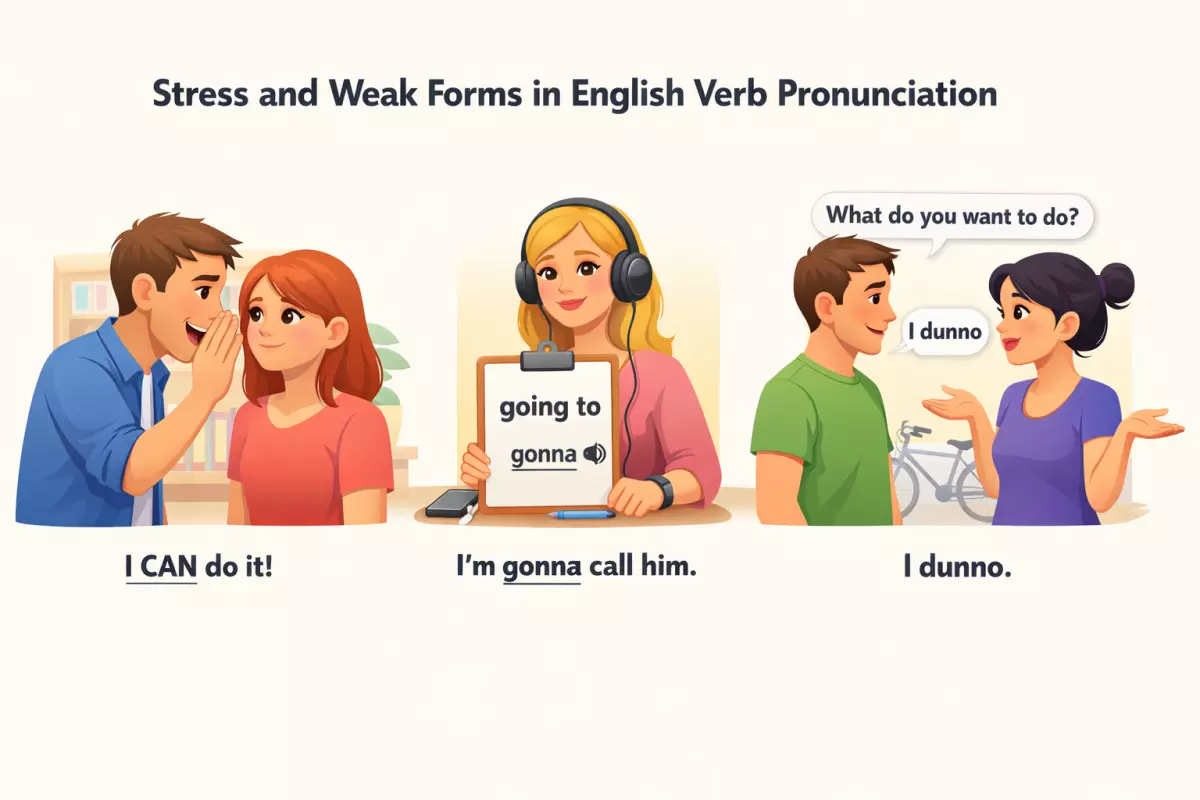 This article explains stress and weak forms, why auxiliaries weaken in speech, and how be, have, and do change in strong vs weak pronunciation. It also covers reduced modals, sentence stress and meaning shifts, common learner issues, practice for natural rhythm, and homework drills.
- What stress and weak forms are
- Why auxiliaries become weak in speech
- Strong vs weak pronunciation of be, have, do
- Reduced modals and connected speech
- Sentence stress and meaning changes
- Common learner pronunciation problems
- Practice techniques for natural rhythm
- Homework: stress and weak form drills
In everyday English, verbs often sound different depending on which words are stressed and which are reduced. You might learn a verb clearly in class but miss it in movies or real conversations because the vowel relaxes or the ending gets softened. This article explains how emphasis changes pronunciation, when reductions happen, and how to train your ear for fast, natural speech.
What stress and weak forms are
English speech is built on rhythm. Some syllables are said clearly and loudly enough to carry the beat, while others are shortened so the sentence stays smooth and fast. This is why the same verb can sound different in careful speech versus everyday conversation.
Stress: the “beat” in a word or sentence
Stress is extra prominence on a syllable. In pronunciation it usually means a slightly longer vowel, clearer vowel quality, and often a small pitch movement. Stress works at two levels:
- Word stress: one syllable in a multi-syllable word is stronger (for example, many two-syllable nouns stress the first syllable, while many two-syllable verbs stress the second).
- Sentence stress: certain words in a sentence are highlighted to carry meaning (often content words like main verbs, nouns, adjectives, and adverbs).
- Stressed syllables tend to keep a “full” vowel sound; unstressed syllables often shift toward a reduced vowel (commonly /ə/).
- Changing sentence stress can change meaning: stressing a verb can signal contrast, correction, or emphasis (e.g., “I did call,” versus “I did call”).
Weak forms: reduced pronunciations in connected speech
Weak forms are common reduced pronunciations that appear when a word is not stressed. They are especially frequent with function words (auxiliaries, modals, prepositions, pronouns, conjunctions) and with short grammatical verb forms. Weak forms help English maintain its stress-timed rhythm.
- Weak forms usually involve vowel reduction (often to /ə/ or /ɪ/) and sometimes consonant changes or deletions in fast speech.
- They are most likely when the word is not the main focus of the message.
- They are less likely in careful speech, at the end of a sentence, or when the speaker is emphasizing or contrasting that word.
- Many weak forms are optional and depend on speed and style, but some are extremely common in everyday conversation.
How this connects to verbs
Verbs are central to meaning, so the main verb in a clause is often stressed. However, English verb phrases also include auxiliary verbs and modals, and these frequently reduce. This is one reason learners hear “different” versions of the same verb phrase.
- Main verbs (work, drive, decide) are commonly stressed when they carry the core information.
- Auxiliaries (be, have, do) often take weak forms when they support another verb: “I’ve finished,” “She’s working,” “They’ve gone.”
- Modals (can, could, should, must, will, would) often reduce in running speech: “I can go,” “You should try,” “We’ll see.”
- Negative forms can shift stress depending on meaning: “I can’t go” (often stressed), versus “I can go, but I won’t.”
Typical patterns you can rely on
- Content words tend to be stressed; grammar words tend to reduce.
- When a function word is emphasized (contrast, correction, strong feeling), it usually uses a strong form, not a weak one.
- Weak forms are common inside a sentence; at the end of a phrase, speakers often use a clearer pronunciation.
- Fast, casual speech increases reduction; slow, careful speech decreases it.
- Listening practice is easier when you expect reduction: many “missing” sounds are actually weak forms rather than completely dropped words.
Why auxiliaries become weak in speech

In connected English, small “grammar” verbs often lose stress so the listener’s attention stays on the main message words (usually the main verb, nouns, adjectives, and key adverbs). This shift in prominence encourages reduced vowels (often toward /ə/), shorter timing, and smoother linking to neighboring sounds.
Core reasons reduced forms are so common
- They carry less new information. Auxiliaries mainly signal tense, aspect, voice, or polarity, so speakers typically highlight the lexical verb instead: “She has finished” tends to stress “finished,” not “has.”
- Rhythm favors alternating strong and weak beats. English stress timing pushes function words into weaker slots between stressed syllables, so auxiliaries compress to fit the rhythm.
- Speakers optimize effort in fast speech. Frequent, predictable items are shortened because listeners can still identify them from context.
- Vowel reduction is a default in unstressed syllables. When an auxiliary loses stress, its full vowel often centralizes (for example, “can” shifting away from a clear /æ/ sound).
- Linking and assimilation encourage smoothing. Sounds blend across word boundaries, making auxiliaries less distinct: final consonants link forward, and neighboring sounds can change their shape.
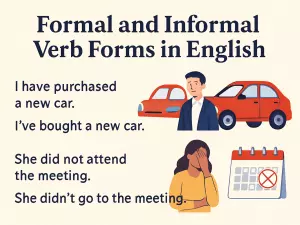
- Contractions are built into everyday grammar. Many weak forms are conventionalized in writing (I’m, we’ve, she’ll), reflecting what speech already does naturally.
When auxiliaries stay strong (and why)
- Contrast or emphasis: “I did call you (not text you).” Stress blocks reduction because the auxiliary carries the contrast.
- Negatives and corrections: “You can’t park here.” The negative meaning often keeps the form clearer (though parts may still reduce).
- Sentence-final position: “Yes, I have.” Final words are more likely to be stressed, so weak forms are less likely.
- Short answers: “Do you like it?” “I do.” The auxiliary becomes the main carrier of meaning.
- Careful or formal speech: Slower pace and deliberate articulation preserve full vowels more often.
Common weakening patterns to listen for
- Reduced vowels: a full vowel shifts toward a more central, shorter vowel in unstressed position.
- Consonant linking: final /v/, /z/, /d/, /t/ often attach to the next word: “I’ve already…” flows as one unit.
- /h/ dropping in pronouns + auxiliaries: “he has,” “she has,” “he had” often lose the /h/ in rapid speech.
- Elision (sound loss): /t/ or /d/ may disappear in clusters: “must have” can lose a consonant in fast speech.
- Assimilation: a sound changes to match a neighbor, especially across word boundaries, making the auxiliary less “separate.”
- Contraction-like timing even without written contractions: speakers may compress “I will” similarly to “I’ll,” even if they don’t fully contract in writing.
High-value examples (full vs. typical connected-speech form)
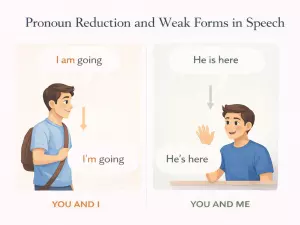
- “I am ready” → “I’m ready” (shorter, less prominent)
- “You are late” → “you’re late”
- “He has gone” → “he’s gone”
- “They have finished” → “they’ve finished”
- “She will call” → “she’ll call”
- “I would like” → “I’d like”
- “We had seen it” → “we’d seen it”
- “It is fine” → “it’s fine”
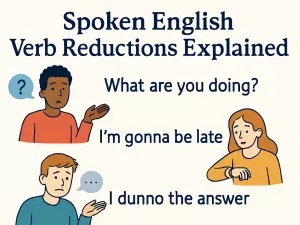
- “What are you doing?” → “what’re you doing?” (often very compressed)
- “Where have you been?” → “where’ve you been?”
- “I can go” → “I can go” with a weaker “can” (unstressed)
- “I can’t go” → “I can’t go” (negative often stays clearer than affirmative “can”)
- “You must have seen it” → “you must’ve seen it”
- “I should have called” → “I should’ve called”
- “They are not coming” → “they aren’t coming” / “they’re not coming” (stress depends on meaning)
- “I do know” → stays strong when used for emphasis (not reduced)
A practical rule is to expect auxiliaries to weaken when they sit between stressed words and don’t carry contrast. When the auxiliary becomes the main signal (emphasis, correction, short answers), it usually keeps a fuller, stronger pronunciation.
Strong vs weak pronunciation of be, have, do
These three very common verbs often reduce in connected speech. The “full” (strong) form tends to appear when the verb is stressed for meaning, said in isolation, placed at the end of a clause, or used for contrast. The reduced (weak) form is typical when the verb is unstressed and functions as a helper in the sentence rhythm.
When speakers use strong forms
- At the end of a clause: “Yes, I am.” / “No, she has.” / “I said I did.”
- In short answers: “Who’s ready?” “I am.” “Have you finished?” “I have.”
- For contrast or emphasis: “I do like it (not just ‘kind of’).” / “He has seen it, but she hasn’t.”
- In negative contractions with emphasis (often stronger than surrounding words): “I don’t agree.” / “She hasn’t called.”
- When the verb is the focus word: “What do you mean by ‘have’?” (talking about the word itself)
- In careful or formal speech (less reduction overall): presentations, reading aloud, dictation, or when clarifying.
When weak forms are most common
- As auxiliaries before another verb: “I’m going.” / “She’s working.” / “They’ve arrived.” / “We’d finished.”
- Inside a sentence (not final): “I’m sure he’s right.” / “I’ve already told you.”
- After a subject pronoun (especially in fast speech): “I’m…” “you’re…” “he’s…” “we’ve…” “they’d…”
- In question inversion: “Are you coming?” “Have they left?” “Do you know?” (often reduced unless emphasized)
- In tag questions: “You’re coming, aren’t you?” / “She’s finished, hasn’t she?” / “You like it, don’t you?”
- In common fixed phrases: “What d’you think?” / “How’ve you been?” (reductions are typical in casual speech)
| Verb | Strong form (typical IPA) | Weak/reduced form (typical IPA) | Example in a sentence |
|---|---|---|---|
| be (am) | /æm/ | /əm/ | “I’m late.” (weak) vs “Yes, I am.” (strong) |
| be (are) | /ɑːr/ (BrE), /ɑːr/~/ɑr/ (AmE) | /ə/ (common in BrE), /ɚ/~/ɹ̩/ (common in AmE) | “Where are you?” (often weak) vs “They are.” (strong) |
| be (is) | /ɪz/ | /z/ or /s/ (after voiceless sounds) | “He’s ready.” (weak) vs “Yes, he is.” (strong) |
| have (auxiliary) | /hæv/ | /həv/ or /əv/ | “I’ve seen it.” (weak) vs “I have.” (strong answer) |
| have (has) | /hæz/ | /həz/ or /əz/ | “She’s/She has finished.” (often weak) vs “She has!” (contrast) |
| do (auxiliary) | /duː/ | /də/ | “Do you agree?” (often weak) vs “I do agree.” (strong emphasis) |
| do (does) | /dʌz/ | /dəz/ | “What does he want?” (often weak) vs “He does.” (strong answer) |
| do (did) | /dɪd/ | /dɪd/ (often stays full, but may be less prominent) | “I did call.” (strong stress) vs “I did call you yesterday.” (less prominent) |
Practical patterns to notice (and copy)
- Pronoun + auxiliary contractions usually signal reduction: I’m, you’re, he’s, we’ve, they’d.
- Weak “have” can sound like /əv/, which is why “could’ve” and “should’ve” are often misheard. In careful writing, it is still “could have,” not “could of.”
- “Do” becomes strong mainly for emphasis: “I do want to help.” Without emphasis, it blends into the rhythm: “Do you want to help?”
- Final position invites a full form: “Yes, I am/are.” “No, I have.” “Yes, I do.”
- Stress changes meaning: “He has finished” (neutral) vs “He has finished” (contrast: not someone else).
- Don’t force reduction in careful speech: when clarity matters, a clearer strong form is natural and often preferable.
Reduced modals and connected speech
In fast, natural speech, modal verbs often lose stress and attach to nearby words. This creates shorter vowel sounds, missing consonants, and smooth links across word boundaries. The result is that the “dictionary form” is still there, but the audible form is lighter and more blended.
What typically reduces (and why)
Modals are function words, so they commonly take a weak form when they are not the main focus. Reduction is especially likely when:
- The modal is followed by a pronoun or a very common verb (think: go, do, be, have).
- The modal is inside a longer phrase and the stress is carried by the main verb or the key content word.
- The modal is negative and the -n’t form is used, which encourages contraction and linking.
- The speaker is giving background information rather than emphasis or contrast.
Common reduction patterns to listen for
- Vowel weakening: full vowels move toward a shorter, more central sound (often a schwa-like quality).
- Consonant simplification: /t/ or /d/ may soften or disappear between consonants (e.g., “must go” can sound like “mus’ go”).
- Linking: final consonants connect to the next word’s vowel (e.g., “can I” links smoothly).
- Assimilation: a sound changes to match a neighbor (e.g., /n/ may sound more like /m/ before /p/ or /b/).
- Intrusive /w/ or /j/ glides: when a rounded or front vowel meets another vowel, a glide may appear (“do it” style linking also happens with some modal + vowel sequences).
High-frequency examples in phrases (with typical spoken outcomes)
- can + pronoun: “can you” often sounds like “c’n you” (weak vowel, quick rhythm).
- can + vowel start: “can I” commonly links and reduces, sounding closer to “c’n I”.
- can’t: the vowel is usually clearer than weak can; the negative meaning is often protected by stronger cues (length, pitch, or the final consonant).
- could + have: “could have” frequently becomes “could’ve” with a reduced have.
- would + have: “would have” often becomes “would’ve” (reduced second word, smooth join).
- should + have: “should have” often becomes “should’ve”; in very fast speech it may be heard as “shoulda” (informal).
- might + have: “might have” often becomes “might’ve” (light /h/ in have).
- must + consonant: “must be” may lose the /t/ in fluent speech (“mus be”).
- must + you: “must you” can compress, with the /t/ weakened and the words tightly linked.
- will + pronoun: “will you” often reduces toward “w’you,” especially in quick questions.
- won’t: typically stays fairly distinct because it carries negation and contrast more often than plain will.
- shall (where used): often weak in offers (“shall we”) with a light vowel and fast linking.
- have to (semi-modal): “have to” often becomes “hafta” in casual speech; the /v/ may disappear.
- has to: commonly reduces toward “hasta” (casual), with a quick /s/ + /t/ transition.
- going to (future marker): often reduces to “gonna” in informal speech, with the middle vowel/consonant compressed.
- got to (obligation): often reduces to “gotta” informally, with a quick flap-like /t/ in some accents.
Negatives: where clarity matters
Negative modals often resist heavy reduction because the negative meaning is important for understanding. Still, connected speech changes are common:
- can’t vs can: learners often confuse these; in many accents, can is weak and quick, while can’t tends to be longer or more clearly marked.
- shouldn’t / wouldn’t / couldn’t: the -n’t cluster can compress, but the negative consonant cue usually remains.
- ✅ “I can do it.” (weak modal, stress on do) → ❌ stressing can without contrast can sound unnatural.
- ✅ “I can’t do it.” (negation kept clear) → ❌ reducing it so much that the t/n’t disappears can cause misunderstanding.
Teaching focus: how to practice the rhythm
- Mark the main stress on the content word, then say the modal quickly before it (e.g., stress the main verb: “can GO,” “should CALL”).
- Practice in short chunks, not isolated words: modal + pronoun, modal + main verb, modal + “have” patterns.
- Use “slow-to-fast” repetition: keep the same stress pattern while increasing speed, so the weak forms appear naturally.
- Record and check for linking: listen for whether the modal’s final consonant connects to the next vowel instead of stopping.
Sentence stress and meaning changes
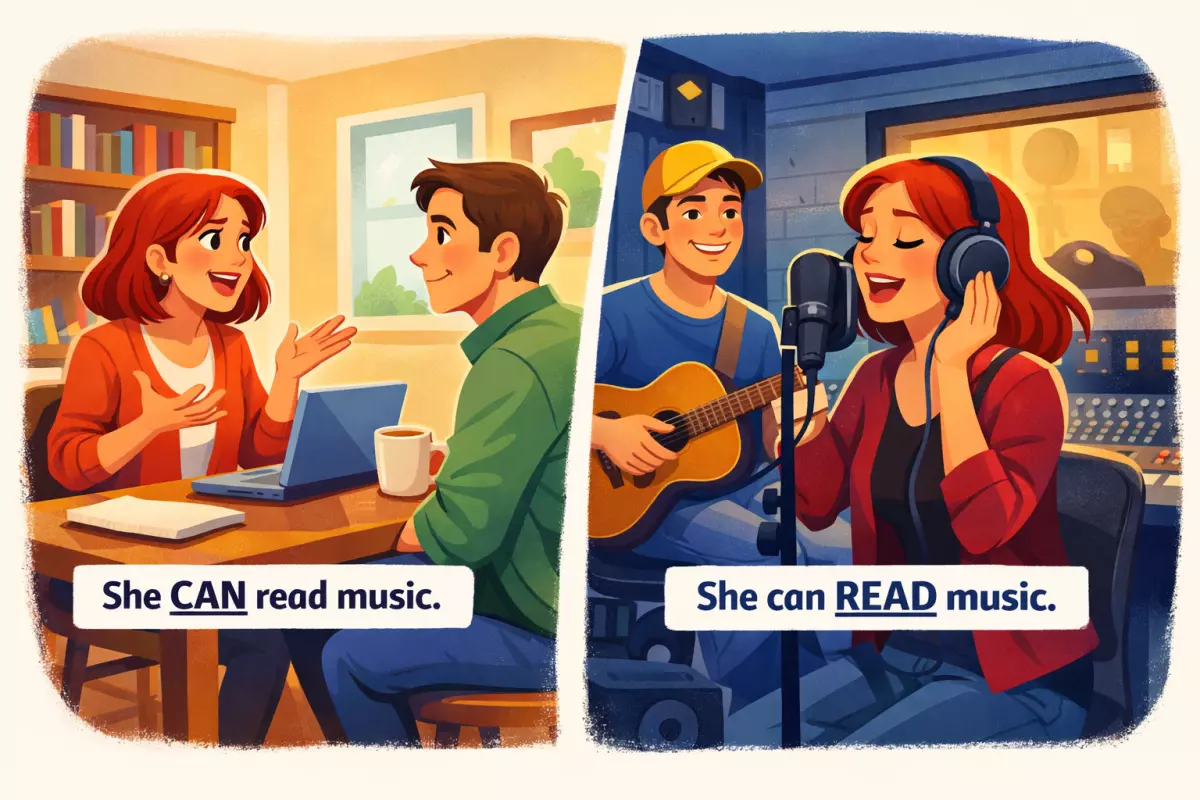
In connected speech, the words you stress tell the listener what is new, important, corrected, contrasted, or emotionally loaded. English verbs are especially sensitive to this because they often appear next to auxiliaries (do, have, be, will), pronouns, and small function words that tend to weaken. Shifting the stress can change what the sentence implies, even when the grammar stays the same.
How stress shifts the message
- New information usually takes the main stress: if the verb is the “news,” it becomes prominent; if the object is the “news,” the verb often reduces.
- Contrast pulls stress forward: when you contrast actions, people, times, or choices, the contrasting word becomes strong (often the main verb or a particle like up, out).
- Correction triggers emphatic stress: if you correct someone, you typically stress the corrected element (“I did send it”).
- Given information weakens: repeated verbs and predictable auxiliaries are commonly reduced, while the new detail carries the beat.
- Focus can move from the verb to the auxiliary: stressing do/did/have often signals insistence, contradiction, or reassurance.
- Negatives attract stress: not and negative contractions often carry strong stress when the negation matters (“I’m not going”).
- Particles can steal the stress: in phrasal verbs, the particle may be stressed to highlight completion or direction (“pick it up”).
- Rhythm encourages weak forms: to keep a steady beat, English reduces less important words (auxiliaries, pronouns) and preserves stress on the focused content word.
Common meaning differences created by stressing different words
| Stress focus | Example (CAPS = main stress) | Typical implied meaning |
|---|---|---|
| Main verb | I SENT the email. | The sending happened (not just planning, not forgetting). |
| Auxiliary “do/did” | I DID send the email. | Insistence/correction: you think I didn’t, but I did. |
| Object | I sent the EMAIL. | Not the file / not the message in the app; the object is the contrast. |
| Time expression | I sent it TODAY. | The timing is the key point (not yesterday/last week). |
| Negative | I’m NOT going. | Strong refusal or important negation. |
| Modal verb | You MUST call her. | Obligation/strong advice is highlighted. |
| Modal + main verb contrast | You must CALL her. | Action contrast: calling (not texting/emailing) is required. |
| Phrasal verb particle | Please pick it UP. | Completion/direction is emphasized (collect it, not just touch it). |
| Subject (agent) | I fixed it. | Not someone else; responsibility/credit is contrasted. |
| Verb phrase “have/has” | She HAS finished. | Reassurance/correction: the result is true now. |
Practical patterns to apply in verb-heavy sentences
- When the main verb is predictable (routine actions like go, get, do), expect it to weaken unless it is contrasted or corrected.
- When you need to sound firm or to contradict an assumption, stress the auxiliary: do/did/have/will often becomes the anchor of the sentence.
- In short answers, auxiliaries frequently carry the stress because they carry the meaning: “Yes, I DO.” / “No, she HASn’t.”
- With phrasal verbs, stress the particle when the “result” matters: turn it OFF, write it DOWN, hand it IN.
- If a word is repeated, reduce it the second time and move the main stress to what changes: “I CALLED her yesterday, and I called her TODAY too.”
Common learner pronunciation problems
Most difficulties come from using “dictionary-style” pronunciation in running speech. English verbs often change their stress pattern and reduce nearby function words, so learners may sound overly careful, place stress on the wrong syllable, or miss the rhythmic contrast between strong and weak forms.
1) Stress placed on the wrong syllable in two-syllable verbs
A frequent pattern error is stressing the first syllable of a verb that is normally stressed on the second syllable in neutral speech. This can make the word sound like a noun/adjective, or simply sound unusual in context.
- Second-syllable stress verbs said with first-syllable stress: reLAX, reLY, deCIDE, reQUIRE, forGET, exPLAIN, arRIVE, beGIN, conTROL, preFER.
- Prefix-related confusion: learners may stress the prefix (re-, de-, con-, pre-) even when it is typically unstressed in the verb.
- Sentence rhythm effect: when the verb is the main “information word,” it usually carries the beat; when it is not, it may lose prominence to another content word.
2) Over-stressing auxiliaries and modals
Auxiliaries are often reduced and unstressed in affirmative statements, but many learners pronounce them in their full, strong form. This can sound abrupt or can shift the meaning (for example, adding contrast or emphasis that was not intended).
- ❌ “I DO know.” (sounds emphatic) → ✅ “I do know.” (neutral rhythm, reduced do).
- ❌ “She CAN swim.” (can sounds like a strong claim) → ✅ “She can swim.” (often reduced in normal speech).
- Common targets for reduction in connected speech: do/does/did, have/has/had, can, could, should, would, will.
- Meaning shift warning: strong forms are correct when you want contrast (e.g., “I did call”), but not as the default.
3) Missing weak forms next to verbs (function words stay “full”)
Another common issue is keeping prepositions, articles, pronouns, and conjunctions fully pronounced. English rhythm relies on these words becoming shorter and less prominent, especially between stressed syllables.
- Prepositions staying strong: “look AT it,” “wait FOR me,” “listen TO this.”
- Articles not reducing: “a” and “the” pronounced as if they were stressed content words.
- Pronouns over-articulated: “him/her/us/them” said with full vowels in fast phrases where they usually reduce.
- Conjunctions kept strong: “and” pronounced fully in every list item instead of reducing in quick coordination.
4) Not linking sounds across word boundaries
Stress and reduction work together with linking. If words are pronounced separately, weak forms become harder to produce and the rhythm becomes choppy.
- Consonant-to-vowel linking: “take it,” “move on,” “call us,” “turn off.”
- Final consonant not released clearly before another consonant: “asked for,” “helped me,” “worked late.”
- Extra pauses inserted before weak words (especially before to, of, for, and), breaking the stress pattern of the phrase.
5) Treating “to” + verb as two equally strong words
Infinitives often cause rhythm problems: learners may stress “to” or pronounce it with a full vowel, which competes with the main verb stress.
- Over-clear “to” in common verb phrases: “want to,” “going to,” “need to,” “have to,” “try to,” “plan to,” “able to.”
- Stress placement issue: the main beat typically belongs on the lexical verb (or the key content word), not on “to.”
- Cluster difficulty: “need to” and “want to” often trigger simplifications in fast speech; learners may avoid them by separating the words too much.
6) Past tense and -ed endings interfering with stress and rhythm
When -ed is added, learners may add an extra syllable everywhere or pronounce the ending too strongly, which disrupts the timing of the phrase.
- Adding /ɪd/ in all cases: “watched-ih,” “helped-ih,” “asked-ih” (only some verbs take an extra syllable).
- Dropping the ending completely in clusters: “asked,” “fixed,” “helped” become hard to hear, especially before another consonant.
- Over-stressing the ending: the main stress stays on the verb’s stressed syllable; the -ed ending is usually not prominent.
7) Stress not adjusted for contrast, correction, or focus
Learners sometimes keep the same stress pattern regardless of meaning. In English, strong forms and extra stress are often used deliberately to correct, contrast, or highlight information.
- Neutral vs. contrast: “I can go” (reduced modal) vs. “I can go” (contrast: not “can’t”).
- Auxiliary emphasis for correction: “He did call” (fixing a misunderstanding).
- Focus shift inside a verb phrase: “She borrowed it” vs. “She borrowed it” depending on what is new or important.
Practice techniques for natural rhythm
Natural-sounding English depends on timing: stressed syllables land clearly, while many function words and auxiliary verbs compress into weak forms. The goal is not to “say everything fast”, but to keep the beat of the sentence steady and let unstressed verbs (and parts of verbs) reduce when they are not carrying emphasis.
1) Build the stress “skeleton” first
Start by speaking only the stressed words (usually content words), then add the weak forms back in without changing the beat.
- Step A: Say the main stressed words only (e.g., “TELL / WANT / GO”).
- Step B: Add pronouns and auxiliaries quietly between beats (e.g., “I’ll TELL you I WANT to GO”).
- Step C: Repeat at the same pace; do not slow down to “fit” the weak forms.
- Use a light tap for each stressed syllable; keep taps evenly spaced.
2) Train common weak-form verb patterns (micro-drills)
Practice short, high-frequency frames until the reductions feel automatic. Keep the stressed word strong and let the auxiliary shrink.
- I’m + -ing: “I’m working / I’m waiting / I’m trying.”
- He’s / She’s + -ing: “She’s coming / He’s leaving / She’s driving.”
- We’re / They’re + -ing: “They’re moving / We’re meeting / They’re calling.”
- I’ve / We’ve / They’ve + past participle: “I’ve seen / We’ve finished / They’ve gone.”
- He’s / She’s + past participle: “He’s done / She’s left / He’s taken it.”
- I’ll / You’ll / We’ll / They’ll + base verb: “I’ll call / You’ll see / We’ll talk / They’ll help.”
- can (weak) + verb: “I can go / You can try / We can meet.”
- can’t (stronger) + verb: “I can’t go / We can’t wait.”
- to (weak) + verb: “to go / to see / to ask.”
- want to → “wanna” (informal): “I wanna go / Do you wanna try?”
- going to → “gonna” (informal): “I’m gonna leave / We’re gonna start.”
- have to → “hafta” (informal): “I hafta work / You hafta listen.”
3) Contrast drills: stressed vs. weak auxiliaries
Use pairs where meaning changes with stress. In many sentences, the auxiliary is weak; it becomes strong when you’re correcting, contrasting, or emphasizing.
- Weak: “I can do it.” (can reduced) → Strong: “I can do it (not you).”
- Weak: “She has been there.” (has reduced) → Strong: “She has been there (I’m sure).”
- Weak: “They were late.” (were reduced) → Strong: “They were late (not early).”
- Weak: “I do know.” (often reduced) → Strong: “I do know!” (emphatic do)
4) Chunking practice: link across word boundaries
Weak forms often sound natural only when they connect to neighboring words. Practice in small chunks rather than isolated words.
- Link consonant-to-vowel: “I’ll_ask / we’ll_open / they’ll_arrive.”
- Link vowel-to-vowel smoothly: “I_am / you_are / we_are.”
- Practice “to” as a quick connector: “want_to go / need_to ask / try_to see.”
- Keep function words short: “I can do it” (not “I CAN DO IT” unless emphasizing).
5) Timed repetition: keep the beat steady
Use a simple timing rule: stressed syllables should be evenly spaced, and everything else fits between them. Repeat the same sentence three times: slow, medium, then natural speed, without changing where the main stresses fall.
- Choose one sentence with 3–5 stresses (e.g., “I’ll CALL you when I GET there”).
- Mark the stressed syllables in writing (CALL, GET, THERE).
- Speak with a metronome-like pace on those stresses; let “I’ll”, “you”, “when I” compress.
- Record and check: are the stressed beats still clear at faster speed?
6) Short practice quiz (identify where weak forms belong)
Read each line aloud twice: first neutrally (weak forms where appropriate), then with emphasis on the auxiliary (strong form) to feel the contrast.
- “I can finish today.” (neutral meaning)
- “I can finish today.” (contrast: not tomorrow)
- “She has been waiting.” (neutral statement)
- “She has been waiting.” (insistence/correction)
- “They were told already.” (neutral)
- “They were told already.” (contrast/correction)
- “I do understand.” (neutral)
- “I do understand!” (emphatic)
Show answers
- Neutral: can is typically weak (reduced), with main stress on “finish” and “to-”.
- Contrast: can becomes strong and clearly stressed.
- Neutral: has is typically weak; “been waiting” carries the main weight.
- Insistence/correction: has becomes strong and stressed.
- Neutral: were is typically weak; stress falls on “told” and “-read-”.
- Contrast/correction: were becomes strong and stressed.
- Neutral: do may be light; the sentence can sound like a calm reassurance.
- Emphatic: do is stressed strongly (“I DO understand!”).
Homework: stress and weak form drills
Build control over English verb pronunciation by practicing two things together: where the sentence stress lands and how function words reduce in connected speech. The goal is consistency: strong forms when a word is stressed or contrasted, and weak forms when it is unstressed and “glued” to its neighbors.
1) Daily routine (10–12 minutes)
- Step 1 (2 min): Read a short paragraph aloud once for meaning, then once again slower, marking the main stressed words (usually content words and the main verb).
- Step 2 (4 min): Repeat the paragraph, reducing function words (auxiliaries, pronouns, articles, prepositions) while keeping the main stresses clear.
- Step 3 (3 min): Shadow a recording (or your own recording): listen to one sentence, pause, repeat with the same rhythm.
- Step 4 (1–3 min): Record yourself and check: (a) stress peaks are spaced out, (b) weak forms are shorter and less clear than stressed words, (c) linking sounds are smooth.
2) Stress placement drills (mark the beat)
For each sentence, read it twice: first with neutral stress, then with the stressed word in capitals. Keep everything else lighter and faster.
- I didn’t say he borrowed my laptop.
- She can finish it today.
- They were waiting for you.
- We have to leave at six.
- You should have told me earlier.
- He’s been working all week.
- Do you want to call her now?
- I can’t believe you did that.
Show answers
- Possible contrast stresses: I DIDN’T say… / I didn’t SAY… / I didn’t say HE… / …BORROWED… / …MY… / …LAPTOP.
- Neutral: She can FINish it toDAY. Contrast options: She CAN finish… (ability/permission) / She can finish it TOday (not tomorrow).
- Neutral: They were WAITing for YOU. Contrast: They WERE waiting… (not just standing) / …for YOU (not someone else).
- Neutral: We HAVE to LEAVE at SIX. Contrast: We have to LEAVE… (not stay) / …at SIX (not seven).
- Neutral: You SHOULD have TOLD me EARlier. Contrast: You SHOULD… (advice/criticism) / …TOLD… (not texted) / …EARlier (timing).
- Neutral: He’s been WORKing all WEEK. Contrast: He’s BEEN working… (duration) / …all WEEK (not one day).
- Neutral: Do you WANT to CALL her NOW? Contrast: CALL her (not message) / NOW (not later).
- Neutral: I CAN’T beLIEVE you DID that. Contrast: I CAN’T believe… (strong reaction) / you DID that (not said it).
3) Weak-form focus: auxiliaries and “to”
Read each line quickly and smoothly. Keep the main verb clearer than the auxiliary. Then repeat with emphasis on the auxiliary to force the strong form (contrast practice).
- I can do it.
- She can swim.
- We should go.
- They must leave.
- You have to try.
- He has to work.
- I want to eat.
- We’re going to meet.
- Did you call?
- Have you seen it?
Show answers
- Typical reduction: can → /kən/ in “I can do it.” Strong form when stressed: “I CAN do it.”
- can → /kən/; strong /kæn/ when contrasted.
- should often reduces (weak vowel); keep GO as the clearest word.
- must may weaken slightly in fast speech; keep LEAVE stressed.
- have to often sounds like “hafta” in casual speech; TRY carries the beat.
- has to often sounds like “hasta”; WORK is the main stress.
- want to often sounds like “wanna”; EAT is clearer.
- going to often sounds like “gonna”; MEET is clearer.
- did is often light and quick; CALL is the main stress.
- have is often reduced; SEEN is the main stress.
4) Weak forms in common function words (sentence sets)
Practice these as rhythm chains. Aim for one main stress per chunk; everything else should compress.
- for: for me, for you, for a minute, for the day, for a while
- to: to go, to see, to ask, to a friend, to the office
- of: a cup of tea, a lot of work, kind of tired, out of time, one of them
- and: bread and butter, black and white, try and see, you and me, up and down
- at: at home, at school, at six, at the end, at the moment
- can/can’t contrast: I can go / I can’t go; She can come / She can’t come
- have/has: I’ve been, he’s been, we’ve got, she’s got, they’ve had
5) Mini check: choose strong vs. weak
Decide whether the bold word should be reduced (weak) or pronounced clearly (strong) in the situation. Then read the sentence aloud.
- I can help you (neutral offer).
- I can help you, but he can’t (contrast).
- What are you looking for (normal question).
- That’s exactly what I’m looking for (emphasis).
- We’re going to leave soon (neutral plan).
- We’re going to leave, not stay (contrast).
- Have you seen him (neutral question).
- No, I haven’t seen him—I’ve seen her (contrast).
Show answers
- Weak.
- Strong on CAN (contrast); the second “can’t” is also clear because it carries meaning.
- Weak.
- Strong (emphasis at the end).
- Weak.
- Strong (contrast).
- Weak.
- Strong on HIM (contrast with “her”).
6) Self-assessment checklist (after recording)
- Stressed words are longer, louder, and clearer; unstressed words are shorter and less distinct.
- Auxiliaries (can, have, do, be, will) are reduced when they are not the focus.
- End-of-sentence function words become clear only when emphasized (contrast, correction, or strong ending).
- Rhythm stays steady: you can tap a beat on the stressed words without speeding up randomly.
- Linking is smooth: consonant-to-vowel connections don’t add extra pauses.