Syllable Structure of English Nouns and Pronunciation Rules

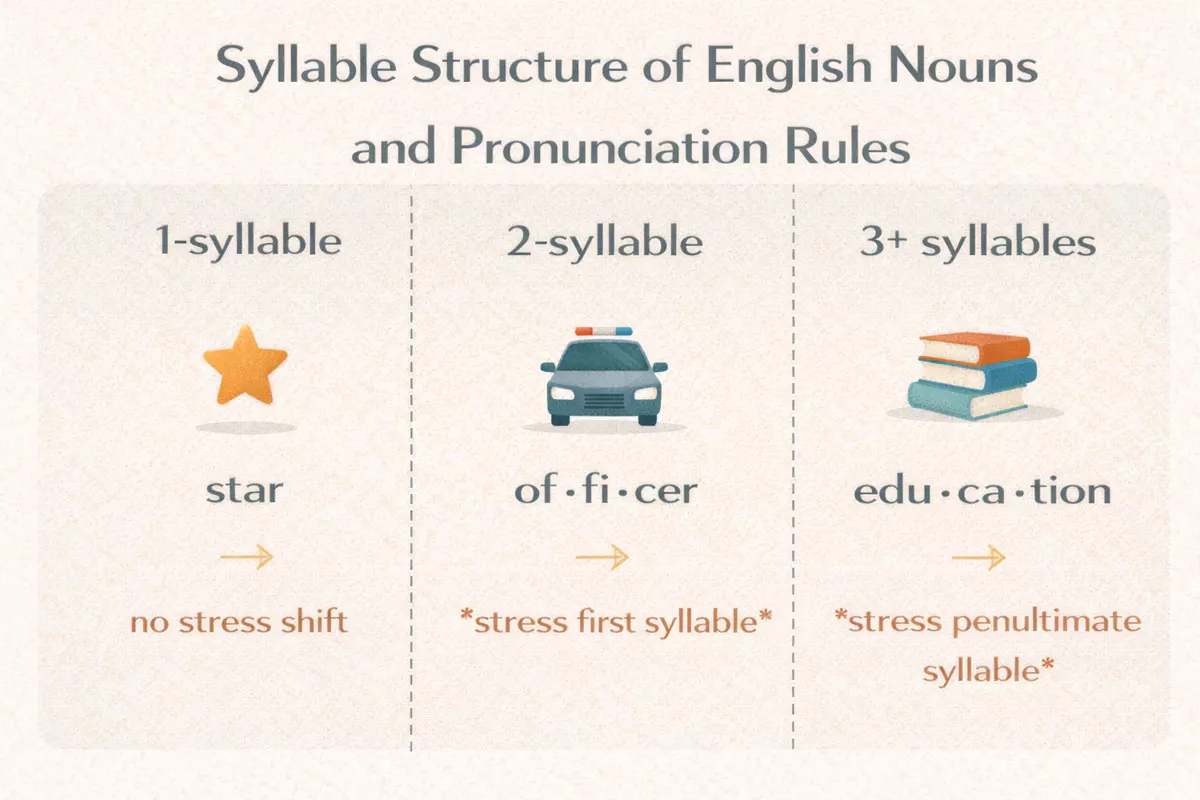 Here we syllable structure in English noun pronunciation, including patterns for nouns with different syllable counts, stress placement, and open versus closed syllables.
- What syllable structure means in pronunciation
- One-, two-, and multi-syllable noun patterns
- How syllables affect stress placement
- Open vs closed syllables in noun pronunciation
- Common pronunciation problems with long nouns
- Listening strategies for recognizing syllable breaks
- Practice: split nouns into syllables and mark stress
Understanding how English nouns are formed from individual sound units can significantly improve your pronunciation and boost your confidence when speaking. By examining how these components come together and recognizing the patterns in their spoken forms, you can develop a more intuitive grasp of word structure. This awareness not only helps you pronounce words more accurately but also enhances your listening skills, making communication in English smoother and more effective overall.
What syllable structure means in pronunciation
Understanding how English words are built from syllables is essential for correct pronunciation. A syllable acts as a basic unit of sound, typically containing a vowel sound and possibly surrounding consonants. The way these sounds are arranged—known as syllable structure—influences both how a word is spoken and which sounds are emphasized.
Key Elements of Syllable Structure
Each English noun can be broken down into distinct syllabic parts. The main components include:
- Onset: The initial consonant(s) before the vowel (e.g., str in "street")
- Nucleus: The core vowel sound (e.g., a in "cat")
- Coda: The final consonant(s) after the vowel (e.g., nd in "hand")
Some syllables may lack an onset or coda, but every syllable has a nucleus. These elements combine in various patterns, shaping the rhythm and clarity of English nouns.
Common Syllable Patterns in English Nouns
English nouns often follow predictable syllable patterns, which affect how they are pronounced. Here are some typical structures:
- CV (Consonant + Vowel): me, no, bee
- CVC (Consonant + Vowel + Consonant): cat, dog, pen
- CCVC (Two Consonants + Vowel + Consonant): plan, drum, frog
- CVCC (Consonant + Vowel + Two Consonants): milk, hand, mask
- V (Vowel only): eye, art, oak
- CCV: sky, play, tree
- CCCVC: street, splash, spring
- CVCV: table, sofa, pizza
- CVCCV: candy, panda, window
- CVCVC: rabbit, pocket, market
How Syllable Structure Affects Pronunciation
The arrangement of sounds in a noun determines stress placement, the linking of sounds, and sometimes even which syllables are reduced or left unstressed. For example, adding consonant clusters at the beginning or end of a word (as in "spring" or "texts") can make pronunciation more challenging, especially for learners.
Syllable boundaries also guide where to divide words for easier articulation and influence rhythm in spoken English. Mispronouncing syllable breaks can lead to misunderstandings or unnatural speech.
Examples of Syllable Structures and Pronunciation Effects
| Word | Syllable Structure | Notes on Pronunciation |
|---|---|---|
| cat | CVC | Single syllable, clear vowel, final /t/ sound |
| window | CVCCV | Two syllables, stress on first, /n/ links to /d/ |
| spring | CCCVC | Initial consonant cluster, single syllable |
| banana | CVCVCV | Three syllables, middle syllable stressed |
| milk | CVCC | Final consonant cluster, single syllable |
| eye | V | Single vowel sound, no consonants |
| rabbit | CVCVC | Two syllables, primary stress on first |
| art | VCC | Starts with a vowel, ends with consonant cluster |
In summary, the internal makeup of a noun—how vowels and consonants are arranged—plays a major role in how speakers pronounce it. Recognizing typical syllable patterns makes it easier to predict word stress, manage difficult clusters, and achieve natural-sounding English pronunciation.
One-, two-, and multi-syllable noun patterns
Understanding how English nouns are structured by syllable count helps with both pronunciation and stress placement. Single-syllable nouns are typically short and straightforward, while two-syllable and longer nouns follow certain stress and pronunciation tendencies that can be useful for learners.
Single-syllable nouns
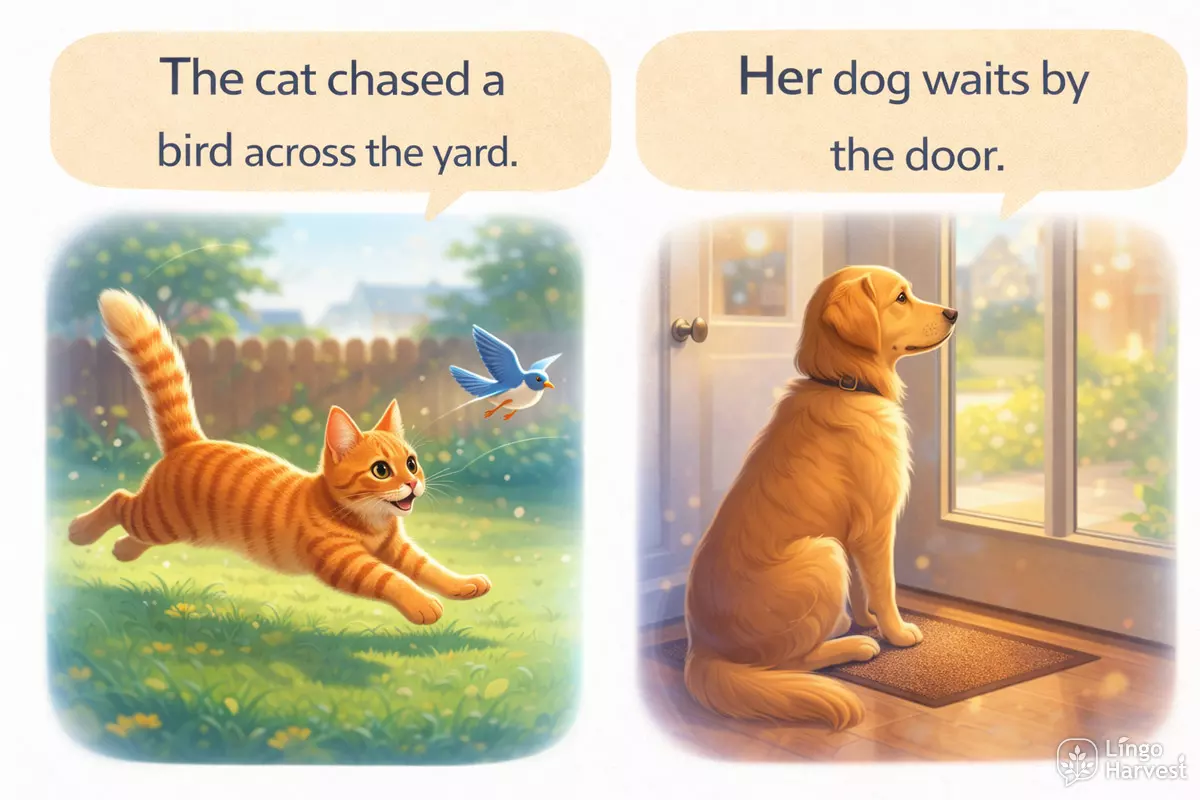
Most one-syllable nouns in English are simple in form and pronunciation. They often follow basic consonant-vowel patterns and are easy to pronounce. Here are some common examples:
- cat → The cat chased a bird across the yard.
- dog → Her dog waits by the door.
- book → I borrowed a book from the library.
- car → His car broke down on the highway.
- chair → Please move the chair closer.
- fish → They cooked fish for dinner.
- plant → This plant needs more sunlight.
- star → A bright star appeared in the sky.
- clock → The clock stopped at noon.
- glass → She filled the glass with water.
These words don’t usually present stress challenges, as the only syllable naturally receives the main emphasis.
Two-syllable noun tendencies
Nouns with two syllables often follow a pattern where the first syllable is stressed. This is a helpful guideline for pronunciation, though there are exceptions. Examples include:
- table (TA-ble)
- window (WIN-dow)
- apple (AP-ple)
- money (MON-ey)
- pencil (PEN-cil)
- river (RIV-er)
- candle (CAN-dle)
- teacher (TEA-cher)
- mountain (MOUN-tain)
- garden (GAR-den)
In these cases, the initial syllable carries the primary stress, which is a strong tendency for English nouns with two syllables.
Multi-syllable noun stress patterns
Longer nouns, with three or more syllables, show more variety in stress placement. However, there are some typical patterns, especially depending on word origin (native English vs. borrowed from other languages). For many multi-syllable nouns, the stress falls on the first syllable, but there are notable exceptions.
| Syllable Count | Common Stress Pattern & Examples |
|---|---|
| Three syllables | Often first syllable stressed: animal (AN-i-mal), family (FAM-i-ly), holiday (HOL-i-day) |
| Four or more syllables | First or penultimate syllable stressed, depending on origin: dictionary (DIC-tion-ar-y), information (in-for-MA-tion), university (u-ni-ver-SI-ty) |
| Borrowed/foreign nouns | Stress can shift, often penultimate: banana (ba-NA-na), tomato (to-MA-to) |
| Compound nouns | Usually stress on the first part: toothbrush (TOOTH-brush), classroom (CLASS-room) |
Summary of pronunciation considerations
When approaching English noun pronunciation, recognizing syllable count is a practical first step. Single-syllable words are direct, while two- and multi-syllable nouns generally put stress on the first or penultimate syllable. Exceptions exist, especially for borrowed words, so listening to native speech and practicing with common examples is recommended for mastering these patterns.
How syllables affect stress placement
The number and type of syllables in English nouns play a central role in determining where the main emphasis, or stress, falls when pronouncing the word. Single-syllable nouns are straightforward, as they almost always carry the stress on their only syllable. However, as words grow longer and more complex, the rules and tendencies for stress assignment become more nuanced.
Syllable Count and Stress Patterns
For two-syllable nouns, the stress generally favors the first syllable. This is evident in common words like table, garden, and window. In contrast, many longer nouns—those with three or more syllables—follow certain patterns based on suffixes or syllable structure. Recognizing these patterns can make pronunciation more predictable.
- Single-syllable nouns: Always stressed (e.g., book, cat).
- Two-syllable nouns: Usually stress on the first syllable (e.g., apple, river).
- Three or more syllables: Stress often depends on suffixes or the position of strong/weak syllables (e.g., photograph, information).
Common Suffixes and Their Influence
Certain noun endings tend to attract stress to a particular syllable. For example, nouns ending in -tion, -sion, or -ic usually place the stress on the syllable before the ending. This pattern helps learners anticipate where to place emphasis.
| Suffix | Typical Stress Placement | Examples |
|---|---|---|
| -tion / -sion | Penultimate (second to last) | nation, extension |
| -ic | Penultimate | graphic, logic |
| -ity | Antepenultimate (third from end) | activity, reality |
| -ee / -eer | Final syllable | employee, engineer |
| -ous | Antepenultimate | generous, famous |
Open vs. Closed Syllables
The character of a syllable—whether it ends in a vowel (open) or consonant (closed)—can also influence stress. Open syllables often attract stress, especially in longer words or those borrowed from other languages. However, this is just one of several factors affecting pronunciation.
Irregularities and Exceptions
Although many nouns follow these patterns, there are exceptions. Some words change stress when used as a verb versus a noun (e.g., record as a noun: REcord; as a verb: reCORD). Others, particularly loanwords or proper nouns, may not fit common stress rules and require memorization.
Understanding the relationship between syllable structure and stress makes English pronunciation more approachable and less mysterious. By paying attention to syllable count, suffixes, and the nature of each syllable, you can predict where emphasis will fall in most nouns you encounter.
Open vs closed syllables in noun pronunciation
Understanding how syllables are structured in English nouns is essential for grasping pronunciation rules. The distinction between open and closed syllables often determines the way vowel sounds are produced, which can impact both spelling and spoken clarity. Open syllables end with a vowel, causing the vowel sound to be long (like the "a" in "paper"). In contrast, closed syllables end with a consonant, making the vowel sound short (such as the "a" in "cat"). Recognizing these patterns can help learners predict how to pronounce unfamiliar words and avoid common mistakes.
Characteristics of Open and Closed Syllables
- Open syllable: Ends in a vowel; the vowel is typically pronounced with its name sound (long vowel).
- Closed syllable: Ends in a consonant; the vowel is usually short.
- English nouns can contain one or more of either type, influencing word stress and intonation.
- Spelling patterns often correspond with syllable type, but there are exceptions.
Common Examples in Nouns
- Open: tiger (ti-ger), robot (ro-bot), music (mu-sic), pilot (pi-lot), paper (pa-per)
- Closed: basket (bas-ket), rabbit (rab-bit), kitten (kit-ten), window (win-dow), helmet (hel-met)
- Notice how the first syllable in "tiger" is open ("ti-"), while in "rabbit" it is closed ("rab-").
Comparing Vowel Pronunciation Patterns
| Syllable Type | Vowel Sound Example |
|---|---|
| Open syllable | Long vowel: pi-lot ("pi" = /paɪ/), mu-sic ("mu" = /mjuː/) |
| Closed syllable | Short vowel: kit-ten ("kit" = /kɪt/), bas-ket ("bas" = /bæs/) |
| Mixed syllable noun | One of each: ro-bot ("ro" = /roʊ/, open; "bot" = /bɒt/, closed) |
| Single syllable noun | Closed only: cat (/kæt/), dog (/dɒɡ/) |
Tips for Identifying Syllable Types in Nouns
- Look for a vowel at the end of a syllable to spot open syllables.
- If the syllable ends with a consonant, it is closed and the vowel is likely short.
- Practice dividing words into syllables and checking vowel sounds to reinforce these patterns.
Mastering the distinction between these two syllable types helps with accurate pronunciation, spelling, and word stress in English nouns.
Common pronunciation problems with long nouns
When English nouns stretch to four syllables or more, speakers often encounter a range of pronunciation challenges. These longer words can make it difficult to maintain correct syllable stress, vowel clarity, and smooth transitions between sounds. Many learners find that as words grow in length, so does the potential for misplacing emphasis or dropping syllables altogether.
Typical issues with lengthy English nouns
Several recurring difficulties arise when pronouncing multi-syllable nouns:
- Misplaced primary stress, leading to unnatural rhythm
- Omitting unstressed syllables, especially in the middle (e.g., saying "unversty" for "university")
- Vowel reduction in unstressed syllables, causing unclear sounds
- Confusing consonant clusters, particularly at syllable boundaries
- Overpronunciation of silent letters
- Running syllables together without clear breaks
- Inconsistent linking between syllables
- Difficulty with secondary stress in complex words
- Substituting similar-sounding vowels or consonants
- Adding or omitting sounds, such as extra vowels ("ath-e-lete" for "athlete")
Stress placement patterns in long nouns

Placing the main stress correctly is crucial for clarity. Many polysyllabic nouns follow consistent stress rules, but there are exceptions. For example, words ending in "-ity" or "-tion" usually have the stress on the syllable before the ending.
| Word | Typical Stress Pattern |
|---|---|
| university | Stress on the third syllable: u-ni-ver-si-ty |
| responsibility | Stress on the fourth syllable: re-spon-si-bi-li-ty |
| communication | Stress on the fourth syllable: com-mu-ni-ca-tion |
| administration | Stress on the fourth syllable: ad-min-is-tra-tion |
| opportunity | Stress on the third syllable: op-por-tu-ni-ty |
| possibility | Stress on the fourth syllable: pos-si-bi-li-ty |
| recommendation | Stress on the fourth syllable: re-com-men-da-tion |
| organization | Stress on the fourth syllable: or-ga-ni-za-tion |
| electricity | Stress on the third syllable: e-lec-tri-ci-ty |
| pronunciation | Stress on the fourth syllable: pro-nun-ci-a-tion |
Tips for improving pronunciation of long nouns
Breaking words into syllables and practicing them slowly can help. Marking the stressed syllable and listening to model pronunciations are also effective. Recording your own speech and comparing it to native speakers can highlight persistent errors. Finally, focus on vowel reduction in unstressed syllables and practice linking sounds smoothly for more natural speech.
Listening strategies for recognizing syllable breaks
Understanding where one syllable ends and another begins in spoken English can be challenging, especially for learners. There are several auditory techniques that help you catch these subtle boundaries and improve your pronunciation of English nouns.
Paying Attention to Natural Pauses and Stress
Native speakers often signal the end of a syllable with a slight pause or by emphasizing a particular part of the word. Listen for these cues:
- Short pauses between syllables (e.g., "ta-ble" vs. "table")
- Increased loudness or pitch on the stressed syllable
- Changes in rhythm or speed within a word
Noticing Vowel and Consonant Patterns
You can often identify syllable divisions by listening for vowel sounds, as each syllable contains one vowel sound. Consonant clusters may indicate the boundary between syllables.
- Identify the main vowel sounds in a word
- Listen for consonant sounds that "bridge" two vowels
- Notice how some consonants are held longer at syllable edges
Echoing and Clapping Exercises
Repeating words after a speaker and physically marking each syllable can reinforce your awareness of syllable structure. Try these activities:
- Repeat words slowly, breaking them into parts (e.g., "com-pu-ter")
- Clap once for each syllable as you say a word aloud
- Use tapping or finger-counting to match syllable beats
Common English Noun Examples
Here are several nouns broken down into their spoken syllables. Practicing with these can help you tune your ear to typical patterns:
- win-dow (2)
- ani-mal (3)
- pic-ture (2)
- el-e-phant (3)
- sta-tion (2)
- doc-u-ment (3)
- com-put-er (3)
- pres-ident (3)
- in-stru-ment (3)
- bas-ket (2)
- pen-cil (2)
- ta-ble (2)
- pho-to-graph (3)
- cat-e-go-ry (4)
- or-gan-i-za-tion (5)
- ac-tiv-i-ty (4)
- re-port (2)
- mag-a-zine (3)
Comparing Syllable Breaks in Similar Words
Sometimes, similar-looking words have different syllable patterns. Notice how the breaks can change the rhythm and meaning:
| Word | Syllable Division |
|---|---|
| present (noun) | pre-sent |
| president | pres-i-dent |
| record (noun) | rec-ord |
| recorder | re-cord-er |
Tips for Practicing Syllable Awareness
- Listen to slow, clear speech in recordings or language learning apps
- Practice shadowing (repeating immediately after a speaker)
- Record yourself and play back to check your syllable divisions
- Pair listening with written syllable breakdowns to reinforce patterns
By using these listening-focused approaches, you can gradually train your ear to detect syllable boundaries in English nouns, leading to clearer pronunciation and better overall comprehension.
Practice: split nouns into syllables and mark stress
Understanding how to break English nouns into syllables and identify main word stress is an essential skill for clear pronunciation. Below, you’ll find practical exercises and examples to help you master this aspect of English phonology. For each noun, try to separate it into syllables (using a hyphen “-”) and indicate the primary stress by making the stressed syllable bold (e.g., TA-ble for “table”).
Exercise: Divide and Mark Stress
Read the following nouns. For each, split it into syllables and highlight the main stress. You can write your answers on paper, then reveal the solutions below.
- banana
- computer
- photograph
- umbrella
- elephant
- information
- music
- university
- family
- appointment
- chocolate
- engineer
- mountain
- department
- activity
- camera
- potato
- holiday
- reception
- dictionary
Show answers
- ba-NA-na
- com-PU-ter
- PHO-to-graph
- um-BREL-la
- EL-e-phant
- in-for-MA-tion
- MU-sic
- u-ni-VER-si-ty
- FAM-i-ly
- ap-POINT-ment
- CHO-co-late
- en-gi-NEER
- MOUN-tain
- de-PART-ment
- ac-TI-vi-ty
- CAM-e-ra
- po-TA-to
- HO-li-day
- re-CEP-tion
- DIC-tion-ar-y
Common Patterns and Tips
English nouns often follow certain stress patterns. Here are some general tendencies:
- Two-syllable nouns: Stress is usually on the first syllable (TA-ble, WIN-dow).
- Words ending in -tion, -sion, -ity: Stress typically falls just before the ending (in-for-MA-tion, ac-TI-vi-ty).
- Compound nouns: The first part is usually stressed (POST-man, TOOTH-brush).
- Words borrowed from other languages may keep their original stress (en-gi-NEER).
Table: Syllable and Stress Comparison
| Word | Syllable Breakdown & Stress |
|---|---|
| banana | ba-NA-na |
| photograph | PHO-to-graph |
| university | u-ni-VER-si-ty |
| department | de-PART-ment |
| dictionary | DIC-tion-ar-y |
| engineer | en-gi-NEER |
Regular practice with both familiar and new nouns will help you internalize these patterns. Listening to native speakers and using online pronunciation tools can also reinforce your understanding of syllable division and stress placement.