Using Adjectives in Academic Writing (concise, significant, relevant)

 Here we how adjectives influence academic tone, highlights typical academic descriptors, and offers guidance on avoiding vague or subjective adjectives.
Carefully chosen descriptive words elevate scholarly writing by making arguments clearer, more precise, and more impactful. Selecting modifiers that are both meaningful and appropriate allows writers to strengthen the effectiveness of academic communication. Precise language helps convey complex ideas with greater accuracy, reducing ambiguity and enhancing the reader’s understanding. Moreover, well-chosen words can engage the audience, maintain their interest, and demonstrate the writer’s command of the subject matter. Ultimately, attention to descriptive language is a key factor in producing high-quality academic work.
Role of adjectives in academic tone
Adjectives shape the clarity and precision of scholarly writing. They help readers distinguish between levels of importance, describe nuanced differences, and avoid ambiguity. By choosing words like "significant," "relevant," or "concise," writers can specify the degree, scope, or value of their claims and evidence. This practice supports a formal, objective, and informative tone, which is crucial in academic contexts.
How adjectives influence clarity and nuance
Writers use descriptive terms to qualify nouns, offering essential detail without overstatement. For example, stating "preliminary results" or "notable findings" makes the message more precise. However, overusing or selecting vague modifiers—such as "interesting" or "good"—can weaken the impact.
- Concise statements avoid unnecessary elaboration (e.g., "brief summary").
- Significant data highlights what matters (e.g., "significant increase").
- Relevant literature focuses the discussion (e.g., "relevant studies").
- Robust methodology signals reliability (e.g., "robust approach").
- Preliminary findings indicate early results.
- Comprehensive analysis covers wide scope.
- Limited evidence signals caution.
- Consistent results build credibility.
- Complex issues show depth.
- Contradictory results highlight uncertainty.
- Innovative solutions suggest originality.
- Empirical data refers to observed evidence.
- Quantitative approach specifies method.
- Qualitative insights add context.
- Primary sources indicate originality.
- Secondary analysis uses existing data.
Adjective selection for objectivity
Appropriate word choice supports an unbiased style. Academic writing favors adjectives that are measurable, transparent, and specific. Terms like "objective," "measurable," or "demonstrable" are preferred over subjective or emotive options. Writers should avoid:
- Overly positive or negative adjectives ("amazing," "terrible")
- Vague descriptors ("some," "various")
- Redundant modifiers ("very unique," "absolutely essential")
Comparing effective and ineffective adjectives

Clear choices help maintain an academic register and communicate with accuracy. Consider the following structured comparison:
| Ineffective | Effective |
|---|---|
| Interesting data | Significant data |
| Some results | Preliminary results |
| Many studies | Relevant studies |
| Good method | Robust method |
| Big increase | Substantial increase |
Choosing precise adjectives not only refines the tone but also enhances the credibility and readability of academic texts. In summary, careful use of descriptive language allows scholars to articulate their ideas clearly, highlight key findings, and present arguments with authority.
Common academic descriptors
Academic writing often relies on precise adjectives to communicate analysis, evaluation, and nuance. These descriptors help clarify arguments, qualify findings, and maintain an objective tone. Choosing the right adjective can make arguments more persuasive and ensure that claims are neither overstated nor vague.
Frequently used adjectives in scholarly contexts
Writers in academic settings tend to use specific modifiers that convey importance, relevance, and accuracy. Here are some of the most common:
- Significant
- Relevant
- Concise
- Robust
- Comprehensive
- Preliminary
- Substantial
- Consistent
- Notable
- Marginal
- Rigorous
- Innovative
- Limited
- Conclusive
- Ambiguous
- Quantitative
- Qualitative
- Empirical
- Relevant
- Contradictory
How descriptors shape academic tone
Choosing between adjectives such as “significant” and “marginal” can suggest the strength of evidence or the importance of results. For instance, labeling findings as “preliminary” signals caution, while “conclusive” indicates a high degree of certainty. The right modifier ensures clarity and helps readers interpret the scope and impact of the research.
Comparing descriptor nuances
Writers sometimes need to select among adjectives with similar meanings but different levels of intensity or specificity. The table below contrasts a selection of commonly used descriptors, highlighting their subtle distinctions:
| Descriptor | Typical Academic Use |
|---|---|
| Significant | Indicates that results or findings are important or meaningful within the research context. |
| Marginal | Suggests that an effect or result is minimal or barely meets criteria for importance. |
| Comprehensive | Describes coverage that is thorough, including all or nearly all aspects of a subject. |
| Preliminary | Labels findings or data as initial and possibly subject to change with further study. |
| Robust | Implies that results or methods are strong, reliable, and resistant to criticism. |
| Ambiguous | Indicates that data or interpretations are unclear or open to multiple explanations. |
Tips for selecting effective descriptors
When choosing adjectives for academic writing, consider the exact nuance you wish to convey. Avoid overly vague modifiers like “good” or “bad”; instead, opt for terms that specify degree, quality, or limitation. This practice not only strengthens your argument but also makes your writing more credible and precise. Always match the adjective to the evidence presented, and be mindful of overstating conclusions.
Avoiding vague and subjective adjectives
Precision in language is crucial when writing academically. Descriptions that rely on imprecise or opinion-based adjectives can weaken arguments and obscure intended meaning. Instead of using words that express personal feelings or lack clear boundaries, strive for terms that convey measurable or widely accepted qualities.
Why clarity matters
Academic readers expect objectivity. Adjectives like “amazing,” “interesting,” or “huge” are open to interpretation and may mean different things to different readers. By contrast, adjectives such as “statistically significant,” “quantifiable,” or “relevant” provide concrete information and help maintain scholarly tone.
Common vague and subjective adjectives to avoid
- amazing → The results were amazing.
- huge → They made a huge mistake.
- interesting → The study presents an interesting idea.
- nice → She wrote a nice summary.
- important (unless clearly defined) → This is an important factor.
- bad/good → The method produced good results.
- incredible → The team achieved incredible progress.
- terrible → The data quality was terrible.
- fantastic → The presentation was fantastic.
- remarkable → The experiment showed remarkable improvement.
- wonderful → She gave a wonderful explanation.
- major/minor (unless quantified) → They identified a major issue.
- significant (if not statistically or contextually specified) → The change had a significant impact.
- excellent → He provided an excellent overview.
- unique (unless demonstrated) → The project offers a unique perspective.
Replacing imprecise terms with precise alternatives
Sometimes, writers use subjective descriptors out of habit or for emphasis. Whenever possible, substitute these with adjectives that can be supported by evidence or data. This approach enhances the credibility and clarity of your writing.
| Vague/Subjective Adjective | More Precise Alternative |
|---|---|
| huge | substantial, considerable, measurable (with data) |
| interesting | noteworthy, relevant, unexpected, novel |
| important | critical, essential, fundamental, statistically significant |
| good | effective, valid, reliable, robust |
| bad | problematic, insufficient, ineffective, flawed |
| unique | unprecedented, distinct, singular (with evidence) |
| major | primary, leading, dominant, principal (if supported) |
| remarkable | notable, significant (if demonstrated), marked |
| wonderful | beneficial, advantageous, effective (if justified) |
| terrible | severe, detrimental, adverse, unfavorable |
Tips for choosing precise adjectives
- Base your descriptions on data or evidence whenever possible.
- Define your terms if using potentially ambiguous words.
- Ask yourself if the adjective could be interpreted differently by another reader; if so, consider rephrasing.
- Favor discipline-specific terminology over general superlatives or vague descriptors.
- Ensure every adjective adds value and clarity to your argument.
By carefully selecting adjectives that are clear, quantifiable, and contextually appropriate, you strengthen your academic writing and communicate your ideas with greater precision.
Strength vs neutrality in academic style
Academic writing often seeks a balance between presenting strong, clear claims and maintaining a neutral, objective tone. The strategic use of adjectives plays a crucial role in achieving this balance. While strong adjectives like significant or remarkable can help emphasize findings or arguments, overusing them may lead to a lack of neutrality or create an impression of bias. On the other hand, overly neutral language may make the writing seem tentative or vague, especially when discussing important results.
When to Use Strong Adjectives
Use emphatic adjectives when you need to highlight the importance or impact of a result, theory, or concept. These words signal to readers that certain points deserve special attention and are not merely incidental. However, it’s important to reserve strong modifiers for genuinely noteworthy cases, ensuring that the language remains credible.
- Significant difference
- Substantial improvement
- Critical factor
- Major challenge
- Remarkable finding
- Profound effect
- Considerable evidence
- Key component
- Robust correlation
- Essential requirement
Neutral Adjectives and Their Functions
Neutral adjectives help maintain objectivity and avoid overstating claims. They are especially useful when describing methodology, background information, or results where caution is warranted. These modifiers keep the tone balanced and analytical.
- Relevant data
- Typical approach
- Specific context
- Concise summary
- General trend
- Initial phase
- Consistent results
- Potential implications
- Comparable figures
- Moderate increase
Comparing Effects of Adjective Choice
| Example Phrase | Effect on Tone |
|---|---|
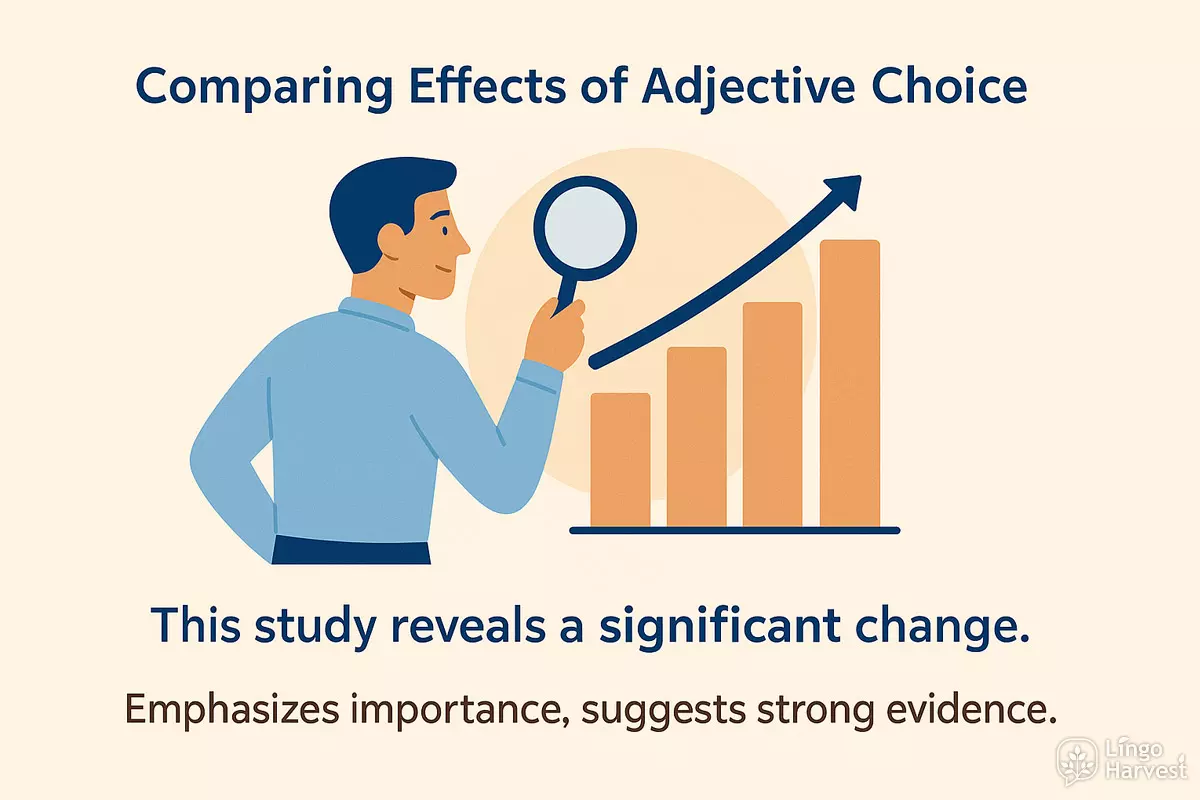
| This study reveals a significant change. | Emphasizes importance, suggests strong evidence. |
| This study reveals a moderate change. | Neutral, cautious; avoids exaggeration. |
| We observed a remarkable improvement. | Highlights an outstanding result, less neutral. |
| We observed a notable improvement. | Balanced; indicates importance without overstatement. |
| The method provides robust results. | Conveys confidence in findings. |
| The method provides consistent results. | Maintains objectivity and precision. |
Choosing the Right Level of Emphasis
Selecting between strong and neutral adjectives depends on context, the strength of your evidence, and the expectations of your discipline. Consider your audience and the purpose of your statement: use strong descriptors for clear, well-supported conclusions, and neutral ones when reporting facts, methods, or areas of uncertainty. This thoughtful approach to adjective choice helps academic writing remain persuasive yet trustworthy.
Adjective placement in complex noun phrases
Understanding where to position adjectives within longer noun groups is essential for clear, precise academic writing. English typically places adjectives before the noun, but when multiple descriptors and modifiers are involved, the order and grouping can influence both meaning and readability. It is especially important in academic contexts, where noun phrases can become quite elaborate.
Order of adjectives in extended noun phrases
In complex constructions, adjectives often appear in a specific sequence: opinion, size, age, shape, color, origin, material, and purpose, before the main noun. For example:
- significant recent theoretical advances
- concise relevant methodological guidelines
- large-scale empirical research studies
- innovative statistical analysis techniques
- comprehensive historical population data
- critical cross-disciplinary review articles
- advanced computational linguistic models
- robust peer-reviewed experimental results
- systematic randomized controlled trials
- well-established theoretical frameworks
- multifaceted practical implementation strategies
- recently published qualitative interview findings
- subtle context-dependent semantic shifts
- complex multi-step analytical procedures
- highly relevant policy implications
- concise data-driven summaries
- significant cross-cultural differences
- innovative long-term intervention projects
Grouping adjectives with other modifiers
When noun phrases include both adjectives and other modifiers (such as prepositional phrases or relative clauses), clarity is improved by grouping related words together. For example, in "relevant studies in contemporary linguistics," the adjective "relevant" directly modifies "studies," while "in contemporary linguistics" further specifies the kind of studies.
Common patterns in academic writing
Writers frequently combine multiple adjectives before the noun, but it is important to avoid overloading phrases. Consider the following structured examples:
| Noun Phrase Example | Analysis |
|---|---|
| concise significant findings | Both "concise" and "significant" precede the noun, with the evaluative adjective first. |
| relevant methodological challenges | "Relevant" (importance) comes before "methodological" (type/field). |
| recent comprehensive systematic reviews | Time ("recent"), scope ("comprehensive"), and type ("systematic") are layered before the noun. |
| critical data-driven policy decisions | Opinion ("critical") is followed by compound adjective ("data-driven") and purpose ("policy"). |
| robust long-term experimental designs | Quality ("robust"), duration ("long-term"), and method ("experimental") are sequenced logically. |
Tips for clarity and conciseness
- Limit the number of adjectives before a noun to three for best readability.
- Use commas only when adjectives are coordinate (equal and reversible in order).
- Place the most important or distinguishing modifier closest to the noun.
- Revise long noun phrases if they become difficult to process or ambiguous.
Applying these principles will help ensure your academic writing remains both precise and accessible, even when handling complex noun phrases with multiple adjectives.
Practice: refine academic sentences
Academic writing values precision and clarity. To achieve this, writers often rely on adjectives like “concise,” “significant,” and “relevant.” However, overusing or misplacing these descriptors can make sentences wordy or vague. The following exercises help you identify, assess, and improve the use of adjectives in scholarly contexts.
Task 1: Identify and Improve Adjectives
Below are several academic sentences. For each, consider whether the adjective is necessary, and if not, refine the sentence. If the adjective is helpful, make sure it is the most precise choice.
- The extremely relevant data supports the main hypothesis.
- This concise summary provides a clear overview of the results.
- The significant increase in efficiency led to improved outcomes.
- Several interesting factors contributed to the observed trend.
- The relevant literature was extensively reviewed in this study.
- The highly important variable influenced the experiment’s results.
- The amazing findings surprised the entire research team.
- The huge improvement in accuracy strengthened the conclusions.
- The wonderful feedback confirmed the study’s usefulness.
- The remarkable progress was noted throughout the project.
Show answers
- “Extremely” is redundant; → “The relevant data supports the main hypothesis.”
- Correct as is; “concise summary” is appropriate.
- Correct; “significant increase” is precise and meaningful.
- Replace “interesting” with something specific or remove it → “Several factors contributed to the observed trend.”
- “Relevant” may be redundant → “The literature was extensively reviewed in this study.”
- “Highly important” is vague → “The key variable influenced the experiment’s results.”
- “Amazing” too subjective → “The findings surprised the entire research team.”
- “Huge” too informal → “The substantial improvement in accuracy strengthened the conclusions.”
- “Wonderful” subjective → “The positive feedback confirmed the study’s usefulness.”
- “Remarkable” subjective unless measured → “The progress was noted throughout the project.”
Task 2: Choose the Most Precise Adjective
Select the most suitable adjective from the options in brackets to complete each sentence appropriately.
- This theory provides a (concise / vague / lengthy) explanation for the phenomenon.
- The research identified a (significant / minor / irrelevant) correlation between variables.
- Only (relevant / random / outdated) sources were included in the bibliography.
- The author offers a (concise / complicated / redundant) definition of the concept.
Show answers
- concise
- significant
- relevant
- concise
Common Academic Adjectives: Effective vs. Ineffective Choices
Review the list below. Which adjectives are generally strong choices in academic writing, and which tend to be too vague or subjective?
- significant
- relevant
- important
- interesting
- concise
- major
- useful
- crucial
- clear
- good
- substantial
- notable
- appropriate
- strong
- effective
- unnecessary
- robust
- minimal
- limited
- random
Show answers
Strong, precise adjectives: significant, relevant, concise, clear, substantial, notable, appropriate, effective, robust, minimal, limited, unnecessary.
Vague or subjective: important, interesting, major, useful, crucial, good, strong, random.
Before and After: Refining Academic Sentences
Compare the initial versions with improved alternatives. Notice how strong, specific adjectives enhance clarity and conciseness.
| Original Sentence | Refined Version |
|---|---|
| The very interesting results show a major difference between groups. | The results show a significant difference between groups. |
| The good summary provides all the necessary information. | The concise summary provides all relevant information. |
| Several useful sources were found during the research. | Several relevant sources were identified during the research. |
| This study makes an important contribution to the field. | This study makes a significant contribution to the field. |
| The big increase in productivity was observed after the intervention. | A substantial increase in productivity was observed after the intervention. |
Key Takeaways
- Use adjectives like “concise,” “significant,” and “relevant” to clarify meaning and add precision.
- Avoid vague or subjective adjectives such as “interesting,” “good,” or “important” unless you can quantify or specify them.
- Regularly review your writing to eliminate unnecessary adjectives and select the most accurate descriptors for your argument.