Evaluative Adjectives for Critical Analysis

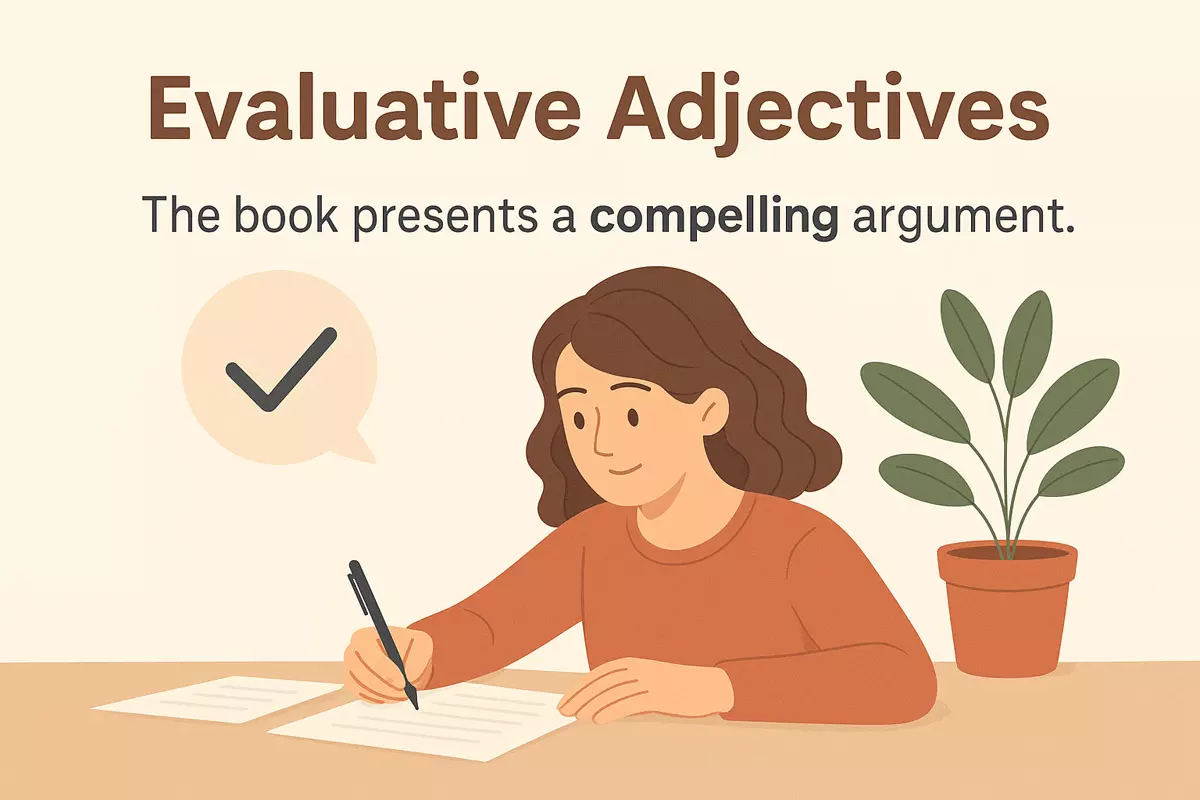 Here we what evaluative adjectives express, common evaluative categories, and how these adjectives influence argument strength and balance precision with bias.
The language we use to analyze literature, films, or arguments significantly influences how our perspectives are understood by others. Carefully selecting descriptive and precise words allows us to convey subtle judgments and deeper insights, making our evaluations more compelling and credible. Thoughtful word choice not only clarifies our own viewpoints but also helps our audience grasp the complexity of the subject under discussion. In any critical conversation, using nuanced language is essential for fostering meaningful dialogue and presenting well-supported opinions.
What evaluative adjectives express
Evaluative adjectives are used to communicate a speaker’s or writer’s judgment about the quality, value, or impact of a subject. These descriptive words go beyond neutral description, allowing us to express approval, criticism, or nuanced opinions about ideas, works, actions, or even people. They help shape the tone of critical analysis, making it clear how the subject is being perceived or assessed.
Types of meaning conveyed
These adjectives can indicate a wide range of subjective responses, such as positivity, negativity, strength, or subtlety. For instance, calling a theory “innovative” suggests admiration, while labeling it “flawed” highlights perceived weaknesses. The choice of adjective often reveals the stance or bias of the evaluator.
- Judgment of quality: excellent, poor, mediocre
- Assessment of impact: significant, negligible, profound
- Degree of originality: original, derivative, groundbreaking
- Clarity or ambiguity: clear, confusing, ambiguous
- Emotional response: moving, uninspiring, disturbing
- Practical value: useful, impractical, relevant
- Consistency or inconsistency: coherent, inconsistent, disjointed
- Persuasiveness: convincing, unconvincing, compelling
- Complexity: complex, simplistic, intricate
- Originality or predictability: novel, conventional, predictable
How evaluative adjectives influence analysis
By choosing specific adjectives, writers and speakers can subtly guide the interpretation of the subject. For example, describing an argument as “well-founded” encourages agreement, while “questionable” invites skepticism. This linguistic tool is essential in academic writing, reviews, and critical essays, where clear evaluation is required.
Comparing positive and negative connotations
The connotations of evaluative adjectives are crucial. Positive terms often signal endorsement, while negative ones highlight shortcomings. Some adjectives are more neutral or context-dependent, requiring careful selection based on the intended message.
| Positive Connotation | Negative Connotation |
|---|---|
| Insightful | Superficial |
| Comprehensive | Inadequate |
| Persuasive | Unconvincing |
| Balanced | Biased |
| Innovative | Derivative |
| Coherent | Disjointed |
In summary, evaluative adjectives are a vital part of critical analysis, allowing writers to make their attitudes explicit and guide readers’ interpretations. Their careful use enhances precision and depth in evaluative writing.
Common evaluative categories
When analyzing texts, works of art, or arguments, it helps to organize your assessment by considering different types of qualities. These categories guide the selection of appropriate evaluative adjectives and help structure critical responses more precisely.
Describing Quality and Merit
Evaluative language often centers on how well something is made, presented, or argued. Some useful adjectives for this purpose include:
- Impressive → The results are impressive and well supported.
- Flawed → The methodology is flawed in several areas.
- Insightful → The paper offers an insightful perspective.
- Inadequate → The explanation is inadequate for advanced learners.
- Outstanding → The researcher presented an outstanding analysis.
- Weak → The argument remains weak without further evidence.
- Competent → The study provides a competent overview of the topic.
- Unconvincing → The conclusions are unconvincing as stated.
- Skillful → The author provides a skillful interpretation of the data.
- Superficial → The discussion is superficial and lacks depth.
Assessing Clarity and Coherence
Clarity and logical flow are essential in critical analysis. You can discuss these features using adjectives such as:
- Lucid → The author presents a lucid explanation of the theory.
- Ambiguous → The conclusion is ambiguous and open to several interpretations.
- Consistent → The argument is consistent with previous research.
- Disjointed → The discussion feels disjointed and hard to follow.
- Transparent → The methodology is transparent and clearly documented.
- Confusing → The structure of the chapter is confusing for readers.
- Structured → The report is clearly structured into logical sections.
- Rambling → The introduction is rambling and lacks focus.
Evaluating Originality and Creativity
Originality is often valued in creative and academic work. Consider these terms:
- Innovative → The study proposes an innovative approach to the problem.
- Derivative → The article feels derivative of earlier work on the topic.
- Fresh → The book offers a fresh perspective on a familiar issue.
- Conventional → The researcher uses a conventional method of analysis.
- Inventive → The author uses an inventive structure to present the data.
- Predictable → The storyline is predictable and lacks surprises.
- Pioneering → This paper makes a pioneering contribution to the field.
- Unoriginal → The arguments are solid but largely unoriginal.
Judging Relevance and Significance
The importance or applicability of points can be highlighted with these adjectives:
- Relevant → The data is highly relevant to the main hypothesis.
- Peripheral → These details are peripheral to the central argument.
- Significant → The study reports a significant improvement in outcomes.
- Trivial → The error is trivial and does not affect the results.
- Essential → A clear definition of terms is essential for understanding.
- Marginal → The effect is marginal and barely observable.
- Pertinent → Her comments are pertinent to the discussion.
- Inconsequential → The differences are inconsequential in practice.
Comparing Tone and Impact
Writers often evaluate the effect or emotional quality of a work. Consider the following examples:
- Persuasive → The author presents a persuasive case for reform.
- Dry → The report is informative but rather dry in style.
- Evocative → The description is evocative and rich in imagery.
- Flat → The conclusion feels flat and lacks emotional impact.
- Moving → The narrative is deeply moving and personal.
- Detached → The tone remains detached and objective.
- Engaging → The article is engaging and easy to follow.
- Monotonous → The speaker’s delivery was monotonous and repetitive.
Summary Table: Sample Categories and Adjectives
| Category | Sample Evaluative Adjectives |
|---|---|
| Quality & Merit | Impressive, flawed, outstanding, weak |
| Clarity & Coherence | Lucid, ambiguous, structured, confusing |
| Originality | Innovative, derivative, fresh, predictable |
| Relevance | Relevant, peripheral, significant, trivial |
| Tone & Impact | Persuasive, evocative, engaging, flat |
By grouping evaluative adjectives according to purpose—such as assessing merit, clarity, originality, and impact—you can sharpen your analysis and communicate your judgments more effectively. The examples above serve as a toolkit for nuanced and precise critical commentary.
Impact on argument strength
Evaluative adjectives play a pivotal role in shaping the perceived credibility and persuasiveness of critical analysis. The adjectives you select can either clarify your stance or undermine your reasoning. When chosen carefully, these words help specify the intensity, value, or quality of the subject under discussion, making your points sharper and more convincing. Overreliance on vague or highly charged adjectives, however, may make arguments seem biased or unsupported.
Clarity and Precision
Clear evaluative language guides readers to your intended interpretation. For instance, describing evidence as "compelling" rather than just "good" adds nuance and signals the strength of your assessment. Precision in word choice prevents ambiguity and reduces the risk of misinterpretation.
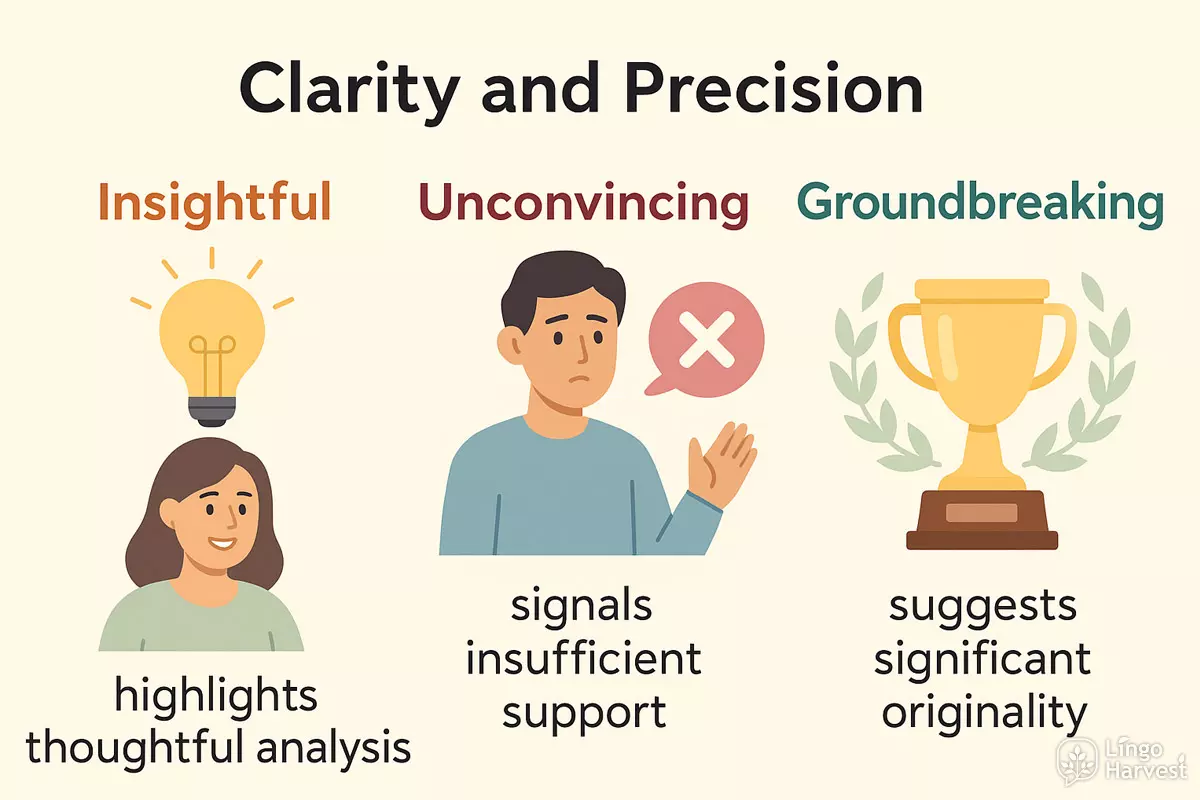
- Insightful — highlights thoughtful analysis
- Unconvincing — signals insufficient support
- Groundbreaking — suggests significant originality
- Flawed — points to specific weaknesses
- Coherent — stresses logical organization
- Redundant — calls out unnecessary repetition
- Inconsistent — notes contradictions
- Pivotal — identifies central importance
- Superficial — critiques lack of depth
- Comprehensive — praises thoroughness
- Ambiguous — highlights unclear points
- Persuasive — credits convincing reasoning
- Biased — exposes partiality
- Robust — commends strength
- Negligible — minimizes significance
- Contradictory — points out direct opposition
- Innovative — recognizes creativity
- Irrelevant — marks off-topic content
- Authoritative — signals expertise
- Dubious — questions reliability
- Limited — indicates narrow scope or coverage
- Tentative — suggests a preliminary or non-final conclusion
- Sophisticated — highlights complexity and refinement
- Transparent — emphasizes clarity and openness of procedure
- Cohesive — notes strong internal connection and unity
- Limitedly generalizable — indicates restricted applicability of findings
- Methodologically sound — highlights solid and appropriate methodology
Positive versus Negative Connotations
The connotation of evaluative adjectives can subtly influence readers. Positive descriptors like "thorough" or "insightful" can boost the perceived merit of a claim, while negative ones such as "inadequate" or "superficial" may weaken it. The balance and appropriateness of these choices are essential for objective analysis.
Comparative Effects
Sometimes, the difference between two similar adjectives can drastically change the effect of your critique. Consider how "adequate" versus "exceptional" shifts expectations about quality.
| Evaluative Adjective | Potential Impact on Reader |
|---|---|
| Insightful | Suggests depth and original thought; strengthens analysis |
| Superficial | Implies lack of depth; weakens credibility |
| Robust | Indicates well-supported evidence; enhances authority |
| Biased | Signals partiality; reduces trust in argument |
| Ambiguous | Highlights unclear reasoning; may confuse or alienate readers |
| Pivotal | Marks something as essential; focuses attention |
Summary
Selecting the right evaluative adjectives is more than a stylistic choice; it directly affects how well your critique is received. Thoughtful application of these descriptors can highlight strengths, expose weaknesses, and clarify the significance of evidence or arguments, ultimately making your analysis more persuasive and respected.
Precision vs bias in evaluation
Evaluative adjectives play a crucial role in shaping our judgments, but their effectiveness depends on how accurately they capture the qualities being described. Using precise language allows for a focused, credible analysis, while careless word choice can introduce bias, leading to skewed or unfair assessments.
Understanding Precision in Evaluative Adjectives
Precision involves selecting adjectives that directly and clearly reflect the attribute under scrutiny. For instance, describing a solution as "innovative" communicates a specific quality, whereas "good" is vague and open to interpretation. The more exact the adjective, the easier it is for readers to understand the reviewer’s criteria and reasoning.
- Detailed: "Meticulous," "thorough," "methodical"
- Clarity: "Transparent," "lucid," "explicit"
- Originality: "Groundbreaking," "novel," "unconventional"
- Effectiveness: "Impactful," "efficient," "potent"
- Consistency: "Reliable," "steady," "predictable"
- Complexity: "Intricate," "multifaceted," "layered"
- Relevance: "Pertinent," "applicable," "timely"
- Engagement: "Captivating," "compelling," "absorbing"
- Balance: "Equitable," "even-handed," "proportionate"
- Depth: "Profound," "comprehensive," "insightful"
Recognizing and Avoiding Bias
Bias arises when adjectives reflect personal preference, emotion, or unexamined assumptions rather than objective criteria. Words like "amazing" or "terrible" reveal more about the reviewer’s feelings than about the subject itself. This can mislead readers or undermine the credibility of the analysis.
- "Biased": "Unfair," "one-sided," "prejudiced," "subjective"
- "Overstated": "Exaggerated," "hyperbolic," "inflated"
- "Dismissive": "Negligent," "indifferent," "apathetic"
- "Loaded": "Manipulative," "emotive," "sensational"
Comparing Precise and Biased Evaluative Adjectives
| Precise Adjective | Biased/Imprecise Adjective |
|---|---|
| Insightful | Amazing |
| Methodical | Boring |
| Comprehensive | Overwhelming |
| Relevant | Irrelevant (without justification) |
| Balanced | Unfair |
| Reliable | Untrustworthy |
| Transparent | Misleading |
| Innovative | Weird |
| Engaging | Dull |
| Consistent | Erratic |
Strategies for Achieving Objectivity
To minimize bias and maximize clarity, evaluators should:
- Choose adjectives that are specific to observable qualities or outcomes.
- Support evaluative statements with evidence or examples.
- Avoid emotionally charged or absolute terms unless justified.
- Be aware of personal perspectives and strive for neutrality.
By carefully balancing accuracy and neutrality in their choice of adjectives, analysts can offer critical insights that are both trustworthy and informative.
Examples from academic papers
Academic writing frequently employs evaluative adjectives to convey nuanced judgments about research, arguments, and evidence. These descriptive words help writers critically assess the strengths and weaknesses of scholarly work, making their analysis more precise and persuasive. Below, we explore how such adjectives are applied in real academic contexts, illustrating both positive and critical evaluations.
Common evaluative adjectives in scholarly critique
Writers often select adjectives carefully to express approval, skepticism, or neutrality. Here are some examples commonly found in journal articles, literature reviews, and critical essays:
- Insightful → The study provides an insightful interpretation of the results.
- Flawed → The experiment was flawed due to inconsistent measurements.
- Robust → The model is supported by robust statistical evidence.
- Speculative → The conclusion remains speculative without further data.
- Comprehensive → The review offers a comprehensive overview of the topic.
- Inadequate → The sample size is inadequate for reliable analysis.
- Persuasive → The author presents a persuasive argument for policy change.
- Ambiguous → The findings are ambiguous and open to multiple interpretations.
- Innovative → The researchers propose an innovative approach to the problem.
- Redundant → Several sections of the article are redundant and unnecessary.
- Thorough → The study provides a thorough examination of the issue.
- Contradictory → The results are contradictory to previous research.
- Groundbreaking → This paper introduces a groundbreaking method.
- Superficial → The analysis is superficial and lacks depth.
- Convincing → The evidence presented is convincing and well-structured.
- Problematic → The assumptions in the model are problematic.
- Coherent → The argument is coherent and logically developed.
- Overstated → The author’s claims seem overstated based on the data.
- Nuanced → The discussion offers a nuanced perspective on the issue.
- Weak → The conclusion is weak and not fully supported by evidence.
Contextual usage in published research
The way these adjectives are used can subtly shift the tone of an academic analysis. Consider the following pairs of sentences, which demonstrate how evaluative language impacts interpretation:
- "The author presents a robust methodology for data collection." → signals reliability and strength.
- "The argument is speculative and lacks sufficient evidence." → highlights uncertainty or a need for caution.
- "This study offers a comprehensive overview of the literature." → suggests thoroughness.
- "Their conclusions are problematic due to limited data." → points out significant issues.
Comparing positive and negative evaluative adjectives
To clarify how these adjectives function, the table below contrasts positive and negative examples often found in academic critique.
| Positive Evaluative Adjectives | Negative Evaluative Adjectives |
|---|---|
| Insightful | Superficial |
| Comprehensive | Inadequate |
| Innovative | Redundant |
| Coherent | Contradictory |
| Groundbreaking | Overstated |
Academic authors use this vocabulary to convey judgments that are both specific and measured. Recognizing these patterns can help readers and writers better understand the subtle art of critical analysis in scholarly communication.
Practice: rewrite arguments using evaluative adjectives
Applying evaluative adjectives can transform basic arguments into nuanced, analytical statements. This not only clarifies your position but also demonstrates critical engagement with the material. Below, you'll find practical exercises and example lists to help you practice this essential academic skill.
Task 1: Enhance Arguments with Evaluative Language
For each example, rewrite the argument by adding suitable evaluative adjectives. Focus on words that convey judgment, quality, or value.
- The film tells a story about family relationships.
- The author's explanation is clear.
- The research method has some problems.
- The solution worked well.
- The proposal is not specific enough.
- The article presents a discussion of recent technological trends.
- The evidence used in the report is limited.
- The book offers ideas about cultural identity.
- The results are surprising.
- The argument in the essay is weak.
Show answers
- The film tells a heartfelt and insightful story about family relationships.
- The author's explanation is remarkably clear and thorough.
- The research method has several significant problems.
- The solution proved to be highly effective.
- The proposal is insufficiently detailed and vague.
- The article presents a comprehensive discussion of recent technological trends.
- The evidence used in the report is inadequate and unconvincing.
- The book offers thought-provoking ideas about cultural identity.
- The results are unexpected and noteworthy.
- The argument in the essay is poorly developed and unpersuasive.
Task 2: Identify and Replace Neutral Adjectives
Below are neutral statements. Your task is to replace the underlined adjective with a more evaluative one to strengthen the argument.
- The results are good.
- His analysis is interesting.
- The evidence is important.
- The argument is weak.
- The conclusion is clear.
- The methodology is simple.
- The findings are unexpected.
- The explanation is long.
- The article is useful.
- The theory is confusing.
Show answers
- The results are impressive.
- His analysis is thought-provoking.
- The evidence is crucial.
- The argument is unsubstantiated.
- The conclusion is coherent.
- The methodology is robust.
- The findings are noteworthy.
- The explanation is overly detailed.
- The article is highly informative.
- The theory is conceptually unclear.
Comparison of Neutral vs. Evaluative Statements
Notice how evaluative adjectives bring precision and nuance to analysis. Compare the following examples:
| Neutral Statement | With Evaluative Adjective |
|---|---|
| The theory is new. | The theory is innovative. |
| The data is complete. | The data is comprehensive. |
| The conclusion is not balanced. | The conclusion is biased. |
| The solution is useful. | The solution is effective. |
| The proposal is not clear. | The proposal is vague. |
Practicing the use of evaluative adjectives enriches your critical analysis and makes your arguments more persuasive and precise.