Academic and Research Verbs in Formal Writing

 Learn why stronger academic verbs make formal writing clearer and more credible, then get verb lists for stating research aims, describing methods, reporting results and trends, and interpreting findings. It also covers hedging verbs, common verb-choice mistakes, and homework rewriting tasks.
- Why academic verbs improve formal writing
- Verbs for describing research aims
- Verbs for methods and procedures
- Verbs for reporting results and trends
- Verbs for analysis and interpretation
- Hedging verbs for cautious claims
- Common mistakes in academic verb choice
- Homework: academic verb rewriting tasks
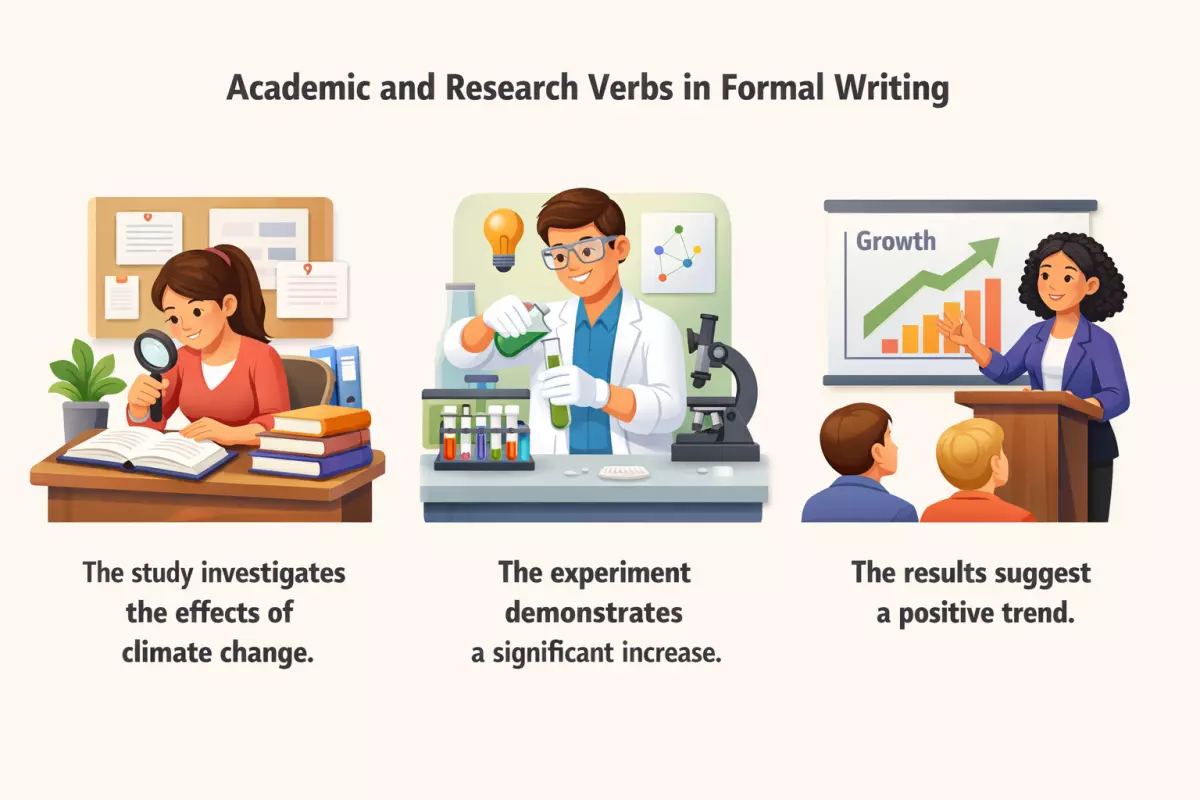
In academic writing, verb choice shapes how credible and precise your argument sounds. Rather than saying something shows or proves, use verbs that reflect your reasoning, such as examine, indicate, suggest, or challenge. Choosing the right action words helps you express evidence, patterns, and limits clearly, while keeping your tone appropriately formal and focused throughout your paper.
Why academic verbs improve formal writing
Precise research-oriented verbs help readers follow what you did, what you found, and how confident you are in each claim. Instead of sounding vague (“talks about,” “shows”), they encode common academic moves—defining a concept, narrowing a scope, testing a relationship, or weighing evidence—so the logic of the paragraph becomes easier to track.
How they strengthen clarity and structure
- They signal the writer’s action. Verbs such as “analyze,” “compare,” and “evaluate” tell the reader what kind of thinking is happening, not just the topic.
- They make claims more specific. “Suggests” and “indicates” differ from “demonstrates” and “establishes,” which helps you match wording to the strength of your evidence.
- They support predictable paragraph patterns. Many academic paragraphs follow a sequence: introduce a focus, describe method, report results, interpret, and qualify. Choosing verbs that fit each step reduces confusion.
- They reduce repetition. Rotating among accurate verbs (“argues,” “contends,” “maintains”) prevents overusing “says” while keeping meaning stable.
- They help separate evidence from interpretation. “Reports” and “observes” suit data; “infers” and “interprets” suit analysis. This distinction improves credibility.
- They improve cohesion across sentences. Verbs like “builds on,” “contrasts with,” and “extends” create explicit links between studies and ideas.
Common usage patterns that readers expect
- Literature positioning: “X argues that…,” “Y challenges the assumption that…,” “Z synthesizes prior findings by…”
- Defining and delimiting: “This paper defines…,” “The study distinguishes between…,” “We restrict the analysis to…”
- Method and procedure: “We measured…,” “The experiment manipulated…,” “The model estimates…,” “The survey captured…”
- Results reporting: “The data reveal…,” “The analysis identifies…,” “The results indicate…,” “We observed…”
- Interpretation: “These findings imply…,” “This pattern suggests…,” “The evidence supports…”
- Qualification and caution: “The results may reflect…,” “This could be explained by…,” “We cannot rule out…”
- Cause/effect and relationships: “X predicts…,” “X is associated with…,” “X mediates…,” “X moderates…”
- Critical evaluation: “The study overstates…,” “The argument overlooks…,” “The approach underestimates…”
Choosing verbs that match evidence strength
- ✅ Use “suggest,” “indicate,” “point to” when evidence is partial, correlational, or based on limited samples.
- ✅ Use “demonstrate,” “confirm,” “establish” when methods and results justify a stronger conclusion.
- ❌ Avoid “prove” in most academic contexts unless you are writing in a field where formal proof is the accepted standard (e.g., mathematics).
- ✅ Use “argue,” “contend,” “maintain” for interpretive or theoretical positions, especially in humanities and social sciences.
- ✅ Use “report,” “document,” “describe” when you are summarizing what a source states without adding your own evaluation.
Practical swaps that improve formality
- Replace “talk about” → “discuss,” “address,” “examine”
- Replace “look at” → “analyze,” “investigate,” “assess”
- Replace “show” → “indicate,” “reveal,” “demonstrate” (choose based on strength)
- Replace “deal with” → “consider,” “engage with,” “account for”
- Replace “make bigger/smaller” → “increase/decrease,” “amplify/reduce,” “attenuate”
- Replace “cause” (when uncertain) → “contribute to,” “be associated with,” “predict”
- Replace “get rid of” → “eliminate,” “remove,” “mitigate”
- Replace “fix” → “resolve,” “address,” “rectify”
- Replace “find out” → “determine,” “establish,” “ascertain”
- Replace “think” → “argue,” “propose,” “hypothesize”
Used consistently, these verb choices make your writing sound more disciplined because they map language to scholarly tasks: stating a position, handling sources, reporting procedures, and calibrating claims. The result is a more readable argument with fewer ambiguous statements and clearer boundaries between what is known, what is observed, and what is inferred.
Verbs for describing research aims

In academic writing, aim statements work best when they use precise verbs that match the scope of the study and the type of contribution you intend to make. The verb you choose signals whether you are testing, mapping, comparing, developing, or evaluating something, and it helps readers predict the methods and outcomes.
Common patterns for stating aims
- “This study aims to + base verb”: This study aims to examine the relationship between X and Y.
- “The research seeks to + base verb”: The research seeks to identify key predictors of Z.
- “This paper sets out to + base verb”: This paper sets out to clarify how A influences B.
- “The objective is to + base verb”: The objective is to evaluate the effectiveness of the intervention.
- “We investigate + noun phrase / wh-clause”: We investigate whether the model generalises across contexts.
- “We explore + noun phrase / how/why clause”: We explore how participants interpret the policy change.
- “We test + hypothesis / whether clause”: We test the hypothesis that exposure increases recall.
Verb choices by research intention
- Examine: neutral, widely applicable; often used for relationships, effects, or trends.
- Investigate: slightly broader than examine; fits mixed methods and complex questions.
- Explore: suitable for early-stage, open-ended, or under-researched topics.
- Identify: used when the aim is to find factors, themes, mechanisms, or variables.
- Determine: signals a more decisive outcome (often quantitative), e.g., determine the extent/impact.
- Assess: focuses on judging quality, level, or performance using stated criteria.
- Evaluate: similar to assess but often implies a formal framework or comparison to benchmarks.
- Measure: used when the outcome is a quantifiable variable or instrument-based result.
- Estimate: appropriate for approximations (e.g., prevalence, risk, effect size) with uncertainty.
- Compare: indicates two or more groups/conditions; often paired with “across,” “between,” or “with.”
- Contrast: emphasises differences rather than similarities; useful in discussion-driven studies.
- Analyse: signals systematic examination of data, texts, or processes; pairs well with “patterns,” “drivers,” “structures.”
- Characterise: used to describe defining features (e.g., characterise a population or phenomenon).
- Describe: appropriate for reporting what is observed without claiming causality.
- Map: used for overviews (e.g., map the literature, map pathways, map stakeholder networks).
- Develop: indicates creating a model, framework, tool, or intervention.
- Propose: used when introducing a new conceptual approach or explanation.
- Validate: used for confirming an instrument/model against data or standards.
- Test: indicates hypothesis-driven work; often paired with “whether” or named hypotheses.
Usage notes: matching verb strength to evidence
- Avoid overstating causality: use “examine” or “assess” rather than “prove.” ❌ This study proves X causes Y. ✅ This study examines whether X is associated with Y.
- Be consistent with method: “measure” and “estimate” imply quantitative outputs; “explore” and “interpret” fit qualitative designs.
- Prefer specific objects: pair the verb with a clear target (variables, population, dataset, timeframe). Example: “compare outcomes between groups A and B over 12 months.”
- Limit aim statements to one main action: if you have multiple aims, list them as separate items rather than stacking verbs in one sentence.
Model aim statements (ready-to-adapt)
- This study aims to evaluate the impact of X on Y in Z context.
- The research seeks to identify factors associated with outcome Y among population Z.
- This paper sets out to compare approaches A and B with respect to metric M.
- We explore how stakeholders perceive and respond to policy X.
- We develop and validate a model for predicting Y using variables X1–Xn.
- The objective is to map existing evidence on X and highlight gaps for future work.
Verbs for methods and procedures
When describing how a study was carried out, choose verbs that clearly signal the action (planning, collecting, processing, or checking) and match the level of detail expected in your field. Method-focused verbs often appear in the past tense in the Methods section (what you did), and in the present tense when stating what a procedure does in general (what the method achieves).
Common verb choices and how they are typically used
- apply: use a technique or rule in a specific context. Example: “We applied a Bonferroni correction to control for multiple comparisons.”
- administer: give a treatment, test, or instrument to participants. Example: “The survey was administered online.”
- collect: gather data, samples, or responses. Example: “We collected blood samples at baseline and week 6.”
- compile: bring together data from multiple sources into one dataset. Example: “We compiled records from three registries.”
- construct: build a measure, index, model, or dataset. Example: “We constructed a composite socioeconomic score.”
- define: specify an operational meaning or criterion. Example: “We defined treatment success as a 30% reduction in symptoms.”
- derive: obtain a variable or value from other measurements. Example: “We derived BMI from height and weight.”
- design: plan an experiment, protocol, or instrument. Example: “We designed a randomized, double-blind trial.”
- employ: use a method (often more formal than “use”). Example: “We employed mixed-effects models to account for clustering.”
- estimate: compute an approximate value or parameter from data. Example: “We estimated effect sizes with 95% confidence intervals.”
- extract: take specific information from a larger source. Example: “We extracted diagnostic codes from electronic records.”
- implement: put a planned procedure into practice. Example: “We implemented quality checks before analysis.”
- measure: quantify a variable using an instrument or protocol. Example: “We measured reaction time using a computerized task.”
- model: represent relationships statistically or computationally. Example: “We modeled growth trajectories across four time points.”
- monitor: track a variable over time for change or compliance. Example: “We monitored adherence via weekly logs.”
- normalize: scale or transform data to a common basis. Example: “Counts were normalized by library size.”
- operate: run equipment or a system according to a protocol. Example: “The instrument was operated under manufacturer settings.”
- optimize: adjust parameters to improve performance or fit. Example: “We optimized hyperparameters using grid search.”
- randomize: assign participants/items by chance. Example: “Participants were randomized in a 1:1 ratio.”
- record: document observations or readings. Example: “We recorded temperature at 10-minute intervals.”
- replicate: repeat procedures to test reliability. Example: “We replicated the assay in triplicate.”
- sample: select a subset from a population or material. Example: “We sampled households using stratified sampling.”
- screen: check eligibility or identify cases meeting criteria. Example: “We screened participants for exclusion conditions.”
- simulate: generate data or outcomes using a model. Example: “We simulated 10,000 runs to assess uncertainty.”
- standardize: apply consistent procedures or convert to comparable units. Example: “Scores were standardized within age groups.”
- validate: confirm accuracy or suitability against a reference. Example: “We validated the classifier on an external dataset.”
Useful grammar patterns in method descriptions
- Passive voice for procedure focus (common when the actor is not important): ✅ “Samples were centrifuged at 10,000 g.” ❌ “We centrifuged samples at 10,000 g” (not wrong, but shifts focus to the researchers).
- Active voice for clarity and responsibility (useful for decisions and judgments): “We excluded participants with incomplete consent forms.”
- Verb + object + instrument/tool: “We measured cortisol using ELISA kits.” / “We recorded responses with a digital logger.”
- Verb + preposition for data sources: “We extracted variables from hospital records.” / “We sampled participants from the registry.”
- Verb + infinitive to state purpose: “We normalized the data to reduce batch effects.” / “We randomized assignments to prevent selection bias.”
- Verb + that-clause for operational decisions: “We defined exposure such that short-term contact was excluded.”
- Sequencing with clear time markers: “First, we screened records; next, we extracted variables; finally, we validated the dataset.”
Choosing precise verbs (and avoiding vague ones)
- Replace “did” or “performed” with the specific action: “performed analysis” → “estimated parameters,” “modeled outcomes,” or “tested assumptions.”
- Use “assess” or “evaluate” when judging quality or performance, but use “measure” when quantifying a variable with an instrument.
- Prefer “derive” for computed variables, “extract” for pulling fields from existing sources, and “collect” for newly gathered data.
- Use “validate” for checking against an external reference; use “verify” for confirming correctness of a step (e.g., code, calculations, or data integrity).
Verbs for reporting results and trends
Results sections and data commentaries rely on precise verbs to describe what the evidence shows, how strong the pattern is, and whether a change is stable or temporary. The most effective choices match the type of evidence (statistical output, qualitative themes, visual trends) and keep the claim proportional to the data.
Common verb choices and what they signal
- show: neutral, widely acceptable for figures and statistical tests (e.g., “The analysis shows…”).
- indicate: slightly cautious; often used when evidence points to an interpretation rather than proving it.
- suggest: more tentative; useful when alternative explanations remain plausible.
- reveal: emphasizes that a pattern became visible through analysis; avoid if the finding is routine.
- demonstrate: stronger than “show”; best when the design and results clearly support the claim.
- confirm: implies prior expectation or hypothesis testing; use when a prediction is supported.
- support: links evidence to a claim (“These results support the hypothesis that…”).
- corroborate: indicates agreement with earlier studies or additional data sources.
- establish: very strong; reserve for robust, well-controlled evidence.
- identify: focuses on detecting a factor, group, or theme (“We identified two clusters…”).
- observe: reports what was seen/measured, often with minimal interpretation.
- report: formal and neutral; common when summarizing outputs or descriptive statistics.
- estimate: highlights uncertainty and model-based quantities (effect sizes, parameters).
- quantify: stresses measurement of magnitude (“We quantified the increase in…”).
- characterize: describes properties or patterns rather than a single directional change.
- vary: indicates differences across conditions or groups without stating direction.
- differ: compares groups/conditions; often paired with “significantly” when appropriate.
- associate: describes relationships without implying causation (“X was associated with Y”).
- predict: indicates model-based forecasting or explanatory power; clarify the model context.
- explain: implies an account of why; use carefully unless mechanisms are tested.
Patterns for describing direction, magnitude, and stability
- increase / rise / grow + by (amount) or to (new level): “Rates increased by 12%.” / “Rates increased to 45%.”
- decrease / decline / fall / drop + by or to: “Errors declined by 0.8 points.”
- peak + at: “The response peaked at 10 minutes.”
- reach + (level): “The concentration reached 3.2 mg/L.”
- remain / stay + (adjective/level): “Values remained stable across conditions.”
- stabilize + after (time/point): “The series stabilized after week 6.”
- fluctuate + between (bounds): “Scores fluctuated between 70 and 78.”
- level off + at: “Growth leveled off at approximately 2%.”
- plateau + at: “Performance plateaued at 90% accuracy.”
- accelerate / slow + (rate phrase): “The decline slowed in the final quarter.”
- widen / narrow + (gap/difference): “The gender gap narrowed over time.”
- diverge / converge: “The trajectories diverged after the intervention.”
Linking claims to evidence without overstating
- Use cautious verbs when the design is correlational or the sample is limited: “The findings suggest…” rather than “The findings prove…”.
- Reserve strong verbs for strong support: “The randomized trial demonstrated…” is more defensible than “The survey demonstrated…”.
- Prefer relationship language when causality is not tested: ✅ “X was associated with Y” ❌ “X caused Y”.
- Match the verb to the output type: models often estimate effects; thematic analyses identify themes; figures show trends.
- Keep adverbs disciplined: “significantly” should refer to statistical significance, not emphasis.
Useful sentence frames
- “Figure 2 shows a steady increase in … over … .”
- “The regression model estimated a positive effect of … on … .”
- “Group A differed from Group B in … (p = …).”
- “The results support the hypothesis that … .”
- “These findings corroborate earlier reports of … .”
- “Scores peaked at … and then declined to … .”
- “After …, the trend leveled off, indicating … .”
- “The data indicate substantial variation across … .”
Verbs for analysis and interpretation
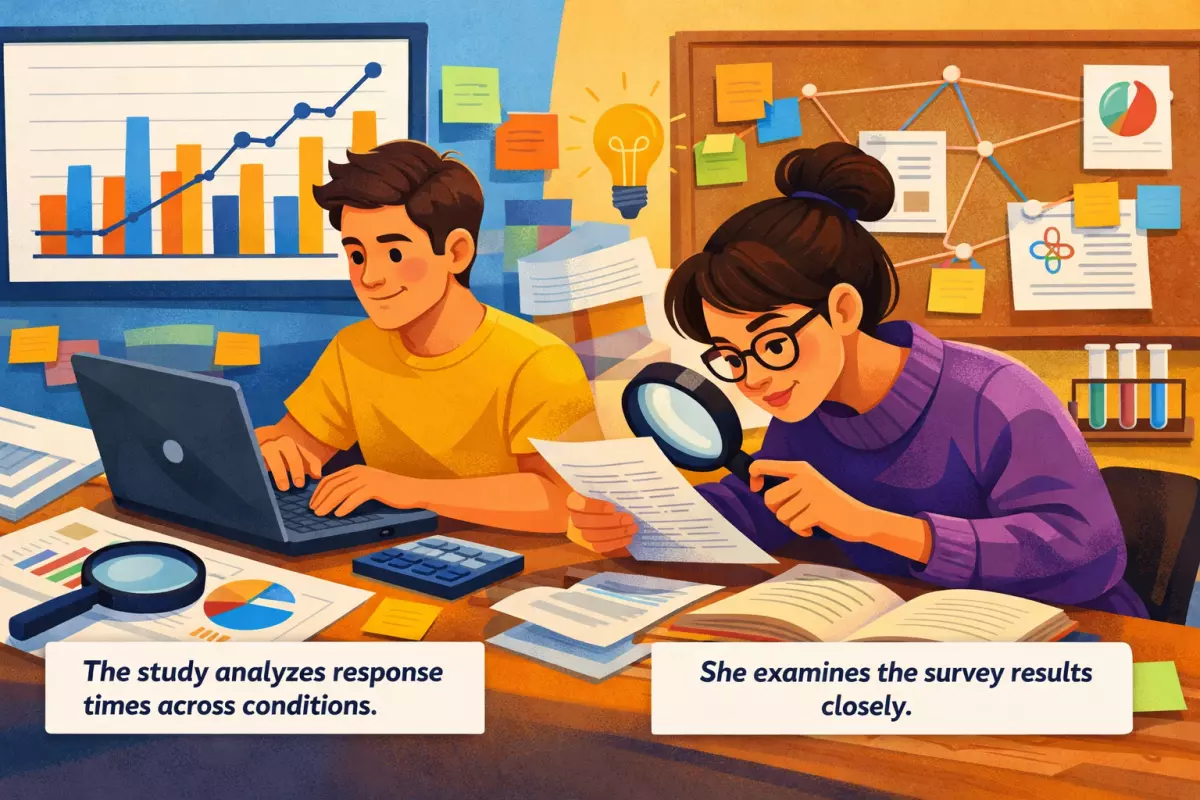
When you explain what data, texts, or observations mean, choose verbs that match the strength of your claim and the type of reasoning you used. Analytical verbs often pair with specific grammatical patterns (for example, a that-clause, a noun phrase, or a prepositional phrase), and those patterns help readers follow how you moved from evidence to meaning.
Common verb choices and the patterns they prefer
- analyze + noun phrase: “The study analyzes response times across conditions.”
- examine + noun phrase: “We examine variation by age group.”
- investigate + noun phrase: “The paper investigates how feedback affects revision quality.”
- interpret + noun phrase / as + noun phrase: “We interpret the spike as an artifact of sampling.”
- evaluate + noun phrase: “The authors evaluate the reliability of the instrument.”
- assess + noun phrase: “This section assesses model fit.”
- compare + noun phrase + with/to + noun phrase: “We compare Group A with Group B.”
- contrast + noun phrase + with + noun phrase: “The discussion contrasts short-term with long-term effects.”
- differentiate between + noun phrase(s): “The analysis differentiates between correlation and causation.”
- identify + noun phrase: “We identify three recurring themes.”
- detect + noun phrase: “The algorithm detects anomalies in the signal.”
- reveal + noun phrase / that-clause: “The results reveal a consistent pattern.” / “The results reveal that training improves accuracy.”
- indicate + that-clause: “The findings indicate that the intervention reduced errors.”
- suggest + that-clause: “The data suggest that motivation mediates the effect.”
- imply + that-clause: “These trends imply that cost is a limiting factor.”
- demonstrate + noun phrase / that-clause: “The experiment demonstrates feasibility.”
- account for + noun phrase: “The model accounts for most of the variance.”
- attribute + noun phrase + to + noun phrase: “We attribute the difference to measurement error.”
- corroborate + noun phrase: “The interviews corroborate the survey results.”
Match the verb to the strength of your inference
Some verbs signal cautious interpretation, while others present a stronger conclusion. Use this contrast to avoid overstating what the evidence can support.
- More cautious: suggest, indicate, appear to (often used with a following infinitive: “appear to reflect”).
- Moderate: support (as in “support the claim”), point to, are consistent with (useful when aligning with prior work).
- Stronger (use only when warranted): demonstrate, establish, confirm (typically appropriate with robust designs, replication, or converging evidence).
Frequent grammar pitfalls (and clean fixes)
- ✅ “The results suggest that X.” ❌ “The results suggest X is.” → Use a full that-clause for clarity.
- ✅ “We attribute the increase to Y.” ❌ “We attribute the increase for Y.” → Keep the standard preposition.
- ✅ “This analysis accounts for 62% of the variance.” ❌ “This analysis accounts 62% of the variance.” → Keep the particle “for.”
- ✅ “We interpret the pattern as evidence of Z.” ❌ “We interpret the pattern evidence of Z.” → Add “as” when naming the interpretation.
For smoother academic flow, place the analytical verb early in the sentence (“The regression indicates…”, “The thematic analysis identifies…”), then follow with the specific evidence or outcome. This structure keeps interpretation anchored to what was actually observed.
Hedging verbs for cautious claims
In academic writing, cautious verb choices help you present findings as evidence-based rather than absolute. These verbs let you signal uncertainty, limit the scope of a claim, and separate what the data show from what you infer. They are especially useful in literature reviews, discussion sections, and any place where conclusions depend on assumptions or incomplete information.
Common verb families and what they imply
- Inference from evidence: suggest, indicate, imply, point to, support, corroborate
- Interpretation: interpret, view, read (as), construe, frame
- Probability and tendency: appear (to), seem (to), tend (to), be likely (to), be unlikely (to)
- Exploration rather than proof: explore, examine, investigate, consider, assess
- Provisional explanation: propose, hypothesize, speculate, posit
- Partial contribution: contribute (to), help (to), play a role (in), be associated (with)
- Reporting others carefully: report, argue, claim, contend, maintain (useful when attributing a position without endorsing it)
- Qualification by context: depend (on), vary (with), differ (across), be contingent (on)
High-utility patterns (with examples)
- Subject + hedging verb + that-clause: “The results suggest that early exposure influences recall.”
- Subject + hedging verb + noun phrase: “These findings indicate a modest increase in risk.”
- It + hedging verb + that-clause: “It appears that the intervention benefits older participants.”
- Hedging verb + to-infinitive: “Participants tended to overestimate their performance.”
- Modal-like verb phrase: “The effect is likely to be smaller in field settings.”
- Evidence framing: “The data point to a seasonal component.”
- Attribution + stance control: “Smith (2022) argues that the model is under-specified.”
- Association instead of causation: “Higher workload is associated with lower satisfaction.”
- Mechanism as a proposal: “We hypothesize that social support mediates this relationship.”
- Scope limitation: “The observed pattern may depend on baseline severity.”
Choosing strength: match the verb to your evidence
- Use stronger cautious verbs when evidence is consistent but not definitive: “The results support the interpretation that…”
- Use neutral inference verbs for typical empirical claims: “The analysis suggests that…” / “The trend indicates…”
- Use weaker appearance verbs when data are limited or noisy: “The effect seems to…” / “It appears that…”
- Use proposal verbs for mechanisms and explanations: “We propose a pathway in which…”
- Prefer association language unless you have causal identification: “X is associated with Y” rather than “X causes Y.”
Common accuracy fixes
- ✅ “The evidence suggests that…” → ❌ “The evidence proves that…” (unless proof is warranted by the method and domain)
- ✅ “The findings indicate a relationship…” → ❌ “The findings demonstrate causation…” (avoid causal overreach)
- ✅ “These results may reflect sampling bias.” → ❌ “These results reflect sampling bias.” (state uncertainty when it is uncertain)
- ✅ “Jones (2020) claims that…” → ❌ “Jones (2020) shows that…” (use reporting verbs to avoid overstating others’ conclusions)
Used well, these verbs help you calibrate commitment: you can be clear about what the study observed while keeping interpretation appropriately tentative. This makes arguments easier to trust because the language matches the strength of the evidence.
Common mistakes in academic verb choice
Verb selection in scholarly writing often goes wrong in predictable ways: the verb is too strong for the evidence, too vague to be informative, or mismatched with the method used. The result can be claims that sound biased, overstated, or unclear about what the research actually did.
1) Overstating certainty (strong verbs without sufficient evidence)
Many drafts use verbs that imply proof or finality when the study only shows an association, trend, or limited support. Choose verbs that match your design (correlational, exploratory, qualitative, small sample, etc.).
- ❌ “This study proves that X causes Y.” → ✅ “This study suggests that X may influence Y.”
- ❌ “The results demonstrate that the policy is effective.” → ✅ “The results indicate that the policy may be effective under these conditions.”
- ❌ “We established a universal principle.” → ✅ “We identified a pattern in the sampled context.”
- ❌ “The intervention eliminated bias.” → ✅ “The intervention reduced bias on the measured outcomes.”
2) Under-specifying actions (vague verbs that hide the method)
General verbs can make procedures and reasoning hard to follow. Replace broad verbs with ones that name the research action (how data were handled, what comparison was made, what was tested).
- “We looked at the data” → “We analyzed the data using …”
- “We did a study” → “We conducted a survey/experiment/interview study”
- “We got results” → “We obtained results” or “We observed results” (depending on context)
- “We talked about limitations” → “We discussed limitations” or “We acknowledged limitations”
- “We made a model” → “We developed a model” or “We specified a model”
- “We checked assumptions” → “We tested assumptions” or “We verified assumptions” (use carefully)
3) Using evaluative or biased verbs in place of neutral reporting
Some verbs embed judgment (praise, blame, dismissal) rather than describing what the evidence shows. In formal writing, prefer neutral verbs that report findings and interpret cautiously.
- ❌ “The author fails to consider…” → ✅ “The author does not address…”
- ❌ “This approach ignores…” → ✅ “This approach does not account for…”
- ❌ “The theory claims…” (when you mean “states/argues”) → ✅ “The theory argues…” or “The theory posits…”
- ❌ “The results show clearly…” → ✅ “The results show…” or “The results suggest…”
4) Misusing “argue,” “claim,” “suggest,” and “imply”
These verbs differ in who is doing the meaning-making (the writer, the evidence, or the text) and how strong the stance is.
- Argue: use when an author presents reasons (a structured position), not just a statement.
- Claim: use for an assertion that may be contested; avoid when you simply mean “state.”
- Suggest: use for tentative interpretation or partial support; common for cautious conclusions.
- Imply: use when something is indicated indirectly (often by results), not explicitly stated.
- Pattern tip: “The results suggest…” is usually safer than “The results prove…” unless the design truly supports proof.
5) Collocation errors (unnatural verb–noun pairings)
Academic verbs tend to appear with specific nouns. Unusual pairings can sound non-native or imprecise even when the grammar is correct.
- Prefer “draw a conclusion” over “make a conclusion.”
- Prefer “pose a question” over “make a question.”
- Prefer “conduct an analysis/experiment” over “do an analysis/experiment” (informal).
- Prefer “provide evidence” or “present evidence” over “give evidence” (often too casual).
- Prefer “address a limitation/issue” over “solve a limitation” (limitations are acknowledged/mitigated, not solved).
- Prefer “report results” over “say results.”
6) Confusing research-process verbs (what you did vs. what you found)
Separate verbs that describe procedure from verbs that describe outcomes. Mixing them can blur the logic of the section.
- Procedure: collect, measure, code, sample, control, randomize, model, estimate, validate, replicate
- Outcome: find, observe, identify, detect, reveal, indicate, show, suggest
- Interpretation: interpret, explain, attribute, contextualize, theorize
7) Overusing “show” and “demonstrate”
Repeated reliance on a small set of verbs makes prose monotonous and can unintentionally strengthen claims. Rotate with precise alternatives that reflect the evidence type.
- Use indicate for signals in data without implying final proof.
- Use reveal for findings that become visible through analysis.
- Use highlight for drawing attention to a notable aspect (not for causal claims).
- Use corroborate when results align with prior evidence (and say what they align with).
- Use support for hypothesis-consistent results (and specify the hypothesis).
8) Inconsistent tense and voice around key verbs
Tense shifts can make it unclear whether you are describing established knowledge, your study’s actions, or your interpretation. Keep tense consistent within each rhetorical move.
- Methods often use past tense: “We collected…,” “We estimated…”
- Results often use past tense for what was found: “The analysis revealed…”
- General truths and established literature often use present tense: “Prior work suggests…”
- Voice choice: use passive selectively when the actor is irrelevant (“Data were coded…”), but keep active when clarity improves (“We coded the data…”).
Homework: academic verb rewriting tasks
Use these exercises to practise replacing vague or informal verbs with precise academic and research verbs. Focus on three patterns: (1) verb + noun (for reporting actions), (2) verb + that-clause (for claims and interpretations), and (3) verb + preposition (for relationships such as comparison and association).
1) Replace weak verbs with stronger research verbs
Rewrite each sentence by changing the underlined verb to a more formal alternative. Keep the meaning and tense the same, and avoid changing the key content words unless needed for grammar.
- The study looks at how sleep quality affects exam performance.
- This paper talks about the limitations of self-reported data.
- The results show that early intervention improves retention.
- We got data from three public databases.
- The authors say that the method is reliable.
- The analysis finds out which variables predict dropout.
- The model uses age and income as control variables.
- The researchers make a comparison between two cohorts.
- The discussion goes into possible explanations for the anomaly.
- The survey asks participants about their daily routines.
- The experiment tries to reduce bias in the sampling process.
- The conclusion gives recommendations for future work.
Show answers
- The study examines how sleep quality affects exam performance.
- This paper discusses the limitations of self-reported data.
- The results indicate that early intervention improves retention.
- We obtained data from three public databases.
- The authors argue that the method is reliable.
- The analysis identifies which variables predict dropout.
- The model incorporates age and income as control variables.
- The researchers compare two cohorts.
- The discussion addresses possible explanations for the anomaly.
- The survey elicits information about participants’ daily routines.
- The experiment aims to reduce bias in the sampling process.
- The conclusion offers recommendations for future work.
2) Match the verb to the strength of the claim
Rewrite each sentence twice: Version A should be cautious (appropriate when evidence is limited). Version B should be stronger (appropriate when evidence is robust). Keep the same basic meaning.
- The findings ______ that policy changes improved access to care.
- The data ______ that the intervention caused the observed effect.
- The results ______ that social support is linked to lower stress.
- The analysis ______ that the proposed framework is applicable across contexts.
- The evidence ______ that the relationship is non-linear.
Show answers
- A: The findings suggest that policy changes improved access to care. B: The findings demonstrate that policy changes improved access to care.
- A: The data imply that the intervention caused the observed effect. B: The data establish that the intervention caused the observed effect.
- A: The results indicate that social support is linked to lower stress. B: The results confirm that social support is linked to lower stress.
- A: The analysis proposes that the proposed framework is applicable across contexts. B: The analysis shows that the proposed framework is applicable across contexts.
- A: The evidence points to the relationship being non-linear. B: The evidence reveals that the relationship is non-linear.
3) Practise common academic verb patterns (verb + noun / that-clause / preposition)
Rewrite each item using the cue in brackets. Maintain grammatical accuracy and keep the register formal.
- We looked at differences between the two groups. (compare)
- The paper talks about how the sample was selected. (describe)
- They found a link between screen time and sleep. (identify; between)
- The authors say that earlier studies were inconsistent. (note; that-clause)
- The study shows that the effect is small. (report; that-clause)
- The researchers used a questionnaire to get responses. (administer)
- We used prior work to support our approach. (draw on)
- The discussion deals with alternative interpretations. (consider)
- The model looks at how price changes affect demand. (estimate)
- The paper makes clear what assumptions are required. (clarify)
Show answers
- We compared differences between the two groups.
- The paper describes how the sample was selected.
- They identified a link between screen time and sleep.
- The authors note that earlier studies were inconsistent.
- The study reports that the effect is small.
- The researchers administered a questionnaire to elicit responses.
- We drew on prior work to support our approach.
- The discussion considers alternative interpretations.
- The model estimates how price changes affect demand.
- The paper clarifies what assumptions are required.
4) Editing checklist for verb choice
- Prefer specific process verbs for methods: measure, calculate, simulate, administer, code, classify.
- Use reporting verbs that match your stance: argue (interpretation), report (neutral), claim (distance), conclude (end-point).
- Check collocations: you typically conduct an experiment, collect data, derive an equation, pose a question, address a limitation.
- Avoid overstatement unless evidence warrants it: ✅ suggest / indicate → ❌ prove (in most empirical writing).
- Reduce repetition by alternating accurate verbs (not random synonyms): examine (scope), analyse (method), evaluate (judgement), compare (contrast).