Evaluative Nouns in Opinion and Review Writing Style

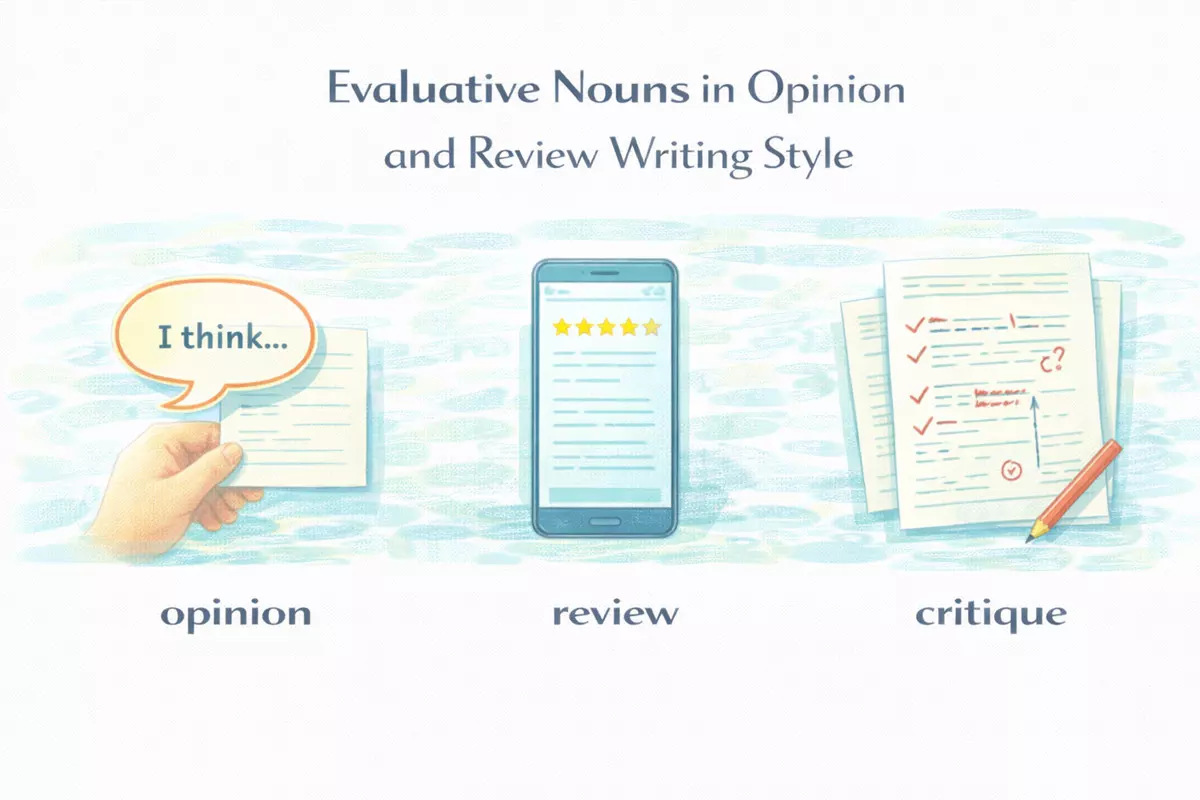 The article details how evaluative nouns function in opinion writing, distinguishes between positive and negative types, compares them to adjective-based evaluations, explains their impact on tone, points out common errors, and offers practice rewriting reviews.
- What evaluative nouns are in opinion writing
- Positive and negative evaluation nouns
- Using evaluative nouns to express judgment
- Difference between adjective-based and noun-based evaluation
- Tone control through noun choice in reviews
- Common learner mistakes with evaluative nouns
- Practice: rewrite review sentences using evaluative noun structures
When discussing movies, books, or products, the words we choose—such as triumph, disappointment, or masterpiece—significantly influence how our opinions are interpreted by others. These descriptive labels not only express our personal reactions but also provide context and emphasis, helping listeners or readers understand the depth of our feelings. By carefully selecting such terms, we add nuance and clarity to our reviews, making them more engaging and relatable for those who encounter our assessments.
What evaluative nouns are in opinion writing
Opinion writing often relies on specific nouns to express judgment, value, or assessment. These are called evaluative nouns, and they help writers convey their stance, appraise a subject, or summarize qualities in a concise way. Rather than simply stating feelings, these nouns encapsulate an evaluation, adding depth and clarity to reviews, critiques, and commentary.
Role and Function
Evaluative nouns act as signals to the reader, indicating the writer’s perspective or the criteria being used for assessment. They can refer to qualities, outcomes, or the worthiness of something being discussed. In opinion pieces or reviews, these terms often frame arguments or provide the basis for recommendations and judgments.
Common Examples of Evaluative Nouns
Writers use a range of evaluative nouns to make their viewpoints clear. Here are some typical examples found in reviews, editorials, and critical essays:
- advantage → One advantage of online learning is flexible scheduling.
- benefit → A major benefit of exercise is improved mental health.
- drawback → The main drawback of this method is its high cost.
- strength → Clear communication is her greatest strength.
- weakness → His weakness is a lack of attention to detail.
- merit → The idea has merit, even if it needs more development.
- flaw → The proposal contains a serious flaw in its logic.
- impact → Social media has a strong impact on public opinion.
- significance → The significance of the discovery was recognised worldwide.
- achievement → Completing the project on time was a major achievement.
- failure → The failure to follow instructions caused errors.
- success → The program was a success and exceeded expectations.
- quality → The quality of the report impressed the teachers.
- shortcoming → A common shortcoming is the lack of reliable data.
- value → Education holds great value in modern society.
- contribution → Her contribution to the study was essential.
- limitation → One limitation of the sample is its small size.
- importance → The importance of teamwork cannot be overstated.
- influence → Culture has a strong influence on language use.
- potential → The team showed great potential for future success.
These nouns can be used as the subject or object in sentences to build arguments, such as “The main strength of the film is its originality,” or “One drawback is the pacing.”
How Evaluative Nouns Shape Arguments
Using such nouns allows writers to structure their opinions logically and with authority. They help break down complex judgments into specific aspects, making critiques clearer for the audience. For instance, by focusing on “merits” and “shortcomings,” a reviewer can systematically discuss both positive and negative elements.
Categories and Nuances
Evaluative nouns can be grouped by the type of judgment they express. Some highlight positive aspects (e.g., “benefit,” “achievement”), while others underscore negatives (e.g., “flaw,” “limitation”). A few, such as “impact” or “potential,” can be context-dependent and neutral, shifting meaning based on how they are used in the sentence.
| Positive | Negative | Neutral/Variable |
|---|---|---|
| Advantage | Drawback | Impact |
| Benefit | Flaw | Influence |
| Strength | Limitation | Significance |
| Merit | Weakness | Potential |
In sum, evaluative nouns are an essential tool in opinion and review writing. They clarify the writer’s stance and help organize commentary, making arguments more persuasive and accessible.
Positive and negative evaluation nouns
Choosing the right evaluative noun can subtly shape the tone and impact of any opinion or review. These nouns allow writers to summarize their stance without overusing adjectives or adverbs. They often appear as the subjects of sentences or as objects following verbs like “give,” “offer,” or “receive.” Understanding the spectrum from praise to criticism helps make reviews more nuanced and credible.
Common positive evaluative nouns

Writers use approving nouns to express endorsement, satisfaction, or admiration. Such terms typically highlight perceived strengths, achievements, or benefits. Here’s a list of frequently used positive options:
- gain → This approach offers a clear gain for small businesses.
- profit → The company made a large profit from online sales.
- strong point → Creativity is her strongest strong point in design tasks.
- key feature → A key feature of the software is automatic saving.
- resource → Skilled workers are a valuable resource in any company.
- victory → Winning the contract was an important victory for the team.
- worth → His idea had worth even though it needed refinement.
- accomplishment → Finishing the degree was a huge accomplishment for him.
- virtue → Patience is a virtue admired in good leaders.
- attraction → The main attraction of the course is its flexibility.
- excellence → The school is known for academic excellence.
- innovation → The device was a major innovation in medical technology.
- improvement → There has been noticeable improvement in her writing skills.
- importance → We discussed the importance of clear communication.
- standard → Their products meet the highest standard in the industry.
Common negative evaluative nouns
On the other hand, critical nouns help signal issues, shortcomings, or disappointments. They often appear in negative reviews or constructive feedback. Examples include:
- Drawback → A major drawback of this method is the high cost.
- Flaw → The plan has a serious flaw in its basic logic.
- Weakness → His main weakness is poor time management.
- Limitation → The limitation of the study is its small sample size.
- Deficiency → There was a clear deficiency in the quality of the data.
- Problem → The problem is that we don’t have enough resources.
- Failure → The failure to follow instructions led to confusion.
- Disadvantage → One disadvantage of city life is the noise level.
- Error → The scientist corrected an error in the original report.
- Shortcoming → A big shortcoming is the lack of detailed research.
- Defect → The product was returned because of a manufacturing defect.
- Obstacle → Low funding is the biggest obstacle to progress.
- Oversight → The missing form was just an oversight by the staff.
- Issue → The issue needs to be discussed before we vote.
- Risk → There is a high risk of failure if we rush the project.
Comparing positive and negative nouns in context
Writers often balance both types to provide a fair assessment. Using both can add credibility and demonstrate objectivity. Here’s a side-by-side look at some typical pairs:
| Positive Example | Negative Example |
|---|---|
| Advantage | Drawback |
| Strength | Weakness |
| Merit | Flaw |
| Asset | Liability |
| Benefit | Disadvantage |
Tips for effective usage
To create engaging and balanced reviews, alternate between positive and negative evaluative nouns as needed. Consider the context and audience, and avoid overloading your writing with one type. Using a mix of both helps readers trust your judgment and understand the full picture.
Using evaluative nouns to express judgment
Writers often rely on specific nouns to communicate their opinions with subtlety and precision. These terms, sometimes called judgment nouns or appraisal nouns, allow reviewers and critics to encapsulate complex attitudes toward a subject in just a word or two. Rather than stating outright whether something is good or bad, these nouns can imply evaluation by their very nature.
What are evaluative nouns?
Evaluative nouns are words that encapsulate a value judgment or assessment. They serve as shorthand for more elaborate opinions and are especially common in reviews, critiques, and analysis. For example, terms like “failure,” “success,” “masterpiece,” and “disaster” each carry an inherent evaluation of the subject.
Common examples in opinion and review writing
Some nouns commonly used to convey appraisal include:
- Accomplishment → Finishing the book was a personal accomplishment for her.
- Disaster → The event turned into a disaster because nothing was prepared.
- Discovery → The discovery changed how scientists viewed the problem.
- Collapse → The company faced collapse after losing all its investors.
- Victory → Their victory proved the new strategy worked.
- Slip → His slip in judgement cost him the opportunity.
- Work of art → The painting was described as a true work of art.
- Disappointment → The low score was a disappointment to the entire team.
- Difficulty → They faced difficulty when the software stopped working.
- Invention → The invention helped reduce pollution in big cities.
- Vulnerability → The plan showed a vulnerability in its structure.
- Power → Knowledge gives people power over their own choices.
- Best part → The best part of the trip was meeting new people.
- Fault → The fault was caused by poor communication.
- Milestone → Winning the award was a career milestone for her.
- Letdown → The concert was a letdown because the sound was terrible.
- Achievement → Publishing her first article was a major achievement.
- Regret → His biggest regret was not travelling when he was younger.
- Gem → That short paragraph was a gem of insight.
- Compromise → They reached a compromise after hours of discussion.
How evaluative nouns shape the tone
Choosing the right noun can dramatically affect the tone of your writing. For instance, calling a film a “masterpiece” sets a much more positive tone than calling it a “disappointment.” These words help readers quickly grasp the writer’s stance without lengthy explanations. They can also create nuance—using “challenge” rather than “problem” may suggest an opportunity rather than a setback.
Patterns for using evaluative nouns in context
In opinion pieces or reviews, these nouns typically appear in certain sentence structures. Some common patterns include:
- [Subject] is a [evaluative noun]. (e.g., “The novel is a triumph.”)
- [Evaluative noun] for [aspect]. (e.g., “A disappointment for fans of the genre.”)
- [Verb] [evaluative noun]. (e.g., “Represents a breakthrough.”)
- [Evaluative noun] in [context]. (e.g., “A highlight in his career.”)
Positive vs. negative evaluative nouns
Writers select nouns to match the intended judgment. Here is a comparison of commonly used positive and negative evaluative nouns:
| Positive Examples | Negative Examples |
|---|---|
| Triumph | Failure |
| Masterpiece | Disaster |
| Innovation | Flaw |
| Highlight | Letdown |
| Gem | Regret |
Tips for effective use
To make your evaluative language more persuasive:
- Choose nouns that match the strength of your opinion—avoid exaggeration unless it’s justified.
- Support your noun choice with evidence or examples.
- Vary your vocabulary to keep your writing engaging.
- Be aware of subtle differences—“flaw” is softer than “disaster.”
Selecting the right nouns for assessment is a key skill in crafting nuanced, credible opinions in reviews and critiques.
Difference between adjective-based and noun-based evaluation
When assessing opinions in reviews or essays, writers often choose between using adjectives or evaluative nouns. Each approach shapes the tone, clarity, and perceived objectivity of the commentary. Adjective-based evaluations are direct and typically attach to the subject, while noun-based phrases package the evaluation as a distinct entity.
Adjective-based evaluation: direct and personal
Writers who opt for adjectives to express judgment make their stance clear and immediate. These constructions are straightforward: “The movie was excellent,” or “The service was disappointing.” This style feels personal, often reflecting the reviewer’s own experience or attitude. Adjective-based comments are concise and easy to understand, but can sometimes seem subjective or even simplistic in formal contexts.
Noun-based evaluation: abstract and formal
In contrast, noun-based evaluation phrases—such as “a disappointment,” “a success,” or “an achievement”—create a sense of distance between the writer and the judgment. This pattern often appears in more formal or academic reviews, where the evaluation is presented as a general conclusion rather than a personal reaction. For example: “The performance was a triumph,” or “The decision was a mistake.” Noun-based forms can sound more objective, and they allow for nuanced discussion about the nature and impact of the topic.
Key distinctions at a glance
Below is a structured comparison highlighting the main differences between the two evaluative styles:
| Adjective-Based Evaluation | Noun-Based Evaluation |
|---|---|
| Directly modifies the subject (e.g., “The book is boring”) | Presents judgment as a noun (e.g., “The book is a bore”) |
| Feels subjective and personal | Conveys distance and formality |
| Often used in casual reviews or speech | Common in formal writing and critique |
| Adjectives: excellent, poor, fascinating, dull, predictable, innovative, uninspired, enjoyable, tedious, powerful | Nouns: success, failure, disappointment, masterpiece, disaster, highlight, letdown, breakthrough, misstep, achievement |
Choosing between the two styles
Selecting the right evaluative form depends on context and audience. For personal blogs or informal feedback, adjectives may feel more natural and engaging. In contrast, noun-based evaluations fit academic reviews, where a degree of detachment is preferred. Understanding the implications of each style helps writers control the tone and credibility of their opinions.
Tone control through noun choice in reviews
Choosing specific nouns is one of the most effective ways to subtly influence the emotional impact and overall impression of a review. The writer’s selection of evaluative nouns can either soften criticism, intensify praise, or convey neutrality, all without resorting to excessive adjectives or adverbs. This approach helps reviews sound more natural and persuasive, as well as more aligned with the reviewer’s intentions.
How noun selection shapes attitude
The right noun can instantly signal approval, disappointment, or indifference. For example, calling a movie a "masterpiece" immediately positions it as an exceptional work, while labeling it a "disaster" leaves no doubt about negative sentiment. Even neutral words like "attempt" or "effort" can imply faint praise or polite criticism, depending on the context.
Common evaluative nouns and their tonal effects

Writers often rely on a small set of nouns to add nuance to their opinions. Here are some commonly used options, each carrying its own connotations:
- Triumph – signals major success or achievement
- Failure – harshly negative, leaves little room for ambiguity
- Gem – suggests rarity and great value
- Flop – bluntly negative, often about commercial or artistic shortcomings
- Challenge – can soften criticism by focusing on obstacles
- Milestone – recognizes importance and progress
- Misstep – a gentler alternative to "mistake" or "blunder"
- Highlight – draws attention to the best feature
- Letdown – conveys disappointment but with less severity than "failure"
- Effort – can be neutral or faintly critical, depending on context
- Breakthrough – emphasizes innovation or progress
- Setback – acknowledges problems without being overly harsh
- Classic – suggests enduring quality or importance
- Mess – more informal, strongly negative
- Revelation – very positive, connotes surprise and delight
- Experiment – can be neutral, positive, or negative depending on results
- Disappointment – mild to moderate criticism
- Surprise – neutral or positive, depending on context
- Success – clear approval
- Obstacle – can explain or excuse shortcomings
Comparing tonal impacts: positive, negative, and neutral nouns
Writers often choose between several nouns to calibrate their review’s mood. The table below illustrates how different noun choices can shift the reader’s perception of a similar situation.
| Positive | Neutral | Negative |
|---|---|---|
| Highlight | Element | Flaw |
| Achievement | Aspect | Shortcoming |
| Asset | Feature | Weakness |
| Benefit | Component | Drawback |
Guidelines for choosing evaluative nouns
To maintain control over tone, consider these practical tips:
- Match the noun’s strength to your intended level of praise or criticism
- Use neutral nouns if you want to appear objective or balanced
- Reserve strongly positive or negative nouns for situations where you want to make a clear, emphatic point
- Be aware that some nouns carry cultural or contextual baggage, so choose with your audience in mind
- Vary your noun choices to avoid repetitive or formulaic writing
By thoughtfully selecting evaluative nouns, reviewers can shape their message’s tone and clarity, helping readers understand not just what is being reviewed, but how the reviewer feels about it. This subtle stylistic tool is essential for anyone seeking to write engaging, credible opinions.
Common learner mistakes with evaluative nouns
Learners often face challenges when using evaluative nouns in opinion and review writing. These nouns, like “success,” “failure,” “problem,” or “advantage,” play a key role in expressing judgments, but their misuse can lead to unclear or awkward sentences. Below, we explore frequent pitfalls and provide guidance on how to avoid them.
Confusing Countable and Uncountable Forms
Many evaluative nouns can be both countable and uncountable, but not always in the same meaning. For instance, “experience” is uncountable when talking about general knowledge, but countable when referring to specific events. Using the wrong article or plurality is a common issue.
- ❌ She gave me an important advice. → Correct: She gave me important advice.
- ❌ There were many progresses. → Correct: There was much progress.
- ❌ He had a lot of experiences in management. (if talking about knowledge, not events)
Misusing Prepositions with Evaluative Nouns
Certain nouns require specific prepositions, and incorrect choices can make writing sound unnatural.
- ❌ The solution for the problem → Correct: The solution to the problem
- ❌ An impact in society → Correct: An impact on society
- ❌ The advantage to this approach → Correct: The advantage of this approach
Overusing Basic Nouns and Lacking Variety
Writers sometimes repeat simple terms like “problem” or “good point” instead of using a wider range of evaluative vocabulary. This can make reviews sound repetitive or unsophisticated.
Alternative evaluative nouns to enrich your writing:
- benefit → A major benefit of online learning is flexible scheduling.
- drawback → The main drawback of the phone is its short battery life.
- merit → His idea has real merit and deserves consideration.
- flaw → The software contains a serious flaw in its security system.
- strength → Communication is her greatest strength in the workplace.
- weakness → His weakness is a lack of attention to detail.
- feature → The automatic update feature makes the app easier to use.
- aspect → One important aspect of language learning is regular practice.
- challenge → Finding enough funding is the biggest challenge we face.
- success → The project was a great success and exceeded expectations.
- failure → Their failure to plan ahead caused delays.
- achievement → Publishing the book was a major achievement in her career.
- shortcoming → A key shortcoming of the article is the lack of detail.
- issue → The issue must be addressed before moving forward.
- asset → Her creativity is a valuable asset to the team.
- liability → The old equipment has become a liability to the company.
- factor → Cost was a major factor in their decision.
- advantage → A clear advantage of the course is the personalised feedback.
- disadvantage → One disadvantage of online shopping is the wait time.
- quality → The quality of the product impressed everyone.
Using Evaluative Nouns without Clear Reference
It’s easy to lose clarity when the noun does not clearly refer back to an idea or action. Always make sure the reader knows what is being evaluated.
- ❌ This is a weakness. (What is the weakness?)
- Clear: The lack of detail is a weakness of the report.
Incorrect Word Formation
Mistakes in forming evaluative nouns from adjectives or verbs are frequent. For example, learners may use “improve” instead of “improvement,” or “efficient” instead of “efficiency.”
| Incorrect Form | Correct Evaluative Noun |
|---|---|
| important | importance |
| efficient | efficiency |
| improve | improvement |
| different | difference |
| fail | failure |
| achieve | achievement |
| strong | strength |
| weak | weakness |
| advantageous | advantage |
| disadvantageous | disadvantage |
Summary
To write effective opinions or reviews, it’s important to choose evaluative nouns carefully, match them with the correct prepositions, and use accurate forms. Expanding your vocabulary and double-checking reference and grammar will help your writing sound more natural and persuasive.
Practice: rewrite review sentences using evaluative noun structures
Applying evaluative nouns transforms everyday opinions into more formal, nuanced review language. This practice section helps you build skill in recognizing and rewriting typical review sentences using evaluative noun forms such as "achievement," "failure," "highlight," "drawback," and more. By converting simple evaluative adjectives and verbs into noun-based constructions, your writing can achieve a more polished, academic, or professional tone.
Task: Rewrite the sentences
Below are sample review sentences. Try to rephrase each one by incorporating an evaluative noun. This often involves restructuring the sentence to use nouns like "success," "problem," "advantage," etc., rather than adjectives or verbs.
- The acting was excellent.
- The plot was confusing.
- The soundtrack stands out as particularly memorable.
- The movie was disappointing overall.
- The visuals were stunning.
- The book lacks originality.
- The customer service was helpful.
- The interface is difficult to use.
- The concert was enjoyable.
- The ending was predictable.
- The hotel location is convenient.
- The instructions are unclear.
- The performance exceeded expectations.
- The price is reasonable.
- The menu offers a wide variety.
- The update fixed many bugs.
- The app is slow to load.
- The product quality is impressive.
- The delivery was late.
- The exhibition was inspiring.
Useful evaluative noun structures
- a strength of…
- a weakness of…
- an advantage/disadvantage of…
- the highlight of…
- a notable feature of…
- the main drawback/problem with…
- the key achievement/accomplishment is…
- a source of disappointment/satisfaction…
- the quality of… is a major asset/liability
- the originality/clarity of…
Comparing original and revised forms
| Original Sentence | Rewritten with Evaluative Noun |
|---|---|
| The acting was excellent. | The excellence of the acting is a highlight of the film. |
| The plot was confusing. | The main weakness of the film is the confusion in its plot. |
| The visuals were stunning. | The visual impact is a notable strength of the movie. |
| The book lacks originality. | The lack of originality is a drawback of the book. |
| The ending was predictable. | The predictability of the ending is a disappointment. |
Quiz: Practice your skills
Try to rewrite these sentences using evaluative noun constructions:
- The instructions are unclear.
- The interface is difficult to use.
- The concert was enjoyable.
- The delivery was late.
- The product feels cheap.
- The film was too long.
- The service was excellent.
- The website loads slowly.
- The staff were very helpful.
- The results were disappointing.
Show answers
- The lack of clarity in the instructions is a significant issue.
- The main problem with the interface is its lack of user-friendliness.
- The enjoyment provided by the concert was a highlight.
- The lateness of the delivery was a major drawback.
- The cheap feel of the product is a noticeable weakness.
- The excessive length of the film was a disadvantage for many viewers.
- The excellence of the service was a key strength of the experience.
- The slow loading speed of the website is a major flaw.
- The helpfulness of the staff was a valuable asset.
- The disappointing results were a serious failure.
Practicing these structures will help you sound more objective and analytical in your reviews, whether you're writing about books, films, services, or products.