Adverbial Clauses vs Adverbial Phrases

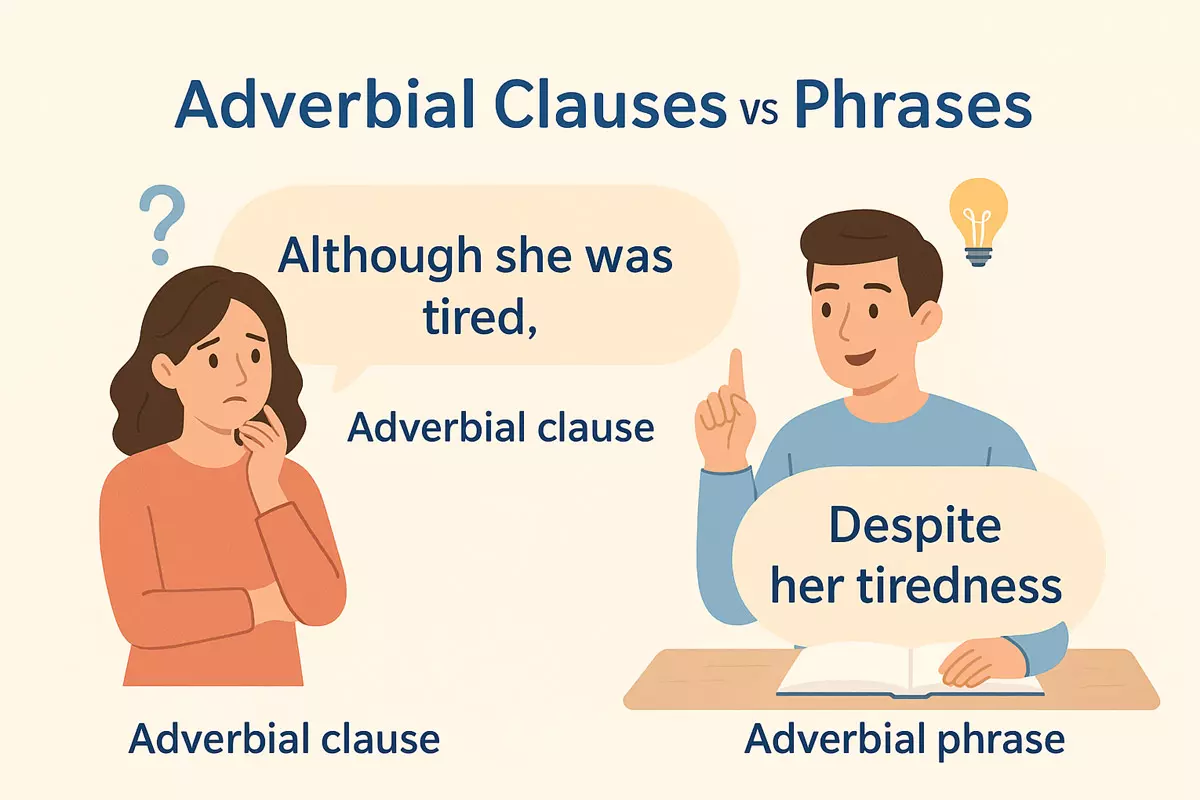 Here we definitions and structural differences between adverbial clauses and phrases, how to reduce clauses, their functions in academic writing, punctuation rules, common mistakes, and provides practice converting clauses into phrases.
Adding detail and context to your sentences can greatly improve your writing, yet telling the difference between various groups of words that modify verbs can be challenging. It is important to understand how these structures—such as adverbs, adverbial phrases, and clauses—function, since each one provides different shades of meaning and clarity. Recognizing their distinctions allows you to choose the most effective way to convey your ideas, making your writing more precise, engaging, and easier for readers to follow.
Definitions and structural differences
Understanding how clauses and phrases function as modifiers is key to mastering sentence structure. Both adverbial clauses and adverbial phrases serve to provide extra information about verbs, adjectives, or other adverbs, but they differ in form and complexity.
What is an adverbial clause?
An adverbial clause is a group of words containing a subject and a verb. It acts as an adverb, answering questions like how, when, where, why, or under what condition something happens. Adverbial clauses are introduced by subordinating conjunctions such as because, although, if, when, or since. For example:
- Because she was tired, she went to bed early.
- He waited until the rain stopped.
- Although he was late, they let him join the meeting.
- If you study hard, you will improve quickly.
- When the movie ended, everyone clapped.
- Since she moved to the city, she has made many new friends.
- While they were cooking dinner, the phone rang.
- Before the class begins, please take your seats.
What is an adverbial phrase?
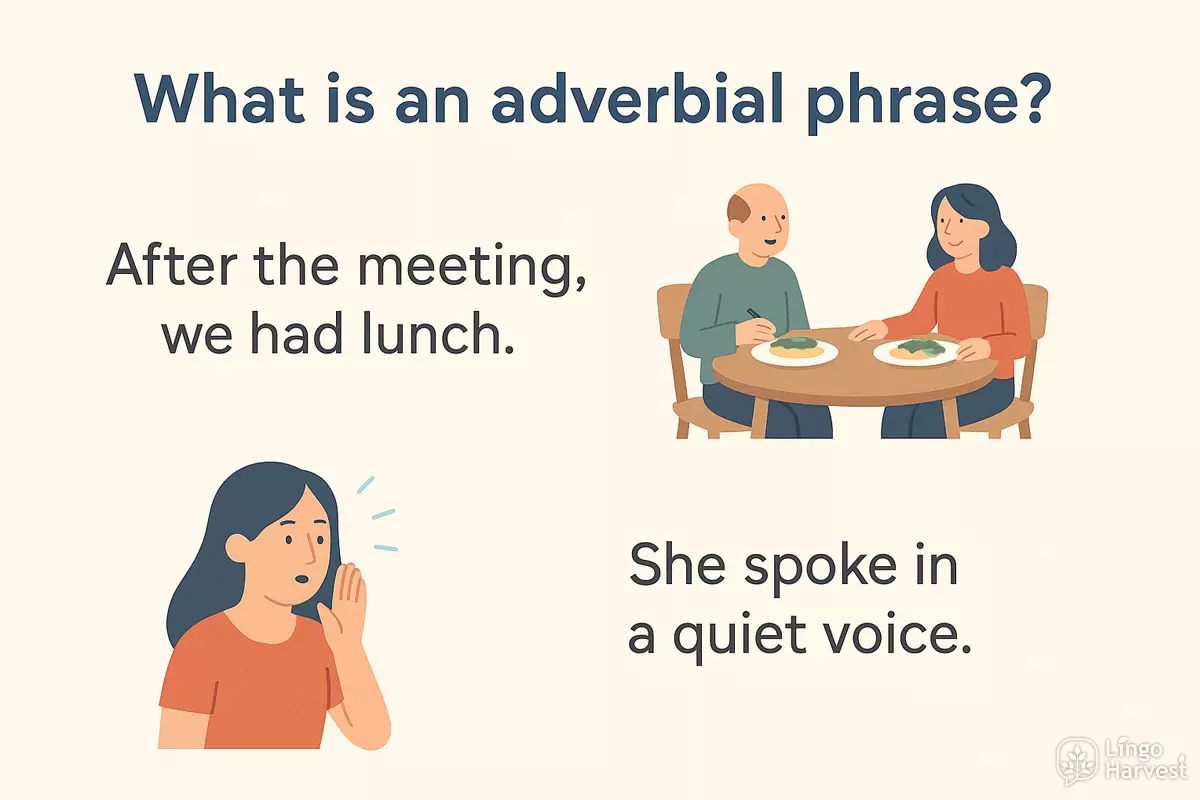
An adverbial phrase does not have both a subject and a verb. Instead, it is a group of words that works together to modify the verb, often built from prepositional phrases or infinitive phrases. Adverbial phrases also answer how, where, or when, but are structurally simpler. For example:
- After the meeting, we had lunch.
- She spoke in a quiet voice.
- In the morning, the streets are empty.
- With great enthusiasm, they started the project.
- At the bus stop, he waited patiently.
- To save time, we skipped the break.
- By the lake, they took photos together.
- Without any hesitation, she accepted the offer.
Structural comparison
The main distinction lies in their internal structure. Adverbial clauses are complete subordinate clauses, while adverbial phrases are fragments lacking a subject-verb pair. This difference affects how flexible and complex each modifier can be within a sentence.
| Feature | Adverbial Clause | Adverbial Phrase |
|---|---|---|
| Contains subject & verb | ✅ Yes | ❌ No |
| Introduced by conjunction | Usually (e.g., because, if) | Rarely (often prepositions) |
| Example | He left because he was late. | He left in a hurry. |
| Complexity | Can express detailed relationships | Usually more concise |
Common patterns and markers
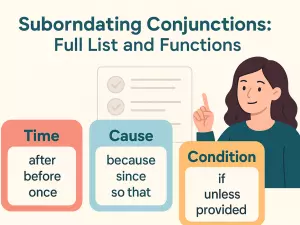
- Adverbial clauses: if, unless, although, because, since, when, while, after, before, whenever, as soon as, even though, so that, in case, whereas, until, though, provided that
- Adverbial phrases: in the morning, after school, with a smile, in a hurry, by chance, at midnight, without warning, for several hours, to avoid confusion, on the roof, by mistake, in silence, out of curiosity, in the distance, in a flash, for fun, at the same time, by heart, with care, on purpose
Recognizing the structural features of each type helps you use them effectively and vary your sentence style.
Reduction of adverbial clauses
Adverbial clauses, especially those expressing time, reason, condition, or contrast, can often be shortened to adverbial phrases for conciseness and variety in writing. This process typically involves removing the subject and changing the verb form, resulting in a more streamlined sentence while maintaining the original meaning.
How reduction works
To shorten these clauses, follow a few general steps:
- Omit the subject if it matches the main clause subject.
- Transform the verb into the -ing form for active meanings.
- Use the past participle for passive meanings.
- Remove the subordinating conjunction (such as "when," "while," "because") unless it’s necessary for clarity.
Common patterns for shortening clauses
Writers frequently apply these transformations to adverbial clauses that begin with words like "after," "before," "while," "when," "because," "although," and "if." Here are some typical structures:
- After she finished her work, she left. → After finishing her work, she left.
- While he was walking to school, he met a friend. → While walking to school, he met a friend.
- Because he didn’t know the answer, he remained silent. → Not knowing the answer, he remained silent.
- If it is used correctly, this tool is helpful. → Used correctly, this tool is helpful.
- Although he was tired, he finished the task. → Although tired, he finished the task.
- When you drive in the rain, be careful. → When driving in the rain, be careful.
- After he had been given instructions, he started the machine. → After being given instructions, he started the machine.
- Since she had no money, she couldn’t buy the book. → Having no money, she couldn’t buy the book.
- Before you leave, lock the door. → Before leaving, lock the door.
- Though he was warned, he ignored the advice. → Though warned, he ignored the advice.
- As I was walking home, I saw an accident. → Walking home, I saw an accident.
- When the test was finished, the students left. → The test finished, the students left.
- If you are seen, you will be punished. → Seen, you will be punished.
Important notes and limitations
- The subject of both clauses must be the same for the reduction to be correct.
- Some adverbial clauses (especially those with different subjects or with certain conjunctions) cannot be reduced without changing the meaning or causing confusion.
- In formal writing, reduced phrases are common but should be used where clarity is not compromised.
Comparison of full and reduced forms
| Full Adverbial Clause | Reduced Adverbial Phrase |
|---|---|
| After she had finished the report, she went home. | After finishing the report, she went home. |
| While he was being interviewed, he felt nervous. | While being interviewed, he felt nervous. |
| Because he didn’t understand, he asked for help. | Not understanding, he asked for help. |
| Although he was warned, he continued. | Although warned, he continued. |
| If you are given instructions, follow them carefully. | Given instructions, follow them carefully. |
By learning how to condense adverbial clauses, you can make your writing more fluent and avoid unnecessary repetition. This technique is especially useful in academic and professional contexts, where clarity and conciseness are valued.
Functions in academic and formal writing
Adverbial clauses and adverbial phrases play distinct roles in scholarly and professional texts. Both structures add context, detail, and nuance, but they differ in complexity and precision. Adverbial clauses, containing both a subject and a verb, often clarify relationships such as cause, contrast, or condition. They help writers create logical connections and avoid ambiguity. In contrast, adverbial phrases—lacking a full subject-verb pair—offer concise background information, commonly modifying actions or descriptions with brevity.
Roles in Structuring Arguments
Writers use these elements to build logical flow and support claims. Adverbial clauses are especially helpful for:
- Signaling cause and effect (e.g., "Because the data were incomplete, the results are inconclusive.")
- Establishing contrast (e.g., "Although the hypothesis was promising, the experiment failed.")
- Expressing condition (e.g., "If the sample size increases, accuracy may improve.")
- Indicating time or sequence (e.g., "After the survey was conducted, the analysis began.")
Adverbial phrases, on the other hand, are usually chosen for their efficiency and rhythm, such as:
- At the beginning of the study
- With careful consideration
- In recent years
- Without hesitation
Comparing Usefulness in Academic Contexts
| Structure | Common Academic Functions | Example | Typical Use |
|---|---|---|---|
| Adverbial Clause | Clarifies logic, adds complexity | “While the results were promising, further research is needed.” | Introducing contrasts, conditions, reasons |
| Adverbial Phrase | Streamlines information, enhances style | “In summary, the findings support the hypothesis.” | Adding context, summarizing, specifying time/manner |
Tips for Effective Use
Choosing between a clause and a phrase often depends on the desired tone and clarity. For formal reports, use adverbial clauses to provide precise reasoning or highlight exceptions. For abstracts or summaries, adverbial phrases can keep sentences concise and direct. Overusing either can make writing cumbersome or unclear, so balance is key.
Examples of Common Patterns
Writers frequently employ these patterns to improve coherence:
- Before conducting the experiment (phrase)
- Since the results were unexpected (clause)
- In light of recent developments (phrase)
- Unless otherwise specified (clause)
- During the initial phase (phrase)
- Even though the evidence is limited (clause)
- For the purpose of clarity (phrase)
- Provided that all criteria are met (clause)
- On the basis of these findings (phrase)
- Whereas previous studies focused on adults (clause)
In summary, the strategic use of adverbial clauses and phrases enhances both the clarity and sophistication of academic and formal writing, allowing authors to guide readers through complex ideas and arguments effectively.
Punctuation and positioning rules
When working with adverbial clauses and adverbial phrases, knowing where to place them in a sentence—and how to punctuate them—can make your writing much clearer. Both types of modifiers can appear at the beginning, middle, or end of a sentence, but their punctuation follows distinct conventions.
Adverbial clauses: Comma usage and placement
Adverbial clauses are dependent clauses, usually introduced by subordinating conjunctions like because, although, when, or if. When an adverbial clause comes at the start of a sentence, it is generally followed by a comma. If it appears at the end, a comma is not usually necessary. Middle placement is rare and often set off by commas.
- Beginning: After she finished her work, Maria went for a walk.
- End: Maria went for a walk after she finished her work.
- Middle (less common): Maria, because she finished her work early, went for a walk.
Adverbial phrases: Flexibility and punctuation
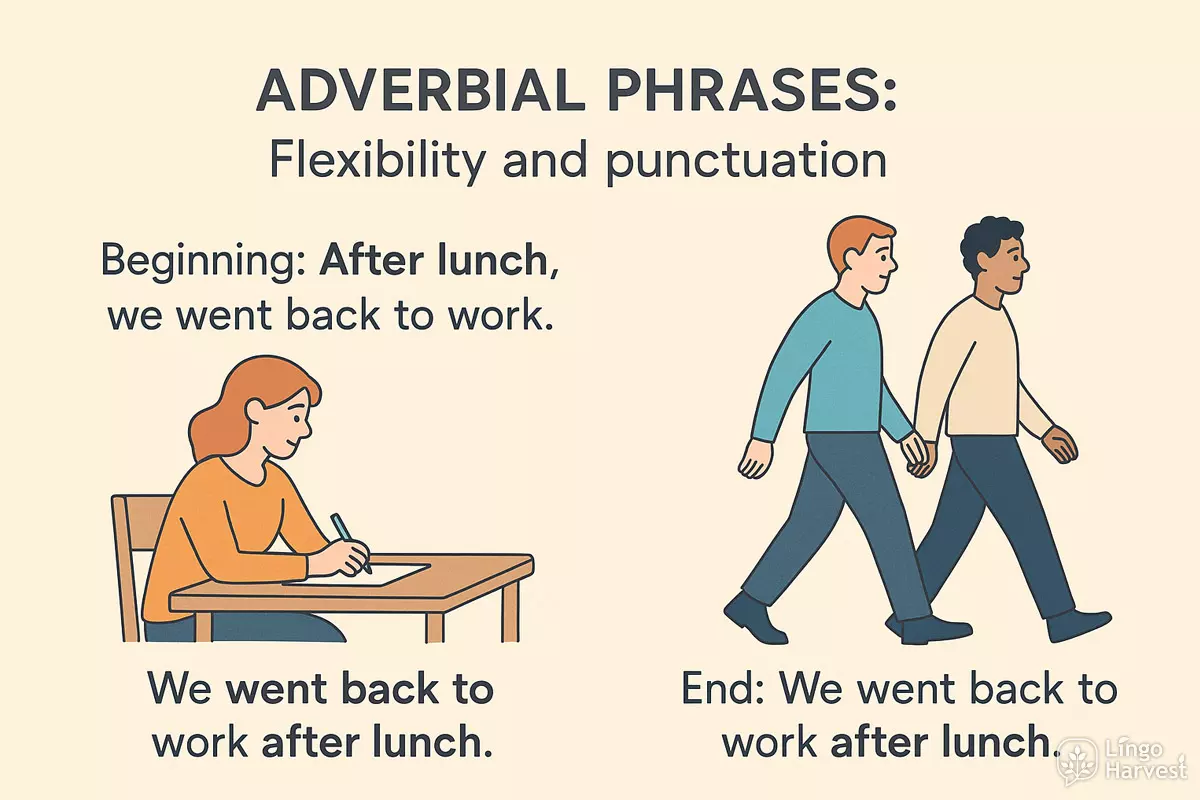
Adverbial phrases, which lack a subject and verb, are more flexible in placement. They rarely require a comma unless they are introductory or need emphasis. For short phrases, commas are often omitted. For longer or more complex introductory phrases, a comma can help readability.
- Beginning: After lunch, we went back to work.
- End: We went back to work after lunch.
- Middle: We, after a quick break, resumed our meeting.
Comparing adverbial clauses and phrases: Summary of rules
Below is a structured overview of where these modifiers can be placed in a sentence, and how punctuation typically applies to each position.
| Placement | Adverbial Clause | Adverbial Phrase |
|---|---|---|
| Beginning | Comma required If the rain stops, we’ll go outside. |
Comma optional (use for clarity) After dinner, we played cards. |
| Middle | Set off by commas We, because we forgot, missed the meeting. |
Comma use depends on length/emphasis We, without any warning, left early. |
| End | No comma needed We’ll go outside if the rain stops. |
Comma rarely needed We played cards after dinner. |
Common pitfalls to avoid
Writers sometimes overuse commas or misplace modifiers, making sentences awkward. To keep your sentences smooth:
- Don’t add a comma before an adverbial clause at the end of a sentence.
- Use a comma after an introductory clause or a long introductory phrase.
- Keep modifiers close to what they describe to avoid confusion.
Mastering these patterns will help your sentences flow naturally and ensure your meaning is always clear.
Common learner mistakes
Many English learners find it tricky to distinguish between adverbial clauses and adverbial phrases, resulting in errors in both writing and speech. These errors often happen because the structures can look similar, but they function differently. Understanding where mistakes commonly occur can help you avoid them and write more clearly.
Mixing up clauses and phrases
One frequent issue is confusing a full adverbial clause (which contains a subject and a verb) with a shorter adverbial phrase (which does not). For example, some learners use a phrase when a full clause is required for clarity, or they add unnecessary words to phrases, making sentences awkward.
- Using a phrase instead of a clause: “After finishing the project, I relaxed.” (correct as a phrase) vs. “After I finished the project, I relaxed.” (correct as a clause)
- Forgetting the subject in a clause: “Because tired, I went home.” (should be “Because I was tired, I went home.”)
Incorrect punctuation and sentence structure
Adverbial clauses and phrases often require commas, especially when they come at the beginning of a sentence. Learners sometimes forget these commas or insert them incorrectly, which can confuse readers.
- Missing comma after introductory adverbial clause: “If it rains we will stay inside.”
- Unnecessary comma with short phrases: “In the morning, I eat breakfast.” (Comma is optional with short phrases, but required with clauses.)
Misusing conjunctions and prepositions
Another common challenge is using the wrong connector. Adverbial clauses typically begin with subordinating conjunctions (because, although, if), while adverbial phrases often start with prepositions (after, before, during).
| Adverbial Clause Example | Adverbial Phrase Example |
|---|---|
| “Because she was late, she missed the bus.” | “Because of her lateness, she missed the bus.” |
| “Although he studied, he failed the test.” | “Despite studying, he failed the test.” |
| “If you call me, I will help.” | “In case of a call, I will help.” |
| “When I arrive, I will call you.” | “On arrival, I will call you.” |
Omitting necessary information
It’s easy to leave out essential parts of a clause or phrase, especially when trying to write concisely. This can lead to confusion or ambiguity. For example, omitting the subject in a clause or the object in a phrase may change the meaning.
- Leaving out the subject: “While driving, the phone rang.” (Who was driving?)
- Missing the connector: “He left early he was tired.” (Should be “because he was tired”)
Summary of pitfalls to watch for
- Confusing clauses and phrases due to similar meaning or form
- Forgetting to use a subject and verb in a clause
- Incorrect use of prepositions or conjunctions
- Improper punctuation, especially with introductory elements
- Omitting necessary information, causing ambiguity
- Overcomplicating phrases by adding unnecessary words
- Using a clause when a phrase would be clearer (and vice versa)
- Making sentence fragments by dropping key elements
- Ignoring parallel structure when combining clauses and phrases
- Misplacing modifiers, leading to confusion about what is being described
By being aware of these typical mistakes, you can improve your understanding and use of both adverbial clauses and phrases, making your communication clearer and more effective.
Practice: convert clauses into phrases
Transforming adverbial clauses into adverbial phrases is a useful skill for making sentences more concise and fluid. This section gives you hands-on experience by working through examples and exercises. You’ll learn to spot the difference, rewrite sentences, and see common patterns that make the process easier.
How to Replace Clauses with Phrases
Start by identifying the subject and verb in the adverbial clause. In most cases, you can remove the subject (if it matches the main clause) and change the verb to its –ing or –ed form, or use a prepositional phrase. Here are some common transformations:
- When she finished her homework, she went out. → After finishing her homework, she went out.
- Because he was tired, he went to bed early. → Being tired, he went to bed early.
- Although it was raining, they played football. → Despite the rain, they played football.
Exercise: Rewrite Each Sentence
Change the adverbial clause to an adverbial phrase. Focus on making the sentence shorter while keeping the meaning.
- Because she felt hungry, Maria made a sandwich.
- When I entered the room, everyone stopped talking.
- If you follow these instructions, you will complete the task successfully.
- Although he was late, he finished the project.
- After she had locked the door, she left the house.
- Since he didn’t study, he failed the exam.
- While he was driving, he listened to music.
- Unless you hurry, you will miss the bus.
- Although the weather was cold, we went swimming.
- Because he wanted to save money, he cooked at home.
Show answers
- Feeling hungry, Maria made a sandwich.
- Entering the room, everyone stopped talking.
- By following these instructions, you will complete the task successfully.
- Despite being late, he finished the project.
- Having locked the door, she left the house.
- Not having studied, he failed the exam.
- Driving, he listened to music.
- Without hurrying, you will miss the bus.
- Despite the cold weather, we went swimming.
- Wanting to save money, he cooked at home.
Patterns to Watch For
Recognizing typical patterns can speed up the conversion process. Here are some frequently used structures:
- After/before + –ing: After finishing the report, she left the office.
- Despite/in spite of + noun/–ing: In spite of feeling tired, he continued working.
- Because/since/as + –ing/past participle: Being a teacher, she loves to help others.
- Having + past participle: Having seen the movie, we discussed it.
- Without + –ing: Without saying a word, he left the room.
Common Transformations
| Adverbial Clause Example | Adverbial Phrase Equivalent |
|---|---|
| When the bell rang, students left the class. | At the bell, students left the class. |
| Because he forgot his umbrella, he got wet. | Having forgotten his umbrella, he got wet. |
| While she was waiting, she read a book. | Waiting, she read a book. |
| Although he is young, he is very responsible. | Despite being young, he is very responsible. |
| If you look carefully, you will find the key. | By looking carefully, you will find the key. |
Practicing these conversions will help you recognize adverbial elements and express ideas with greater brevity. Pay attention to verb forms, and remember that the subject of the phrase must match the subject of the main clause for clarity.