Build Long Sentences Using 3–4 Conjunctions (Advanced)

 Here we how to join multiple ideas in one sentence, select the right conjunctions for complex logic, organize subordinate clauses, and balance clarity with length. It also provides examples and practice for building longer sentences.
- How to combine multiple ideas into a single sentence
- Choosing appropriate conjunctions for multi-step logic
- Balancing length, clarity, and readability
- Techniques for organizing layered subordinate clauses
- Examples of well-constructed long sentences
- Practice: build sentences using 3–4 conjunctions from prompts
To ensure your writing flows smoothly and effectively conveys complex ideas, it is important to master the use of multiple linking words to connect several clauses within a sentence. This ability allows you to create sophisticated and nuanced statements that both impress and engage your readers, making your arguments clearer and your overall message more compelling. By practicing and refining this skill, you will enhance the coherence and depth of your writing, helping you communicate even the most intricate concepts with confidence and clarity.
How to combine multiple ideas into a single sentence
Linking several thoughts together smoothly requires careful use of conjunctions and punctuation. Instead of writing multiple short sentences, you can join related ideas to form longer, more sophisticated statements. This approach not only improves the flow of your writing but also allows you to express complex relationships between concepts.
Choosing the Right Conjunctions
To connect three or four ideas, you’ll need to mix coordinating, subordinating, and even correlative conjunctions. Each type serves a different function:
- Coordinating conjunctions (and, but, or, nor, for, so, yet) join equal ideas.
- Subordinating conjunctions (because, although, while, if, since, unless) introduce dependent clauses, showing cause, contrast, or condition.
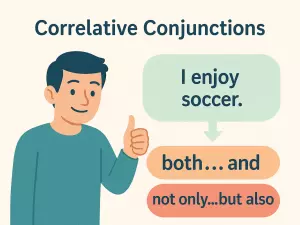
- Correlative conjunctions (either...or, neither...nor, not only...but also, both...and) create balanced pairs within a sentence.
Strategies for Merging Multiple Clauses
Start by identifying which ideas are closely related or which depend on each other. Arrange them logically, ensuring each clause leads naturally to the next. Use a mix of conjunctions, commas, and, when needed, semicolons to keep the sentence clear.
Common Patterns and Examples

Below are some effective patterns for weaving three or more ideas into one sentence. Notice how conjunctions and punctuation guide the reader:
- I wanted to go hiking, but it started raining, so we stayed home and watched a movie.
- Not only did she finish her work early, but she also helped her colleagues and organized the files.
- While you can choose to stay at home, you might miss the event, and you won’t see your friends.
- He studied hard because he wanted to succeed, and although the test was difficult, he passed with flying colors.
- If you call me before noon, we can meet for lunch, or we can reschedule for tomorrow.
- Although the weather looked bad, we packed our bags, and we left before sunrise.
- Either you finish your assignment tonight, or you ask for an extension, but you cannot ignore it.
- She was tired, yet she finished her project, and she even volunteered for extra work.
- Since you have your passport, and your visa is approved, you can book your flight as soon as possible.
- The team trained every day, and although they faced many setbacks, they never gave up and eventually won the championship.
Tips for Clarity and Flow
- Use commas to separate clauses, but avoid comma splices by ensuring each clause is properly linked.
- Vary the types of conjunctions to avoid monotony.
- If a sentence becomes too long or confusing, consider breaking it into two for readability.
- Read your sentence aloud to check if it sounds natural and clear.
Combining several thoughts effectively is a hallmark of advanced writing. By practicing these structures and paying attention to logic and rhythm, you’ll be able to construct sentences that convey complex information without confusion.
Choosing appropriate conjunctions for multi-step logic
When constructing long sentences that involve several steps of reasoning or description, selecting the right linking words is crucial. Each conjunction has its own nuance and function, so understanding how to use them in sequence helps your sentences remain clear and logical, even as they become more complex.
Types of Conjunctions for Complex Sentences
There are three main categories to consider:
- Coordinating conjunctions (and, but, or, nor, for, so, yet) — connect equal parts of a sentence.
- Subordinating conjunctions (because, although, since, unless, if, while, whereas, after, before, even though) — introduce dependent clauses that provide conditions or reasons.
- Correlative conjunctions (either…or, neither…nor, not only…but also, both…and, whether…or) — pair up to link balanced ideas.
Logical Flow and Sequencing
The order of conjunctions shapes the logical progression of your ideas. For example, use "although" to show contrast before providing an explanation with "because." A sequence might look like: Although she was tired, she finished her work because the deadline was near, and she wanted to impress her boss.
Common Multi-Step Patterns
Writers often combine conjunctions to express layered logic. Here are some useful patterns:
- Although… because… and… → Although it was late, he kept working because the deadline was close and he wanted to finish on time.
- If… then… but… → If you study regularly, then you will improve, but you must stay consistent.
- Not only… but also… because… → Not only did she win the competition, but she also set a new record because she trained hard.
- While… although… so… → While he enjoys sports, although he doesn’t play often, he still watches every game, so he knows all the players.
- Since… if… and… → Since it’s your birthday, if you want, we can go out and celebrate.
- Even though… yet… since… → Even though he was tired, yet he continued working since the task was urgent.
- After… although… so that… → After he finished his presentation, although he was nervous, he answered questions confidently so that the audience understood him.
- Neither… nor… yet… → Neither the manager nor the assistants were available, yet the meeting continued.
- Before… since… and… → Before you leave, since it might rain, take an umbrella and wear a jacket.
- Unless… because… or… → Unless you leave now, you’ll be late because traffic is heavy, or you might miss the bus entirely.
- Both… and… if… → Both the children and the parents can join the trip if they register early.
- Whereas… although… and… → Whereas he prefers quiet places, although he lives in the city, he still finds time to visit parks and relax.
- Whether… or… so that… → Whether you choose tea or coffee, let me know so that I can prepare it for you.
- Because… while… and… → Because it was cold, while the wind was strong, they stayed inside and played board games.
- Despite… although… so… → Despite the noise, although it was distracting, she stayed focused so she could finish the assignment.
- Provided that… and… but… → You can borrow my car provided that you fill the tank and drive carefully, but return it by evening.
- Not only… but also… while… → Not only is he great at cooking, but he’s also skilled at photography while working full-time.
- So that… although… and… → He spoke slowly so that everyone understood him, although the room was noisy and people were talking.
Comparison of Conjunction Functions
Below is a table summarizing how different conjunctions guide sentence logic and structure:
| Conjunction | Logical Function |
|---|---|
| and | Adds information of equal weight |
| but / yet | Shows contrast or exception |
| because / since | Gives reasons or causes |
| although / even though | Introduces a concession or contrast |
| if / unless | Sets up conditions |
| so / so that | Expresses result or purpose |
| before / after / while | Places actions in time |
| either…or / neither…nor | Presents choices or alternatives |
When building a sentence with three or more linking words, pay attention to the relationship each one signals. This helps your readers follow your reasoning, even through multiple steps or layers of argument. Don’t be afraid to rearrange clauses or substitute conjunctions if the logic feels muddled. With practice, complex sentences become second nature.
Balancing length, clarity, and readability
Writing extended sentences with multiple conjunctions can showcase advanced language skills, but it’s important to ensure your message remains accessible. Long sentences risk confusing readers if structure and purpose aren’t carefully managed. Instead of focusing solely on sentence length, prioritize how each part connects and contributes to the overall meaning.
Techniques for Managing Complex Sentences
- Group related ideas together to avoid reader confusion.
- Use punctuation—commas, semicolons, and em dashes—to signal shifts or breaks within the sentence.
- Vary conjunctions (such as and, but, although, because, while, unless) to clarify relationships between clauses.
- Keep clauses concise, ensuring each one adds new information or nuance.
- Read your sentence aloud; if you lose track of the subject or main idea, consider splitting it.
Common Pitfalls and How to Avoid Them
- Overloading with too many conjunctions, which can obscure the main point.
- Using ambiguous pronouns that confuse the reader about what refers to what.
- Letting a sentence run on without clear transitions or logical sequence.
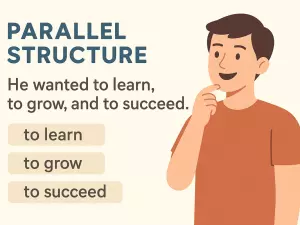
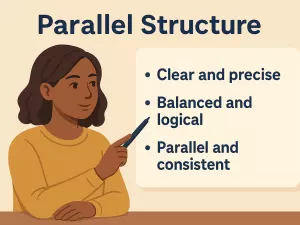
- Neglecting parallel structure, making the sentence harder to process.
Examples: Effective vs. Overly Complex Sentences
| Effective Long Sentence | Overly Complex Sentence |
|---|---|
| She wanted to attend the workshop, but she had to finish her project, and because the deadline was approaching, she decided to work late. | She wanted to attend the workshop and she had to finish her project and the deadline was approaching and she decided to work late and she felt tired. |
| Although the weather was bad and the roads were slippery, we left early so we could arrive on time and avoid the traffic. | Although the weather was bad and the roads were slippery and we left early and we wanted to arrive on time and avoid the traffic and it was cold. |
| He read the instructions carefully, but since the process was complicated and time was limited, he asked for help. | He read the instructions and the process was complicated and time was limited and he asked for help and he was confused. |
| We discussed the proposal, considered the alternatives, and agreed to revise the plan, even though some concerns remained. | We discussed the proposal and considered alternatives and agreed to revise the plan and some concerns remained and people were unhappy. |
Quick Tips for Readable Advanced Sentences
- Limit to three or four conjunctions per sentence for maximum clarity.
- Use variety: alternate between short and long sentences in your writing.
- Highlight main ideas early; subordinate details can follow.
- Check for logical flow between clauses.
- Edit ruthlessly—remove anything that doesn’t add value.
Techniques for organizing layered subordinate clauses
Structuring sentences with multiple subordinate clauses can feel daunting, especially when aiming for clarity and flow. The key is to manage complexity by grouping related ideas, choosing conjunctions wisely, and following a logical sequence. When several dependent clauses are stacked, it's easy to lose track of the main point, so keeping the hierarchy and relationships clear is essential.
Sequencing and hierarchy
Start by identifying the main clause, then decide the order in which to introduce subordinate clauses. Place the most context-setting information first, then move toward details or consequences. This helps readers follow your reasoning without confusion.
- Begin with time or condition: "If you want to master long sentences..."
- Follow with cause or reason: "...because complex ideas often require elaboration..."
- Add contrast or exception later: "...although too many layers can obscure meaning."
Conjunction selection and variety
Using a mix of conjunctions (such as because, although, while, since, unless, even though, after, before, so that, as if, in order that, whereas, provided that, once, when, until, whether, as long as, now that) prevents monotony and signals the relationship between clauses.
Punctuation and clause boundaries
Proper punctuation is critical when layering subordinate clauses. Commas help separate clauses for readability, especially when the sentence is long or when clauses are nonessential. However, overuse can fragment the sentence, so balance is key.
Patterns for layering
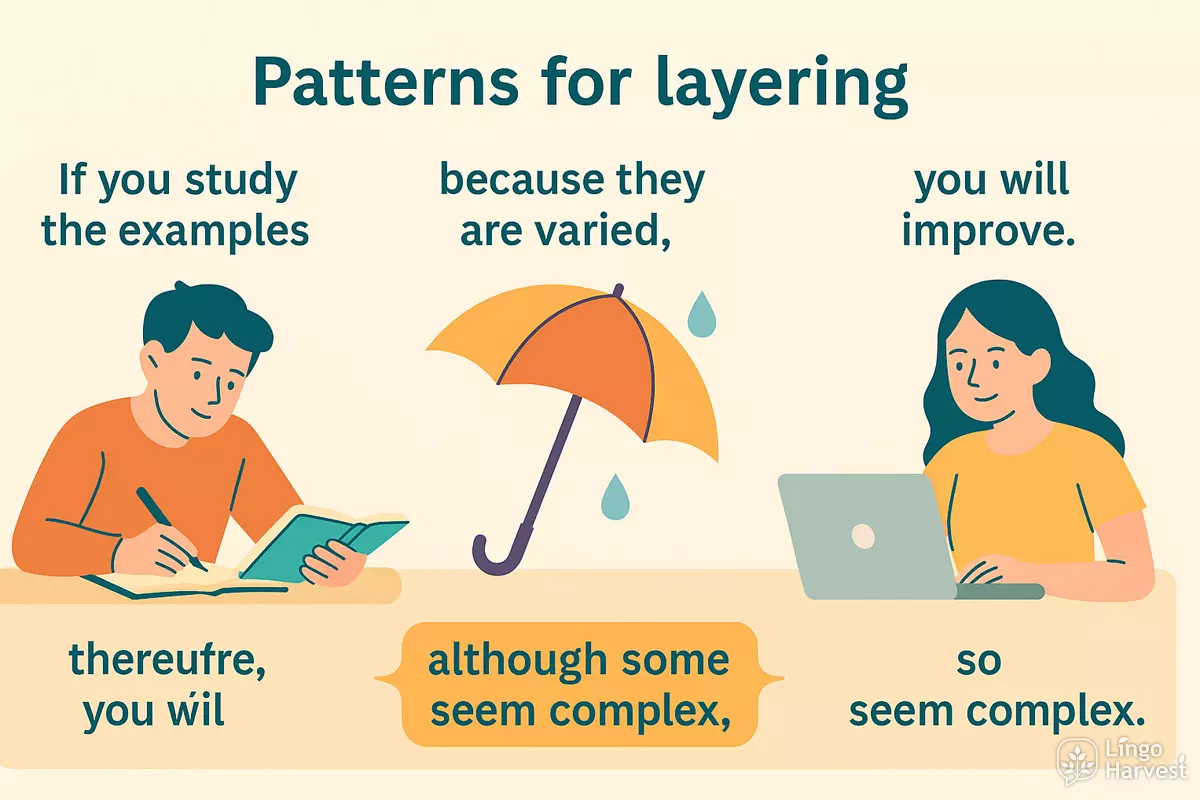
Here are some common patterns for arranging multiple subordinate clauses:
- If + because + although: "If you study the examples because they are varied, although some seem complex, you will improve."
- When + so that + unless: "When you practice regularly so that your skills develop, unless you neglect feedback, progress is steady."
- After + since + while: "After you understand the basics, since they provide the foundation, while experimenting with new structures, you'll gain confidence."
Comparison of clause layering strategies
| Strategy | Description & Example |
|---|---|
| Linear chaining | Each clause follows the previous one in a straight sequence. Example: "If you read carefully, because the material is dense, and since you take notes, you will remember more." |
| Nested embedding | One subordinate clause sits inside another, creating a hierarchy. Example: "You will succeed if, although you may struggle, you persist because practice leads to mastery." |
| Parallel subordination | Multiple subordinate clauses at the same level, often joined by coordinating conjunctions. Example: "If you plan well and if you revise often, your sentences will improve." |
| Mixed strategies | Combines linear, nested, and parallel approaches for nuanced expression. Example: "If you read, while you analyze examples, and as you practice, your confidence grows because you see results." |
Tips for clarity
- Keep the main idea near the start or end of the sentence for emphasis.
- Limit the number of layers to what your reader can easily process.
- Use pronouns or repetition sparingly to avoid ambiguity.
- Read sentences aloud to check for natural flow and coherence.
- Revise long sentences for unnecessary clauses or awkward phrasing.
With mindful organization, you can construct advanced sentences that remain clear, logical, and engaging—even when using several conjunctions and layers of meaning.
Examples of well-constructed long sentences
Long sentences allow writers to express complex relationships and ideas by connecting multiple clauses with conjunctions. Mastering this skill helps convey nuanced meaning, show cause and effect, or build a narrative with clarity. Below, you’ll find several advanced sentence constructions that use three or more conjunctions to illustrate how such structures can be handled effectively.
Sample Sentences Featuring Multiple Conjunctions
- Although she was tired after the long journey, and because the weather was turning colder, she decided to take a walk through the park so she could clear her mind and enjoy the fresh air before dinner.
- If you want to succeed in this course, you must not only attend every class but also complete the assignments on time and participate actively in discussions, even when the topics seem challenging.
- He promised he would call when he arrived, yet because his phone battery died and since he couldn't find a charger, he was unable to let anyone know he was safe until the next morning.
- While the city was bustling with activity and because the festival attracted so many visitors, traffic was heavy, so we decided to leave early and take an alternate route home.
- Since the forecast predicted rain, and because the children were eager to play outside, we set up a tent in the backyard so they could have fun even if the weather turned bad.
- She not only finished the project ahead of schedule but also organized the files carefully and prepared a summary report, so her manager was both surprised and impressed.
- Although he had little experience, and since the team needed help urgently, he volunteered to lead the group, but he asked for guidance whenever he was unsure.
- Because the recipe called for several unusual ingredients and since the store was about to close, she rushed to gather everything she needed, yet she still forgot the most important spice.
- Whenever the power goes out and if the backup generator fails, we have to rely on flashlights or candles, so it’s important to keep them handy at all times.
- Even if the meeting runs long, and although the agenda is packed, we should make time for questions so everyone can clarify their concerns before the session ends.
Common Patterns for Linking Clauses
Expanding sentences with several conjunctions often involves combining different types—coordinating, subordinating, and correlative. Here are a few structures to consider:
- Subordinating + Coordinating + Subordinating: “While I wanted to leave early, and because the weather was bad, I waited until the storm passed.”
- Correlative + Coordinating + Subordinating: “Not only did he finish his work, but he also helped others when they struggled.”
- Multiple subordinating clauses: “If you study hard, and if you ask questions when confused, you are more likely to understand the material thoroughly.”
Tips for Clarity in Extended Sentences
- Use punctuation (such as commas) to separate clauses clearly.
- Vary conjunctions to avoid monotony and improve flow.
- Check that each clause adds meaningful information to avoid unnecessary length.
- Read aloud to ensure the sentence remains understandable.
Long, well-structured sentences can enrich your writing, but always ensure each component serves a clear purpose and maintains readability.
Practice: build sentences using 3–4 conjunctions from prompts
To master complex sentence construction, it's useful to practice combining several ideas with different conjunctions. This exercise will help you join clauses smoothly, using both coordinating and subordinating conjunctions in one sentence. Below, you'll find prompts and example lists to guide your practice.
Conjunctions to Use
- and → She cooked dinner and he washed the dishes.
- but → I wanted to go out, but it started raining.
- because → He stayed home because he was sick.
- although → Although it was late, they kept talking.
- if → If it snows, we’ll stay inside.
- so → It was cold, so we made hot tea.
- while → She read a book while he watched TV.
- unless → You won’t improve unless you practice.
- since → Since you’re here, let’s start the meeting.
- even though → Even though he was tired, he went running.
- when → Call me when you arrive.
- as long as → You can stay as long as you’re quiet.
- whereas → She loves the city, whereas he prefers the countryside.
- before → Wash your hands before you eat.
- after → After he finished work, he went home.
- though → Though it looked difficult, she solved it quickly.
- yet → He studied a lot, yet he failed the test.
- nor → She didn’t call, nor did she send a message.
Sentence-Building Prompts
- Describe a day when you had to change your plans more than once.
- Explain a situation where you wanted to do something, but external factors stopped you, and how you responded.
- Combine reasons for your choice of study or career, mentioning both positive and negative influences.
- Tell a story about someone who succeeded despite challenges, and include the consequences of their actions.
Sample Multi-Conjunction Sentences
- Although I wanted to go to the beach and the weather was perfect, I had to stay home because I needed to finish my project, which was due the next day.
- If you study hard and ask for help when needed, you will improve, but you must not give up even when the material seems difficult.
- She was tired since she had worked all night, yet she agreed to help her friend, although she could have refused.
- We could go hiking after breakfast, or we could visit the museum if it rains, but either way, we’ll do something interesting before the day ends.
- He practiced every day because he wanted to win, and although he injured his foot, he kept training so that he would not lose his chance.
- Unless you call ahead and confirm your appointment, you might have to wait, or you could even miss your spot if the office is busy.
- Even though the team was losing, they played harder, and since the coach encouraged them, they managed to score twice before halftime.
- While I enjoy reading fiction, I also like biographies, but I rarely read poetry unless someone recommends a good collection.
- When you travel abroad and try new foods, you learn about cultures, yet you may miss familiar flavors until you adapt.
- Before you decide, consider all your options and talk to your mentor, so you can make an informed choice, although the final decision is yours.
Practice: Build Your Own Sentences
Using the prompts above, try to write original sentences that connect three or four ideas with different conjunctions. Aim for natural flow, and check for clarity and logic in your structure.
Show answers
- Prompt 1: I planned to meet my friends at the park, but it started raining, so we decided to go to a café instead, although I had really wanted to play soccer.
- Prompt 2: I wanted to attend the concert, but since tickets were sold out and my friend was sick, I stayed home and watched a movie instead.
- Prompt 3: I chose engineering because I enjoy solving problems and my parents encouraged me, although some of my friends warned me that it would be challenging.
- Prompt 4: Even though she had little experience and faced many obstacles, she worked hard and learned quickly, so her manager promoted her after only six months.