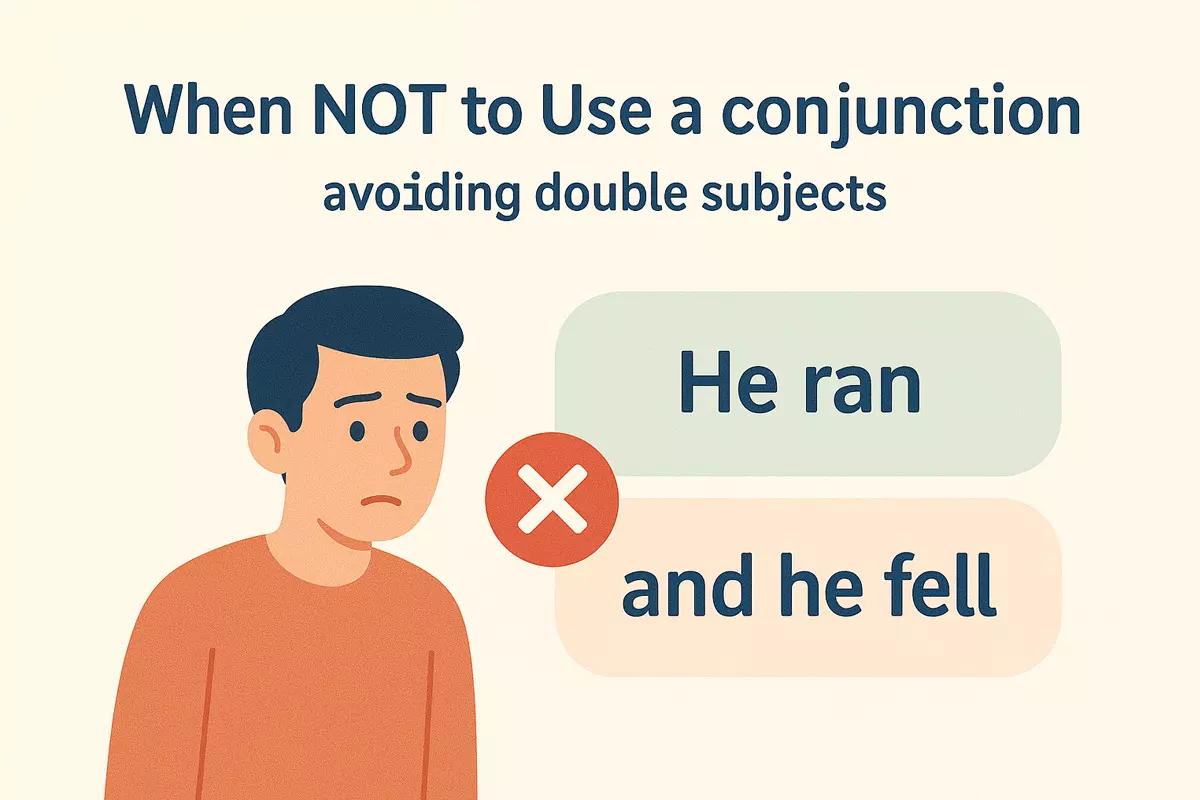
When NOT to Use a Conjunction: avoiding double subjects

 This article explains why learners often add too many conjunctions, how to spot double subjects and double conjunctions, and when conjunctions are unnecessary. It covers compound predicates versus clauses, tips for fixing run-ons, and practice exercises.
- Common learner habit of adding too many conjunctions
- What double subjects and double conjunctions look like
- Examples of sentences where the conjunction is not needed
- Difference between compound predicate and two full clauses
- How to fix run-on sentences created by extra conjunctions
- Guidelines for deciding when to join and when to separate ideas
- Practice: delete or keep conjunctions to improve sentences
Mastering smooth sentence flow in English often involves knowing when to leave out unnecessary connecting words. Adding a conjunction where each side already has its own subject can disrupt the rhythm and clarity of your writing, even for experienced writers. By paying attention to sentence structure and avoiding extra connectors, you can create more concise and effective prose. This skill not only improves readability but also helps your ideas stand out more clearly to your audience.
Common learner habit of adding too many conjunctions
Many English learners tend to overuse conjunctions such as "and," "but," and "so" when connecting ideas. This often happens because students want to make their sentences sound more complex, or they directly translate from their native language, where frequent conjunction use might be more natural. However, piling on too many connecting words can lead to confusing sentences, double subjects, and even grammatical mistakes.
Why do learners add excessive conjunctions?
Often, this habit comes from wanting to link every single idea or action. Learners may believe that adding more conjunctions makes writing richer, but in English, it can instead make the sentence awkward or unclear. For example, trying to combine two full sentences with "and" when each already has a clear subject can result in double subjects—one of the key issues to avoid.
Common patterns of overuse
- Starting nearly every sentence with "and" or "but"
- Using "and" to join clauses that should be separate sentences
- Inserting "so" or "because" between clauses with their own subjects
- Writing run-on sentences by stringing together multiple ideas
- Adding conjunctions even when the ideas are not logically connected
- Combining two subjects unnecessarily (e.g., "My friend and she she went to the store")
- Repeating conjunctions for emphasis ("and and then he left")
- Using "but" after a negative statement where it’s not needed
- Translating directly from another language’s structure
- Believing every new idea must be joined with a connector
- Misplacing conjunctions, resulting in incomplete or fragmented sentences
Examples: Too many conjunctions vs. correct usage
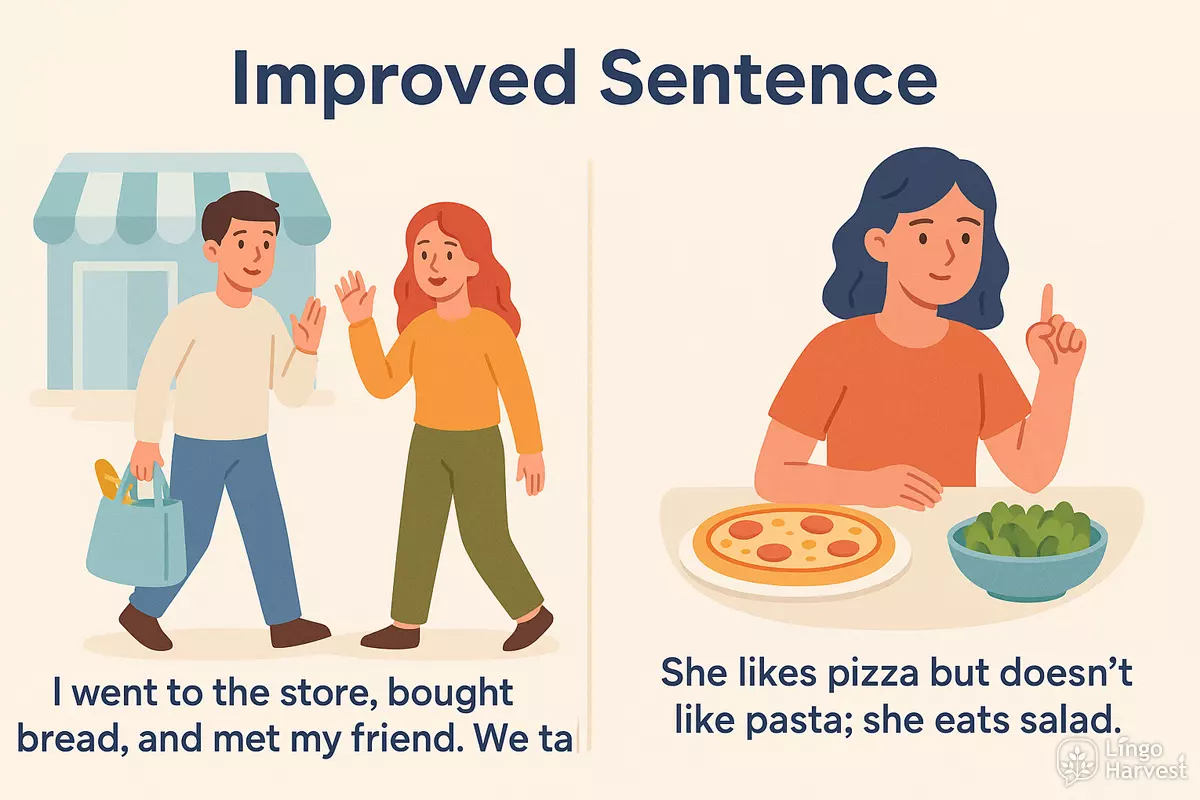
Below is a table comparing sentences that overuse connectors with their improved forms. Notice how removing unnecessary conjunctions often clarifies the sentence and avoids double subjects.
| Overused Conjunctions | Improved Sentence |
|---|---|
| I went to the store and I bought bread and I met my friend and we talked. | I went to the store, bought bread, and met my friend. We talked. |
| She likes pizza but she doesn’t like pasta but she eats salad. | She likes pizza but doesn’t like pasta; she eats salad. |
| He was tired so he went home and he slept. | He was tired, so he went home and slept. |
| My brother and he he plays football and he studies a lot. | My brother plays football and studies a lot. |
| We were late because the bus was slow and because it was raining. | We were late because the bus was slow and it was raining. |
Tips to avoid overusing connectors
- Check if each clause really needs a conjunction or if it can stand alone.
- Read your sentence aloud; if it feels too long, consider splitting it.
- Use punctuation (commas, periods) to separate ideas instead of always using "and" or "but".
- Be careful not to repeat the subject after a conjunction unless it changes the meaning.
- Focus on clarity and flow rather than length or complexity.
By being mindful of these habits, learners can create clearer, more natural-sounding sentences and avoid common pitfalls, such as double subjects, that come from misusing conjunctions.
What double subjects and double conjunctions look like
Seeing double in your sentences? That usually means there’s a problem with repeated subjects or unnecessary conjunctions. Double subjects happen when a sentence names the subject twice, making it confusing or redundant. Double conjunctions, on the other hand, occur when two joining words are used where only one is needed. Both mistakes can muddle your meaning and make your writing harder to read.
Double Subjects: What to Watch For
A double subject appears when both a noun and a pronoun (or two nouns) are used to refer to the same thing in the same clause. This not only sounds awkward, but it also creates grammatical errors.
- ❌ My brother he likes pizza. (“My brother” and “he” refer to the same person.)
- ✅ My brother likes pizza.
- ✅ He likes pizza.
- ❌ The cat it is sleeping.
- ❌ John and he they went to the store.
Double Conjunctions: Common Pitfalls
Double conjunctions slip in when two joining words (like “and” + “but” or “because” + “so”) are stacked together, even though only one is needed. This can create clunky or incorrect sentences.
- ❌ Because she was tired, so she went to bed early.
- ❌ Although it was raining, but we went outside.
- ✅ Because she was tired, she went to bed early.
- ✅ Although it was raining, we went outside.
- ❌ And but I wanted to go, I couldn’t.
Quick Reference: Avoiding Double Trouble
Below are some paired examples that contrast incorrect and correct forms, helping you spot and fix these mistakes:
| Incorrect Example | Corrected Version |
|---|---|
| My friend she is coming. | My friend is coming. |
| Because I was late, so I missed the bus. | Because I was late, I missed the bus. |
| The dog it barked loudly. | The dog barked loudly. |
| Although it was cold, but we went swimming. | Although it was cold, we went swimming. |
Summary: How to Spot and Fix These Errors
When editing your writing, scan for instances where the subject is named twice or where two conjunctions appear together. Reading aloud often helps catch these slips. If you spot a double subject or conjunction, try removing one to see if the sentence still makes sense—chances are, it will be clearer and more correct that way.
Examples of sentences where the conjunction is not needed
When crafting sentences, it's easy to assume you always need a conjunction to join two ideas, but that's not the case—especially when it comes to avoiding double subjects. Sometimes, dropping the conjunction makes your writing clearer and more direct. Below, you'll find scenarios and patterns where omitting the conjunction helps avoid unnecessary repetition or awkwardness.
Common Patterns Where Conjunctions Should Be Omitted
- When two clauses share the same subject and verb, a conjunction is redundant.
- In compound predicates (one subject, two verbs), you can often remove the conjunction for brevity.
- Sentences that introduce a second subject after a conjunction often create a double subject error.
- Commands or instructions (imperatives) typically do not require conjunctions unless joining two distinct actions.
Sample Sentences Without Unnecessary Conjunctions
- She finished her homework, went to bed early.
- The rain stopped, the sun came out.
- Tom opened the window, let fresh air in.
- Close the door, turn off the lights.
- The teacher explained the lesson, students took notes.
- We arrived at the station, caught the last train.
- Call me, I'll help you.
- He studied all night, passed the exam.
- Mix the ingredients, bake for 30 minutes.
- The bell rang, everyone went inside.
- She packed her bags, left the house quietly.
- Read the instructions, assemble the parts.
- He grabbed his coat, hurried outside.
- Turn left at the corner, walk two blocks.
- Lisa finished her project, submitted it online.
- Check your answers, hand in your test.
- The cat jumped onto the table, knocked over the vase.
- He signed the contract, started work immediately.
- Open your books, start reading.
- The bus arrived, passengers boarded quickly.
Double Subject Errors to Avoid
- Incorrect: She finished her homework and she went to bed early. ❌ (Double subject)
- Correct: She finished her homework, went to bed early. ✅
Comparison: With vs. Without Conjunction (for Double Subjects)
| With Conjunction (Incorrect) | Without Conjunction (Correct) |
|---|---|
| He opened the door and he walked inside. | He opened the door, walked inside. |
| We packed our bags and we left for the airport. | We packed our bags, left for the airport. |
| She called her friend and she told her the news. | She called her friend, told her the news. |
| I finished my meal and I paid the bill. | I finished my meal, paid the bill. |
These examples illustrate how removing the conjunction not only prevents double subject errors, but also streamlines your writing. Pay attention to sentence structure—especially when listing actions by the same subject—to ensure your message remains concise and grammatically correct.
Difference between compound predicate and two full clauses
Understanding when to use a conjunction—and when to avoid one—often comes down to recognizing the structure of your sentence. In English, a compound predicate and two separate clauses look similar on the surface, but they function differently and follow different punctuation rules.
A compound predicate features a single subject performing multiple actions. There is no need to repeat the subject or use a conjunction like "and" to link separate clauses. In contrast, two full clauses each have their own subject and verb, and they're typically connected by a coordinating conjunction (such as "and," "but," or "or").
Spotting a Compound Predicate
If you find the same subject carrying out several verbs in one sentence, you've got a compound predicate. No extra subject is introduced after the conjunction.
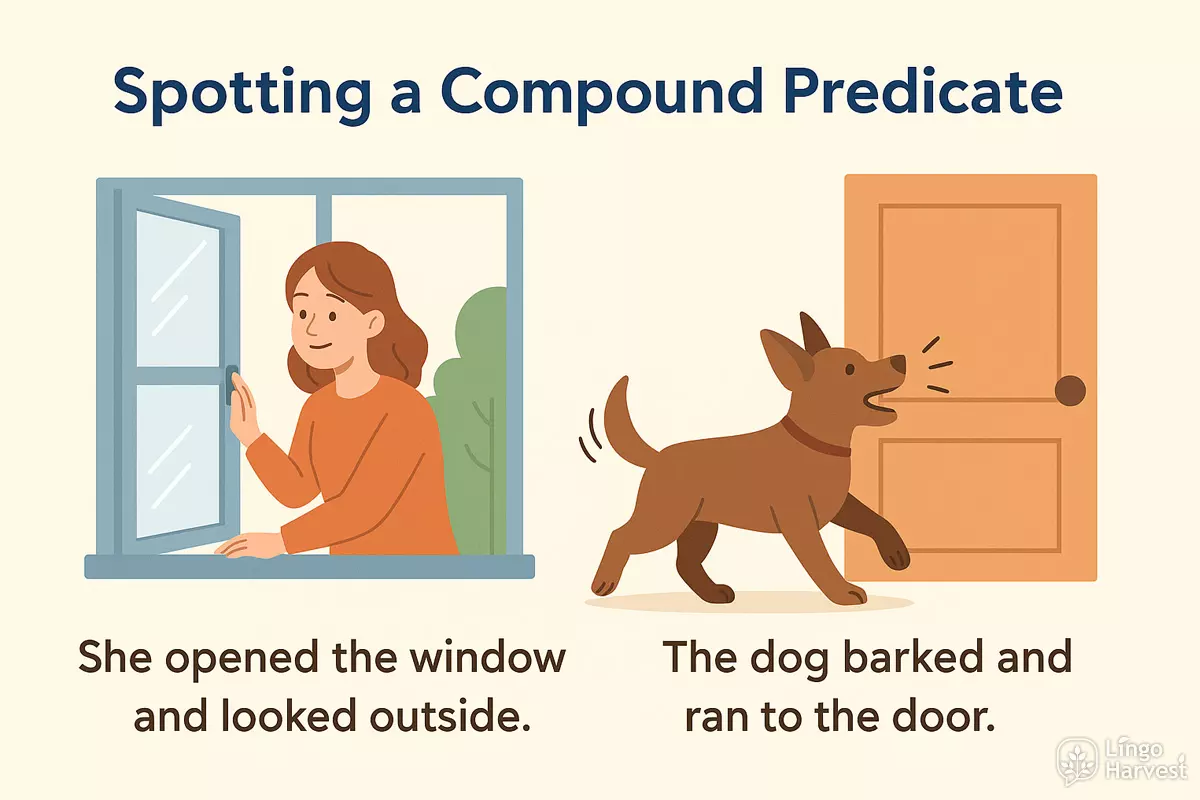
- She opened the window and looked outside.
- The dog barked and ran to the door.
- Mark finished his homework and went to bed.
- They packed and left quickly.
- We drove to the store and bought groceries.
- He called and apologized immediately.
- The teacher explained and wrote examples on the board.
- The phone rang and woke everyone up.
- She laughed and cried at the same time.
- My brother cleaned and organized his room.
Identifying Two Full Clauses
When you see two subjects, each with its own verb, you’re dealing with two clauses. This usually requires a conjunction and sometimes a comma. Avoid using a conjunction if the second subject is just a repeat—this is the classic "double subject" mistake.
- She opened the window, and she looked outside.
- The dog barked, and it ran to the door.
- Mark finished his homework, and he went to bed.
- They packed, and they left quickly.
- We drove to the store, and we bought groceries.
- He called, and he apologized immediately.
- The teacher explained, and she wrote examples on the board.
- The phone rang, and it woke everyone up.
- She laughed, and she cried at the same time.
- My brother cleaned, and he organized his room.
Quick Comparison: Compound Predicate vs. Two Clauses
| Compound Predicate | Two Full Clauses |
|---|---|
| She opened the window and looked outside. ✅ One subject, two verbs. |
She opened the window, and she looked outside. ❌ Subject repeated. |
| The dog barked and ran. | The dog barked, and it ran. |
| We drove and bought groceries. | We drove, and we bought groceries. |
| He called and apologized. | He called, and he apologized. |
Key Takeaways
- Use a compound predicate when the subject stays the same and simply performs multiple actions.
- Write two full clauses only if you introduce a new subject for the second action.
- Avoid repeating the subject after a conjunction unless you intend to form two independent clauses.
- Double subjects after a conjunction are usually unnecessary and can make your writing awkward.
How to fix run-on sentences created by extra conjunctions
Extra conjunctions often lead to confusing, lengthy sentences with double subjects or unnecessary repetition. To make your writing clearer, the solution is usually to revise the sentence structure. This means identifying where an extra “and,” “but,” “or,” or similar word creates a run-on, then breaking the sentence into smaller units or removing the redundant conjunction.
Recognizing the problem
When too many conjunctions are used, sentences can end up with two subjects or verbs joined incorrectly. For example, “My brother and he went to the store and he bought milk and he forgot bread.” Here, “and he” is repeated, making the sentence awkward and difficult to follow.
Strategies for correction
- Remove unnecessary conjunctions: Delete extra “and,” “but,” or “or” that join complete sentences without proper punctuation.
- Use punctuation effectively: Replace some conjunctions with periods or semicolons to separate independent clauses.
- Combine similar ideas: When two clauses share the same subject, merge their predicates to avoid repetition.
- Use pronouns carefully: Don’t repeat the subject after a conjunction unless absolutely necessary.
- Break up long sentences: Turn one run-on into two or more shorter, clear sentences.
Common patterns and fixes
| Problematic Sentence | Improved Version |
|---|---|
| She likes apples and she likes oranges and she likes bananas. | She likes apples, oranges, and bananas. |
| He went to the library and he studied for hours and he forgot to eat. | He went to the library, studied for hours, and forgot to eat. |
| The dog barked and it chased the cat and it knocked over a lamp. | The dog barked, chased the cat, and knocked over a lamp. |
| I wanted to go out but it was raining and I stayed home. | I wanted to go out, but it was raining, so I stayed home. |
| We finished dinner and we watched a movie and we went to bed. | We finished dinner, watched a movie, and went to bed. |
Quick tips for revision
- Read the sentence aloud; if it feels long or confusing, check for extra conjunctions.
- Ask if each “and,” “but,” or “or” is joining two complete sentences—if so, consider splitting them.
- Look for repeated subjects after conjunctions and see if you can omit them.
- When in doubt, make two short, clear sentences instead of one long, awkward one.
Careful editing for unnecessary conjunctions not only prevents double subjects but also improves clarity and flow. Practice recognizing these patterns, and your writing will become more concise and effective.
Guidelines for deciding when to join and when to separate ideas
When writing, knowing whether to combine two thoughts with a conjunction or to keep them apart is essential for clarity and correct grammar. This is especially important when dealing with subjects in a sentence; joining ideas incorrectly can result in double subjects or confusing structure. Here are some practical tips to help you decide when it’s best to link ideas and when to keep them separate.
When to Join Ideas with a Conjunction
Connecting ideas with conjunctions like and, but, or or works well when:
- Both clauses have the same subject and verb tense.
- The two statements are closely related and logically connected.
- Combining the ideas does not create ambiguity or an unintended double subject.
- The sentence flows naturally when joined.
- You want to avoid unnecessary repetition of the subject.
- Examples:
- Maria and Tom went to the market.
- The dog barked, and the cat ran away.
When to Separate Ideas
Splitting ideas into separate sentences or clauses is preferable when:
- Each clause has its own subject and verb, leading to a double subject if joined.
- The two thoughts are only loosely related or have different tones.
- Joining would make the sentence too long or cumbersome.
- There's a risk of confusing the reader with multiple subjects or actions in one sentence.
- One idea is a complete thought and the other is an afterthought or explanation.
- Examples:
- Maria went to the market. Tom stayed home.
- The dog barked. The cat ran away.
Common Pitfalls and How to Avoid Double Subjects
Writers often mistakenly join sentences with conjunctions, resulting in awkward double subjects. Watch out for these patterns:
- A subject is repeated after a conjunction:
Incorrect: The teacher explained the lesson and the students they listened.
Correct: The teacher explained the lesson, and the students listened. - Both clauses have different subjects but are joined as if sharing one:
Incorrect: She finished her work and he left the office. - Attempting to join unrelated ideas creates confusion:
Incorrect: The sun set and I like pizza.
Quick Reference: When to Join vs. Separate
| Join with Conjunction | Separate into Sentences |
|---|---|
| Shared subject or logical connection ✅ Maria cooked and cleaned. ✅ The phone rang but no one answered. |
Different subjects or unrelated ideas ❌ Maria cooked and Tom he cleaned. ✅ Maria cooked. Tom cleaned. |
| Avoids repetition, keeps sentence concise. ✅ She laughed and cried. |
Prevents double subjects or run-on sentences. ✅ She laughed. He cried. |
| Actions happen together or in sequence. ✅ They arrived and sat down. |
Ideas are distinct or need emphasis. ✅ They arrived. The meeting began. |
| Both ideas are equally important and related. | One idea explains, contrasts, or follows the other. |
Key Points to Remember
- Join ideas only if they share a clear logical link and do not cause double subjects.
- Separate when each clause introduces a new subject or when clarity could suffer.
- Reread sentences aloud to check for awkwardness or confusion.
- When in doubt, shorter sentences are usually clearer.
Practice: delete or keep conjunctions to improve sentences
Editing out unnecessary conjunctions can clarify sentence structure, especially when avoiding double subjects. Sometimes, keeping the conjunction is correct; other times, removing it improves readability and grammar. Below, you’ll find practical exercises and examples to help you decide when to keep or delete conjunctions like and, but, or or.
Spotting Redundant Conjunctions
Writers often add a conjunction before a new subject, even if the sentence is already complete. This can lead to awkward double subjects or fragments. Review these sentences and decide if the conjunction should stay or go:
- I went to the store and my brother stayed home.
- She finished her work but her friend was still working.
- We arrived early and the doors were locked.
- He likes coffee but he doesn’t drink it at night.
- The sun was shining and we went for a walk.
- The team practiced hard but they lost the game.
- She wants to travel and her partner prefers to stay home.
- I called her but she didn’t answer.
- He opened the window and a bird flew in.
- We studied all night but the test was difficult.
For each, consider whether the conjunction connects two complete sentences (independent clauses) or unnecessarily creates a double subject. If both sides can stand alone, keeping the conjunction is often correct, but sometimes separating into two sentences or using a semicolon gives better flow.
Quick Practice: Improve These Sentences
- Maria finished her assignment and her friend started a new project.
- The lights went out but everyone kept calm.
- He washed the dishes and his sister dried them.
- The teacher explained the lesson but the students didn’t understand.
Show answers
- Maria finished her assignment. Her friend started a new project. (OR: Maria finished her assignment, and her friend started a new project.)
- The lights went out, but everyone kept calm. (Conjunction is appropriate; both are full sentences.)
- He washed the dishes. His sister dried them. (OR: He washed the dishes, and his sister dried them.)
- The teacher explained the lesson, but the students didn’t understand. (Conjunction is correct here.)
Guidelines for Using or Removing Conjunctions
- Keep the conjunction if you are joining two independent clauses and want to show a clear relationship.
- Remove the conjunction if it causes a double subject or makes the sentence confusing.
- Consider splitting into two sentences for clarity, especially in formal writing.
- Use a comma before the conjunction when joining two complete sentences (independent clauses).
- If the second part is not a full sentence, keep the conjunction without a comma.
Editing Practice: Choose to Delete or Keep
Decide whether to delete the conjunction, keep it, or rewrite the sentence:
- Tom likes to swim and he joined the swim team.
- We saw the movie but the ending was confusing.
- The concert was loud and the music was great.
- She opened the door and her cat ran outside.
- He cooked dinner and they ate together.
- I called her but she didn’t answer.
- The test was difficult and many students struggled.
- We arrived early but the store was closed.
- She cleaned the house and her brother washed the dishes.
- He wanted to go out but it started raining.
Show answers
- Tom likes to swim. He joined the swim team. (Or: Tom likes to swim, and he joined the swim team.)
- We saw the movie, but the ending was confusing. (Correct conjunction use.)
- The concert was loud, and the music was great. (Correct; can also be separate sentences.)
- She opened the door. Her cat ran outside. (Or: She opened the door, and her cat ran outside.)
- He cooked dinner, and they ate together. (Correct use of 'and'.)
- I called her, but she didn’t answer. (Correct contrast.)
- The test was difficult, and many students struggled. (Correct addition.)
- We arrived early, but the store was closed. (Correct contrast.)
- She cleaned the house, and her brother washed the dishes. (Two actions, correct addition.)
- He wanted to go out, but it started raining. (Correct contrast.)
With careful editing, you can improve clarity and avoid awkward double subjects. Review your writing for unnecessary conjunctions and choose the best structure for each situation.