Subordinating Conjunctions: Full List and Functions

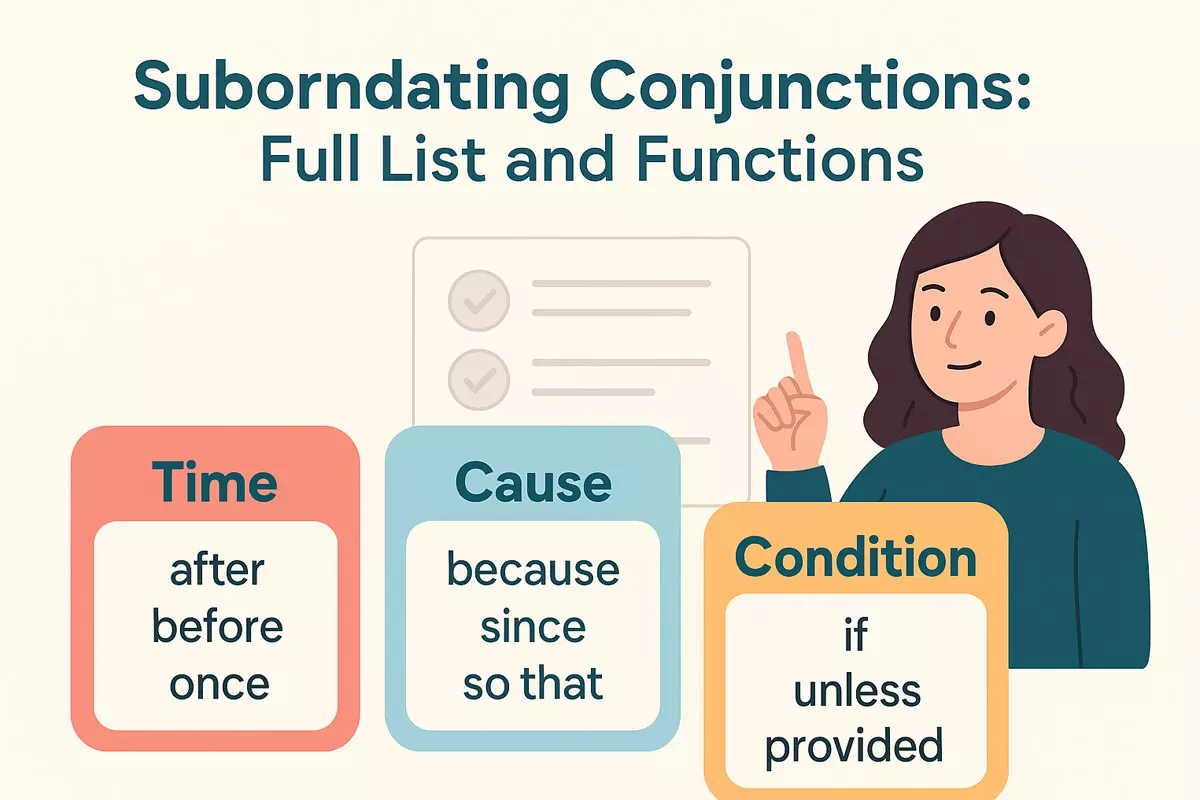 The article compares main and subordinate clauses, defines subordinating conjunctions, and reviews common types like because, if, and although. It explains their uses, word order, punctuation rules, and offers practice matching each subordinator to its function.
- Review of main clause vs subordinate clause
- Definition of subordinating conjunctions in clear terms
- Overview of common subordinators: because, if, when, although, while, etc.
- How subordinating conjunctions show time, reason, condition, contrast, result
- Word order: subordinate clause before or after the main clause
- Punctuation patterns with initial and final subordinate clauses
- Extended list of useful subordinating conjunctions for B1–B2
- Practice: match each subordinator with its main function and example
Connecting words, often called conjunctions or transitional phrases, are essential for creating clear and cohesive sentences by linking ideas and showing the relationships between them. They help readers follow the flow of thoughts, making writing more understandable and engaging. These words can indicate contrast, addition, cause and effect, or sequence, among other relationships. By using connecting words effectively, writers can build complex arguments, clarify meaning, and guide readers smoothly from one point to the next, enhancing both clarity and coherence in their writing.
Review of main clause vs subordinate clause
Understanding how sentences are built requires familiarity with both main and subordinate clauses. A main clause (also called an independent clause) can stand alone as a complete sentence. It contains a subject and a predicate, expressing a complete thought. In contrast, a subordinate clause (or dependent clause) cannot stand alone and relies on the main clause for its full meaning. Subordinate clauses are typically introduced by subordinating conjunctions like "because," "although," or "if."
Key Differences Between Main and Subordinate Clauses
The essential distinction is that main clauses are structurally complete, while subordinate clauses depend on another part of the sentence. Recognizing this difference is crucial when identifying how subordinating conjunctions function within sentences.
| Main Clause | Subordinate Clause |
|---|---|
| Expresses a complete thought | Does not express a complete thought |
| Can stand alone as a sentence | Cannot stand alone; needs a main clause |
| Example: She went home. | Example: because she was tired |
| No introductory word required | Often begins with a subordinating conjunction |
| Answers the question: "What happened?" | Answers questions like "Why?", "When?", "Where?", "How?" |
Examples of Each Clause Type
- Main: The sun set.
- Subordinate: after the sun set
- Main: We will start now.
- Subordinate: if everyone is ready
- Main: I stayed inside.
- Subordinate: because it was raining
- Main: She smiled.
- Subordinate: although she was tired
- Main: He called me.
- Subordinate: when he arrived
- Main: The dog barked.
- Subordinate: while the mailman was outside
- Main: You can come with us.
- Subordinate: unless you are busy
- Main: We finished our work.
- Subordinate: before the deadline passed
Practice: Identify the Clause Type
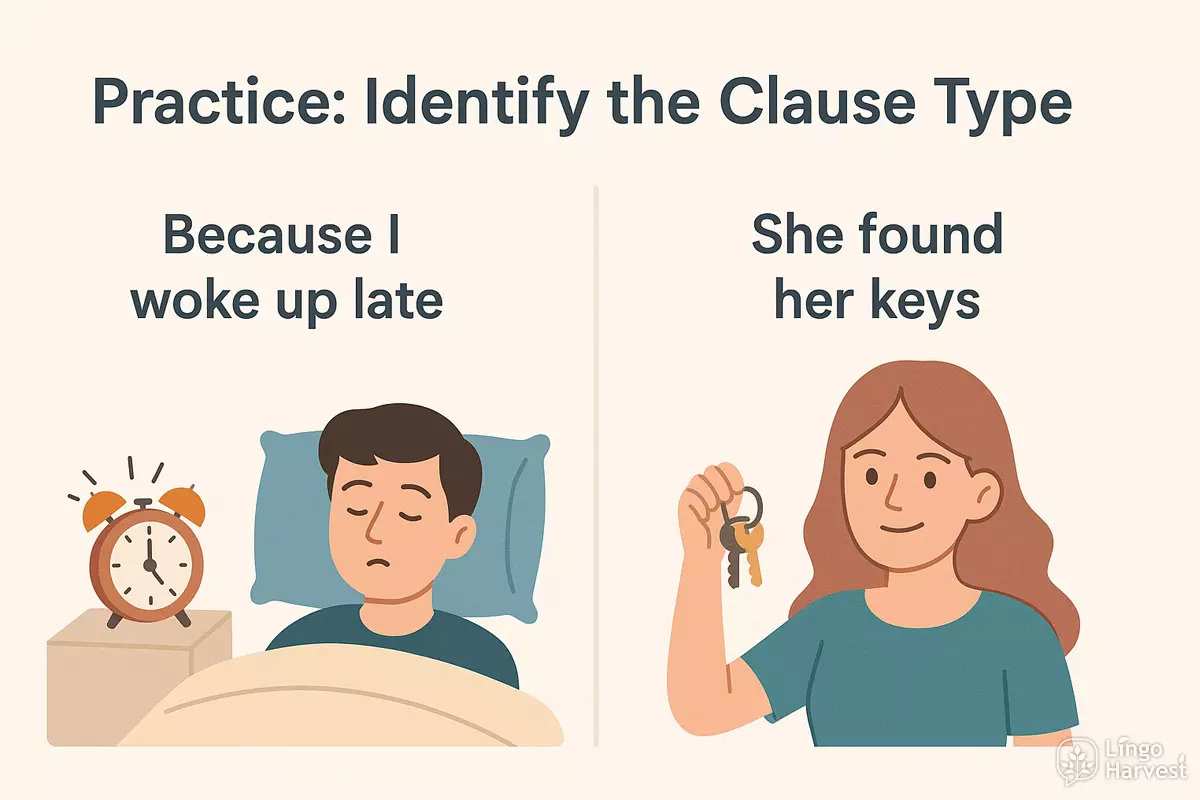
Read each phrase and decide whether it is a main clause or a subordinate clause:
- Because I woke up late
- She found her keys
- Whenever you call
- They will join us
- Although it was cold
- He laughed
Show answers
- Subordinate clause
- Main clause
- Subordinate clause
- Main clause
- Subordinate clause
- Main clause
Recognizing these patterns makes it easier to use subordinating conjunctions effectively and to construct clear, complex sentences.
Definition of subordinating conjunctions in clear terms
A subordinating conjunction is a word or phrase that connects a dependent (subordinate) clause to an independent (main) clause. These connectors signal the relationship between the two parts of a sentence, making it clear how they are logically or temporally linked. Typically, the dependent clause cannot stand alone as a complete sentence, while the main clause can.
How subordinating conjunctions function
These conjunctions introduce dependent clauses and show how one idea relates to another. Most often, they express relationships such as cause and effect, time, condition, contrast, or purpose. For example, in the sentence "She stayed inside because it was raining," the word "because" connects the reason (it was raining) to the main action (she stayed inside).
- After — shows time: "We went home after the movie ended."
- Although — shows contrast: "Although it was late, he kept working."
- Because — shows reason: "They left because they were tired."
- Before — shows time: "Finish your homework before you play outside."
- If — shows condition: "If it rains, bring an umbrella."
- Since — shows reason or time: "Since you asked, I'll explain."
- Unless — shows exception: "You won’t pass unless you study."
- When — shows time: "Call me when you arrive."
- While — shows contrast or time: "She listened while he spoke."
- Though — shows contrast: "Though it’s cold, we’ll go jogging."
- Until — shows time: "Wait here until I return."
- Whereas — shows contrast: "He likes tea, whereas she prefers coffee."
- Even though — shows strong contrast: "Even though he's busy, he helps."
- As soon as — shows immediate timing: "Call me as soon as you can."
- In case — shows precaution: "Take your phone in case you get lost."
- So that — shows purpose: "We left early so that we wouldn’t be late."
- Provided (that) — shows condition: "You can go provided you finish your work."
- Now that — shows cause: "Now that you’re here, we can start."
- Once — shows time: "Once you finish, we’ll leave."
- Wherever — shows place: "Sit wherever you like."
Key features of subordinating conjunctions
- They always introduce a dependent clause.
- The dependent clause linked by one cannot stand alone as a full sentence.
- They clarify logical relationships (time, cause, contrast, condition, purpose, etc.).
- They often answer questions like when, why, or under what condition something happens.
In summary, these conjunctions help organize complex ideas within a sentence by clearly linking supporting information to the main point. Their role is essential for expressing nuanced relationships between actions, events, and ideas in both spoken and written English.
Overview of common subordinators: because, if, when, although, while, etc.
Subordinating conjunctions, often called subordinators, play a crucial role in connecting clauses and indicating relationships such as cause, time, contrast, and condition. These words introduce subordinate (dependent) clauses, helping to create complex and meaningful sentences by linking ideas clearly.
Key Types of Subordinators and Their Functions
Different subordinators express various logical relationships. Here’s a breakdown of some common categories:
- Cause/Reason: because, since, as
- Condition: if, unless, provided (that), in case
- Time: when, while, after, before, until, as soon as, once
- Contrast/Concession: although, though, even though, whereas, while
- Purpose: so that, in order that
- Result: so (that), such that
- Comparison: than, as…as
- Place: where, wherever
How Subordinators Work in Sentences
Subordinators usually appear at the beginning of a dependent clause, which can come before or after the main clause. For example:
- Because it was raining, we stayed inside.
- We stayed inside because it was raining.
- If you finish early, call me.
- Call me if you finish early.
Notice that when the dependent clause comes first, a comma is typically used.
Expanded List of Common Subordinators
Here’s a selection of widely used subordinating conjunctions to help you recognize patterns and expand your sentence-building skills:
- after → We went for a walk after the rain stopped.
- although → Although it was late, they kept talking.
- as → She smiled as he opened the gift.
- as long as → You can stay here as long as you keep quiet.
- as soon as → Call me as soon as you arrive.
- because → They stayed inside because it was too cold.
- before → Wash your hands before you eat.
- even if → I’ll support you even if you fail.
- even though → She went jogging even though she was tired.
- if → If it rains, we’ll cancel the trip.
- in case → Take a jacket in case it gets cold.
- once → Once you finish, we can leave.
- since → Since you’re here, help me with this box.
- so that → He spoke loudly so that everyone could hear.
- than → She runs faster than her brother.
- though → He kept smiling though he was nervous.
- unless → You won’t improve unless you practice.
- until → Wait here until I come back.
- when → Call me when you’re ready.
- whenever → You can visit whenever you want.
- where → This is the place where we met.
- whereas → She loves horror movies, whereas he prefers comedies.
- wherever → Sit wherever you like.
- while → She cooked while he cleaned.
Comparing Functions of Selected Subordinators
| Subordinator | Main Function | Example |
|---|---|---|
| because | Expresses cause or reason | She left early because she was tired. |
| if | Expresses condition | If it rains, we’ll cancel the picnic. |
| when | Indicates time | Call me when you arrive. |
| although | Shows contrast/concession | Although he was tired, he kept working. |
| while | Indicates time or contrast | Read while you wait. |
Understanding how and when to use these connectors helps you communicate more precisely and fluently. Each subordinator brings a unique nuance, so choosing the right one is key to expressing your intended meaning.
How subordinating conjunctions show time, reason, condition, contrast, result
Subordinating conjunctions play a crucial role in linking dependent clauses to main clauses, providing context and clarity. These connectors signal relationships such as time, cause, condition, contrast, and result, helping readers or listeners understand how ideas relate to each other.
Expressing Time
Words like after, before, when, while, as soon as, and until introduce clauses that indicate when something happens. For example:
- After she arrived, the meeting started.
- While he was cooking, the phone rang.
- We will leave as soon as you finish.
Giving Reasons
To explain why something occurs, conjunctions such as because, since, and as are used:
- He left early because he was tired.
- Since it was raining, we stayed indoors.
Stating Conditions
Conditional relationships are marked with words like if, unless, provided that, and in case:
- If you study, you will pass.
- We’ll go for a walk unless it rains.
- You can borrow my car provided that you return it on time.
Showing Contrast
Contrast is introduced with conjunctions such as although, though, even though, and whereas:
- Although it was cold, they went swimming.
- She likes coffee, whereas he prefers tea.
- Even though I was late, I finished the test.
Indicating Results
To show results or consequences, use conjunctions like so that, in order that, and so (when used as a subordinating conjunction):
- He whispered so that no one could hear.
- She left early in order that she could catch the bus.
| Function | Common Subordinating Conjunctions |
|---|---|
| Time | after, before, when, while, as soon as, until, since, once, whenever |
| Reason | because, since, as, now that, inasmuch as |
| Condition | if, unless, provided that, in case, even if, only if |
| Contrast | although, though, even though, whereas, while |
| Result | so that, in order that |
By choosing the right subordinating conjunction, speakers and writers can clearly indicate how ideas connect, making sentences precise and easy to follow. Using a variety of these connectors adds nuance and depth to communication.
Word order: subordinate clause before or after the main clause
The placement of a subordinate clause depends on what you want to emphasize and the flow of your sentence. Subordinate clauses, introduced by subordinating conjunctions, can come at the start or end of a sentence. Both options are grammatically correct, but the choice affects punctuation and style.
Subordinate clause at the beginning
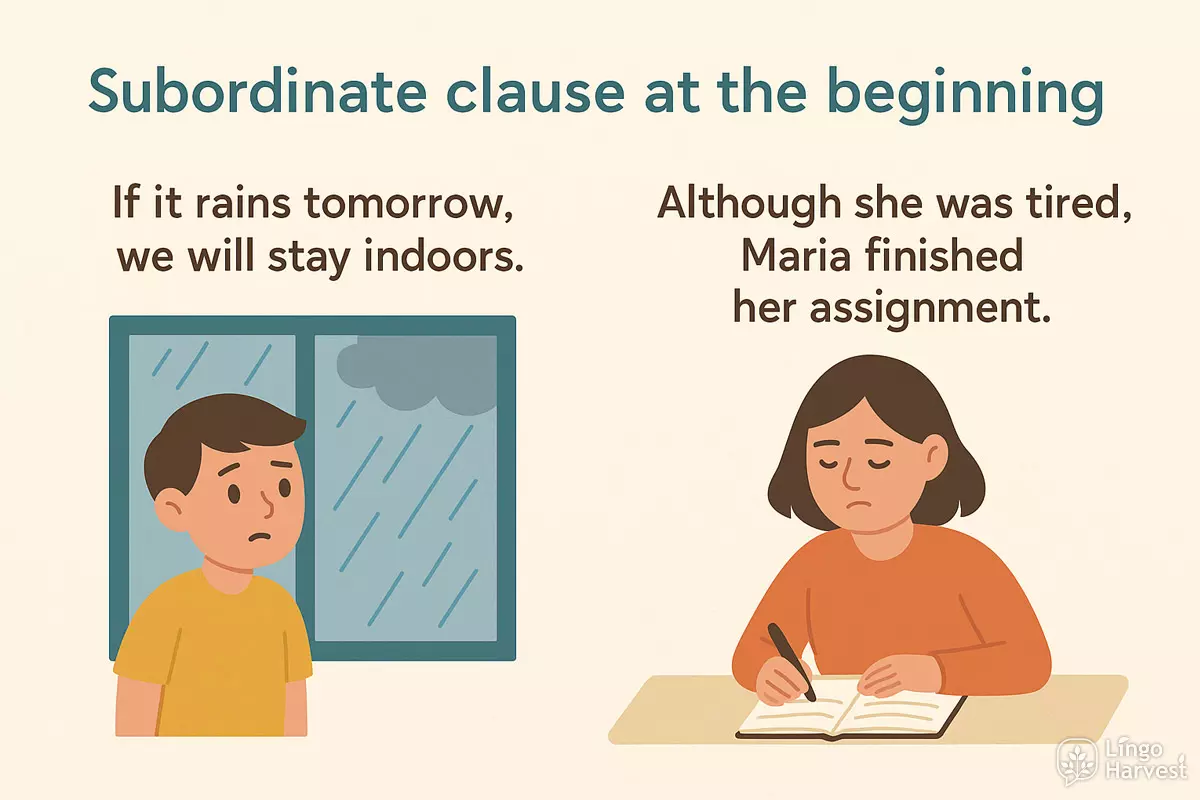
When the dependent clause comes before the main clause, it sets the context or background for the main idea. In this position, it’s common to use a comma after the subordinate clause. For example:
- If it rains tomorrow, we will stay indoors.
- Although she was tired, Maria finished her assignment.
- Because he forgot his keys, Sam was late for work.
- When the bell rings, please line up quietly.
- Since you asked, I will explain the process.
Subordinate clause at the end
Placing the subordinate clause after the main idea often puts emphasis on the result or consequence. In this structure, a comma is usually not needed unless the clause is nonessential or adds contrast. Examples include:
- We will stay indoors if it rains tomorrow.
- Maria finished her assignment although she was tired.
- Sam was late for work because he forgot his keys.
- Please line up quietly when the bell rings.
- I will explain the process since you asked.
Comparison: Initial vs. final position
The choice between placing the dependent clause before or after the main part of the sentence can subtly shift the focus. Here’s a structured comparison:
| Subordinate Clause First | Subordinate Clause Last |
|---|---|
| Because she studied hard, she passed the test. | She passed the test because she studied hard. |
| If you need help, let me know. | Let me know if you need help. |
| Although it was late, they kept working. | They kept working although it was late. |
| Since we arrived early, we got good seats. | We got good seats since we arrived early. |
| When the sun sets, the lights turn on automatically. | The lights turn on automatically when the sun sets. |
Punctuation tips
- Comma required when the dependent clause is at the beginning.
- No comma usually needed when the subordinate clause is at the end.
Style and emphasis
Choosing where to place a dependent clause lets you control sentence rhythm and what the reader notices first. Starting with the subordinate element can highlight conditions or reasons, while ending with it can keep the focus on the main action. Both patterns are flexible and can be used to improve clarity and flow in your writing.
Punctuation patterns with initial and final subordinate clauses
When working with sentences that include subordinate (dependent) clauses, the placement of the clause affects punctuation. If the dependent clause comes first, it usually ends with a comma before the main clause. However, if it follows the main clause, a comma is generally not needed unless the clause is nonessential or adds contrast.
Initial subordinate clauses: comma required
Starting a sentence with a dependent clause—often introduced by subordinating conjunctions like because, although, if, when, unless, while—requires a comma to separate it from the independent clause that follows. This pause helps readers process the introductory information.
- If you finish your homework early, you can watch TV.
- Although it was raining, we went for a walk.
- Because she studied hard, Maria passed the exam.
- When the bell rings, please line up quietly.
- While I appreciate your help, I need to do this myself.
- Unless you hurry, you will miss the train.
- Even though he was tired, he finished the project.
- Since you asked, I’ll explain in more detail.
- After the show ended, we went out for dinner.
- As soon as the doors opened, the crowd rushed in.
Final subordinate clauses: comma usually omitted
When the subordinate clause comes after the main clause, a comma is not typically used. The flow of information is straightforward, and a pause is unnecessary.
- You can watch TV if you finish your homework early.
- We went for a walk although it was raining.
- Maria passed the exam because she studied hard.
- Please line up quietly when the bell rings.
- I need to do this myself while I appreciate your help.
- You will miss the train unless you hurry.
- He finished the project even though he was tired.
- I’ll explain in more detail since you asked.
- We went out for dinner after the show ended.
- The crowd rushed in as soon as the doors opened.
Quick comparison: comma placement with subordinate clauses
| Clause Position | Punctuation Rule & Example |
|---|---|
| Beginning of sentence | Comma required When it rains, we stay inside. |
| End of sentence | No comma (unless for contrast) We stay inside when it rains. |
| Nonessential/contrast clause | Comma may be needed She finished first, although she started late. |
| Essential information | No comma Call me if you need help. |
Exceptions and special cases
While the above guidelines cover most situations, exceptions do occur. For instance, a comma may be used before a final subordinate clause for emphasis or contrast, or to prevent ambiguity. Also, very short introductory clauses sometimes appear without a comma, especially in informal writing, but including the comma is generally recommended for clarity. In summary, knowing where to place commas in sentences with dependent clauses ensures your writing is clear and easy to follow.
Extended list of useful subordinating conjunctions for B1–B2
Learning to use a wider range of subordinating conjunctions helps learners express more complex ideas and connect sentences smoothly. At the B1 and B2 levels, students often move beyond basic connectors like "because" and "when" to more varied options. This section explores some of the most practical and versatile subordinators for intermediate learners, with example sentences and brief notes on usage.
Commonly Used Subordinating Conjunctions
- Although – Although it was raining, we went for a walk.
- Even though – Even though he was tired, he finished his project.
- Unless – You can’t go out unless you finish your homework.
- Since – Since I moved here, I’ve made new friends.
- While – While I was cooking, she set the table.
- As soon as – Call me as soon as you arrive.
- Before – Before you leave, check your bag.
- After – After he finished work, he went home.
- Whenever – Whenever I see her, I smile.
- Until – Wait here until I come back.
- Because – She left early because she was feeling sick.
- So that – He spoke loudly so that everyone could hear.
- In case – Take an umbrella in case it rains.
- Unless – I won’t go unless you come with me.
- Once – Call me once you’re ready.
- Now that – Now that you mention it, I remember.
- Provided (that) – You can borrow my car provided that you drive carefully.
- Though – Though he tried hard, he didn’t win.
- As long as – You can stay as long as you like.
Comparing Similar Conjunctions
Some subordinating conjunctions are very similar in meaning but used in slightly different contexts. The table below highlights a few pairs that often confuse learners, with examples for each.
| Conjunction | Example Sentence |
|---|---|
| Although / Though | Although it was late, we kept talking. Though he was tired, he went out. |
| Even though / While | Even though it’s cold, she swims every day. While I was reading, the phone rang. |
| Unless / If | You won’t pass unless you study. If you study, you will pass. |
| As soon as / Once | Call me as soon as you arrive. Once you finish, we can leave. |
Tips for Practice
Try using these conjunctions in your own sentences. Notice how they change the meaning or order of information. With regular practice, you’ll find it easier to express cause, contrast, time, and condition in English.
Practice: match each subordinator with its main function and example
Understanding how subordinating conjunctions function is key to building complex sentences and expressing nuanced relationships between ideas. Below, you’ll find a variety of common subordinators, their primary functions (such as showing time, cause, or contrast), and sample sentences to illustrate their use. Try matching each conjunction to its main function and the correct example.
Subordinators and Their Main Uses
- Although – introduces contrast
- Because – shows reason or cause
- When – indicates time
- Unless – expresses condition
- Since – can show time or reason
- After – time relationship
- While – simultaneous actions or contrast
- As soon as – immediate sequence in time
- If – condition
- Although – contrast
- Before – time, precedence
- So that – purpose
- Even though – strong contrast
- Whereas – contrast/comparison
- Unless – negative condition
- Until – up to a point in time
- Once – after something happens
- In case – precaution
- Since – time or cause
- Though – contrast
Match the Subordinators
For each item, match the subordinator to its primary function and choose the correct example sentence.
| Subordinator | Main Function | Example Sentence |
|---|---|---|
| Because | Reason/Cause | I stayed home because it was raining. |
| Unless | Negative Condition | You won’t pass unless you study. |
| After | Time (sequence) | She left after she finished her work. |
| Although | Contrast | Although he was tired, he kept working. |
| So that | Purpose | I’ll write it down so that I don’t forget. |
| While | Simultaneous Actions/Contrast | He read while she cooked. |
| Until | Time (up to a point) | We waited until the rain stopped. |
| Even though | Strong Contrast | Even though it was late, they continued talking. |
| If | Condition | If you call, I’ll answer. |
| Since | Time or Reason | Since you are here, let’s start. |
Quick Practice: Identify the Function
- ________ she moved abroad, we saw each other every week.
- I always take notes ________ I don’t forget important details.
- ________ you need help, just call me. (Which expresses possibility?)
- We won’t begin ________ everyone arrives. (Which expresses time?)
- ________ he worked hard, he didn’t get the promotion. (Which shows contrast?)
- Bring a jacket ________ it gets cold later. (Which shows precaution?)
- ________ you finish the report, send it to me immediately. (Which shows time?)
- We can’t leave ________ the meeting ends. (Which expresses limitation?)
- ________ they practice regularly, they won’t improve. (Which expresses negative condition?)
- He joined the class ________ he wanted to learn more. (Which expresses reason?)
Show answers
- Before
- So that
- If
- When
- Although
- In case
- Once
- Until
- Unless
- Because
Reviewing and practicing with subordinating conjunctions helps you connect ideas clearly and express complex relationships in your writing. Try writing your own sentences using these words for extra practice.