Degree Adverbs with Abstract Concepts (advanced use)

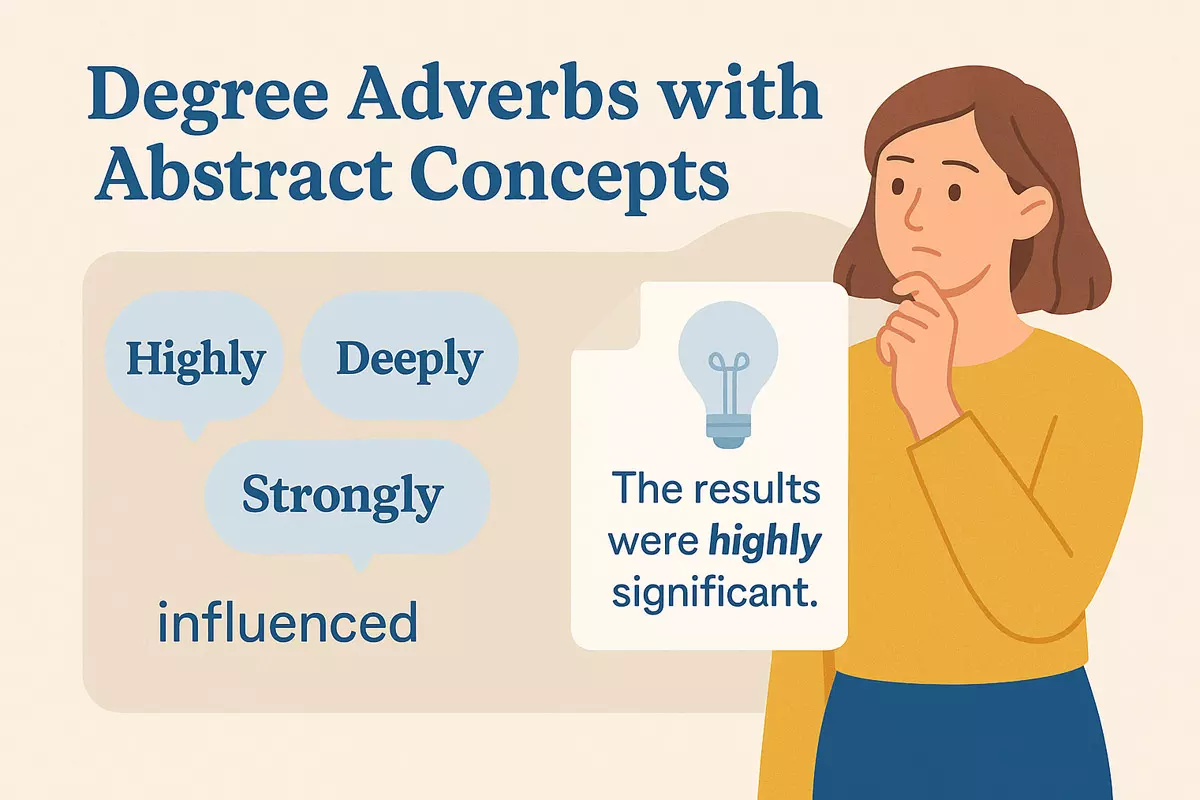 Here we how to use degree adverbs like highly, deeply, and strongly with abstract nouns. It compares their tone in academic versus conversational English, highlights common errors, and offers practice for natural, accurate usage.
Using intensifiers in your language enhances subtlety and precision, particularly when expressing abstract ideas such as emotions or qualities. By carefully choosing and applying these modifiers, you can convey shades of meaning that might otherwise be lost, allowing your communication to become more nuanced and sophisticated. This attention to detail not only clarifies your intent but also engages your audience more effectively, making your descriptions of intangible concepts both vivid and relatable.
Abstract nouns and advanced modifiers
When discussing degree adverbs with abstract concepts, it’s important to consider how adverbs interact with abstract nouns such as “freedom,” “intensity,” or “significance.” Unlike concrete nouns, abstract nouns refer to intangible ideas, qualities, or states. This often requires more nuanced or sophisticated modifiers to communicate subtle differences in meaning, especially at an advanced level.
How degree adverbs modify abstract nouns
Degree adverbs such as “utterly,” “remarkably,” “profoundly,” and “barely” can intensify, diminish, or otherwise shape the meaning of abstract nouns. For example, “utterly confusion” is incorrect, but “utter confusion” is idiomatic and natural. Selecting the right adverb-noun pairing is crucial for clarity and precision.
- Utter chaos
- Sheer determination
- Profound disappointment
- Marked improvement
- Absolute certainty
- Considerable influence
- Scant evidence
- Marginal benefit
- Overwhelming support
- Vast potential
- Partial understanding
- Heightened awareness
- Intense rivalry
- Minimal risk
- Excessive ambition
- Complete ignorance
- Notable resistance
- Substantial progress
- Virtually no chance
Common pitfalls and advanced usage
Pairings of adverbs and abstract nouns are not always interchangeable. Some combinations are fixed collocations in English, while others may sound awkward or incorrect. For instance, “highly happiness” is wrong, but “great happiness” is correct. Awareness of these patterns helps avoid common errors and makes writing and speech sound more natural.
| Adverb + Abstract Noun | Acceptability | Notes |
|---|---|---|
| Utter confusion | ✅ Natural | “Utter” commonly modifies negative states |
| Highly importance | ❌ Incorrect | Use “of great importance” instead |
| Profound impact | ✅ Natural | “Profound” intensifies the effect |
| Barely knowledge | ❌ Incorrect | Say “barely any knowledge” or “limited knowledge” |
| Considerable progress | ✅ Natural | Common collocation for achievement |
| Extremely belief | ❌ Incorrect | Use “strong belief” or “deep belief” |
Building advanced expressions
To express subtle degrees or attitudes, advanced speakers often combine degree adverbs with qualifying adjectives before an abstract noun. For example: “a slightly increased awareness,” “an exceptionally high level of trust,” or “a remarkably low tolerance.” Experimenting with these combinations allows for more precise and expressive communication, especially in academic or formal contexts. Understanding which modifiers work with abstract nouns, and which do not, is a practical skill that distinguishes advanced English proficiency. Practice, exposure, and attention to collocations are key to mastering these patterns.
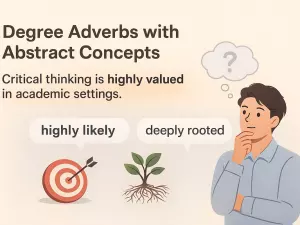
Patterns with highly, deeply, strongly
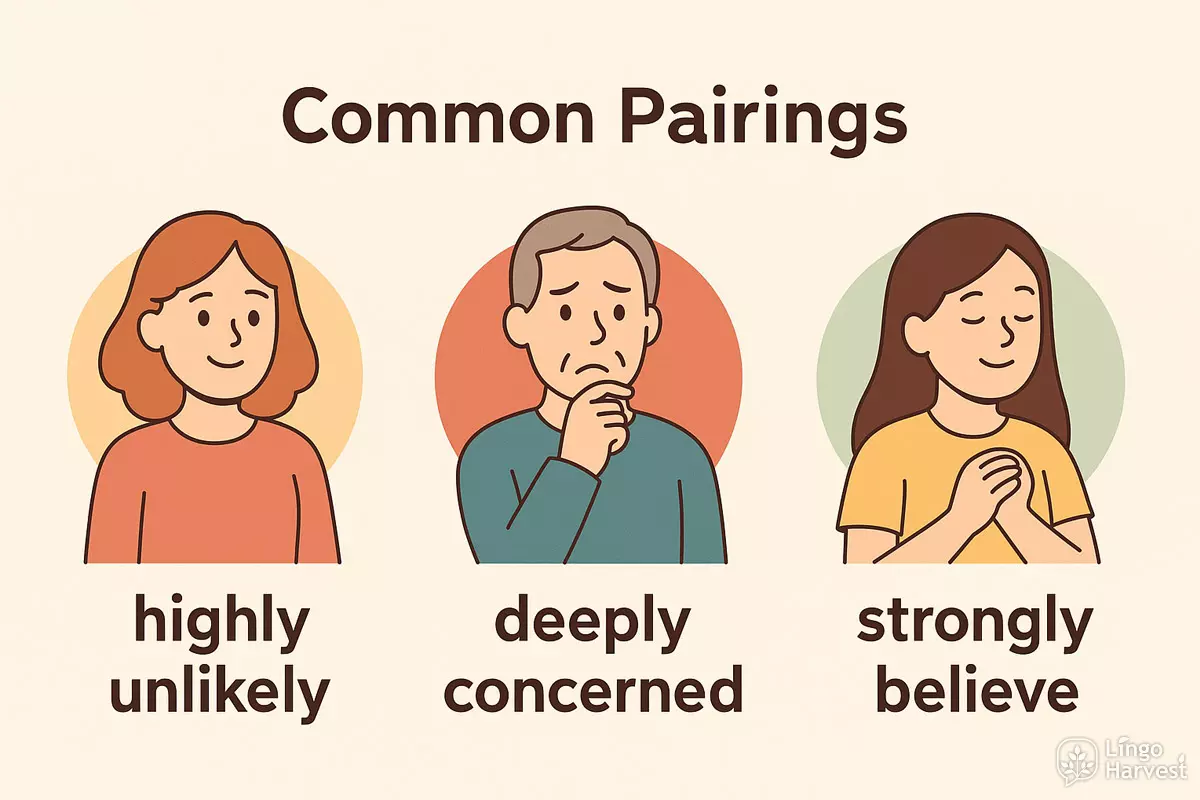
When we talk about abstract ideas or emotions in English, certain adverbs of degree—such as "highly," "deeply," and "strongly"—are used to intensify the meaning. These adverbs often combine with specific adjectives or verbs, creating fixed patterns rather than being used interchangeably. Understanding their typical collocations is essential for sounding natural and precise, especially in formal or advanced contexts.
Typical Collocations for Each Adverb
- Highly: often used with adjectives expressing value, probability, or opinion.
- Deeply: frequently paired with words relating to emotions, feelings, or states of being.
- Strongly: commonly combined with verbs or adjectives expressing opinion, belief, or recommendation.
Common Pairings and Usage
The following table illustrates some of the most frequent combinations. Notice how each adverb tends to collocate with certain types of words, and using the wrong adverb can sound unnatural.
| Adverb | Typical Collocations |
|---|---|
| Highly |
|
| Deeply |
|
| Strongly |
|
Notes on Usage
Choosing the correct intensifier depends on the meaning you want to express. For example, "highly" works with abstract qualities or evaluations ("highly skilled"), while "deeply" is more emotional or psychological ("deeply troubled"). "Strongly" typically emphasizes actions or opinions ("strongly urge").
- ✅ Correct: "highly intelligent," "deeply grateful," "strongly recommend"
- ❌ Incorrect: "strongly intelligent," "highly grateful," "deeply recommend"
Using these adverbs accurately helps convey subtle differences in intensity and appropriateness. These patterns are especially useful in academic writing, formal speech, or any context requiring precision with abstract concepts.
Tone differences across degree adverbs
When using degree adverbs with abstract concepts, the choice of adverb can subtly shift the attitude or emotional color of your message. Some intensifiers sound neutral and objective, while others introduce emotion, subjectivity, or even exaggeration. Recognizing these nuances helps you select the best adverb for your intended effect.
Comparing Common Degree Adverbs
Consider how different intensifiers interact with abstract nouns and adjectives like "importance," "complexity," or "certainty." Some lend a formal, understated touch, while others add emphasis or even drama.
| Adverb | Typical Tone with Abstract Concepts | Example Phrase | Notes |
|---|---|---|---|
| Highly | Formal, objective | highly relevant | Preferred in academic or professional contexts |
| Extremely | Emphatic, slightly subjective | extremely challenging | Stronger than "very," but less formal than "highly" |
| Incredibly | Colloquial, expressive | incredibly valuable | Often used in spoken or informal writing |
| Moderately | Neutral, measured | moderately complex | Suggests a balanced or cautious view |
| Somewhat | Mild, understated | somewhat ambiguous | Downplays intensity; useful for hedging |
| Totally | Strong, absolute | totally unjustified | Can sound dramatic or categorical |
| Utterly | Intense, literary | utterly irrational | Often used for emphasis in formal or literary contexts |
| Fairly | Gentle, moderate | fairly typical | Softens the intensity; often conversational |
| Absolutely | Forceful, unequivocal | absolutely essential | Leaves no room for doubt; can be persuasive |
| Deeply | Emotional, subjective | deeply meaningful | Often paired with feelings or values |
Tips for Choosing the Right Adverb
- Match the context: Use more formal intensifiers (like "highly") in academic or professional settings.
- Consider the audience: Colloquial adverbs ("incredibly") may feel out of place in formal writing.
- Control emphasis: Strong adverbs ("absolutely," "utterly") can sound persuasive or emotional; use with care.
- Soften claims: Milder options ("somewhat," "fairly") help hedge statements and avoid overstatement.
Subtle Effects on Meaning
The same abstract concept can feel more urgent, more tentative, or more personal depending on your adverb choice. For example, "highly probable" suggests strong likelihood, but remains neutral; "utterly impossible" adds drama and finality. Understanding these tonal differences allows for more precise and effective communication.
Academic vs conversational usage
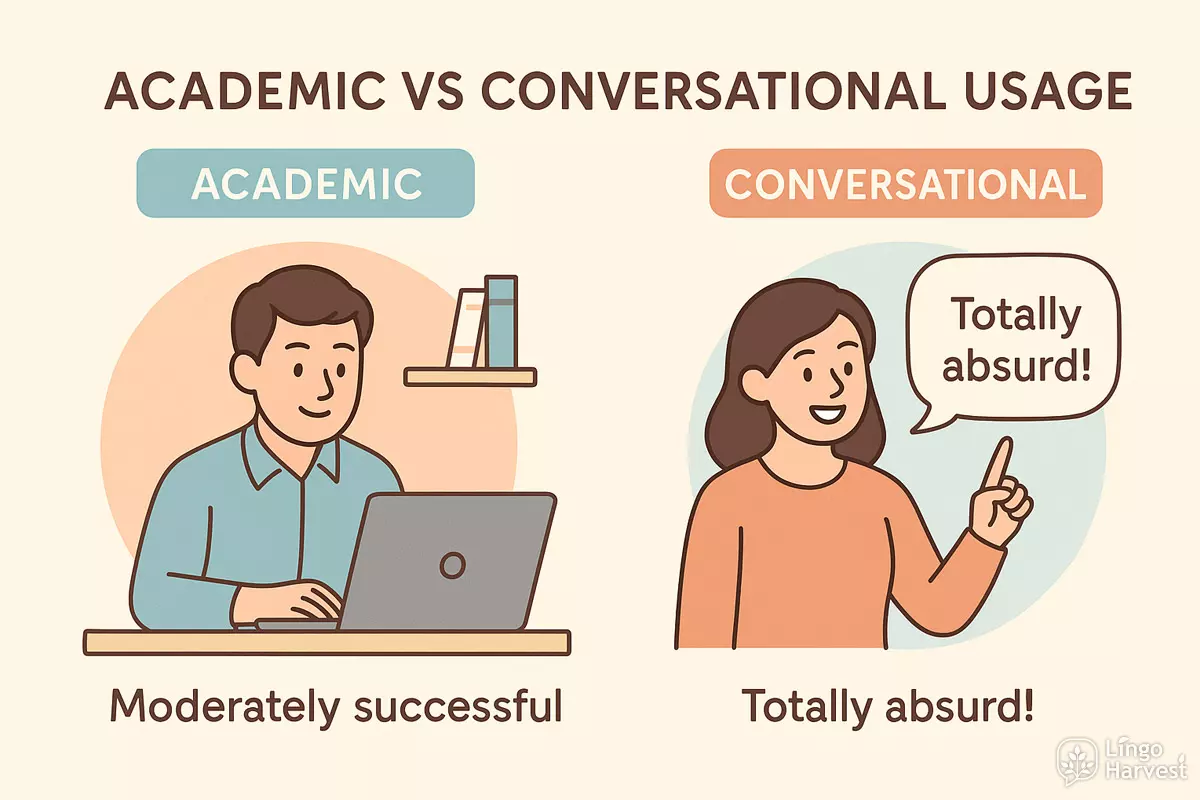
When using degree adverbs with abstract concepts, context and register make a significant difference in how these modifiers are perceived. In formal, academic writing, degree adverbs tend to be chosen for precision and subtlety. Authors often avoid informal intensifiers, opting instead for terms that convey nuanced shades of meaning. In contrast, conversational English is more flexible, frequently favoring vivid or emphatic degree adverbs to express personal attitudes or highlight subjective impressions.
Common patterns and preferences
- Academic style: typically uses adverbs like "somewhat," "considerably," "moderately," "marginally," and "predominantly" with abstract nouns (e.g., "moderately successful," "considerably influenced").
- Conversational style: often employs stronger or more colloquial adverbs such as "totally," "really," "absolutely," "incredibly," or "pretty" ("totally absurd," "really important," "pretty unlikely").
Comparing usage: examples in context
| Academic Example | Conversational Example |
|---|---|
| The results were somewhat inconclusive. | That was pretty confusing. |
| The theory is largely accepted among scholars. | People totally believe that. |
| The policy was significantly revised. | They really changed the policy. |
| The impact is relatively minor. | It's not that big a deal. |
Key considerations
- Academic contexts value clarity and restraint; overuse of emphatic adverbs can undermine objectivity.
- Everyday speech welcomes exaggeration and intensification, especially to convey emotion or personal opinion.
- Certain adverbs ("utterly," "completely," "barely") can sound awkward or out of place with some abstract terms in scholarly writing.
- Conversational English sometimes uses degree adverbs almost as discourse markers or fillers, while academic writing avoids this.
Selecting the right degree adverb for abstract concepts depends on your audience and purpose. In formal writing, choose modifiers that precisely reflect your intended meaning without overstating. In informal situations, a broader range of intensifiers is acceptable, allowing for more expressive and subjective communication.
Common pitfalls and miscollocations
Using degree adverbs with abstract concepts often leads to subtle errors, especially when learners overextend patterns from concrete language or translate directly from their native tongue. Many adverbs that intensify or weaken meaning do not fit naturally with abstract nouns or adjectives, resulting in awkward or incorrect phrasing.
Overuse and redundancy
Writers sometimes combine degree adverbs with abstract terms in a way that adds no extra meaning or is redundant. For instance, "very unique" or "completely impossible" are common, but strictly speaking, "unique" and "impossible" are absolutes and do not typically require intensification.
- Absolutely essential ❌ (often redundant; "essential" is already absolute)
- Extremely necessary ❌ ("necessary" rarely takes intensifiers)
- Highly impossible ❌ (illogical pairing)
- Very inevitable ❌ ("inevitable" is not gradable)
- Quite mandatory ❌ (unnatural collocation)
- Utterly probable ❌ ("probable" is not absolute)
- Completely satisfied ✅ (acceptable: "satisfied" is gradable)
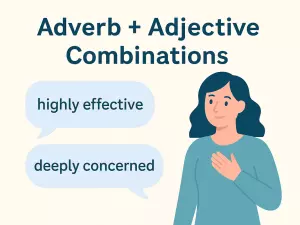
- Deeply concerned ✅ (commonly accepted)
- Highly recommended ✅ (standard collocation)
- Strongly believe ✅ (natural pairing)
Confusing gradable and ungradable adjectives
Abstract adjectives differ: some can show degrees (gradable), while others cannot (ungradable). Mixing the wrong adverb with an ungradable adjective is a frequent misstep.
| Adverb + Abstract Adjective | Acceptable? |
|---|---|
| Absolutely certain | Yes |
| Very certain | Sometimes (context-dependent) |
| Completely aware | No (awkward; use "fully aware") |
| Deeply disappointed | Yes |
| Highly impossible | No (illogical) |
| Totally acceptable | Yes |
| Extremely ideal | No (illogical; "ideal" is not gradable) |
Literal vs idiomatic usage
Abstract concepts often require idiomatic combinations. For example, "deeply regret" is idiomatic, but "strongly regret" is not. Similarly, "highly likely" is correct, but "strongly likely" is not.
- Deeply regret ✅
- Strongly regret ❌
- Highly likely ✅
- Strongly likely ❌
- Fully aware ✅
- Completely aware (less natural) ❌/→ use "fully"
- Utterly convinced ✅
- Entirely convinced ✅
- Totally unclear ✅
- Very unclear ✅
Understanding which adverbs collocate naturally with abstract terms—and which do not—is key to sounding fluent and precise. When in doubt, consult examples from authentic texts or trusted reference sources.
Practice: pair degree adverbs with abstract nouns
To master advanced combinations of degree adverbs and abstract nouns, it's helpful to see which pairings sound natural and which feel awkward. Degree adverbs like "deeply," "utterly," or "profoundly" often modify intangible qualities, feelings, or ideas. Below, you'll find a range of tasks and examples to sharpen your sense of which combinations work best, and why.
Common degree adverbs for abstract nouns
- deeply concerned
- utterly confusion
- highly importance
- profound disappointment
- strong suspicion
- completely trust
- pure joy
- total chaos
- sheer determination
- absolute certainty
- intense rivalry
- overwhelming gratitude
- considerable doubt
- barely hope
- remarkable progress
- genuine affection
- significant risk
- scarcely belief
- tremendous respect
- virtually silence
Task: Choose the best adverb-noun pair
For each item, select the most natural adverb to match the abstract noun.
- _________ relief
- _________ indifference
- _________ admiration
- _________ misunderstanding
- _________ fear
- _________ effort
- _________ support
- _________ disappointment
- _________ interest
- _________ confusion
Show answers
- great relief
- complete indifference
- genuine admiration
- total misunderstanding
- intense fear
- considerable effort
- strong support
- deep disappointment
- keen interest
- utter confusion
Comparison of degree adverbs: nuances and appropriateness
| Degree Adverb | Example with Abstract Noun | Nuance/Comment |
|---|---|---|
| utterly | utterly confusion | Extreme or total; best with negative nouns (e.g., failure, chaos) |
| profoundly | profoundly respect | Deep, serious feeling or state |
| highly | highly importance | Usually with positive qualities (e.g., skilled, regarded) |
| barely | barely hope | Minimal degree; often with hope, notice, survive |
| overwhelmingly | overwhelmingly gratitude | So strong it is difficult to resist or ignore |
Practice: create your own combinations
Try forming natural-sounding pairs using the degree adverbs and abstract nouns below. Write one phrase for each.
- Degree adverbs: fiercely, marginally, genuinely, absolutely, scarcely
- Abstract nouns: loyalty, hope, confusion, regret, enthusiasm
Show answers
- fiercely loyalty
- marginally hope
- genuinely regret
- absolutely confusion
- scarcely enthusiasm
Experimenting with these pairings will help you develop a more refined sense of which combinations are idiomatic, and which may seem unusual or forced. Consider the emotional intensity or scope each adverb imparts to the noun, and note how this affects overall meaning.