Nouns Expressing Degree and Intensity in Modern English

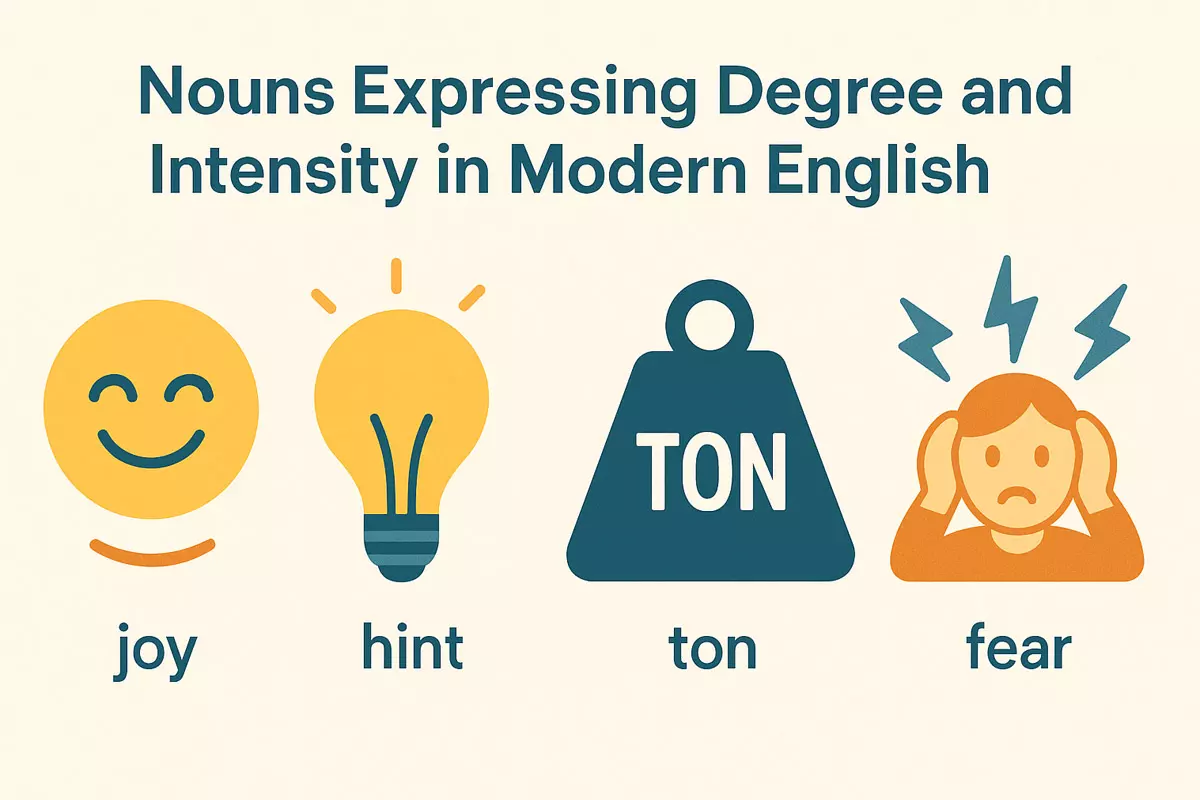 Here we how English nouns show strength and nuance, discusses common degree and intensity nouns, and explains how to use them with adjectives and verbs. It also compares formal and informal choices and points out common learner mistakes.
- How nouns express strength and level of meaning
- Common degree nouns like level, degree, and extent
- Intensity nouns used in opinion and evaluation
- Combining degree nouns with adjectives and verbs
- Formal vs informal degree noun choices
- Typical learner mistakes with intensity expressions
- Practice: strengthen or soften statements using degree nouns
Examining how English employs specific nouns and adjectives to express varying degrees or strengths of feelings and qualities reveals the language’s remarkable capacity for nuance. Through careful word choice, speakers can distinguish subtle shifts in emotion, measurement, and intensity, allowing for more precise and vivid communication. This ability not only enriches personal expression but also enhances clarity in both written and spoken language, demonstrating the flexibility and depth that characterize English vocabulary.
How nouns express strength and level of meaning
Nouns in English are not just labels for things—they often signal the intensity, amount, or degree of a quality or experience. Through careful word choice, speakers and writers can convey everything from mild suggestion to overwhelming force. For example, using "gust" instead of "breeze" instantly raises the perceived strength of the wind.
Lexical choices and nuance
Different nouns can indicate varying levels of force, size, or significance, even when describing similar concepts. Consider how the following words suggest different intensities:
- Hint vs. trace vs. sign (minimal presence)
- Amount vs. heap vs. mountain (increasing quantity)
- Tap vs. knock vs. bang (growing force)
- Murmur vs. shout vs. uproar (escalating volume)
These choices help speakers fine-tune their message, offering subtle or dramatic shades of meaning.
Common noun patterns for expressing degree
Writers often select nouns to emphasize degree through metaphor, exaggeration, or gradation. Some patterns include:
- Collective nouns: crowd, flock, army (suggesting magnitude)
- Abstract nouns: intensity, passion, fury (conveying emotional strength)
- Mass nouns: flood, torrent, deluge (implying overwhelming quantity)
- Minimizing nouns: whisper, speck, glimmer (indicating slightness)
Comparing degrees: Examples in context
Writers and speakers often choose between nouns to reflect subtle differences in degree. Here’s a structured comparison:
| Low Degree | Medium Degree | High Degree |
|---|---|---|
| drop (of rain) | shower | downpour |
| hint (of trouble) | problem | crisis |
| murmur (of sound) | chatter | clamor |
| spark (of hope) | glow | blaze |
| touch (of color) | streak | explosion |
Summary of functions
The choice of noun can clarify, intensify, or soften the message. Whether describing emotions, quantities, or actions, selecting a term with the right degree of force makes communication more precise and expressive. English offers a wide range of nouns that allow speakers to calibrate meaning with remarkable subtlety.
Common degree nouns like level, degree, and extent
The English language uses a variety of nouns to express how much or how little of something exists, occurs, or is felt. Words such as level, degree, and extent are especially frequent when discussing the intensity, quantity, or scope of an attribute or phenomenon. These nouns play a crucial role in both spoken and written communication, helping speakers to specify measurements, comparisons, and abstract qualities.
Usage in Sentences
These nouns often appear after prepositions (such as to, at, in, or by) or with determiners and adjectives that further define the amount or quality being discussed. For example:
- To a high degree of certainty
- At an advanced level of understanding
- To some extent, the problem is solvable
- By a remarkable degree of effort
- In a significant extent
Comparing Common Degree Nouns
Each of these nouns tends to highlight a slightly different nuance:
- Level – often refers to a measurable stage or rank (e.g., "oxygen level," "skill level").
- Degree – emphasizes gradation or intensity (e.g., "a degree of difficulty," "to a great degree").
- Extent – focuses on the scope or limits of something (e.g., "the extent of the damage," "to some extent").
Other Related Nouns Expressing Intensity or Quantity
While level, degree, and extent are among the most frequent, English offers several other nouns for similar functions. Here are some additional examples:
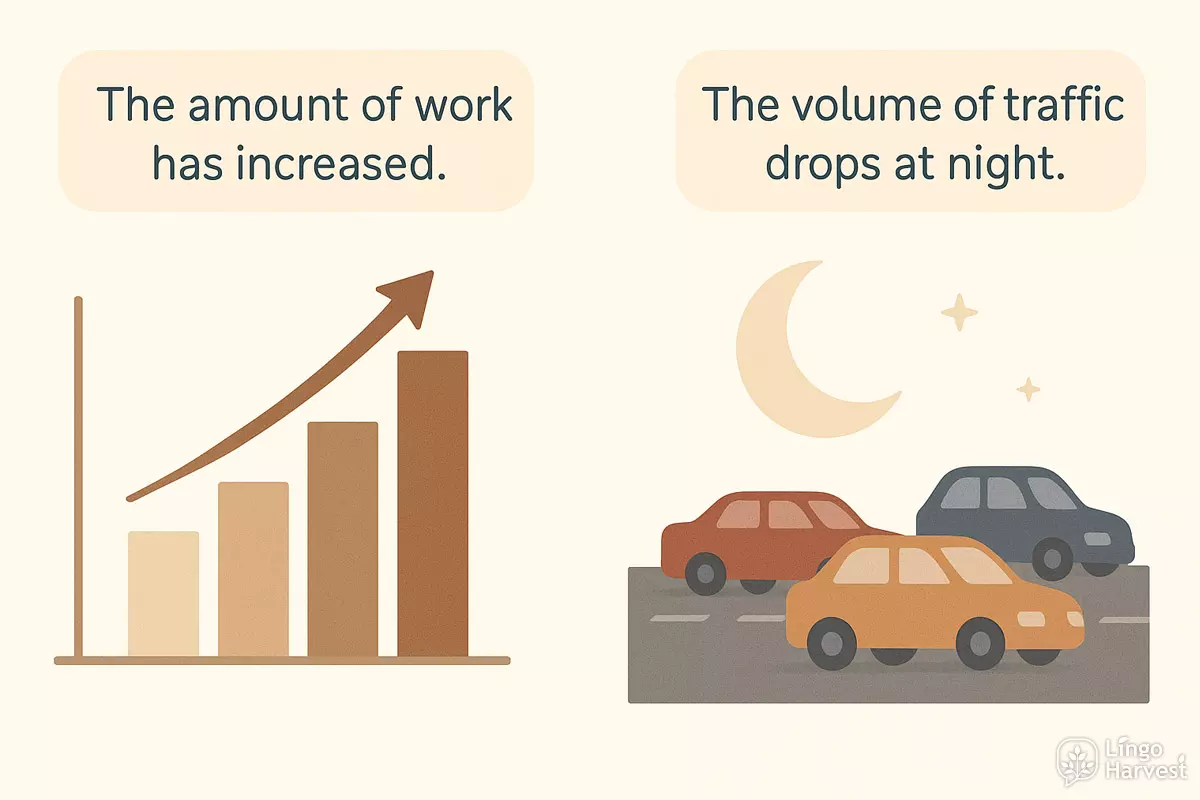
- Amount → The amount of work has increased.
- Volume → The volume of traffic drops at night.
- Magnitude → Scientists measured the magnitude of the earthquake.
- Intensity → The intensity of the storm surprised everyone.
- Proportion → A large proportion of students agreed.
- Scale → The project was large in scale.
- Concentration → High concentration is needed for this task.
- Range → The price range is reasonable.
- Frequency → The frequency of errors has decreased.
- Rate → The unemployment rate is falling.
- Quantity → The quantity of materials was limited.
- Strength → The strength of the signal is weak.
- Measure → This policy is an important measure.
- Threshold → He did not reach the required threshold.
- Limit → There is a strict limit on spending.
- Capacity → The hall has a seating capacity of 500.
- Force → The force of the impact caused damage.
- Density → Population density is high in this area.
- Ratio → The ratio of men to women is equal.
- Scope → The scope of the agreement is broad.
Patterns and Collocations
Degree nouns frequently combine with adjectives and modifiers to create precise expressions:
- High/low level
- Great/small degree
- Full/limited extent
- Considerable amount
- Significant proportion
Summary Table: Typical Contexts for Degree Nouns
| Noun | Typical Contexts / Examples |
|---|---|
| Level | Skill level, water level, noise level, energy level |
| Degree | Degree of certainty, degree of risk, to a certain degree |
| Extent | Extent of damage, to some extent, full extent |
| Amount | Amount of effort, large amount, small amount |
| Intensity | Intensity of light, intensity of feeling |
| Magnitude | Magnitude of change, order of magnitude |
| Scale | Large scale, small scale, scale of operation |
These nouns help English speakers fine-tune their descriptions, allowing for nuanced discussion of how much, how strong, or how widespread something is. Using them appropriately enhances both clarity and precision in communication.
Intensity nouns used in opinion and evaluation
Nouns that convey degree or strength often play a crucial role in expressing judgments, attitudes, and assessments in English. These words allow speakers and writers to indicate the force or extent of their opinions, making statements more precise and impactful. Instead of relying solely on adjectives or adverbs, choosing the right noun can sharpen the nuance of an evaluation.
Common nouns signaling intensity in evaluations
Writers often choose specific nouns to underscore how strongly they feel about a subject or to frame the scale of an issue. Here are several useful examples:
- Intensity → The intensity of the heat was unbearable.
- Magnitude → The magnitude of the earthquake shocked the region.
- Degree → She was surprised by the degree of support.
- Extent → The extent of the damage is still unclear.
- Severity → Doctors assessed the severity of the injury.
- Strength → The strength of the wind increased overnight.
- Force → The force of the explosion shattered windows.
- Volume → The volume of traffic dropped after midnight.
- Concentration → High concentration is required for this task.
- Impact → The policy had a major impact on small businesses.
- Weight → The weight of the package exceeded the limit.
- Depth → The depth of the water makes swimming dangerous.
- Level → Stress levels were high during the exam period.
- Amount → The amount of rainfall broke records.
- Frequency → The frequency of errors has decreased.
- Abundance → The region is known for its abundance of wildlife.
- Prevalence → The prevalence of the disease has declined.
- Significance → The discovery is of great significance.
These words are especially valuable in both formal and informal contexts, such as academic writing, reviews, and everyday conversations.
How intensity nouns shape subjective statements
Selecting a noun that reflects intensity can change the reader’s or listener’s perception of your stance. For example, "the severity of the problem" signals a more urgent concern than simply "the problem." Similarly, "the magnitude of her achievement" elevates the sense of accomplishment compared to "her achievement" alone. This subtle shift is often used to convey approval, criticism, or the perceived importance of a topic.
Patterns and collocations with evaluative intensity nouns
Certain patterns frequently appear when these nouns are used in evaluative statements. Consider the following structures:
- the degree of (certainty, influence, difficulty)
- the extent of (damage, progress, agreement)
- the level of (interest, risk, satisfaction)
- the intensity of (emotion, competition, demand)
- the severity of (criticism, punishment, symptoms)
- the magnitude of (challenge, crisis, response)
- the weight of (evidence, expectation, responsibility)
These patterns help clarify the speaker’s attitude or the scale of the subject under discussion.
Comparison of intensity nouns in evaluative contexts
Some nouns overlap in meaning but carry different nuances. The table below compares several commonly used options, highlighting how their connotations can affect the tone or emphasis of an evaluation.
| Noun | Typical Context and Nuance |
|---|---|
| Severity | Used for negative judgments, such as criticism or punishment; implies harshness or strictness |
| Magnitude | Refers to the large scale or importance of something, often neutral or positive |
| Extent | Focuses on the range or scope, can be used for both positive and negative topics |
| Intensity | Highlights the strength or forcefulness, often used with emotions, reactions, or experiences |
| Level | Describes position on a scale or continuum, frequently neutral and quantitative |
Choosing among these nouns depends on the intended shade of meaning and the overall message. By mastering their use, you can craft more nuanced and persuasive evaluations.
Combining degree nouns with adjectives and verbs
Understanding how degree nouns interact with adjectives and verbs is crucial for expressing intensity and nuance in English. Degree nouns such as "level," "degree," "amount," "extent," and "intensity" often form collocations that subtly shift or clarify the meaning of descriptive or action words. These pairings can highlight not just the existence of a quality or action, but its scale or impact.
Common patterns with adjectives
Degree nouns frequently precede or follow adjectives, creating phrases that specify the strength or scope of a characteristic. Here are some typical combinations:
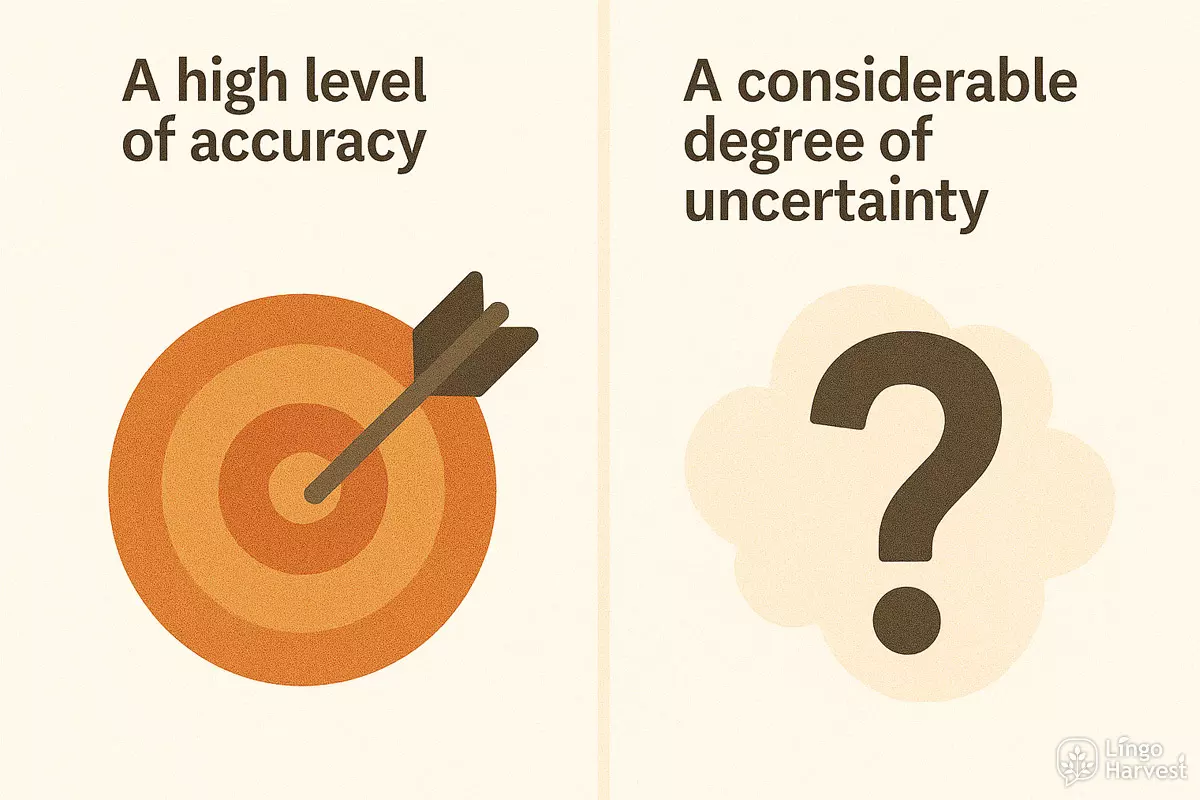
- a high level of accuracy
- a considerable degree of uncertainty
- a large amount of enthusiasm
- an extreme intensity of pain
- a minimal extent of damage
- a moderate level of risk
- a vast amount of knowledge
- a certain degree of flexibility
- a significant level of detail
- a surprising amount of creativity
- a low degree of confidence
- a remarkable intensity of emotion
- a great extent of support
- a negligible amount of effort
These constructions allow speakers and writers to fine-tune descriptions, emphasizing just how pronounced (or limited) a quality truly is.
Pairing degree nouns with verbs
Degree nouns also combine with verbs, often indicating the measurement, change, or acknowledgment of a certain intensity or quantity. Typical verbs include "increase," "reduce," "reach," "demonstrate," and "maintain." Some example phrases:
- increase the level of participation
- reduce the amount of waste
- reach a new degree of precision
- demonstrate a high intensity of effort
- maintain a certain level of performance
- achieve a considerable extent of coverage
- monitor the degree of compliance
- measure the amount of rainfall
- adjust the level of brightness
- experience a low intensity of symptoms
Comparing degree noun collocations
Some degree nouns are more commonly used with specific adjectives or verbs. For instance, "amount" is typically paired with uncountable nouns, while "number" is used with countable nouns. The following table summarizes some preferred combinations:
| Degree Noun | Typical Combinations |
|---|---|
| level | high/low/moderate level of skill, increase/maintain level, reach a level |
| degree | certain/considerable degree of certainty, achieve a degree, measure the degree |
| amount | large/small/negligible amount of information, increase/reduce amount |
| extent | great/limited extent of damage, determine/assess extent |
| intensity | high/low intensity of light, measure intensity, experience intensity |
| number | large/small number of participants, count/increase number |
Nuances and stylistic choices
Choosing the right degree noun and its modifiers impacts both clarity and tone. For formal writing, phrases like "a considerable degree of" or "a significant extent of" are typical. In everyday conversation, simpler forms such as "a lot of" or "a bit of" may replace more formal degree nouns. The context and desired emphasis determine which combinations are most effective for the message.
Formal vs informal degree noun choices
How speakers express intensity or degree often depends on context, especially when choosing between formal and informal nouns. Academic writing, professional communication, and official documents typically require more formal degree nouns, while everyday conversation or casual writing leans toward informal options.
Common patterns in formal and informal degree nouns
The distinction between formal and informal degree nouns is not only about vocabulary but also about register and nuance. Formal nouns often derive from Latin or Greek roots, lending them a more abstract or precise flavor. Informal nouns tend to be shorter, plainer, and more direct.
- Formal: magnitude, extent, intensity, abundance, deficiency, excess, proliferation, paucity, enormity, sufficiency
- Informal: lot, load, heap, ton, bunch, bit, pile, smidgen, dash, touch
Choosing the right noun for the context
Selecting between formal and informal degree nouns depends on your audience and purpose. For example, "a great deal of effort" (formal) fits a research paper, while "a ton of work" (informal) works better in a friendly email.
| Formal Example | Informal Equivalent |
|---|---|
| There was a significant increase in temperature. | There was a big jump in temperature. |
| The abundance of choices was overwhelming. | There were loads of choices. |
| She demonstrated remarkable proficiency. | She was really good at it. |
| We observed a deficiency of resources. | We didn’t have enough stuff. |
| The intensity of his reaction surprised us. | He reacted so much more than we thought. |
When to prefer one style over the other
Use formal degree nouns for clarity, precision, or when you want to sound objective. Informal nouns are best for personal stories, dialogues, or when aiming for relatability and ease. Adjusting your choice can subtly shift the tone and impact of your message.
Typical learner mistakes with intensity expressions
Many English learners find degree and intensity nouns confusing, often because their use is quite idiomatic. These nouns—such as "amount," "level," "degree," "extent," "intensity," and others—are not always interchangeable, and their collocations can be tricky. Errors often stem from direct translation, overgeneralization, or confusion between countable and uncountable forms.
Common misuse of intensity nouns
Some nouns expressing degree require specific collocations. For example, "a large amount of" works with uncountable nouns, but not with countables like "books." Learners might say "a high degree of books" or "a strong amount of rain," which are not idiomatic in English.
- Incorrect: a high level of water ❌ Correct: a high level of pollution ✅
- Incorrect: a big degree of noise ❌ Correct: a high degree of noise ✅
- Incorrect: a strong amount of support ❌ Correct: a great amount of support ✅
- Incorrect: a large number of information ❌ Correct: a large amount of information ✅
- Incorrect: a high intensity of effort ❌ Correct: a great deal of effort ✅
- Incorrect: a big extent of damage ❌ Correct: a large extent of damage ✅
- Incorrect: a strong level of interest ❌ Correct: a high level of interest ✅
- Incorrect: a great quantity of people ❌ Correct: a large number of people ✅
- Incorrect: a high number of water ❌ Correct: a large amount of water ✅
- Incorrect: a big intensity of pain ❌ Correct: a high intensity of pain ✅
Confusion between countable and uncountable nouns
Mistakes often involve using "number" with uncountables or "amount" with countables. For example, "a large number of sand" is incorrect because "sand" is uncountable.
| Expression | Is it correct? |
|---|---|
| a large amount of people | ❌ (should be "a large number of people") |
| a large number of advice | ❌ (should be "a large amount of advice") |
| a great deal of time | ✅ (correct) |
| a high degree of certainty | ✅ (correct) |
| a high amount of noise | ❌ (should be "a high level of noise" or "a large amount of noise") |
Direct translation issues
In some languages, the equivalents of "degree," "level," or "amount" are used more flexibly. When learners transfer these patterns directly, the result can sound awkward or incorrect in English. For instance, "the intensity of his happiness" is possible but unusual; "the degree of his happiness" or "the extent of his happiness" is more natural.
Summary tips for avoiding mistakes
- Check if the noun you’re describing is countable or uncountable.
- Learn common collocations: "large number of people," "great amount of work," "high level of risk," "degree of difficulty."
- Avoid mixing up the modifiers ("high," "large," "great") with incompatible nouns.
- Double-check idiomatic usage in context rather than translating word-for-word.
Understanding these patterns helps learners use intensity nouns accurately and naturally in English.
Practice: strengthen or soften statements using degree nouns
Understanding how degree nouns function lets you adjust the impact of your language. By choosing the right noun, you can make a statement more forceful or more moderate. This practice section will help you recognize and use these nouns effectively in different contexts.
Common Degree Nouns: Intensifiers and Softeners
Degree nouns modify the strength of your statements. Some amplify (intensify) meaning, while others downplay (soften) it. Here are several examples, organized by function:
- Intensifiers: abundance, flood, wealth, torrent, mountain, host, sea, array, explosion, barrage, storm, tide, avalanche, surge, deluge, wave, glut, mass, profusion, excess, outpouring
- Softeners: touch, hint, trace, drop, dash, shade, whisper, suggestion, fraction, bit, fragment, smattering, handful, trickle, pinch, particle, scrap, shadow, speck, modicum
Transforming Statements with Degree Nouns
You can make your statements more emphatic or more reserved by substituting ordinary nouns with ones expressing degree. Here are some practical tasks to develop this skill:
- Rewrite each sentence, first making it stronger and then softer by using a suitable degree noun.
a) There was interest in the new policy.
b) She showed skill during the match.
c) He made a mistake on the form.
d) The city faced opposition to the project. - Choose the best degree noun to complete each sentence:
a) The announcement triggered a _______ of reactions.
b) There was only a _______ of hope left.
c) We received a _______ of applications for the job.
d) The solution offered just a _______ of improvement.
Show answers
-
- a) Stronger: There was a flood of interest in the new policy.
Softer: There was a hint of interest in the new policy. - b) Stronger: She showed a wealth of skill during the match.
Softer: She showed a touch of skill during the match. - c) Stronger: He made a series of mistakes on the form.
Softer: He made a slip on the form. - d) Stronger: The city faced a storm of opposition to the project.
Softer: The city faced a whisper of opposition to the project.
- a) Stronger: There was a flood of interest in the new policy.
-
- a) The announcement triggered a wave of reactions.
- b) There was only a shadow of hope left.
- c) We received a host of applications for the job.
- d) The solution offered just a fraction of improvement.
Comparing Degree Nouns: Impact Spectrum
Consider how the following degree nouns change the nuance of similar statements.
| Statement | Degree Noun Used |
|---|---|
| There was enthusiasm for the idea. | surge (intensifier), touch (softener) |
| She felt regret about the decision. | torrent (intensifier), trace (softener) |
| They encountered resistance. | barrage (intensifier), hint (softener) |
| He experienced pain after the injury. | storm (intensifier), shade (softener) |
Working with degree nouns helps you fine-tune your message, whether you want to highlight intensity or show restraint. Practice using these forms in your own writing to develop a more nuanced and expressive style.