Formal and Literary Quantifiers: Tone, Context, and Usage

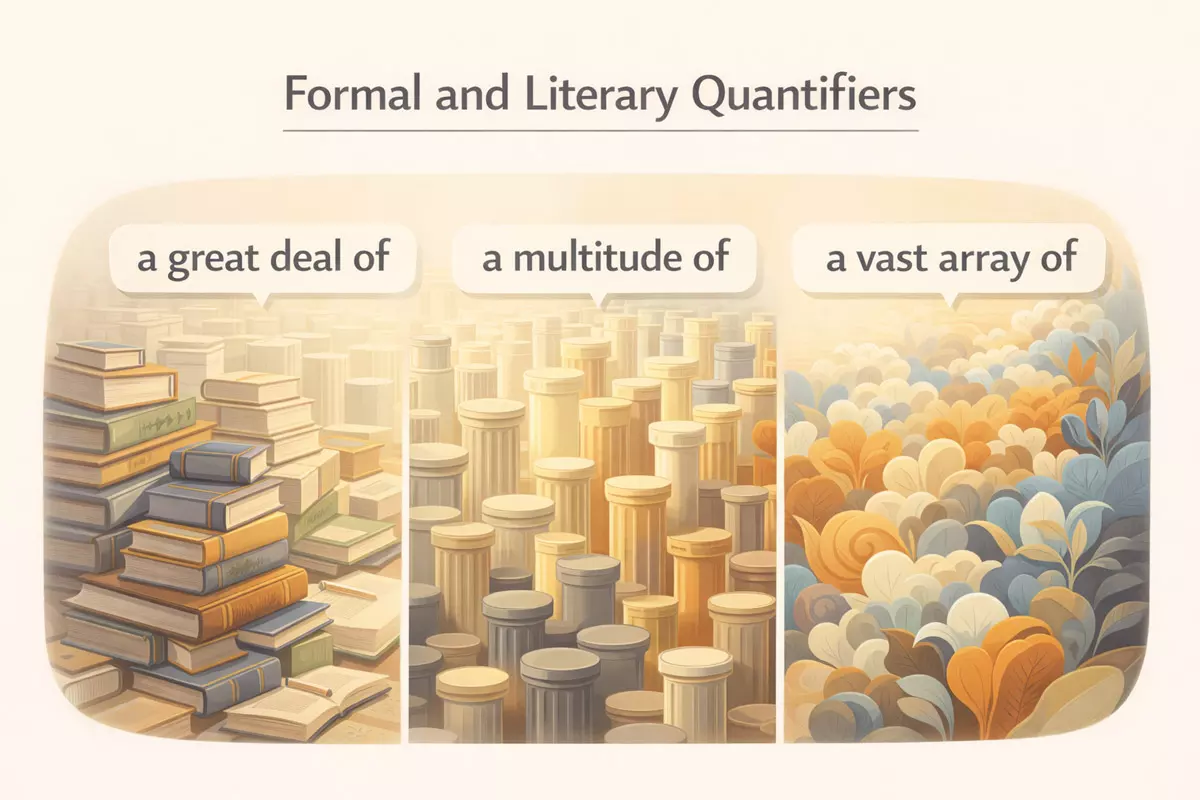 Here we what makes quantifiers formal or literary, where they are commonly used, their impact on tone, how they differ from neutral forms, frequent literary examples, risks of overuse, and offers practice on choosing the right style.
- What makes a quantifier sound formal or literary
- Typical contexts where formal quantifiers appear
- Tone and stylistic effect on the reader
- Differences between neutral and elevated usage
- Common literary-style quantifiers
- Risks of overuse in everyday writing
- Examples from formal and literary texts
- Practice: choosing the right stylistic level
Choosing between scholarly and creative language when expressing amounts or degrees can significantly affect both the tone and clarity of your writing. Scholarly terms often convey precision and formality, making them suitable for academic or professional contexts, while creative expressions can add flair and engage the reader in more informal or artistic settings. Recognizing which style fits your purpose and audience is key to ensuring your message is both appropriate and effective.
What makes a quantifier sound formal or literary
The impression of formality or literariness in quantifiers often comes down to word choice, context, and structure. Certain quantifiers are associated with elevated or traditional registers, while others sound more conversational. For instance, “much,” “many,” and “several” are neutral, but “a plethora of” or “a modicum of” signal a more refined or bookish tone.
Features That Influence Formal Tone
- Lexical rarity: Less common quantifiers, such as “myriad,” “scant,” and “abundance,” are often perceived as formal or literary.
- Historical or classical roots: Words borrowed from Latin, French, or Greek (e.g., “plethora,” “modicum,” “multitude”) tend to feel more sophisticated.
- Complexity and specificity: Multi-word expressions (“a great many,” “a considerable number of”) often raise the register of a sentence.
- Context and collocation: Placement within formal writing or alongside similarly elevated language enhances the effect.
- Absence of contractions or slang: Traditional quantifiers avoid colloquial forms, reinforcing seriousness.
Common Formal and Literary Quantifiers
- myriad → A myriad challenges remain unresolved.
- plethora → The report presents a plethora evidence supporting the theory.
- multitude → A multitude factors influence consumer behavior.
- abundance → The region is known for an abundance natural resources.
- modicum → He showed a modicum restraint during the debate.
- scant → There is scant information available on the incident.
- innumerable → The novel explores innumerable interpretations of truth.
- considerable → The project required considerable effort and time.
- ample → We were given ample opportunity to revise the proposal.
- countless → The discovery led to countless new research questions.
- an array of → The exhibition features an array of modern artworks.
- a host of → The policy change caused a host of unexpected problems.
- a wealth of → The archive contains a wealth of historical data.
- a dearth of → There is a dearth of reliable witnesses.
- scores of → Scores of applications were submitted before the deadline.
- a profusion of → The garden was filled with a profusion of colors.
- a handful of (for effect) → Only a handful of voices opposed the reform.
- no small amount → The task required no small amount of dedication.
- the greater part of → The greater part of the budget was allocated to research.
- an excess of → An excess of caution delayed the final decision.
Comparing Formal, Literary, and Neutral Quantifiers
| Neutral | Formal/Literary | Colloquial |
|---|---|---|
| many | myriad | a bunch of |
| some | modicum | a bit of |
| lots of | plethora | tons of |
| few | scant | a couple of |
| several | multitude | loads of |
Context and Appropriateness
Register matters: using elaborate quantifiers in informal contexts can sound pretentious, while plain terms in formal writing may seem blunt or underwhelming. Literary quantifiers often appear in essays, speeches, or creative works aiming for elegance or rhetorical impact. Select quantifiers that align with your intended tone, audience, and purpose to ensure clarity and stylistic harmony.
Typical contexts where formal quantifiers appear
Formal quantifiers frequently surface in writing and speech that demands precision, objectivity, or an elevated register. Their use is especially noticeable in academic, legal, and official communications, where ambiguity must be minimized. In these environments, quantifiers such as several, numerous, the majority of, and a considerable number of help clarify amounts or proportions without resorting to informal or colloquial alternatives.
Academic and scholarly writing
In research papers, theses, and dissertations, writers often rely on formal quantifiers to report data, describe trends, or discuss findings. These expressions convey impartiality and avoid the vagueness that more casual phrasing might introduce. For instance, instead of saying "a lot of participants," a researcher might write "a significant proportion of participants."
- A substantial portion of the sample
- Many studies indicate
- A minority of respondents
- The overwhelming majority
- Virtually all cases
- A limited number of trials
- Few instances were recorded
- Considerable evidence suggests
- Most observations
- Several factors contributed
- Each participant
- Every attempt
- No significant differences
- Any relevant data
Legal, bureaucratic, and official documents
Legal texts and administrative correspondence often use precise quantifiers to avoid misinterpretation. Words and phrases like all parties, each applicant, or no fewer than are common in contracts, statutes, and formal letters. Clarity in quantity or scope helps to uphold the enforceability and seriousness of such documents.
- Each party involved
- Any individual concerned
- All relevant documents
- No fewer than ten days
- The entirety of the property
- None of the above
- Several provisions apply
- Every clause
- Most sections
- Any breach thereof
Comparing formal and informal quantifiers
The distinction between formal and informal quantifiers becomes clear when comparing their tone and typical usage. Formal quantifiers are generally longer, more precise, and less likely to be ambiguous. Informal quantifiers, meanwhile, favor brevity and conversational style. The table below illustrates some common pairs:
| Formal Quantifier | Informal Equivalent |
|---|---|
| Numerous | A lot of |
| A significant number of | Plenty of |
| The majority of | Most |
| Few | Not many |
| Each | Every single |
| No fewer than | At least |
| None | Zero |
| All | Everyone |
Writers and speakers choose formal quantifiers when they need to convey authority, maintain decorum, or ensure that their statements are interpreted exactly as intended. Whether in scholarly analysis, official proclamations, or legal stipulations, these quantifiers support clarity and professionalism.
Tone and stylistic effect on the reader
Understanding how formal and literary quantifiers shape the impression of a text is crucial for both writers and readers. Formal quantifiers—such as "several," "numerous," or "a majority of"—tend to create a sense of precision and objectivity. They often appear in academic, legal, or technical settings where clarity and neutrality are prized. Literary quantifiers, in contrast, include words and phrases like "countless," "myriad," or "a sea of," which evoke imagery, emotion, and atmosphere. This difference in approach can subtly, or sometimes dramatically, alter how a passage is received.
Formality and Perceived Authority
When quantifiers are chosen for their precision, the text feels more authoritative and detached. Readers may sense a deliberate, measured tone, which can instill trust or, conversely, seem distant. Literary quantifiers, meanwhile, may draw readers in by appealing to the senses or emotions, making the prose feel more intimate or evocative.
- Formal: "A significant proportion of respondents agreed."
- Literary: "A chorus of voices rose in agreement."
- Formal: "Few exceptions were noted."
- Literary: "Hardly a soul dissented."
- Formal: "Several factors contributed."
- Literary: "A tapestry of influences shaped the outcome."
- Formal: "Only a minority opposed."
- Literary: "A mere handful stood against the tide."
- Formal: "Many participants reported satisfaction."
- Literary: "Satisfaction blossomed among the throng."
Stylistic Nuance and Reader Engagement
The choice between formal and literary quantifiers affects more than just tone; it also changes the level of engagement. Literary expressions can paint vivid mental pictures or stir feelings, while formal quantifiers help anchor the argument in logic or data. This interplay is especially important in essays, fiction, or persuasive writing, where the desired response from the audience varies.
| Quantifier Type | Stylistic Effect |
|---|---|
| Formal ("numerous," "a majority of") | Conveys precision, objectivity, and seriousness |
| Literary ("countless," "a flood of") | Evokes imagery, emotion, and immersion |
| Formal ("several," "few") | Suggests measured, factual reporting |
| Literary ("a handful of," "a sea of") | Creates mood, drama, or poetic resonance |
Context and Intended Effect
Writers select quantifiers based on their goals: to inform, to persuade, to move, or to entertain. In scientific or business documents, formal quantifiers support credibility. In creative writing, literary alternatives enhance mood and voice. Readers subconsciously respond to these cues, adjusting their expectations and emotional involvement. In summary, the strategic use of quantifiers—whether formal for clarity or literary for vividness—shapes not only the tone but also the reader's engagement and interpretation. Choosing the right style is essential for achieving the intended effect in any context.
Differences between neutral and elevated usage
Understanding how quantifiers shift between everyday and more formal or literary contexts is essential for effective writing. In casual settings, quantifiers tend to be direct and widely understood, while literary or elevated contexts often favor more elaborate or nuanced choices. This change affects the tone, register, and even the rhythm of sentences.
Common Features of Neutral Quantifiers

Neutral quantifiers are those you hear in daily conversation or read in straightforward prose. They are clear, concise, and avoid drawing attention to themselves. Their main function is to convey quantity or degree without adding stylistic weight.
- some → Some students missed the deadline.
- many → Many people prefer working remotely.
- few → Few answers were completely correct.
- all → All files must be submitted online.
- none → None of the tickets were refunded.
- several → Several issues remain unresolved.
- most → Most employees agreed with the change.
- much → There isn’t much time left.
- each → Each participant received a certificate.
- every → Every detail was carefully checked.
Characteristics of Elevated or Literary Quantifiers
Elevated quantifiers, by contrast, often evoke a specific mood, adopt rarer forms, or introduce a poetic or rhetorical tone. They are commonly used in literary, academic, or expressive writing to add emphasis or atmosphere.
- a profusion of → The garden displayed a profusion of colors.
- a wealth of → The library offers a wealth of historical sources.
- a dearth of → There was a dearth of clear guidance.
- scores of → Scores of witnesses came forward.
- legions of → Legions of fans gathered outside the stadium.
- bevy of → A bevy of reporters surrounded the speaker.
- no end of → She faced no end of difficulties.
- every last → He checked every last detail.
- not a single → Not a single word was spoken.
- an excess of → An excess of caution slowed progress.
- ample → The committee was given ample time.
- considerable → The task required considerable effort.
- scant → Only scant evidence supported the claim.
- the greater part of → The greater part of the budget was approved.
- a host of → The announcement caused a host of reactions.
- no small amount → The project demanded no small amount of patience.
- an array of → The course covers an array of topics.
- a multitude of → A multitude of factors influenced the outcome.
Direct Comparison of Usage
To highlight how these two registers differ, consider the following examples. The table below shows how the same idea can be expressed neutrally or in a more elevated, literary style.
| Neutral Expression | Elevated / Literary Expression |
|---|---|
| many people | a multitude of souls |
| very few options | scant alternatives |
| lots of problems | a host of troubles |
| almost everyone | all and sundry |
| no one | not a soul |
| many choices | a plethora of choices |
| countless times | times without number |
| all the food | the whole of the feast |
Context, Tone, and Appropriateness
Choosing between neutral and more ornate quantifiers depends on context and intent. In technical writing or conversation, neutral forms are preferred for clarity. Elevated quantifiers can enrich creative works, speeches, or essays where mood and imagery matter. Overuse of literary forms in informal settings may seem pretentious, while too much neutrality in creative writing can feel flat.
- Neutral quantifiers ✅ clarity, everyday communication, directness.
- Elevated quantifiers ✅ stylistic effect, formality, emotional resonance.
Ultimately, effective writers choose their quantifiers with an eye toward audience, genre, and the desired emotional or rhetorical impact.
Common literary-style quantifiers
Writers often draw on expressive quantifiers to evoke atmosphere, suggest ambiguity, or add color to their prose. Unlike precise formal quantifiers such as “all,” “some,” or “none,” those found in literary contexts typically lean into nuance and subjectivity. Their use can subtly shift tone, build imagery, or allow for open interpretation.
Literary quantifiers that shape mood and imagery

Fiction and essays often rely on expressive quantifiers to suggest scale, absence, or subtle presence without using exact numbers. The following forms are typical in literary contexts and help create tone, rhythm, or emotional emphasis:
- a multitude of → A multitude of memories flooded back at once.
- a dearth of → There was a dearth of warmth in his voice.
- no small number of → No small number of critics praised the novel.
- a profusion of → The hall was decorated with a profusion of lights.
- a modicum of → She spoke with a modicum of restraint.
- a wealth of → The archives contained a wealth of forgotten letters.
- an excess of → An excess of emotion overwhelmed him.
- barely any → Barely any light reached the forest floor.
- hardly a trace of → There was hardly a trace of fear in her expression.
- in short supply → Patience was in short supply that evening.
- more than enough → He had more than enough reason to leave.
- little more than → The house was little more than a ruin.
- a hint of → There was a hint of irony in his smile.
- brimming with → Her speech was brimming with confidence.
- devoid of → The landscape was devoid of color.
- a touch of → He added a touch of humor to the story.
- nothing but → The room held nothing but silence.
- rich in → The novel is rich in symbolism.
- replete with → The poem is replete with classical references.
- scarcely a → Scarcely a moment passed without interruption.
Contrasts with formal quantifiers
While literary quantifiers prioritize impression and tone, formal language often demands precision. For example, “several” might mean three to seven in everyday English, but in a poem, “several” might simply evoke a sense of more than two, leaving the actual count ambiguous. This flexibility lets authors convey mood or uncertainty, as in “a handful of stars glimmered in the dusk,” which paints a picture rather than stating a number.
| Literary Quantifier | Typical Effect or Usage |
|---|---|
| Myriad | Suggests innumerable, often used for poetic exaggeration |
| Scant | Implies insufficiency or sparsity, sometimes with a wistful tone |
| Legions of | Evokes a sense of overwhelming numbers, often applied to people or abstract entities |
| A mere | Minimizes quantity, often to highlight modesty or insignificance |
| Overflowing with | Emphasizes superabundance or emotional excess |
Writers select these quantifiers not just for meaning, but for rhythm, imagery, or tone. Choosing “a smattering of applause” instead of “some applause” immediately sets a different scene. Similarly, “not a soul” carries more atmosphere than “no one.” The right phrase can turn a simple statement into something memorable, evocative, or even ambiguous—qualities prized in literary craft.
Risks of overuse in everyday writing
Relying too heavily on formal or literary quantifiers in daily communication can unintentionally create distance or confusion. While these expressions add sophistication and nuance in the right setting, their frequent use in emails, texts, or casual notes may come across as pretentious or unclear. Readers often expect plain, direct language in informal exchanges, so ornate quantifiers can disrupt the natural flow or obscure the actual message.
Potential pitfalls of frequent use
- Ambiguity: Literary quantifiers like "a plethora of" or "myriad" may lack clear numerical meaning, leaving readers unsure about the scale involved.
- Unintended formality: Phrases such as "a modicum of" or "scarcely any" can sound overly formal for routine contexts, making the tone seem stilted.
- Obscured intent: Overly elaborate quantifiers may bury the main point, requiring readers to work harder to interpret the intended message.
- Perceived pretentiousness: Repeated use of ornate language can make the writer appear insincere or disconnected from the audience.
- Reduced clarity: Everyday readers may misinterpret or overlook the quantifier, especially if it is uncommon or archaic.
Contextual appropriateness: When less is more
Choosing the right quantifier depends on the audience and purpose. In business memos, direct terms like "many" or "few" are usually clearer than elaborate alternatives. Literary quantifiers may be better reserved for creative writing, essays, or speeches where expressive tone is required. Overuse in routine writing can undermine clarity and reader trust, especially if the language feels out of place.
Summary: Striking a balance
While sophisticated quantifiers have their place, moderation is key in everyday writing. Matching the register to the context ensures messages are both clear and relatable, fostering genuine communication rather than alienating the reader.
Examples from formal and literary texts
Writers and speakers often select specific quantifiers to match the tone and expectations of formal or literary contexts. Whether in official documents, scholarly works, or creative literature, certain phrases signal nuance, precision, or a heightened sense of style. Below are a variety of quantifiers and their typical usages, illustrating how language shifts between the formal and the literary.
Common Formal Quantifiers
- Several – “Several studies have demonstrated…”
- Numerous – “Numerous attempts were made to resolve the issue.”
- A majority of – “A majority of respondents agreed.”
- A minority of – “A minority of participants objected.”
- A considerable number of – “A considerable number of factors must be considered.”
- Few – “Few alternatives remain viable.”
- Much – “Much evidence supports this conclusion.”
- Little – “Little information is available on this topic.”
- All – “All members were present.”
- Each – “Each applicant was interviewed.”
- Every – “Every precaution was taken.”
- None – “None of the proposals succeeded.”
Literary Quantifiers and Their Effects
Literary texts often employ quantifiers for dramatic, poetic, or emotional effect, sometimes favoring less direct expressions or archaic forms.
- Myriad – “Myriad stars dotted the sky.”
- Scores of – “Scores of voices rose in song.”
- Countless – “Countless dreams vanished at dawn.”
- Not a soul – “Not a soul remained in the hall.”
- All manner of – “All manner of creatures stirred in the forest.”
- Every last – “Every last hope was extinguished.”
- No end of – “No end of troubles awaited them.”
- Nary a – “Nary a word was spoken.”
- Scarcely any – “Scarcely any light penetrated the gloom.”
- A host of – “A host of memories flooded her mind.”
- Not one – “Not one dared to move.”
Contextual Considerations
When choosing quantifiers, context is crucial. Academic writing values precision and clarity, favoring expressions like “the vast majority” or “a minority of cases.” In contrast, narrative and poetic texts often use more evocative or figurative quantifiers to shape mood and imagery. The right choice can subtly influence the reader’s perception, whether aiming for objectivity or emotional resonance.
Practice: choosing the right stylistic level
Selecting the most appropriate quantifier—whether formal, literary, or neutral—depends on tone, audience, and context. In this section, you'll have the chance to test your sense of style by matching quantifiers to various sentences and settings. Recognizing which expressions elevate your writing and which are better suited for everyday use is key to effective communication.
Task: Match the quantifier to the sentence
For each sentence, choose the quantifier or phrase that best fits the intended tone and style. Consider whether the context calls for a formal, literary, or neutral register.
- In academic writing, one should use (many / a multitude of / loads of) sources to support an argument.
- The ancient forest was home to (a lot of / innumerable / heaps of) secrets.
- She received (numerous / tons of / a plethora of) compliments on her presentation.
- During the meeting, (plenty of / a considerable number of / stacks of) ideas were discussed.
- The poet describes (countless / lots of / a good deal of) stars in the night sky.
- The report outlines (many / a significant number of / loads of) challenges facing the industry.
- The historian uncovered (a lot of / a wealth of / heaps of) evidence supporting the theory.
- The novel contains (numerous / tons of / masses of) references to classical mythology.
- The city experienced (many / a surge of / stacks of) visitors during the festival.
- The researcher reviewed (a lot of / an extensive range of / loads of) previous studies.
Show answers
- a multitude of
- innumerable
- numerous
- a considerable number of
- countless
- a significant number of
- a wealth of
- numerous
- a surge of
- an extensive range of
Common quantifiers by stylistic level
Below is a comparison of how different quantifiers typically align with formal, literary, or neutral contexts. Use this as a reference when crafting your own sentences or analyzing texts.
| Neutral | Formal | Literary |
|---|---|---|
| many | numerous | innumerable |
| a lot of | a multitude of | myriad |
| lots of | a considerable number of | countless |
| plenty of | a plethora of | legion |
| loads of | an abundance of | a sea of |
| tons of | a great deal of | swarms of |
| some | several | multitudinous |
| few | a small number of | scant |
| not much | insufficient | meagre |
| hardly any | minimal | paltry |
Quick challenge: Spot the stylistic mismatch
Identify the quantifier in each sentence that feels out of place for the context. Think about how you might rephrase it to better suit the style.
- The legal document referenced loads of statutes.
- The novel depicted a considerable number of stars twinkling in the sky.
- She described the festival as a plethora of fun.
- The academic paper relied on tons of previous research.
- The fairy tale speaks of numerous magical creatures.
- The business report mentioned a bunch of financial risks.
- The poem reflects on several endless nights.
- The scientist explained the theory using loads of examples.
- The travel blog promised a multitude of amazing experiences.
- The news article reported heaps of public complaints.
Show answers
- "loads of" is too informal for a legal context; use "numerous" or "a multitude of".
- "a considerable number of" is too formal for a literary description of stars; use "countless" or "myriad".
- "a plethora of" is too formal or technical for casual "fun"; use "lots of" or "loads of".
- "tons of" is too informal for academic writing; use "a large amount of" or "extensive".
- "numerous" is acceptable but neutral; for a fairy-tale tone, "countless" or "myriad" fits better.
- "a bunch of" is too informal for a business report; use "several" or "a number of".
- "several" weakens the poetic effect; use "endless" or "countless" for stronger imagery.
- "loads of" sounds informal in scientific explanation; use "many" or "numerous".
- "a multitude of" may sound inflated for a blog; "many" or "lots of" is more natural.
- "heaps of" is informal for news reporting; use "many" or "a large number of".
By paying attention to the subtle differences in quantifiers, you can fine-tune your writing to fit the precise context and tone you intend. Practice revising sentences and experimenting with alternatives to build stylistic flexibility and awareness.