Degree Adverbs with Abstract Concepts (highly likely, deeply rooted)

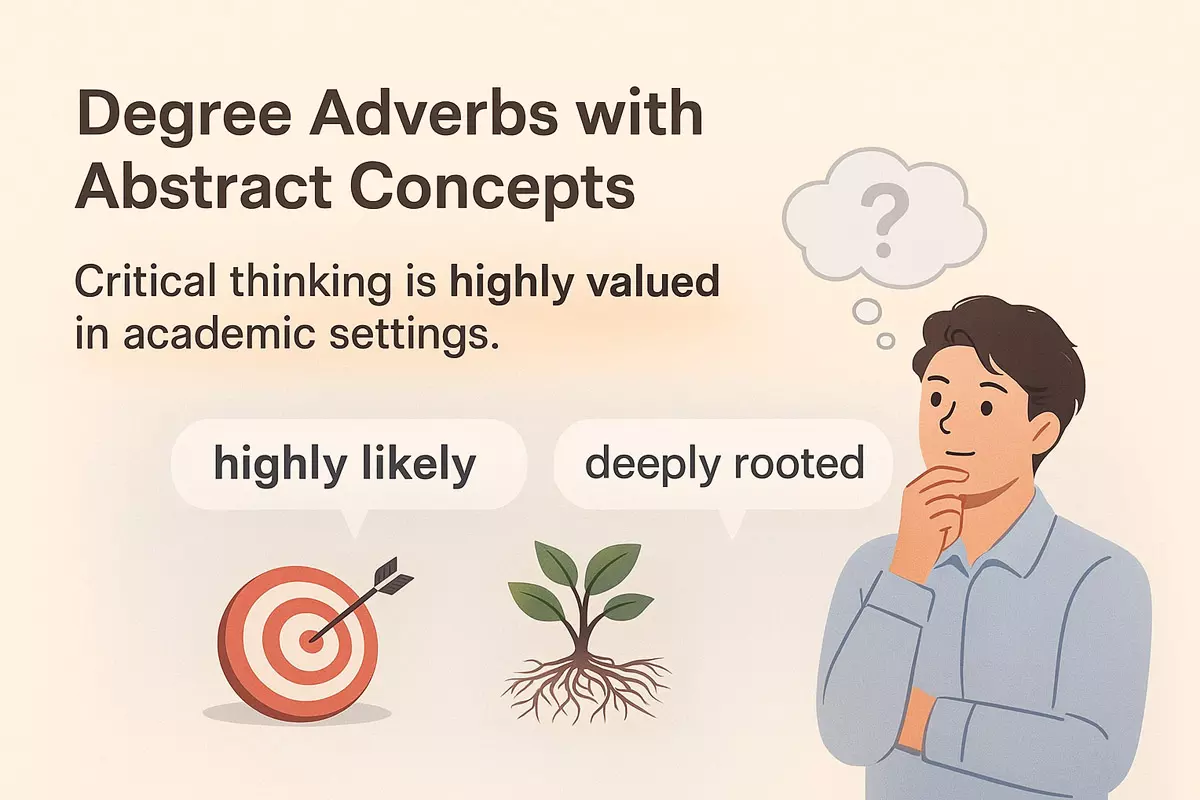 Here we how degree adverbs intensify meaning, highlights strong collocations with abstract nouns, and discusses common mistakes with very and really. It also provides academic examples and practice for selecting the best degree adverbs.
Have you ever considered how we make descriptions of intangible concepts more powerful? Using words such as highly or deeply adds emphasis to abstract ideas, allowing us to convey the intensity of emotions, convictions, or possibilities with greater precision and subtlety. These modifiers help us communicate more effectively, giving our language the ability to express not just what we think or feel, but also how strongly we experience those thoughts and feelings, making our communication richer and more nuanced.
How degree adverbs intensify meaning
Degree adverbs allow us to sharpen, soften, or otherwise adjust the force of abstract ideas in English. When we talk about things like beliefs, possibilities, emotions, or attitudes, these modifiers provide nuance. For instance, saying something is highly likely communicates a much stronger probability than simply likely.
Common Patterns with Abstract Concepts
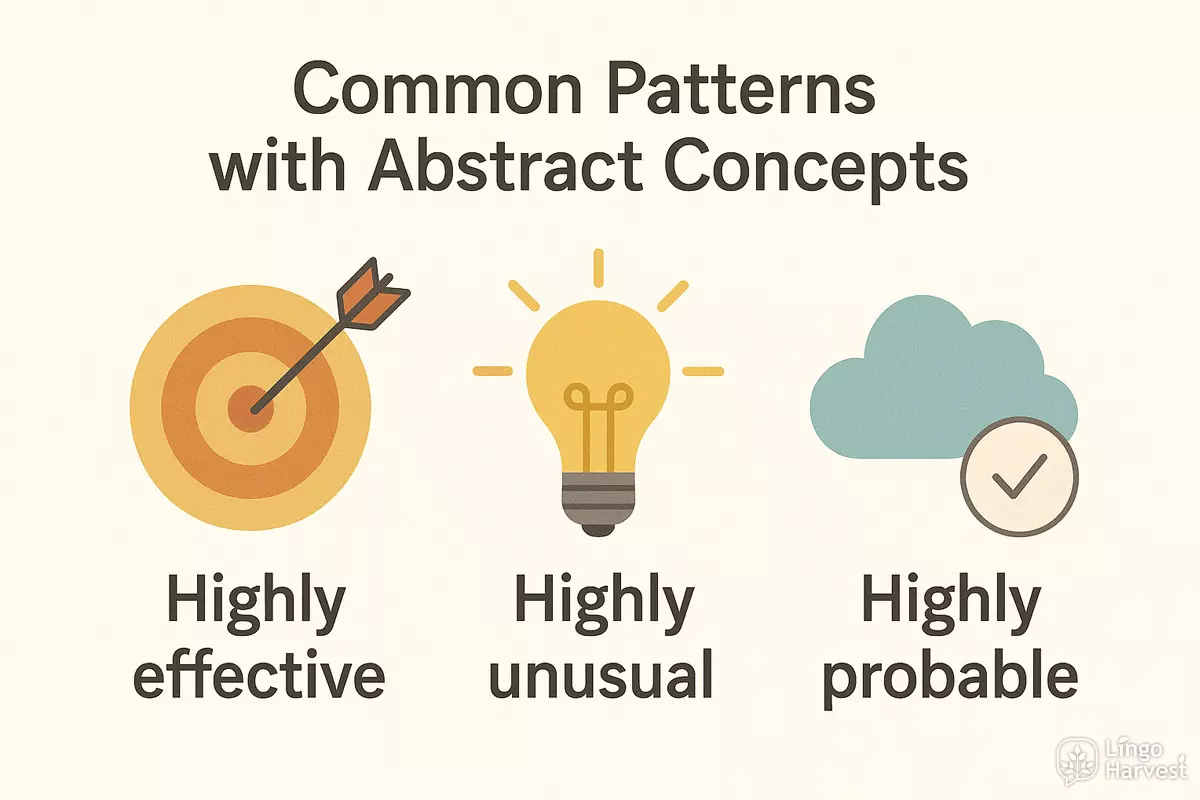
Many abstract nouns and adjectives pair naturally with particular intensifiers. These combinations often sound more idiomatic or natural than others. Here are some frequent pairings:
- highly effective, highly unusual, highly probable
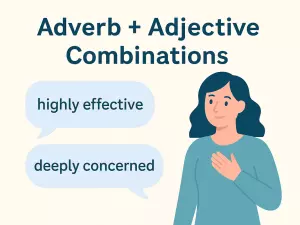
- deeply rooted, deeply concerned, deeply held (beliefs)
- strongly recommended, strongly opposed, strongly influenced
- utterly ridiculous, utterly alone, utterly impossible
- completely different, completely unaware, completely satisfied
- perfectly clear, perfectly reasonable, perfectly normal
- entirely possible, entirely dependent, entirely consistent
- purely hypothetical, purely symbolic, purely academic
- profoundly affected, profoundly grateful, profoundly mistaken
- absolutely essential, absolutely certain, absolutely necessary
How Intensity Changes the Message
The choice of adverb not only adjusts strength, but sometimes shifts the tone or emotional weight. For example, deeply concerned feels more personal and emotional than very concerned. Similarly, utterly impossible leaves no room for flexibility, while highly unlikely suggests a small chance remains.
Comparing Degrees of Intensity
| Adverb | Effect on Meaning | Example Phrase |
|---|---|---|
| highly | Strongly increases probability or intensity | highly likely |
| deeply | Adds emotional or personal depth | deeply rooted |
| utterly | Expresses totality or extremity | utterly impossible |
| completely | Signals total completeness | completely unaware |
| strongly | Emphasizes firmness or conviction | strongly recommended |
| profoundly | Highlights significant depth or seriousness | profoundly affected |
Selecting the right intensifier helps convey your attitude, certainty, or emotional investment. With abstract concepts, these choices make communication more precise and expressive.
Strong collocations with abstract nouns
When discussing degree adverbs and abstract concepts, certain adjective-noun pairings stand out as especially natural or frequent in English. These combinations are not random; they have become fixed through common usage. Words like "highly," "deeply," and "strongly" often appear with intangible ideas, emotions, or conditions, creating powerful and precise expressions.
Common Degree Adverbs with Abstract Ideas
Some adverbs are more likely to form stable, idiomatic pairings with abstract nouns. Here are examples that illustrate how native speakers intensify or specify meanings:
- highly unlikely / likely / effective / skilled / recommended
- deeply rooted / concerned / divided / respected / affected
- strongly opposed / influenced / associated / believed / encouraged
- greatly appreciated / admired / exaggerated / improved / enhanced
- utterly impossible / ridiculous / devastated / amazed / confused
- perfectly clear / reasonable / acceptable / natural / understandable
- fully aware / committed / equipped / justified / understand
- profoundly affected / grateful / disappointed / different / deaf
- completely satisfied / wrong / different / forgotten / destroyed
- totally unacceptable / dependent / convinced / unnecessary / anonymous
Patterns and Usage Tips
Many of these word combinations are predictable, but some require memorization. For example, "deeply rooted" is far more common than "highly rooted," and "utterly impossible" is preferred over "completely impossible." Using the wrong adverb can sound unnatural to fluent speakers.
| Degree Adverb | Typical Abstract Nouns/Adjectives |
|---|---|
| highly | likely, effective, skilled, recommended |
| deeply | rooted, concerned, divided, respected |
| strongly | opposed, influenced, associated, believed |
| utterly | impossible, ridiculous, devastated, amazed |
| perfectly | clear, reasonable, acceptable, understandable |
Why Some Combinations Work
The strength of these pairings comes from convention and collocational frequency. For learners and advanced writers, mastering these strong pairings improves clarity and naturalness. When in doubt, it’s helpful to check examples in context or consult reliable usage guides. In summary, selecting the right adverb with a particular abstract concept can significantly impact the tone and precision of your sentence. Recognizing these established combinations will make your English sound both more fluent and more idiomatic.
Common mistakes with very and really
People often use "very" and "really" as general intensifiers, but these adverbs are not always suitable when describing abstract concepts. Choosing the right degree adverb can make your English sound more natural and precise. For example, certain adjectives and participles—like "likely," "recommended," or "rooted"—work better with more specific intensifiers.
Why "very" and "really" may sound odd
Some abstract adjectives simply do not combine well with "very" or "really." Native speakers prefer alternatives such as "highly," "deeply," or "strongly." Using the wrong intensifier can make your speech sound unnatural or awkward. For instance, "very likely" is acceptable, but "very recommended" is not.
Typical misuses and better alternatives
- ❌ very recommended → ✅ highly recommended
- ❌ really probable → ✅ highly probable
- ❌ very unlikely (acceptable, but "highly unlikely" is preferred)
- ❌ really appreciated → ✅ greatly appreciated
- ❌ very beneficial (acceptable, but "highly beneficial" is preferred)
- ❌ really rooted → ✅ deeply rooted
- ❌ very respected → ✅ highly respected
- ❌ really influenced → ✅ strongly influenced
- ❌ very motivated → ✅ highly motivated
- ❌ very appreciated → ✅ greatly appreciated
- ❌ really recommended → ✅ highly recommended
- ❌ very skilled → ✅ highly skilled
Patterns to watch for
When using abstract adjectives or past participles, check if there is a more natural intensifier. Here are some frequent pairings:
- highly: likely, recommended, skilled, probable, unlikely, motivated
- deeply: rooted, concerned, involved, affected
- strongly: influenced, opposed, supported, linked
- greatly: appreciated, valued, admired
By choosing the right adverb, you can avoid awkward phrasing and sound more fluent. Next time you want to intensify an abstract concept, try to recall these preferred combinations.
Academic examples using degree adverbs
Writers in scholarly contexts often use intensifiers to add nuance to abstract concepts, such as probability, belief, or tradition. Degree adverbs help to precisely indicate strength, frequency, or depth when discussing intangible ideas. They are especially prevalent in research papers, literature reviews, and theoretical discussions, where subtle distinctions are critical.
Common patterns in academic writing
- highly + probability/likelihood terms: "highly probable," "highly unlikely"
- deeply + emotional or conceptual nouns: "deeply rooted," "deeply held beliefs"
- strongly + verbs of opinion or support: "strongly suggest," "strongly support"
- closely + verbs of relation: "closely related," "closely associated"
- largely + verbs of explanation: "largely attributed," "largely determined"
- particularly + adjectives: "particularly relevant," "particularly significant"
- purely + abstract nouns: "purely theoretical," "purely symbolic"
- fundamentally + adjectives: "fundamentally different," "fundamentally flawed"
- remarkably + adjectives: "remarkably consistent," "remarkably stable"
- utterly + negative adjectives: "utterly impossible," "utterly irrational"
- virtually + quantifiers: "virtually identical," "virtually nonexistent"
- relatively + comparatives: "relatively minor," "relatively stable"
- inherently + qualities: "inherently unstable," "inherently subjective"
- significantly + verbs or adjectives: "significantly affect," "significantly different"
- increasingly + adjectives: "increasingly important," "increasingly complex"
- profoundly + verbs or adjectives: "profoundly impact," "profoundly influenced"
- widely + verbs: "widely accepted," "widely recognized"
- substantially + verbs: "substantially improve," "substantially reduce"
Contrast of degree adverbs with abstract concepts
| Degree Adverb | Example in Academic Context |
|---|---|
| Highly | The outcome is highly likely given the current data. |
| Deeply | The tradition is deeply rooted in local culture. |
| Fundamentally | These theories are fundamentally different in their approach. |
| Virtually | The two samples are virtually identical in composition. |
| Strongly | The findings strongly suggest a correlation. |
| Largely | The results are largely consistent across studies. |
| Significantly | Intervention significantly improved outcomes. |
| Remarkably | The data remain remarkably stable over time. |
Using these modifiers allows researchers to convey certainty, doubt, or emphasis with precision. This careful calibration of language is essential for clarity and accuracy in academic communication.
Building advanced vocabulary combinations
When discussing abstract ideas, pairing degree adverbs with conceptual nouns or adjectives can create nuanced and precise meanings. These combinations not only enrich your language but also help you express subtle shades of certainty, intensity, or emotion. Mastering such pairings is particularly useful in academic writing, professional communication, or creative work.
Common Patterns with Degree Adverbs

Degree adverbs like "highly," "deeply," "strongly," and "utterly" are often used with abstract concepts to intensify or qualify the statement. It's important to choose the adverb that naturally collocates with the concept or adjective, as some combinations sound more natural than others.
- highly likely → It is highly likely that the meeting will be postponed.
- deeply rooted → These traditions are deeply rooted in local culture.
- strongly recommended → This book is strongly recommended for advanced learners.
- utterly convinced → She is utterly convinced that she made the right choice.
- profoundly affected → He was profoundly affected by the experience.
- acutely aware → We are acutely aware of the potential risks.
- perfectly reasonable → Your question is perfectly reasonable.
- seriously concerned → The doctors are seriously concerned about his condition.
- severely limited → Their budget is severely limited this year.
- greatly appreciated → Your help would be greatly appreciated.
- entirely dependent → The project is entirely dependent on external funding.
- fully justified → Her decision was fully justified by the results.
- genuinely surprised → I was genuinely surprised by the outcome.
- strongly opposed → Many people are strongly opposed to the new law.
- deeply disappointed → We were deeply disappointed with the service.
- highly controversial → The proposal is highly controversial among experts.
- purely hypothetical → This is a purely hypothetical example.
- completely irrelevant → That comment is completely irrelevant to the topic.
- totally unacceptable → Such behavior is totally unacceptable.
- thoroughly enjoyed → We thoroughly enjoyed our trip.
Choosing the Right Degree Adverb
Some adverbs are more compatible with certain abstract words. For example, "deeply" works well with emotions or states (deeply concerned, deeply grateful), while "highly" often modifies adjectives denoting probability or value (highly unlikely, highly beneficial).
| Degree Adverb | Typical Abstract Pairings |
|---|---|
| Highly | likely, effective, recommended, skilled, valued |
| Deeply | rooted, concerned, held, personal, disappointed |
| Utterly | impossible, ridiculous, alone, convinced, devastated |
| Strongly | opposed, supported, recommended, believe, suggest |
| Entirely | dependent, different, separate, unexpected, consistent |
Tips for Effective Use
- Always consider collocation: not all adverbs sound natural with every abstract word. - Use these pairings to specify intensity or certainty, especially in formal or persuasive texts. - Overusing intensifiers can make your writing sound exaggerated; use them for emphasis where it adds value. By experimenting with these advanced combinations, you can communicate more precisely and leave a stronger impression in both speaking and writing.
Practice: choose the best degree adverb
Understanding how to modify abstract concepts with degree adverbs is essential for expressing subtle differences in meaning. In this section, you'll find exercises and examples that focus on choosing the most suitable intensifier for a range of abstract ideas, such as likelihood, importance, or emotional states. This will help you sound more natural and precise in both writing and conversation.
Common Degree Adverbs for Abstract Concepts
The following adverbs are frequently used to modify abstract nouns or adjectives. Notice how each adds a specific nuance:
- highly likely → It is highly likely that the results will change.
- deeply rooted → These beliefs are deeply rooted in the community.
- strongly recommended → This approach is strongly recommended by experts.
- utterly convinced → She is utterly convinced that she is right.
- profoundly affected → He was profoundly affected by the news.
- closely related → The two issues are closely related.
- sharply divided → Public opinion is sharply divided on this matter.
- severely limited → Their resources are severely limited this year.
- widely accepted → This theory is widely accepted in the academic world.
- greatly appreciated → Your support is greatly appreciated.
- fully aware → We are fully aware of the potential risks.
- strongly opposed → Many people are strongly opposed to the new policy.
- deeply concerned → They are deeply concerned about climate change.
- highly unusual → The behavior was highly unusual for him.
- strongly influenced → Her decision was strongly influenced by her family.
- utterly impossible → It is utterly impossible to finish this today.
- deeply disappointed → We were deeply disappointed by the results.
- closely monitored → The situation is being closely monitored by authorities.
Choose the Most Suitable Degree Adverb
For each sentence below, pick the adverb that best completes the meaning. Think about the strength and typical collocations of each modifier.
- She was _______ affected by the news of her friend's departure.
- It is _______ likely that the event will be postponed due to weather.
- His beliefs are _______ rooted in his upbringing.
- This method is _______ recommended by health experts.
- The community is _______ divided over the proposed changes.
- Her contributions to the project were _______ appreciated.
- The two phenomena are _______ related.
- Their resources are _______ limited, so they must plan carefully.
- He is _______ aware of the risks involved.
- The findings are _______ accepted among researchers.
Show answers
- profoundly / deeply
- highly
- deeply
- strongly
- sharply
- greatly
- closely
- severely
- fully
- widely
Comparing Degree Adverbs: Usage Overview
Below is a summary of how certain degree adverbs pair with abstract concepts. This helps clarify which combinations are natural and which are less common.
| Degree Adverb | Typical Abstract Collocations |
|---|---|
| highly | likely, unusual, recommended, effective, successful |
| deeply | rooted, concerned, affected, disappointed, divided |
| strongly | recommended, opposed, influenced, suggest, believe |
| utterly | convinced, impossible, useless, alone, wrong |
| widely | accepted, used, regarded, known, recognized |
| closely | related, connected, monitored, linked, associated |
| severely | limited, damaged, affected, criticized, restricted |
| fully | aware, understand, support, recover, funded |
Reflect: Why Do These Collocations Matter?
Choosing the right degree adverb is not just about intensity; it's also about conventional usage. Certain combinations sound natural because they are established in English, while others may seem awkward or unclear. Reviewing these patterns helps you communicate more fluently and accurately, especially when discussing nuanced or abstract topics.