Adverb + Adjective Combinations (highly effective, deeply concerned)

 The article defines English collocations, focusing on typical adverb and adjective pairs. It compares strong and weak combinations, formal and informal options, and offers practice selecting the most suitable adverb for each adjective.
Pairing intensifiers with descriptive words in English can add vivid emphasis and nuance to your sentences, making your language more expressive and impactful. By choosing the right combinations, you can convey emotions or qualities with greater clarity and strength. For example, using an intensifier like “incredibly” with an adjective such as “happy” results in “incredibly happy,” which communicates a stronger feeling than “happy” alone. Mastering these word pairings helps you express yourself more precisely and adds depth to your communication.
What collocations are in English
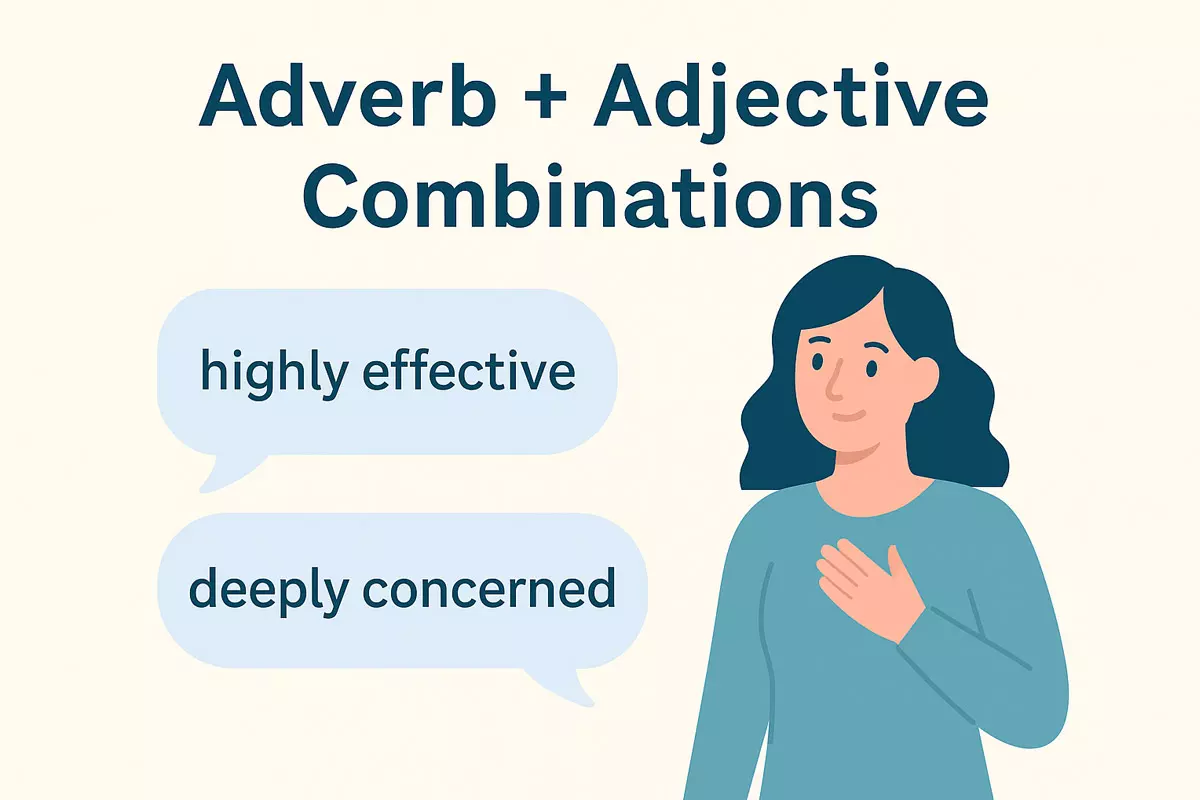
Collocations refer to words that often appear together in natural speech and writing. In English, these pairings sound “right” to native speakers, even though there might not be an obvious rule explaining why. One common type is the combination of adverbs and adjectives, such as “highly effective” or “deeply concerned.” Mastering these fixed or semi-fixed phrases helps learners use the language more fluently and naturally.
Why collocations matter
Using common word pairings makes your English smoother and easier to understand. Native speakers instantly recognize these patterns, so using them correctly avoids awkward or unnatural phrasing. For example, we say “strong coffee” but not “powerful coffee,” or “utterly ridiculous” rather than “completely ridiculous.”
Types of collocations
English includes several kinds of word partnerships:
- Adverb + Adjective (e.g., “highly unlikely”)
- Verb + Noun (e.g., “make a decision”)
- Adjective + Noun (e.g., “heavy rain”)
- Noun + Noun (e.g., “data analysis”)
- Verb + Adverb (e.g., “apologize sincerely”)
For this article, the focus is on adverb + adjective combinations, which often express intensity or degree.
Common Adverb + Adjective Collocations
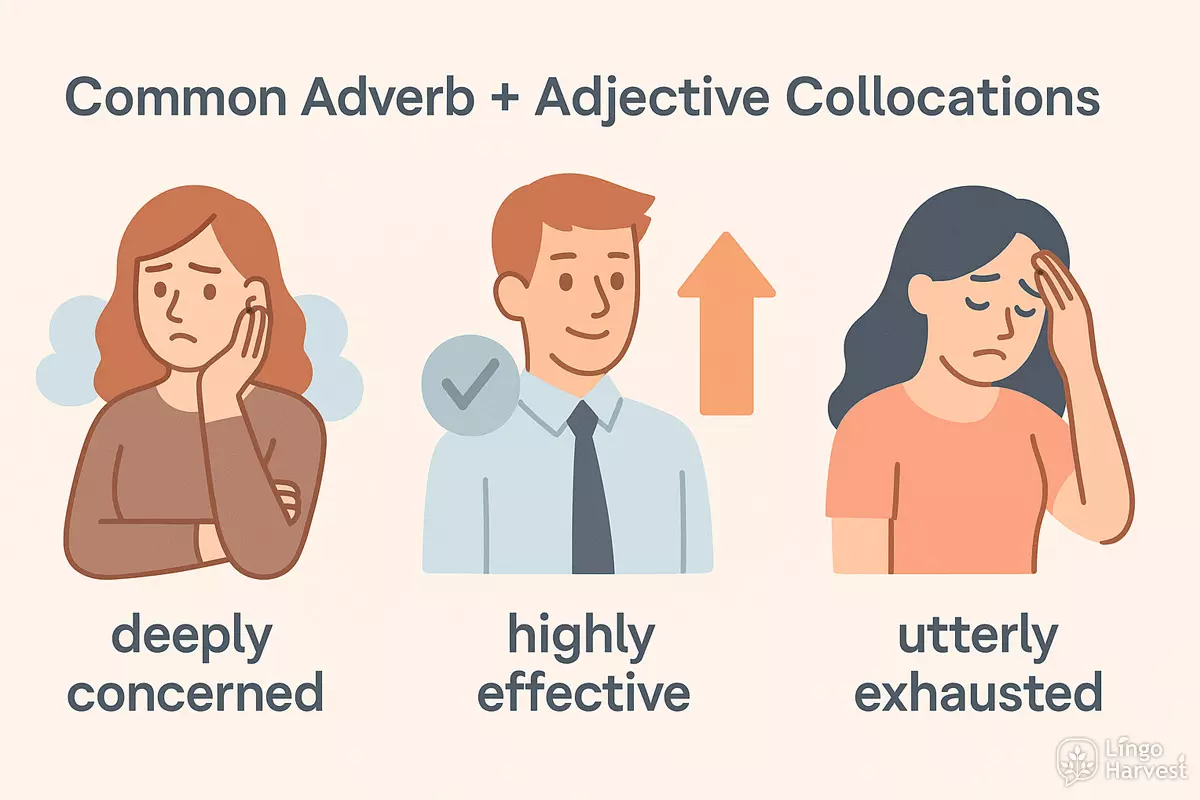
Here are some widely used adverb–adjective pairings:
- deeply concerned
- highly effective
- utterly exhausted
- strongly recommended
- perfectly clear
- completely satisfied
- totally unacceptable
- fully aware
- seriously ill
- extremely difficult
- absolutely certain
- greatly appreciated
- remarkably similar
- vastly different
- readily available
- highly unlikely
- particularly important
- deeply disappointed
- incredibly easy
- severely limited
- highly qualified
- utterly amazed
- strongly supported
- perfectly balanced
- completely wrong
- totally convinced
- seriously affected
- extremely valuable
- absolutely essential
- greatly reduced
How are these word pairs learned?
Learners usually pick up collocations through exposure—reading, listening, and practice. Dictionaries and vocabulary books sometimes highlight these pairings, but noticing them in context is key. Memorizing lists can help, but using them in real sentences makes them stick.
Typical patterns and flexibility
Some adverb–adjective combinations are almost fixed (“utterly ridiculous”), while others allow more variation (“extremely/very/quite difficult”). Overusing uncommon pairings can sound odd or unclear, so it’s best to stick with well-established patterns when possible. Recognizing which adverbs “fit” with which adjectives is an important part of sounding natural in English.
Typical adverb + adjective pairs
Knowing which adverbs combine naturally with which adjectives can help sentences sound more fluent and idiomatic. Some word pairings are used frequently in English and have come to sound “right” to native speakers, while other combinations may seem awkward or unusual. Learning common patterns makes it easier to understand and use descriptive language effectively. Many adverbs—such as “highly,” “deeply,” “utterly,” and “perfectly”—are often paired with particular adjectives to add emphasis or modify meaning. These combinations often express degree, emotion, or quality. For example, “highly effective” suggests a strong degree of effectiveness, while “deeply concerned” indicates an intense emotional state.
Common adverb + adjective combinations
Here are some widely used pairings that you’ll encounter in both spoken and written English:
- utterly ridiculous
- perfectly normal
- completely unaware
- totally different
- badly damaged
- incredibly difficult
- extremely important
- profoundly deaf
- particularly useful
- widely available
- highly efficient
- deeply rooted
- utterly pointless
- perfectly acceptable
- completely accurate
- partially correct
- greatly expanded
- severely restricted
- widely respected
- mildly surprising
Patterns and guidelines
Some adverbs tend to pair only with certain adjectives. For instance, “utterly” is rarely used with positive adjectives (e.g., you’ll hear “utterly impossible,” but not “utterly wonderful”). In contrast, “highly” is often used to intensify positive qualities, such as “highly skilled” or “highly probable.” These patterns help learners avoid awkward phrasing and sound more natural.
Summary table: Adverbs and their typical adjective partners
| Adverb | Example Adjectives |
|---|---|
| highly | effective, skilled, recommended, unlikely |
| deeply | concerned, ashamed, offended, grateful |
| utterly | ridiculous, impossible, useless, alone |
| perfectly | normal, clear, reasonable, safe |
| seriously | ill, injured, concerned, damaged |
| absolutely | certain, necessary, essential, delighted |
By noticing these frequent combinations, you’ll improve not only your vocabulary but also your sense for natural-sounding English. Practice using these pairings in your writing and speech for more precise and expressive communication.
Strong vs weak combinations
Not every adverb pairs naturally with every adjective. Some word partnerships sound natural and clear, while others feel odd or forced. Experienced speakers often know which combinations work well, but for learners, it helps to see which pairs are widely accepted and which are not.
What makes a combination “strong”?
A “strong” pairing is one that native speakers use frequently and that expresses meaning clearly. For example, highly effective or deeply concerned sound natural. These collocations have become fixed in usage, making them easy to understand and recognize.
Why are some combinations “weak”?
A “weak” pairing may be grammatically possible but is rarely used in practice. It might sound awkward or unclear: for example, very unique or completely impossible can be confusing because the adjectives themselves are already extreme. Sometimes, a weak combination results from simply matching any adverb to any adjective without considering common usage.
Examples of strong and weak adverb + adjective pairs
| Adverb + Adjective (Strong) | Adverb + Adjective (Weak or Unnatural) |
|---|---|
| highly effective | highly big |
| deeply concerned | deeply happy |
| strongly recommended | strongly blue |
| perfectly clear | perfectly angry |
| utterly ridiculous | utterly mild |
| completely different | completely tasty |
| absolutely certain | absolutely small |
| totally unacceptable | totally soft |
| seriously ill | seriously green |
| fully aware | fully tired |
Tips for choosing natural pairs
- Look for common collocations in reading and listening materials.
- Be cautious with extreme adjectives (e.g., unique, perfect); they rarely need intensifying adverbs.
- Some adverbs, like completely, utterly, or absolutely, tend to go with adjectives expressing extremes or absolutes.
- Practice with lists of natural-sounding combinations to build intuition.
Mastering these pairings helps your English sound more fluent and idiomatic. If a combination feels odd, try searching for more common alternatives.
Formal vs informal adverb + adjective choices
Understanding the difference between formal and informal adverb + adjective combinations helps you choose the right tone for your writing or speech. Some adverbs pair naturally with adjectives in professional or academic contexts, while others sound more relaxed or conversational. The distinction often depends on the strength, nuance, and tradition of each phrase.
Common Patterns in Formal Language
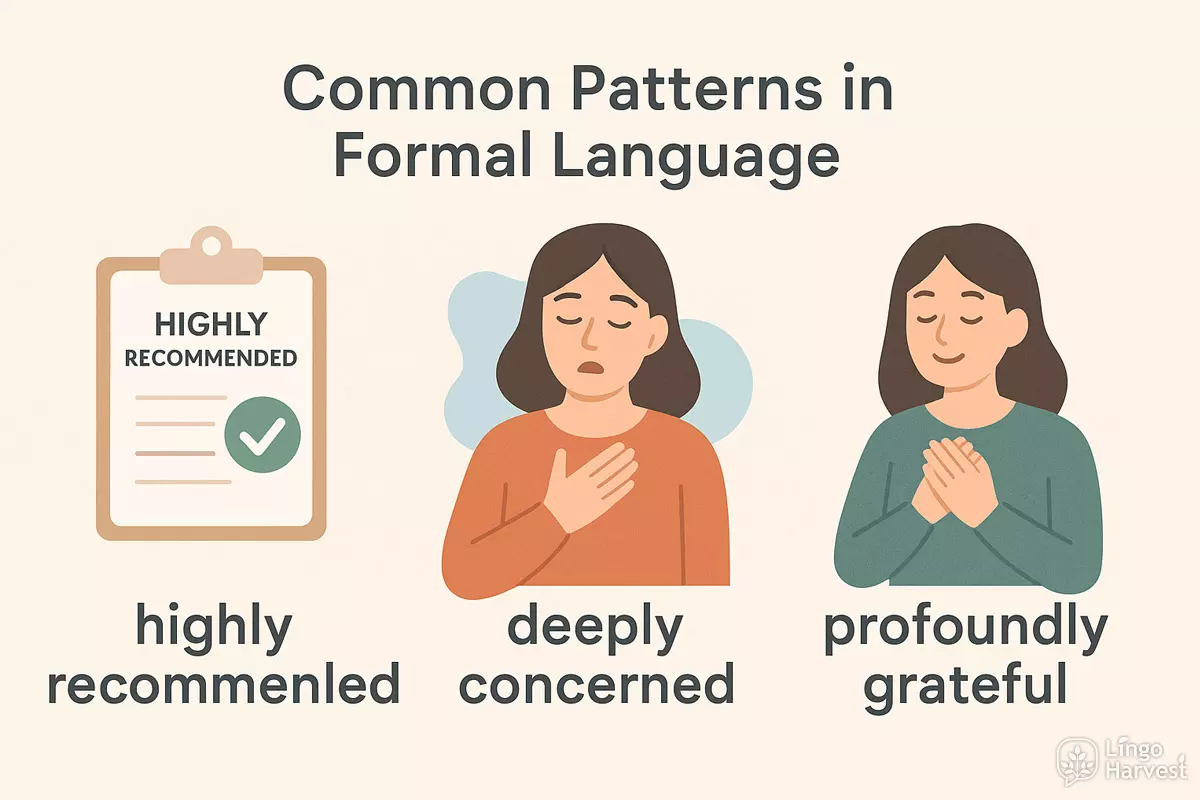
Writers and speakers often select adverbs like highly, deeply, or profoundly to intensify adjectives in more serious or official contexts. These combinations are frequently found in reports, essays, and presentations. For example:
- profoundly grateful
- closely related
- severely limited
- largely responsible
- highly consistent
- deeply meaningful
- strongly supported
- fully justified
- greatly enhanced
- sharply defined
- widely documented
- critically important
- substantially revised
- heavily regulated
These pairings are generally more precise and carry a sense of gravity or objectivity.
Informal Combinations in Everyday English
In casual conversation, people tend to use adverbs like really, pretty, or super with adjectives. These feel more spontaneous and less strict. For instance:
- really good
- pretty tired
- super excited
- totally awesome
- quite nice
- absolutely sure
- so happy
- fairly easy
- kind of strange
- just right
- really funny
- pretty cool
- super easy
- totally fine
- kind of boring
- really weird
- pretty normal
- super loud
- really sweet
- totally unexpected
These combinations tend to be less formal and are common in friendly emails, texts, or spoken English.
Direct Comparison: Formal vs Informal Examples
| Formal Combination | Informal Equivalent |
|---|---|
| highly effective | really good |
| deeply concerned | pretty worried |
| strongly recommended | totally worth it |
| greatly appreciated | super thankful |
| closely related | kind of similar |
| severely limited | really restricted |
| fully aware | totally know |
| profoundly grateful | so thankful |
| sharply critical | pretty harsh |
| largely responsible | mainly to blame |
Choosing the right adverb + adjective pairing depends on your audience and purpose. In formal writing, precise and established collocations sound more authoritative. For informal settings, relaxed combinations help you sound natural and approachable. Recognizing which phrases fit which situation will make your English clearer and more effective.
Building more natural descriptions
Choosing the right adverb and adjective pairings helps your English sound more fluent and precise. These combinations, like “highly effective” or “deeply concerned,” add subtle shades of meaning and make your writing or speech more engaging. Instead of relying on generic words, picking specific adverb + adjective sets can make your descriptions clearer and more relatable.
Why use adverb + adjective combinations?
Pairing an adverb with an adjective allows you to express intensity, degree, or manner. For example, “very important” is common, but “vitally important” or “absolutely essential” are more vivid and specific. The choice of adverb can completely change the nuance of your statement, making it more accurate or expressive.
Common patterns and examples
Some adverbs naturally fit with certain adjectives, while others sound awkward or unnatural. Here are some typical and widely accepted combinations:
- severely damaged
- greatly improved
- heavily influenced
- seriously injured
- purely hypothetical
- deeply moved
- widely recognized
- poorly organized
- distinctly possible
- highly skilled
- utterly amazed
- strongly encouraged
- perfectly accurate
- severely criticized
- greatly underestimated
- widely accepted
- heavily impacted
- seriously outdated
- purely symbolic
How to choose natural-sounding pairs
Not all adverbs work with every adjective. Some combinations are common and sound right to native speakers, while others can seem unusual or even incorrect. To help, here’s a quick comparison of natural versus awkward pairings:
| Natural Combination | Unnatural Combination |
|---|---|
| highly effective | highly big |
| deeply concerned | deeply tall |
| seriously ill | seriously blue |
| utterly amazed | utterly small |
Notice how the natural examples are commonly used in English, while the awkward ones don’t fit standard patterns. When in doubt, listen for combinations in authentic English or check reliable sources.
Tips for expanding your descriptive language
- Read widely and note which adverb + adjective pairs native speakers use.
- Practice replacing basic modifiers (like “very” or “really”) with more specific adverbs.
- When learning a new adjective, look up typical adverbs that modify it.
- Be cautious about inventing new combinations—stick with established patterns for clarity.
Experimenting with these combinations will help your English sound more natural and expressive, whether you’re writing an essay, giving a presentation, or having a conversation.
Practice: choose the best adverb for each adjective
When combining adverbs and adjectives, certain adverbs naturally fit specific adjectives. This exercise will test your understanding of which adverbs most commonly and naturally modify particular adjectives in English. Choose the most suitable adverb for each adjective below.
Match the Adverb to the Adjective
For each item, select the adverb that best collocates with the given adjective. Think about which combinations sound natural and are commonly used by native speakers.
- ________ effective
- a) highly
- b) deeply
- c) completely
- ________ concerned
- a) absolutely
- b) deeply
- c) fairly
- ________ aware
- a) strongly
- b) fully
- c) widely
- ________ successful
- a) highly
- b) strongly
- c) fairly
- ________ possible
- a) deeply
- b) absolutely
- c) highly
- ________ recommended
- a) highly
- b) fairly
- c) strongly
- ________ unlikely
- a) highly
- b) completely
- c) deeply
- ________ aware
- a) deeply
- b) fully
- c) highly
- ________ satisfied
- a) absolutely
- b) completely
- c) deeply
- ________ grateful
- a) deeply
- b) highly
- c) fairly
Useful Adverb + Adjective Pairs
Here are some common and natural adverb-adjective combinations you are likely to encounter:
- highly effective
- deeply concerned
- fully aware
- highly successful
- absolutely necessary
- completely satisfied
- strongly recommended
- perfectly clear
- utterly amazed
- genuinely surprised
- deeply grateful
- highly unlikely
- fairly common
- totally different
- vastly improved
- strongly opposed
Show answers
- highly effective
- deeply concerned
- fully aware
- highly successful
- absolutely possible
- highly recommended
- highly unlikely
- fully aware
- completely satisfied
- deeply grateful