Ambiguous Modifiers: advanced repair techniques

 Here we types of ambiguous modifiers, how to spot unclear attachment, and repair strategies such as repositioning, rephrasing, or splitting sentences. It also offers formal writing guidelines, real examples, and practice correcting modifiers.
Writers sometimes struggle when vague descriptions make their sentences difficult to understand, which can confuse readers and weaken their message. By learning effective strategies for clarifying ambiguous wording and refining sentence structure, writers can significantly improve the clarity and impact of their prose. Careful attention to word choice, sentence flow, and the overall organization of ideas helps ensure that the intended meaning is communicated clearly, making the writing more engaging and accessible to its audience.
Types of ambiguous modifiers
Ambiguity in modification arises when it’s unclear which word or phrase a modifier is meant to describe. This confusion can disrupt meaning, especially in academic or formal writing. Understanding the various forms these unclear elements can take is the first step toward correcting them.
Common categories of unclear modifiers
Writers often encounter more than one kind of modifier that causes doubt. Some are misplaced, while others are dangling or squinting, each creating its own type of confusion. Here’s a breakdown of the most frequently observed categories:
- Misplaced modifiers: Words or phrases positioned so that they seem to modify the wrong part of the sentence.
- Dangling modifiers: Phrases that do not clearly and logically refer to any word in the sentence.
- Squinting modifiers: Modifiers placed between two clauses or phrases, making it unclear which one is being described.
- Ambiguous pronoun references: Pronouns that could refer to more than one antecedent, leading to uncertainty.
- Ambiguous adverb placement: Adverbs whose location in a sentence allows multiple interpretations of what they modify.
- Elliptical modifiers: Phrases with omitted words that are necessary for clarity, resulting in potential misreading.
- Ambiguous prepositional phrases: Prepositional phrases that could logically attach to more than one part of a sentence.
- Double modifiers: Two modifiers used in succession where it’s unclear which one applies to which word.
- Vague quantifiers: Words like “many,” “some,” or “few” that lack a clear reference point in context.
- Unclear comparative structures: Comparisons that do not specify what is being compared, leaving the meaning open to interpretation.
Examples and analysis

To clarify how each type functions in practice, consider these sample sentences and the confusion they can cause:
- Misplaced: She nearly drove her kids to school every day. (Did she almost drive, or did she drive almost every day?)
- Dangling: Walking through the park, the flowers were blooming. (Who is walking?)
- Squinting: Students who study rarely get good grades. (Does “rarely” modify “study” or “get”?)
- Ambiguous pronoun: John told Mark that he needed help. (Who needed help?)
- Ambiguous adverb: Only she said she loved him. (Did only she say it, or did she only say it?)
- Elliptical: While running, the rain started. (Who was running?)
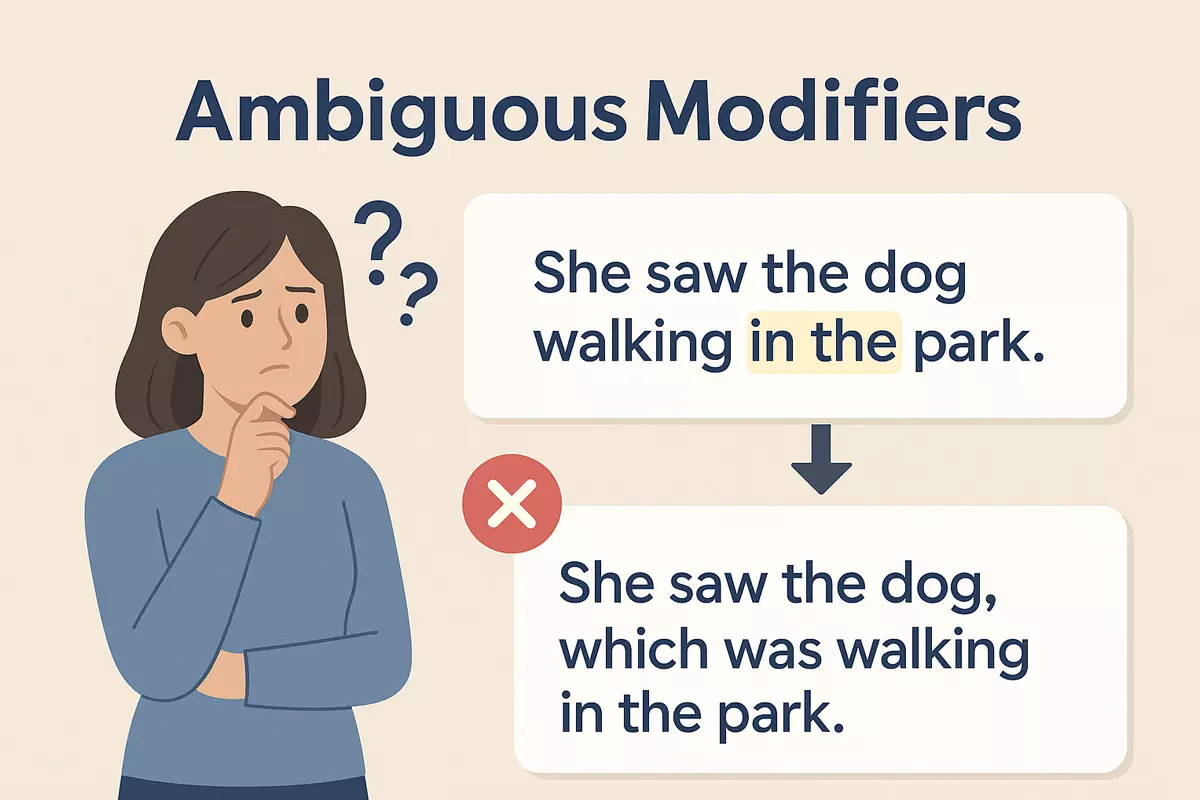
- Ambiguous prepositional phrase: I saw the man with the telescope. (Who has the telescope?)
- Double modifier: Quickly approaching the station sign, the train slowed. (Is the train or the sign approaching?)
- Vague quantifier: Some reports were reviewed yesterday. (Which reports?)
- Unclear comparative: Her essay was better than Tom. (Better than Tom’s essay or than Tom himself?)
Summary comparison
| Type of Modifier | Typical Ambiguity |
|---|---|
| Misplaced | Modifier appears to describe the wrong word or phrase |
| Dangling | No clear subject for the modifier to describe |
| Squinting | Modifier could attach to either of two parts of the sentence |
| Ambiguous pronoun | Pronoun has multiple possible antecedents |
| Ambiguous adverb | Adverb’s placement changes the sentence’s meaning |
| Elliptical | Omitted words create uncertainty about meaning |
| Ambiguous prepositional phrase | Phrase could modify more than one element |
| Double modifier | Unclear which modifier goes with which word |
| Vague quantifier | Lacks a clear reference in the sentence |
| Unclear comparative | Comparison target is not specified |
Recognizing these patterns helps writers spot trouble before it confuses readers. Each category demands a specific repair strategy, so a nuanced understanding of these structures is essential for advanced editing.
Spotting unclear attachment
Ambiguous modifiers can slip into writing unnoticed, causing confusion about which word or phrase they are intended to modify. Recognizing these unclear connections is essential for clarity. Often, sentences with modifiers placed too far from their targets or nestled among other possible referents create uncertainty for the reader.
Common signals of ambiguous modification
Writers can look for specific patterns that frequently result in unclear attachment:
- Introductory phrases with multiple possible referents
- Modifiers separated from their targets by intervening clauses
- Adjectives or adverbs placed in a position where more than one word could be modified
- Participial phrases not immediately following the noun they describe
- Prepositional phrases at the end of sentences
- Dangling modifiers lacking a clear subject
- Multiple nouns clustered together before a modifier
- Relative clauses that could refer to more than one antecedent
- Ambiguous pronouns used as modifiers
- Elliptical constructions omitting essential context
- Adverbs placed between auxiliary and main verbs
- Sentences with stacked modifiers at the beginning or end
- Appositive phrases without clear linkage
- Use of "which," "that," or "who" after several possible nouns
- Comparative or superlative forms with unclear scope
- Sentences beginning with "While," "After," or "When" without an explicit subject
- Modifiers following a comma but not adjacent to their target
- Infinitive phrases with unclear actors
Examples: When attachment is uncertain
Ambiguity often arises in sentences where the reader must guess what the modifier applies to. Consider the following:
- Running quickly, the finish line seemed to get closer. (Who is running?)
- She saw the man with the telescope. (Who has the telescope?)
- He only gave her a dollar. (What is "only" modifying?)
- The students discussed the results in the library. (Where did the discussion or the results occur?)
Comparing clear vs. ambiguous modifier attachment
Below is a structured comparison of sentences with ambiguous and clarified modifier placement:
| Ambiguous Example | Clear Revision |
|---|---|
| Walking down the street, the trees looked beautiful. | Walking down the street, I thought the trees looked beautiful. |
| She served sandwiches to the children on paper plates. | She served sandwiches on paper plates to the children. |
| I saw the dog with one eye. | With one eye, I saw the dog. or I saw the one-eyed dog. |
| They discussed the proposal in the meeting room. | In the meeting room, they discussed the proposal. |
Tips for identifying potential confusion
To catch ambiguous attachment, try reading sentences aloud, pausing to ask: “What exactly is being modified?” Rewriting sentences to move modifiers closer to their intended targets, or specifying nouns more precisely, can help. Peer review and reading work after a break may also reveal unclear connections that were missed during drafting.
Repair strategies: reposition, rephrase, split
When a modifier in a sentence causes ambiguity, clarity can often be restored by changing its place, wording, or the sentence structure itself. These techniques are essential for advanced writers and editors who want to ensure that their meaning is unmistakable. Let’s explore how to address ambiguous modifiers using three principal methods.
Repositioning: Moving Modifiers for Clarity
Sometimes, a misplaced modifier leads to confusion about what is being described. By shifting it closer to the word or phrase it modifies, you can eliminate doubt and sharpen your message. Consider these ways to reposition:
- Place descriptive phrases directly before or after the noun they explain.
- Move time expressions to the start or end of a sentence for emphasis.
- Ensure limiting modifiers like “only” or “almost” are adjacent to the term they affect.
- Shift adverbial modifiers away from subjects to clarify which verb they modify.
- Reorder participial phrases so they are unmistakably linked to the right noun.
Rephrasing: Choosing New Words or Structures
If moving words isn't enough, changing how the information is presented can resolve ambiguity. Rephrasing involves selecting clearer vocabulary or reconstructing the sentence:
- Replace vague modifiers with precise adjectives or adverbs.
- Convert ambiguous phrases into relative clauses (e.g., “who was running quickly”).
- Use prepositional phrases to specify relationships (“in the morning” vs. “by morning”).
- Switch from passive to active voice to clarify the actor.
- Break up long strings of modifiers with punctuation or conjunctions.
Splitting: Breaking Sentences to Remove Ambiguity
Complex sentences with multiple modifiers often benefit from being split into two or more simpler statements. This method works especially well when a single sentence tries to say too much at once.
- Divide long sentences so each statement contains only one modifier.
- Separate descriptive elements into their own clauses for emphasis.
- Use coordinating conjunctions to make relationships explicit.
- Clarify chronology by assigning each event its own sentence.
- Isolate parenthetical information to prevent confusion with the main idea.
Comparing Strategies in Practice
The table below illustrates how each technique can resolve ambiguity in real examples:
| Original Sentence | Ambiguity | Repaired Example | Technique |
|---|---|---|---|
| She saw the man with the telescope. | Who has the telescope? | She used the telescope to see the man. | Rephrase |
| Only John said he would help. | Who is “only” modifying? | John only said he would help. | Reposition |
| Running quickly, the dog chased the ball and the cat ran away. | Who is running quickly? | The dog chased the ball quickly. The cat ran away. | Split |
| I almost drove my sister to school every day. | Did I drive her or almost do it? | I drove my sister to school almost every day. | Reposition |
| He promised to call her yesterday. | When did he promise? When did he call? | Yesterday, he promised to call her. | Reposition |
| The teacher gave a book to the student with the red cover. | Which has the red cover? | The teacher gave a book with a red cover to the student. | Rephrase |
| Flying above the city, the lights fascinated us. | What was flying? | As we flew above the city, we were fascinated by the lights. | Rephrase |
| He nearly drove for eight hours a day. | How long did he drive? | He drove for nearly eight hours a day. | Reposition |
Formal writing guidelines
Precision and clarity are essential in academic and professional prose, especially when repairing ambiguous modifiers. Writers should focus on eliminating confusion by structuring sentences so that each modifier clearly refers to its intended word or phrase. Consistently applying these strategies helps maintain credibility and readability in formal contexts.
Principles for Resolving Ambiguous Modifiers
Writers can use several strategies to clarify meaning and avoid misinterpretation. Here are some widely recognized techniques:
- Place modifiers as close as possible to the words they modify.
- Revise sentences to eliminate misplaced or dangling modifiers.
- Use active voice when possible to clarify agency.
- Break complex sentences into shorter, simpler statements.
- Rely on parallel structure to reinforce intended relationships.
- Introduce clarifying phrases (e.g., "who," "which," "that").
- Use commas to set off introductory or nonrestrictive modifiers appropriately.
- Replace ambiguous pronouns with explicit nouns.
- Favor specific over general terms when context could be unclear.
- Review sentences aloud to catch unintended meanings.
- Solicit peer feedback to identify possible ambiguities.
- Employ transition words or phrases for smoother flow.
- Be consistent with tense and point of view.
- Limit sentence length to prevent modifier confusion.
- Use passive constructions cautiously and only when the agent is unimportant or unknown.
- Apply style guides (APA, MLA, Chicago) for discipline-specific conventions.
- Edit for conciseness without sacrificing necessary detail.
- Check for hidden modifiers in compound or complex sentences.
Common Ambiguous Modifier Types and Repair Methods
| Type of Modifier | Repair Technique | Example (Before → After) |
|---|---|---|
| Misplaced Modifier | Move modifier next to target word | She served sandwiches to the children on paper plates → She served the children sandwiches on paper plates. |
| Dangling Modifier | Add subject to clarify agent | Running down the street, the backpack fell off. → Running down the street, I dropped my backpack. |
| Squinting Modifier | Rephrase sentence for clarity | Students who study rarely succeed. → Students who rarely study succeed. |
| Ambiguous Pronoun Reference | Replace pronoun with noun | When Jim met Tom, he was happy. → When Jim met Tom, Jim was happy. |
Checklist for Academic and Professional Contexts
Before finalizing formal documents, consider the following:
- ✅ Have all modifiers been placed near their targets?
- ✅ Are introductory phrases clearly linked to the subject?
- ✅ Do all pronouns have clear, unambiguous antecedents?
- ✅ Are sentences concise but complete in meaning?
- ✅ Has the document been reviewed for unintended double meanings?
Attention to these details ensures the message is communicated accurately and professionally, minimizing the risk of misinterpretation in formal writing.
Examples from real texts
Ambiguous modifiers can cause confusion or unintended humor in writing, especially in academic, journalistic, or technical contexts. Looking at actual sentences from published materials helps clarify how these constructions function and how they might be clarified.
Common patterns that create confusion
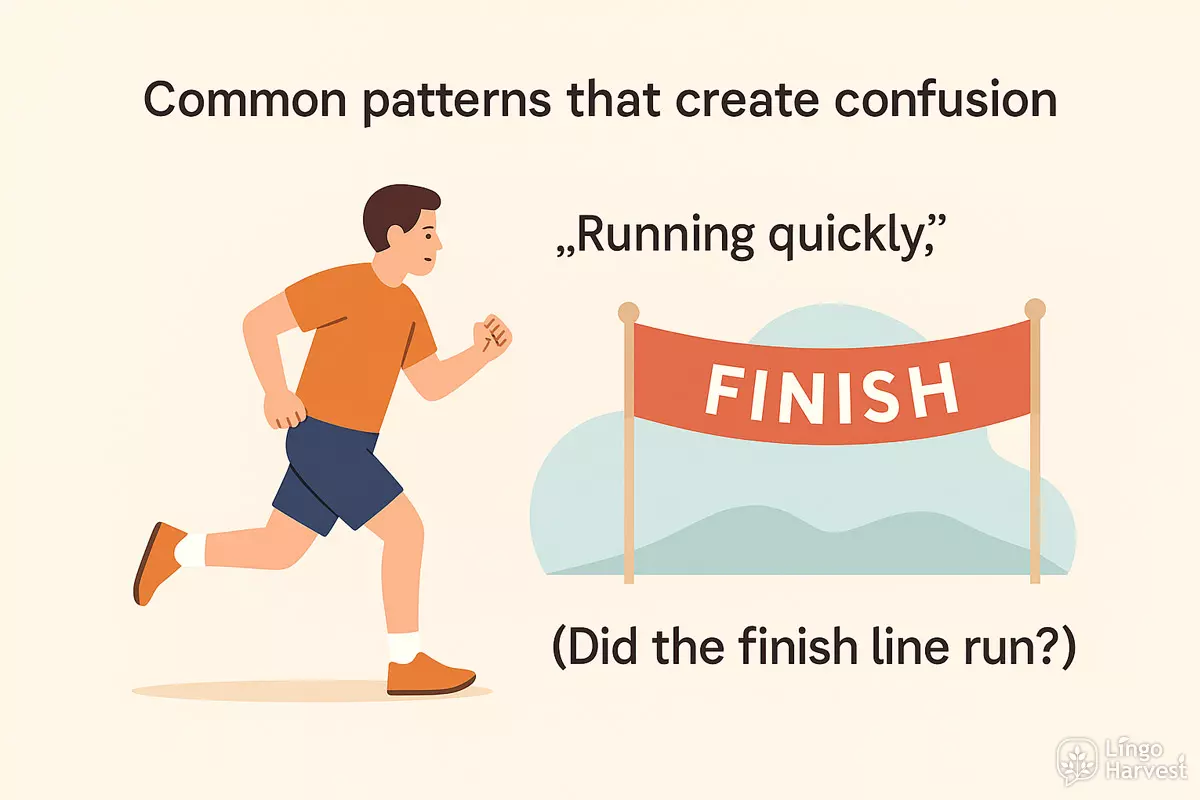
Writers often unintentionally misplace modifying phrases, leading to unclear or misleading interpretations. Here are several real-world examples with brief notes on how ambiguity arises:
- "Running quickly, the finish line seemed to approach faster."
(Did the finish line run?) - "She nearly drove her kids to school every day."
(Did she almost drive, or did she drive them almost every day?) - "I saw the man with the telescope."
(Who has the telescope?) - "Covered in syrup, John enjoyed the pancakes."
(Was John covered in syrup?) - "We served sandwiches to the children on paper plates."
(Are the children on plates?) - "Only John said he was wrong."
(Did John alone speak, or did he only say he was wrong?) - "To improve her results, the experiment was repeated."
(Who wanted to improve?) - "Barking loudly, the mailman avoided the dog."
(Who barked?) - "He told his friend when he left he would call."
(Who left?) - "Listening to loud music slowly gives me a headache."
(Does the music play slowly or does the headache develop slowly?) - "Flying over the city, the skyscrapers looked beautiful."
(Are skyscrapers flying?) - "Walking down the street, the wallet was found."
(Did the wallet walk?) - "After eating the dog food, the vet said the dog was fine."
(Who ate?) - "She saw a man on a hill with binoculars."
(Who had binoculars?) - "The patient was referred to a psychiatrist with severe depression."
(Who is depressed?)
Before-and-after comparisons
Advanced repair techniques often involve rephrasing, repositioning modifiers, or clarifying referents. See how ambiguity is resolved in the following cases:
| Ambiguous Sentence | Clarified Version |
|---|---|
| While walking in the park, the flowers were beautiful. | While walking in the park, I thought the flowers were beautiful. |
| Reading the book, the plot was confusing. | While I was reading the book, I found the plot confusing. |
| He served soup to the children in bowls. | He served soup in bowls to the children. |
| Almost everyone ate all the cookies. | Everyone ate almost all the cookies. |
| Hiking the trail, the birds chirped loudly. | As we hiked the trail, we heard birds chirping loudly. |
By analyzing these authentic examples, writers can better recognize unclear modifiers and apply targeted strategies to clarify meaning.
Practice: correct ambiguous modifiers
Ambiguous modifiers can cause confusion in sentences, making it unclear which word or phrase they are intended to modify. To develop mastery in editing such ambiguities, it’s useful to review examples, identify the source of confusion, and practice rewriting sentences for clarity.
Common Patterns of Ambiguous Modifiers
- Misplaced modifiers (where the modifier is too far from the word it’s meant to describe)
- Dangling modifiers (where the word being modified is missing or unclear)
- Squinting modifiers (where a modifier could modify words before or after it)
Identify and Revise: Sentences with Ambiguous Modifiers
Read each sentence and rewrite it to eliminate ambiguity. Focus on reordering words or clarifying references.
- Walking down the street, the wallet was found by Anna.
- She almost drove her kids to school every day.
- They offered cookies to the children wrapped in foil.
- Only Jane said she could help with the project.
- Reading the instructions carefully improves your results.
- He promised to call her yesterday.
- We saw a man on a hill with a telescope.
- After eating, the plates were cleared from the table.
- She served sandwiches to the boys on paper plates.
- Running quickly improves your stamina.
Show answers
- While Anna was walking down the street, she found the wallet.
- She drove her kids to school almost every day.
- They offered cookies, which were wrapped in foil, to the children.
- Jane was the only one who said she could help with the project.
- If you read the instructions carefully, your results will improve.
- He promised yesterday that he would call her.
- Using a telescope, we saw a man on a hill.
- After we ate, we cleared the plates from the table.
- She served the boys sandwiches on paper plates.
- If you run quickly, your stamina will improve.
Quick Reference: How to Clarify Modifiers
| Ambiguous Version | Clear Version |
|---|---|
| Hiking the trail, the birds chirped loudly. | As we hiked the trail, we heard birds chirping loudly. |
| He nearly watched the whole movie. | He watched nearly the whole movie. |
| The man saw the dog with binoculars. | The man used binoculars to see the dog. |
| She told her friend while baking the cake was difficult. | While baking, she told her friend the cake was difficult. |
| While reading the book, the phone rang. | While I was reading the book, the phone rang. |
Tips for Repairing Ambiguous Modifiers
- Place the modifier next to the word it describes for clarity.
- If the subject is missing, add it to avoid dangling modifiers.
- Rewrite sentences to specify who or what is performing the action.
- Be cautious with words like "only," "almost," and "just"—their placement changes meaning.
- Read sentences aloud to check if the intended meaning is clear.
Regular practice with these techniques sharpens your editing skills and helps ensure your writing is precise and unambiguous.