Master Test: Adjectives & Adverbs in Academic and Professional English

 Here we advanced adjective and adverb exercises, challenging adverb placement, and C1–C2 level error correction. It also includes sentence rewriting for tone, mini-passage editing, and a comprehensive final test.
Effective communication in academic and professional environments depends on your ability to describe and refine ideas with precision. This article invites you to assess your skill in using descriptive and modifying language to enhance clarity and impact in your writing. By practicing the careful selection of words that convey specific meanings and nuances, you can greatly improve the effectiveness of your written communication, making your arguments more persuasive and your messages more easily understood by your audience.
Mixed advanced adjective tasks
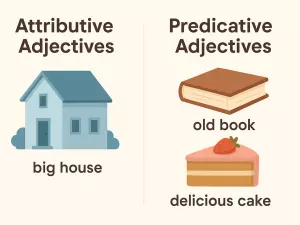
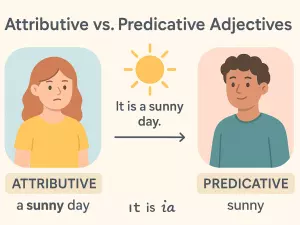
In academic and professional contexts, adjectives often perform specialized functions, from precise description to subtle evaluation. Mastering their use requires more than knowing the basics; it involves understanding gradability, collocation, and the distinction between attributive and predicative positions. Below, you’ll find a variety of advanced exercises and examples designed to test and expand your command of adjectives in complex English.
Challenging adjective collocations
Some adjectives naturally pair with specific nouns or take on different meanings depending on context. Choose the most suitable adjective for each phrase:
- ________ evidence (compelling / loud / circular)
- ________ consequences (unintended / edible / diverse)
- ________ agreement (unanimous / conditional / edible)
- ________ demand (overwhelming / edible / conditional)
- ________ debate (heated / edible / conditional)
- ________ improvement (significant / tasty / conditional)
- ________ analysis (thorough / spicy / fragile)
- ________ progress (steady / crunchy / irrelevant)
- ________ results (conclusive / sweet / inflatable)
- ________ solution (practical / sugary / vague)
Show answers
- compelling evidence
- unintended consequences
- unanimous agreement
- overwhelming demand
- heated debate
- significant improvement
- thorough analysis
- steady progress
- conclusive results
- practical solution
Comparative and superlative paradigms
Advanced English frequently requires forming comparatives and superlatives of irregular or multi-syllable adjectives. Review the table below for some challenging forms and their correct usage:
| Base Adjective | Comparative | Superlative | Example Sentence |
|---|---|---|---|
| complex | more complex | most complex | This is the most complex theory in the field. |
| far | farther / further | farthest / furthest | Her research went further than anyone expected. |
| little | less | least | He had the least experience among the candidates. |
| efficient | more efficient | most efficient | This method is more efficient than the previous one. |
| good | better | best | Her analysis was the best presented. |
Identify gradable vs. ungradable adjectives
Adjectives can be gradable (having degrees—e.g., very cold) or ungradable/absolute (e.g., unique, perfect). Classify the following as gradable (G) or ungradable (U):
- essential
- efficient
- impossible
- reliable
- unique
- comfortable
- fatal
- obvious
- critical
- useful
Show answers
- essential – U
- efficient – G
- impossible – U
- reliable – G
- unique – U
- comfortable – G
- fatal – U
- obvious – G
- critical – U
- useful – G
Adjectives before and after nouns
Some adjectives change meaning depending on whether they appear before or after the noun. Match the position with the correct meaning in these phrases:
- concerned students / students concerned
- present members / members present
- involved parties / parties involved
- available data / data available
- required documents / documents required
- mentioned topics / topics mentioned
- selected candidates / candidates selected
- invited guests / guests invited
- missing files / files missing
- remaining questions / questions remaining
Show answers
- concerned students = worried students; students concerned = the students who are involved in the matter
- present members = members who are here now; members present = the members who are here (formal listing)
- involved parties = parties taking part; parties involved = the parties that are included or affected
- available data = data that exists to use; data available = the data that is accessible now
- required documents = documents that must be provided; documents required = the documents that are needed (formal)
- mentioned topics = topics already referred to; topics mentioned = the topics that were listed
- selected candidates = chosen candidates; candidates selected = the candidates that were chosen (formal listing)
- invited guests = guests who received invitations; guests invited = the guests who were invited (emphasis on action)
- missing files = files that are not found; files missing = the files that are absent
- remaining questions = questions that are still left; questions remaining = the questions that are still unresolved
Advanced adjective usage: error correction
Review the sentences below. One adjective is misused in each. Rewrite the sentence with the correct adjective.
- The results were more perfect than expected.
- She made a very fatal mistake.
- This is the most unique solution we have seen.
- His explanation was extremely essential.
- The task became more impossible every minute.
- They reached a completely unanimous decision.
- This method is highly indispensable.
- Her behavior was very outrageous.
- The problem is absolutely minor.
- The conclusion is totally obvious.
Show answers
- The results were perfect / better than expected.
- She made a fatal mistake.
- This is a unique solution we have seen.
- His explanation was essential.
- The task seemed impossible.
- They reached a unanimous decision.
- This method is indispensable.
- Her behavior was outrageous.
- The problem is minor.
- The conclusion is obvious.
By practicing with nuanced adjective forms and their correct contexts, you strengthen your ability to write and analyze texts at a professional or scholarly level.
Complex adverb placement problems
Adverbs often seem straightforward, but in academic and professional English, their positioning can affect clarity, emphasis, or even meaning. Unlike adjectives, which nearly always precede the noun they modify, adverbs can appear in several places within a sentence—sometimes with subtle differences in nuance. This section explores frequent areas of confusion and provides guidance to help you make informed choices about where to place adverbs for maximum precision.
Common trouble spots in adverb placement
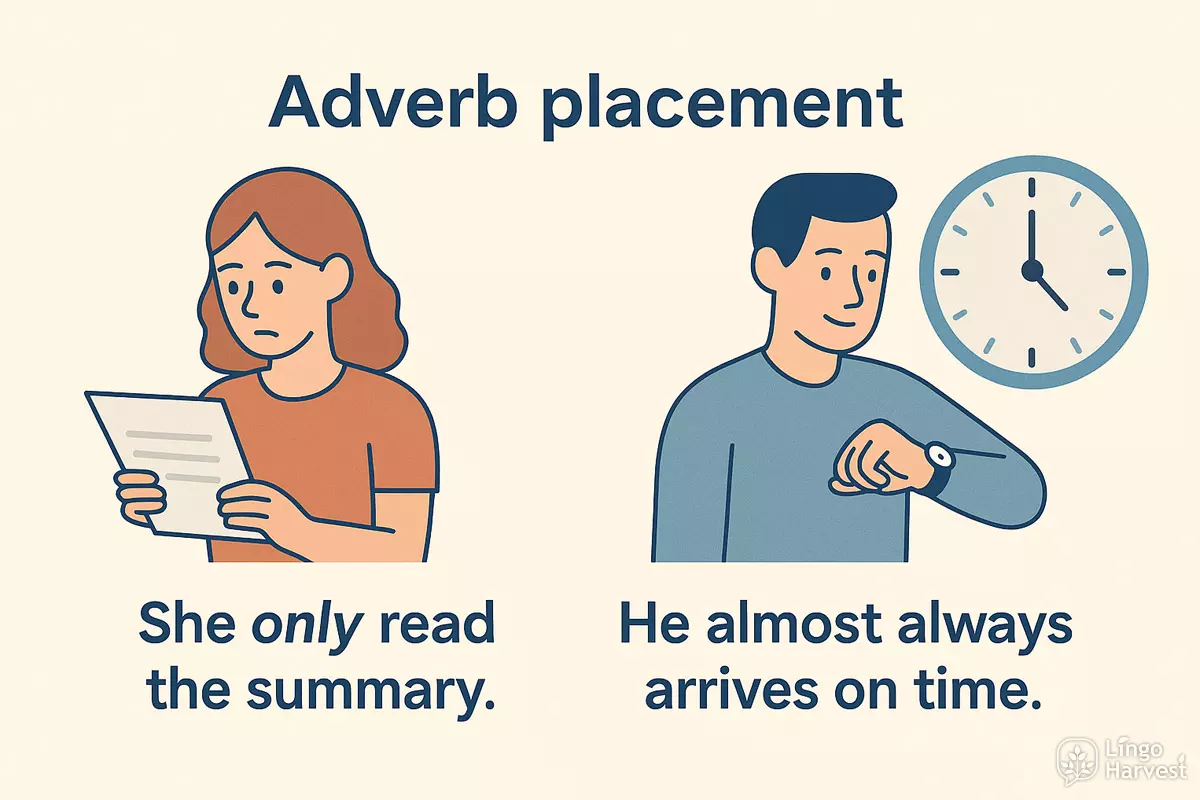
Writers frequently misplace adverbs when using compound verbs, negative structures, or when modifying entire clauses. Consider the distinction between “only,” “even,” or “just,” which can drastically alter the sense of a sentence depending on their position.
- She only read the summary. (She did not do anything else with the summary.)
- She read only the summary. (She did not read anything else.)
- He almost always arrives on time. (Frequency adverbs like “always,” “usually,” and “often” typically go before the main verb.)
- They have never been to Canada.
- The results clearly demonstrate a trend.
- We will soon announce the winners.
- She quickly finished the assignment.
- He has just completed the report.
- It was recently discovered.
- Unfortunately, the proposal was rejected.
- They probably won’t attend the meeting.
- The study was thoroughly reviewed.
Adverbs in multi-word verb phrases
Placement becomes more challenging with auxiliary verbs, modal verbs, and passive structures. The following table illustrates typical positions for adverbs in relation to these verbs:
| Verb Construction | Correct Adverb Placement |
|---|---|
| Main verb only | He quickly agreed. She often writes reports. |
| Auxiliary + main verb | They have already left. She is always prepared. |
| Modal + main verb | You should never ignore feedback. He might possibly join us. |
| Passive voice | The data was carefully analyzed. The proposal was recently approved. |
Special focus: Sentence adverbs
Adverbs that modify the entire sentence (such as “fortunately,” “regrettably,” “ideally,” or “surprisingly”) most often appear at the beginning, but can also be placed mid-sentence for stylistic variety. Their placement can subtly influence the tone and focus of your statement.
- Ideally, the experiment should be repeated.
- Surprisingly, few participants objected.
- The results, interestingly, contradict previous research.
Mastering these patterns is vital for academic and business contexts, where precise adverb positioning ensures your intended meaning is communicated without ambiguity.
Error correction at C1–C2
At advanced levels, refining the use of adjectives and adverbs is crucial for clarity and precision in academic or professional writing. Learners often make subtle mistakes that can undermine the sophistication of their English. Addressing these errors involves recognizing patterns typical at upper-intermediate and advanced stages, and applying targeted strategies for improvement.
Common Issues with Adjectives and Adverbs
- Confusing adjective and adverb forms (e.g., quick vs. quickly).
- Incorrect placement of adverbs within sentences.
- Overusing intensifiers, such as “very” or “really”.
- Misusing comparatives and superlatives (e.g., more better).
- Using adjectives with verbs that require adverbs (e.g., He spoke loud instead of loudly).
- Mixing up gradable and ungradable adjectives (e.g., very unique).
- Forgetting to use hyphens in compound adjectives (e.g., well known author instead of well-known author).
- Misplacing adverbs of frequency or degree.
- Choosing overly informal adverbs/adjectives in formal contexts.
- Relying on basic vocabulary instead of more precise alternatives.
Strategies for Accurate Usage
Focusing on context and collocation helps learners avoid common pitfalls. Reading model texts and noting how modifiers are used in academic journals or professional documents can reinforce correct structures. Additionally, self-editing with error checklists is effective for identifying subtle mistakes.
Examples: Typical Mistakes and Corrections
| Incorrect Usage | Corrected Version |
|---|---|
| The results are highly significant improved. | The results are highly significantly improved. |
| She performed exceptional in the interview. | She performed exceptionally in the interview. |
| This is the most best solution. | This is the best solution. |
| The conference was wonderfully organized event. | The conference was a wonderfully organized event. |
| He is absolutely tired. | He is absolutely exhausted. (Use with ungradable adjectives) |
Checklist for Self-Correction
- ✅ Double-check adjective/adverb forms after verbs.
- ✅ Review modifier placement in complex sentences.
- ✅ Replace generic words with more specific or academic alternatives.
- ✅ Ensure intensifiers match the gradability of the adjective.
- ✅ Use hyphens in compound adjectives before nouns.
Consistent review and attention to detail are essential for mastering modifiers at C1 and C2. Integrating feedback from peers or instructors further sharpens accuracy and style in both academic and professional communication.
Sentence rewriting for tone
Adjusting sentences for tone is a crucial skill in academic and professional English. The choice and placement of adjectives and adverbs can subtly change how a message is received—making it sound more formal, objective, diplomatic, or even persuasive. When revising your writing, consider how modifiers affect the impression your sentences make.
Why tone matters in academic and professional writing
Academic and workplace communication often requires a balanced, respectful, and clear tone. Overly strong adjectives or adverbs can make arguments appear biased, while weak or vague modifiers may reduce the impact of your message. By thoughtfully rewriting sentences, you can better align your writing with the expectations of your audience.
Common strategies for adjusting tone
- Soften claims by using adverbs like “generally,” “often,” or “potentially.”
- Increase formality by replacing casual adjectives with more precise or academic alternatives.
- Express caution with adverbs such as “apparently,” “seemingly,” or “reportedly.”
- Show objectivity by minimizing subjective adjectives (“good,” “bad”) and focusing on measurable qualities.
- Use hedging language to avoid overgeneralization (“may be,” “could indicate”).
- Emphasize strength with adverbs like “significantly,” “notably,” or “considerably” when evidence supports it.
- Use neutral vocabulary to avoid sounding emotional or biased.
- Clarify frequency or likelihood with adverbs such as “rarely,” “frequently,” or “occasionally.”
- Maintain professionalism by avoiding slang or overly informal modifiers.
- Balance positive and negative descriptors for fair and nuanced statements.
Examples: Rewriting sentences for different tones
| Original Sentence | Rewritten for Academic/Professional Tone |
|---|---|
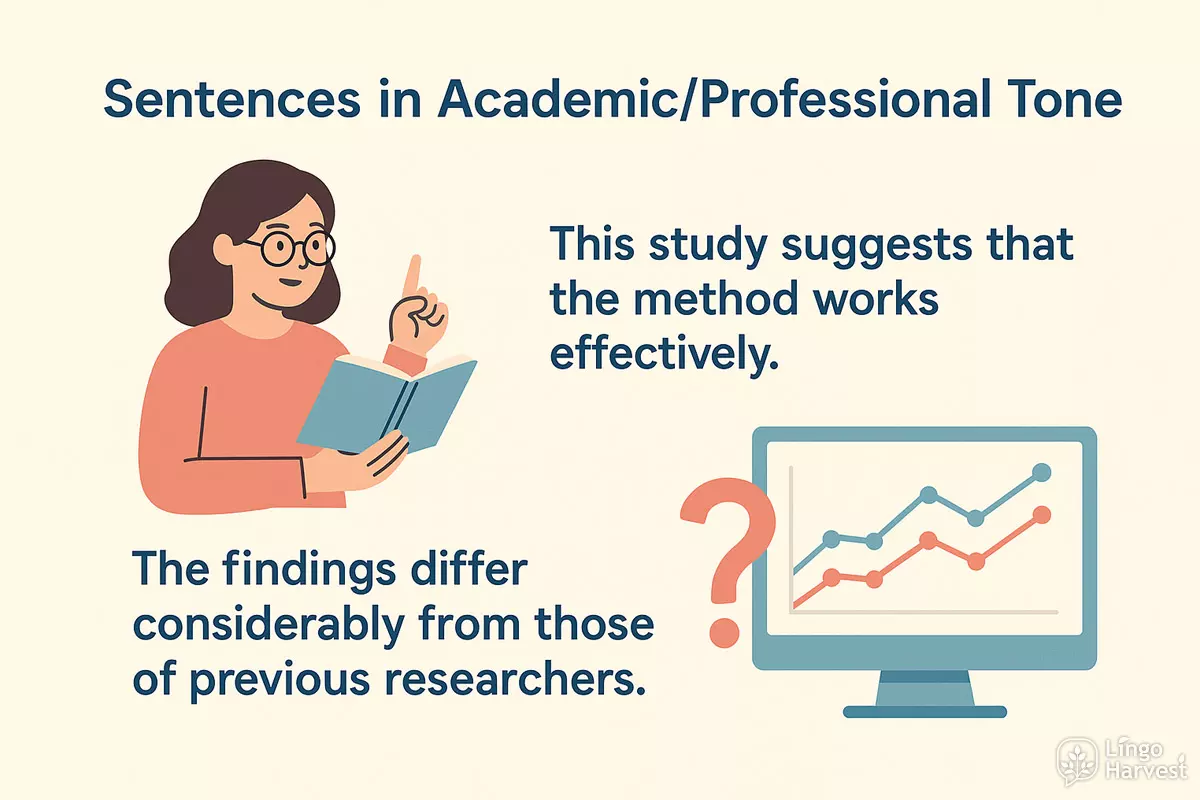
| This study proves that the method works perfectly. | This study suggests that the method works effectively. |
| We totally disagree with the previous researchers. | The findings differ considerably from those of previous researchers. |
| The results are really surprising. | The results are notably unexpected. |
| There were a lot of mistakes in the experiment. | Numerous errors were observed during the experiment. |
| Obviously, this solution is better. | This solution appears to be more effective. |
Tips for effective tone adjustment
- Read your sentences aloud to check for unintended emphasis or bias.
- Ask whether each adjective or adverb adds clarity or simply exaggerates.
- Replace emotionally charged words with factual or neutral alternatives.
- When in doubt, prioritize clarity and precision over embellishment.
By carefully selecting and revising your modifiers, you can ensure your writing is both appropriate and effective for academic or professional contexts.
Mini-passage editing
Refining short texts is a practical way to master the distinction between adjectives and adverbs, especially in formal or academic writing. When reviewing a passage, pay close attention to words that describe nouns (adjectives) and those that modify verbs, adjectives, or other adverbs (adverbs). Often, errors occur when these forms are confused or used inconsistently.
Common Issues in Short Passages
Writers frequently mix up modifiers, leading to awkward or unclear sentences. Look for these pitfalls:
- Using an adjective instead of an adverb after action verbs (e.g., "She spoke quick" instead of "She spoke quickly").
- Placing an adverb where an adjective is needed (e.g., "The carefully plan" instead of "The careful plan").
- Overusing intensifiers like "very" or "extremely" where a precise modifier would be stronger.
- Inconsistency in tone—switching between formal and informal modifiers within a single passage.
Editing Example: Before and After
Consider the following sample text:
"The data was analyzed thorough. The results showed a significantly increase in efficiency. The team worked hardly to meet the deadline."
Let's identify and revise the errors:
- thorough is an adjective, but an adverb is needed. Correct form: thoroughly.
- significantly is an adverb, but here it modifies a noun (“increase”). The correct adjective is significant.
- hardly means “barely,” which is not the intended meaning. The correct adverb is hard.
Revised passage:
"The data was analyzed thoroughly. The results showed a significant increase in efficiency. The team worked hard to meet the deadline."
Checklist for Reviewing Short Academic Texts
When editing, use the following checklist to spot and correct modifier mistakes:
- ✅ Are all actions described with adverbs, not adjectives?
- ✅ Do adjectives directly modify nouns?
- ✅ Is there consistency in style and tone?
- ✅ Have redundant modifiers been removed?
- ✅ Are degree adverbs (e.g., "quite," "rather") used appropriately?
- ✅ Is word order correct (adjective before noun, adverb before or after verb)?
- ✅ Are comparative and superlative forms accurate (e.g., "more efficient," "most rapidly")?
Adjective and Adverb Forms: Quick Reference
Below is a reference comparing common adjectives and their related adverbs, which are often confused in editing tasks.
| Adjective | Adverb | Example (Academic/Professional) |
|---|---|---|
| careful | carefully | "The report was carefully reviewed." |
| efficient | efficiently | "Data was processed efficiently." |
| frequent | frequently | "Errors occur frequently." |
| significant | significantly | "The results differ significantly." |
| rapid | rapidly | "The market changed rapidly." |
| recent | recently | "Data was collected recently." |
| direct | directly | "Contact us directly with questions." |
| hard | hard | "They worked hard." |
| late | late | "The team arrived late." |
| high | highly | "This method is highly effective." |
Reviewing and revising brief passages with a focus on modifiers strengthens clarity and professionalism in both academic and workplace communication.
Full-length test for consolidation
This comprehensive practice section is designed to assess your understanding of adjectives and adverbs in academic and professional English. The following tasks cover identification, correct formation, and appropriate usage in context. Read each instruction carefully and take your time to consider the best options.
Part 1: Identify the Word Type
For each sentence, decide whether the bolded word is an adjective or an adverb.
- The results were significant in the final analysis.
- The manager responded quickly to the urgent request.
- This is a highly efficient method.
- They provided a comprehensive overview.
- She spoke fluently during the presentation.
- The instructions were clear and easy to follow.
- The team worked effectively under pressure.
- He offered a helpful suggestion.
- The device operates smoothly after the update.
- They conducted a thorough investigation.
Show answers
- Adjective
- Adverb
- Adverb
- Adjective
- Adverb
- Adjective
- Adverb
- Adjective
- Adverb
- Adjective
Part 2: Choose the Correct Form
Select the right form (adjective or adverb) for each blank.
- The project was completed (efficient/efficiently).
- This is a (remarkable/remarkably) discovery.
- The engineer worked (precise/precisely).
- We need a (clear/clearly) explanation.
- He answered the questions (confident/confidently).
- The software runs (smooth/smoothly) on most devices.
- They gave a (detailed/detailedly) report.
- The device malfunctioned (unexpected/unexpectedly).
- She made a (careful/carefully) observation.
- The results were interpreted (accurate/accurately).
Show answers
- efficiently
- remarkable
- precisely
- clear
- confidently
- smoothly
- detailed
- unexpectedly
- careful
- accurately
Part 3: Error Correction
Each sentence contains a mistake related to adjective or adverb usage. Identify and correct it.
- The data was analyzed careful.
- She gave a detailedly description of the process.
- The new policy is effectly implemented.
- They responded rapid to the situation.
- The speaker talked loud during the meeting.
- The instructions were explained unclear.
- The machine operates perfect now.
- He solved the problem effortless.
- The system was tested thorough.
- She performed exceptional during the exam.
Show answers
- careful → carefully
- detailedly → detailed
- effectly → effectively
- rapid → rapidly
- loud → loudly
- unclear → unclearly
- perfect → perfectly
- effortless → effortlessly
- thorough → thoroughly
- exceptional → exceptionally
Part 4: Common Academic and Professional Adjectives & Adverbs
Below is a list of useful modifiers commonly found in formal settings. Expand your vocabulary by reviewing these examples:
- accurate / accurately
- relevant / relevantly
- efficient / efficiently
- frequent / frequently
- systematic / systematically
- logical / logically
- substantial / substantially
- critical / critically
- significant / significantly
- professional / professionally
- comprehensive / comprehensively
- effective / effectively
- innovative / innovatively
- consistent / consistently
- constructive / constructively
- adequate / adequately
- essential / essentially
- typical / typically
- occasional / occasionally
- ethical / ethically
Part 5: Adjective & Adverb Forms Table
Understanding the relationship between adjectives and adverbs can clarify usage. The table below gives common patterns:
| Adjective | Adverb | Example in Context |
|---|---|---|
| accurate | accurately | The results were accurately measured. |
| efficient | efficiently | She completed the work efficiently. |
| systematic | systematically | The data was systematically reviewed. |
| logical | logically | He explained the process logically. |
| frequent | frequently | Meetings are held frequently. |
| critical | critically | They critically assessed the proposal. |
| significant | significantly | The numbers have significantly increased. |
| professional | professionally | She handled the issue professionally. |
| comprehensive | comprehensively | The subject was comprehensively covered. |
| innovative | innovatively | The team solved the problem innovatively. |
Review your responses and reflect on areas where you hesitated or made mistakes. Mastery of modifiers is essential for clarity and precision in academic and professional communication.