Attributive vs Predicative Adjectives

 Here we attributive and predicative adjective positions, linking verb patterns, and how adjective meaning changes by position. It also offers examples, common mistakes to avoid, and a quick practice exercise.
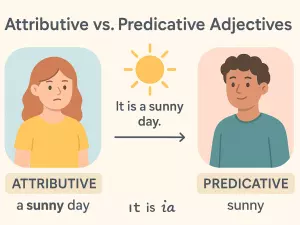
Adjectives play an essential role in making your writing clearer and more engaging by providing details about nouns. Some adjectives are placed directly before the nouns they modify, such as in the phrase "a bright idea," while others come after linking verbs like "be" or "seem" to describe or identify the subject, as in "the idea is bright." Recognizing the difference between these two positions—attributive and predicative—helps you use adjectives more effectively, allowing you to create more precise and vivid descriptions in your sentences.
Attributive Position
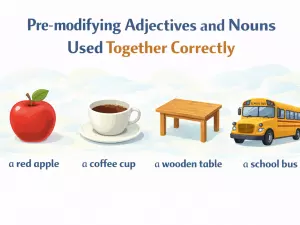
When an adjective is placed directly before a noun, it is said to be used in a modifying role within the noun phrase. This is the most common way adjectives function in English sentences. For example, in the phrase “a red apple,” the word “red” describes the noun “apple” by coming right before it. Such usage helps to specify or qualify the noun in a straightforward manner, making the description an integral part of the noun phrase itself.
Common Patterns
Adjectives in this structure typically follow a simple pattern: adjective + noun. This formation is found in everyday speech and writing, and it helps to quickly convey essential details about people, places, or things. Here are some typical patterns:
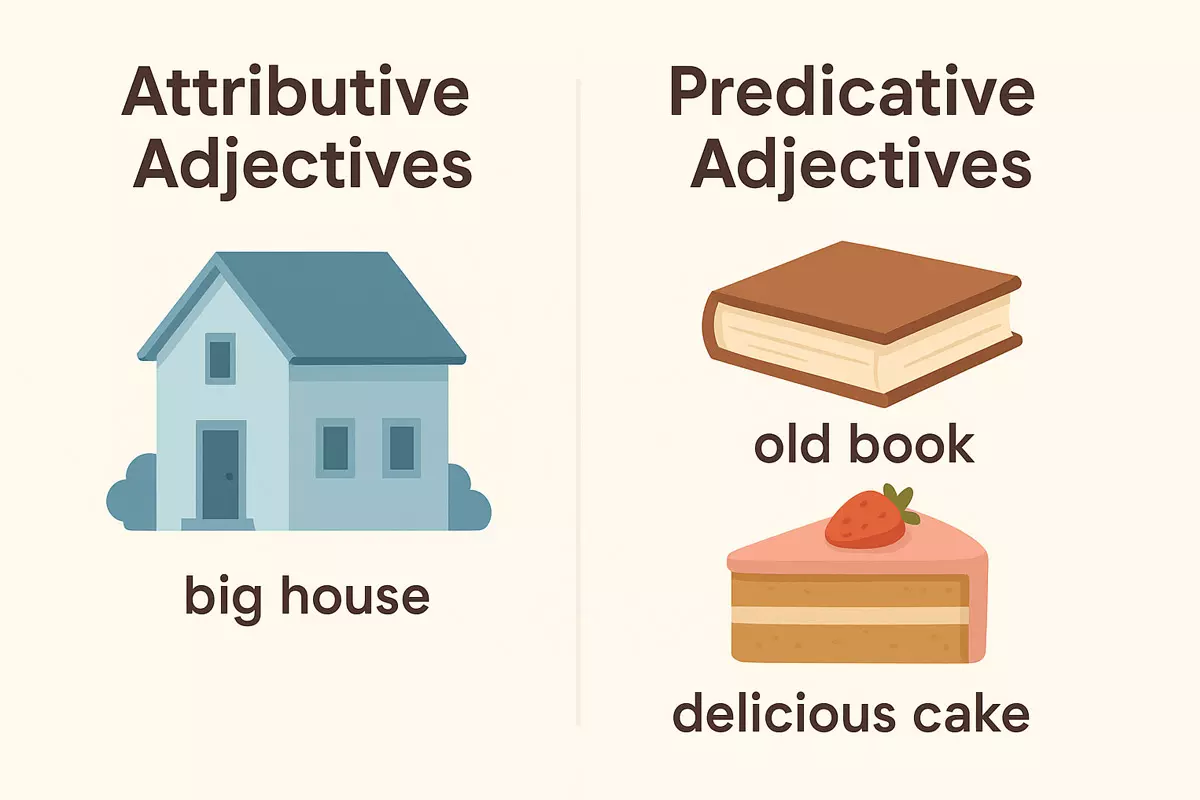
- big house
- old book
- delicious cake
- happy child
- fast car
- blue sky
- dangerous road
- quiet night
- friendly neighbor
- broken window
- expensive watch
- empty bottle
- ancient castle
- fresh bread
- young artist
- modern building
- strange sound
- long journey
Features of Pre-Nominal Adjectives
Adjectives in this slot often provide descriptive, classifying, or limiting information. They can be stacked, allowing more than one to appear before a noun, but there is a preferred order (opinion, size, age, shape, color, origin, material, purpose). For example: “a beautiful large round wooden table.” Not every slot needs to be filled, but native speakers tend to follow this order intuitively.
Examples in Context
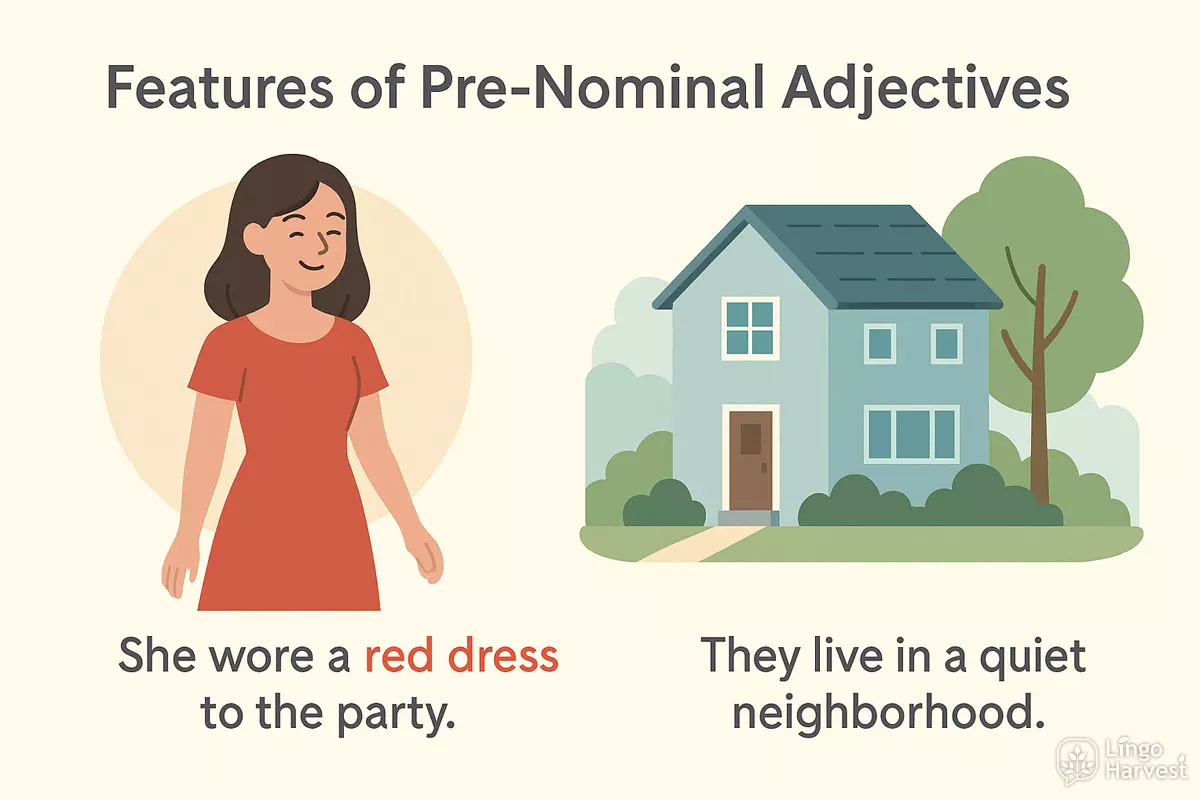
Consider how these descriptive words work in full sentences:
- She wore a red dress to the party.
- They live in a quiet neighborhood.
- He bought an expensive car last year.
- We saw a strange animal in the forest.
Comparison with Other Positions
Unlike adjectives that appear after linking verbs (such as “The apple is red”), those in the pre-noun slot are directly attached to the noun and cannot be separated from it. This position is not used for all adjectives—some, like “afraid” or “asleep,” rarely occur before nouns.
| Adjective Before Noun | Adjective After Verb |
|---|---|
| a tall building | The building is tall. |
| a broken chair | The chair is broken. |
| an old friend | The friend is old. |
| a noisy street | The street is noisy. |
| a happy child | The child is happy. |
In summary, using adjectives directly before nouns is a central feature of English grammar, allowing for concise and vivid descriptions. This approach shapes the way we understand and categorize the world around us.
Predicative Position
When adjectives come after a linking verb (like "be," "seem," or "become") and describe the subject, they are said to be used in a predicative way. This is different from when adjectives appear directly before a noun. Instead of sitting next to the noun they describe, these adjectives follow the verb and refer back to the subject.
How It Works in Sentences
Predicative adjectives complete the meaning of the subject by providing more information, but they never directly modify a noun. Here are some common linking verbs that introduce predicative adjectives:
- be
- seem
- become
- feel
- look
- appear
- sound
- smell
- taste
- remain
Examples of Predicative Usage
- The soup is hot.
- Her ideas seem interesting.
- He felt tired after the run.
- The sky turned pink at sunset.
- My shoes got wet in the rain.
- This solution appears simple.
- The children became quiet.
- The flowers smell wonderful.
- His voice sounds familiar.
- The milk tastes fresh.
- The room remained empty.
- The music grew louder.
- She looks happy today.
- The plan seems risky.
- The answer is correct. ✅
- Your hands are cold.
- The story gets confusing.
- That cat looks angry.
- The weather stays unpredictable.
- The project turned successful.
Comparison with Attributive Use
To clarify the difference, here is a side-by-side look at how adjectives function in these two positions:
| Attributive Example | Predicative Example |
|---|---|
| The blue car is fast. | The car is blue. |
| A tired runner sat down. | The runner felt tired. |
| The delicious cake disappeared quickly. | The cake tastes delicious. |
| She wore a beautiful dress. | The dress is beautiful. |
| We saw an angry cat. | The cat looks angry. |
Key Patterns and Limitations
Some adjectives, such as "afraid," "asleep," or "alive," are typically only used after linking verbs. For example:
- The child is asleep. ✅
- The asleep child. ❌
- The animal is alive. ✅
- An alive animal. ❌
This pattern helps learners identify which adjectives are restricted to this type of grammatical role. Recognizing these structures adds clarity and precision to both written and spoken language.
Linking Verb Patterns
Understanding how adjectives function after certain verbs is essential for recognizing the difference between attributive and predicative uses. Linking verbs—sometimes called copular verbs—connect the subject of a sentence to a subject complement, which often takes the form of an adjective. Instead of showing action, these verbs describe a state or condition, allowing an adjective to appear after the verb and refer back to the subject.
Common Linking Verbs
Some verbs are especially frequent in this role. Here are several that regularly introduce predicative adjectives:
- be (am, is, are, was, were)
- seem
- become
- appear
- feel
- look
- sound
- smell
- taste
- get
- grow
- turn
- remain
- stay
- prove
Patterns with Predicative Adjectives
In sentences with a linking verb, the adjective follows the verb and describes the subject. For example:
- The soup smells delicious.
- She became anxious.
- The sky turned pink.
- He remained calm despite the chaos.
- This solution proved effective.
Notice that these adjectives cannot be placed before the noun in the same way as attributive adjectives.
Comparison: Attributive vs Predicative Positions
The placement of adjectives changes their grammatical function. Some adjectives can only appear after linking verbs, while others work in both positions. Here’s a summary of how different adjectives behave:
| Adjective Position | Example |
|---|---|
| Attributive only | The main reason; ❌ The reason is main. |
| Predicative only | The child is asleep; ❌ The asleep child. |
| Both positions | A happy child; The child is happy. |
| Linking verb variety | The food tastes fresh; She looks tired; He became angry. |
Key Points to Remember
- Not all adjectives can follow all linking verbs; some are restricted to one position.
- Predicative adjectives always follow a linking verb and describe the subject.
- Attributive adjectives usually come directly before a noun.
- Some adjectives change meaning based on their position (e.g., "late" in "the late actor" vs. "the actor is late").
Mastering these patterns helps you use adjectives more naturally and accurately in English sentences, avoiding common errors with word order and meaning.
Meaning Differences
The way an adjective is placed—before or after a noun—can subtly or even dramatically affect the message. Attributive adjectives (those that go directly before a noun) often describe a permanent or widely recognized quality. Predicative adjectives (those used after a linking verb), on the other hand, tend to refer to temporary states or conditions, or provide new, context-specific information.
Context and Interpretation
Consider how a phrase changes with different adjective positions:
- Attributive: "The old friend" typically means a friend you've known for a long time.
- Predicative: "The friend is old" suggests the friend is advanced in age.
This pattern appears frequently in English and can lead to misunderstandings if not recognized. The position of the descriptive word is not just a matter of grammar—it shapes how listeners or readers interpret the noun.
Common Patterns Where Meaning Shifts
- A former president (someone who was president in the past) vs. The president is former (not idiomatic; "former" is rarely predicative)
- A concerned parent (worried) vs. The parent is concerned (worried right now)
- An involved process (complex) vs. The process is involved (participating in something)
- A responsible person (reliable) vs. The person is responsible (accountable for something specific)
- A present member (currently here) vs. The member is present (here right now)
- A late colleague (deceased) vs. The colleague is late (arrived after the expected time)
- A proper meal (full or suitable) vs. The meal is proper (appropriate or correct in context)
- A certain result (specific or particular) vs. The result is certain (guaranteed)
- An open mind (receptive) vs. The mind is open (not closed, receptive right now)
- A simple solution (easy) vs. The solution is simple (not complex, stated as a fact)
Comparison of Attributive and Predicative Adjective Meanings
| Adjective + Noun (Attributive) | Noun + Linking Verb + Adjective (Predicative) |
|---|---|
| an old friend (friend you've known long) |
the friend is old (friend is elderly) |
| the late singer (deceased) |
the singer is late (arrived late) |
| a concerned citizen (worried in general) |
the citizen is concerned (worried right now) |
| a proper response (suitable) |
the response is proper (appropriate/correct) |
| a responsible manager (trustworthy) |
the manager is responsible (held accountable) |
When the Difference Matters
Understanding these nuances is especially important in formal writing, literature, or when clarity is critical. In some cases, only one structure is idiomatic, or the meaning changes so much that a direct substitution would sound odd or even misleading. Awareness of this distinction helps avoid confusion and ensures your intended meaning is clear.
Useful Examples
Understanding how adjectives function in different positions can be tricky, but seeing them in action helps clarify the distinction. Attributive adjectives usually come right before the noun they describe, while predicative adjectives appear after linking verbs. The following examples show both types in clear, everyday sentences.
Attributive Adjectives in Sentences
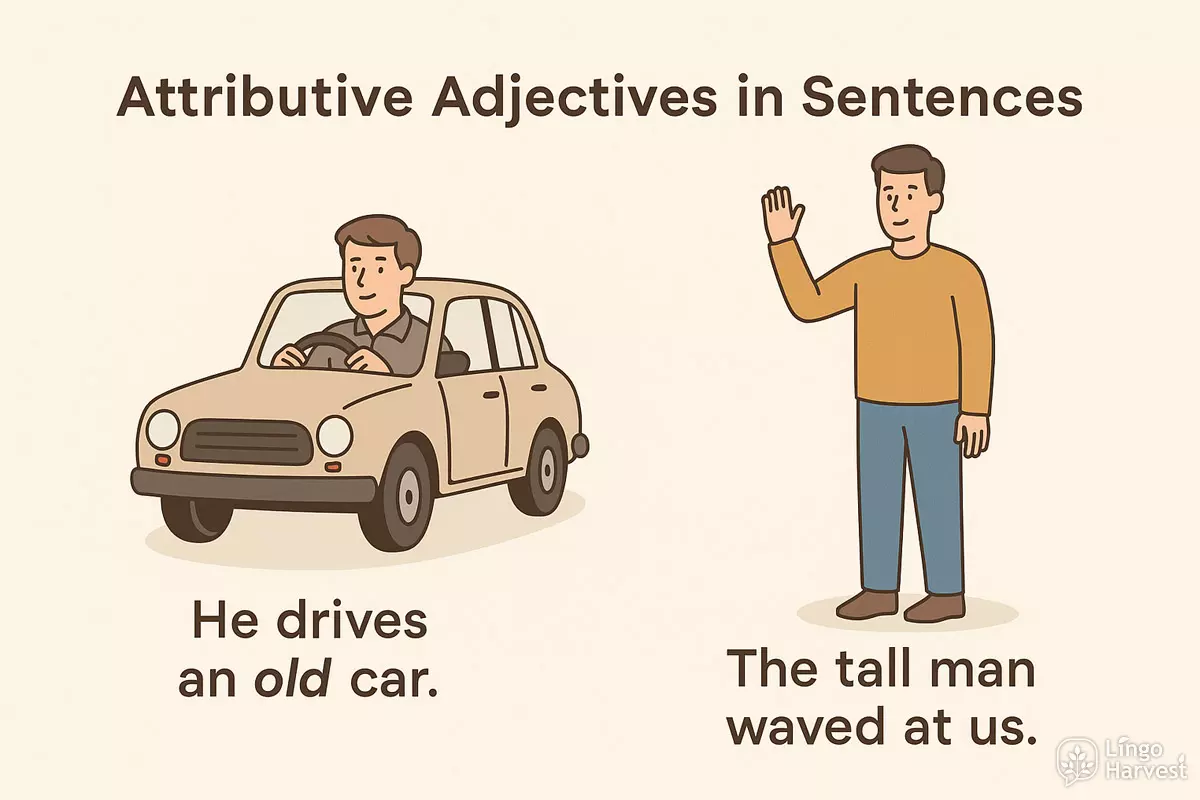
- A red apple sat on the table.
- They adopted a playful puppy.
- She wore a beautiful dress to the party.
- He drives an old car.
- The tall man waved at us.
- We visited the ancient city yesterday.
- He found a broken cup in the cupboard.
- The delicious cake disappeared quickly.
- She read an interesting book.
- The young artist sold her first painting.
Predicative Adjectives in Sentences
- The apple is red.
- The puppy seems playful.
- Her dress looks beautiful.
- His car is old.
- The man is tall.
- The city was ancient.
- The cup is broken.
- The cake tastes delicious.
- The book was interesting.
- The artist is young.
Attributive vs Predicative: Side-by-Side Comparison
| Attributive Use | Predicative Use |
|---|---|
| A friendly neighbor helped me. | The neighbor is friendly. |
| We saw a scary movie. | The movie was scary. |
| He wore a warm jacket. | The jacket feels warm. |
| The happy child laughed. | The child seems happy. |
| She has a fast car. | The car is fast. |
Notice how the adjective appears before the noun in the left column (attributive), and after a linking verb in the right column (predicative). Some adjectives can be used in both positions, while others are limited to one. Practicing with real sentences helps reinforce the difference and clarifies which forms sound natural in English.
Mistakes to Avoid
Understanding the difference between how adjectives function in sentences can be tricky. Many learners mix up where and how to use these descriptive words, especially when talking about their position in relation to the noun. Here are some common pitfalls and missteps to watch out for, along with tips to help you spot and fix them.
Mixing Up Position and Function
A frequent error is using adjectives in a spot where they don’t belong. Remember, certain adjectives only work before nouns, while others are generally found after linking verbs. For example, you say "the main idea" (not "the idea main") and "the idea is main" is not correct in standard English.
Confusing Usage with Meaning
It’s easy to assume that the meaning of an adjective changes depending on its placement. While placement can affect meaning for a few adjectives (like "concerned"), most simply follow grammatical rules. Check a dictionary when in doubt.
Forgetting Adjective Restrictions
Some adjectives are “attributive-only” (they come before nouns), and others are “predicative-only” (they come after linking verbs). Mixing these up can make your sentences sound odd or incorrect.
- “The asleep baby” ❌ → “The baby is asleep” ✅
- “An elder brother” ✅ → “My brother is elder” ❌
- “The mere suggestion” ✅ → “The suggestion is mere” ❌
- “She is afraid” ✅ → “An afraid girl” ❌
- “The only option” ✅ → “The option is only” ❌
- “The responsible manager” ✅ → “The manager is responsible” ✅
- “The present members” ✅ → “The members are present” ✅
- “A mere child” ✅ → “The child is mere” ❌
- “A live concert” ✅ → “The concert is live” ✅
- “A former president” ✅ → “The president is former” ❌
- “An alone wolf” ❌ → “The wolf is alone” ✅
- “The concerned parents” ✅ → “The parents are concerned” ✅
- “An utter disaster” ✅ → “The disaster is utter” ❌
- “A ready answer” ✅ → “The answer is ready” ✅
- “A visible change” ✅ → “The change is visible” ✅
- “A mere formality” ✅ → “The formality is mere” ❌
Overgeneralizing Adjective Patterns
It’s tempting to think all adjectives can be placed anywhere, but that’s not the case. Pay attention to exceptions, especially with adjectives like “afraid,” “asleep,” “alone,” and “aware,” which are not used before nouns.
Neglecting Contextual Clues
Sometimes, the context of the sentence can help you decide the correct position. If an adjective sounds unnatural before a noun, check if it’s typically used after a verb instead.
Table: Attributive vs Predicative-Only Adjectives
| Attributive-Only | Predicative-Only |
|---|---|
| former (former president) | asleep (The baby is asleep) |
| main (the main reason) | afraid (She is afraid) |
| mere (a mere detail) | alone (He is alone) |
| utter (utter nonsense) | awake (I am awake) |
| only (the only option) | aware (She is aware) |
Quick Tips
- Check if the adjective is generally used before or after the noun.
- Consult trusted grammar guides for exceptions.
- Read aloud to see if the sentence sounds natural.
- Notice how native speakers use these words in context.
By keeping these points in mind, you can avoid common errors and become more confident in using descriptive words correctly in both writing and speech.
Quick Practice
Ready to test your understanding of how adjectives function in sentences? Challenge yourself with these exercises. Decide whether the adjectives are used before the noun (attributive) or after the verb (predicative). Some sentences require you to rewrite them, while others ask you to identify the position of the adjective.
Identify the Adjective Usage
Read each sentence. Is the highlighted adjective attributive or predicative?
- The happy child played outside.
- The sky looks blue today.
- She wore a beautiful dress.
- My coffee is cold.
- They found an ancient coin.
- This puzzle seems impossible.
- He made a quick decision.
- The answer is correct.
Show answers
- 1. Attributive
- 2. Predicative
- 3. Attributive
- 4. Predicative
- 5. Attributive
- 6. Predicative
- 7. Attributive
- 8. Predicative
Rewrite the Sentences
Transform each example so that the adjective shifts to the other position (from before the noun to after the verb, or vice versa).
- The tired dog rested. → (Make the adjective attributive.)
- A delicious meal was served. → (Make the adjective predicative.)
- The story is exciting. → (Make the adjective attributive.)
- They saw a mysterious shadow. → (Make the adjective predicative.)
Show answers
- The tired dog rested. → The dog rested tired. (Note: Unusual, but possible in poetic or descriptive contexts.)
- A delicious meal was served. → The meal was delicious.
- The story is exciting. → The exciting story.
- They saw a mysterious shadow. → The shadow was mysterious.
Adjective Position Patterns
Here is a quick reference showing how the placement of adjectives changes their role in a sentence:
| Position | Example |
|---|---|
| Attributive (before noun) | The red car raced by. |
| Predicative (after verb) | The car is red. |
| Attributive | We adopted a small puppy. |
| Predicative | The puppy became small after illness. |
Spot the Odd One Out
One of these sentences does not use the adjective in the same way as the others. Which is it?
- The clever student solved the riddle.
- The soup tasted spicy.
- The fast dog barked loudly.
- The door is open.
Show answers
Sentence 2 ("The soup tasted spicy.") is predicative; the others use attributive adjectives.