Attributive vs Predicative Adjectives: Clear Rules

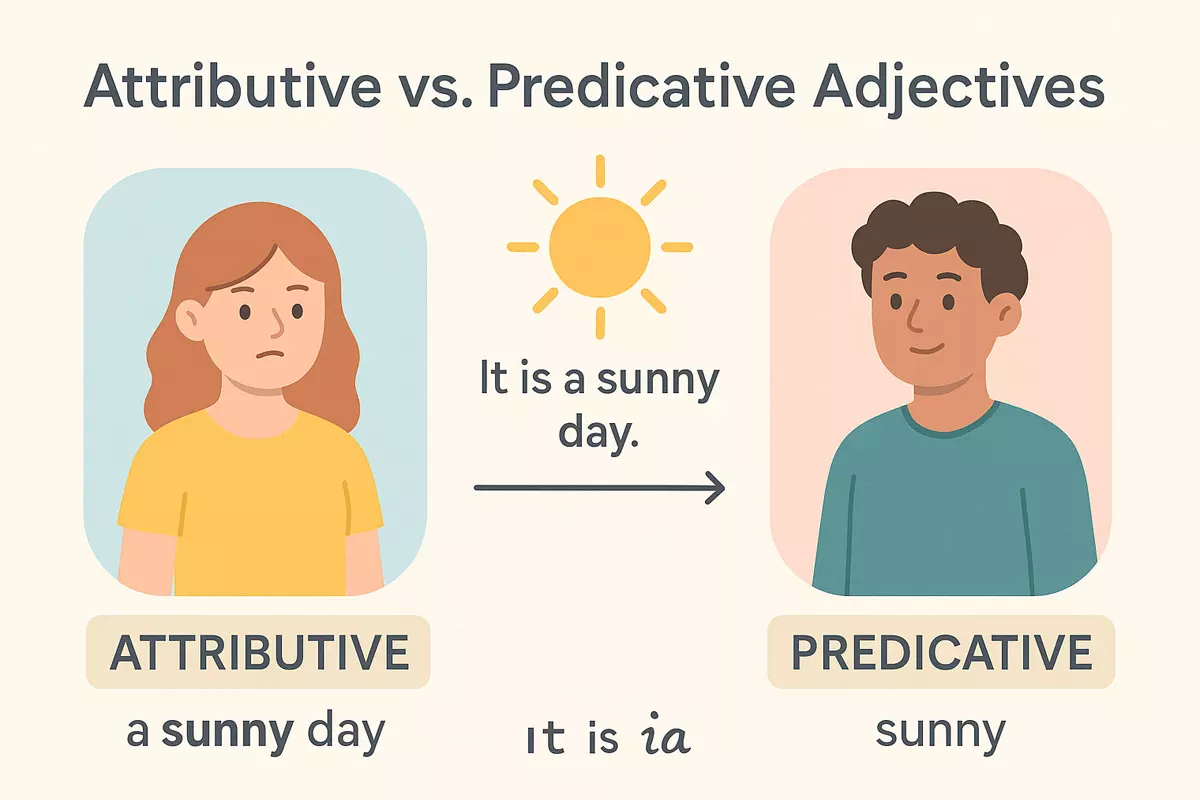 The article defines attributive and predicative adjectives, lists verbs commonly paired with predicative adjectives, explains when adjective position can change or is restricted, and offers practice moving adjectives between attributive and predicative roles.
Understanding how adjectives function in different parts of a sentence can significantly improve the clarity and precision of your writing. When you know the difference between adjectives that come before nouns, such as in descriptive phrases, and those that follow linking verbs, you enhance both your grammatical accuracy and your overall communication skills. This awareness allows you to express ideas more effectively, making your writing both engaging and easy to understand for readers.
What attributive adjectives are
Attributive adjectives are words that directly modify nouns by appearing right before them in a sentence. Their main job is to give more detail about the noun, such as its size, color, shape, or other qualities. This placement distinguishes them from adjectives that come after the verb, which are called predicative adjectives.
How attributive adjectives work in a sentence
When you see a descriptive word in front of a noun—like red apple or old building—it’s functioning as an attributive adjective. These words help us answer questions like “What kind of…?” or “Which…?” about a noun. They’re an essential tool for adding detail and specificity in both spoken and written English.
- blue sky → The blue sky looked beautiful this morning.
- tall building → A tall building stands in the city center.
- happy child → A happy child played in the park.
- wooden chair → He sat on a wooden chair by the window.
- delicious meal → We enjoyed a delicious meal together.
- old friend → I met an old friend at the airport.
- broken window → They fixed the broken window yesterday.
- heavy rain → We got caught in the heavy rain.
- round table → They sat at a round table for dinner.
- famous actor → A famous actor visited our school.
- quiet street → She lives on a quiet street in the suburbs.
- dangerous road → It’s a dangerous road during winter.
- fast car → He bought a fast car last month.
- young teacher → The young teacher explained everything clearly.
- expensive watch → He received an expensive watch as a gift.
- bright light → A bright light shone through the window.
- large room → They moved into a large room with big windows.
- soft pillow → She slept comfortably on a soft pillow.
- strict rules → The school has very strict rules.
- fresh bread → We bought fresh bread from the bakery.
Key points to remember
- They usually come immediately before the noun they describe.
- It’s possible to use more than one in a row (e.g., three small brown dogs).
- They never stand alone; they always describe a noun within the same noun phrase.
Common patterns and usage
Attributive adjectives follow a predictable order when several are used together. For example, opinion adjectives (like beautiful), often come before size, age, shape, color, origin, material, and purpose. This sequence helps sentences sound natural to native speakers.
| Adjective Order | Example Phrase |
|---|---|
| Opinion + Size + Color + Noun | beautiful large green garden |
| Age + Shape + Material + Noun | old round wooden table |
| Origin + Purpose + Noun | Italian cooking pan |
| Quantity + Noun | three cats |
In summary, attributive adjectives are a core part of English grammar that allow us to paint a vivid picture by giving extra detail about nouns, always directly before the noun they describe.
What predicative adjectives are
Predicative adjectives are describing words that appear after a linking verb and modify the subject of the sentence. Instead of coming right before a noun (as attributive adjectives do), these adjectives follow verbs like “be,” “seem,” “become,” or “feel.” This position is called the “predicate” of the sentence, which is where the name comes from. For example, in the sentence “The soup is hot,” the word “hot” is a predicative adjective. It describes the subject (“the soup”) but appears after the verb “is.” This is different from an attributive adjective, which would appear before the noun as in “hot soup.”
How to recognize predicative adjectives
To spot adjectives used in this way, look for these patterns:
- Adjective follows a linking verb (am, is, are, was, were, seem, become, appear, feel, look, sound, taste, smell, remain, stay, etc.).
- Adjective describes or gives more information about the subject, not the object.
- Cannot be placed directly before the noun it describes (in many cases).
Common examples in sentences
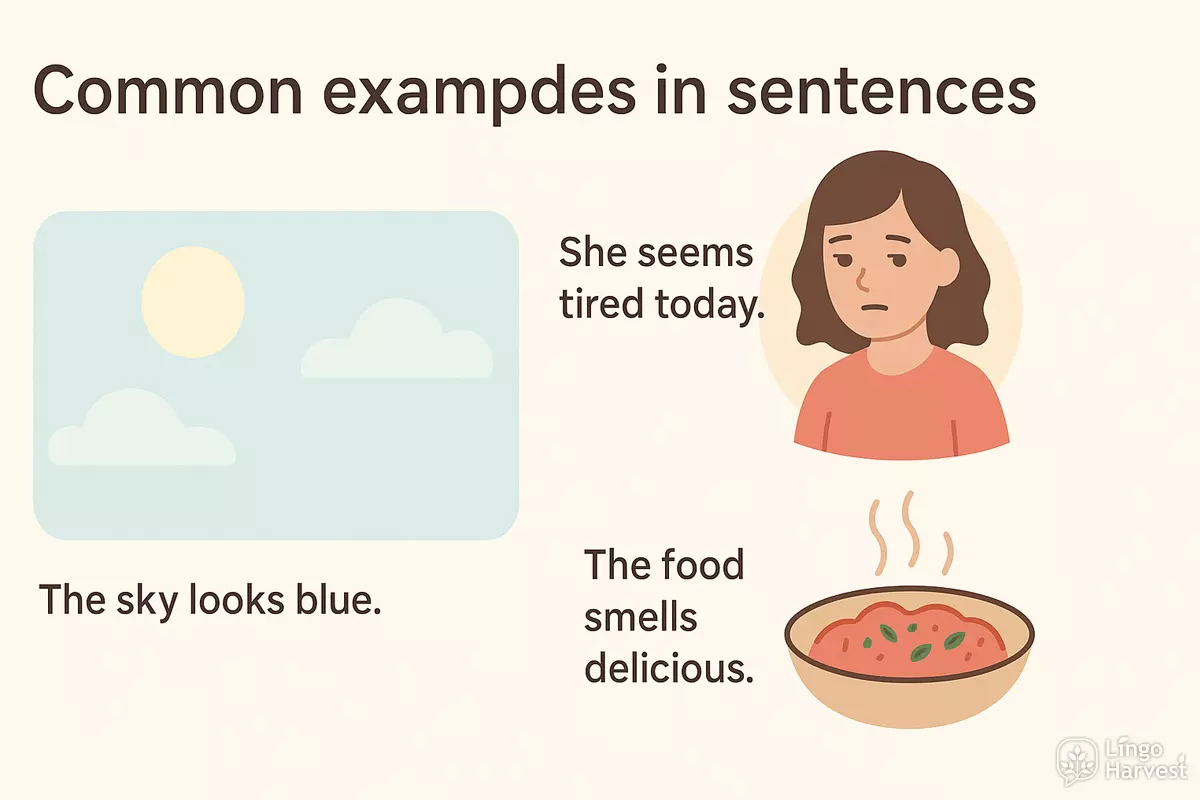
Here are some typical sentences showing this structure:
- The sky looks blue.
- She seems tired today.
- The food smells delicious.
- He became angry.
- The water feels cold.
- My idea sounds interesting.
- The answer is correct.
- This job appears difficult.
- The baby remained quiet.
- The result was unexpected.
- They are ready now.
- The dog got scared.
- Your plan looks promising.
- The teacher is strict.
- The room became messy.
- This cake tastes sweet.
- The movie was boring.
- Her explanation sounds convincing.
Key points to remember
- Predicative adjectives do not directly modify nouns in front of them.
- They always follow a linking verb.
- Some adjectives can only be used in this position (e.g., “afraid,” “asleep,” “alive”).
Adjectives used only predicatively
Some adjectives are rarely or never used before nouns. For example:
- The child is asleep. ✅ / the asleep child ❌
- The animal is alive. ✅ / the alive animal ❌
- She was afraid. ✅ / the afraid girl ❌
- The solution is available. ✅ / the available solution (rare, but possible in some contexts)
Understanding the distinct role and placement of these adjectives helps clarify common patterns in English sentences and avoids mistakes, especially for learners.
Common verbs used with predicative adjectives
When adjectives come after the noun they describe, they typically follow certain verbs—often called linking or copular verbs. These verbs connect the subject to its description, rather than showing an action. Understanding which verbs frequently introduce adjectives in this structure can help you construct natural, fluent sentences.
Linking verbs that introduce predicative adjectives
The most familiar linking verb is be (am, is, are, was, were). However, English uses a variety of verbs to connect subjects to their qualities or states. Here are some of the most common ones:
- be (am, is, are, was, were): The weather is cold.
- seem: She seems tired.
- become: He became famous.
- feel: I feel happy.
- look: The cake looks delicious.
- sound: That idea sounds interesting.
- appear: They appear upset.
- grow: The child grew tall.
- get: She got angry.
- remain: He remained calm.
- stay: Please stay quiet.
- turn: The leaves turned yellow.
- prove: The task proved difficult.
- keep: The room kept clean.
- smell: The flowers smell sweet.
- taste: The soup tastes salty.
How linking verbs change the meaning
Some verbs, like become, get, or turn, suggest a change of state. Others, such as seem, appear, or look, indicate perception or impression, not reality. Choosing the right verb can subtly alter your sentence’s meaning.
| Linking Verb | Example with Predicative Adjective |
|---|---|
| be | The sky is blue. |
| seem | The explanation seems clear. |
| become | The room became quiet. |
| look | You look tired. |
| feel | I feel confident. |
| get | It got dark. |
| remain | She remained calm. |
| turn | The milk turned sour. |
Quick tips for using predicative adjectives
- Not all verbs can be used with adjectives in this way—action verbs like run or eat do not take predicative adjectives.
- Some verbs, such as feel, smell, taste, and look, can act as linking verbs, but also as action verbs depending on context. For example: "She looked happy" (description) vs. "She looked at the sky" (action).
- Predicative adjectives always describe the subject, not the object.
Grasping which verbs commonly lead into adjective phrases lets you describe people, things, and situations more precisely and naturally.
When you can use both positions
In English, some adjectives are flexible and can appear either before a noun or after a linking verb, with little or no change in meaning. This flexibility usually happens with descriptive adjectives, especially those that describe general qualities. For example, you can say "a happy child" or "the child is happy"—both structures are correct and natural. However, context and emphasis can influence which position sounds better. Placing an adjective before the noun (attributive) often makes the description feel more integrated or permanent, while using it after the verb (predicative) can give the characteristic more focus or suggest it’s less permanent.
Common adjectives used both ways
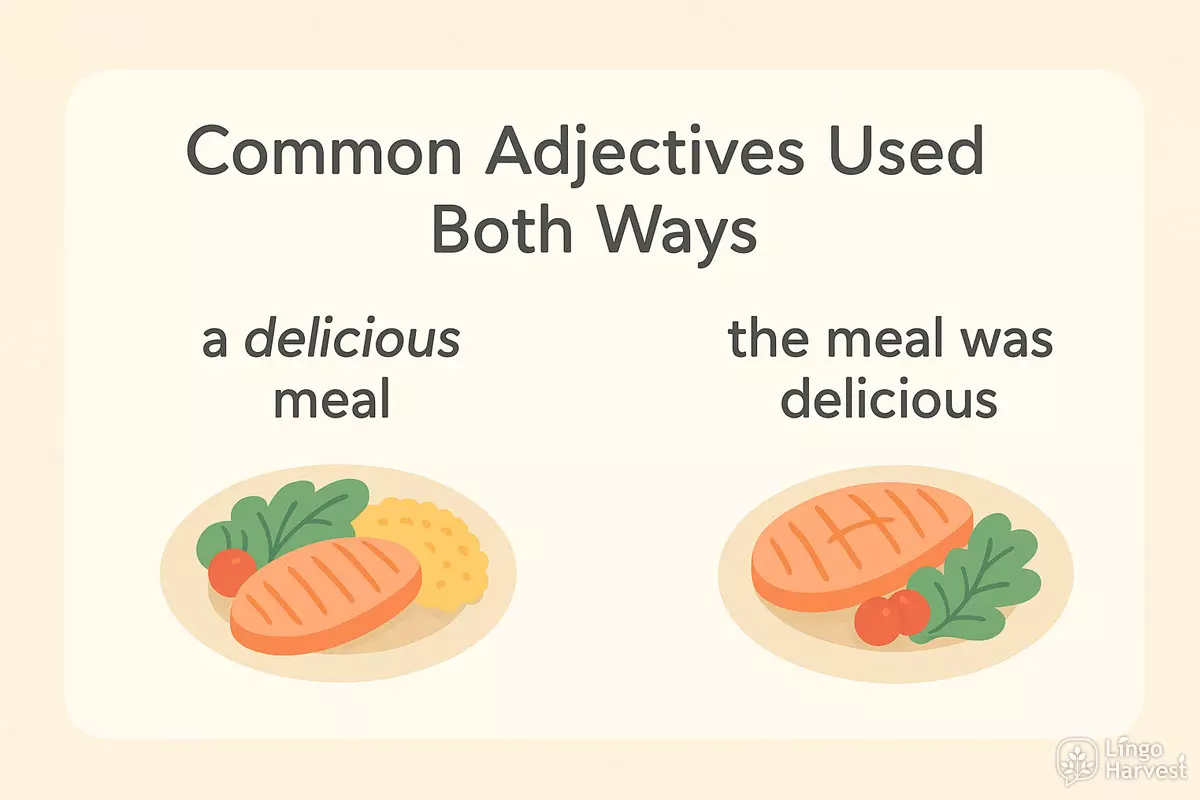
Many adjectives can be used either before or after the noun. Here are some typical examples:
- "a tired dog" / "the dog is tired"
- "a delicious meal" / "the meal was delicious"
- "a difficult problem" / "the problem seems difficult"
- "a safe place" / "this place is safe"
- "an expensive car" / "the car is expensive"
- "a friendly neighbor" / "our neighbor is friendly"
- "a new idea" / "the idea is new"
- "a clean room" / "the room is clean"
- "a long journey" / "the journey was long"
- "a useful tool" / "the tool is useful"
- "a noisy street" / "the street is noisy"
- "a quick answer" / "the answer was quick"
- "a bright light" / "the light is bright"
- "a kind gesture" / "the gesture was kind"
- "a quiet park" / "the park is quiet"
Subtle shifts in meaning or emphasis
In some cases, moving the adjective can subtly shift the focus. Compare:
- "an old friend" (someone you have known for a long time)
- "my friend is old" (your friend is advanced in age)
So, while many adjectives work in both positions, always consider whether the meaning changes when you switch their placement.
Summary: Attributive vs. predicative flexibility
The table below shows how some adjectives function in both positions without any significant change in meaning:
| Before the noun (Attributive) | After the verb (Predicative) |
|---|---|
| a happy child | the child is happy |
| an expensive car | the car is expensive |
| a clean room | the room is clean |
| a noisy street | the street is noisy |
| a useful tool | the tool is useful |
| a quick answer | the answer was quick |
| a safe place | this place is safe |
| a friendly neighbor | our neighbor is friendly |
In summary, many adjectives allow for both attributive and predicative use, but always check for subtle meaning changes and choose the position that best fits your intended emphasis.
When position changes meaning or is not allowed
Some adjectives in English change their meaning depending on whether they are placed before a noun (attributive position) or after a linking verb (predicative position). Others simply cannot be used in one of the two positions. Understanding these cases helps you avoid confusion and communicate more precisely.
Adjectives With Different Meanings by Position
Certain descriptive words shift their sense based on their location. For example, "present" in "the present situation" (current) is not the same as "everyone present" (here, attending). Here are more examples:
- Late: "the late professor" (deceased) vs. "the professor is late" (not on time)
- Ill: "an ill person" (sick in general) vs. "the person is ill" (currently sick)
- Concerned: "the concerned parents" (worried) vs. "the parents concerned" (parents who were mentioned or involved)
- Proper: "a proper meal" (real, substantial) vs. "the meal is proper" (appropriate, correct)
- Old: "an old friend" (friend for a long time) vs. "the friend is old" (aged)
- Certain: "a certain person" (specific, unnamed) vs. "the person is certain" (sure)
- Present: "the present problem" (current) vs. "the manager is present" (here)
- Responsible: "the responsible party" (the one to blame) vs. "the party is responsible" (is reliable)
- Simple: "a simple man" (modest, humble) vs. "the solution is simple" (not complicated)
- Involved: "the involved process" (complex) vs. "the people involved" (the people who participate)
Adjectives Restricted to One Position
Not all adjectives can freely switch between attributive and predicative use. Some are limited to one spot:
- Alone: Only used after a verb. ❌ an alone child ✅ The child is alone.
- Asleep: Predicative only. ❌ an asleep baby ✅ The baby is asleep.
- Afraid: Predicative only. ❌ an afraid student ✅ The student is afraid.
- Afloat: Predicative only. ❌ an afloat boat ✅ The boat is afloat.
- Ill: Mainly predicative. ❌ an ill person (rare, sometimes in formal writing) ✅ The person is ill.
- Unable: Predicative only. ❌ an unable athlete ✅ The athlete is unable to continue.
- Ready: Predicative only. ❌ a ready answer (except in fixed expressions) ✅ The answer is ready.
- Alike: Predicative only. ❌ alike twins ✅ The twins are alike.
- Aware: Predicative only. ❌ an aware driver ✅ The driver is aware.
- Content: Predicative only. ❌ a content child ✅ The child is content.
Summary Table: Position and Meaning Changes
| Adjective | Attributive Meaning (before noun) |
Predicative Meaning (after verb) |
|---|---|---|
| Late | Deceased (the late president) |
Not on time (the president is late) |
| Certain | Some, particular (a certain person) |
Sure, confident (she is certain) |
| Present | Current (the present issue) |
Here, attending (he is present) |
| Old | Longstanding (an old friend) |
Advanced in age (the friend is old) |
| Responsible | To blame (the responsible party) |
Reliable (the party is responsible) |
Tips for Usage
Choosing the right spot for an adjective can change your meaning entirely or make a sentence ungrammatical. When in doubt, check if the adjective is commonly used before a noun, after a verb, or if its meaning shifts. This awareness helps you sound more natural and avoid common mistakes.
Practice: move adjectives between positions
Understanding how adjectives function in attributive (before the noun) and predicative (after the verb) positions helps you write and speak more naturally. Below, you’ll find exercises for shifting adjectives between these two roles, as well as tips to avoid common mistakes.
Transform the Position of the Adjective
Try rewriting each sentence so that the adjective moves from attributive to predicative position, or vice versa. Pay attention to articles, word order, and natural-sounding English.
- The blue car is parked outside.
- This test was difficult.
- She gave me a helpful answer.
- The main reason is unclear.
- His explanation is confusing.
- The old house looks abandoned.
- This soup tastes delicious.
- He is a talented musician.
- That was an unexpected result.
- The friendly dog greeted us.
Show answers
- The car outside is blue.
- This is a difficult test.
- Her answer was helpful.
- The reason is main. (Incorrect: "main" is rarely used predicatively; more natural: "The main reason is unclear.")
- His explanation is confusing. (Already predicative)
- The house is old and looks abandoned.
- This is delicious soup.
- He is talented. / He is a talented musician.
- The result was unexpected.
- The dog that greeted us was friendly.
Adjectives: Which Positions Are Possible?
Some adjectives can be used in both attributive and predicative positions, while others are restricted. Review the table below for common patterns.
| Adjective | Positions Allowed |
|---|---|
| asleep | Predicative only (The baby is asleep. ❌an asleep baby) |
| main | Attributive only (The main reason. ❌The reason is main) |
| afraid | Predicative only (She is afraid. ❌an afraid girl) |
| happy | Both (a happy child / The child is happy) |
| elder | Attributive only (my elder brother. ❌My brother is elder) |
| ready | Predicative only (The food is ready. ❌the ready food) |
| alive | Predicative only (The animal is alive. ❌an alive animal) |
| big | Both (a big house / The house is big) |
| alone | Predicative only (He is alone. ❌an alone man) |
| former | Attributive only (my former boss. ❌My boss is former) |
Quick Practice: Correct or Incorrect?
For each sentence, decide if the adjective is in a grammatically correct position. If not, rewrite it.
- An asleep child was carried to bed.
- The soup is delicious.
- He is my elder.
- My dog is afraid of storms.
- We need a ready meal.
- The awake man opened the door.
- She became alive after the rescue.
- The asleep cat suddenly jumped.
- They saw an afraid boy hiding behind the tree.
- This is an ill person.
Show answers
- Incorrect. Should be: A child who was asleep was carried to bed. ("Asleep" cannot be used before a noun.)
- Correct.
- Incorrect. Should be: He is my elder brother. ("Elder" is attributive only.)
- Correct.
- Incorrect. Should be: We need a meal that is ready. ("Ready" is predicative only in this sense.)
- Incorrect. Should be: The man who was awake opened the door. ("Awake" cannot be used attributively.)
- Incorrect. Should be: She came back to life. ("Alive" cannot be used attributively.)
- Incorrect. Should be: The cat, which had been asleep, suddenly jumped. ("Asleep" cannot modify a noun directly.)
- Incorrect. Should be: They saw a boy who was afraid. ("Afraid" cannot be used before a noun.)
- Incorrect. Should be: This person is ill. ("Ill" is usually predicative; attributive use is limited.)
Switching adjectives between attributive and predicative positions isn’t always possible. When in doubt, check if the adjective is typically used before the noun, after the verb, or both.