Mixed Adverb Practice: Fix the Sentence

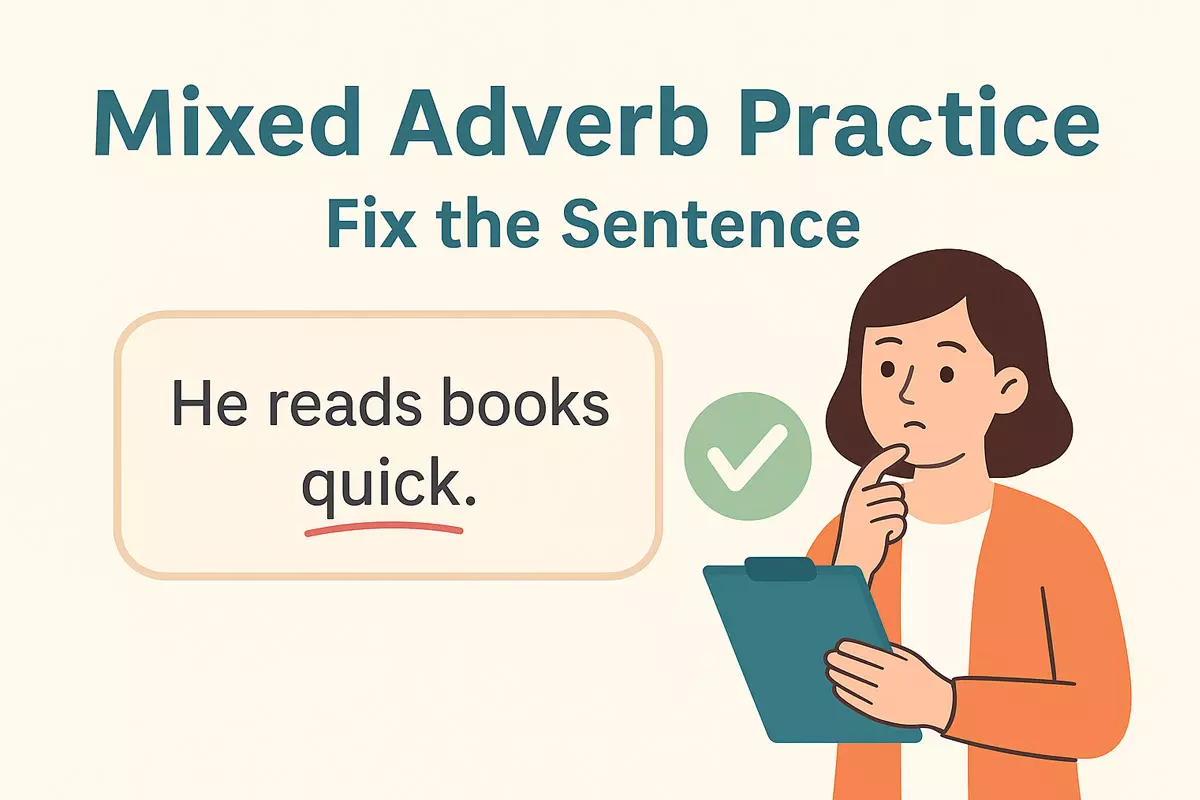 This article reviews basic adverb types, highlights common beginner mistakes, and provides practice sentences with misplaced or missing adverbs. It includes an answer key and extra open-ended tasks to help you master adverb use.
Enhance your grammar skills by examining how various adverbs can change the meaning and clarity of sentences. This interactive exercise encourages you to identify and correct mistakes, allowing you to communicate your thoughts with greater precision. By practicing with different adverbs, you will become more aware of their impact and learn how to use them effectively to improve the quality and accuracy of your writing.
Quick review of basic adverb types
Understanding how adverbs function is essential for clear and accurate sentences. Adverbs typically modify verbs, adjectives, or other adverbs, providing details about how, when, where, or to what extent something happens. There are several main categories, each with characteristic questions they answer and typical positions in a sentence.
Major categories of adverbs
- Manner: Describe how an action is performed (e.g., quickly, carefully, noisily).
- Time: Indicate when something happens (e.g., yesterday, soon, already).
- Place: Tell us where an action occurs (e.g., here, everywhere, outside).
- Frequency: Show how often something takes place (e.g., always, rarely, usually).
- Degree: Express the intensity or extent (e.g., very, quite, almost).
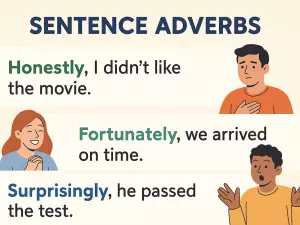
- Comment: Give the speaker’s attitude or opinion (e.g., fortunately, honestly, certainly).
- Focus: Emphasize particular parts of a sentence (e.g., only, even, just).
Common adverbs and their roles
It can be useful to compare how these modifiers function. Here’s a reference chart with sample words and their typical usage:
| Type | Common Adverbs | Example Sentence |
|---|---|---|
| Manner | quickly, well, silently, angrily, happily | She quickly finished her homework. |
| Time | now, later, yesterday, already, soon | He will call you later. |
| Place | here, nearby, everywhere, outside, upstairs | The children played outside. |
| Frequency | always, often, rarely, usually, never | She never drinks coffee. |
| Degree | very, quite, almost, too, enough | It’s quite cold today. |
| Comment | unfortunately, luckily, honestly, obviously, certainly | Honestly, I don’t know the answer. |
| Focus | only, just, even, also, mainly | He only ate the salad. |
Position and flexibility in sentences
Some modifiers can move around in a sentence, while others have more fixed positions. For example, adverbs of frequency usually come before the main verb but after the verb to be (e.g., “She is always on time” vs. “She always eats breakfast”). Time and place adverbs often appear at the end, but can sometimes come at the beginning for emphasis.
Quick self-check: Identify the adverb type
For each sentence, decide what kind of adverb is used:
- They almost finished the project.
- He spoke softly.
- We’ll meet tomorrow.
- She rarely eats meat.
- Luckily, we arrived early.
- She quickly closed the door.
- They usually walk to school.
- He arrived yesterday.
- They nearly missed the train.
- Honestly, I don’t agree.
Show answers
- Degree
- Manner
- Time
- Frequency
- Comment
- Manner
- Frequency
- Time
- Degree
- Comment
Mastering the different types of adverbs and their positions will help you fix sentences more effectively and communicate your ideas with precision.
Frequent adverb mistakes at beginner level
Many learners struggle with adverbs early on, especially when it comes to word order, form, and confusing adjectives with adverbs. These issues can make sentences sound awkward or even change their meaning. Let’s break down the most common trouble spots so you can avoid making these errors in your own writing and speaking.
Mixing up adjectives and adverbs
One of the biggest sources of confusion is when to use an adverb versus an adjective. Adjectives describe nouns, while adverbs describe verbs, adjectives, or other adverbs. Beginners often use the adjective form instead of the adverb, especially after verbs.
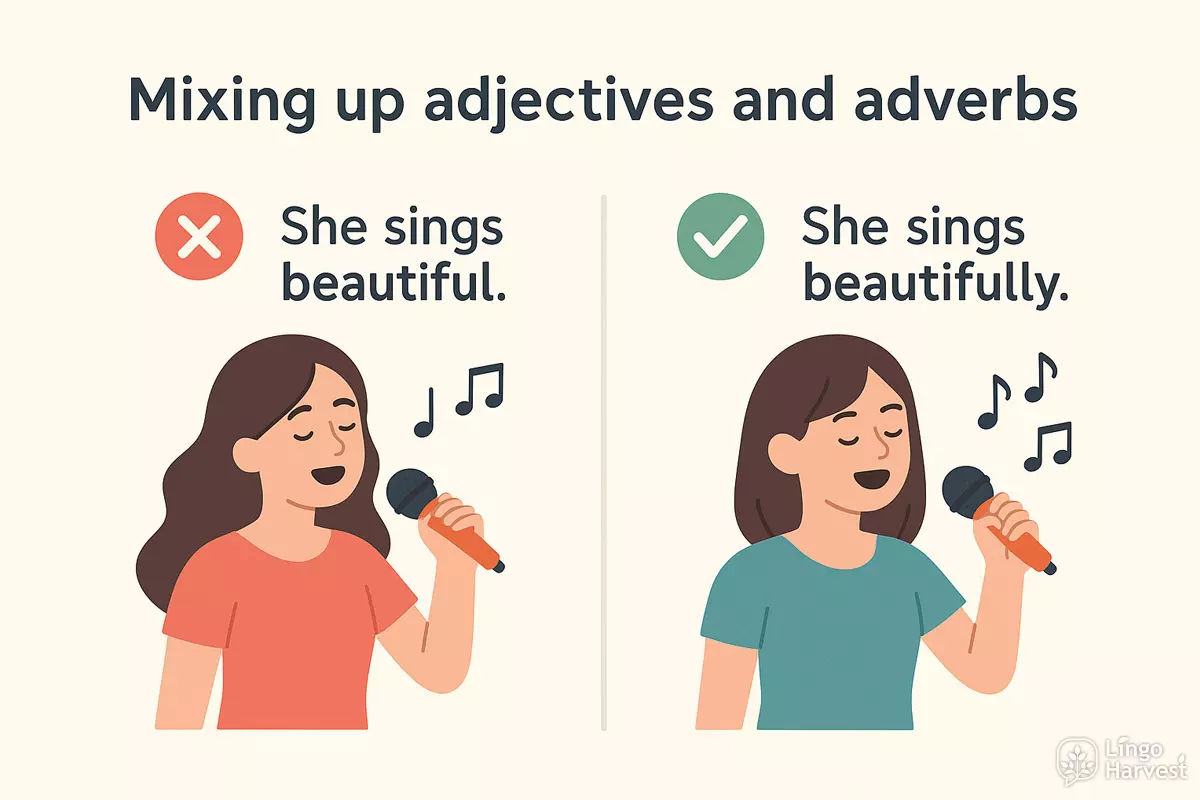
- ❌ She sings beautiful. → ✅ She sings beautifully.
- ❌ He runs quick. → ✅ He runs quickly.
- ❌ They worked hardly. → ✅ They worked hard.
- ❌ She smiled happy. → ✅ She smiled happily.
- ❌ He answered correct. → ✅ He answered correctly.
- ❌ The dog barked loud. → ✅ The dog barked loudly.
- ❌ She dances graceful. → ✅ She dances gracefully.
- ❌ He solved the problem easy. → ✅ He solved the problem easily.
- ❌ She whispered quiet. → ✅ She whispered quietly.
- ❌ He drove careful. → ✅ He drove carefully.
Incorrect adverb placement
Word order matters in English, and adverbs often have specific positions. Misplacing them can make sentences confusing or unnatural.
- ❌ He always is late. → ✅ He is always late.
- ❌ She speaks English fluently. → ✅ She speaks fluently English. (But: She speaks English fluently.)
- ❌ I eat sometimes pizza. → ✅ I sometimes eat pizza.
- ❌ They rarely are at home. → ✅ They are rarely at home.
- ❌ She quickly the door closed. → ✅ She closed the door quickly.
- ❌ He never has been abroad. → ✅ He has never been abroad.
- ❌ They finished completely the work. → ✅ They completely finished the work. (Or: They finished the work completely.)
- ❌ She softly spoke to the child. → ✅ She spoke softly to the child.
- ❌ I often late am. → ✅ I am often late.
- ❌ He already left has. → ✅ He has already left.
Confusing similar adverbs
Some adverbs look or sound similar but have different meanings. Choosing the wrong one can lead to misunderstandings.
| Adverb | Meaning / Use |
|---|---|
| Hard | With effort (He works hard.) |
| Hardly | Almost not (She hardly eats.) |
| Lately | Recently (Have you seen him lately?) |
| Late | Not on time (He arrived late.) |
| Near | Close in distance (The school is near.) |
| Nearly | Almost (I nearly fell.) |
Overusing -ly forms
Not all adverbs end in -ly, but beginners sometimes try to add it everywhere. Here are some common adverbs that do not take -ly:
- Fast
- Hard
- Late
- Early
- Well (not “goodly”)
- Far
- High
- Long
- Right
- Wrong
Summary tips
To avoid beginner mistakes with adverbs:
- Check if you need an adjective or adverb.
- Be careful with word order, especially with frequency adverbs (always, never, usually).
- Don’t add -ly to every word—some adverbs are irregular.
- Pay attention to pairs like “hard/hardly” and “late/lately”.
Awareness of these patterns makes your sentences clearer and more natural.
Sentences with wrong or missing adverbs
Adverbs are essential for expressing how, when, where, or to what degree something happens. When these words are used incorrectly or left out, meaning and clarity can suffer. Learners often make mistakes such as placing an adverb in the wrong position, choosing the wrong word, or omitting it altogether. These errors can make sentences sound unnatural or even change their meaning entirely.
Common mistakes with adverbs
Some typical problems include:
- Forgetting to use an adverb when describing actions (e.g., "She sings beautiful" instead of "She sings beautifully").
- Using an adjective in place of an adverb (e.g., "He runs quick" instead of "He runs quickly").
- Placing the adverb in an awkward spot (e.g., "He only eats vegetables" vs. "He eats only vegetables").
- Selecting the incorrect adverb for the context (e.g., "She drives hardly" instead of "She hardly drives").
- Omitting frequency adverbs where needed (e.g., "I go to the gym" instead of "I usually go to the gym").
Examples: Identifying and Fixing Mistakes
Below are sample sentences where adverbs are either missing or misused. See if you can spot the issue and consider how to correct each one:
- He speaks English fluent. ❌ → He speaks English fluently. ✅
- They completed the project quick. ❌ → They completed the project quickly. ✅
- She almost ate all the cake. (Correct) ✅
- I can hardly believe it. (Correct) ✅
- We did our homework careful. ❌ → We did our homework carefully. ✅
- He drives very dangerous. ❌ → He drives very dangerously. ✅
- You should speak polite to your elders. ❌ → You should speak politely to your elders. ✅
- She sings beautiful. ❌ → She sings beautifully. ✅
- I always am late. ❌ → I am always late. ✅
- He only eats vegetables. (Position may change meaning.)
- We seldom goes out. ❌ → We seldom go out. ✅
- He works very hard. (Correct) ✅
- I completely forgot the meeting. (Correct) ✅
- She can sings well. ❌ → She can sing well. ✅
- He angry shouted at them. ❌ → He shouted at them angrily. ✅
- They finished happy. ❌ → They finished happily. ✅
Comparison: Adjective vs. Adverb Forms
It's helpful to see how adjectives and adverbs differ in form and function. Here are some common pairs:
| Adjective | Adverb |
|---|---|
| quick | quickly |
| careful | carefully |
| happy | happily |
| angry | angrily |
| polite | politely |
| beautiful | beautifully |
| dangerous | dangerously |
| fluent | fluently |
| quiet | quietly |
| soft | softly |
| simple | simply |
| serious | seriously |
| immediate | immediately |
| perfect | perfectly |
| graceful | gracefully |
Mastering the use of adverbs improves both accuracy and expression in English writing and speaking. By recognizing and correcting these common issues, you can make your sentences clearer and more effective.
Steps to correct adverb form and position
Correcting adverbs in a sentence starts with identifying two things: whether the adverb is in its correct form, and if it appears in a natural position. Both of these elements are essential for clear and accurate communication. Adverbs can describe how, when, where, or how often something happens, so their placement affects meaning and style.
1. Check the adverb’s form
Many adverbs are formed by adding -ly to adjectives, but there are exceptions. Make sure you are not confusing adjectives and adverbs. For example, use quickly (not quick) to describe a verb: “She runs quickly.”
- ✅ slow → slowly
- ✅ careful → carefully
- ✅ good → well (irregular form!)
- ✅ happy → happily
- ✅ hard → hard (same form, but different meaning from hardly)
- ✅ fast → fast (no change)
2. Locate the correct position for the adverb
Adverbs can appear in different places depending on what they modify. Generally, adverbs of manner (how) come after the verb or verb phrase, while adverbs of frequency and time have their own typical spots.
| Adverb Type | Common Position | Example |
|---|---|---|
| Manner (how?) | After the main verb or object | He speaks softly. |
| Frequency (how often?) | Before the main verb (except "to be") | They always arrive early. |
| Time (when?) | End or beginning of sentence | We met yesterday. |
| Degree (how much?) | Before the word it modifies | She is quite tired. |
| Place (where?) | Usually at the end | He looked outside. |
3. Watch for common errors
Some adverbs and adjectives have forms that look similar or even identical, leading to mistakes. For example, hard (with effort) vs. hardly (almost not). Also, check for double negatives and misplaced words that can change the meaning.
- ❌ She spoke quiet. → ✅ She spoke quietly.
- ❌ He answered correct. → ✅ He answered correctly.
- ❌ They walked slow. → ✅ They walked slowly.
- ❌ The baby slept peaceful. → ✅ The baby slept peacefully.
- ❌ She nearly always arrives late. (misplaced adverb) → ✅ She always nearly arrives late. (correct meaning) / She nearly always arrives late. (natural phrasing depends on meaning)
- ❌ He almost ran quickly the race. → ✅ He almost ran the race quickly.
- ❌ I didn’t see nothing. (double negative) → ✅ I didn’t see anything.
- ❌ She completely understood well. → ✅ She understood completely.
- ❌ He loudly always complains. → ✅ He always complains loudly.
- ❌ They nearly all finished the work. (meaning error) → ✅ They almost finished all the work.
- ❌ She feels badly today. → ✅ She feels bad today. ("feel" uses an adjective)
- ❌ He spoke highly of the plan highly. → ✅ He spoke highly of the plan.
4. Revise for clarity and emphasis
Sometimes, moving an adverb changes the emphasis or meaning of your sentence. If you want to stress the frequency, put the adverb at the start: “Usually, I walk to work.” For strong emphasis, place it before the verb: “She really loves chocolate.”
Reviewing these steps helps ensure your adverbs do their job—modifying verbs, adjectives, or other adverbs—without causing confusion. Practice by spotting and correcting issues in real sentences to build your confidence.
Answer key to check your work
Reviewing your corrected sentences is essential for mastering adverb usage. Below, you'll find model answers and explanations for each exercise. Compare your revisions to these samples to pinpoint where your understanding is strong and where you might need more practice.
Sample Corrections for Mixed Adverb Practice
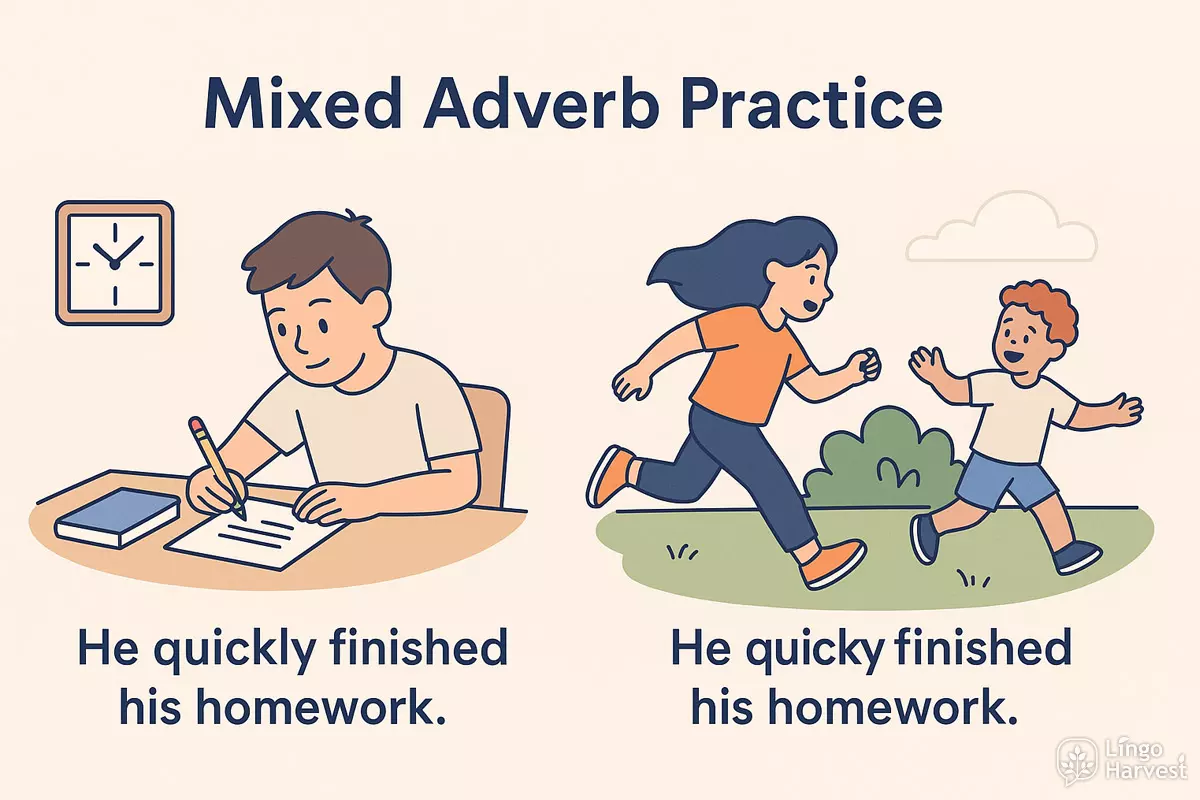
- He quickly finished his homework before dinner. (modifies "finished")
- The children played outside yesterday. (modifies "played")
- She sings beautifully at every concert. (modifies "sings")
- We will meet soon to discuss the project. (modifies "meet")
- Tom rarely eats breakfast at home. (modifies "eats")
- The cat waited patiently by the door. (modifies "waited")
- They will leave immediately if it starts raining. (modifies "leave")
- My friend speaks French fluently. (modifies "speaks")
- He arrived late because of traffic. (modifies "arrived")
- The teacher explained the lesson clearly. (modifies "explained")
- She almost forgot her keys. (modifies "forgot")
- We always walk to school together. (modifies "walk")
- I am completely ready for the test. (modifies "ready")
- He never misses a meeting. (modifies "misses")
- The dog barked loudly at the stranger. (modifies "barked")
- She answered the question correctly. (modifies "answered")
- We traveled abroad last summer. (modifies "traveled")
- The movie started early. (modifies "started")
- He usually drinks coffee in the morning. (modifies "drinks")
- The team worked together to solve the problem. (modifies "worked")
Common Adverb Corrections
For more structured understanding, see how the original sentences were improved by inserting or moving adverbs. This helps recognize patterns and avoid typical pitfalls.
| Incorrect Sentence | Corrected Sentence |
|---|---|
| She sings beautiful at every concert. | She sings beautifully at every concert. |
| He arrived lately because of traffic. | He arrived late because of traffic. |
| Tom eats rarely breakfast at home. | Tom rarely eats breakfast at home. |
| My friend speaks French fluent. | My friend speaks French fluently. |
| The teacher explained clearly the lesson. | The teacher explained the lesson clearly. |
Check your answers with the examples above. If your corrections differ, review the function and placement of adverbs in your sentences. Remember, adverbs can describe how, when, where, or how often something happens. Practicing these patterns will help you gain confidence and accuracy in your writing.
Short extra practice with open-ended tasks
Looking for more ways to strengthen your understanding of adverb use? Try the following open-ended exercises. These tasks are designed to help you not only spot mistakes but also to think creatively about sentence construction and adverb placement.
Rewrite the Sentences
Below are several sentences with missing or misplaced adverbs. Rewrite each sentence, adding or moving an adverb to make the meaning clearer or more natural. Feel free to use any adverb that fits.
- She finished her homework.
- The cat waited by the door.
- He speaks to his friends.
- They arrived at the party.
- I understood the instructions.
- The baby fell asleep.
- We finished the project.
- He opened the window.
- They cleaned the room.
- She answered the question.
Show answers
- She quickly finished her homework.
- The cat patiently waited by the door.
- He always speaks politely to his friends.
- They finally arrived at the party.
- I immediately understood the instructions.
- The baby suddenly fell asleep.
- We successfully finished the project.
- He slowly opened the window.
- They thoroughly cleaned the room.
- She confidently answered the question.
Open-ended Correction
Each sentence below contains an error in adverb placement or choice. Rewrite the sentence to correct it. There may be more than one way to fix each example.
- Rarely I have seen such a beautiful sunset.
- She speaks French fluently very.
- He drives to work fast usually.
- Almost they finished the project.
- He completely not understood the question.
- Often she late arrives to class.
- He loudly always complains about the noise.
- Sometimes I forget nearly my keys.
- They quickly the room cleaned.
- He already has left never early.
Show answers
- I have rarely seen such a beautiful sunset.
- She speaks French very fluently.
- He usually drives to work fast.
- They almost finished the project.
- He did not completely understand the question.
- She often arrives late to class.
- He always complains loudly about the noise.
- I nearly always forget my keys. / I sometimes nearly forget my keys.
- They quickly cleaned the room.
- He has never left early already. (Preferred: He has never left early.)
Adverb Variety Challenge
Try using a different adverb in each of the following sentences to change the meaning. Write at least two versions for each sentence, using adverbs that indicate time, frequency, manner, or degree.
- She answered the question.
- He left the room.
- The baby cried.
- I finished my meal.
- They opened the window.
- He cleaned his desk.
- We started the meeting.
- She closed the book.
- I woke up early.
- The dog ran away.
Show answers
- She quickly answered the question. / She thoughtfully answered the question.
- He suddenly left the room. / He quietly left the room.
- The baby loudly cried. / The baby rarely cried.
- I finally finished my meal. / I barely finished my meal.
- They slowly opened the window. / They carefully opened the window.
- He neatly cleaned his desk. / He quickly cleaned his desk.
- We officially started the meeting. / We immediately started the meeting.
- She gently closed the book. / She quickly closed the book.
- I unexpectedly woke up early. / I suddenly woke up early.
- The dog quickly ran away. / The dog suddenly ran away.
Common Adverbs: Quick Reference
Here is a list of common adverbs that you can use to add detail and variety to your writing. Try using several of them in your own sentences as extra practice:
- quickly
- usually
- never
- always
- rarely
- easily
- softly
- almost
- completely
- finally
- sometimes
- loudly
- immediately
- often
- carefully
- barely
- politely
- eventually
Feel free to mix and match these adverbs in your own examples. The more you experiment, the more confident you’ll become in using them naturally.