Sentence Adverbs: honestly, fortunately, surprisingly

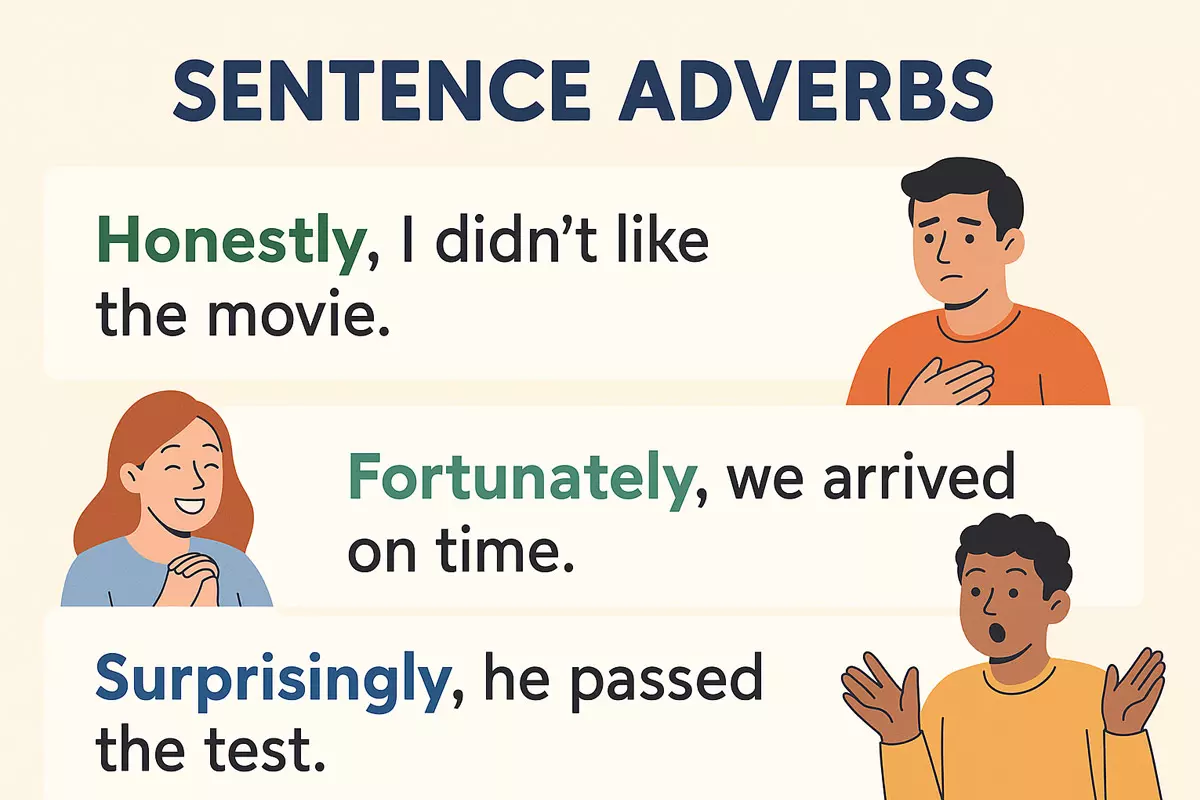 This article explains what sentence adverbs express, how they comment on whole statements, and where to place them in sentences. It covers formality in spoken versus written English, common sentence adverbs, examples, and practice exercises.
Have you ever noticed how a single word can immediately influence the mood or reveal the writer’s attitude in a piece of writing? Words such as honestly, fortunately, or surprisingly serve this purpose by adding emotion, perspective, or nuance to a statement. These words help shape the tone and guide readers through the narrative, making the author’s viewpoint clearer and the reading experience more engaging. By choosing such words carefully, writers can subtly influence how their message is received and understood.
What sentence adverbs express
Sentence adverbs are used to comment on the whole statement, rather than just a single verb or action. They allow the speaker or writer to show their attitude, opinion, or evaluation about what they're saying. These words often set the tone for the sentence, making it clear if the message is meant to be taken seriously, humorously, or with some reservation.
Types of meaning conveyed by sentence adverbs
The function of adverbs like "honestly," "fortunately," and "surprisingly" is to signal how the information should be interpreted. Here are some typical uses:
- Attitude or opinion: "Frankly," "honestly," "personally"
- Evaluation of information: "Fortunately," "sadly," "regrettably"
- Expectation or surprise: "Surprisingly," "predictably," "naturally"
- Certainty or doubt: "Clearly," "obviously," "apparently"
- Generalization or limitation: "Generally," "typically," "ideally"
- Connecting or sequencing: "Firstly," "finally," "meanwhile"
Common sentence adverbs and their effects
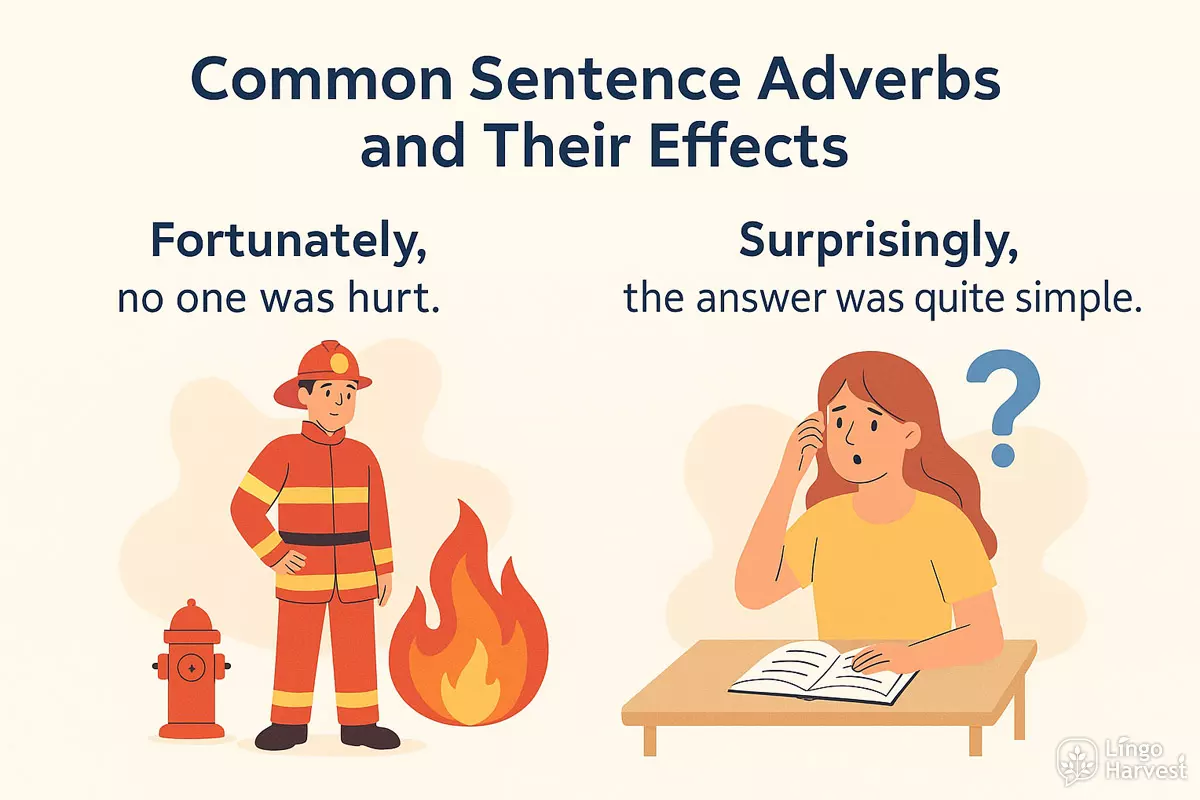
Some sentence adverbs express positive or negative reactions, while others simply clarify the speaker’s stance. Here are several examples:
- Honestly, I didn’t expect him to win. ❌ (too informal for academic writing)
- Fortunately, no one was hurt. ✅
- Surprisingly, the answer was quite simple. ✅
- Regrettably, we missed the train. ✅
- Clearly, she’s made up her mind. ✅
- Apparently, the meeting was canceled. ✅
- Frankly, this isn’t good enough. ❌ (can sound rude or confrontational)
- Ideally, we should start earlier. ✅
- Typically, he arrives late. ✅
- Thankfully, help arrived quickly. ❌ (not recommended in formal writing)
- Unfortunately, the weather was terrible. ✅
- Personally, I prefer coffee. ❌ (too subjective for academic tone)
- First, let’s check the schedule. ✅
- Finally, we reached our goal. ✅
- Seriously, you can’t be suggesting that. ❌ (informal/emotional)
How sentence adverbs differ from other adverbs
Unlike adverbs that modify only a verb ("He ran quickly"), these special adverbs comment on the whole situation or statement. They often appear at the beginning of a sentence, separated by a comma, but can also come at the end or in the middle for emphasis.
Summary of core functions
Sentence adverbs are valuable tools for expressing emotion, judgment, and perspective. They help listeners and readers understand the speaker’s attitude, making communication richer and more precise. Whether expressing relief, surprise, criticism, or certainty, these words frame the message and clarify intent.
How they comment on the whole statement
Sentence adverbs like "honestly," "fortunately," and "surprisingly" express the speaker’s attitude toward the entire idea in the sentence, not just a single verb or noun. Rather than modifying a specific action, these adverbs provide commentary on the truth, emotion, or unexpectedness of the statement as a whole. For example, when someone says, "Honestly, I didn’t expect that result," the word "honestly" signals that the speaker is sharing a candid opinion about the entire situation.
Functions and placement in sentences
Typically, these adverbs appear at the beginning of a sentence, but they can also be found in mid or end positions for stylistic reasons. Their primary function is to set the tone or context for what follows, helping listeners or readers grasp the speaker’s intended nuance.
- Honestly – suggests sincerity or truthfulness regarding the statement.
- Fortunately – indicates that the speaker sees the situation as positive or lucky.
- Surprisingly – shows that the information is unexpected.
- Frankly – emphasizes directness or openness.
- Regrettably – signals that something is unfortunate.
- Clearly – implies the statement is obvious to the speaker.
- Sadly – adds a note of sadness or disappointment.
- Hopefully – expresses a wish or desire for the situation.
- Apparently – suggests the information is based on what seems to be true.
- Thankfully – conveys gratitude about the outcome.
- Interestingly – highlights an intriguing aspect of what is being said.
- Undoubtedly – stresses certainty about the statement.
- Admittedly – concedes a point before stating it.
- Presumably – indicates an assumption.
- Unbelievably – marks something as hard to believe.
- Unfortunately – introduces bad news or disappointment.
- Ideally – expresses what would be best in theory.
- Seriously – underlines the sincerity or gravity of the statement.
Comparing effects of different sentence adverbs
The choice of adverb shapes the listener’s expectations. Using "fortunately" before a statement frames it positively, while "sadly" does the opposite. This small change can completely alter the emotional impact of what’s being communicated.
| Sentence Adverb | Effect on the Statement |
|---|---|
| Honestly | Signals sincerity or truthfulness; emphasizes the speaker’s genuine feelings. |
| Fortunately | Highlights a positive or lucky outcome; shifts the tone to optimism. |
| Surprisingly | Indicates unexpectedness; prepares the listener for something unusual. |
| Regrettably | Introduces disappointment or an unfortunate fact; expresses regret. |
| Clearly | Shows confidence in the statement’s obviousness; reduces ambiguity. |
| Sadly | Adds a note of sorrow or disappointment to the message. |
| Apparently | Suggests information is based on appearance, not certainty. |
Sentence adverbs are especially useful in both spoken and written English to clarify your stance or emotional response, making communication more nuanced and expressive. The choice and placement of these words help guide your audience’s interpretation of the entire message.
Placement rules at the beginning, middle, and end
Sentence adverbs like "honestly," "fortunately," and "surprisingly" can be positioned in various places within a sentence to create subtle differences in tone or emphasis. Where you place these adverbs affects both the rhythm of your writing and the nuance of your statement. Let's look at how their placement changes meaning and flow.
At the Beginning
Starting a sentence with an adverb sets the tone immediately. This is common when the writer wants to frame the entire sentence with a particular attitude or emotion. For example:
- Honestly, I didn't expect him to arrive so early.
- Fortunately, the rain stopped just in time for the ceremony.
- Surprisingly, she agreed to the proposal without hesitation.
Beginning placement is especially useful in both written and spoken English to clearly signal the speaker's perspective or reaction.
In the Middle
Placing a sentence adverb after the subject (or between clauses) is also common, especially in formal writing. This position tends to be less forceful but still provides commentary. Examples:
- She, honestly, had no idea what was happening.
- The team, fortunately, found a solution before the deadline.
- He has, surprisingly, finished the project ahead of schedule.
When used mid-sentence, these adverbs are usually set off by commas to indicate their parenthetical nature.
At the End
Ending a sentence with an adverb is less common but can be impactful, especially in informal contexts. This placement can add a reflective or afterthought quality:
- I didn't see the warning signs, honestly.
- We made it to the airport on time, fortunately.
- The results were better than expected, surprisingly.
This arrangement often suggests that the adverb qualifies the entire preceding statement.
Quick Reference: Placement and Effect
| Position | Effect & Example |
|---|---|
| Beginning | Sets the tone for the whole sentence. → Honestly, I was surprised by the results. |
| Middle | Acts as a parenthetical comment, softening or clarifying the statement. → The team, fortunately, avoided delays. |
| End | Adds an afterthought or reflective note. → She finished the test on time, surprisingly. |
Tips for Natural Placement
- Use commas to separate sentence adverbs when they occur at the beginning or in the middle.
- For emphasis or dramatic effect, start with the adverb.
- To blend the adverb more subtly, insert it mid-sentence.
- End placement can sound casual or conversational.
- Not every sentence needs a sentence adverb; use them to highlight attitude, not just for style.
By adjusting where you place sentence adverbs, you can fine-tune the tone and clarity of your English writing.
Formality levels: spoken vs written English
Sentence adverbs like honestly, fortunately, and surprisingly appear in both conversation and writing, but their tone and frequency can differ depending on the context. In casual speech, these adverbs often convey attitude, reactions, or emotions, making the speaker’s stance clear. In formal writing, they add nuance or guide the reader’s interpretation, but overuse can make the text seem subjective or informal.
Usage in conversation
- Honestly: Common in speech to emphasize sincerity or personal opinion (e.g., "Honestly, I didn’t expect that result.").
- Fortunately: Used to highlight positive outcomes, often as a transition ("Fortunately, nobody was hurt.").
- Surprisingly: Expresses unexpectedness, sometimes with a touch of emphasis ("Surprisingly, he agreed right away.").
In spoken English, sentence adverbs usually sound natural at the start of a statement, and speakers often use them to signal their feelings or reactions in real time.
Use in formal and academic writing
In more formal or academic texts, sentence adverbs add commentary or clarify the writer’s stance. However, they should be used with moderation. Over-reliance on adverbs like honestly can make arguments seem subjective or less objective, while fortunately and surprisingly are generally acceptable when reporting results or drawing attention to unexpected findings.
| Adverb | Typical Context | Formality Level | Sample Sentence |
|---|---|---|---|
| Honestly | Expressing personal opinion or sincerity | Informal | Honestly, I think this plan will fail. |
| Fortunately | Reporting positive or lucky outcomes | Neutral/Formal | Fortunately, the data confirmed our hypothesis. |
| Surprisingly | Highlighting unexpected results | Neutral/Formal | Surprisingly, very few students objected. |
| Frankly | Direct or blunt personal comment | Informal | Frankly, your answer wasn’t convincing. |
| Regrettably | Reporting negative outcomes in formal style | Formal | Regrettably, the experiment failed. |
| Admittedly | Conceding a point, especially in argument | Neutral/Formal | Admittedly, this approach has limitations. |
| Clearly | Stating something obvious or well-supported | Neutral/Formal | Clearly, more research is needed. |
| Undoubtedly | Emphasizing certainty | Formal | Undoubtedly, climate change is a global issue. |
| Presumably | Indicating assumption | Formal | Presumably, the results will be published soon. |
| Luckily | Expressing positive outcome informally | Informal | Luckily, I caught the last bus home. |
Choosing the right adverb for the setting
When selecting a sentence adverb, consider the audience and purpose. In everyday conversation, personal and expressive adverbs fit naturally. For academic papers or professional correspondence, favor more neutral or objective options, and limit direct expressions of feeling. If in doubt, review examples from similar texts to match the expected tone.
Common sentence adverbs and their functions
Sentence adverbs are special words that comment on an entire statement, rather than just a verb or adjective. They help the speaker or writer express their attitude, opinion, or perspective about what they’re saying. For instance, words like honestly, fortunately, and surprisingly set the tone for the message that follows. These adverbs often appear at the start of a sentence, but can sometimes be placed elsewhere for emphasis or style.
What do sentence adverbs do?
These adverbs serve several purposes in communication:
- Show the speaker’s feelings or attitude (e.g., frankly, sadly)
- Indicate how likely something is (e.g., probably, undoubtedly)
- Express the manner of speaking (e.g., honestly, seriously)
- Signal contrast or unexpectedness (e.g., surprisingly, ironically)
- Provide structure or transitions in discourse (e.g., firstly, consequently)
Examples of common sentence adverbs
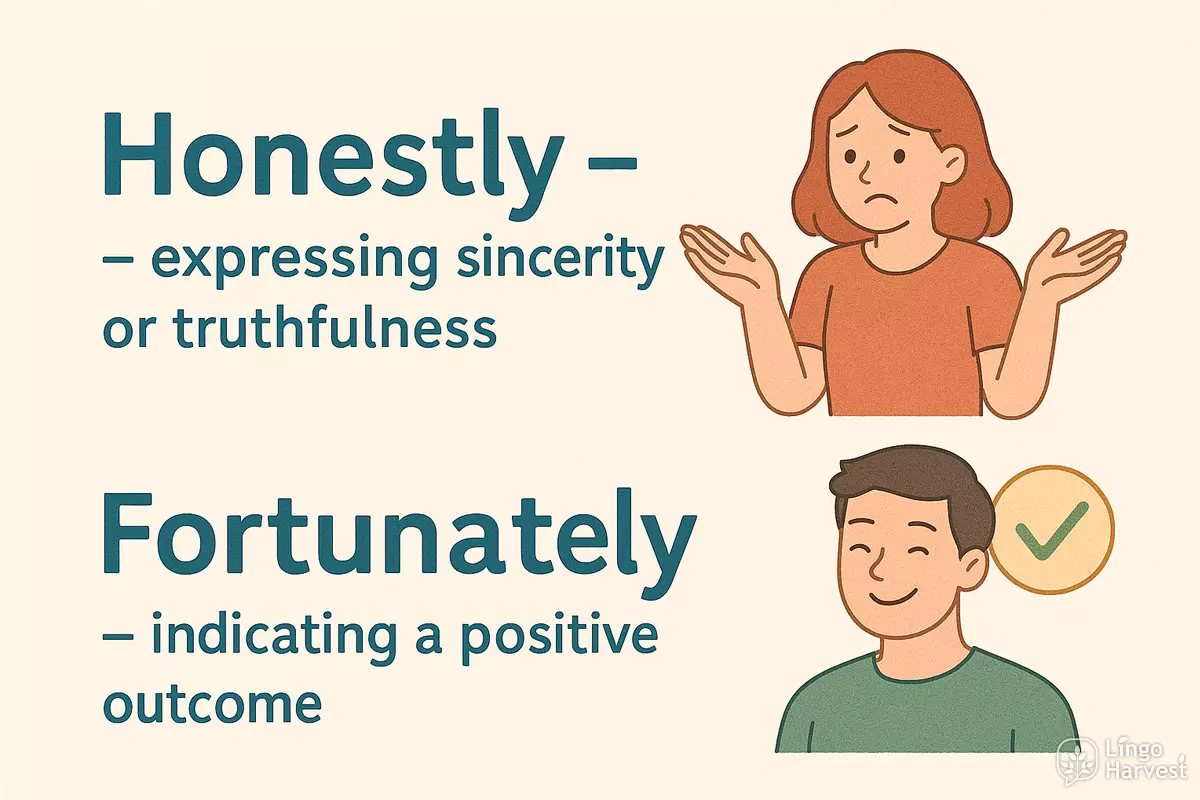
Here are some widely used sentence adverbs, each serving a slightly different function:
- Honestly – expressing sincerity or truthfulness
- Fortunately – indicating a positive outcome
- Surprisingly – highlighting something unexpected
- Clearly – showing certainty or obviousness
- Unfortunately – pointing out an undesirable situation
- Apparently – suggesting something seems true based on what is known
- Seriously – emphasizing importance or reality
- Regrettably – expressing regret
- Ideally – describing a preferred or perfect situation
- Frankly – signaling directness or honesty
- Presumably – indicating an assumption
- Thankfully – showing gratitude for a circumstance
- Undoubtedly – expressing certainty
- Briefly – introducing a summary
- Oddly – noting something strange
- Interestingly – drawing attention to something noteworthy
- Ironically – pointing out an ironic situation
- Conceivably – suggesting possibility
How sentence adverbs affect meaning
Placing these adverbs at the beginning of a statement often helps clarify the speaker’s intent. For example, starting with surprisingly signals that what follows may defy expectations. Using fortunately can soften bad news by focusing on a positive aspect.
Comparing their functions
Below is a summary of the nuances behind some of the most frequent sentence adverbs:
| Adverb | Function in a sentence |
|---|---|
| Honestly | Shows sincerity; emphasizes truthfulness or directness. |
| Fortunately | Expresses relief or a positive outcome in a situation. |
| Surprisingly | Highlights something unexpected or out of the ordinary. |
| Unfortunately | Indicates disappointment or a negative result. |
| Apparently | Suggests something seems true based on available evidence. |
| Frankly | Signals openness or bluntness about a topic. |
By using sentence adverbs thoughtfully, you can add nuance, attitude, or clarity to your statements, shaping how your message is received.
Examples in everyday and academic sentences
Sentence adverbs such as "honestly," "fortunately," and "surprisingly" are often used to express the speaker's attitude or comment on the whole statement. In both daily conversation and formal writing, these adverbs help clarify opinions, highlight unexpected outcomes, or show relief. Their placement at the start of a sentence is most common, but they can also appear mid-sentence for emphasis.
Everyday Usage
- Honestly, I didn’t expect you to arrive so early.
- Fortunately, the rain stopped before we left the house.
- Surprisingly, the test was much easier than I thought.
- Honestly, I can’t remember where I put my keys.
- Fortunately, nobody was hurt in the accident.
- Surprisingly, she agreed to join us on such short notice.
- Honestly, that movie was not as good as people said.
- Fortunately, we found a parking spot right away.
- Surprisingly, he passed the exam without studying much.
- Honestly, I prefer tea over coffee.
Academic and Formal Contexts
- Honestly, the data does not support the initial hypothesis.
- Fortunately, recent studies have addressed this gap in the literature.
- Surprisingly, the results contradict earlier research findings.
- Honestly, further investigation is required to draw firm conclusions.
- Fortunately, the methodology was robust enough to ensure reliable outcomes.
- Surprisingly, participant feedback was overwhelmingly positive.
- Honestly, the limitations of this study should not be overlooked.
- Fortunately, funding was secured for the next phase of the project.
- Surprisingly, no significant differences were observed between the groups.
- Honestly, more comprehensive data would strengthen the argument.
Comparison of Sentence Adverbs in Context
| Adverb | Example Sentence |
|---|---|
| Honestly | Honestly, I don’t believe this approach will be effective. |
| Fortunately | Fortunately, the team completed the project ahead of schedule. |
| Surprisingly | Surprisingly, the experiment yielded the desired results on the first attempt. |
Sentence adverbs add nuance, allowing speakers and writers to comment on the truthfulness, luck, or unexpectedness of a statement. In both informal and academic settings, their correct use can make your communication clearer and more engaging.
Practice: rewrite using sentence adverbs
To become more comfortable with sentence adverbs like "honestly," "fortunately," and "surprisingly," try rewriting plain sentences to include these adverbs at the beginning. This practice helps you express attitude, emotion, or reaction in a more nuanced way.
Rewrite the sentences
Below are basic statements. Transform each one by adding a sentence adverb (honestly, fortunately, or surprisingly) at the start. Consider which adverb best fits the context.
- I passed the exam.
- He didn’t call me back.
- They finished the project on time.
- She forgot her keys again.
- It rained during our picnic.
- We found the missing document.
- The shop was closed when we arrived.
- He agreed to help us.
- The results were better than expected.
- I made a mistake on the report.
Show answers
- Fortunately, I passed the exam.
- Honestly, he didn’t call me back.
- Fortunately, they finished the project on time.
- Surprisingly, she forgot her keys again.
- Unfortunately, it rained during our picnic. (Note: "unfortunately" is also a sentence adverb, though not listed in the article; "surprisingly" could fit if the rain was unexpected)
- Fortunately, we found the missing document.
- Unfortunately, the shop was closed when we arrived. ("Surprisingly" could also work if the closure was not expected)
- Surprisingly, he agreed to help us.
- Surprisingly, the results were better than expected.
- Honestly, I made a mistake on the report.
Identify the meaning conveyed
Sentence adverbs set the tone for the whole statement. Match each adverb to the kind of attitude it expresses:
- Honestly: shows sincerity, truthfulness, or frankness.
- Fortunately: expresses relief or good luck.
- Surprisingly: highlights something unexpected.
Make your own examples
Try composing your own sentences using each adverb at the beginning. Aim for at least two sentences with each one:
- Honestly, I didn't enjoy the movie.
- Honestly, this task is more difficult than I thought.
- Fortunately, the weather improved in the afternoon.
- Fortunately, the bus arrived on time.
- Surprisingly, the answer was correct.
- Surprisingly, nobody complained about the noise.
Practicing with sentence adverbs helps you communicate your attitude clearly and naturally in both writing and conversation.