Insert the Adverb: Word Order Challenge

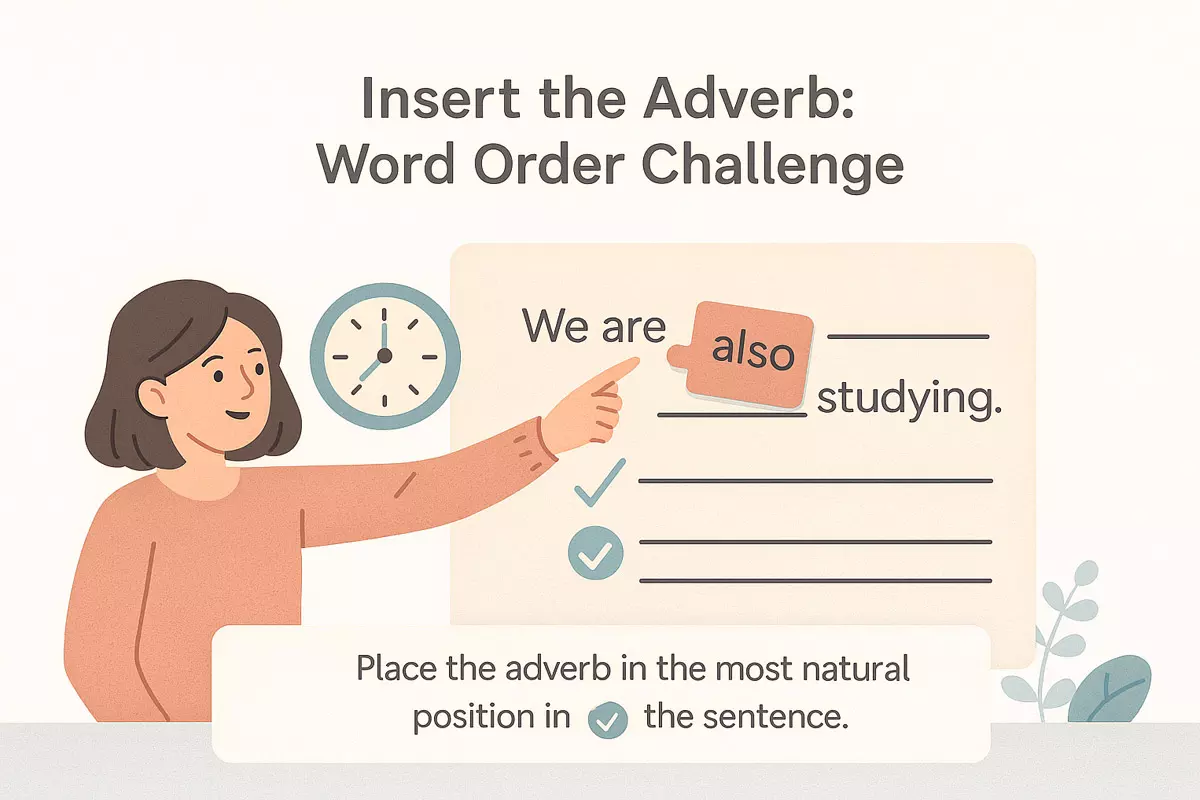 Here we basic rules for adverb placement, shows where to put time, manner, and frequency adverbs, and compares natural and unnatural orders. It includes a short exercise and an answer key with notes on the best adverb positions.
Have you ever wondered where to place tricky modifying words in your sentences? Mastering the placement of adverbs can transform even simple statements into clear, polished English. Knowing whether an adverb should come before or after the verb, or at the beginning or end of a sentence, is essential for effective communication. Practice and attention to word order can help you avoid awkward constructions and make your writing sound more natural. Challenge yourself to spot the best placement for adverbs and improve your grasp of English sentence structure.
Basic rules for adverb position
Understanding where to place adverbs in an English sentence is essential for clarity and natural expression. Adverbs can modify verbs, adjectives, other adverbs, or even whole sentences, and their position often changes the meaning or emphasis.
General principles
The most common locations for adverbs are:
- Before the main verb: She quickly finished her homework.
- After the verb “to be”: He is always happy.
- At the beginning of a sentence (for emphasis): Fortunately, the rain stopped.
- At the end of a sentence: They left quietly.
Some adverbs, especially of frequency (such as “often”, “never”, “usually”), typically appear before the main verb but after an auxiliary verb. Adverbs of manner, place, and time usually go at the end, though not always.
Common types and their typical positions
| Adverb Type | Most Common Position | Example |
|---|---|---|
| Frequency | Before main verb; after “be” | She usually walks / He is never late |
| Manner | End of sentence | He spoke clearly |
| Time | End or start of sentence | We met yesterday / Yesterday, we met |
| Place | End of sentence | They looked everywhere |
| Degree | Before adjective/adverb | It’s very cold / She ran quite fast |
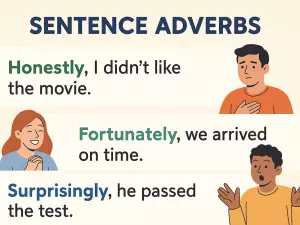
| Sentence adverbs | Start of sentence | Honestly, I disagree |
Special notes and exceptions
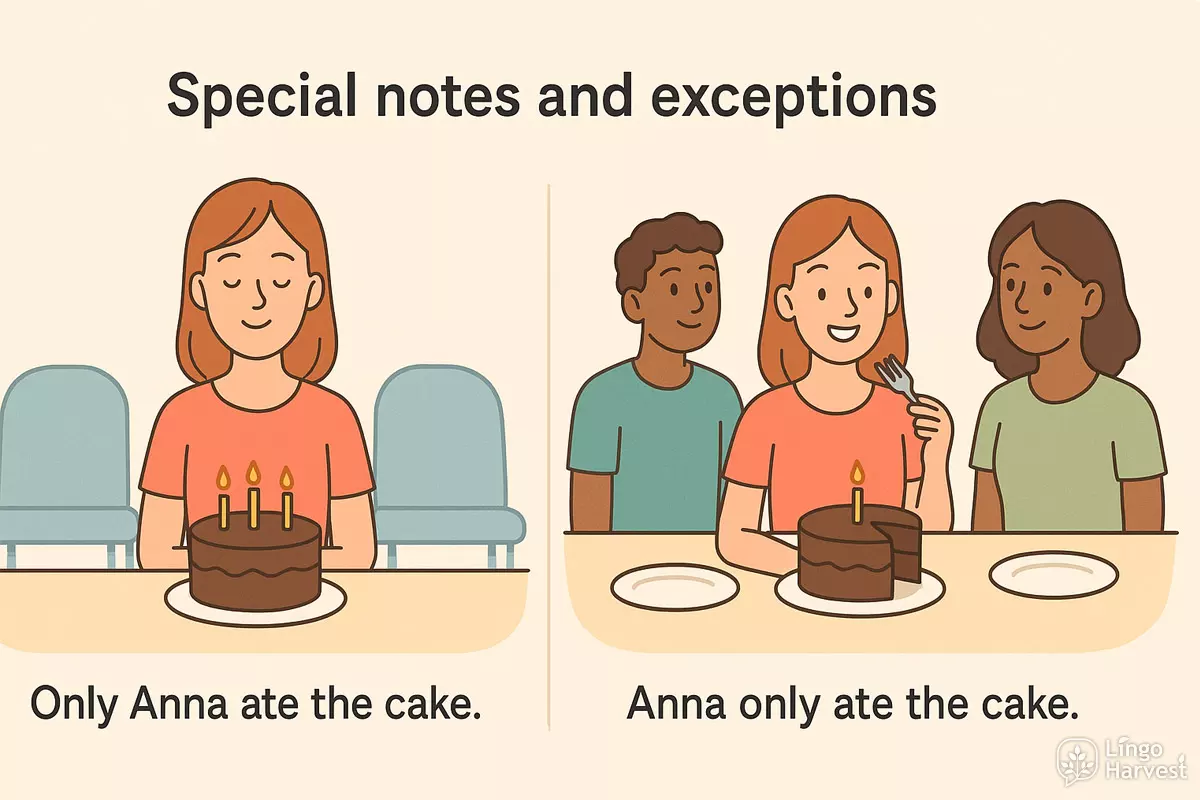
Some adverbs, like “only,” “even,” and “just,” can dramatically change the meaning depending on where they are placed. For example:
- Only Anna ate the cake. (No one else ate it)
- Anna only ate the cake. (She did nothing else with it)
- Anna ate only the cake. (She ate nothing else)
It’s also important to avoid splitting verb phrases unnecessarily. For example, in “She has always been kind,” “always” fits naturally between the auxiliary “has” and the main verb “been.” However, adverbs should not interrupt to-infinitive phrases: He decided quickly to leave (✅), not He decided to quickly leave (❌ in formal writing).
Quick tips for correct placement
- Frequency adverbs (always, never, usually, often, sometimes, rarely, seldom) go before the main verb, but after “be”.
- Adverbs of manner, place, and time usually follow the object or the main verb if there’s no object.
- Don’t put adverbs between a verb and its direct object.
- Sentence adverbs (fortunately, luckily, honestly) typically start the sentence or clause.
- Be mindful: shifting adverbs can subtly change the meaning.
Mastering these patterns helps you place adverbs accurately and express your meaning with confidence.
Common places for time and manner adverbs
Adverbs that describe when or how something happens usually have particular spots in English sentences. Knowing where to insert time and manner adverbs can make your sentences sound more natural and clear. Let’s look at how these adverb types typically fit into word order.
Time Adverbs: Usual Positions
Words like "yesterday," "soon," "now," or "every week" tend to appear at the beginning or end of a sentence. Placing them at the end is often the default, but starting with a time adverb can add emphasis or context.
- He called me yesterday.
- Every morning, she drinks tea.
- I will finish the project soon.
- Last year, we traveled to Japan.
- We have a meeting tomorrow.
- At 8 o’clock, the show begins.
- The bus leaves in five minutes.
- She moved here recently.
- After dinner, I usually read.
- Let’s meet next week.
- I haven’t seen him lately.
- She will arrive in two hours.
- On Monday, we start the new project.
- We go jogging every evening.
- The results will be ready soon after.
Manner Adverbs: Where They Sit
Adverbs like "quickly," "carefully," "loudly," or "well" describe how something is done. These often come after the main verb or after the object if there is one.
- He spoke softly.
- They finished the work efficiently.
- She sang the song beautifully.
- He answered the question correctly.
- The dog barked loudly.
- She drives carefully.
- He laughed happily.
- I solved the puzzle easily.
- She writes neatly.
- They played enthusiastically.
- He reacted angrily when he heard the news.
- She responded politely to the question.
- The baby slept peacefully all night.
- They moved slowly through the crowd.
- He worked diligently on his project.
Comparing Placement: Time vs. Manner
Sometimes, both types appear together. Their usual order is: verb + object + manner adverb + time adverb. Here’s a comparison:
| Sentence | Adverb Placement |
|---|---|
| She finished her homework quickly yesterday. | Manner adverb before time adverb at the end |
| Yesterday, she finished her homework quickly. | Time adverb at the start, manner adverb at the end |
| He answered the question correctly this morning. | Manner adverb before time adverb at the end |
| This morning, he answered the question correctly. | Time adverb at the start, manner adverb at the end |
Quick Tips
- Place time expressions at the start for emphasis, or at the end for a neutral tone.
- Manner adverbs usually come after the verb or object, but rarely before the main verb in simple tenses.
- If both adverb types are present, manner comes before time at the end of the sentence.
Understanding these common patterns helps you confidently insert adverbs for clearer, more natural English sentences.
Where to put frequency adverbs in simple tenses
Understanding the usual placement of frequency adverbs like “always,” “never,” and “sometimes” can make your English much clearer. In simple verb tenses—such as the present simple or past simple—these adverbs typically appear in specific spots within the sentence. Knowing these patterns helps your sentences sound natural and avoids confusion.
Standard Position: Between Subject and Main Verb
For most statements in the present or past simple, frequency adverbs go right after the subject but before the main verb. For example:
- I always eat breakfast.
- She never drinks coffee.
- We often walk to school.
- They rarely watch TV.
- He sometimes forgets his keys.
- You usually take the bus to work.
- My brother occasionally visits us.
- The students frequently ask questions.
- She hardly ever eats fast food.
- We regularly practice English.
With the Verb “To Be”
When you use the verb “to be” (am, is, are, was, were), the adverb comes after the verb, not before it. For example:
- She is always happy.
- We are usually on time.
- I am never late.
- They were often tired.
- He is sometimes rude.
- You are rarely wrong.
- The kids are frequently noisy.
- My boss is hardly ever at the office.
- The room was constantly cold.
- The streets are occasionally crowded.
Negative Sentences and Questions
In negatives and questions, frequency adverbs keep their logical place:
- He doesn’t usually play chess.
- Do you ever eat sushi?
- We don’t often go out.
- Does she always arrive early?
- They don’t normally work on weekends.
- Do you sometimes forget names?
- She doesn’t rarely make mistakes.
- Do they usually cook at home?
- We don’t ever argue.
- Does he frequently travel abroad?
Comparing Adverb Placement
| Sentence Type | Adverb Position Example |
|---|---|
| Present Simple (main verb) | They often read books. |
| Present Simple (“to be”) | He is always polite. |
| Negative form | She doesn’t usually swim. |
| Question | Do you ever travel abroad? |
Common Frequency Adverbs
Here are some of the most widely used frequency adverbs, from most to least frequent:
- Always
- Usually
- Frequently
- Often
- Regularly
- Sometimes
- Occasionally
- Seldom
- Rarely
- Hardly ever
- Never
- Almost always
- Nearly always
- From time to time
- Every now and then
- Not very often
- Once in a while
- Hardly at all
- Scarcely ever
- Practically never
Mastering the placement of these adverbs in simple tenses lets you express routines, habits, and exceptions with confidence. As you practice, try moving the adverb to the correct spot and see how the meaning or flow changes—this is a great way to develop an instinct for word order in English.
Examples of natural vs unnatural order
Understanding where adverbs fit can be tricky, especially for learners. In English, some word orders just sound right—while others, even if technically possible, feel odd or forced. Let’s look at how adverbs shift the feel of a sentence depending on their placement.
Natural Adverb Placement
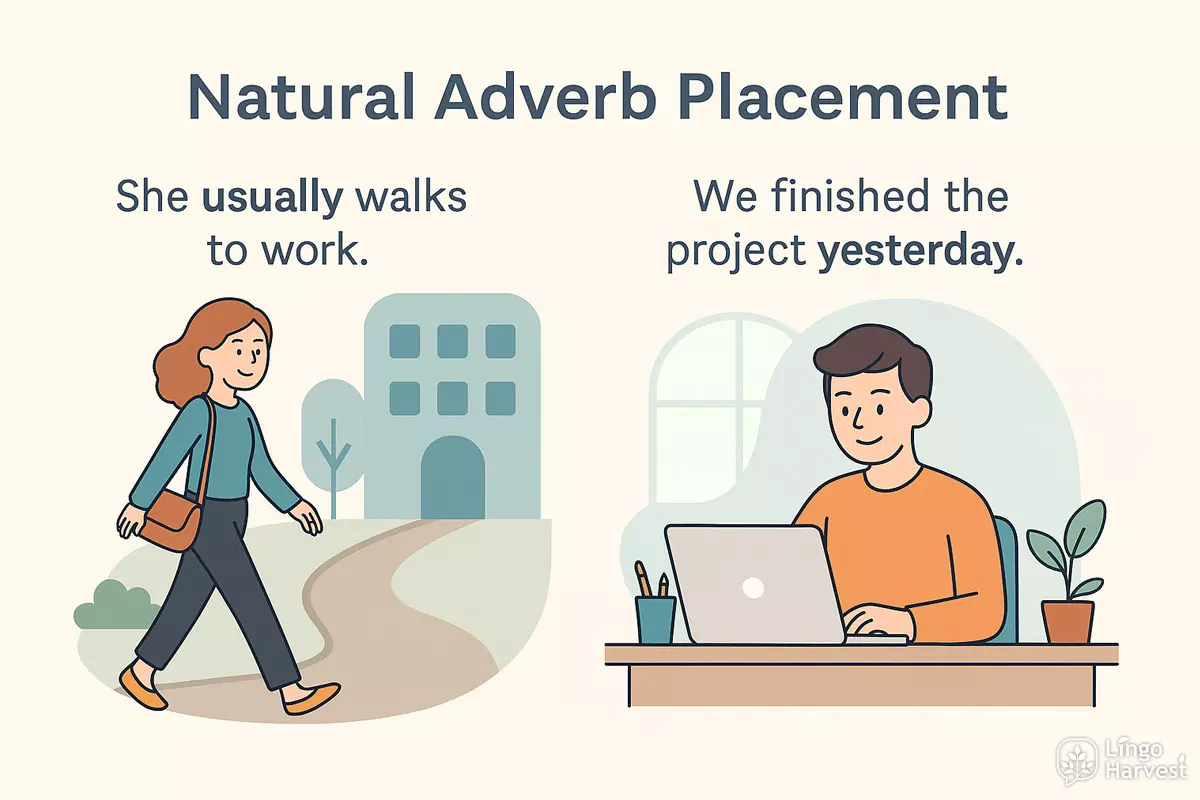
Most native speakers instinctively place adverbs in positions that flow smoothly. For instance, frequency adverbs (like "always" or "never") typically go before the main verb but after the subject. Time adverbs, on the other hand, are often found at the end or beginning of a sentence. Here are some natural-sounding examples:
- She usually walks to work.
- We finished the project yesterday.
- Quickly, he grabbed his coat and left.
- They have never been to Paris.
- I will see you tomorrow.
- He can easily solve this problem.
- The children are always happy to play outside.
- Suddenly, the lights went out.
- She almost missed the bus.
- They rarely eat out.
Unnatural or Awkward Arrangements
When adverbs are placed in unusual spots, sentences may sound clumsy or hard to process. While these constructions aren’t always strictly incorrect, they can disrupt the reader’s or listener’s understanding.
- She walks usually to work. ❌ → She usually walks to work. ✔️
- We yesterday finished the project. ❌ → We finished the project yesterday. ✔️
- He grabbed quickly his coat and left. ❌ → He quickly grabbed his coat and left. ✔️
- They have been to Paris never. ❌ → They have never been to Paris. ✔️
- Will I see you tomorrow. ❌ → Will I see you tomorrow? ✔️
- He solves easily this problem. ❌ → He easily solves this problem. ✔️ / He solves this problem easily. ✔️
- The children happy are always to play outside. ❌ → The children are always happy to play outside. ✔️
- The lights went suddenly out. ❌ → The lights suddenly went out. ✔️
- She missed almost the bus. ❌ → She almost missed the bus. ✔️
- They eat out rarely. ❌ (awkward) → They rarely eat out. ✔️
- He speaks English very good. ❌ → He speaks English very well. ✔️
- She usually is late to work. ❌ → She is usually late to work. ✔️
- I drink always coffee in the morning. ❌ → I always drink coffee in the morning. ✔️
- They go seldom to the cinema. ❌ → They seldom go to the cinema. ✔️
- You are driving too fastly. ❌ → You are driving too fast. ✔️
- He finished quickly the task. ❌ → He quickly finished the task. ✔️ / He finished the task quickly. ✔️
- We are going tomorrow to the beach. ❌ → We are going to the beach tomorrow. ✔️
- She answered the question wrong. ❌ → She answered the question incorrectly. ✔️ / She got the answer wrong. ✔️
- He almost every day goes to the gym. ❌ → He goes to the gym almost every day. ✔️
- The teacher explained clearly the rule. ❌ → The teacher clearly explained the rule. ✔️ / The teacher explained the rule clearly. ✔️
Comparing Word Order at a Glance
For a clearer contrast between smooth and awkward structures, here’s a side-by-side comparison:
| Natural order ✅ | Unnatural order ❌ |
|---|---|
| He quickly answered the question. | He answered quickly the question. |
| They never eat meat. | They eat never meat. |
| Usually, I drink coffee in the morning. | I drink coffee in the morning usually. |
| She almost forgot her keys. | She forgot almost her keys. |
| We will visit you tomorrow. | We will tomorrow visit you. |
Key Takeaways
Positioning adverbs thoughtfully helps sentences sound natural and easy to understand. Practicing with real examples, like those above, can sharpen your intuition for what “sounds right” in English.
Short exercise: insert adverbs into given sentences
Practicing adverb placement helps improve both understanding and fluency in English. Below, you’ll find a series of sentences with missing adverbs. Your task is to choose a logical adverb and insert it in the most natural position. Pay attention to the type of adverb (frequency, manner, degree, etc.) and the usual word order in English sentences.
Quick practice: Where does the adverb go?
Read each sentence and decide where the adverb fits best. Try to use a variety of adverbs (such as "quickly", "always", "rarely", "carefully", "almost", "already", "never", "just", "still", "often").
Common adverbs for practice
- always
- never
- quickly
- carefully
- almost
- already
- just
- still
- rarely
- often
- usually
- hardly
- completely
- sometimes
- frequently
- immediately
- nearly
- really
- She ________ goes to the gym before work.
- We have ________ finished our homework.
- He drives ________, so be careful when you’re with him.
- I ________ eat breakfast at home.
- The teacher explained the problem ________.
- They have ________ arrived at the airport.
- My cat ________ sleeps on my bed.
- Sam ________ forgets to bring his lunch.
- Lisa completed the project ________.
- The children are ________ playing outside.
- We ________ see snow in this part of the country.
- He is ________ late for his appointments.
- The movie was ________ interesting.
- I have ________ met his parents.
- The bus ________ arrives on time.
Tips for correct placement
Frequency adverbs (like "always", "never", "often") typically go before the main verb but after "be" verbs. Manner adverbs (such as "quickly", "carefully") usually follow the main verb or go at the end of the sentence. Adverbs of degree ("almost", "completely") often come before the adjective or another adverb.
Show answers
- always
- already
- quickly
- usually
- carefully
- already
- often
- sometimes
- completely
- still
- rarely
- never
- really
- never
- usually
Answer key with notes on the best position
Understanding where to place adverbs in English sentences can be tricky, especially when word order changes meaning or emphasis. Below you'll find model answers for a range of common adverbs, along with commentary on why each position is preferable in context.
General principles for adverb placement
Adverbs typically go in one of three places:
- Front position (before the subject): Sometimes, especially for emphasis or style.
- Mid position (before the main verb, after auxiliary verbs): This is most common for adverbs of frequency and manner.
- End position (after the object or verb): Often used for adverbs of manner, place, and time.
Sample sentences with ideal adverb placement
Below are example sentences, showing the best spot for each adverb. Notes explain why that position is preferred.
- I always eat breakfast at 7 a.m. (Frequency adverb before the main verb)
- She has already finished her homework. ('Already' goes after the auxiliary verb)
- They will probably arrive late. ('Probably' before the main verb, after the modal)
- He speaks English fluently. (Manner adverb at the end)
- Usually, we go for a walk after lunch. (For emphasis, 'usually' at the beginning)
- The train left yesterday. (Adverb of time at the end)
- You can never be too careful. ('Never' before the main verb, after modal)
- I have just seen her. ('Just' after auxiliary 'have')
- He answered the question correctly. (Manner adverb at the end)
- We rarely watch TV. (Frequency adverb before the main verb)
- She is always cheerful. (After 'be' verb, before adjective)
- They arrived early. (Time adverb at the end)
- He quickly finished his meal. (Manner adverb before the main verb for emphasis)
- We will meet tomorrow. (Time adverb at the end)
- The cat is often hungry. (After 'be' verb, before adjective)
- I can hardly believe it. ('Hardly' before the main verb, after modal)
- They sometimes forget their keys. (Frequency adverb before the main verb)
- He reads quietly in the library. (Manner adverb at the end)
- We recently moved here. (Time adverb before the main verb)
- I have never visited Japan. ('Never' after auxiliary 'have')
Comparing adverb positions: When options exist
Some adverbs can move depending on emphasis or style. Here’s a comparison of possible placements and their effects:
| Sentence | Effect/Note |
|---|---|
| Usually, I drink coffee in the morning. | Emphasizes routine by fronting 'usually'. |
| I usually drink coffee in the morning. | Standard, neutral statement of frequency. |
| I drink coffee in the morning, usually. | ‘Usually’ at the end for informal or conversational tone. |
| She quickly answered the question. | Highlights the speed of action; more formal or literary. |
| She answered the question quickly. | Standard, most common word order for manner adverbs. |
Key takeaways
- Place adverbs of frequency before the main verb, but after “be” verbs.
- Adverbs of manner usually go at the end, but can be moved for emphasis.
- Time adverbs often appear at the end, but can go at the start for stylistic reasons.
- Multiple adverbs can be used together, but keep their typical order: manner → place → time.
Experiment with these guidelines to improve clarity and natural flow in your writing.