Main Verbs and Auxiliary Verbs: How English Verbs Really Work

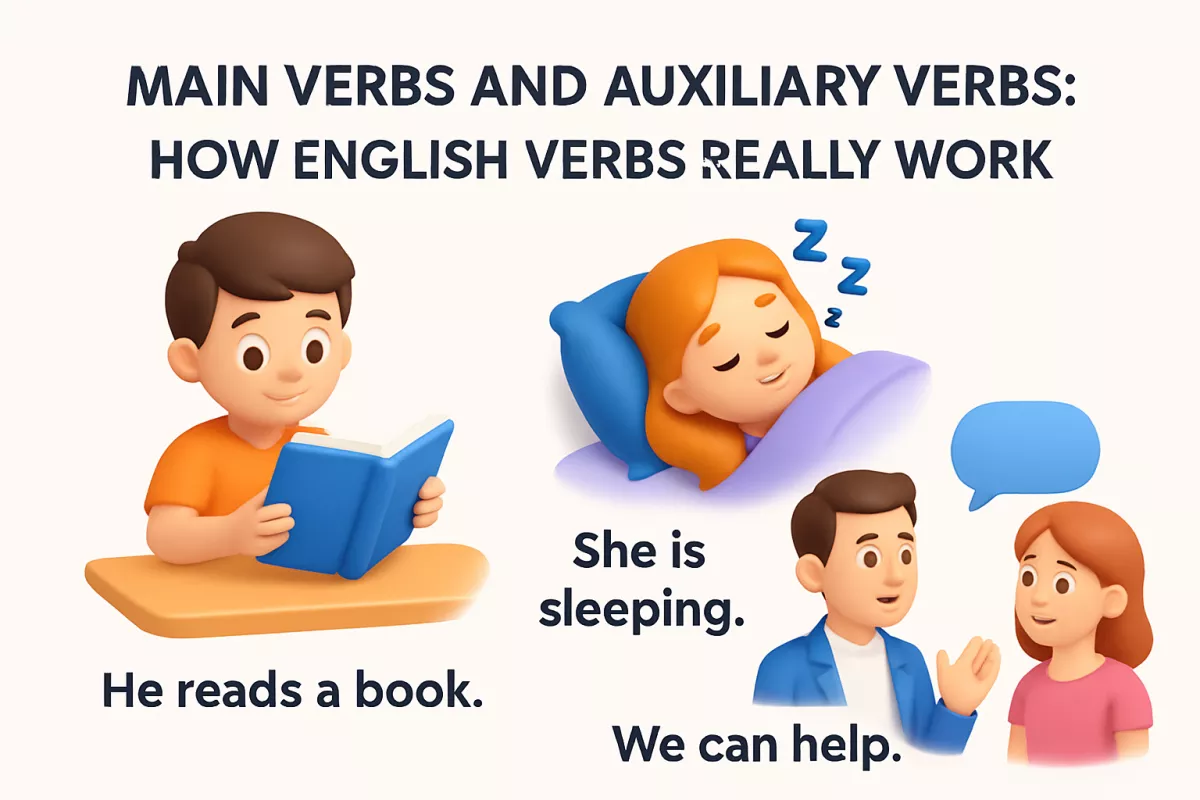 Here we the difference between main and auxiliary verbs, how auxiliaries like be, have, do, and modals create tense, aspect, and voice, their use in questions and negatives, common mistakes, and offers exercises to practice main versus auxiliary verbs.
- What main verbs and auxiliary verbs are
- How auxiliaries build tense, aspect, and voice
- The three core auxiliaries: be, have, do
- Modals as auxiliaries: can, will, should
- Auxiliaries in questions and negatives
- Short answers and auxiliary verbs
- Common mistakes with auxiliaries
- Homework: main vs auxiliary verb exercises
Have you ever noticed that English often uses more than one verb to express a single idea? In many sentences, one verb carries the main meaning (the action or state), while another verb helps to “build” the grammar around it — showing time, duration, completion, possibility, or passive meaning. Once you can spot the main verb and the helping verb, your sentences become clearer, more accurate, and much easier to control in both speaking and writing.
What main verbs and auxiliary verbs are
English verbs usually work in a team. The main verb carries the core meaning, while an auxiliary verb adds grammatical information such as tense, aspect, voice, and mood. This partnership is one of the most practical grammar skills you can learn, because it explains why English forms like is sleeping, has finished, or will go behave the way they do.
Main verbs: the action or state
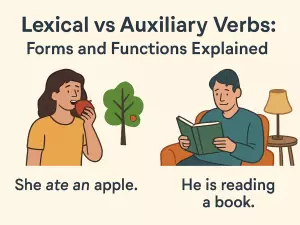
A main verb (also called a lexical verb) tells what the subject actually does or what state the subject is in. It answers the basic question: What happens? Main verbs can stand alone (She sings.) or appear after auxiliaries (She is singing.), but they always carry the key meaning of the sentence.
- run → I run every morning.
- think → I think this idea is useful.
- eat → We eat dinner at six.
- sleep → The baby sleeps well at night.
- believe → I believe you.
- laugh → They laughed at the joke.
- arrive → She arrived late.
- grow → Children grow quickly.
- change → Plans can change.
- feel → I feel tired today.
- remember → I remember your name.
- drive → He drives to work.
- sing → She sings beautifully.
- study → I study English every day.
- wait → Please wait here.
- watch → We watch movies on weekends.
- learn → They learned a new rule today.
- build → We built a simple website.
- choose → Choose the best option.
- explain → Can you explain that again?
- need → I need more time.
- prefer → I prefer tea to coffee.
- create → She creates clear examples.
- understand → I understand the point now.
Tip: if you remove any helping verb and the sentence still has a clear action or state, the remaining verb is usually the main verb. For example, She is sleeping becomes She sleeps — the meaning is still there, so sleep is the main verb.
Auxiliary verbs: the helpers
Auxiliary verbs (also called “helping verbs”) don’t show action by themselves. Instead, they support the main verb by providing grammatical information, such as tense (when something happens), aspect (whether it’s finished or ongoing), voice (active or passive), or mood (possibility, necessity, etc.). Common auxiliary verbs include “be,” “have,” and “do,” along with modal verbs like “can” and “must.”
- am, is, are, was, were
- have, has, had
- do, does, did
- will, would
- shall, should
- can, could
- may, might
- must
- ought to
- need (as auxiliary)
How main and auxiliary verbs work together
In many sentences, both types appear together. The auxiliary verb sets up the tense, aspect, or mood, while the main verb supplies the core action or state. For example, in “She is running,” “is” shows the present continuous tense and “running” gives the main activity.
| Main Verb | Auxiliary Verb(s) | Verb Form Built | Example Sentence | What the Auxiliary Adds |
|---|---|---|---|---|
| eat | have, has, had | Present / Past Perfect | They have eaten lunch. | Shows completed action with present relevance |
| go | will | Future Simple | I will go tomorrow. | Expresses future time or intention |
| write | am, is, are | Present Continuous | She is writing a letter. | Shows action happening now or temporarily |
| sing | can | Modal Ability | You can sing well. | Expresses ability or skill |
| finish | should | Modal Advice | We should finish soon. | Gives advice or recommendation |
| sleep | was, were | Past Continuous | The baby was sleeping quietly. | Shows an action in progress in the past |
| study | have been | Present Perfect Continuous | I have been studying English. | Emphasizes duration up to now |
| help | do, does, did | Emphasis / Questions / Negatives | I do help when needed. | Adds emphasis or supports questions and negatives |
| clean | was, were | Passive Voice (Past) | The room was cleaned yesterday. | Shifts focus to the result or receiver of the action |
| learn | might | Modal Possibility | She might learn fast. | Expresses uncertainty or possibility |
To sum up, main verbs deliver the core message, while auxiliary verbs add important detail about how, when, or in what way the action takes place. Both are essential for expressing ideas clearly in English.
How auxiliaries build tense, aspect, and voice
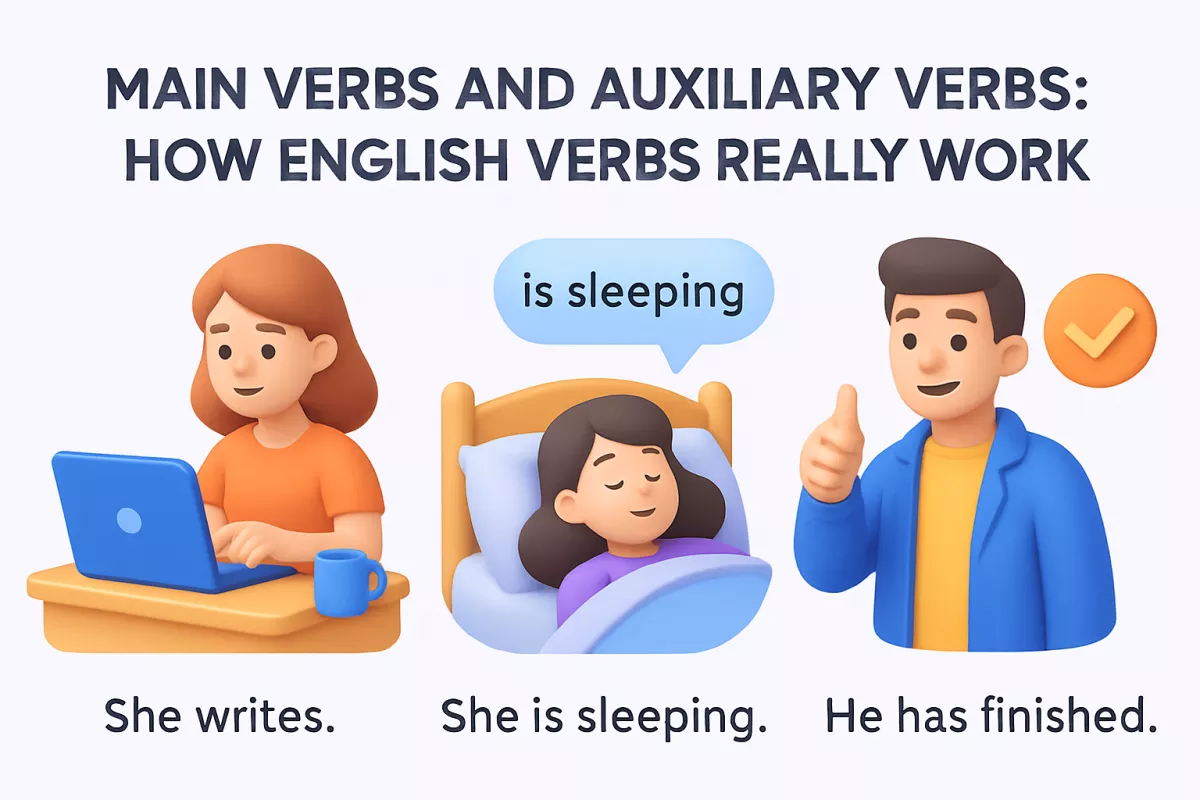
Auxiliary verbs, also known as “helping verbs,” are the backbone of English grammar when it comes to expressing time, structure, and meaning in sentences. By combining with main verbs, auxiliaries create different tenses (like past, present, and future), outline ongoing or completed actions (aspect), and indicate who performs or receives the action (voice). Without these supporting verbs, English would lose much of its subtlety and power to convey complex ideas.
Building Tense with Auxiliaries
Tense in English often relies on auxiliaries, especially for anything beyond the simple present and simple past. For example, will marks the future (She will go), while have creates the present perfect (They have eaten). The auxiliary do is used for negatives and questions in the present and past (Do you know?, Did he call?).
- will (for future: will finish)
- have/has/had (perfect tenses: has seen, had arrived)
- do/does/did (questions/negatives: does not agree, did you leave?)
- am/is/are/was/were (for continuous/progressive: is running, were watching)
Showing Aspect: Simple, Progressive, and Perfect
Aspect tells us whether an action is ongoing, completed, or repeated. Auxiliaries are essential for forming these distinctions:
- Progressive (continuous): be + present participle (is reading, were playing)
- Perfect: have + past participle (has finished, had broken)
- Perfect progressive: have been + present participle (has been working)
Voice: Active and Passive
Auxiliaries also help switch between active and passive voice. In passive constructions, some form of be is paired with a past participle:
- Active: The chef cooked the meal.
- Passive: The meal was cooked (by the chef).
The passive voice always requires an auxiliary for correct formation.
Auxiliary Combinations: Examples Across Tense, Aspect, and Voice
Many forms use a sequence of auxiliaries to layer tense, aspect, and voice together. Here’s a comparison of how these building blocks combine:
| Form | Example |
|---|---|
| Present Simple | She eats |
| Present Continuous | She is eating |
| Present Perfect | She has eaten |
| Present Perfect Continuous | She has been eating |
| Past Simple | She ate |
| Past Continuous | She was eating |
| Past Perfect | She had eaten |
| Future Simple | She will eat |
| Passive Voice | The meal was eaten |
| Future Perfect Passive | The meal will have been eaten |
In summary, auxiliaries are the essential tools that let English speakers express not just when something happens, but how, for how long, and by whom. Their flexibility and combinations make a wide range of meanings possible, from simple statements to complex narratives.
The three core auxiliaries: be, have, do
English relies on three main auxiliary verbs—often called “helping verbs”—to form a wide range of tenses, questions, negatives, and passive voice. These are be, have, and do. Each plays a unique role in supporting main verbs, allowing us to express time, aspect, voice, and emphasis with precision.
What makes an auxiliary?
Auxiliary verbs combine with main verbs to create verb phrases that carry extra grammatical meaning. Without them, English would struggle to form questions (“Do you know?”), negatives (“She is not coming”), or complex tenses (“They have finished”). These helpers are essential in both spoken and written language.
How each auxiliary works
- Be is used to form continuous (progressive) tenses and the passive voice. For example: “She is running,” “The cake was eaten.”
- Have helps create perfect tenses, showing that an action is completed in relation to another time: “I have seen that movie,” “They had left before noon.”
- Do is used for emphasis, questions, and negatives in the simple present and past: “Do you like tea?”, “He does not understand,” “I did finish my work.”
Forms and uses
Each of these auxiliaries takes different forms depending on tense and subject. Here’s a quick overview of their common forms and where you’ll encounter them:
| Auxiliary | Key Forms | Typical Uses |
|---|---|---|
| Be | am, is, are, was, were, being, been | Continuous tenses, passive voice |
| Have | have, has, had, having | Perfect tenses |
| Do | do, does, did, doing | Questions, negatives, emphatic forms |
Examples in action
- Are you coming to the party?
- The letter was sent yesterday.
- She has finished her homework.
- We had already left.
- Do you know the answer?
- He does not like broccoli.
- Did you see that?
- I am being honest.
- They were playing outside.
- Having heard the news, we left.
- He is being silly.
- We have been waiting for hours.
- Did she call you?
- It was being repaired.
Understanding how these three auxiliaries function is the foundation for mastering English verb structures. By recognizing their forms and uses, you can interpret and build almost any sentence pattern found in everyday communication.
Modals as auxiliaries: can, will, should
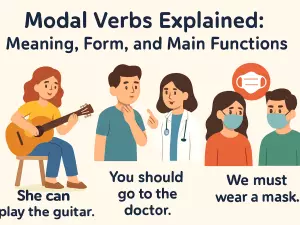
Some verbs in English, like can, will, and should, are called modal auxiliaries. These words help express ideas such as possibility, future actions, or advice, and they always come before the main verb in a sentence. Unlike regular auxiliaries like be or have, modals don’t change form for tense or subject. They are essential for making questions, negatives, and polite requests sound natural.
How modals work with main verbs
Modals act as helpers to the main verb, providing extra meaning or showing the speaker’s attitude. For example, can is used for ability or permission, will for future intentions or promises, and should for advice or expectation. You’ll always see the base form of the main verb after a modal (never an -ing or -ed form).
- Can: She can swim. (ability)
- Will: I will call you tomorrow. (future action)
- Should: You should see a doctor. (advice)
- Can you help me? (request)
- We should leave now. (recommendation)
- Will he join us? (future possibility)
- They cannot attend. (negative)
- Should I bring my umbrella? (question)
- You can try again. (permission)
- I will not forget. (promise/negative)
- Should we start? (suggestion)
- Can she come too? (possibility)
Negatives and questions with modals
Forming negatives and questions with these auxiliary verbs is straightforward. Simply add not after the modal for negatives, or invert the subject and modal for questions. There’s no need for auxiliary do in these structures.
| Structure | Form | Example | Meaning / Use |
|---|---|---|---|
| Affirmative (modal ability) | Subject + can + base verb | You can play. | Ability, possibility |
| Negative (modal ability) | Subject + cannot / can’t + base verb | You cannot (can’t) play. | Lack of ability, impossibility |
| Question (modal ability) | Can + subject + base verb? | Can you play? | Asking about ability / possibility |
| Request / permission | Can + subject + base verb? | Can I sit here? | Asking for permission (informal) |
| Affirmative (advice) | Subject + should + base verb | You should study. | Advice, recommendation |
| Negative (advice) | Subject + should not / shouldn’t + base verb | You shouldn’t skip class. | Advice against something |
| Question (advice) | Should + subject + base verb? | Should we leave now? | Asking for advice or suggestion |
| Affirmative (future) | Subject + will + base verb | He will arrive soon. | Future prediction, decision, promise |
| Negative (future) | Subject + will not / won’t + base verb | He won’t arrive today. | Future negative prediction / refusal |
| Question (future) | Will + subject + base verb? | Will he arrive soon? | Asking about the future |
| Obligation (strong) | Subject + must + base verb | You must wear a seat belt. | Strong obligation / rule |
| Negative obligation | Subject + must not / mustn’t + base verb | You mustn’t park here. | Prohibition |
| Possibility (uncertain) | Subject + might / may + base verb | She might be late. | Possibility, uncertainty |
| Ability (past) | Subject + could + base verb | When I was five, I could swim. | Past ability |
| Polite request | Could + subject + base verb? | Could you help me? | More polite request than can |
Key points about modals as auxiliaries
- They never take -s, -ed, or -ing endings.
- Always followed by the base (infinitive) form of the main verb.
- Used for ability, possibility, advice, requests, offers, and future actions.
- Form questions and negatives directly, without do.
Understanding these helping verbs is crucial for expressing a range of meanings in English. Whether you’re giving advice, making plans, or asking for permission, modals like can, will, and should make your intentions clear.
Auxiliaries in questions and negatives
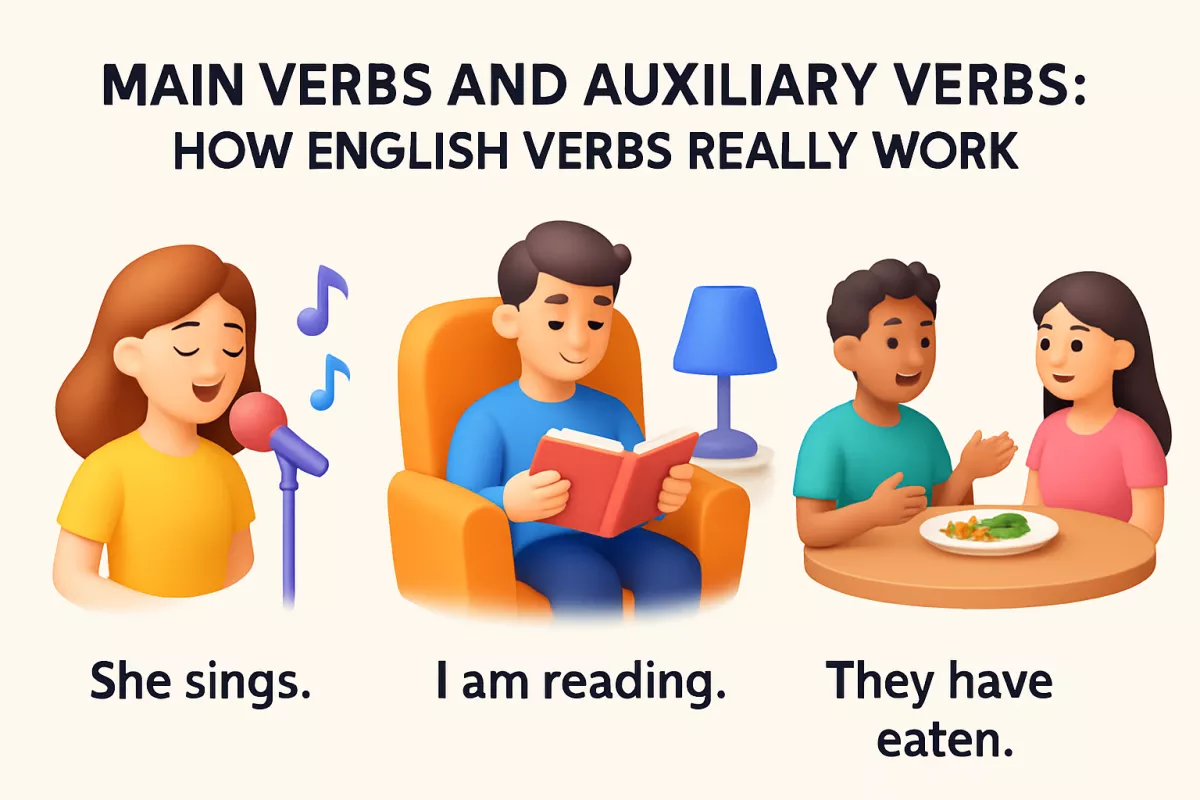
In English, forming questions and negative statements relies heavily on auxiliary verbs. These "helping verbs" are essential for structuring sentences correctly, especially when the main verb alone cannot carry the necessary grammatical information. Understanding how these helpers work can make it much easier to form correct questions and negatives in both spoken and written English.
How auxiliary verbs create questions
To turn most statements into questions, English uses auxiliaries such as do, be, and have. The auxiliary typically moves to the front of the subject, a process called inversion. For example, "She is coming" becomes "Is she coming?" If the main verb is already an auxiliary (like is, are, was, have, will), no extra helper is needed. If not, do is used as a "dummy" auxiliary for most verbs.
- Is she ready? (auxiliary be)
- Have you finished? (auxiliary have)
- Do you like coffee? (dummy do)
- Did they arrive on time? (past tense, auxiliary do)
- Will it rain tomorrow? (modal auxiliary)
- Can you help me?
- Does she know?
- Are we late?
- Would you mind waiting?
- Should I call?
- Could he come earlier?
- Has it started?
- Was the film good?
- Were you there?
- Must we leave now?
Making negatives with auxiliaries
For negative sentences, "not" is placed directly after the auxiliary verb. If there is no natural auxiliary in the statement, do steps in to carry the negative. For example, "She goes" becomes "She does not go." Modal verbs like can, will, and must also take "not" directly after them.
- She is not ready.
- You do not understand.
- They did not call.
- We have not seen it.
- I cannot swim.
- He will not come.
- She does not agree.
- You should not worry.
- It has not started.
- We are not late.
- You must not forget.
- They were not invited.
Comparing statement, question, and negative forms
| Statement | Question | Negative | Auxiliary Used | Why It Is Needed |
|---|---|---|---|---|
| She plays tennis. | Does she play tennis? | She does not play tennis. | do / does | Supports questions and negatives in the present simple |
| They are ready. | Are they ready? | They are not ready. | be (are) | Main verb be acts as its own auxiliary |
| He has finished. | Has he finished? | He has not finished. | have / has | Forms the present perfect tense |
| We can go. | Can we go? | We cannot go. | can | Modal verb used for ability or permission |
| You will help. | Will you help? | You will not help. | will | Forms the future tense |
| She is reading. | Is she reading? | She is not reading. | be (is) | Builds the continuous aspect |
| They were waiting. | Were they waiting? | They were not waiting. | be (were) | Forms the past continuous tense |
| I had eaten. | Had I eaten? | I had not eaten. | had | Builds the past perfect tense |
| She should leave. | Should she leave? | She should not leave. | should | Modal verb used for advice or recommendation |
| He might be late. | Might he be late? | He might not be late. | might | Expresses possibility or uncertainty |
Key points to remember
- Auxiliaries are vital for forming correct questions and negatives in English.
- Use do/does/did when no other helper is present.
- With modal and primary auxiliaries, place "not" right after the auxiliary for negatives.
- In questions, invert the auxiliary and the subject.
- Some main verbs (like be) act as their own auxiliary.
Mastering these patterns will help you communicate more clearly and naturally in English, both when asking questions and expressing negatives.
Short answers and auxiliary verbs
In English, short responses often rely on auxiliary verbs instead of repeating the entire sentence. This makes conversations quicker and more natural. For instance, when someone asks, “Are you coming?” a typical reply would be, “Yes, I am,” rather than “Yes, I am coming.” The auxiliary verb stands in for the full verb phrase, avoiding unnecessary repetition.
How auxiliaries work in brief replies
Auxiliary verbs—such as do, be, have, and modal verbs like can, will, or should—carry the tense, agreement, and sometimes the meaning of the main verb. In short answers, they replace the main verb to keep communication efficient and clear. This pattern is especially common in spoken English.
- Are you ready? – Yes, I am.
- Did she call? – No, she didn’t.
- Will they join us? – Yes, they will.
- Has it started? – No, it hasn’t.
- Can you swim? – Yes, I can.
- Should we wait? – No, we shouldn’t.
- Is he coming? – Yes, he is.
- Do you like coffee? – No, I don’t.
- Have you finished? – Yes, I have.
- Could she help? – No, she couldn’t.
Positive and negative short answers
Short replies can be either affirmative or negative. In positive responses, the auxiliary verb matches the subject and tense. For negative answers, add not or its contracted form (e.g., isn’t, don’t, can’t). This structure signals agreement or disagreement without repeating the whole statement.
| Question | Short Answer | Auxiliary Used | Full Answer (Optional) |
|---|---|---|---|
| Are they coming? | Yes, they are. No, they aren't. |
be (are) | Yes, they are coming. No, they aren't coming. |
| Did you see it? | Yes, I did. No, I didn't. |
do (did) | Yes, I saw it. No, I didn't see it. |
| Will she help? | Yes, she will. No, she won't. |
will | Yes, she will help. No, she won't help. |
| Has it finished? | Yes, it has. No, it hasn't. |
have (has) | Yes, it has finished. No, it hasn't finished. |
| Can you drive? | Yes, I can. No, I can't. |
can | Yes, I can drive. No, I can't drive. |
| Do you like coffee? | Yes, I do. No, I don't. |
do | Yes, I like coffee. No, I don't like coffee. |
| Is he working now? | Yes, he is. No, he isn't. |
be (is) | Yes, he is working now. No, he isn't working now. |
| Were they invited? | Yes, they were. No, they weren't. |
be (were) | Yes, they were invited. No, they weren't invited. |
| Have you ever been there? | Yes, I have. No, I haven't. |
have | Yes, I have been there. No, I haven't been there. |
| Should we leave now? | Yes, we should. No, we shouldn't. |
should | Yes, we should leave now. No, we shouldn't leave now. |
| Must I pay today? | Yes, you must. No, you don't have to. |
must / do | Yes, you must pay today. No, you don't have to pay today. |
| Might it rain later? | Yes, it might. No, it might not. |
might | Yes, it might rain later. No, it might not rain later. |
Key points to remember
- Use the same auxiliary verb as in the question for your reply.
- Match the subject and tense in your answer.
- For negatives, add not or use a contraction.
- Main verbs (except be) do not appear in short answers—only auxiliaries.
Relying on auxiliary verbs in short answers is a core feature of natural English conversation. It keeps exchanges clear, concise, and easy to follow.
Common mistakes with auxiliaries
Even advanced learners sometimes stumble over helping verbs, leading to confusion or awkward sentences. Many errors happen because auxiliary verbs behave differently from main verbs in questions, negatives, and short answers. Spotting these patterns can make your English clearer and more natural.
Mixing up auxiliary and main verb roles
One frequent issue is using a main verb where an auxiliary is required, or vice versa. For example, in questions or negatives, English needs an auxiliary like do or did for most main verbs, but not with be or modal verbs. Check the following examples:
- ❌ She not like coffee. → ✅ She does not like coffee.
- ❌ Went you to the store? → ✅ Did you go to the store?
- ❌ He can goes. → ✅ He can go.
Forming negatives and questions incorrectly
Another common pitfall is forgetting that auxiliaries are required for negatives and questions (except with be or modal verbs). Learners often omit do, does, or did, especially in the present simple or past simple.
- ❌ You like pizza? → ✅ Do you like pizza?
- ❌ He not went. → ✅ He did not go.
Double auxiliaries or unnecessary repetition
Some speakers add extra helping verbs or repeat them where only one is needed. This is especially common when combining modals and other auxiliaries.
- ❌ Did you did finish? → ✅ Did you finish?
- ❌ He will can come. → ✅ He will be able to come.
Confusing contracted and full forms
Contracted forms like don’t, isn’t, or won’t can cause trouble. Learners sometimes mix up the contraction or use it in the wrong context.
- ❌ He don’t like it. → ✅ He doesn’t like it.
- ❌ They is not coming. → ✅ They aren’t coming.
Auxiliary verb errors at a glance
| Incorrect Sentence | Corrected Version |
|---|---|
| She not understand. | She does not understand. |
| Did you went home? | Did you go home? |
| He don’t knows. | He doesn’t know. |
| Where you are going? | Where are you going? |
| They will can help. | They will be able to help. |
| Is she likes tea? | Does she like tea? |
Summary: Watch for typical traps
- Always use the correct auxiliary for negatives and questions.
- Don’t mix main verb endings with modals (can go, not can goes).
- Remember: be and modals don’t need do/does/did as helpers.
- Check subject-auxiliary agreement (doesn’t with he/she/it, don’t with I/you/we/they).
- Avoid double auxiliaries in one verb phrase.
Paying attention to these patterns makes your English sound more fluent and accurate.
Homework: main vs auxiliary verb exercises
Understanding the difference between main verbs and auxiliary verbs is essential for mastering English verb phrases. Practice identifying and using both types with the exercises below. The tasks progress from simple identification to more applied sentence work, giving you a chance to consolidate your knowledge.
Task 1: Identify the Verb Types
Read the following sentences. For each, decide which verb is the main verb and which (if any) is the auxiliary verb.
- She is running in the park.
- They have finished their homework.
- I will call you tomorrow.
- He plays the guitar.
- We were watching TV last night.
- You do understand the rule.
- She has been working all day.
- They are invited to the event.
- He did forget his keys.
- I have seen this movie before.
Show answers
- is (auxiliary), running (main)
- have (auxiliary), finished (main)
- will (auxiliary), call (main)
- plays (main only)
- were (auxiliary), watching (main)
- do (auxiliary), understand (main)
- has (auxiliary), been working (main)
- are (auxiliary), invited (main)
- did (auxiliary), forget (main)
- have (auxiliary), seen (main)
Task 2: Complete the Sentences
Fill in the blanks with a suitable auxiliary verb (be, have, do, will) and a main verb from the list: eat, go, finish, read, make.
- They ________ already ________ dinner.
- She ________ not ________ to the meeting yet.
- I ________ ________ my homework by 8 PM.
- We ________ ________ a cake this afternoon.
- He ________ ________ a book right now.
- You ________ not ________ dinner yet.
- They ________ ________ the report by tomorrow morning.
- She ________ ________ a new plan this week.
- We ________ not ________ to the office today.
- I ________ ________ a chapter every evening.
Show answers
- have, eaten
- has, gone
- will, finish
- are, making
- is, reading
- have, eaten
- will, finish
- have, made
- are, going
- do, read
Task 3: Main vs Auxiliary Verb Comparison Table
The table below compares the typical roles of main and auxiliary verbs in English sentences.
| Main Verb | Auxiliary Verb |
|---|---|
| Shows the main action or state (e.g., run, think, eat) | Helps to form tenses, questions, negatives (e.g., be, have, do, will) |
| Usually only one per clause | Can appear in combination with main verbs |
| Can stand alone in simple sentences | Rarely stands alone; usually supports a main verb |
| Example: She reads every day. | Example: She is reading now. |
Task 4: Transform the Sentences
Rewrite each sentence using an auxiliary verb to change the tense or form. Use the main verb given in parentheses.
- He works hard. (make it present continuous)
- They go to school. (make it present perfect)
- I eat breakfast. (make it future simple)
- She reads novels. (make it negative, present simple)
- We watch movies. (make it past continuous)
- You finish the task. (make it present perfect)
- He plays football. (make it negative, past simple)
- They are ready. (make it future simple)
- She writes emails. (make it present continuous)
- I make dinner. (make it negative, future simple)
Show answers
- He is working hard.
- They have gone to school.
- I will eat breakfast.
- She does not read novels.
- We were watching movies.
- You have finished the task.
- He did not play football.
- They will be ready.
- She is writing emails.
- I will not make dinner.
These exercises are designed to help you spot the difference between key verb types and use them correctly in sentences. Review your answers and try making your own examples for extra practice.