Stance Adverbs (apparently, evidently, supposedly)

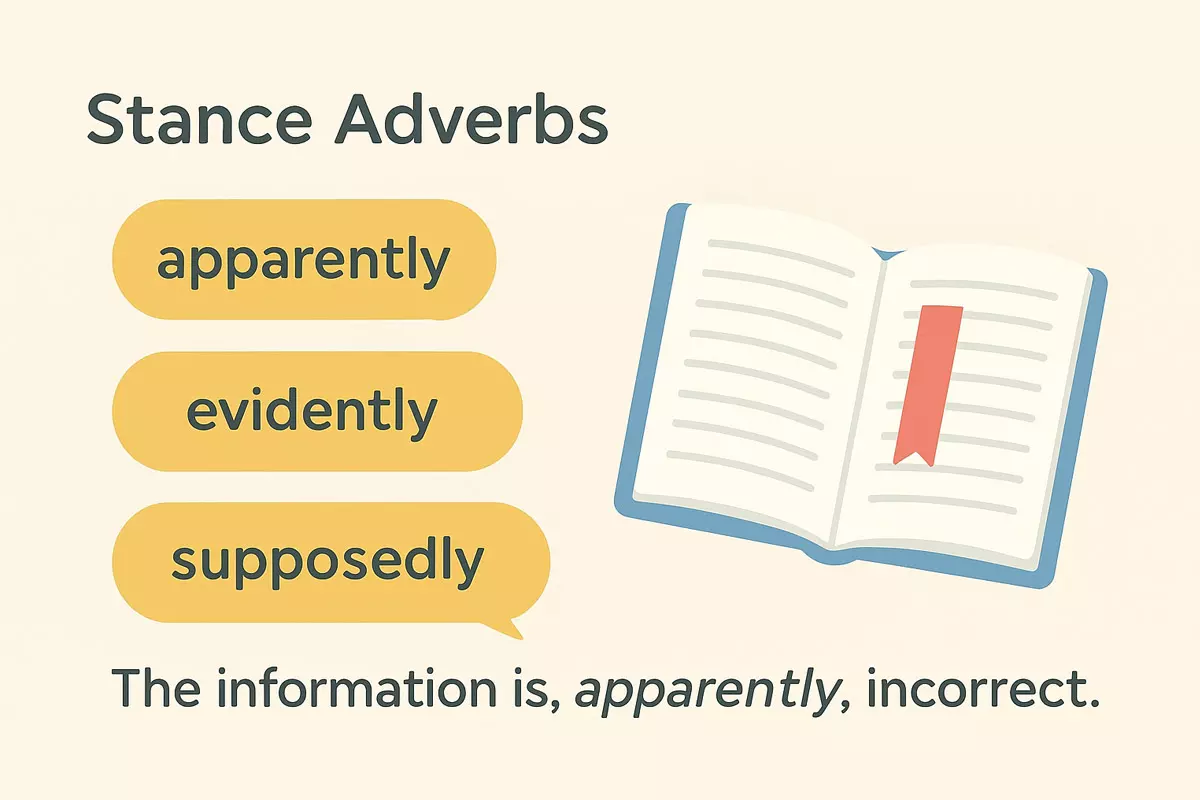 Here we what stance adverbs express, common examples with their nuances, and where to place them in sentences. It also contrasts them with opinion and certainty adverbs, gives everyday examples, and offers advice and exercises for correct use.
We often use words such as apparently, evidently, and supposedly when we want to share information that we are not entirely certain about or that we have learned from someone else. These words help us signal to others that what we are saying may not be fully confirmed or is based on secondhand knowledge. By using such language, we can communicate uncertainty or distance ourselves slightly from the information, making it clear that we are not claiming firsthand expertise or absolute truth.
What Stance Adverbs Express
Stance adverbs such as "apparently," "evidently," and "supposedly" enable speakers to indicate their attitude, perspective, or degree of certainty about the information they are sharing. Rather than describing an action, these words comment on the truthfulness, reliability, or source of a statement. By using these adverbs, you can signal to your listener whether you are confident, skeptical, or simply reporting what you have heard from others.
Types of Meanings Conveyed
Stance adverbials often express one (or more) of the following:
- Uncertainty – The speaker is not completely sure about the information.
- Inference – The statement is based on evidence or reasoning, not direct knowledge.
- Reportedness – The information comes from another source, not the speaker’s own experience.
- Assumption – The speaker is making an educated guess.
- Distance – The speaker wishes to distance themselves from the claim.
- Surprise or Contradiction – Sometimes used to highlight unexpectedness.
Common Stance Adverbs and Their Typical Uses
Speakers use a variety of stance adverbs to express different shades of meaning. Here are some of the most common, along with their usual implications:
- Apparently – The speaker believes something is true based on what they have heard or observed, but does not guarantee it.
- Supposedly – The information is widely believed or claimed, but the speaker is skeptical or unsure.
- Evidently – There is visible or clear evidence for the statement, but the speaker may not have direct proof.
- Allegedly – Used when something has been claimed, often in legal or formal contexts, but is not confirmed.
- Presumably – The speaker assumes something is true, often due to logic or likelihood.
- Clearly – The speaker feels the information is obvious; may be used sincerely or sarcastically.
- Admittedly – Acknowledges a point that might weaken the speaker’s case or argument.
- Undoubtedly – Expresses strong certainty or conviction.
- Thankfully – Indicates relief or gratitude about the situation described.
- Frankly – Signals honesty or directness about the speaker’s attitude.
- Honestly – Emphasizes the truthfulness of the statement or the speaker’s sincerity.
- Regrettably – Shows that the speaker feels regret about the information shared.
- Surprisingly – Marks information as unexpected.
- Technically – Points out that, by strict definition, something is (or isn’t) the case.
- Fortunately – Expresses positive feelings about the news.
- Unquestionably – Indicates that there is no doubt in the speaker’s mind.
- Ostensibly – Something appears to be true, but may not be in reality.
- Arguably – Suggests that the statement is open to debate.
- Conceivably – The speaker thinks something is possible, though not certain.
- Predictably – Indicates the information is not surprising, given the circumstances.
How These Adverbs Affect Interpretation
By choosing specific stance adverbs, speakers can subtly influence how their message is received. For instance, "He is supposedly arriving at noon" sounds more doubtful than "He is evidently arriving at noon." These words guide the listener’s expectations and help clarify whether a statement is a fact, an inference, or a rumor.
Comparing Nuances
The nuances between these adverbs can be subtle. For example, "apparently" often signals that the speaker has indirect evidence, while "supposedly" carries more skepticism. "Evidently" suggests the speaker sees some clear sign or logical basis for the information.
| Stance Adverb | Typical Implication |
|---|---|
| Apparently | Based on indirect evidence; not fully confirmed |
| Supposedly | Commonly believed or claimed; speaker is unsure or skeptical |
| Evidently | Clear evidence or logical deduction; more confident than "apparently" |
| Allegedly | Claimed by others, not yet proven or accepted as fact |
| Presumably | Assumed true based on logic or likelihood |
| Ostensibly | Appears to be true, but may not be so in reality |
Why Use Stance Adverbs?
These adverbs are essential for expressing shades of meaning in everyday conversation and writing. They help you communicate not only facts, but also your relationship to those facts—whether you are cautious, confident, skeptical, or simply passing along information. This makes your language more precise and nuanced, and helps avoid misunderstandings about your level of certainty or involvement in the information you share.
Common Stance Adverbs and Their Nuances
When expressing attitudes or indicating the source of information, English speakers often turn to stance adverbs such as "apparently," "evidently," and "supposedly." These words help signal that the speaker is reporting, inferring, or hedging rather than stating something as certain fact. Understanding their subtle differences enriches both comprehension and expression.
Subtle Differences in Meaning
Each of these adverbs offers a distinct shade of meaning. For example, "apparently" often implies that something seems true based on what is seen or heard, but the speaker might not be fully convinced. "Evidently" suggests a conclusion drawn from available evidence, while "supposedly" casts more doubt, hinting that the information is believed by others but not necessarily by the speaker.
- Apparently – The speaker has seen or heard something, but details may be uncertain.
- Evidently – The evidence points strongly in one direction, so the speaker feels fairly confident.
- Supposedly – The speaker refers to what is generally believed, but distances themselves from the claim.
Expanded List of Common Stance Adverbs
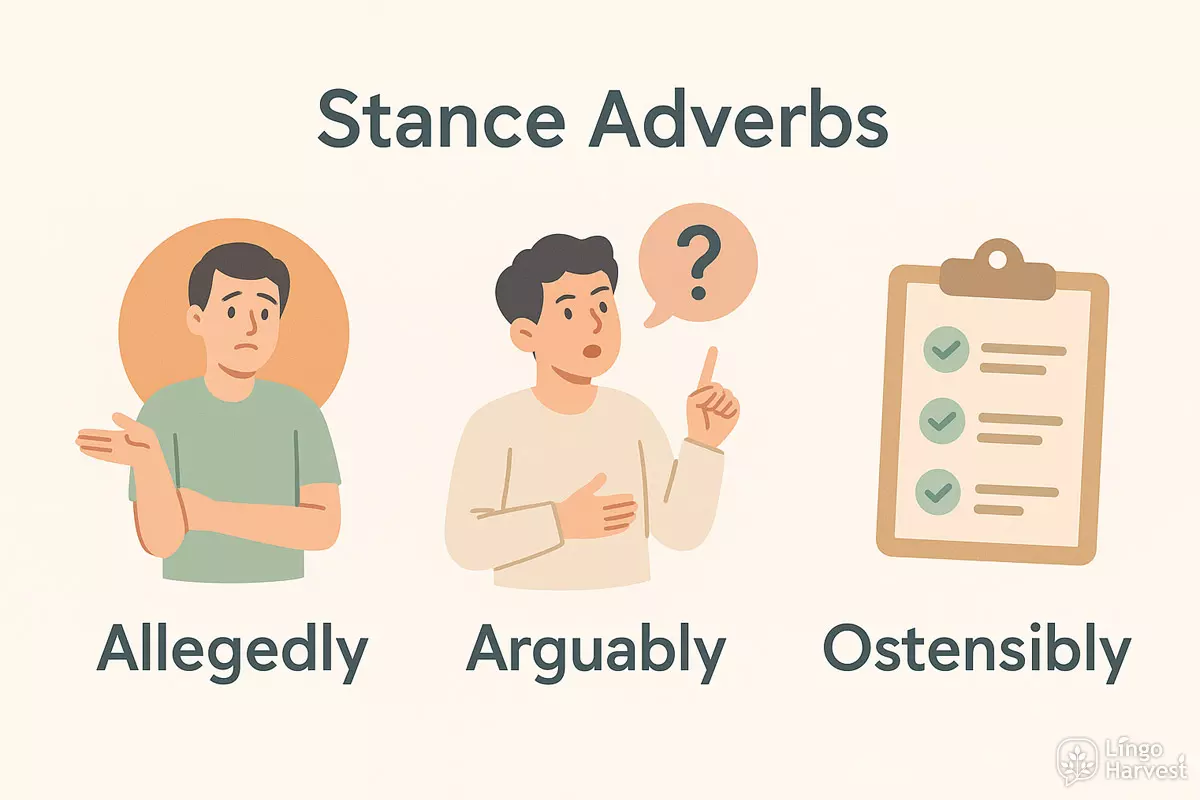
Here are other frequently used adverbs that convey a stance or attitude:
- Allegedly
- Arguably
- Ostensibly
- Presumably
- Reportedly
- Seemingly
- Clearly
- Undoubtedly
- Unquestionably
- Admittedly
- Frankly
- Honestly
- Curiously
- Surprisingly
- Interestingly
- Regrettably
- Thankfully
- Remarkably
Usage Patterns and Examples
These adverbs typically appear at the beginning of a sentence, but can also be placed after the subject or at the end for emphasis. Compare these example sentences:
- Apparently, the meeting was canceled.
- The meeting was evidently canceled.
- The meeting was canceled, supposedly because of the weather.
Comparing Nuances
To clarify how these adverbs differ in tone and implication, see the table below:
| Adverb | Implication | Typical Use |
|---|---|---|
| Apparently | Appears to be true based on what is observed or heard, but may not be confirmed | “Apparently, he left early.” |
| Evidently | Conclusion drawn from evidence; speaker feels fairly certain | “Evidently, she knew about the plan.” |
| Supposedly | Something is believed or claimed by others, but the speaker is skeptical | “Supposedly, the store opens at 7.” |
| Reportedly | Information comes from reports, not direct knowledge | “He was reportedly seen downtown.” |
| Presumably | Assumed to be true, though not verified | “Presumably, the results will be published soon.” |
Mastering the use of these adverbs allows for more precise and nuanced communication, especially when discussing information that is secondhand, uncertain, or open to interpretation.
Position in the Sentence
Stance adverbs like "apparently," "evidently," and "supposedly" most often appear at the beginning of a sentence, but they can also move to other places for nuance or emphasis. Their placement can subtly change the focus or tone, signaling to the reader or listener how confident the speaker is about the information.
Common Placements
The most typical positions for these adverbs are:
- Sentence-initial: Apparently, he missed the meeting.
- After the subject: She evidently forgot the appointment.
- Before the main verb: He supposedly knows the answer.
- After the verb "to be": The results are apparently correct.
- At the end of the sentence: They finished the project, supposedly.
Effect of Position
Where you place a stance adverb can affect the strength and clarity of your statement. Beginning a sentence with one makes the speaker’s attitude clear right away. Putting it in the middle can make the statement sound more objective or matter-of-fact. Ending with the adverb can add a sense of afterthought or uncertainty.
Examples in Different Positions
Below is a comparison of how each adverb functions in various locations within a sentence:
| Sentence Position | Example |
|---|---|
| Beginning | Apparently, the store is closed today. |
| After subject | The manager evidently approved the plan. |
| Before main verb | She supposedly finished her work early. |
| After verb "to be" | The solution is apparently simple. |
| End of sentence | He moved to Canada, supposedly. |
Quick Reference: Expanded Examples
A variety of sample sentences show how flexible these adverbs can be:
- Apparently, she was not invited.
- They evidently misunderstood the rules.
- We supposedly have a meeting at noon.
- The results are evidently inconclusive.
- He failed the test, apparently.
- Supposedly, this medication works quickly.
- Jane apparently left early.
- The team is supposedly ready.
- The evidence is evidently missing.
- They finished on time, evidently.
- Apparently, we need more information.
- The project is supposedly complete.
- He evidently didn’t hear the announcement.
- The plan failed, supposedly.
Stance vs Opinion vs Certainty Adverbs
Understanding how adverbs like “apparently,” “evidently,” and “supposedly” work requires knowing the subtle differences between stance, opinion, and certainty adverbs. Each group shapes the meaning of a sentence in its own way by expressing the speaker’s attitude, belief, or confidence about the information given.
What Sets These Adverbs Apart?
Stance adverbs communicate the speaker’s viewpoint or attitude toward the statement. For example, “apparently” signals that the information is second-hand or inferred. Opinion adverbs, such as “personally” or “frankly,” make it clear the statement reflects the speaker’s own view. Certainty adverbs, including “definitely” or “probably,” specify how confident someone is that the statement is true.
Common Examples and Their Nuances
Let’s look at a range of adverbs across these three categories. Each type brings its own flavor to a sentence:
- Stance: apparently, evidently, supposedly, reportedly, allegedly, arguably, presumably, seemingly, supposedly, theoretically
- Opinion: personally, honestly, frankly, thankfully, sadly, unfortunately, hopefully, surprisingly, ideally, regrettably
- Certainty: definitely, certainly, probably, possibly, undoubtedly, clearly, surely, likely, maybe, conceivably
How These Adverbs Affect Meaning
While all three types can appear in similar sentence positions (often at the start or just before the main verb), they color the message differently. For instance, “Evidently, the meeting was canceled” suggests the information is based on available evidence, while “Honestly, the meeting was canceled” signals a personal view, and “Definitely, the meeting was canceled” indicates high confidence.
Comparison Table: Stance, Opinion, and Certainty Adverbs
| Type | Main Function | Typical Examples | Sample Usage |
|---|---|---|---|
| Stance | Indicate speaker’s perspective or information source | apparently, evidently, reportedly | Apparently, she left early. |
| Opinion | Express personal feelings or judgments | personally, honestly, thankfully | Honestly, I didn’t like it. |
| Certainty | Show degree of confidence or probability | definitely, probably, undoubtedly | She will probably call you. |
Summary
Choosing the right adverb depends on what you want to highlight: your source, your perspective, or your confidence level. Recognizing these differences helps you communicate more precisely and understand nuance in both spoken and written English.
Examples from Everyday English
Stance adverbs like “apparently,” “evidently,” and “supposedly” often appear in spoken and written language to signal uncertainty, hearsay, or the speaker’s attitude toward the information being shared. These words are especially useful when you want to show that your statement is based on indirect knowledge, rumors, or logical deduction rather than firsthand experience.
How These Adverbs Are Used in Conversation
In daily speech, people use these adverbs to soften statements or indicate that something might not be entirely confirmed. Here are some typical ways you might hear or read them:
- Apparently, the meeting was canceled. (The speaker heard this from someone else.)
- Evidently, she forgot her keys again. (There is evidence, such as her not being able to open the door.)
- Supposedly, there’s a new restaurant opening downtown. (This is a rumor or unverified information.)
- Apparently, he’s moving to Canada next month.
- Evidently, the package arrived while we were out.
- Supposedly, this phone has the best battery life.
- Apparently, it’s going to rain tomorrow.
- Evidently, they’ve already made a decision.
- Supposedly, the movie is based on a true story.
- Apparently, there’s a problem with the Wi-Fi.
- Evidently, he didn’t get the message.
- Supposedly, the concert tickets sold out in minutes.
Comparing the Nuances
While all three adverbs express some distance or uncertainty, their usage depends on the source and reliability of the information. Here’s a summary of their typical distinctions:
| Adverb | Typical Use | Example |
|---|---|---|
| Apparently | Information received indirectly, often through hearsay | Apparently, the train is delayed. |
| Evidently | Conclusion drawn from evidence or obvious signs | Evidently, no one locked the door. |
| Supposedly | Information that is believed or rumored, but may not be true | Supposedly, he’s an expert on the subject. |
Common Patterns and Placement
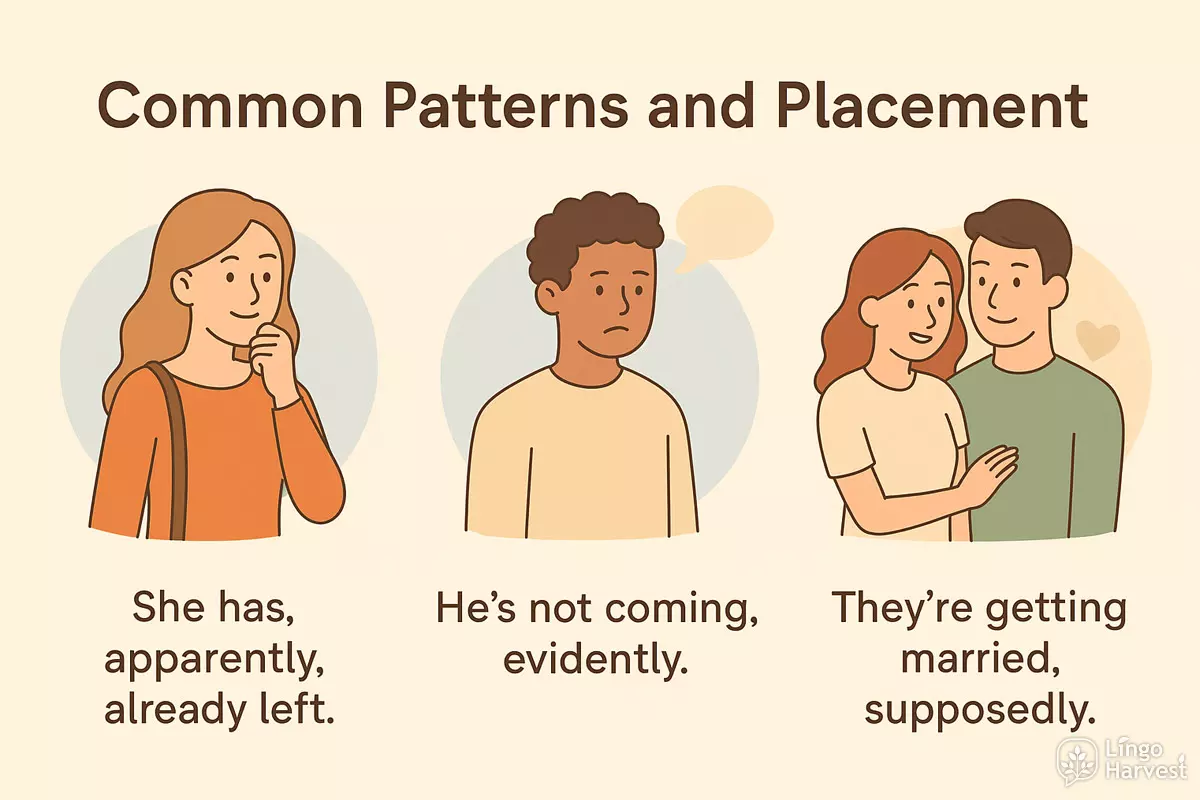
These adverbs usually appear at the beginning of a sentence, but they can also be placed in the middle for emphasis or at the end for stylistic reasons:
- Apparently, she already left. / She has, apparently, already left.
- He’s not coming, evidently.
- They’re getting married, supposedly.
By using these words, speakers can express doubt, share secondhand news, or distance themselves from the truth of a statement—all useful tools for nuanced communication.
Avoiding Overuse in Writing
Writers often rely on stance adverbs like "apparently," "evidently," and "supposedly" to express uncertainty or indicate secondhand information. While these words are useful for showing distance or doubt, using them too frequently can weaken your arguments and create a hesitant tone. It’s important to recognize when these adverbs truly add value and when they simply clutter your sentences.
Common Pitfalls of Excessive Use
Overusing modal adverbs can make your writing seem unsure or indirect. Readers may start to question your confidence or the reliability of your information. Here are some issues that come up when these words are sprinkled too liberally:
- Sentences become wordy and less direct.
- The writer’s voice may sound indecisive or passive.
- The text can lose its persuasive power.
- Readers may find the repetition distracting.
Recognizing When to Use Stance Adverbs
Consider if the information truly requires a marker of uncertainty. If the source is unclear or you’re reporting something you haven’t confirmed, using a stance adverb is appropriate. Otherwise, it’s often better to state facts directly or attribute them to a source.
Alternatives and Revisions
Replacing or omitting stance adverbs can strengthen your writing. Here are some strategies:
- Attribute claims to specific sources instead of using a general adverb (e.g., "According to the report, …").
- Use stronger verbs to convey nuance (e.g., "It appears" or "It seems" instead of "apparently").
- Rewrite sentences to be more direct when certainty is not in question.
- Vary your language to avoid monotony.
Examples: Weak vs. Strong Usage
Below is a comparison of sentences with and without stance adverbs, showing how clarity and confidence can change:
| Original (with stance adverb) | Revision (more direct/varied) |
|---|---|
| Apparently, the meeting was canceled. | The meeting was canceled. OR According to the memo, the meeting was canceled. |
| Evidently, she misunderstood the instructions. | She misunderstood the instructions. OR It seems she misunderstood the instructions. |
| Supposedly, the new policy takes effect next week. | The new policy takes effect next week. OR The new policy is said to take effect next week. |
| Apparently, the results will be published soon. | The results will be published soon. OR Reports indicate the results will be published soon. |
Tips for Balanced Use
To keep your writing clear and credible, try these approaches:
- Limit stance adverbs to situations where uncertainty or indirectness is necessary.
- Read your work aloud to spot repetitive or hesitant language.
- Revise for precision—replace vague adverbs with specific details whenever possible.
- Vary sentence structure for a more engaging style.
Thoughtful use of modal adverbs can enhance your writing, but restraint ensures your message remains strong and confident.
Practice: Choose the Right Stance Adverb
Understanding how to select the appropriate stance adverb—such as "apparently," "evidently," or "supposedly"—is key to expressing the level of certainty or source of information in English. The following exercises will help you master using these adverbs in real-life situations.
Fill in the Blanks
For each sentence below, decide which stance adverb fits best: "apparently," "evidently," or "supposedly."
- _______, the meeting has been postponed until next week.
- The streets are wet; _______ it rained last night.
- He’s _______ moving to Canada, but I haven’t confirmed it yet.
- _______, she forgot about the appointment and never showed up.
- He _______ finished the project, but I haven’t seen the final result.
Show answers
- Apparently
- Evidently
- Supposedly
- Apparently
- Supposedly
Identify the Source of Information
Match each stance adverb to its typical use. Choose from: "direct evidence," "hearsay/rumor," or "general impression."
- Apparently: _____
- Evidently: _____
- Supposedly: _____
Show answers
- Apparently: general impression (what seems to be true based on what you know)
- Evidently: direct evidence (clear proof or visible result)
- Supposedly: hearsay/rumor (what people say, but not confirmed)
Stance Adverb Usage Table
| Stance Adverb | Typical Use | Example Sentence |
|---|---|---|
| Apparently | Based on what you have heard, read, or seen; impression | Apparently, the store closes early on Sundays. |
| Evidently | Based on clear evidence or facts | Evidently, someone left the door open; the house is cold. |
| Supposedly | Based on what is claimed or rumored, not confirmed | Supposedly, this recipe is from a famous chef. |
Choose the Best Option
For each scenario, pick the most natural stance adverb:
- You see muddy footprints in the hallway after a rainstorm. Which adverb fits? Apparently / Evidently / Supposedly
- You heard from a friend that a new café opened, but you haven’t seen it. Which adverb fits?
- All the lights are off in the building, so it must be closed. Which adverb fits?
Show answers
- Evidently
- Supposedly
- Apparently
Mastering these subtle differences helps your English sound more natural and precise. Practice with your own sentences to reinforce the distinctions among these common stance adverbs.