Stance Adverbs for Opinion and Attitude (extended list)

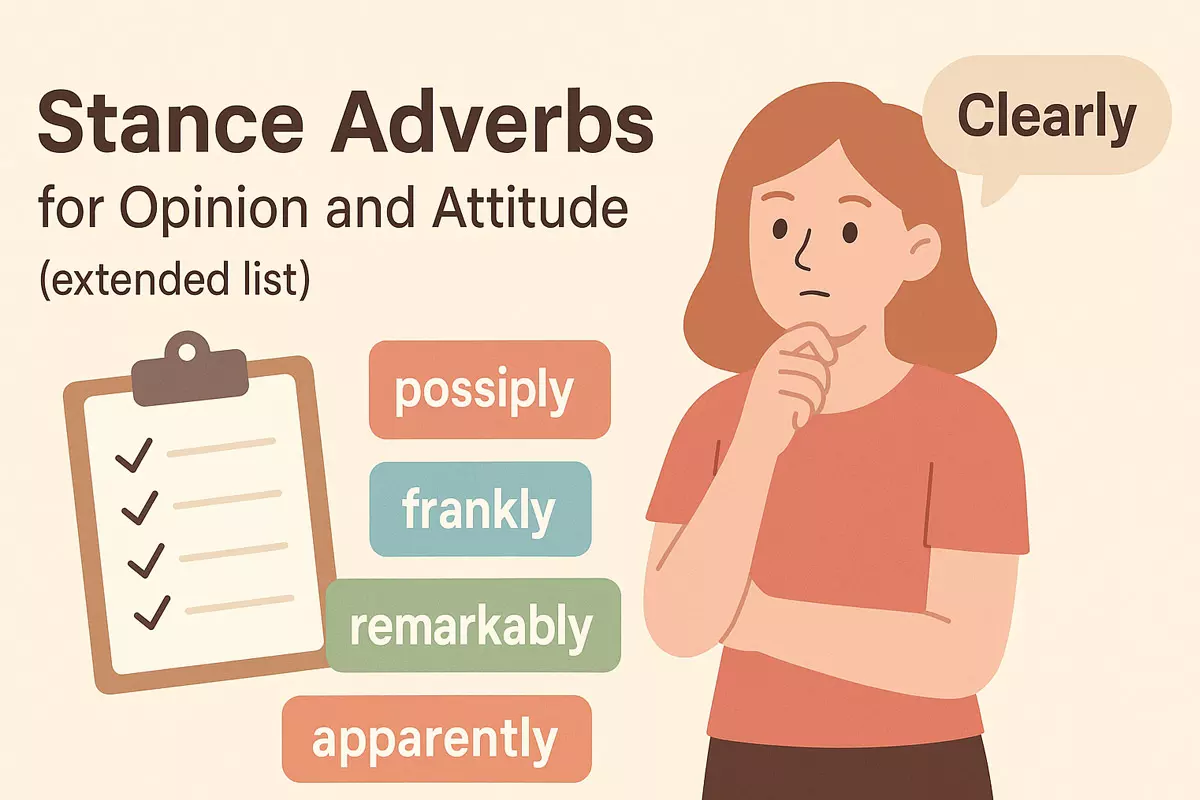 This article explains how stance adverbs express opinion, evaluation, and reaction in English. It details their types, correct placement, and provides an extended list with examples, plus practice for using them to build coherent opinion paragraphs.
- What stance adverbs show (opinion, evaluation, reaction)
- Types: epistemic, evaluative, style adverbs
- How stance adverbs change tone and attitude
- Correct placement at the beginning or mid-position
- Extended list with meanings and examples
- Building coherent opinion paragraphs
- Short practice: add stance adverbs to texts
Expressing your viewpoint clearly can significantly enhance your writing, and mastering a wide variety of adverbs that indicate personal attitude or judgment is vital for this purpose. These adverbs, such as fortunately, surprisingly, or understandably, allow you to subtly communicate your stance or emotions regarding a topic. By thoughtfully incorporating them, you can guide your readers toward your intended interpretation and make your arguments more persuasive. Expanding your knowledge of such words enriches your writing style and ensures your message is both precise and engaging.
What stance adverbs show (opinion, evaluation, reaction)
Stance adverbs help speakers and writers express their personal attitudes, judgments, or emotional responses toward what they are communicating. These words indicate not just the facts, but how someone feels about those facts—whether they are offering an opinion, making an evaluation, or reacting to information.
Opinion: Expressing Personal Viewpoints
Many stance adverbs signal that the statement reflects a personal point of view. They clarify that the speaker or writer is not stating an objective fact, but rather sharing their own belief or perspective. For example:
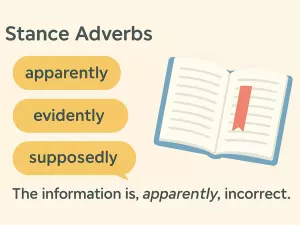
- Apparently (suggests uncertainty or second-hand information)
- Clearly (shows strong confidence in the statement)
- Obviously (the speaker thinks the point is self-evident)
- Presumably (indicates an assumption)
- Supposedly (implies doubt or hearsay)
Evaluation: Judging or Assessing Information
Some adverbs convey an evaluative stance, showing approval, disapproval, or a value judgment. These words let the audience know how the speaker rates or assesses the subject:
- Fortunately (positive evaluation)
- Regrettably (negative evaluation)
- Surprisingly (unexpected evaluation)
- Understandably (shows empathy or justification)
- Ideally (expresses what is best or preferred)
Reaction: Showing Emotional Response
Other stance adverbs reveal emotional reactions or how the speaker feels about the information shared. These often appear at the start of a sentence to set the mood:
- Sadly (expresses sadness or disappointment)
- Happily (shows pleasure or satisfaction)
- Frankly (suggests openness or honesty)
- Honestly (emphasizes sincerity)
- Thankfully (indicates relief or gratitude)
Comparing the Functions of Stance Adverbs
To better understand how these adverbs function, here’s a comparison of typical uses and meanings:
| Adverb | Main Function |
|---|---|
| Apparently | Conveys reported opinion or uncertainty |
| Fortunately | Expresses positive evaluation of events |
| Frankly | Signals honest or direct reaction |
| Regrettably | Shows negative emotional response |
| Clearly | States strong personal conviction |
Stance adverbs enrich communication by clarifying the speaker’s attitude, making it easier for listeners and readers to interpret both the message and the intention behind it. Using them thoughtfully can add nuance and precision to both spoken and written English.
Types: epistemic, evaluative, style adverbs
When discussing adverbs that express opinion or attitude, it helps to group them based on the kind of meaning they convey. Three key categories are epistemic, evaluative, and style adverbs, each serving a distinct function in expressing a writer’s or speaker’s stance.
Epistemic Adverbs
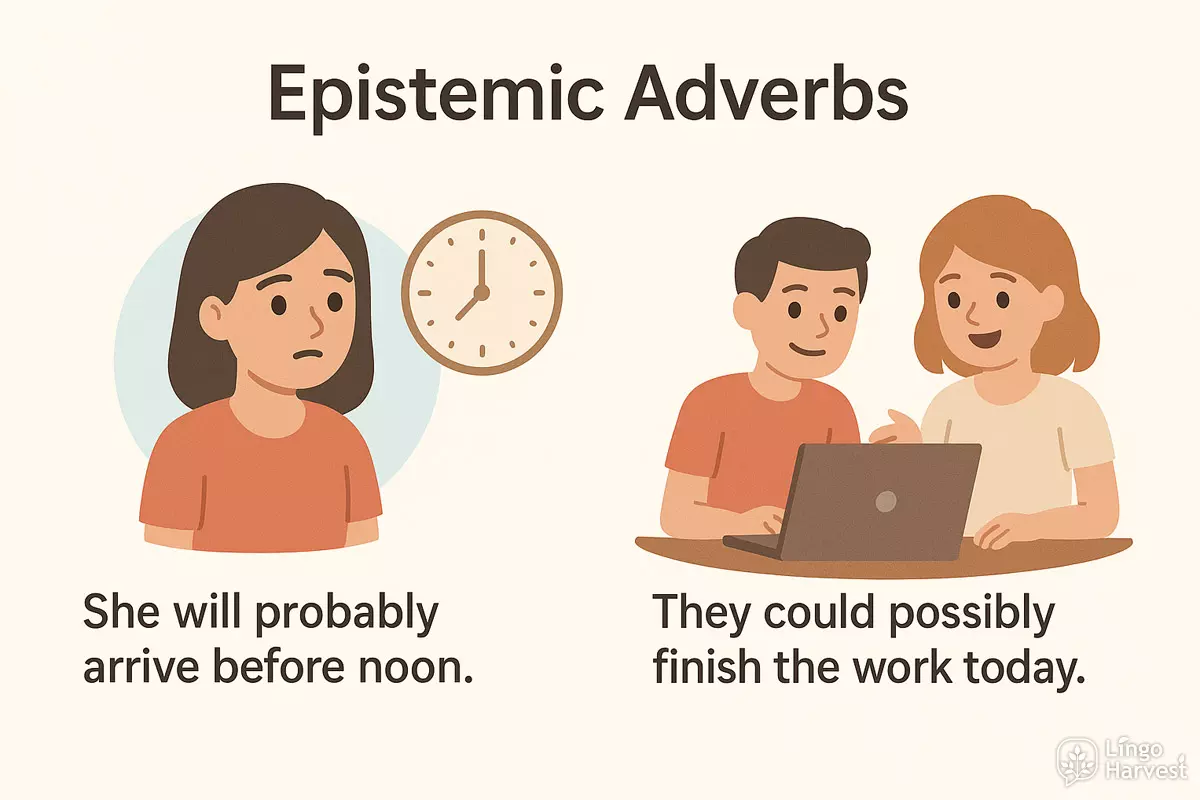
Epistemic adverbs signal how certain the speaker is about a statement or how likely they think something is. These words often comment on the truth or probability of what is being said. Common examples include:
- probably → She will probably arrive before noon.
- possibly → They could possibly finish the work today.
- certainly → He certainly knows what he’s doing.
- undoubtedly → The team will undoubtedly win.
- apparently → Apparently, the store is closed today.
- presumably → Presumably, he forgot about the meeting.
- evidently → She was evidently upset about the results.
- supposedly → This book is supposedly based on a true story.
- clearly → She clearly misunderstood the question.
- seemingly → The task was seemingly simple at first.
Evaluative Adverbs
- unfortunately → Unfortunately, we missed the last train.
- surprisingly → Surprisingly, the exam was very easy.
- interestingly → Interestingly, no one complained.
- happily → Happily, the plan worked out well.
- regrettably → Regrettably, we can’t attend the event.
- frankly → Frankly, I don’t agree with that idea.
- sadly → Sadly, he lost his wallet.
- luckily → Luckily, no one was injured.
- honestly → Honestly, I didn’t expect this result.
- disappointingly → Disappointingly, the concert was canceled.
- amazingly → Amazingly, the old car still works.
- ironically → Ironically, he forgot the speech about memory.
Style Adverbs
- briefly → She briefly explained the situation.
- seriously → He seriously considered moving abroad.
- strictly → The rules are strictly followed here.
- honestly → She honestly admitted her mistake.
- roughly → They roughly estimated the total cost.
- personally → Personally, I prefer quiet places.
- confidentially → Confidentially, he may resign soon.
- officially → The results were officially announced today.
- literally → He literally ran the entire distance.
- generally → Generally, people like this restaurant.
- theoretically → Theoretically, the plan could work.
- practically → Practically, we are already finished.
They add nuance to how the message should be interpreted or understood.
Comparison of Stance Adverb Types
| Type | Main Function | Sample Adverbs |
|---|---|---|
| Epistemic | Expresses certainty, doubt, or likelihood | probably, evidently, presumably |
| Evaluative | Shows attitude or judgment | unfortunately, luckily, frankly |
| Style | Describes manner or approach | briefly, seriously, personally |
Each category provides a different layer of meaning to a sentence: epistemic adverbs qualify the truth, evaluative ones judge or react, and style adverbs convey how or in what spirit something is communicated. Using a variety of these stance adverbs can make writing richer and more precise.
How stance adverbs change tone and attitude
Stance adverbs play a crucial role in shaping the meaning and emotional color of sentences. By signaling the speaker’s viewpoint, certainty, or emotional involvement, these adverbs can make statements sound more confident, hesitant, critical, or supportive. The choice and placement of such adverbs directly influence how readers or listeners interpret both the content and the intent behind it.
Shifting certainty and doubt
Writers and speakers often use stance adverbs to express levels of certainty, skepticism, or reservation. For example, adverbs like definitely or certainly signal strong conviction, while possibly or apparently introduce doubt or indirectness. This subtle adjustment helps to manage expectations and guide audience interpretation.
- Clearly - shows strong belief in accuracy
- Presumably - suggests a logical assumption, but not full certainty
- Supposedly - indicates something reported or believed, but perhaps doubted
- Undoubtedly - excludes doubt and reinforces the statement
- Arguably - marks the statement as open to debate
Adjusting personal involvement and attitude
Stance adverbs can reveal a speaker’s emotional distance or engagement. Using words like frankly, honestly, or personally signals that the opinion is subjective or heartfelt. In contrast, objectively or technically imply detachment or a focus on facts. This distinction helps clarify whether a statement is meant to be taken as a personal view or an impartial observation.
- Honestly - adds sincerity or transparency
- Personally - marks the statement as the speaker’s own view
- Admittedly - concedes a point, often before a contrast
- Surprisingly - signals unexpectedness
- Regrettably - expresses negative feeling about the information
Comparing tone shifts with stance adverbs
| Without Stance Adverb | With Stance Adverb |
|---|---|
| It will rain tomorrow. | Apparently, it will rain tomorrow. |
| This is the best solution. | Arguably, this is the best solution. |
| You made a mistake. | Regrettably, you made a mistake. |
| He’s late. | Surprisingly, he’s late. |
| She can finish the project. | Undoubtedly, she can finish the project. |
Key takeaways
Selecting the right stance adverb is a powerful tool for expressing attitude, fine-tuning the level of certainty, and managing the emotional impact of your message. Whether you want to sound more tentative, authoritative, or empathetic, these adverbs help you control the tone and nuance of what you say or write.
Correct placement at the beginning or mid-position
Stance adverbs, which express a speaker’s attitude or opinion, can generally appear at the start of a sentence or before the main verb. Where these adverbs are placed often influences the tone and emphasis of the statement. For clarity and natural flow, it’s essential to know which position works best for each adverb and how the meaning may shift with placement.
Typical Placement Patterns
- Sentence-initial: Many stance adverbs (e.g., Personally, Honestly, Frankly) frequently appear at the very beginning, setting the tone for what follows.
- Mid-position: Some adverbs fit well just before the main verb, especially after the subject (e.g., He probably knows). Modal verbs and auxiliary verbs provide anchor points for mid-position placement.
- After the verb “to be”: With forms of “be,” stance adverbs usually follow the verb (She is obviously upset).
Examples: Beginning vs. Mid-position
Consider how these adverbs can shift position:
- Clearly, she disagrees. / She clearly disagrees.
- Unfortunately, we missed the train. / We unfortunately missed the train.
- Personally, I find it boring. / I personally find it boring.
- Frankly, that’s not true. / That’s frankly not true.
List of Common Stance Adverbs and Typical Placement
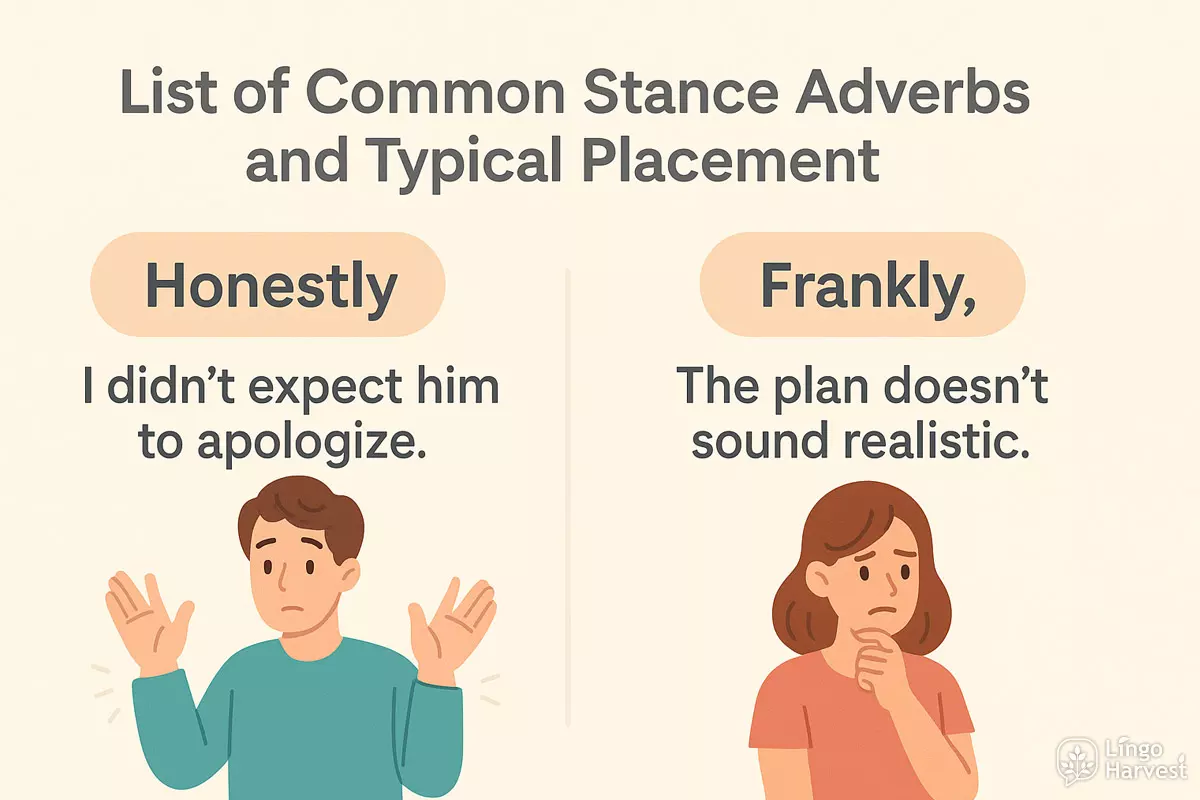
- Honestly → Honestly, I didn’t expect him to apologize.
- Frankly → Frankly, the plan doesn’t sound realistic.
- Sadly → Sadly, the project was canceled.
- Regrettably → Regrettably, we can’t join you tonight.
- Admittedly → Admittedly, I should have prepared better.
- Apparently → Apparently, they moved to another city.
- Presumably → Presumably, she forgot about the meeting.
- Clearly → Clearly, something went wrong in the process.
- Obviously → Obviously, we need more time to finish.
- Personally → Personally, I prefer working in the morning.
- Seriously → Seriously, you need to rest more.
- Surprisingly → Surprisingly, the test was very easy.
- Undoubtedly → Undoubtedly, she is the best candidate.
- Fortunately → Fortunately, no one was hurt.
- Hopefully → Hopefully, the weather will improve tomorrow.
- Ideally → Ideally, we should start earlier next time.
- Possibly → Possibly, he misunderstood the instructions.
- Probably → Probably, they’ll arrive late again.
Comparison of Initial and Mid-position Usage
| Adverb | Sentence-initial Example | Mid-position Example |
|---|---|---|
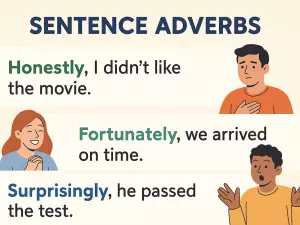
| Honestly | Honestly, I didn’t like the movie. | I honestly didn’t like the movie. |
| Apparently | Apparently, she left early. | She apparently left early. |
| Surprisingly | Surprisingly, no one objected. | No one surprisingly objected. |
| Fortunately | Fortunately, we arrived on time. | We fortunately arrived on time. |
| Clearly | Clearly, this is a mistake. | This is clearly a mistake. |
| Regrettably | Regrettably, they lost the match. | They regrettably lost the match. |
| Undoubtedly | Undoubtedly, she deserves the award. | She undoubtedly deserves the award. |
| Admittedly | Admittedly, it was a difficult task. | It was admittedly a difficult task. |
While most stance adverbs can be placed at the start or before the main verb, some sound more natural in a specific position. Reading and listening to native usage helps develop an intuitive sense for the best placement.
Extended list with meanings and examples
Stance adverbs help speakers express their viewpoint, attitude, or feelings toward what they’re saying. These words often come at the beginning of a sentence, but can also appear elsewhere for emphasis. Here, you’ll find a broad selection of opinion and attitude adverbs, each with a clear meaning and a practical example. These can make your communication more precise and engaging.
Common stance adverbs: definitions and sample usage
- Obviously – Clearly or without doubt.
Example: Obviously, we need to finish the project by Friday. - Clearly – Without confusion; plainly.
Example: Clearly, she was upset by the news. - Frankly – Honestly, without hiding the truth.
Example: Frankly, I don’t think that’s a good idea. - Honestly – To express sincerity or truthfulness.
Example: Honestly, I’ve never seen anything like it. - Personally – Expressing a personal opinion.
Example: Personally, I prefer coffee to tea. - Surprisingly – Unexpectedly or contrary to what was thought.
Example: Surprisingly, the test was quite easy. - Unfortunately – Showing regret or disappointment.
Example: Unfortunately, the meeting was canceled. - Thankfully – Expressing relief or gratitude.
Example: Thankfully, nobody was hurt in the accident. - Regrettably – Indicating you wish something were not true.
Example: Regrettably, we cannot accept your offer. - Ideally – In a perfect situation.
Example: Ideally, we would start earlier in the day. - Admittedly – Conceding a point or weakness.
Example: Admittedly, I could have done better. - Arguably – It can be argued or debated.
Example: Arguably, this is the best solution available. - Presumably – Based on what is likely or assumed.
Example: Presumably, he missed the bus. - Apparently – Based on what seems to be true.
Example: Apparently, they have already left. - Undoubtedly – Without doubt; certainly.
Example: Undoubtedly, this will require more work. - Seriously – To show you mean what you say.
Example: Seriously, you should see a doctor. - Hopefully – With hope or optimism.
Example: Hopefully, the weather will improve. - Essentially – Basically; in essence.
Example: Essentially, the plan remains unchanged. - Technically – According to the facts or rules.
Example: Technically, that’s not correct. - Seriously – To stress sincerity or importance.
Example: Seriously, this is your last warning.
Comparing stance adverbs by meaning
| Adverb | Meaning / Typical Use | Example Sentence |
|---|---|---|
| Frankly | Expresses honesty, sometimes bluntly | Frankly, I don’t agree with this approach. |
| Regrettably | Shows disappointment or apology | Regrettably, we are unable to help further. |
| Hopefully | Expresses hope or optimism | Hopefully, things will improve soon. |
| Apparently | Based on what seems true or what’s heard | Apparently, the store is closed today. |
| Admittedly | Accepting something is true, often reluctantly | Admittedly, I was wrong about the results. |
| Undoubtedly | Emphasizes certainty | Undoubtedly, this will be a challenge. |
| Technically | Refers to strict or literal accuracy | Technically, your answer is correct. |
These words offer nuanced ways to communicate your personal view, certainty, doubt, regret, or hope. Experiment with these adverbs in your speech and writing to clarify your position and add subtlety to your statements.
Building coherent opinion paragraphs
Writing a well-structured opinion paragraph involves more than just stating your viewpoint. The effective use of stance adverbs can clarify your attitude, connect ideas smoothly, and strengthen the overall flow. These adverbs help signal certainty, doubt, agreement, or other attitudes, making your argument more convincing and engaging for readers.
Key steps for structuring opinion-based writing
Begin by introducing your main idea clearly, often using a stance adverb to express your attitude. Follow with supporting reasons or examples, weaving in additional adverbs to show the degree of certainty or contrast. Conclude by reinforcing your opinion, possibly with a summarizing or hedging adverb.
- Clearly, this policy will benefit most citizens.
- Frankly, I doubt the plan will succeed.
- Admittedly, there are some risks involved.
- Surprisingly, the results were positive.
- Regrettably, not everyone agrees.
- Undoubtedly, further research is needed.
- Ideally, all students would have equal access.
- Presumably, costs will decrease over time.
- Understandably, some people are concerned.
- Thankfully, help arrived in time.
- Perhaps, a compromise could be reached.
- Importantly, this affects future generations.
- Honestly, I was not expecting such progress.
- Unquestionably, the evidence is compelling.
- Coincidentally, a similar event occurred last year.
- Predictably, critics have voiced concerns.
- Inevitably, change will take time.
- Fortunately, resources are now available.
- Hopefully, more support will follow.
- Significantly, this marks a turning point.
Organizing your argument with stance adverbs
To ensure logical progression, position stance adverbs at the start of sentences for emphasis, or within sentences for subtlety. Mixing different types of adverbs—such as those expressing certainty, contrast, or emotion—adds nuance and prevents repetition.
| Stance Adverb | Function in Paragraph |
|---|---|
| Undoubtedly | Expresses strong certainty or conviction about a statement. |
| Admittedly | Concedes a point before presenting a counter-argument or main opinion. |
| Surprisingly | Introduces unexpected findings or opinions. |
| Ideally | Expresses a preferred or perfect scenario, often contrasting with reality. |
| Regrettably | Shows disappointment or a negative attitude towards an aspect of the topic. |
| Importantly | Highlights key points or critical aspects of the argument. |
| Presumably | Signals assumption or speculation based on available information. |
| Fortunately | Introduces positive outcomes or relief. |
Tips for paragraph cohesion
- Vary your choice of stance adverbs to avoid monotony.
- Use them to connect ideas, signal transitions, or emphasize your attitude.
- Combine stance adverbs with linking words (however, therefore, moreover) for smoother flow.
- Consider the tone you want to convey: formal, neutral, or emotional.
- Practice using stance adverbs regularly to make your writing more coherent, persuasive, and engaging.
Short practice: add stance adverbs to texts
Practicing with stance adverbs helps you express attitudes, certainty, or opinion more clearly in writing. Below you’ll find a set of short exercises where you can improve your use of these adverbs by inserting them into sample sentences. Stance adverbs include words like "frankly," "surprisingly," "undoubtedly," or "personally," and they can appear at the start, middle, or end of a sentence. These adverbs help clarify the writer’s or speaker’s position.
Task 1: Insert a stance adverb
Read each sentence. Choose an appropriate stance adverb from the list and add it where it fits best. You can place it at the beginning, before the main verb, or at the end. Try to match the adverb to the meaning or feeling expressed.
- I think the plan will succeed. (certainty)
- She didn't enjoy the meal. (surprise)
- We need to change our approach. (personal opinion)
- The new policy is effective. (evidence-based)
- The weather was perfect for the event. (luck/fortune)
Possible stance adverbs to use: undoubtedly, personally, evidently, fortunately, surprisingly
Show answers
- Undoubtedly, I think the plan will succeed.
- She didn't enjoy the meal, surprisingly.
- Personally, we need to change our approach.
- The new policy is evidently effective.
- Fortunately, the weather was perfect for the event.
Task 2: Choose the best stance adverb
Select the most natural stance adverb from the choices in brackets. Consider the context of each sentence.
- (Frankly / Surely), I don’t think this is working.
- He will win the competition, (apparently / undoubtedly).
- (Regrettably / Admittedly), we made a mistake.
- (Presumably / Surprisingly), she arrived on time.
- (Clearly / Honestly), the results are disappointing.
- (Fortunately / Sadly), the weather improved.
- They will finish the project, (probably / definitely).
- (Ideally / Possibly), we should start earlier next time.
- (Personally / Officially), I don’t support this idea.
- The team will qualify for the finals, (hopefully / surely).
Show answers
- Frankly, I don’t think this is working.
- He will win the competition, undoubtedly.
- Regrettably, we made a mistake.
- Surprisingly, she arrived on time.
- Clearly, the results are disappointing.
- Fortunately, the weather improved.
- definitely
- Ideally, we should start earlier next time.
- Personally, I don’t support this idea.
- hopefully
Task 3: Expand a sentence with stance adverbs
Below are neutral sentences. Add a stance adverb to each to express attitude or opinion more strongly.
- It is time to start the meeting.
- We finished the project.
- You should see a doctor.
- The solution is simple.
- They accepted the offer.
- He arrived earlier than expected.
- The test was easier than we thought.
- They will announce the results tomorrow.
- The plan needs some changes.
- You handled the situation well.
Show answers
- Honestly, it is time to start the meeting.
- We finally finished the project.
- Seriously, you should see a doctor.
- The solution is remarkably simple.
- Thankfully, they accepted the offer.
- Surprisingly, he arrived earlier than expected.
- Interestingly, the test was easier than we thought.
- Officially, they will announce the results tomorrow.
- Clearly, the plan needs some changes.
- Thankfully, you handled the situation well.
Useful stance adverbs for practice
Here is an expanded list of stance adverbs you can use in your own writing and speaking:
- admittedly
- apparently
- clearly
- evidently
- frankly
- fortunately
- honestly
- naturally
- obviously
- personally
- presumably
- regrettably
- seriously
- surely
- surprisingly
- thankfully
- undoubtedly
- unfortunately
- remarkably
- ideally
Try to incorporate some of these into your own sentences to make your opinions and attitudes clearer.