Sentence Adverbs: Commenting on the Whole Clause

 The article explains how sentence adverbs express opinions on entire statements, their typical placement, and common examples. It also covers how they affect meaning and tone, highlights frequent mistakes, and includes a short practice section.
Have you ever noticed how just one word can completely change the mood or tone of a statement? Words like certainly, possibly, or unfortunately act as modifiers, allowing us to subtly express our opinions or attitudes about what we are saying. By choosing these words carefully, we can shape the listener’s understanding and influence their reaction, making our communication more precise and impactful from the very beginning. Using the right modifier helps ensure that our intended meaning comes across clearly.
What Sentence Adverbs Do
Sentence adverbs play a unique role in expressing the writer's or speaker’s attitude toward the entire statement, rather than just modifying a single verb or adjective. These words and phrases—like fortunately, sadly, or frankly—comment on the whole idea of the sentence, providing context, evaluation, or opinion. They often appear at the beginning of a sentence but can also be placed mid-sentence or at the end for emphasis.
How Sentence Adverbs Shape Meaning
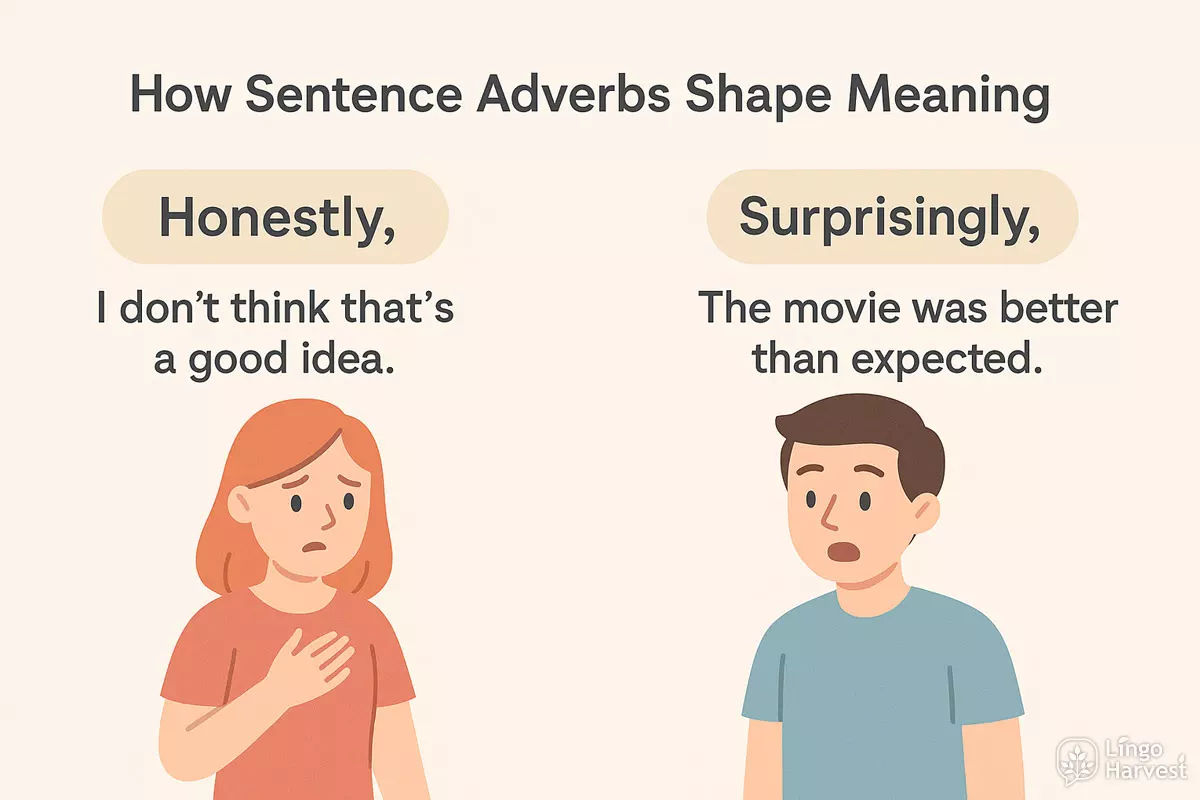
By using these adverbs, you can signal certainty, doubt, manner of speaking, or even the logical connection between ideas. This helps guide the reader or listener’s interpretation, making your point of view clear. For example, unfortunately signals regret, while clearly suggests that something is obvious.
- Honestly, I don’t think that’s a good idea. → expresses truthfulness about the speaker’s opinion
- Surprisingly, the movie was better than expected. → shows the outcome was unexpected
- Regrettably, we missed the last train. → indicates a sense of disappointment
- Ideally, everyone should arrive on time. → presents the preferred situation
- Technically, that’s not correct. → highlights a detail based on rules or facts
- Obviously, this needs more work. → marks something as clear to all
- Generally, people enjoy sunny weather. → makes a generalization
- Fortunately, nobody was hurt. → conveys relief
- Seriously, you should see this. → stresses sincerity or urgency
- Incidentally, I met your friend yesterday. → adds extra, less relevant information
- Frankly, I was bored. → signals openness or honesty
- Interestingly, he never mentioned it. → points out something noteworthy
- Luckily, we had an umbrella. → expresses positive chance
- Admittedly, it was my fault. → concedes a point
Sentence Adverbs vs. Regular Adverbs
Unlike adverbs that modify specific verbs or adjectives (like quickly in “she ran quickly”), sentence adverbs affect the tone or perspective of the entire clause. This distinction changes both the meaning and the placement of the adverb in a sentence.
| Sentence Adverb | Regular Adverb | Effect |
|---|---|---|
| Honestly, I forgot your birthday. | I forgot your birthday honestly. | First: speaker’s attitude; Second: how the forgetting was done |
| Clearly, it’s raining outside. | She spoke clearly. | First: states obviousness; Second: modifies manner of speaking |
| Unfortunately, we lost the game. | We lost the game unfortunately. | First: expresses regret; Second: less common, less natural |
| Ideally, everyone would participate. | They participated ideally. | First: states an ideal; Second: describes how participation happened |
Guiding the Reader’s Reaction
Using sentence adverbs helps you manage the emotional and logical impact of your writing. Whether you want to soften a statement (perhaps, apparently), show agreement (certainly, indeed), or add a personal touch (personally, frankly), these words let you comment directly on your message as a whole.
Position in Sentence
Sentence adverbs usually have a distinct placement compared to other adverbs. Instead of modifying just a single verb, adjective, or adverb, they comment on the entire idea expressed by the clause. Most often, these adverbs are positioned at the beginning of a sentence, setting the tone or attitude of the speaker. However, they can also appear in the middle or at the end, depending on emphasis and style.
Initial Placement
Starting a sentence with a commenting adverb is the most common method. This placement signals to the reader that the adverb is meant to influence the whole statement, not just a single part. For example:
- Frankly, I don’t believe his story.
- Unfortunately, the concert was canceled.
- Ideally, everyone would arrive on time.
- Honestly, I forgot about the meeting.
This position draws immediate attention to the writer’s or speaker’s attitude.
Mid-Sentence and End Placement
Sometimes, these adverbs are inserted after the subject or later in the clause, often set off by commas. This can soften their effect or make the tone more conversational. For example:
- The project, fortunately, finished ahead of schedule.
- Your suggestion, frankly, surprised me.
- We can, ideally, solve this together.
Placing the adverb at the end is less frequent, but possible, especially in spoken English:
- I missed your call, unfortunately.
- She will join us, hopefully.
Common Sentence Adverbs and Their Typical Positions
The following table gives a quick overview of where some frequent sentence adverbs are usually placed in clauses:
| Sentence Adverb | Typical Position(s) |
|---|---|
| However | Beginning or after a semicolon |
| Fortunately | Beginning, middle, or end |
| Honestly | Beginning or after the subject |
| Sadly | Beginning or end |
| Clearly | Beginning or mid-sentence |
| Apparently | Usually at the start |
| Surprisingly | Beginning or after the subject |
| Ideally | Beginning or mid-sentence |
| Presumably | Beginning or after the subject |
| Regrettably | Beginning or end |
Summary of Placement Choices
Choosing where to place a sentence adverb can subtly change the emphasis of your statement. Placing it at the start gives it prominence, while inserting it later can make your tone sound more nuanced or less direct. End placement is rare but can be effective for spoken emphasis. Always use commas to set off these adverbs for clarity.
Common Sentence Adverbs
Sentence adverbs are words or phrases that allow the speaker or writer to express an attitude toward the entire statement, rather than just modifying a single verb or adjective. These adverbs often appear at the beginning of a sentence, setting the tone for what follows. They help convey opinions, certainty, doubt, or connect ideas, making writing clearer and more nuanced.
Frequent Examples
Many adverbs serve this function, each introducing a subtle shade of meaning. Here are some of the most widely used options:
- Unfortunately
- Frankly
- Obviously
- Interestingly
- Surprisingly
- Clearly
- Apparently
- Luckily
- Honestly
- Ideally
- Regrettably
- Presumably
- Undoubtedly
- Actually
- Seriously
- Curiously
- Hopefully
- Incidentally
How Sentence Adverbs Work in Context
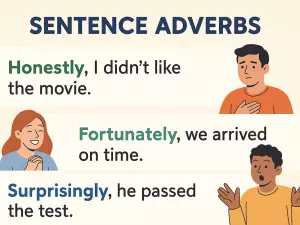
These modifiers typically stand apart from the main sentence, often separated by a comma. They comment on the whole idea, not just a single action. For example: “Honestly, I didn’t expect that result.” Here, “honestly” reflects the speaker’s attitude toward the entire statement.
Comparison: Sentence vs. Manner Adverbs
To clarify how these words function differently from adverbs of manner, consider the following table:
| Sentence Adverb | How It Modifies the Clause |
|---|---|
| Surprisingly | Expresses that the whole statement is unexpected: “Surprisingly, he passed the test.” |
| Quickly | Describes how the action is performed (not a sentence adverb): “He quickly passed the test.” |
| Regrettably | Shows the speaker’s regret about the fact: “Regrettably, the event was canceled.” |
| Slowly | Describes the manner of an action: “She slowly entered the room.” |
Where to Place Them
Most sentence adverbs work best at the start of a sentence, though some can also appear mid-clause or at the end. Placement can subtly change emphasis, but the overall meaning remains a comment on the entire idea. For instance: “Hopefully, the weather will improve.”
Meaning and Tone
Sentence adverbs play a key role in expressing a speaker’s attitude or viewpoint about an entire statement, rather than modifying a specific verb or adjective. They typically provide a comment, judgment, or perspective on what follows (or sometimes precedes) in the sentence. This makes them useful tools for clarifying intent, softening statements, or marking certainty and doubt.
How Sentence Adverbs Shape Communication
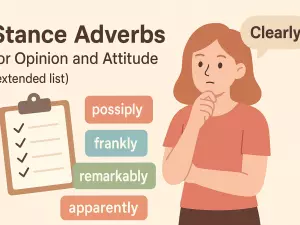
When you use adverbs like fortunately, frankly, or apparently, you’re not just adding detail: you’re signaling how the message should be interpreted. For example, unfortunately signals regret or bad news, while clearly stresses confidence in what’s being stated. Some adverbs can soften criticism (perhaps, presumably), while others can make praise or critique more direct (undoubtedly, honestly).
Common Functions
- Expressing opinion or evaluation: Frankly, I think the rules are too strict.
- Showing certainty or uncertainty: Obviously, the answer is correct. / Presumably, he missed the bus.
- Indicating attitude or emotion: Thankfully, everyone arrived safely.
- Managing politeness: Honestly, I didn’t expect that result.
- Highlighting logical connections: Consequently, we had to cancel the event.
Sample Sentence Adverbs and Their Typical Effect
| Adverb | Typical Effect or Attitude |
|---|---|
| Unfortunately | Signals regret, disappointment, or bad news |
| Hopefully | Expresses hope or positive expectation |
| Surprisingly | Highlights unexpectedness or irony |
| Obviously | Shows confidence, sometimes impatience |
| Frankly | Marks honesty, directness, or even bluntness |
| Apparently | Indicates information is second-hand or uncertain |
| Thankfully | Expresses relief or gratitude |
| Presumably | Suggests something is likely but not confirmed |
| Consequently | Signals logical result or outcome |
| Ideally | Describes a preferred or perfect situation |
Nuances and Tone Shifts
The placement of a sentence adverb often affects tone. Starting a sentence with one can sound more formal or emphatic: Honestly, I disagree. Placing it later may make the tone more neutral: I disagree, honestly. Some adverbs can also come across as sarcastic or dismissive depending on context and intonation. Choosing the right one helps shape how your message is received—whether you want to be diplomatic, assertive, or cautious.
Examples
Sentence adverbs are commonly used to express a writer’s attitude or to comment on the whole statement, rather than just a single verb or idea. These adverbials often appear at the beginning of a sentence, but can also be placed elsewhere for emphasis or style. Below, you’ll find a range of typical sentence adverbs, along with sample sentences to illustrate how they function within different contexts.
Common Sentence Adverbs in Use
- Fortunately, everyone arrived on time despite the traffic.
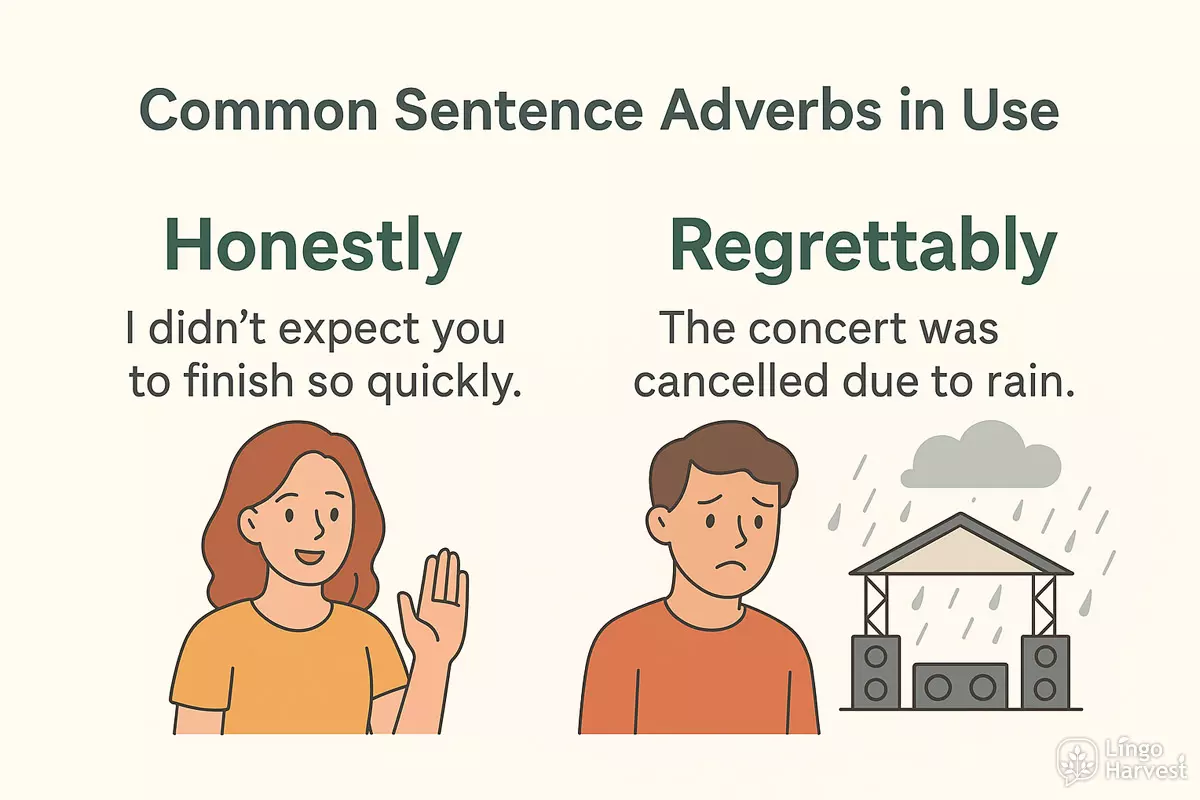
- Honestly, I didn’t expect you to finish so quickly.
- Regrettably, the concert was cancelled due to rain.
- Surprisingly, she enjoyed the horror movie.
- Clearly, we need to start earlier next time.
- Unfortunately, there was nothing we could do.
- Frankly, your explanation doesn’t make sense.
- Ideally, every student should participate.
- Apparently, the meeting has been postponed.
- Seriously, you should see a doctor about that cough.
- Technically, the deadline is midnight.
- Admittedly, I made a mistake in the calculation.
- Hopefully, the weather will improve tomorrow.
- Interestingly, nobody objected to the proposal.
- Undoubtedly, this is the best solution we have.
- Incredibly, he finished the marathon with a broken shoe.
- Presumably, they’ll let us know if plans change.
- Seriously, this shouldn’t be ignored.
Sentence Adverbs vs. Adverbs Modifying Verbs
To clarify how these adverbials work, compare their use at the sentence level with adverbs that only modify verbs. Notice how the meaning shifts depending on placement and function.
| Sentence Adverb (Whole Clause) | Adverb (Verb Modifier) |
|---|---|
| Frankly, I don’t agree with that decision. | She spoke frankly about her concerns. |
| Unfortunately, we missed the last bus. | He unfortunately dropped the keys. |
| Clearly, something is wrong here. | He explained the rules clearly. |
| Hopefully, the repairs will be finished soon. | They answered hopefully when asked about the results. |
Placement and Punctuation
Sentence adverbs most often appear at the start of a statement, followed by a comma, but they can also be placed mid-sentence or at the end for stylistic effect:
- Honestly, I have no idea what happened. → At the beginning
- I have, honestly, no idea what happened. → In the middle
- I have no idea what happened, honestly. → At the end
In summary, these adverbs help writers and speakers signal their perspective or attitude, shaping the tone and clarity of communication.
Mistakes to Avoid
When using sentence adverbs to comment on an entire clause, certain pitfalls can easily slip into your writing. Overusing these adverbs or placing them incorrectly can make your sentences sound awkward or unclear. It's also common for writers to confuse sentence adverbs with regular adverbs, which can change the intended meaning.
Common Errors with Placement
Placing these adverbs in the wrong part of a sentence can obscure your meaning. Typically, sentence adverbs like "fortunately," "honestly," or "surprisingly" appear at the beginning of a clause, but they can sometimes go at the end. Placing them in the middle often confuses readers.
- Incorrect: She, frankly, doesn't care. ❌
- Correct: Frankly, she doesn't care. ✅
- Incorrect: He arrived, unfortunately, late. ❌
- Correct: Unfortunately, he arrived late. ✅
Confusing Sentence and Manner Adverbs
One frequent misstep is using an adverb meant to describe how an action is performed ("manner adverb") when you intend to comment on the whole statement.
- Wrong: She quickly, finished the test. (Describes "how")
- Right: Fortunately, she finished the test. (Comments on the event)
Excessive Use
Relying too heavily on these adverbs can make writing sound unnatural or overly opinionated. Moderation is key; using several in a single paragraph is rarely justified.
Mixing Up Meaning
Some adverbs look similar but have different functions. For example, "hopefully" (commenting: 'I hope') and "hopeful" (describes a person) are not interchangeable.
| Sentence Adverb | Typical Use | Misuse Example | Correction |
|---|---|---|---|
| Honestly | Expresses speaker’s opinion about the clause | She answered honestly the question was hard. ❌ | Honestly, the question was hard. ✅ |
| Surprisingly | Highlights unexpected information | The test was surprisingly, easy. ❌ | Surprisingly, the test was easy. ✅ |
| Unfortunately | Shows regret about the situation | He, unfortunately, failed. ❌ | Unfortunately, he failed. ✅ |
| Hopefully | Expresses hope about the clause | Hopefully the train arrives soon. (Correct, but informal) | It is to be hoped that the train arrives soon. (Formal) |
Avoiding Ambiguity
Be careful not to place these adverbs where it’s unclear whether they modify the entire statement or just a verb. If your reader has to pause to figure out your intent, consider rewording.
- Place sentence adverbs at the start of the clause for clarity.
- Don’t use them in every sentence—reserve for emphasis or commentary.
- Check that your adverb fits the tone and meaning you want to convey.
- Remember: Not all adverbs work as sentence adverbs. Choose carefully.
By keeping these points in mind, you’ll avoid muddy phrasing and ensure your commentary always adds value and clarity.
Short Practice
To help you get comfortable with sentence adverbs, try identifying them in context and using them to comment on entire clauses. These exercises will guide you through recognizing and applying such adverbs to convey attitude, opinion, or evaluation about a statement as a whole.
Identify the Sentence Adverb
Read each sentence below. Decide which word or phrase is acting as a sentence adverb, expressing the speaker’s viewpoint about the entire clause.
- Frankly, I don’t think this plan will work.
- Surprisingly, the team finished the project early.
- John, unfortunately, missed his flight.
- She will, hopefully, join us tomorrow.
- Honestly, I have never seen such a mess.
Show answers
- Frankly
- Surprisingly
- Unfortunately
- Hopefully
- Honestly
Rewrite with a Sentence Adverb
Transform each statement by adding a suitable commenting adverb at the beginning. Choose from: fortunately, obviously, ideally, regrettably, seriously.
- I forgot my umbrella and got soaked.
- Our meeting has been postponed.
- We should finish the report by Friday.
- The solution was right in front of us.
- The patient is recovering well after surgery.
Show answers
- Regrettably, I forgot my umbrella and got soaked.
- Seriously, our meeting has been postponed.
- Ideally, we should finish the report by Friday.
- Obviously, the solution was right in front of us.
- Fortunately, the patient is recovering well after surgery.
Common Sentence Adverbs: Quick Reference
Here is a handy list of sentence adverbs you might encounter or use in speech and writing. These words signal the speaker’s attitude toward the entire statement, not just one part.
- Actually
- Apparently
- Clearly
- Fortunately
- Frankly
- Honestly
- Ideally
- Interestingly
- Naturally
- Obviously
- Regrettably
- Seriously
- Surprisingly
- Unfortunately
- Hopefully
- Presumably
- Undoubtedly
- Luckily
Spot the Difference: Sentence vs. Regular Adverbs
Compare how adverbs can function differently depending on their placement and meaning. Review the examples below:
| Sentence Adverb (comments on the whole clause) | Regular Adverb (modifies a verb, adjective, or other adverb) |
|---|---|
| Honestly, I didn’t know about the meeting. | She answered honestly. |
| Fortunately, no one was injured in the accident. | He arrived fortunately just as the doors were closing. |
| Clearly, we need a new approach. | She explained the rules clearly. |
| Surprisingly, the answer was correct. | He reacted surprisingly calmly. |
Notice how sentence adverbs set the tone or attitude for the entire sentence, while regular adverbs focus on specific actions or qualities.