Fronted Adverbs for Emphasis: How to Highlight Key Information

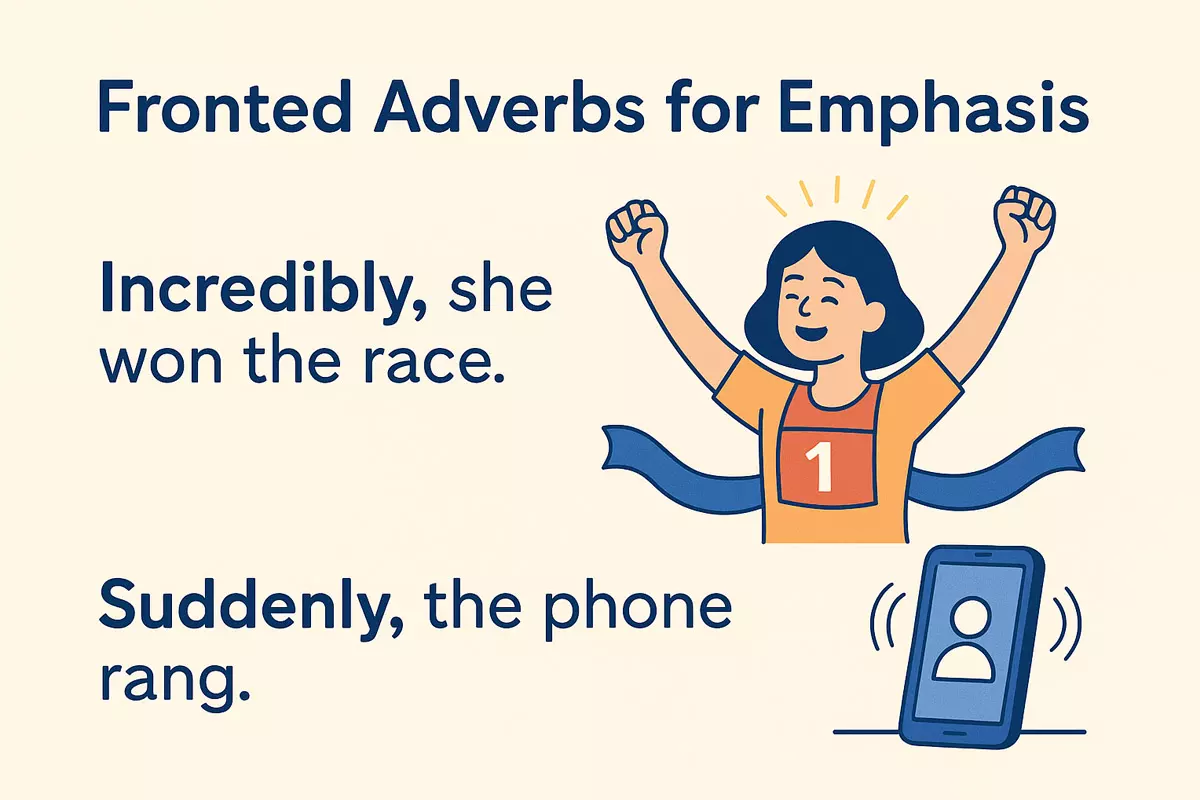 The article defines fronting and its purpose, lists commonly fronted adverbs, and explains comma usage. It also discusses how fronting affects focus and tone, gives examples from various genres, and offers practice with rewriting sentences.
By starting sentences with descriptive words or phrases, you can give your writing a compelling edge that captures attention and emphasizes key details. This technique not only adds variety and style but also helps highlight important information, making your message more engaging for readers. Shifting the usual sentence structure in this way can create a more dynamic and interesting flow, encouraging your audience to pay closer attention to what you have to say and enhancing the overall impact of your writing.
What fronting is and why writers use it
Fronting is a technique where a writer moves a word, phrase, or clause—often an adverbial element—to the beginning of a sentence. This rearrangement draws attention to the fronted element, helping writers emphasize specific aspects of their message. By shifting the usual word order, authors can highlight time, place, manner, or reason, making their writing more engaging and nuanced.
How does fronting work?
Normally, English sentences follow a subject-verb-object pattern. When a phrase is fronted, it precedes the subject, altering the rhythm and focus. For example, instead of “She finished her homework quickly,” fronting produces “Quickly, she finished her homework.” This subtle change makes “quickly” the center of attention.
Reasons for using fronted adverbials
- Emphasis: Placing adverbs at the start highlights important details.
- Variety: Changing sentence structure keeps writing lively and avoids monotony.
- Contrast: Fronted elements can signal a shift or contrast with previous information.
- Cohesion: Linking ideas across sentences is easier when a fronted phrase refers back to earlier content.
- Style: Writers use fronting to control flow, build suspense, or create a particular tone.
Common types of fronted adverbials
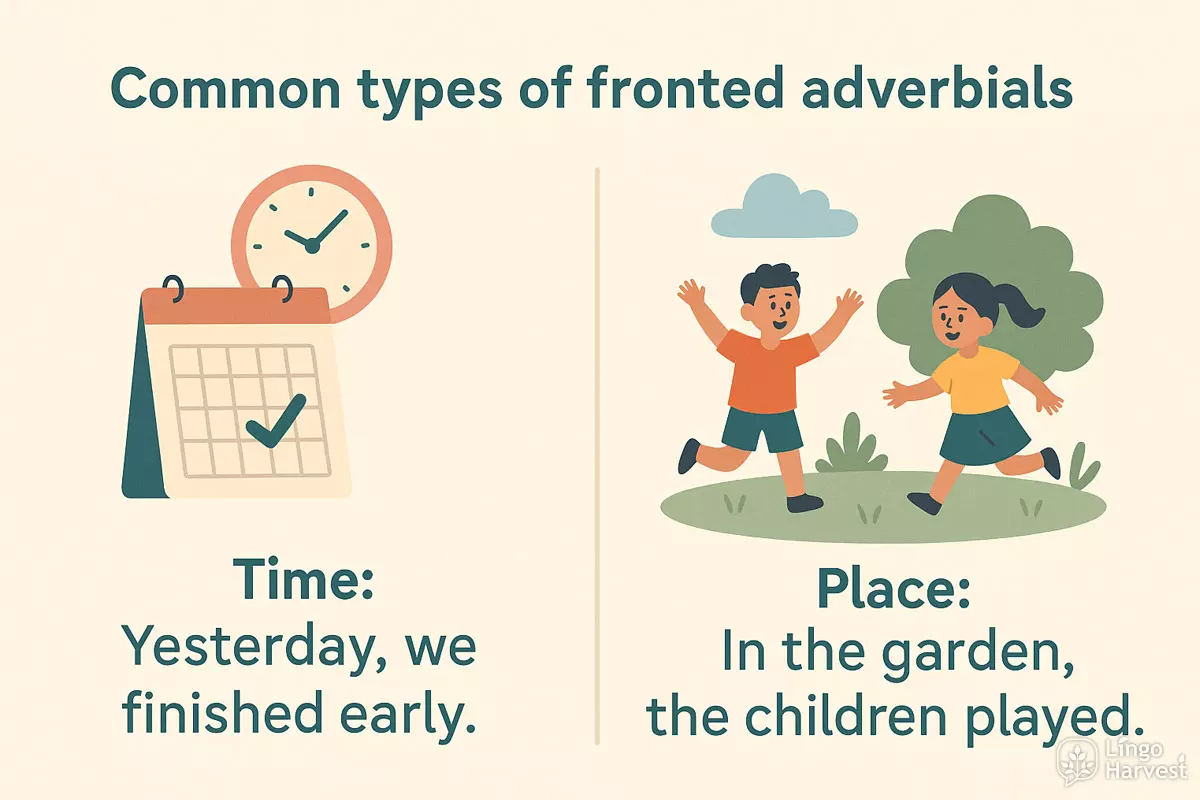
- Time: Yesterday, we finished early.
- Place: In the garden, the children played.
- Manner: With great care, she painted the vase.
- Reason: Because of the storm, the match was postponed.
- Condition: If necessary, call for help.
- Frequency: Every morning, he jogs in the park.
- Concession: Despite the rain, the event continued.
- Result: As a result, they succeeded.
- Attitude: Surprisingly, everyone agreed.
- Focus: Only then, did she realize the truth.
- Sequence: First, we need to gather supplies.
- Comparison: Like her brother, she enjoys chess.
Why choose fronting?
Writers often select fronting to guide the reader’s attention or to foreground information that might otherwise be overlooked. By manipulating sentence order, they can control pacing, create suspense, or echo spoken emphasis. This technique helps texts sound more natural and expressive, especially in creative writing, journalism, and formal discourse.
Types of adverbs commonly fronted
When speakers want to highlight a particular aspect of a sentence, they often move certain adverbs to the start. This technique is especially effective for drawing attention to time, manner, frequency, or degree. Not every adverb works equally well at the beginning, though. Some lend themselves naturally to this position, while others rarely appear there in standard usage.
Time adverbs
Adverbs indicating when something happens are frequently placed at the front. This helps set the scene or clarify sequence:
Time adverbs
- Yesterday → Yesterday, we visited my grandparents.
- Soon → Soon, everything will make sense.
- Already → Already, the results look promising.
- Later → Later, we can discuss the details.
- Eventually → Eventually, the truth came out.
- Recently → Recently, I started a new course.
- Immediately → Immediately, he stood up and left.
- Then → Then, the lights suddenly went out.
- Finally → Finally, they reached an agreement.
- Afterwards → Afterwards, we went out for dinner.
- Earlier → Earlier, she called to confirm.
- Beforehand → Beforehand, make sure you read the instructions.
- Tonight → Tonight, we will review the report.
- Tomorrow → Tomorrow, the team will begin testing.
- Nowadays → Nowadays, people rely heavily on technology.
Placing these words first can subtly shift the focus to timing, making narratives or instructions clearer.
Manner and degree adverbs
Words describing how or to what extent something is done also appear at the front for emphasis or stylistic effect. For instance:
- Quietly → Quietly, she closed the door behind her.
- Suddenly → Suddenly, the crowd began to cheer.
- Carefully → Carefully, he placed the vase on the shelf.
- Deliberately → Deliberately, she ignored the comment.
- Gently → Gently, he touched the injured bird.
- Completely → Completely, the plan changed overnight.
- Absolutely → Absolutely, you should follow the guidelines.
- Clearly → Clearly, there was a misunderstanding.
- Surprisingly → Surprisingly, the solution was simple.
- Thoroughly → Thoroughly, they checked every document.
- Effortlessly → Effortlessly, she solved the equation.
- Precisely → Precisely, he explained how it works.
- Intensely → Intensely, the audience watched the scene.
- Remarkably → Remarkably, the team finished ahead of schedule.
- Fully → Fully, he supports the new initiative.
This approach is common in narratives or instructions, where the manner of action is crucial.
Frequency and viewpoint adverbs
Adverbs that express how often something occurs, or the speaker's perspective, can also be fronted:
- Often → Often, we forget how lucky we are.
- Sometimes → Sometimes, a small break is enough.
- Rarely → Rarely, you see such dedication.
- Never → Never, have I heard a stranger excuse.
- Usually → Usually, the office opens at 8.
- Frankly → Frankly, I expected more from the presentation.
- Personally → Personally, I prefer a simpler design.
- Honestly → Honestly, I didn’t think he would come.
- Admittedly → Admittedly, the task was harder than expected.
- Generally → Generally, people trust familiar brands.
- Typically → Typically, this model performs better.
- Ideally → Ideally, the process should take one day.
- From my perspective → From my perspective, the plan is solid.
- In my opinion → In my opinion, this is unnecessary.
- On balance → On balance, the advantages outweigh the drawbacks.
Fronting these adverbs adds nuance and directs the reader’s attention to frequency or attitude.
Comparing fronted and unfronted adverbs
| Fronted Position | Standard Position |
|---|---|
| Suddenly, the lights went out. | The lights went out suddenly. |
| Rarely do we see such talent. | We rarely see such talent. |
| Honestly, I didn’t expect that. | I didn’t expect that, honestly. |
| Yesterday, she called me. | She called me yesterday. |
Fronting is most natural with certain adverbs, as shown above. Notice how the emphasis shifts—placing the adverb first draws attention to time, frequency, manner, or viewpoint, giving the sentence a different rhythm and focus.
Comma rules after fronted adverbs
When an adverb or adverbial phrase is placed at the beginning of a sentence for emphasis, it’s common practice to set it off with a comma. This punctuation helps clarify the sentence structure and signals to the reader that the introductory element modifies what follows. While these commas are generally recommended, there are some nuances and exceptions, especially with shorter or less emphatic adverbs.
General guideline for using commas
Most introductory adverbs—especially those indicating time, manner, degree, place, or linking ideas—should be followed by a comma. This is especially true when the adverb is used to highlight or emphasize a point at the start of a sentence.
- Yesterday, we finished the project early.
- Surprisingly, no one objected to the change.
- Honestly, I didn’t expect that result.
- Reluctantly, he agreed to help.
- Suddenly, the lights went out.
- Incredibly, they solved the puzzle in minutes.
- Fortunately, the weather improved.
- Once again, she missed the deadline.
- In the meantime, please wait in the lobby.
- Afterwards, we went for coffee.
When can the comma be omitted?
For very short, common adverbs (such as "now," "then," "soon," "yesterday") that do not carry strong emphasis, the comma is sometimes optional, especially in informal writing. However, adding a comma is never incorrect and often improves clarity.
- Now(,) let’s begin. ✅
- Then(,) she left the room. ✅
Comparing sentence clarity: comma vs. no comma
| With comma | Without comma |
|---|---|
| Quickly, she answered the phone. | Quickly she answered the phone. |
| Unfortunately, we missed the train. | Unfortunately we missed the train. |
| Later, he explained everything. | Later he explained everything. |
| Finally, the meeting ended. | Finally the meeting ended. |
| In general, people prefer simple explanations. | In general people prefer simple explanations. |
Summary of best practices
- Use a comma after introductory adverbs or adverbial phrases to ensure clarity.
- Short, common adverbs may omit the comma in informal contexts, but it’s clearer with one.
- Longer or more complex introductory phrases should always be followed by a comma.
- Consistency helps your writing look polished and professional.
How fronting changes focus and tone
Moving an adverb or adverbial phrase to the beginning of a sentence instantly shifts what readers or listeners notice first. This technique, called “fronting,” can give a sentence a sense of drama, contrast, or urgency by placing important information in the spotlight. For example, compare these two sentences:
- Suddenly, the lights went out. (The interruption is dramatic and immediate.)
- The lights went out suddenly. (The event is reported more neutrally.)
Fronting is especially useful when you want to highlight time, place, or manner. It can also soften directives, create suspense, or clarify what’s most relevant in the context. The effect depends on which element is moved to the front and the context in which it appears.
Common effects of fronted adverbs
- Emphasis: The fronted element stands out, drawing attention to new or surprising information.
- Contrast: Placing an adverb at the start can signal a change or exception (e.g., On the contrary, she agreed).
- Tone shift: The sentence may feel more formal, literary, or expressive.
- Focus: The speaker or writer guides the reader toward what matters most in the sentence.
- Variety: Altered word order breaks monotony and adds stylistic interest.
Comparing standard and fronted forms
| Standard Order | Fronted Adverb |
|---|---|
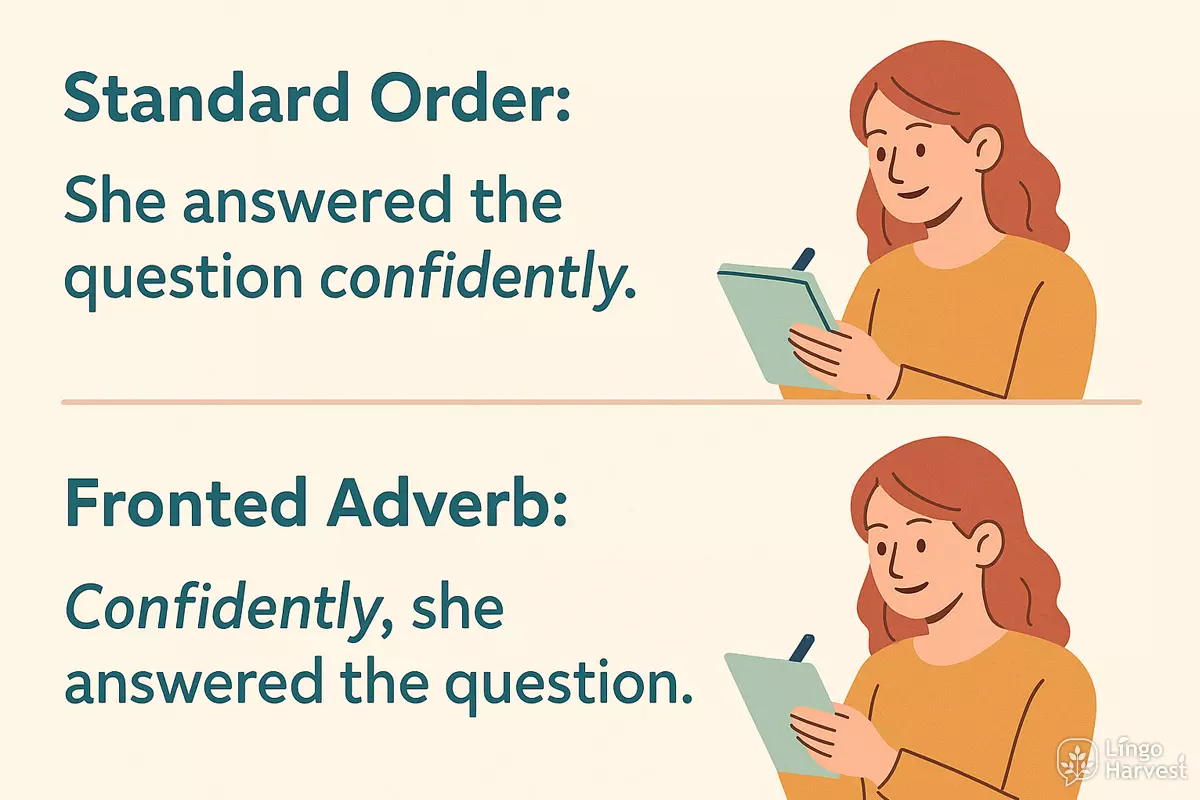
| She answered the question confidently. | Confidently, she answered the question. |
| We will meet tomorrow. | Tomorrow, we will meet. |
| He spoke after the meeting. | After the meeting, he spoke. |
| They worked in silence. | In silence, they worked. |
| The kids ran outside quickly. | Quickly, the kids ran outside. |
Nuances and stylistic choices
Writers often use this device to control the rhythm and flow of their prose. In narratives, it can build suspense (At that moment, the door creaked open). In academic or formal writing, it can clarify logical relationships (Therefore, the results support our hypothesis). However, overusing fronted adverbs can make writing sound forced or artificial, so it’s best used for special effect or clarity.
In conversation, fronted adverbs are less common, but they do occur for emphasis or dramatic effect. Choosing when to front an adverb depends on the desired tone, context, and the writer’s intent.
Examples in storytelling, essays, and speeches
Fronting adverbs at the start of a sentence can dramatically shift a reader’s or listener’s focus, making your writing or speech more vivid and engaging. Writers and speakers use this technique to draw attention to specific details, set the mood, or highlight contrast. Whether you’re telling a story, crafting a thoughtful essay, or delivering a compelling speech, placing an adverb (or adverbial phrase) at the front can help control pacing and emphasis.
Storytelling: Setting the Scene and Mood
When narrating events, fronted adverbials can immediately establish time, place, or manner. This approach is common in fiction and personal anecdotes.
- Suddenly, the lights flickered out.
- Without warning, the dog began to bark.
- In the distance, thunder rumbled ominously.
- Carefully, she opened the ancient box.
- Before dawn, the village was already bustling.
- On the edge of the cliff, he stood motionless.
- With trembling hands, he dialed the number.
- Reluctantly, she agreed to the proposal.
- For hours, they waited in silence.
- Once again, the mysterious figure appeared.
Essays: Strengthening Arguments and Contrast
In formal or academic writing, leading with an adverb can highlight a point or clarify relationships between ideas.
- Importantly, this study challenges previous assumptions.
- However, the data suggests otherwise.
- Consequently, the policy was revised.
- Surprisingly, the results were inconclusive.
- Historically, such events have led to reform.
- In contrast, later research found no evidence.
- Undoubtedly, these findings are significant.
- Notably, participation rates have increased.
- For example, many cities have adopted this approach.
- Ultimately, the choice rests with the voters.
Speeches: Enhancing Delivery and Persuasion
Orators often place adverbs at the start for dramatic effect or to guide the audience’s attention.
- Now, we stand at a crossroads.
- Tonight, we celebrate our achievements.
- Above all, we value integrity.
- Frankly, this is unacceptable.
- Once more, we must rise to the challenge.
- With courage, let us face the future.
- Against all odds, we prevailed.
- In truth, our work is only beginning.
- Step by step, we will build a better tomorrow.
- From this moment on, change is possible.
Comparing Standard vs. Fronted Adverbial Placement
Moving an adverb to the front isn’t just stylistic; it can affect tone and focus. Here’s a comparison:
| Standard Placement | Fronted Adverbial |
|---|---|
| She opened the box carefully. | Carefully, she opened the box. |
| He spoke frankly about the issue. | Frankly, he spoke about the issue. |
| The village was bustling before dawn. | Before dawn, the village was bustling. |
| We must face the future with courage. | With courage, we must face the future. |
By experimenting with adverb placement, you can add variety and emphasis to your writing or speech, making your message more memorable and effective.
Practice: rewrite sentences using fronting
Fronting adverbials is a powerful way to add emphasis or variety to your writing. This exercise encourages you to take standard sentences and rephrase them by moving an adverbial phrase or clause to the beginning. Doing so highlights important information and can change the tone or focus of a sentence.
Instructions
Below are several sentences written in a standard word order. For each, rewrite the sentence so that an adverbial (such as a time, manner, or place phrase) comes first. This will help you practise using fronted adverbials for emphasis. Consider what information you want to highlight and how the fronting affects the emphasis.
- She finished her work quickly.
- We met at the café after the movie.
- He will never forget that day.
- The children played in the garden until sunset.
- They rarely see such beautiful sunsets.
- I found my keys under the sofa.
- You must submit the form before Friday.
- The team celebrated their victory with great excitement.
- He reads the newspaper every morning.
- They moved to the city last year.
- She only realized the mistake later.
- We heard the news during breakfast.
- He travels abroad whenever he can.
- The dog barked loudly at midnight.
- They completed the project ahead of schedule.
Common Patterns for Fronting
- Time: Yesterday, we went hiking.
- Place: In the park, children were playing.
- Manner: With great care, she painted the wall.
- Frequency: Every week, he visits his grandmother.
- Conditional: If it rains, we'll stay home.
Compare Standard and Fronted Versions
| Standard Word Order | Fronted Adverbial |
|---|---|
| She finished her work quickly. | Quickly, she finished her work. |
| We met at the café after the movie. | After the movie, we met at the café. |
| The children played in the garden until sunset. | Until sunset, the children played in the garden. |
| He reads the newspaper every morning. | Every morning, he reads the newspaper. |
| They moved to the city last year. | Last year, they moved to the city. |
Practice Answers
Show answers
- Quickly, she finished her work.
- After the movie, we met at the café.
- Never will he forget that day.
- Until sunset, the children played in the garden.
- Rarely do they see such beautiful sunsets.
- Under the sofa, I found my keys.
- Before Friday, you must submit the form.
- With great excitement, the team celebrated their victory.
- Every morning, he reads the newspaper.
- Last year, they moved to the city.
- Only later did she realize the mistake.
- During breakfast, we heard the news.
- Whenever he can, he travels abroad.
- At midnight, the dog barked loudly.
- Ahead of schedule, they completed the project.