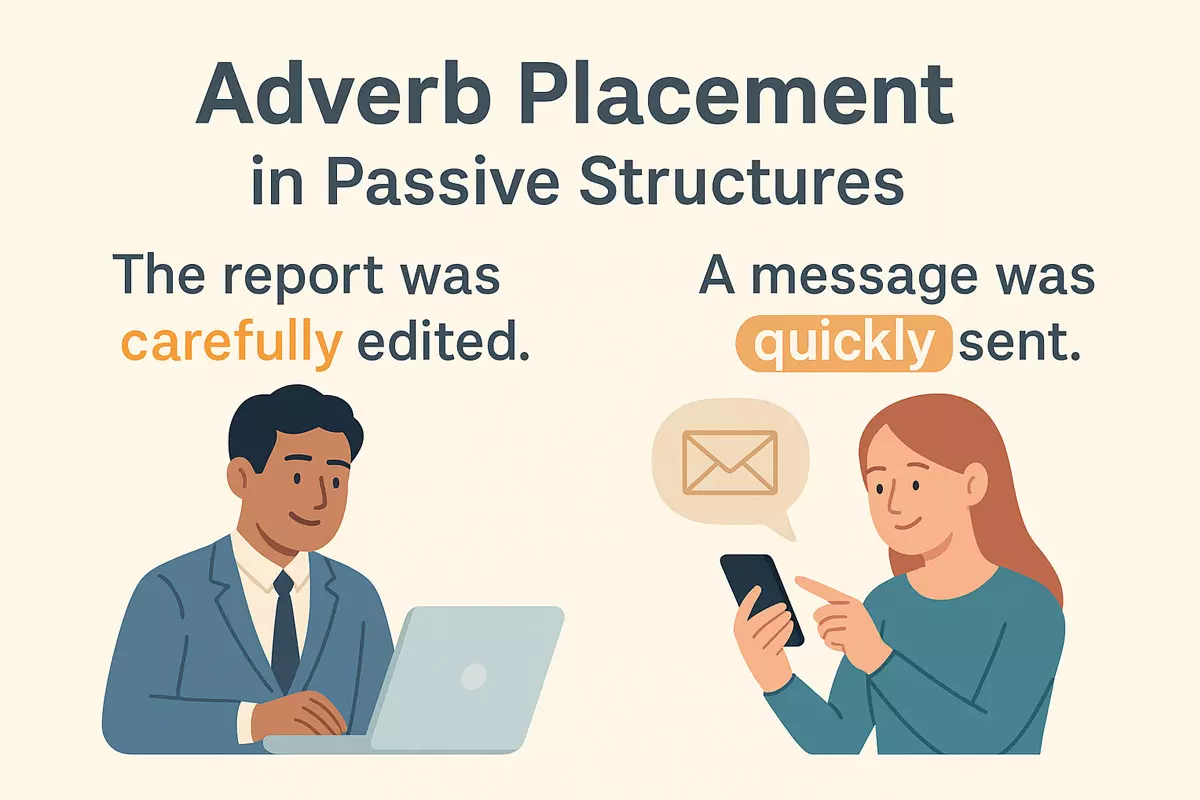
Adverb Placement in Passive Structures

 Here we how to form passive sentences, where to position adverbs in passive clauses, and the distinction between mid- and end-position. It also discusses placement in complex passives, offers real examples, and includes practice exercises.
Many English learners and writers find it challenging to determine the correct placement of modifying words in sentences that use the passive voice. Properly positioning these descriptive elements is essential for ensuring clarity and precision in writing. Modifiers such as adverbs or phrases should be placed as close as possible to the words they describe to avoid confusion, especially in passive constructions where word order can already be less direct. Mastering this aspect of sentence structure enhances readability and helps communicate ideas more effectively.
How passive sentences are built
Passive constructions shift focus from the subject performing an action to the object receiving it. To form such sentences, English uses a combination of the verb “to be” and the past participle of the main verb. The agent (the doer) can be included using “by,” but it’s often omitted when the agent is unknown or irrelevant.
Core Structure of Passive Forms
The basic formula is: Subject + form of "to be" + past participle (+ by + agent). This allows the original object of an active sentence to become the grammatical subject of the passive version. For example:
- Active: The chef prepares the meal.
- Passive: The meal is prepared (by the chef).
Building Passive Sentences in Different Tenses
The form of "to be" changes based on tense, and the main verb always appears as a past participle. Below is a comparative overview of passive sentence patterns in various tenses:
| Tense | Active Example | Passive Example |
|---|---|---|
| Present Simple | They write letters. | Letters are written (by them). |
| Past Simple | She cleaned the room. | The room was cleaned (by her). |
| Present Continuous | He is fixing the car. | The car is being fixed (by him). |
| Present Perfect | We have made a cake. | A cake has been made (by us). |
| Future Simple | They will announce results. | Results will be announced (by them). |
Common Patterns for Passive Construction
- Use the correct tense of “to be”: am, is, are, was, were, being, been, will be, etc.
- Always follow “to be” with the past participle of the main verb.
- “By + agent” is optional and often omitted if obvious or unimportant.
- Modal verbs: modal + be + past participle (e.g., The report can be finished).
- For questions: invert “to be” and subject (e.g., Is the letter written?).
- Negative forms: add “not” after “to be” (e.g., The door is not locked).
- Intransitive verbs (verbs with no object) are not used in the passive.
- Some verbs with two objects allow both to become the subject (e.g., She was given a gift, A gift was given to her).
Understanding these building blocks helps in recognizing where adverbs can be placed within passive structures, as the auxiliary and participle create new options for word order.
Common adverb positions in passive clauses
Understanding how adverbs fit within passive sentences can be a challenge, since their placement sometimes shifts compared to active structures. Typically, adverbs in passive constructions appear in three main spots: before the main verb, after the auxiliary verb, or at the end of the clause. Each position can subtly change the emphasis or flow of your sentence.
Typical spots for adverbs in passive sentences
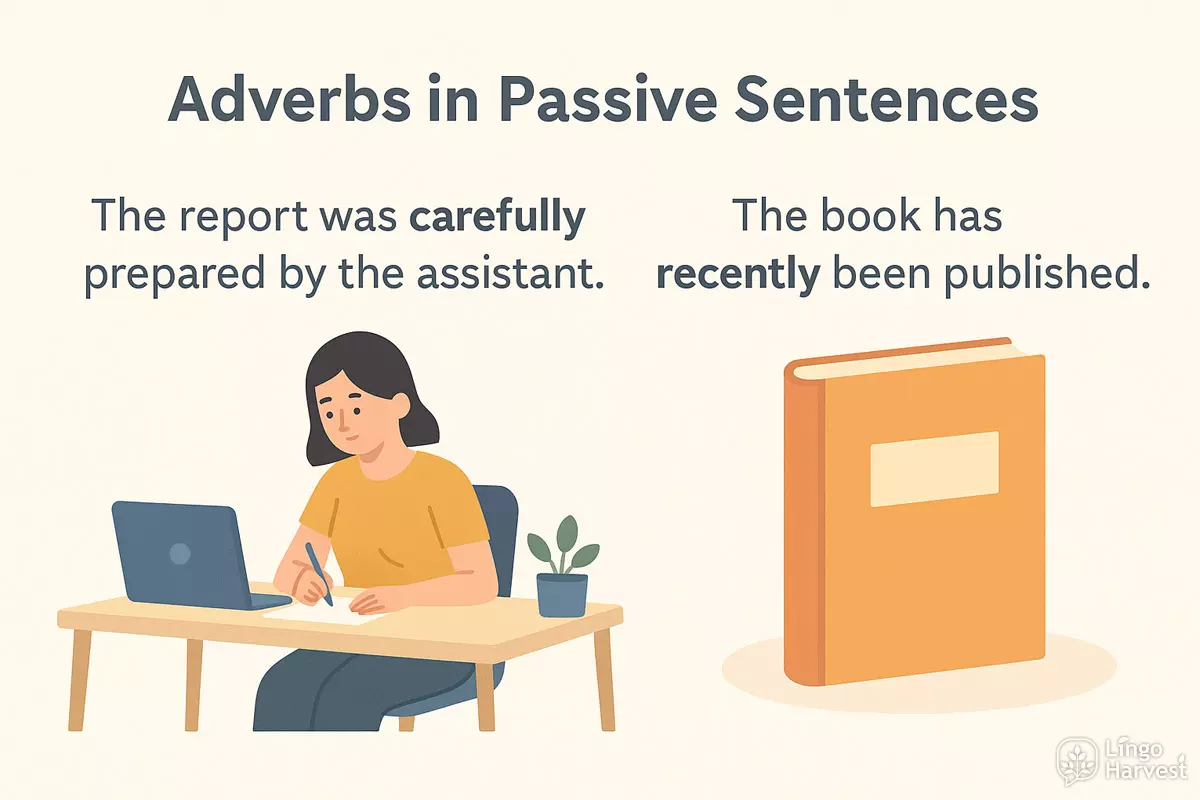
- Before the main verb: "The report was carefully prepared by the assistant."
- After the auxiliary verb: "The book has recently been published."
- At the end of the clause: "The message was delivered yesterday."
How adverb type affects placement
Some adverbs, especially those of manner (such as "quickly" or "thoroughly"), are commonly found right before the main verb or at the end of the clause. Adverbs of frequency (like "often" or "rarely") tend to follow the auxiliary verb. Time adverbs usually appear at the end, but can sometimes come at the beginning for emphasis.
Comparing adverb positions: Examples
| Adverb Position | Example (Passive Clause) |
|---|---|
| After the auxiliary verb | The decision was quickly made by the committee. |
| Before the main verb | The cake was carefully decorated. |
| At the end of the clause | The announcement was made yesterday. |
| At the beginning (for emphasis) | Recently, the rule was changed. |
| Between auxiliary verbs (with modals) | The results can easily be interpreted. |
| With frequency adverbs | The work is usually completed on time. |
| With negative adverbs | The rules are never broken. |
| With degree adverbs | The task was completely finished. |
Summary of adverb use in passives
Choosing the right spot for an adverb in a passive sentence depends on both the adverb type and the desired emphasis. While many adverbs can move between positions, their placement affects how information is highlighted. Practice with varied examples helps deepen your understanding of these subtle but important choices.
Difference between mid-position and end-position
Understanding how adverbs fit into passive sentences involves knowing the typical places they appear: mid-position (within the verb phrase) and end-position (after the main verb or object). These positions are not interchangeable, as each one affects the sentence's focus and meaning.
Mid-position: Inside the Verb Phrase
Mid-position means the adverb comes after any auxiliary verbs but before the main verb. In passive constructions, this usually places the adverb between the form of "be" and the past participle. This spot is often chosen for common adverbs of frequency, degree, or certainty.
- He was always invited to the meetings.
- The results have already been announced.
- The project is often completed ahead of schedule.
This placement emphasizes how often, how much, or in what manner the action occurs, without shifting the focus away from the event itself.
End-position: After the Main Verb or Object
End-position refers to adverbs coming at the end of the clause, following the main verb or its object. This is typical for adverbs of manner, time, or place, especially when the information is new or important.
- The report was delivered yesterday.
- The cake was eaten quickly.
- The decision was made in the afternoon.
Placing an adverb at the end can highlight the action’s circumstances, making the adverb stand out.
Comparing Typical Uses
The two positions often serve different communicative functions. Here’s a structured comparison:
| Mid-position (within verb phrase) | End-position (after main verb/object) |
|---|---|
| He was never chosen for the team. | He was chosen for the team last year. |
| The package has just been sent. | The package was sent by courier. |
| It is usually completed on time. | It was completed with care. |
| The task will probably be finished soon. | The task was finished quickly. |
Summary of Key Points
- Mid-position is best for adverbs of frequency, certainty, or degree; it sits between auxiliary and main verb.
- End-position is preferred for adverbs of manner, place, or time; it comes at the clause’s end.
- Switching positions can alter nuance or even make the sentence unnatural.
- Some adverbs can fit in both spots, but the meaning or emphasis may shift.
Choosing the right spot for an adverb in passive voice ensures your message is clear and natural.
Placement with long and complex passives
Understanding where to position adverbs in extended or intricate passive sentences can be challenging. As passives become longer—with embedded clauses, multiple auxiliaries, or heavy noun phrases—the flexibility of adverb placement often decreases and ambiguity can arise. Let’s explore strategies and common patterns for handling these cases, so your meaning remains clear and natural.
General Principles for Adverb Position
Adverbs in passive constructions typically appear:
- Before the main verb or auxiliary (e.g., The report was carefully reviewed).
- Between auxiliaries, especially with modal verbs (e.g., The proposal has already been approved).
- After the past participle, but this is less common and can sound awkward in lengthy sentences.
With complex passives, the safest choice is usually near the first auxiliary or just before the past participle.
Challenges in Extended Passive Structures
When sentences contain relative clauses, prepositional phrases, or a series of verbs, adverb placement can affect clarity. Misplaced adverbs may unintentionally modify the wrong verb or clause. For example:
- The manuscript that was recently submitted by Dr. Lee was accepted. (clear: "recently" modifies "submitted")
- The manuscript was accepted recently by the committee. (clear: "recently" modifies "accepted")
- The manuscript was by the committee recently accepted. (awkward and ambiguous)
- The report that was carefully reviewed by the team was approved. (clear: "carefully" modifies "reviewed")
- The report was approved quickly by management. (clear: "quickly" modifies "approved")
- The report was by management quickly approved. (unnatural and confusing)
- The data that was initially collected showed inconsistencies. (clear: "initially" modifies "collected")
- The data was analyzed thoroughly by the researchers. (clear: "thoroughly" modifies "analyzed")
- The data was by the researchers thoroughly analyzed. (awkward placement)
- The instructions that were recently updated are easier to follow. (clear: "recently" modifies "updated")
- The instructions were explained clearly by the teacher. (clear: "clearly" modifies "explained")
- The instructions were by the teacher clearly explained. (unnatural and overly formal)
Examples: Adverb Positions in Long Passive Sentences
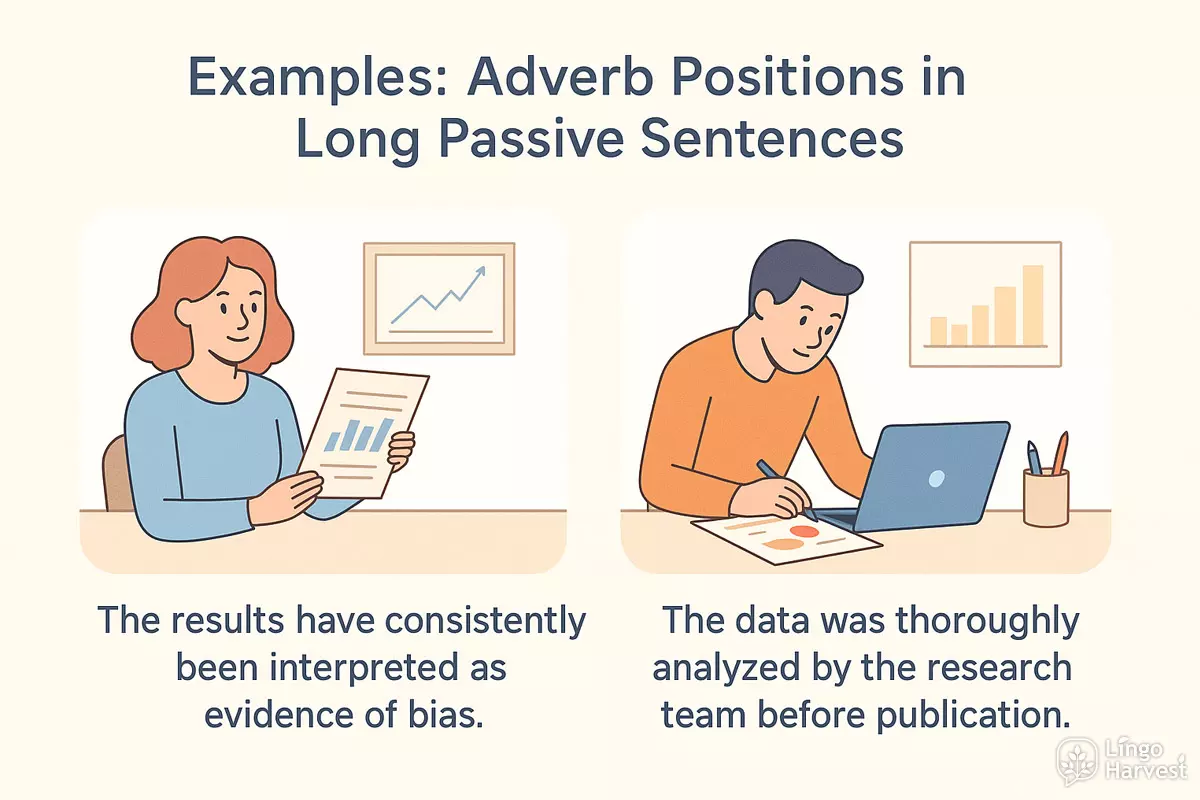
Below is a selection of passive constructions with varying adverb placements. Notice how the position changes the emphasis or clarity.
- The results have consistently been interpreted as evidence of bias.
- The data was thoroughly analyzed by the research team before publication.
- The procedures are usually completed within two hours.
- The recommendations were quickly and efficiently implemented by the staff.
- The error had already been discovered when the audit was conducted.
- The application is being carefully reviewed by multiple departments.
- The solution was immediately adopted after the crisis was identified.
- The issue has frequently been discussed during meetings.
- The equipment will eventually be replaced by newer models.
- The letter is sometimes misplaced during processing.
- The system had never been tested under these conditions before the failure occurred.
- The new policy is generally accepted by most employees.
- The complaint was formally addressed by the board in last week’s session.
- The project is currently being managed by an external consultant.
- The findings will likely be published in the upcoming journal issue.
- The task was deliberately assigned to a neutral party.
- The medication has recently been approved for use in children.
- The event was unexpectedly cancelled by the organizers.
Comparison: Adverb Placement in Simple vs. Complex Passives
| Simple Passive | Long/Complex Passive | Notes |
|---|---|---|
| The letter was quickly sent. | The letter was quickly sent to the committee by the secretary after the meeting. | Adverb stays before past participle for clarity. |
| The cake was eagerly eaten. | The cake that had been eagerly anticipated was eaten by the children at the party. | Adverb can modify the participle or the relative clause, depending on placement. |
| The proposal is often accepted. | The proposal is often accepted by management after thorough review and discussion. | Adverb remains close to auxiliary for natural flow. |
| The solution was immediately implemented. | The solution was immediately implemented by the team once approval was granted. | Longer objects and phrases follow the adverb + verb core. |
Tips for Natural Placement
- Keep adverbs close to the verb they modify, especially in lengthy sentences.
- If the passive contains multiple verbs, position the adverb before the main past participle or after the auxiliary for clarity.
- Avoid placing adverbs between a preposition and its object or after a long agent phrase.
- Reread for ambiguity: move the adverb if its target verb or clause isn’t immediately clear.
In summary, as passives grow in length and complexity, careful adverb placement is essential for readability and precision. Consistent patterns—placing adverbs before the main verb or auxiliary—help maintain clarity, especially in academic or formal writing.
Examples from news, reports, and emails
Writers and speakers often need to decide where to place adverbs in passive sentences, especially in formal contexts like journalism, business reports, and professional emails. The position of adverbs can subtly affect emphasis and clarity. Below, you’ll find authentic sample sentences and patterns, illustrating how adverb placement works in such passive structures.
Typical adverb positions in passive voice
In passive constructions, adverbs commonly appear:
- Before the main verb (e.g., “was quickly resolved”)
- After the main verb (e.g., “was resolved quickly”)
- Between auxiliary and past participle (e.g., “has consistently been reported”)
- At the end of the clause for adverbs of manner or frequency (e.g., “was reviewed thoroughly”)
Real-world sample sentences
- The error was immediately corrected by the technician. ✅
- The findings have frequently been cited in recent publications.
- The request was not approved by management. ❌
- The decision has already been made.
- The equipment was carefully inspected before use.
- The report is being actively discussed by the board.
- The shipment was unfortunately delayed due to weather.
- The update will be automatically installed overnight.
- The proposal has consistently been rejected in past meetings.
- The issue is rarely addressed in annual summaries.
- The message was promptly forwarded to all departments.
- The policy will soon be revised.
- The budget was unexpectedly increased last quarter.
- The project has just been completed.
- The data were thoroughly analyzed before publication.
- The contract has not yet been signed.
Comparing adverb positions
| Pattern | Example |
|---|---|
| Auxiliary + Adverb + Past Participle | has recently been updated |
| Main Verb + Adverb (end position) | was reviewed thoroughly |
| Adverb + Main Verb | was immediately adopted |
| Negative Adverb + Auxiliary + Past Participle | has never been confirmed |
These examples reflect patterns you’ll see in real news articles, official reports, and everyday business correspondence. Notice how the placement of adverbs like immediately, thoroughly, and recently not only clarifies timing or manner but also shapes the focus of the sentence. Adjusting adverb position can make writing more precise and natural in passive constructions.
Practice: rewrite active into passive with correct placement
To master adverb placement in passive structures, it’s helpful to transform active sentences into their passive equivalents, making sure to position adverbs naturally and clearly. The placement of adverbs such as "always," "already," "quickly," or "carefully" can change the focus or nuance of a sentence, so attention to their location is crucial.
Instructions
Below are several active voice sentences. Rewrite each one in the passive voice, ensuring you place the adverb appropriately. Consider whether the adverb should come before or after the main verb (the form of "be" + past participle) depending on the type of adverb and what it modifies.
- She always finishes the project before the deadline.
- The chef quickly prepared the meal.
- They carefully cleaned the ancient vase.
- He already solved the problem.
- The students usually complete the homework on time.
- The manager just approved the request.
- The technician thoroughly tested the system.
- The committee recently made the decision.
- The artist happily accepted the award.
- The company frequently updates its software.
Adverb Placement Patterns in Passive Sentences
Here are some common patterns for adverb placement in passive constructions:
- Frequency adverbs (always, often, never, usually) typically go between the auxiliary verb ("is/are/was/were") and the past participle.
- Manner adverbs (carefully, quickly, thoroughly) usually follow the main verb phrase, but can sometimes go before the past participle for emphasis.
- Time adverbs (recently, just, already) often appear between the auxiliary verb and past participle, or at the end of the sentence.
| Active Sentence | Passive Sentence (with correct adverb placement) |
|---|---|
| She always finishes the project before the deadline. | The project is always finished by her before the deadline. |
| The chef quickly prepared the meal. | The meal was quickly prepared by the chef. |
| They carefully cleaned the ancient vase. | The ancient vase was carefully cleaned by them. |
| He already solved the problem. | The problem has already been solved by him. |
| The students usually complete the homework on time. | The homework is usually completed on time by the students. |
| The manager just approved the request. | The request has just been approved by the manager. |
| The technician thoroughly tested the system. | The system was thoroughly tested by the technician. |
| The committee recently made the decision. | The decision was recently made by the committee. |
| The artist happily accepted the award. | The award was happily accepted by the artist. |
| The company frequently updates its software. | The software is frequently updated by the company. |
Show answers
- The project is always finished by her before the deadline.
- The meal was quickly prepared by the chef.
- The ancient vase was carefully cleaned by them.
- The problem has already been solved by him.
- The homework is usually completed on time by the students.
- The request has just been approved by the manager.
- The system was thoroughly tested by the technician.
- The decision was recently made by the committee.
- The award was happily accepted by the artist.
- The software is frequently updated by the company.
Practice transforming active to passive sentences helps you develop a natural sense for where adverbs belong in passive structures. As you work through more examples, pay special attention to how the meaning shifts if you change the adverb’s position. This awareness will improve both your accuracy and your style in English writing.