Active vs Passive Voice: How to Choose the Right Form

 Learn the difference between active and passive voice, when each is preferred or sounds natural, and how focus shapes information flow. It also covers style in writing vs speech, common learner fixes, sentence transforms, and homework rewrites.
Choosing between action-focused sentences and ones that highlight the receiver can change how your message is understood. In everyday writing, it helps to know when to name the doer for clarity, precision, and momentum, and when to shift attention to the receiver for tact, emphasis, or smoother flow. Practice revising a few lines both ways to see which version fits your purpose and audience.
Difference between active and passive voice
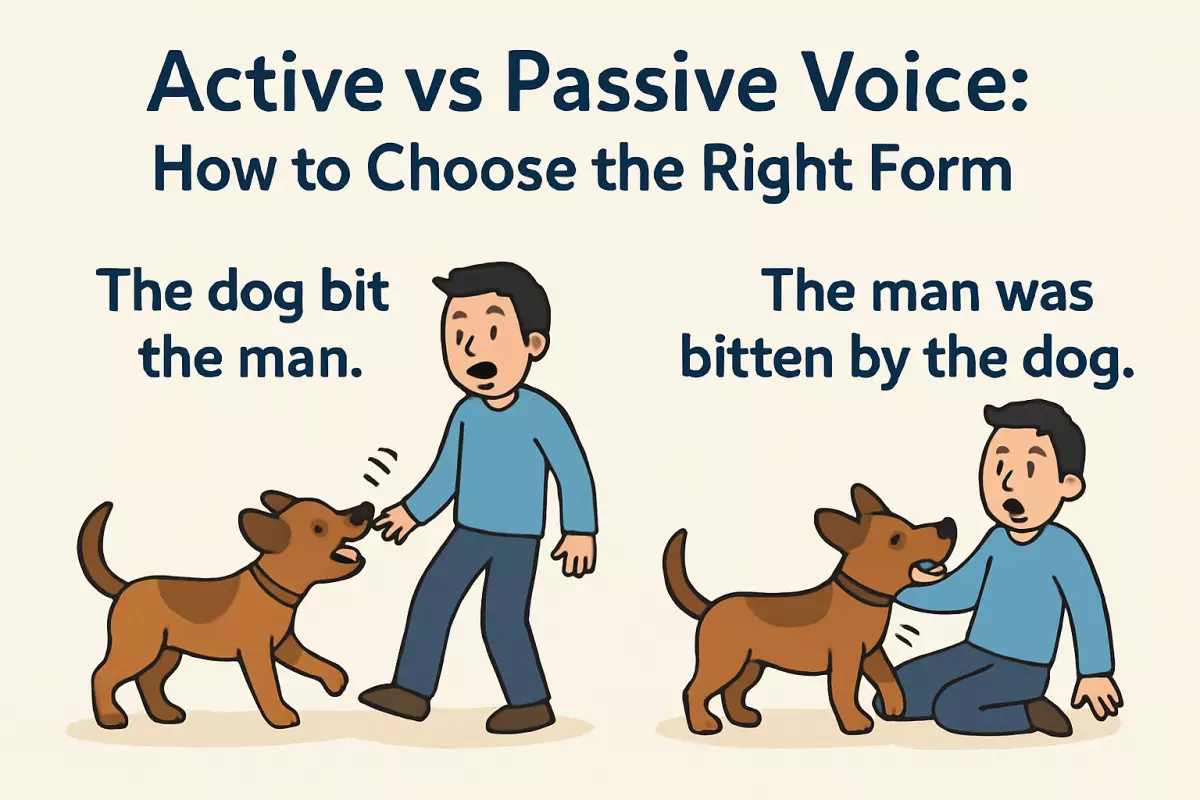
These two voice forms organize the same event in different ways: one highlights who does the action, and the other highlights what receives the action. The choice changes emphasis, sentence rhythm, and how easily a reader can identify the main actor.
| Feature | Active voice | Passive voice |
|---|---|---|
| Focus | The doer (agent) is the subject. | The receiver (patient) is the subject. |
| Basic pattern | Subject → verb → object | Subject → be + past participle (+ by + agent) |
| Typical question answered | Who did it? | What happened to it? |
| Clarity of responsibility | Usually explicit. | Can be explicit or hidden (agent omitted). |
| Conciseness | Often shorter and more direct. | Often longer due to extra verb phrase. |
| When it reads naturally | When the actor matters or is known. | When the result matters more than the actor, or the actor is unknown. |
| Common use cases | Instructions, narratives, most general writing. | Processes, formal reports, tactful or neutral tone. |
| Agent phrase | Not needed (agent is already the subject). | Optional: add by + noun if the doer is important. |
How to recognize each form
Look first at the main verb phrase. Active clauses typically use a simple verb or a tense with auxiliaries that still keep the agent as the subject. Passive clauses use a form of be (or sometimes get) plus a past participle, and they may include a by-phrase.
- ✅ Active signal: the subject performs the action (e.g., “The team completed the project.”).
- ✅ Passive signal: be + past participle (e.g., “The project was completed.”).
- ✅ Optional agent in passive: “The project was completed by the team.”
- ❌ Not automatically passive: “The project is important.” (This is a linking verb, not a passive construction.)
Pattern shifts: what changes when you switch voice
Changing voice usually moves the object into the subject position and adjusts the verb phrase. This is not just grammar; it changes what the reader notices first.
- Active: “A researcher analyzed the data.” → Passive: “The data were analyzed (by a researcher).”
- Active: “The manager approved the budget.” → Passive: “The budget was approved (by the manager).”
- Active: “Someone stole my bike.” → Passive: “My bike was stolen.” (agent unknown or unimportant)
- Active: “The storm damaged the roof.” → Passive: “The roof was damaged (by the storm).”
Passive voice forms you will see often
Passive constructions appear across tenses and with modals. The constant piece is the past participle; the auxiliary changes to match tense or modality.
- Present simple: “is/are + past participle” (e.g., “Orders are processed daily.”)
- Past simple: “was/were + past participle” (e.g., “The file was deleted.”)
- Present continuous: “is/are being + past participle” (e.g., “The system is being updated.”)
- Past continuous: “was/were being + past participle” (e.g., “The issue was being investigated.”)
- Present perfect: “has/have been + past participle” (e.g., “Changes have been made.”)
- Past perfect: “had been + past participle” (e.g., “The decision had been announced.”)
- Future: “will be + past participle” (e.g., “Results will be shared tomorrow.”)
- Modal: “can/must/should be + past participle” (e.g., “Payments must be received by Friday.”)
- Infinitive: “to be + past participle” (e.g., “The form needs to be signed.”)
- Gerund: “being + past participle” (e.g., “She dislikes being interrupted.”)
- Get-passive (more informal): “get + past participle” (e.g., “The window got broken.”)
When active voice is preferred
Choose the active form when you want the sentence to clearly show who is doing what. It tends to read faster, reduces ambiguity, and makes responsibility and sequence of actions easier to follow.
Situations where the active form works best
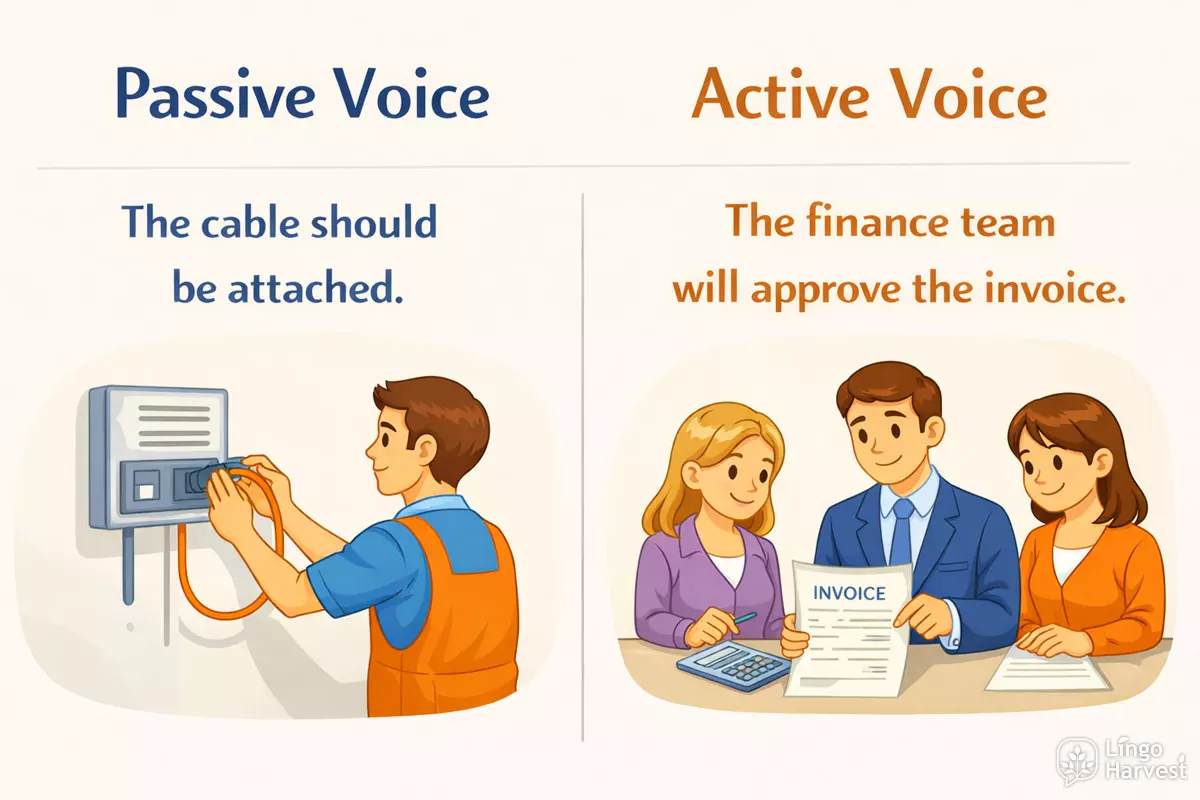
- Instructions and procedures: Use direct commands so readers can act immediately. → “Attach the cable,” not “The cable should be attached.”
- Business and workplace writing: Clarify ownership of tasks and deadlines. → “The finance team will approve the invoice.”
- Academic writing that emphasizes agency: Highlight what the researcher or study did. → “We measured the samples at 20°C.”
- News and reporting when attribution matters: Identify the source of actions or claims. → “The committee rejected the proposal.”
- Performance reviews and feedback: Keep statements specific and actionable. → “You met the target,” rather than “The target was met.”
- Customer support and troubleshooting: Make steps unambiguous and sequential. → “Restart the router, then update the firmware.”
- Legal or policy writing that assigns responsibility: Reduce interpretive gaps. → “The tenant must notify the landlord within 24 hours.”
- Project updates and status reports: Make progress and blockers traceable. → “Engineering fixed the bug; QA verified the patch.”
- Safety guidance: Keep the actor and action explicit to prevent mistakes. → “Wear protective gloves,” not “Protective gloves should be worn.”
- Storytelling and narrative: Maintain momentum and vividness. → “The dog chased the ball.”
- Emails that request action: Reduce back-and-forth. → “Please send the draft by Friday.”
- Data commentary and analysis: Make causal claims easier to track. → “Higher prices reduced demand.”
Common patterns that signal a good active rewrite
- “There is/There are” openings: Replace with a concrete subject when possible. → “The report includes three charts.”
- Hidden actors: If the doer matters, name them. → “IT reset the passwords.”
- Nominalizations (nouns made from verbs): Turn the noun back into a verb. → “We decided,” instead of “A decision was made.”
- Overuse of “by” phrases: Move the actor to the subject position. → “The manager approved the request.”
- Weak verbs plus extra words: Prefer a single strong verb. → “The team resolved the issue,” not “The issue was addressed by the team.”
Quick check before you choose active
- ✅ If the reader needs to know who is responsible, lead with the actor.
- ✅ If you are describing steps in order, keep the subject consistent across sentences.
- ❌ If the actor is unknown or irrelevant, or you must emphasize the result over the doer, passive may be the better fit in that specific sentence.
When passive voice is more natural
Use the passive when the receiver of the action is the real focus, when the doer is unknown or irrelevant, or when the context calls for an objective, process-centered tone. In these cases, the passive voice helps you keep the sentence aligned with what readers care about most: the result, the event, or the affected thing.
Common situations where passive is the smoother choice
- The actor is unknown: “The window was broken overnight.” (No reliable information about who did it.)
- The actor is unimportant: “The forms were filed yesterday.” (Who filed them does not change the point.)
- The actor is obvious from context: “You will be contacted within 24 hours.” (The organization is implied.)
- You want to emphasize the result: “The issue was resolved after the update.” (Outcome first; agent secondary.)
- Process descriptions and instructions: “The solution is heated to 80°C and then cooled.” (Steps matter more than the person doing them.)
- Scientific and technical writing: “Samples were collected and analyzed.” (Focus on method and reproducibility.)
- Formal reports and audits: “Two discrepancies were identified during the review.” (Findings foregrounded.)
- Policies and rules: “Access is granted only after verification.” (Rule-centered phrasing.)
- Customer support and service updates: “Your request has been received.” (Status update; agent not needed.)
- Legal or compliance language: “The contract was signed on March 3.” (Event and record are primary.)
- Diplomatic or tactful phrasing: “Mistakes were made in the final report.” (Softens direct blame.)
- To avoid naming a specific person: “The decision was approved by the committee.” (Shifts focus from individuals.)
- To maintain topic continuity: If a paragraph is about “the proposal,” then “The proposal was revised and resubmitted” keeps the same subject.
- Headlines and summaries: “New guidelines were released Monday.” (What happened first; who did it may come later.)
- When the agent is long or distracting: “The schedule was changed after a recommendation from the cross-functional planning group.”
Useful passive patterns to recognize and use
- Be + past participle: “The report was finalized.”
- Get + past participle (more informal, often for changes/events): “The file got deleted.”
- Modal + be + past participle: “The device must be restarted.”
- Perfect passive: “The package has been shipped.”
- Passive with agent (add “by …” only when it matters): “The proposal was rejected by the board.”
- Passive without agent (most common in practice): “The proposal was rejected.”
Quick checks to keep passive clear
- ✅ Name the agent with a “by …” phrase when responsibility, credit, or causation matters.
- ✅ Keep the main subject aligned with the paragraph topic (often the affected item, not the actor).
- ❌ Avoid stacking passives in a row if it makes the timeline hard to follow; mix in active sentences for clarity.
- ❌ Watch for vague agents like “by someone” or “by the team” when readers need specifics.
Focus and information structure
Choose active or passive based on what you want readers to notice first and what you want to place in the background. In many sentences, the first position signals “this is what the sentence is about,” while later elements carry newer or less central information. Voice lets you control that ordering without changing the facts.
How voice changes what feels “central”
- Active voice typically foregrounds the doer (agent) and makes the action feel direct: The analyst reviewed the data.
- Passive voice foregrounds the receiver (patient) and can downplay or omit the agent: The data were reviewed (by the analyst).
- Use passive when the receiver is already the topic of the paragraph and you want continuity: The data were reviewed, then archived.
- Use active when the agent is the topic or when responsibility and decision-making matter: The team approved the change.
- Passive can help when the agent is unknown, irrelevant, or too obvious to state: The window was left open overnight.
- Active can reduce ambiguity when multiple possible agents exist: The vendor shipped the parts (clearer than The parts were shipped if shipping responsibility matters).
Typical information patterns that favor each voice
- Known → new flow: Put familiar information first, new information later. If the “known” element is the receiver, passive often fits: The proposal was revised to address the budget.
- Topic chaining across sentences: Keep the same starting element to avoid jolts. If a paragraph is about “the samples,” passive keeps them in subject position: The samples were labeled. They were stored at 4°C.
- Process descriptions: When steps matter more than who performs them, passive can keep attention on the procedure: The solution is heated, then filtered.
- Accountability and decisions: When you need a clear actor, active is usually better: Finance rejected the request.
- Results-first reporting: When the outcome is the headline, passive can lead with it: Two errors were detected during testing.
- Contrast and emphasis: Use voice to highlight the contrasted element: The committee criticized the plan, but the timeline was praised.
Practical rewrites that shift emphasis
- Active: The manager assigned the task. → Passive: The task was assigned (by the manager). Effect: task-centered vs manager-centered.
- Active: Researchers collected the samples. → Passive: The samples were collected. Effect: method/results foregrounded; agent optional.
- Active: IT updated the servers overnight. → Passive: The servers were updated overnight. Effect: timing and system status emphasized.
- Active: The reviewer flagged three inconsistencies. → Passive: Three inconsistencies were flagged. Effect: problems highlighted first.
- Active: The courier delivered the package to reception. → Passive: The package was delivered to reception. Effect: package as the main thread.
- Active: The board approved the merger. → Passive: The merger was approved by the board. Effect: decision outcome foregrounded; authority still stated if needed.
- Active: Someone misplaced the file. → Passive: The file was misplaced. Effect: agent removed when unknown or unhelpful.
- Active: The editor shortened the introduction. → Passive: The introduction was shortened. Effect: document-centered revision narrative.
- Active: The storm damaged the roof. → Passive: The roof was damaged in the storm. Effect: condition of the roof is the headline.
- Active: The team will implement the fix tomorrow. → Passive: The fix will be implemented tomorrow. Effect: schedule emphasized; actor optional.
- Active: The lab confirmed the diagnosis. → Passive: The diagnosis was confirmed. Effect: result-centered reporting.
- Active: The instructor graded the exams. → Passive: The exams were graded. Effect: student-facing status update.
Quick checks for choosing the best ordering
- ✅ If the paragraph is mainly about the receiver (object), consider passive to keep that element in the subject position.
- ✅ If the paragraph is mainly about the doer (person/team/system), prefer active to keep responsibility clear.
- ✅ If you need to introduce a new actor, active often reads smoother: A new contractor repaired the line.
- ❌ Avoid passive when it hides an agent the reader expects to know (especially in policies, incident reports, or decisions).
- ❌ Avoid long passive chains if they make sentences heavy; mix voices to keep the topic clear and the prose moving.
Style differences in writing and speech
Different contexts reward different choices: everyday conversation tends to favor direct, agent-first wording, while formal writing often uses constructions that foreground results, processes, or objects. Understanding these patterns helps you decide when an active verb sounds natural and when a passive verb better matches the situation.
Typical patterns in conversation
In speech, people usually lead with the doer and keep sentences short. Active voice is common because it is quick to process, easy to respond to, and fits turn-taking.
- Agent first: “I sent the email.” / “They changed the schedule.”
- Short clauses with fewer add-ons: “We fixed it.” rather than “It was fixed.”
- Clear responsibility when asking or blaming: “Who broke this?”
- Natural imperatives: “Close the door.” (active command)
- Storytelling flow that follows actors: “She called, then he replied, then we met.”
- Repairs and clarifications that prefer active verbs: “No, I meant I moved it.”
- Informal pronouns as subjects: “We,” “you,” “they,” “someone.”
- Passive used selectively to soften blame: “Mistakes were made.”
- Passive used when the agent is unknown: “My bike was stolen.”
- Passive used to keep focus on the topic: “The tickets were already sold out.”
Typical patterns in formal and informational writing
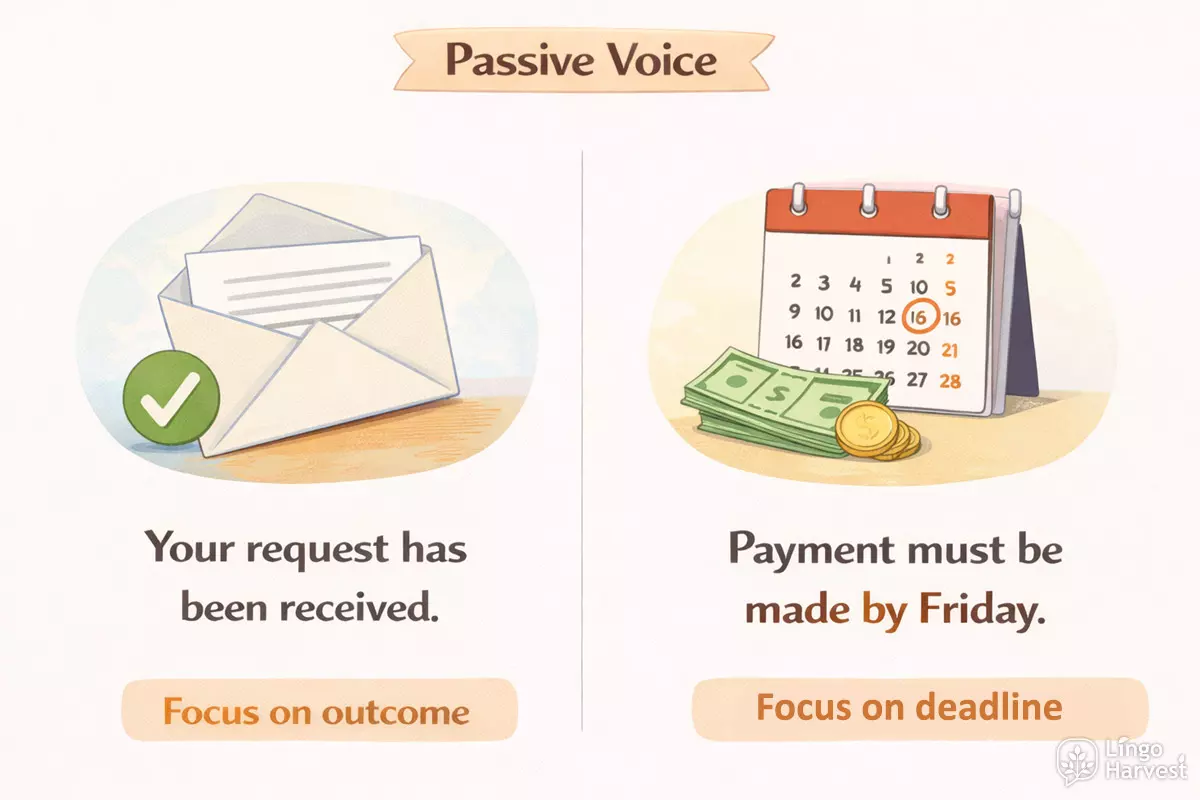
In many written genres, the focus is often on outcomes, evidence, and procedures. Passive voice is more frequent because it can keep attention on the thing being studied, built, or decided, especially when the actor is obvious, irrelevant, or intentionally backgrounded.
- Process focus: “The samples were heated to 80°C.” (method over actor)
- Result focus: “A solution was identified.” (finding over finder)
- Consistency of topic: keeping the same subject across sentences: “The policy was revised. It was then approved.”
- Institutional tone: “Your request has been received.”
- Legal and compliance phrasing: “Payment must be made by Friday.”
- Neutrality when attributing actions could sound accusatory: “The deadline was missed.”
- Genre expectations in reports and documentation: “The device was tested under load.”
- Active voice still preferred when accountability matters: “The committee approved the budget.”
- Active voice for clarity when multiple agents are possible: “The vendor shipped the parts, and the warehouse received them.”
- Overuse warning: long passive chains can feel heavy: “It was decided that it would be implemented…”
Practical cues for choosing the form
- ✅ Use active voice when the reader needs to know who did it, when giving instructions, or when you want energetic pacing.
- ✅ Use passive voice when the result matters most, the agent is unknown, or you need a neutral, procedural tone.
- ❌ Avoid passive constructions that hide responsibility in contexts that require transparency (policies, incident reports, evaluations).
- → If a sentence feels vague, test a revision by adding an explicit agent (“by the team,” “by the system”) or switching to an active verb.
Common learner confusion and fixes
Many problems with voice come from mixing up who does the action, what receives the action, and which information should be the focus. Use the fixes below to spot the pattern quickly and rewrite with control.
- Confusion: Treating passive as “past tense.”
Fix: Passive is a structure, not a tense. It uses be (or sometimes get) + past participle, and you can build it in any tense.
✅ Present passive: “The report is reviewed every Friday.”
✅ Past passive: “The report was reviewed yesterday.”
✅ Future passive: “The report will be reviewed tomorrow.” - Confusion: Using passive when the verb is intransitive.
Fix: Only transitive verbs (verbs that take an object) can form a true passive.
❌ “The accident was happened.” → ✅ “The accident happened.”
❌ “A solution was arrived.” → ✅ “We arrived at a solution.” - Confusion: Forgetting the past participle form.
Fix: Passive needs the past participle, not the simple past. Watch irregular forms.
❌ “The email was send.” → ✅ “The email was sent.”
❌ “The window was broke.” → ✅ “The window was broken.” - Confusion: Dropping the auxiliary be.
Fix: If you remove be, you usually lose the passive and create a fragment or a different meaning.
❌ “The forms submitted yesterday.” → ✅ “The forms were submitted yesterday.” - Confusion: Overusing “by + agent” even when it adds nothing.
Fix: Add “by…” only when the doer is important, specific, or surprising. Otherwise, omit it.
✅ “The policy was updated.” (agent not needed)
✅ “The policy was updated by the legal team.” (agent matters) - Confusion: Avoiding passive even when the doer is unknown or irrelevant.
Fix: Passive is useful when you do not know who did it, or when the receiver of the action is the topic.
✅ “My bike was stolen.” (doer unknown)
✅ “The samples were labeled incorrectly.” (focus on samples and result) - Confusion: Using passive to sound “formal,” creating vague responsibility.
Fix: If accountability matters, choose an active subject and a clear verb.
❌ “Mistakes were made.” → ✅ “We made mistakes.” / “The team made mistakes.”
❌ “The deadline was missed.” → ✅ “I missed the deadline.” - Confusion: Mixing active and passive in the same sentence without control.
Fix: Keep one main voice per clause unless you have a reason to shift focus.
❌ “We reviewed the file and the decision was made.” → ✅ “We reviewed the file and made a decision.”
✅ “The file was reviewed, and a decision was made.” (consistent focus on process) - Confusion: Passive vs. adjective (state) with past participles.
Fix: Some “be + past participle” forms describe a state, not an action. Test it by adding a “by…” phrase or a time of action.
✅ Action (passive): “The door was closed by the guard at 9.”
✅ State (adjective): “The door was closed all night.” (describes condition) - Confusion: Choosing the wrong “be” tense for the timeline.
Fix: Keep the auxiliary aligned with time and aspect; the participle stays the same.
✅ “The data are being analyzed now.”
✅ “The data have been analyzed already.”
✅ “The data had been analyzed before the meeting.” - Confusion: Passive with modals (can, must, should) and missing “be.”
Fix: Modal + be + past participle.
❌ “The form must submitted.” → ✅ “The form must be submitted.”
❌ “The issue should fixed.” → ✅ “The issue should be fixed.” - Confusion: Using “get” passive in inappropriate contexts.
Fix: “Get + past participle” often sounds informal and can imply change or an unexpected result. Use it in conversation, not in careful formal writing unless it fits the tone.
✅ Informal: “I got invited to the event.”
✅ More neutral: “I was invited to the event.” - Confusion: Passive with two objects (give, send, offer).
Fix: You can often choose which object becomes the subject; pick the one you want to highlight.
✅ “A refund was offered to the customer.” (focus on refund)
✅ “The customer was offered a refund.” (focus on customer) - Confusion: Passive questions and word order.
Fix: In questions, invert the auxiliary be with the subject.
✅ “Was the package delivered?”
✅ “When was the package delivered?” - Confusion: Writing “by” when you mean a deadline.
Fix: “By Monday” is time (deadline), not an agent. Do not confuse it with “by + doer.”
✅ Deadline: “The report must be submitted by Monday.”
✅ Agent: “The report was submitted by Maria.” - Confusion: Choosing voice without checking the real subject.
Fix: Identify the action and ask: “Who performs it?” If that performer is your subject, use active; if the receiver is your subject, use passive.
→ Active pattern: “Doer + verb + receiver.”
→ Passive pattern: “Receiver + be + past participle (+ by doer).”
Transforming sentences between voices
Switching between active and passive forms is mostly a matter of tracking three parts: who does the action (agent), what receives the action (object), and the verb tense. The goal is to keep the meaning and time frame the same while changing which element appears as the subject.
Core conversion pattern
- Active → Passive: Move the object to the subject position, add the appropriate form of be, use the past participle, and optionally add by + agent.
- Passive → Active: Make the agent the subject (often found after by), use the same tense in an active verb, and place the former subject as the object.
- Keep tense consistent: The passive uses be to carry tense and agreement; the main verb becomes a past participle.
- Decide whether to keep the agent: Include by + agent when responsibility matters; omit it when the doer is unknown, obvious, or irrelevant.
Quick tense and form guide (active vs passive)
| Active form | Passive form |
|---|---|
| Present simple: She writes the report. | The report is written (by her). |
| Past simple: They approved the plan. | The plan was approved (by them). |
| Present continuous: He is fixing the car. | The car is being fixed (by him). |
| Past continuous: We were reviewing the file. | The file was being reviewed (by us). |
| Present perfect: Someone has closed the window. | The window has been closed. |
| Past perfect: The team had finished the test. | The test had been finished (by the team). |
| Future: They will announce the results. | The results will be announced (by them). |
| Modal: You must follow the rules. | The rules must be followed. |
Common edits that improve accuracy and clarity
- Check transitivity: Only verbs that take a direct object convert cleanly (e.g., build, approve, choose). Intransitive verbs usually cannot be passivized (e.g., arrive, sleep).
- Keep pronouns in the correct case: She → by her; they → by them.
- Use the right participle: irregular forms matter (e.g., write → written, choose → chosen).
- Avoid awkward agents: If the agent is long or vague, consider staying active or rewriting the sentence to name a clear subject.
- Prefer passive without “by” when the doer is unknown: The package was delivered. (Agent omitted because it is not identified.)
- Keep meaning when changing focus: If the active sentence implies intent or responsibility, include the agent in the passive to preserve that nuance.
- Watch for double objects: With verbs like give or send, either object can become the passive subject, but choose the one that matches your emphasis.
- Keep time markers where they belong: Place adverbs so they modify the same action (e.g., yesterday, already, currently).
- Be careful with “get” passives: got promoted is common in speech, but was promoted is often better for formal writing.
- Don’t force a conversion: If the passive version becomes longer or less clear, an active rewrite may be the better choice.
Homework: active and passive rewriting tasks
Build control over voice by rewriting the same meaning in two ways: one version that highlights the doer (active) and one that highlights the action or result (passive). Focus on consistent tense, clear agents, and natural word order.
How to rewrite accurately
- Keep the tense the same. If the original is past simple, your rewrite should stay past simple.
- Move the object to subject position when making a passive: object → subject.
- Use the right form of be + past participle (is done, was done, has been done, will be done).
- Add by + agent only when it matters for clarity, responsibility, or contrast.
- Check pronouns. I → me (after by), they → them, etc.
- Keep meaning stable. Do not add new information or remove key details.
- Watch for verbs that resist passive. Many intransitive verbs (arrive, sleep, happen) do not form a normal passive.
Task 1: Rewrite active → passive
Rewrite each sentence in the passive. Include by + agent only if it improves clarity.
- The technician fixed the router in ten minutes.
- Someone left the meeting notes on the printer.
- The company will announce the results tomorrow.
- They have postponed the launch again.
- The editor is reviewing your draft now.
- The storm damaged several roofs overnight.
- We sent the invoice to the wrong address.
- The team had completed the migration before the outage.
- People speak Spanish in many countries.
- The manager should approve all reimbursements.
Show answers
- The router was fixed in ten minutes (by the technician).
- The meeting notes were left on the printer.
- The results will be announced tomorrow (by the company).
- The launch has been postponed again.
- Your draft is being reviewed now (by the editor).
- Several roofs were damaged overnight (by the storm).
- The invoice was sent to the wrong address.
- The migration had been completed before the outage (by the team).
- Spanish is spoken in many countries.
- All reimbursements should be approved (by the manager).
Task 2: Rewrite passive → active
Rewrite each sentence in the active. Choose a sensible subject if the agent is missing, but do not change the meaning.
- The report was submitted before noon.
- The tickets have been refunded.
- The office is cleaned every Friday.
- The package will be delivered between 9 and 11.
- The error was noticed during testing.
- All users are being logged out.
- The policy had been updated twice that year.
- The final decision should be communicated clearly.
- The files were not backed up.
- Access has been granted to the contractor.
Show answers
- Someone submitted the report before noon.
- They have refunded the tickets.
- Someone cleans the office every Friday.
- The courier will deliver the package between 9 and 11.
- The testers noticed the error during testing.
- The system is logging out all users.
- They had updated the policy twice that year.
- Someone should communicate the final decision clearly.
- They did not back up the files.
- They have granted the contractor access.
Task 3: Choose the better voice for the context
For each item, pick A or B. Prefer the version that fits the purpose: responsibility and action (active) or process and result (passive).
- A) We misplaced your application.
B) Your application was misplaced. - A) The lab measured the samples twice.
B) The samples were measured twice. - A) The committee approved the budget.
B) The budget was approved. - A) A driver hit the fence last night.
B) The fence was hit last night. - A) Our team will fix the bug today.
B) The bug will be fixed today. - A) The assistant scheduled the interviews.
B) The interviews were scheduled. - A) Someone leaked the draft.
B) The draft was leaked. - A) The system encrypted the data automatically.
B) The data was encrypted automatically. - A) We will notify customers by email.
B) Customers will be notified by email. - A) The supplier shipped the parts late.
B) The parts were shipped late.
Show answers
- A
- B
- A
- B
- A
- B
- B
- B
- B
- A
Task 4: Pattern practice (build the passive correctly)
Rewrite each sentence using the cue in parentheses. Keep the meaning and tense.
- They are repairing the elevator. (is being)
- Someone has stolen my bike. (has been)
- The chef will prepare the meal at 7. (will be)
- They were interviewing candidates all morning. (were being)
- We had already sent the documents. (had been)
- They can complete the form online. (can be)
- Someone must lock the door. (must be)
- They should not publish the photos. (should not be)
- They might cancel the flight. (might be)
- People are discussing the proposal. (is being)
Show answers
- The elevator is being repaired.
- My bike has been stolen.
- The meal will be prepared at 7 (by the chef).
- Candidates were being interviewed all morning.
- The documents had already been sent.
- The form can be completed online.
- The door must be locked.
- The photos should not be published.
- The flight might be cancelled.
- The proposal is being discussed.