Rhythm and Intonation with Adverbs (full theory)

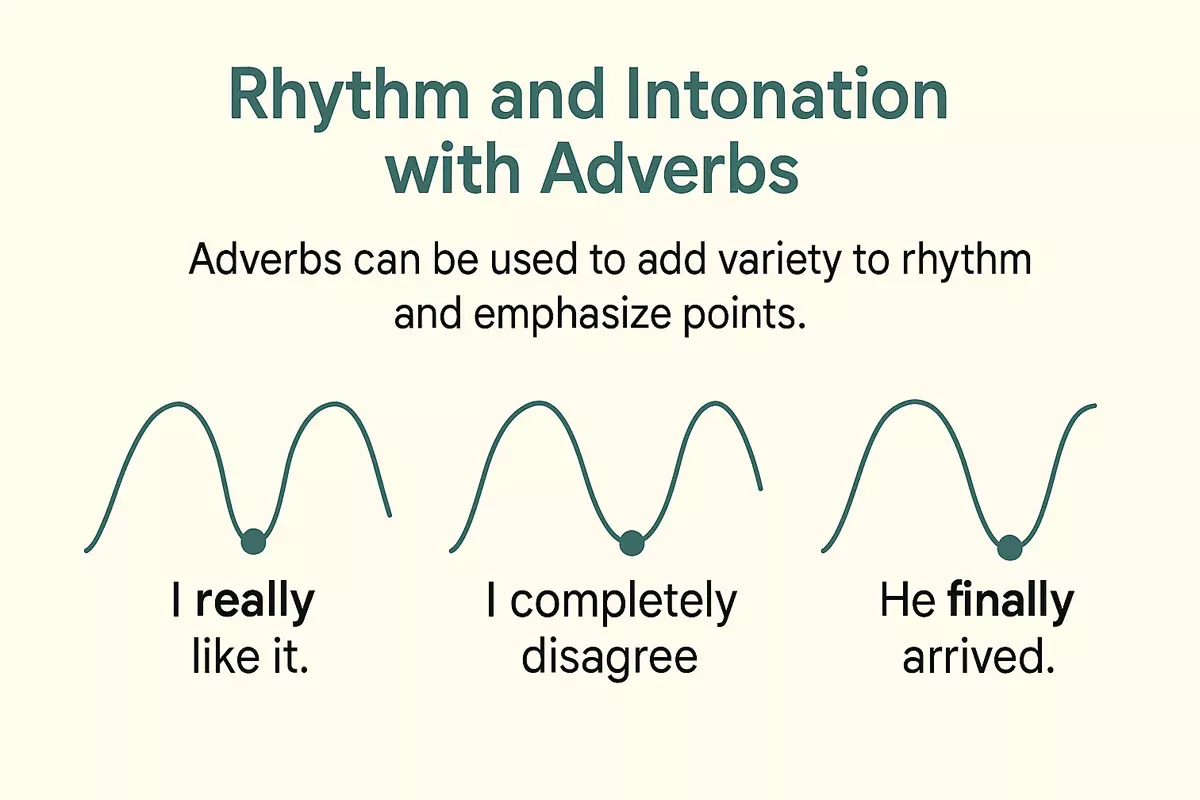 This article explains how adverbs affect English sentence rhythm, covering stress patterns, adverb types, speech tempo, and intonation shifts with fronting or emphasis. It includes natural examples and practical read-aloud exercises for practice.
Mastering the flow and melody of speech becomes even more intriguing when you incorporate descriptive words that modify actions, as these modifiers can add nuance and emphasis to your message. By understanding how such modifiers interact with patterns of stress and pitch, you can transform your communication style, making your speech more dynamic, engaging, and effective. This awareness allows you to highlight key points, convey emotions more clearly, and ensure your audience remains attentive and interested throughout your conversation.
How adverbs influence sentence rhythm
Adverbs shape the musicality of spoken language by affecting stress patterns, pacing, and the overall flow of sentences. When you insert an adverb, especially at the beginning or in the middle of a sentence, it often changes which words are emphasized and how naturally the sentence flows. This shift can draw attention to certain actions or qualities, subtly guiding the listener’s focus.
Placement and its Effects
Where an adverb appears—at the start, between the subject and verb, or at the end—alters the sentence’s cadence. Initial adverbs like "suddenly" or "fortunately" often receive primary stress, setting the tone and speed for what follows. Medial adverbs, such as "always" or "never," can create a pause or a rhythmic bump, while final adverbs tend to round off the idea, sometimes slowing the pace.
- Beginning: "Carefully, she poured the tea." (Emphasis on the manner)
- Middle: "She carefully poured the tea." (Balanced rhythm, focus on the action)
- End: "She poured the tea carefully." (Action comes first, adverb softens the close)
Adverb Length and Rhythm
Short adverbs like "now" or "then" tend to keep the tempo brisk, while longer ones such as "immediately" or "surprisingly" may slow things down, adding a natural pause. This can be especially noticeable in speech, where longer adverbs might be given their own rhythmic beat.
Common Adverb Placement Patterns and Their Rhythmic Impact
The following table compares how different placements of adverbs can affect emphasis and pace within a sentence:
| Adverb Position | Rhythmic Effect | Example |
|---|---|---|
| Initial | Sets the tempo, draws attention to the manner or attitude; often a slight pause after | "Quickly, he left the room." |
| Medial (before main verb) | Creates syncopation; can highlight the verb or split subject/verb, adding a rhythmic bump | "He quietly left the room." |
| Medial (after auxiliary) | Shortens the gap between auxiliary and verb; can quicken the pace or spotlight the adverb | "He has quietly left the room." |
| Final | Slows sentence ending, gives closure or afterthought feeling | "He left the room quietly." |
Adverb Types and Stress Patterns
Intensifiers (like "very," "extremely") and frequency adverbs ("often," "rarely") have different effects on intonation. Intensifiers usually attract stress themselves, while frequency adverbs often share stress with the verb. This interplay can create syncopation or reinforce regularity, depending on the combination.
Examples of Adverb Use Affecting Rhythm
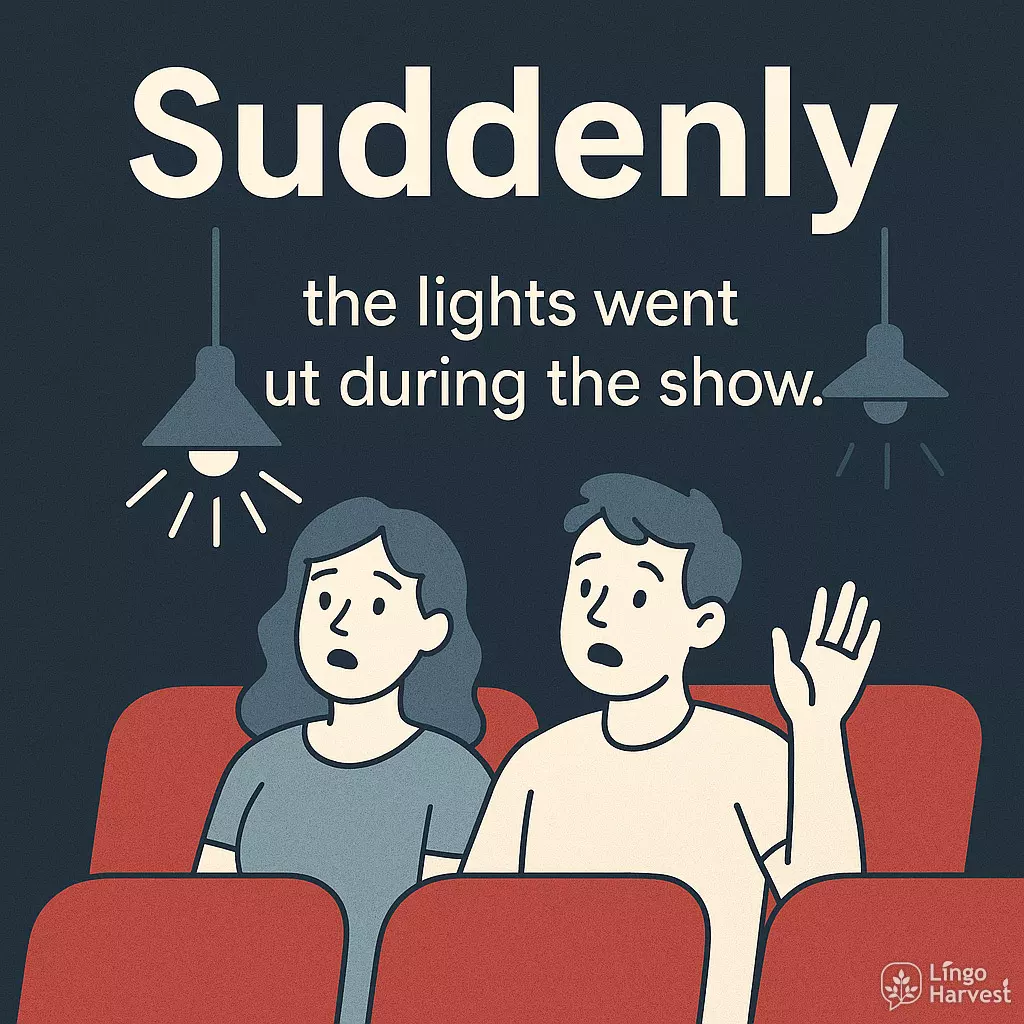
Here are some common adverbs that can noticeably change the flow of a sentence, especially when read aloud:
- Suddenly → Suddenly, the lights went out during the show.
- Slowly → She slowly opened the old wooden door.
- Always → He always arrives ten minutes early.
- Never → I never drink coffee after midnight.
- Already → They have already finished their homework.
- Usually → We usually walk to school together.
- Perhaps → Perhaps we can meet tomorrow instead.
- Just → I just saw him a moment ago.
- Completely → The room was completely silent.
- Really → She really enjoyed the concert.
- Almost → He almost missed the last bus.
- Still → She still lives in the same apartment.
- Finally → We finally reached the top of the mountain.
- Immediately → Please call me immediately if anything changes.
- Rarely → He rarely watches television.
- Clearly → She clearly explained the instructions.
- Probably → They will probably arrive late.
- Even → She didn’t even say goodbye.
By carefully choosing and positioning adverbs, speakers and writers can fine-tune the rhythm of their language, making it more engaging, natural, or emphatic as needed. This subtle control is key to mastering the musical qualities of speech and effective communication.
Stress patterns with different adverb types
Understanding how stress falls on adverbs in spoken English is essential for natural rhythm and clear intonation. Adverbs are a diverse group, and their placement and meaning can shift where the main emphasis lands in a sentence. Let’s look at how stress interacts with various adverb categories, including manner, frequency, degree, viewpoint, and focusing adverbs.
Manner and Frequency Adverbs
Adverbs describing how or how often something happens, such as “quickly,” “slowly,” “always,” or “never,” are typically unstressed unless they are being contrasted or emphasized for meaning. For example:
- She always arrives early. (adverb is unstressed)
- She always arrives early, but today she’s late. (adverb is stressed for contrast)
Degree and Focusing Adverbs
Degree adverbs, like “very,” “quite,” “almost,” and “completely,” often precede adjectives or other adverbs. They usually receive a secondary stress, but become prominent if they carry contrast or correction. Focusing adverbs (“even,” “only,” “just”) naturally attract stress, as they modify the scope or focus of the statement.
| Adverb Type | Typical Stress Pattern |
|---|---|
| Manner ("quickly", "softly") | Usually unstressed, unless contrasted or at sentence end |
| Frequency ("always", "never") | Unstressed in neutral statements; stressed in corrections |
| Degree ("very", "quite") | Secondary stress; can be primary in emphatic contexts |
| Focusing ("only", "even") | Usually carries primary stress for focus |
| Viewpoint ("technically", "honestly") | Often stressed at the start for speaker attitude |
Position and Emphasis
The location of an adverb in a sentence can alter the rhythm. Sentence-initial adverbs, such as “Honestly,” or “Fortunately,” often receive strong stress to signal the speaker’s perspective. Adverbs at the end of a sentence may also be stressed for emphasis or contrast.
- Honestly, I don’t know the answer. (viewpoint, initial position)
- I finished the work quickly. (manner, final position, optional emphasis)
- She only ate the salad. (focusing, stress shifts meaning)
- He almost missed the train. (degree, possible secondary stress)
- They never complain. (frequency, unstressed unless contrasted)
- She’s quite certain. (degree, light stress unless emphasized)
- Unfortunately, the flight was cancelled. (viewpoint, initial and stressed)
- He spoke softly to avoid waking the baby. (manner, unstressed in neutral context)
- We sometimes go hiking. (frequency, typically unstressed)
- He even brought dessert. (focusing, stressed for effect)
Summary
Stress on adverbs is not fixed; it depends on their type, position, and communicative purpose. Recognizing these patterns helps listeners identify what the speaker considers most important, contributing to more natural and effective spoken English.
Adverbs in fast and slow speech
How we pronounce and position adverbs can shift noticeably depending on whether we’re speaking quickly or taking our time. In slow, careful speech, adverbs often receive their own rhythmic space and a clearer intonation pattern. This helps listeners process meaning, especially when an adverb carries important information or contrast. In contrast, during rapid conversation, adverbs may become reduced, blended, or even nearly invisible, both in sound and in rhythm.
Changes in rhythm and stress
In deliberate speech, adverbs like always, never, quickly, and probably often stand out. The speaker tends to stress the adverb, making it a rhythmic anchor in the sentence. This is especially true if the adverb changes the entire meaning, such as “He always forgets” vs. “He forgets.” In fast speech, however, these words are more likely to be de-emphasized, reduced to a weaker syllable, or even merged with neighboring words.
Common patterns in connected speech
- Adverbs at the beginning (“Usually, I…”) get more stress in slow speech, less in fast.
- Mid-sentence adverbs (“He quickly left”) often lose prominence when spoken rapidly.
- Sentence-final adverbs (“…very easily”) tend to be compressed and less distinct in quick talk.
- In fast speech, function words and adverbs like just, even, really often blend with adjacent words.
- Sometimes, adverbs are dropped entirely in very rapid or informal conversation.
Examples: Adverbs in slow vs. rapid delivery
- Slow: “He definitely did it.” (adverb is clearly stressed)
- Fast: “He ’finitely did it.” (adverb reduced, initial syllable dropped)
- Slow: “She quickly answered.” (adverb distinct, with a full vowel)
- Fast: “She quickly answered.” (the adverb may sound like “kwikly”)
- Slow: “They never come late.” (clear stress on ‘never’)
- Fast: “They never come late.” (may blend to “nev’r”)
Pronunciation shifts: Adverbs in context
| Adverb in Careful Speech | Adverb in Fast Speech |
|---|---|
| Absolutely not | Abs’lutely not |
| I really like it | I r’lly like it |
| She actually called | She ‘ctually called |
| He probably knows | He prob’ly knows |
| We totally agree | We t’ally agree |
Understanding how adverbs shift in rhythm and intonation between slow and quick speech helps with both listening and speaking fluency. Paying attention to these patterns can make your English sound more natural and improve comprehension in real-world conversations.
Intonation changes with fronting and emphasis
When adverbs are moved to the beginning of a sentence, or are strongly stressed for emphasis, the pitch and rhythm of the sentence often shift in distinct ways. These shifts can signal contrast, highlight new information, or clarify the speaker’s attitude. Recognizing these patterns helps with both understanding and producing natural-sounding speech.
Fronting Adverbs: Prosodic Effects
Placing an adverb at the start of a sentence (fronting) typically causes a noticeable rise in pitch on the adverb itself, followed by a reset or drop for the rest of the clause. This initial rise draws attention to the adverb’s meaning and marks it as important.
- Suddenly, everyone stood up. (Pitch peak on "Suddenly")
- Usually, I walk to work. (Emphasis signals routine)
- Only then did he apologize. (Contrastive focus on "Only")
Emphasizing Adverbs in Place
When adverbs remain in a more neutral position but are emphasized, speakers often use increased loudness, lengthening, and a higher pitch on the adverb itself. This can override the normal intonation pattern for the sentence, especially with adverbs of frequency or degree.
- She really likes jazz. (Strong pitch and stress on "really")
- He arrived late. (Pitch prominence on "late" shows disapproval or surprise)
- The results were completely unexpected.
Comparing Intonation Patterns
The following table illustrates typical intonation contours when adverbs are fronted, emphasized in situ, or unstressed. Notice how placement and stress change the overall melody and rhythm of the sentence.
| Adverb Position | Intonation Pattern | Effect/Function |
|---|---|---|
| Fronted (e.g., "Quickly, she left.") |
High pitch on adverb, reset after comma | Highlights adverb, signals contrast or new info |
| Emphasized in place (e.g., "She quickly left.") |
Strong stress and pitch on adverb within clause | Draws focus to degree, frequency, or manner |
| Unstressed (e.g., "She quickly left.") |
Lower pitch, reduced length, blends into rhythm | Adverb is backgrounded, not the main point |
| Contrastive stress (e.g., "She ONLY left.") |
Sharp pitch rise on adverb, often with a pause | Clarifies scope or limits of meaning |
Key Takeaways for Learners
- Fronting adverbs almost always triggers an intonation reset—listen for a clear pitch peak at the start.
- Stressing an adverb mid-sentence can override the default rhythm, especially with words like "always," "never," "already," and "only."
- Backgrounded adverbs blend into the sentence melody and receive little or no prominence.
- Contrastive or corrective uses (e.g., "even," "just," "still") often come with a sharp rise and fall in pitch.
- Pausing after a fronted or emphasized adverb can further enhance its impact in spoken English.
Understanding these prosodic adjustments is essential for both listening comprehension and speaking fluency. Mastery of intonation with adverbs enables more nuanced expression and clearer communication in a variety of contexts.
Examples in natural spoken English
Everyday speech naturally showcases how rhythm and intonation shift when adverbs are used. These shifts often depend on the placement and function of the adverb within the sentence. For instance, adverbs at the beginning of a sentence often receive a rising intonation, while those at the end may be de-emphasized. Stress patterns can also change to highlight contrast or importance.
Common Patterns with Adverbs in Conversation
- Quickly: "She quickly finished her homework." – The adverb usually receives secondary stress, with the main verb remaining prominent.
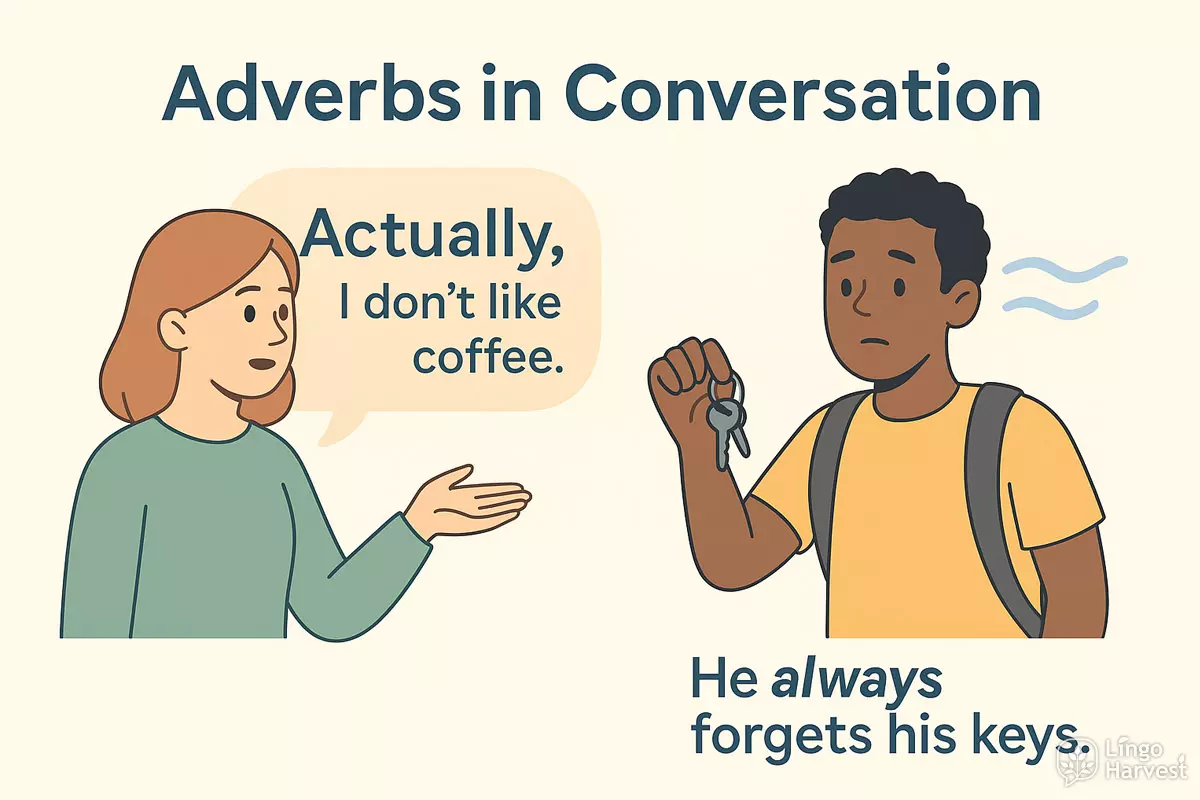
- Actually: "Actually, I don't like coffee." – Placed at the start, it often gets a higher pitch and stress.
- Always: "He always forgets his keys." – The adverb fits into the rhythm, with natural stress on the verb.
- Definitely: "I'll definitely call you." – Used for emphasis, both the adverb and the verb may be stressed.
- Really: "That was really amazing." – "Really" gets extra length and pitch to intensify the adjective.
- Never: "I've never seen that before." – "Never" often carries a strong stress, showing importance.
- Probably: "He'll probably be late." – This adverb is usually unstressed, blending into the sentence flow.
- Sometimes: "We sometimes eat out." – May get slight emphasis, but the main stress stays on the verb.
- Almost: "She almost won." – The adverb is unstressed; the verb is the focal point.
- Just: "I just arrived." – "Just" is often short and unstressed unless used for emphasis.
- Clearly: "Clearly, that's not the case." – When used at the beginning, it gets more pitch and stress.
- Maybe: "Maybe we'll go later." – Initial position leads to a higher pitch and slight stress.
- Honestly: "Honestly, I don't remember." – Similar to other sentence-initial adverbs, it attracts attention via intonation.
- Totally: "That's totally fine." – Used for emphasis, both the adverb and the adjective can be stressed.
- Already: "I've already eaten." – "Already" fits naturally into the rhythm, rarely stressed unless for emphasis.
Contrast and Emphasis in Spoken Dialogue
Speakers often use intonation to contrast ideas or add emphasis. For example, in “He really didn’t mean it,” the word “really” might be elongated and raised in pitch to underline sincerity or surprise. In contrast, “He really didn’t mean it” shifts the main stress to “didn’t” for stronger negation.
Comparison of Adverb Placement and Stress
| Sentence | Rhythm & Intonation Note |
|---|---|
| Suddenly, the lights went out. | Suddenly gets high pitch and initial stress, setting the scene. |
| The lights suddenly went out. | Adverb fits mid-sentence, with slight stress, but main focus stays on "went out." |
| The lights went out suddenly. | Adverb is de-emphasized, with intonation falling at the end. |
| Frankly, I’m surprised you came. | Sentence-initial adverb receives strong stress and a raised pitch. |
| I’m frankly surprised you came. | “Frankly” is lightly stressed, blending with the verb. |
In natural conversation, these patterns help listeners quickly interpret meaning, intent, and emotional emphasis. Noticing how rhythm and intonation interact with adverbs can make speech sound more authentic and expressive.
Practice: read aloud with correct rhythm
Reading sentences out loud is a practical way to internalize the natural stress and melody of English, especially when adverbs are involved. To develop a strong sense of rhythm and intonation, focus on how adverbs affect which words are emphasized and where the pitch rises or falls.
Step-by-step exercise
- Identify the adverb: Find adverbs in each sentence and notice their position—beginning, middle, or end.
- Mark the stress: Underline or highlight the main stressed syllables. Adverbs often carry stress, but not always.
- Practice aloud: Read each sentence, exaggerating stress and intonation to feel the rhythm.
Read these sentences with attention to rhythm
- She always arrives early.
- Quickly, he finished his homework.
- They finished the project successfully.
- I rarely eat dessert.
- He never forgets your birthday.
- We often go for a walk in the evening.
- The train just left.
- She almost missed the bus.
- He spoke very quietly.
- Usually, I drink tea in the morning.
- They already saw the movie.
- Carefully, she opened the old box.
- He sometimes works from home.
- The answer was completely wrong.
- We soon realized our mistake.
- She barely passed the test.
- He usually takes the bus.
- The cat silently watched the bird.
- They almost won the game.
- He frequently travels abroad.
Spot the difference: adverb position and rhythm
| Sentence | Intonation & Stress Pattern |
|---|---|
| Usually, he eats breakfast at home. | Adverb at the start; initial stress and rising tone at the beginning. |
| He usually eats breakfast at home. | Adverb mid-sentence; main verb and adverb both stressed, flatter intonation. |
| He eats breakfast at home, usually. | Adverb at the end; final stress and slight falling-rising tone at the close. |
| Quickly, she left the room. | Adverb fronted; strong stress and high pitch at the beginning. |
| She left the room quickly. | Adverb at the end; stress and falling intonation on the adverb. |
Mini-quiz: Choose the best rhythm
Which word should be stressed most strongly in each sentence? Say the sentence out loud, then choose:
- He rarely misses a meeting.
a) He
b) rarely
c) misses - She answered the question correctly.
a) answered
b) question
c) correctly - Suddenly, the lights went out.
a) suddenly
b) lights
c) out - They never argue about work.
a) they
b) never
c) argue - He finished the task quickly.
a) finished
b) task
c) quickly - We usually eat breakfast at 8.
a) we
b) usually
c) eat - She immediately called for help.
a) she
b) immediately
c) help - They arrived late to the event.
a) arrived
b) late
c) event - He completely forgot the appointment.
a) he
b) completely
c) forgot - Finally, we reached the station.
a) finally
b) reached
c) station
Show answers
- b) rarely
- c) correctly
- a) suddenly
- b) never
- c) quickly
- b) usually
- b) immediately
- b) late
- b) completely
- a) finally
To build natural rhythm, repeat the sentences, focusing on where your voice rises and falls, and which words get extra emphasis. Record yourself and compare with model sentences if possible.