Positive vs Negative Connotation (extended theory)

 The article defines connotation in English, discusses how words can have positive, neutral, or negative meanings, explains how connotation shapes tone and attitude, gives adjective examples in context, and includes practice with rewriting for different effects.
The emotional undertones carried by words can significantly influence how we interpret messages, shaping our perceptions with feelings of warmth or discomfort. Here we the subtle ways in which language affects thought, analyzing the nuanced spectrum between positive and negative associations. By delving into these complexities, it aims to provide a broader understanding of how emotional cues embedded in language impact communication and the ways we connect with others.
What connotation means in English
In English, connotation refers to the emotional or cultural undertones that a word carries, beyond its straightforward dictionary meaning. While a word’s denotation is its literal definition, its connotation includes the associations, feelings, or ideas that listeners or readers might connect with it. These subtle shades of meaning can influence how language is interpreted and the reaction it provokes.
Understanding Connotation vs. Denotation
Denotation is about the explicit, factual meaning, like what you’d find in a dictionary. Connotation, on the other hand, is more subjective and can shift depending on context, culture, and even personal experience. For instance, the word “childlike” denotes someone similar to a child. Its connotation, though, might suggest innocence or immaturity, depending on how it’s used.
Types of Connotation
Words can evoke positive, negative, or neutral reactions:
- Positive connotation: Suggests favorable or pleasant associations (e.g., “youthful” implies energy and freshness).
- Negative connotation: Implies criticism or disapproval (e.g., “childish” often hints at immaturity).
- Neutral connotation: Carries no strong emotional charge (e.g., “young” is typically neutral).
Examples of Connotative Meaning
Here are several words with their connotations, showing how similar meanings can feel very different:
- Stubborn ❌ vs. Determined ✅
- Cheap ❌ vs. Inexpensive ✅
- Curious ✅ vs. Nosy ❌
- Unique ✅ vs. Weird ❌
- Confident ✅ vs. Arrogant ❌
- Slender ✅ vs. Skinny ❌
- Vintage ✅ vs. Old ❌
- Home ✅ vs. House (neutral)
- Assertive ✅ vs. Pushy ❌
- Frugal ✅ vs. Stingy ❌
- Inquisitive ✅ vs. Snooping ❌
- Energetic ✅ vs. Hyperactive ❌
- Meticulous ✅ vs. Fussy ❌
- Easygoing ✅ vs. Laid-back (neutral) vs. Careless ❌
Why Connotation Matters
The subtle emotional coloring of vocabulary shapes how messages are received. Choosing words with the intended connotation can help you sound more persuasive, polite, or precise. Misjudging these undertones can lead to misunderstandings or unintended offense. For writers, speakers, and learners, being aware of these nuances is essential for clear and impactful communication.
Positive, neutral, and negative shades of meaning
Understanding how words carry subtle emotional coloring is crucial to interpreting language accurately. Each term can evoke a different response depending on its connotation—whether it suggests something favorable, impartial, or unfavorable—beyond its strict definition. These nuances are not always obvious, and context often determines how a word is perceived.
How context affects connotation
The emotional impact of a word can shift depending on who is speaking, the audience, and the situation. For example, describing someone as "slim" versus "skinny" or "thrifty" versus "stingy" changes the listener’s perception, even though the words are similar in meaning.
Examples of words with different shades
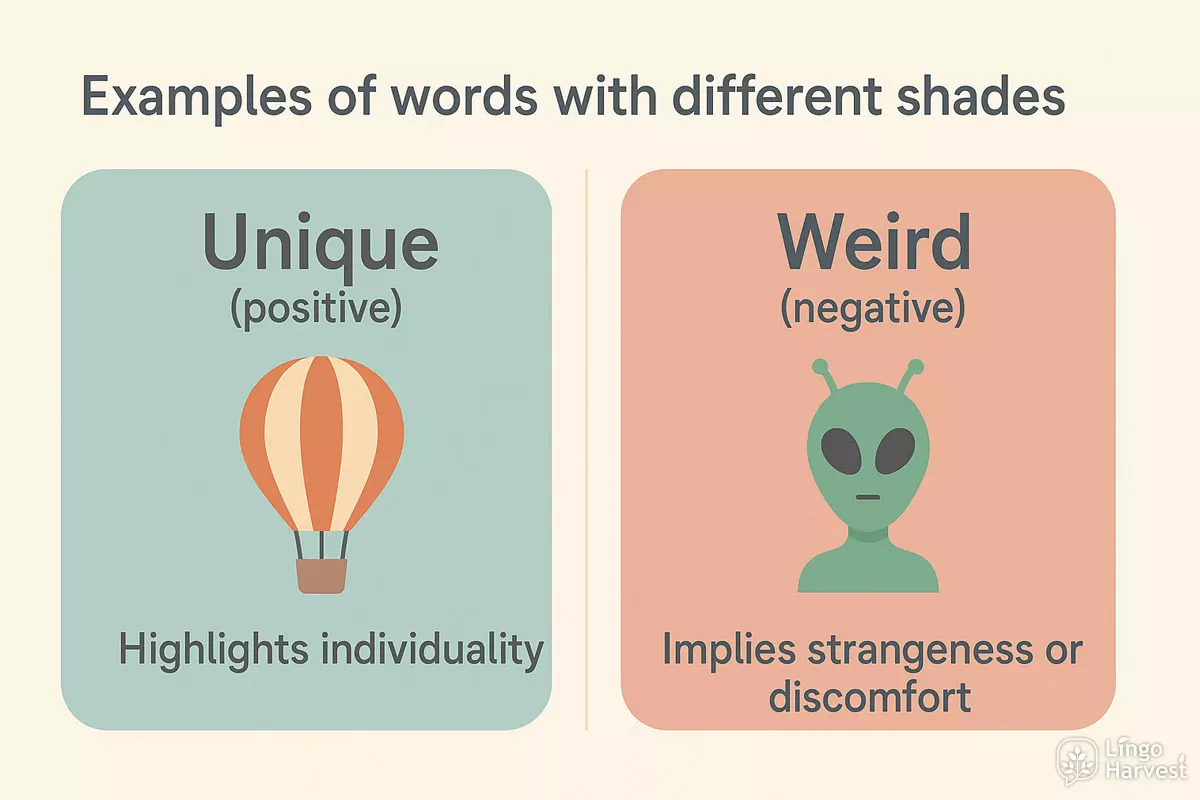
Some English words have very clear positive, neutral, or negative undertones. Here are several examples that illustrate these gradations:
- Childlike (positive): Suggests innocence and wonder.
- Childish (negative): Implies immaturity.
- Unique (positive): Highlights individuality.
- Weird (negative): Implies strangeness or discomfort.
- Confident (positive): Shows self-assurance.
- Arrogant (negative): Suggests an overbearing attitude.
- Inexpensive (neutral): Simply means not costly.
- Cheap (negative): Implies low quality.
- Economical (positive): Suggests wise spending.
- Curious (positive): Describes eagerness to learn.
- Nosey (negative): Implies intrusive behavior.
- Determined (positive): Shows perseverance.
- Stubborn (negative): Implies inflexibility.
- Reserved (neutral): Describes a quiet personality without judging it.
- Pushy (negative): Suggests aggressive insistence.
- Assertive (positive): Communicates confidence and clarity.
- Meticulous (positive): Implies careful attention to detail.
- Picky (negative): Suggests excessive fussiness.
Comparing connotative shades
The same basic idea can be expressed with words that project different emotional undertones. Here is a comparison of such word sets:
| Word (Positive) | Word (Neutral/Negative) | Meaning |
|---|---|---|
| Youthful | Immature | A person who acts young |
| Frugal | Cheap | Careful with money |
| Confident | Cocky | Self-assured or overconfident |
| Curious | Nosy | Interested in learning or intruding |
| Unique | Odd | Different from the norm |
Recognizing neutral language
Neutral words are neither flattering nor critical and are often used in objective descriptions. Examples include "building," "object," "person," "information," and "report." Using neutral terms can help maintain impartiality, especially in academic or journalistic writing.
Why connotation matters
Choosing words with the intended emotional resonance is essential for clear and effective communication. Selecting a term with the right shade can build rapport, avoid misunderstandings, and convey attitudes subtly without explicit statements. Being aware of these nuances enriches both writing and everyday conversation.
How connotation changes tone and attitude
The emotional weight of words—what we call connotation—plays a crucial role in shaping the mood and stance of any message. While two terms may share a similar literal meaning, their implied associations can make communication feel friendly, harsh, sarcastic, or neutral. This subtlety often determines how a reader or listener perceives the intent behind your words.
Positive and Negative Shading
Word choices can tilt a sentence toward encouragement or criticism, simply through their underlying associations. For example, describing someone as "persistent" suggests admirable determination, whereas "stubborn" implies inflexibility and a negative trait, even if both refer to the same behavior.
- Curious vs. Nosy
- Thrifty vs. Stingy
- Confident vs. Arrogant
- Unique vs. Weird
- Assertive vs. Aggressive
- Energetic vs. Hyperactive
- Meticulous vs. Fussy
- Traditional vs. Old-fashioned
- Bold vs. Reckless
- Dedicated vs. Obsessed
- Easygoing vs. Lazy
- Resilient vs. Unyielding
- Selective vs. Picky
- Protective vs. Overbearing
- Economical vs. Cheap
- Expressive vs. Dramatic
- Focused vs. Narrow-minded
Impact on the Speaker's Attitude
Selecting words with positive or negative overtones not only changes how the subject is viewed, but also reveals the speaker's attitude. If someone calls a proposal "innovative" instead of "risky," it signals openness and optimism rather than skepticism. Listeners infer opinions and emotional intent from these subtle cues, sometimes even more than from explicit statements.
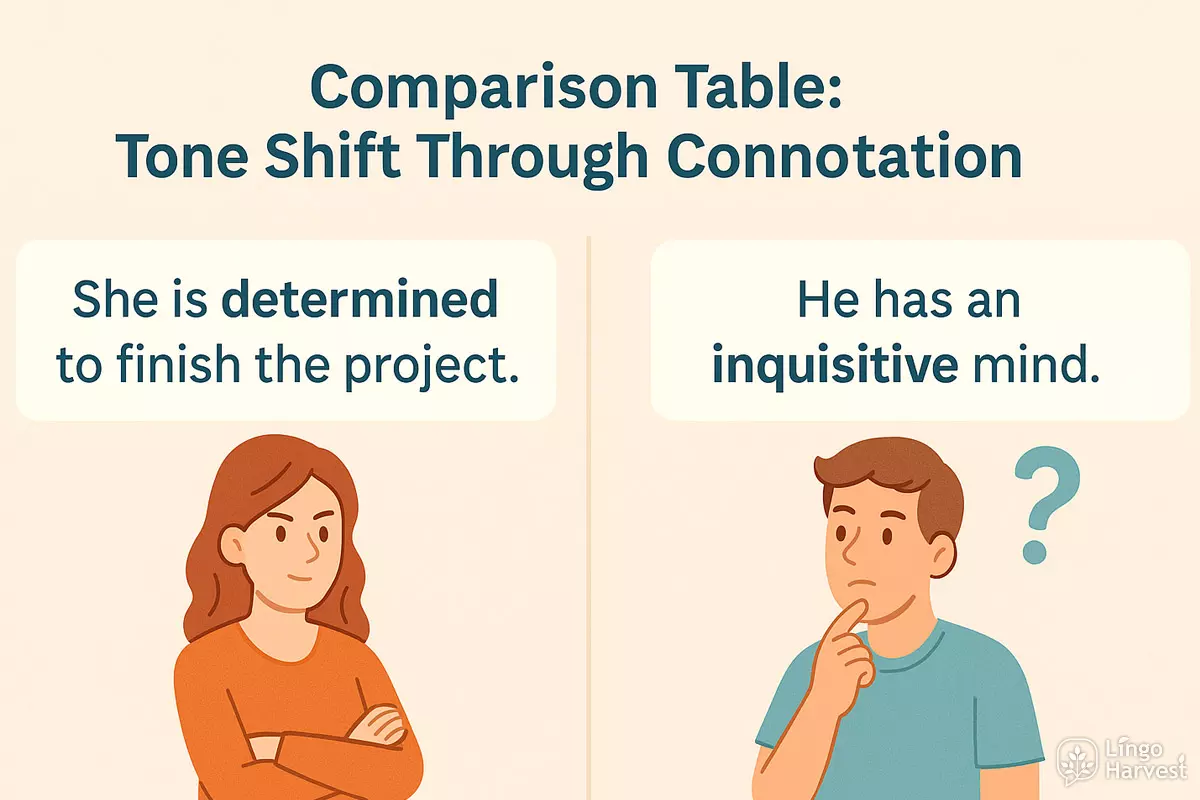
Comparison Table: Tone Shift Through Connotation
| Neutral/Positive Wording | Negative Wording |
|---|---|
| She is determined to finish the project. | She is stubborn about finishing the project. |
| He has an inquisitive mind. | He has a nosy attitude. |
| Their approach is unconventional. | Their approach is strange. |
| The plan was ambitious. | The plan was unrealistic. |
Why Subtle Differences Matter
Choosing between words with different emotional undertones can alter relationships, influence decisions, and affect credibility. Writers and speakers who are mindful of these nuances can intentionally guide reactions and establish trust. In summary, the implied meanings behind word choices function as powerful tools for steering both the mood of a conversation and the perceived attitude of its participants.
Examples with adjectives used in different contexts
How an adjective is interpreted often depends on the context, tone, and even cultural expectations. The same descriptive word can carry a positive, neutral, or negative shade depending on how and where it's used. Below, you'll find a variety of examples showing how connotation shifts according to situation and intention.
Adjectives with Shifting Connotations
- Assertive → Positive in leadership ("an assertive manager"), but negative in criticism ("she's so assertive, it's off-putting").
- Cheap → Neutral for cost ("cheap tickets"), negative for quality ("a cheap product").
- Stubborn → Negative for inflexibility ("a stubborn child"), positive for perseverance ("stubborn determination").
- Unique → Positive for creativity ("a unique idea"), sometimes negative for awkwardness ("unique behavior").
- Curious → Positive when referring to learning ("curious student"), negative when implying nosiness ("curious neighbor").
- Bold → Positive for courage ("a bold move"), negative for rudeness ("a bold remark").
- Plain → Neutral for simplicity ("plain yogurt"), negative for lack of beauty ("plain appearance").
- Delicate → Positive for refinement ("delicate flavor"), negative for weakness ("delicate health").
- Reserved → Positive for discretion ("reserved nature"), negative for social awkwardness ("too reserved to join in").
- Frugal → Positive for saving ("frugal lifestyle"), negative for stinginess ("frugal to a fault").
- Ambitious → Positive for drive ("ambitious project"), negative for overreaching ("ambitious to a fault").
- Persistent → Positive for tenacity ("persistent effort"), negative for annoyance ("persistent salesman").
- Simple → Positive for clarity ("simple solution"), negative for lack of sophistication ("simple mind").
- Critical → Positive for analytical thinking ("critical approach"), negative for fault-finding ("critical comment").
- Flexible → Positive for adaptability ("flexible schedule"), negative for lack of principles ("flexible morals").
- Naive → Sometimes positive for innocence ("naive charm"), often negative for lack of experience ("naive mistake").
- Selective → Positive for discernment ("selective reader"), negative for pickiness ("selective eater").
- Modern → Positive for innovation ("modern design"), negative for lack of tradition ("modern attitude").
- Obsessive → Positive for dedication ("obsessive attention to detail"), negative for unhealthy fixation ("obsessive behavior").
- Independent → Positive for self-reliance ("independent thinker"), negative for lack of cooperation ("independent to a fault").
Comparing Connotations Side by Side
| Adjective | Positive vs. Negative Context |
|---|---|
| Clever | ✅ "A clever solution" → creative ❌ "A clever liar" → manipulative |
| Sensitive | ✅ "A sensitive friend" → empathetic ❌ "A sensitive employee" → easily upset |
| Youthful | ✅ "Youthful energy" → lively ❌ "Youthful mistake" → inexperienced |
| Direct | ✅ "Direct communication" → clear, honest ❌ "Direct manner" → blunt, insensitive |
| Cautious | ✅ "Cautious investor" → prudent ❌ "Cautious approach" → hesitant, fearful |
| Meticulous | ✅ "Meticulous work" → thorough ❌ "Meticulous to a fault" → overly fussy |
As you can see, context and the speaker’s attitude strongly influence whether a descriptive term feels encouraging or critical. Paying attention to these nuances is key for accurate interpretation and effective communication.
Practice: rewrite using softer or stronger connotations
Exploring how word choice affects tone can make your writing more precise or nuanced. In this exercise, you'll work with sentences or phrases, adjusting them to convey either a gentler or a more forceful impression. This helps you internalize how synonym selection shapes the emotional impact of language.
Task 1: Choose a Softer or Stronger Alternative
Below are several phrases. Rewrite each to express either a more positive/softer or more negative/stronger connotation. Think about the context in which each word might be used and the feelings it might evoke.
- Cheap (softer or more positive alternative)
- Stubborn (softer or more positive alternative)
- Assertive (stronger or more negative alternative)
- Old (softer or more respectful alternative)
- Pushy (softer or more neutral alternative)
- Skinny (softer or more complimentary alternative)
- Nosy (softer or more positive alternative)
- Lazy (softer or more neutral alternative)
- Unique (stronger or more negative alternative)
- Frugal (stronger or more negative alternative)
Show answers
- Cheap → affordable, inexpensive
- Stubborn → determined, persistent
- Assertive → aggressive, domineering
- Old → elderly, senior
- Pushy → enthusiastic, motivated
- Skinny → slim, slender
- Nosy → curious, inquisitive
- Lazy → relaxed, laid-back
- Unique → odd, strange
- Frugal → stingy, miserly
Task 2: Practice with Sentences
Rewrite the following sentences to either soften them or make them more direct and forceful. Consider the effect each change has on the overall tone.
- He is old-fashioned in his methods.
- She complained about the service.
- They are obsessed with details.
- This solution is risky.
- The presentation was unclear.
- Her attitude seemed negative today.
- The plan feels unrealistic.
- His approach is aggressive.
- The design looks outdated.
- They sounded disappointed after the meeting.
Show answers
- old-fashioned → traditional / outdated
- complained → expressed concern / whined
- obsessed → highly focused / fixated
- risky → bold / dangerous
- unclear → vague / confusing
- negative → unfriendly / pessimistic
- unrealistic → impractical / idealistic
- aggressive → assertive / hostile
- outdated → old-fashioned / obsolete
- disappointed → unsatisfied / let down
Common Pairs for Softer/Stronger Connotations
Here are some frequent examples where one word carries a softer or more positive feeling, and the other a harsher or more negative sense. Use these as inspiration for your own rewrites.
| Softer/Positive | Stronger/Negative |
|---|---|
| economical | cheap |
| childlike | childish |
| firm | stubborn |
| inquisitive | nosy |
| youthful | immature |
| unique | weird |
| confident | arrogant |
| thrifty | stingy |
| slim | skinny |
| vintage | old |
Try to apply these distinctions in your daily communication or writing. Noticing subtle shifts in meaning can help you achieve a more precise and nuanced expression, whether you want to soften your tone or make your message more forceful.