Practical Test: Adjectives & Adverbs in Short Paragraphs

 Here we an integrated test on adjectives and adverbs. It includes exercises on missing modifiers, selecting the correct adjective or adverb, checking word order and tone, detailed answer explanations, and a final paragraph writing task.
Test your ability to identify and use descriptive words and modifiers with this practical exercise designed to enhance your writing skills. Through a series of short, engaging passages, you will be challenged to recognize words and phrases that add detail, clarity, and vividness to sentences. By focusing on how modifiers function within context, you can improve both your comprehension and your own use of descriptive language, making your writing more precise and engaging for readers.
Instructions for the integrated test
To complete the practical exercise on adjectives and adverbs in short paragraphs, read each prompt carefully and respond according to the guidelines below. The tasks will ask you to identify, modify, or create sentences using descriptive words in context. Pay close attention to word forms and placement, as this will help you distinguish between modifiers and understand their roles in sentences.
How to approach each question
- Read the paragraph or sentence thoroughly before answering.
- Underline or highlight all words that describe nouns (adjectives) and verbs (adverbs).
- For transformation tasks, ensure you change only the target word and not the sentence meaning.
- When asked to create sentences, focus on using a variety of modifiers for richer descriptions.
Common adjective and adverb patterns
Remember these frequent endings and clues to help you recognize and use these modifiers correctly:
- Adjectives: -ous (dangerous), -ful (beautiful), -ive (active), -al (natural), -y (funny)
- Adverbs: -ly (quickly), -ward(s) (backwards), -wise (clockwise), sometimes identical to adjectives (fast, hard)
- Adjectives usually come before nouns: the red apple
- Adverbs often modify verbs, adjectives, or other adverbs: He ran quickly, incredibly fast
Practice tasks
- Identify all adjectives and adverbs in the following paragraph:
The small brown dog barked loudly at the quickly moving car. Its owner, clearly worried, shouted angrily. - Rewrite the sentence by replacing each adjective with a synonym:
She wore a beautiful dress and gave a cheerful speech. - Transform these adverbs into adjectives to fit the sentence:
- He spoke softly → His ___ voice was calming.
- The cat moved gracefully → The cat’s ___ movements impressed us.
- Create two original sentences—one using at least two adjectives, and one using at least two adverbs.
Show answers
- Adjectives: small, brown, moving (as a present participle adjective);
Adverbs: loudly, quickly, clearly, angrily. - She wore a lovely dress and gave a joyful speech.
-
- softly → soft
- gracefully → graceful
- Example sentences:
Adjectives: The old wooden bridge creaked.
Adverbs: She quickly and quietly left the room.
Tips for success
- Double-check your answers for correct word forms and placement.
- Use a variety of descriptive words to avoid repetition.
- Practice by reading short texts and highlighting all modifiers you find.
Short paragraphs with missing modifiers
In this section, we'll examine brief passages where essential descriptive words—adjectives and adverbs—have been purposefully omitted. The goal is to practice identifying where modifiers should be added to clarify meaning, improve precision, or create more vivid imagery. By working through these examples, you'll sharpen your ability to spot places where details are lacking and need enhancement.
Why missing modifiers matter
Leaving out modifiers can make sentences vague or ambiguous. For instance, compare "She spoke" with "She spoke softly." The latter gives a clearer sense of how the action was performed. In short paragraphs, the absence of these words is often more noticeable, making it an effective exercise for language learners.
Examples of short texts missing modifiers
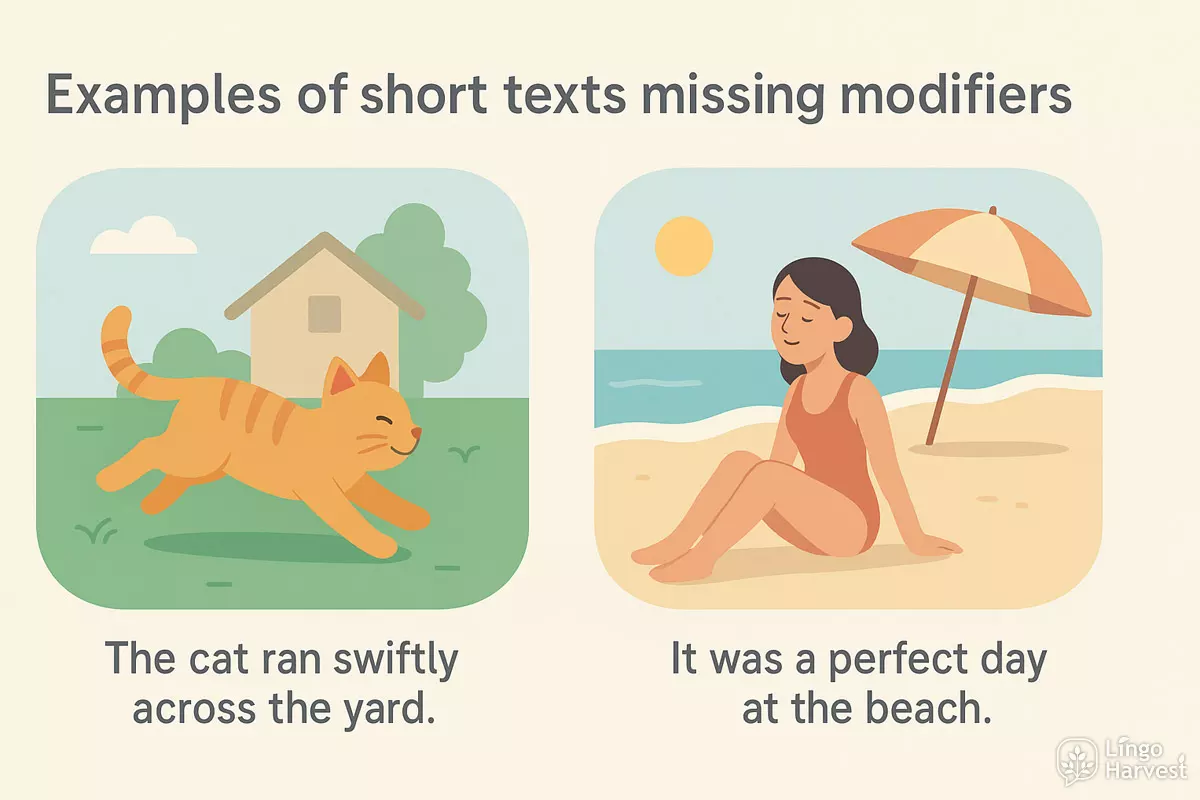
Below is a list of sample sentences and mini-paragraphs that lack one or more descriptive words. Consider what kind of adjective or adverb could be added to each blank to make the text more complete:
- The cat ran ______ across the yard.
- It was a ______ day at the beach.
- He finished his homework ______.
- The soup tasted ______.
- They moved the furniture ______ into the room.
- Maria wore a ______ dress to the party.
- He answered the question ______.
- The weather was ______ during our hike.
- She painted her room a ______ color.
- The children played ______ in the garden.
- We arrived at the station ______.
- The movie was ______ than I expected.
- He looked at her ______.
- The cake smelled ______.
- She solved the puzzle ______.
- The road was ______ after the rain.
- The dog barked ______ at the stranger.
- He gave a ______ explanation.
- The music played ______ in the background.
- They left the party ______.
Show answers
- quickly / swiftly
- sunny / beautiful / perfect
- carefully / quickly
- delicious / salty / spicy
- slowly / carefully
- elegant / colorful / fancy
- confidently / correctly
- windy / cold / pleasant
- bright / soft / pastel
- happily / noisily
- early / late
- better / worse
- warmly / gently
- amazing / sweet
- easily / quickly
- slippery / muddy
- loudly / angrily
- clear / detailed
- softly / quietly
- suddenly / quietly
Tips for identifying missing modifiers
- Look for nouns that could use more description (adjectives).
- Check verbs to see if the manner, time, or place is specified (adverbs).
- Ask yourself: Does the sentence answer "how," "when," "where," or "what kind"?
- If something feels bland or unclear, a modifier is probably missing.
Common places modifiers are omitted
Writers often leave out modifiers in quick descriptions, instructions, or when summarizing events. In practice tests, this omission encourages you to supply the right descriptive word to match the context. By consistently practicing with these short texts, you'll develop a sharper sense for when and where modifiers are needed, ultimately making your writing more precise and engaging.
Choose the correct adjective or adverb
When working with short paragraphs, it’s crucial to understand whether an adjective or an adverb fits the context. Adjectives describe nouns, while adverbs typically modify verbs, adjectives, or other adverbs. Paying attention to what each word modifies can help prevent common mistakes in usage.
Spotting the Difference in Context
Let’s consider a few practical examples. In the sentence “She sings beautifully,” the word modifies the verb “sings,” so an adverb is required. In contrast, “She has a beautiful voice” uses an adjective, since “voice” is a noun being described.
- He runs quickly (modifies the verb “runs”)
- He is a quick runner (modifies the noun “runner”)
- The soup tastes good (not “well”—“tastes” links to a noun state)
- She answered politely (describes how she answered)
- It was an easy question (describes the question)
- She solved the problem easily (describes how she solved it)
- He spoke loudly (modifies “spoke”)
- The loud music kept us awake (modifies “music”)
- They arrived late (adverb of time)
- The late bus frustrated commuters (adjective for the noun “bus”)
- She is a hard worker (adjective)
- She works hard (adverb—note: “hard” is both adjective and adverb)
- He feels bad about the mistake (adjective after “feel”)
- He performed badly in the test (adverb for “performed”)
- Drive safe vs. Drive safely (the latter is correct as an adverb)
Common Traps and Exceptions
Some words look similar but change form depending on their function. For example, “hard” is both an adjective and adverb, but “hardly” means “almost not,” which is different. Similarly, “late” is both forms, but “lately” means “recently.”
| Adjective | Adverb |
|---|---|
| good | well |
| fast | fast |
| hard | hard |
| late | late |
| easy | easily |
| careful | carefully |
| quick | quickly |
| loud | loudly |
| polite | politely |
| happy | happily |
Practice by reading short passages and identifying which words describe a noun (adjectives) and which describe an action or another modifier (adverbs). With regular exposure, choosing the right word will become second nature.
Check word order, meaning, and tone
When working with adjectives and adverbs in English paragraphs, it’s vital to pay attention to the sequence of words, the intended message, and the writer’s style. Misplacing an adverb can change the whole meaning of a sentence, while incorrect adjective order can sound unnatural. In practical tests, examiners often look for these subtle errors to assess real fluency, not just vocabulary knowledge.
Understanding Common Word Order Issues
English has specific patterns for placing adjectives and adverbs. For example, adjectives usually go before the noun ("a beautiful day"), while adverbs often modify verbs, adjectives, or other adverbs ("She sings beautifully."). Getting this order wrong can cause confusion or make sentences sound awkward. Here are some typical trouble spots:
- Adjective order: "a small red car," not "a red small car"
- Adverb placement: "He quickly finished the test," not "He finished quickly the test"
- Comparatives and superlatives: "She is the most talented player" or "He runs faster than John"
- Frequency adverbs: "She always eats breakfast"
- Intensifiers: "very interesting," "extremely loud"
- Adverbs with adjectives: "incredibly fast car"
- Adverbs of manner: "She spoke softly"
- Adjective + noun: "an old wooden table"
- Sequence of descriptive adjectives: "a lovely old Italian lamp"
- Position of adverbs with auxiliary verbs: "He has never been late"
Meaning and Tone: Why They Matter
Choosing between an adjective or an adverb can subtly shift the sense of a sentence. For example, "He is a quick worker" (adjective) versus "He works quickly" (adverb). The first describes the person’s characteristic; the second focuses on the manner of working. Tone is also affected by word choice and order – "She spoke softly" sounds gentle, while "She softly spoke" feels more formal or poetic.
Spotting Common Errors
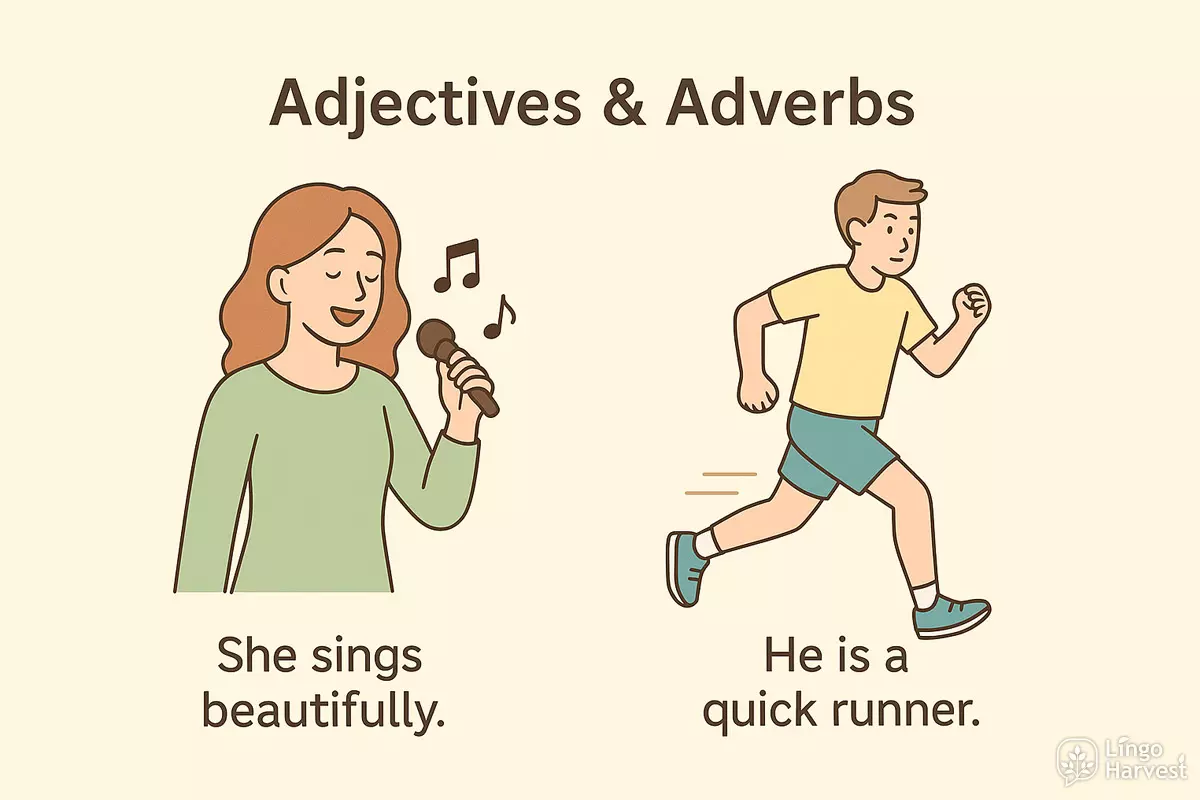
Writers and learners often confuse these forms, especially under time pressure. To illustrate how different choices affect clarity and tone, here’s a comparison of sentences that use adjectives and adverbs correctly and incorrectly:
| Incorrect Example | Corrected Version |
|---|---|
| She sings beautiful. | She sings beautifully. |
| He is a quickly runner. | He is a quick runner. |
| I saw a red big balloon. | I saw a big red balloon. |
| He completed his homework careful. | He completed his homework carefully. |
| She almost drove every day her car. | She drove her car almost every day. |
| This is the interestingest book. | This is the most interesting book. |
| He speaks English very good. | He speaks English very well. |
| He is more taller than me. | He is taller than me. |
| She always is happy. | She is always happy. |
| He runs fastly. | He runs fast. |
Quick Tips for Paragraph Practice
- Read sentences aloud to check if they sound natural.
- Ask yourself what exactly you want to describe: the person (use an adjective) or the action (use an adverb).
- Remember the usual order: opinion, size, age, shape, color, origin, material, purpose (for adjectives before nouns).
- Use adverbs to add detail and nuance, but avoid overusing them, which can make writing wordy.
- Pay attention to tone—formal writing often prefers standard word order, while creative texts may experiment for effect.
Mastering word order, meaning, and tone in short paragraphs takes practice, but careful review of these elements will help your writing feel clear and natural.
Answer key with explanations
Below you'll find a detailed breakdown of the correct answers from the practical test on adjectives and adverbs in short paragraphs. Each item includes a brief explanation to clarify the grammatical choice, helping you understand not just what the answer is, but also why it fits best in context.
Key examples explained
- Quickly – Used as an adverb to describe how an action is performed (e.g., “She ran quickly to the door.”). The -ly ending signals an adverb modifying the verb “ran.”
- Beautiful – Functions as an adjective, providing information about a noun (“a beautiful garden”). It modifies “garden,” describing its appearance.
- Careful vs. Carefully – “Careful” describes a person or a noun (adjective: “a careful driver”), while “carefully” describes how an action is done (adverb: “drove carefully”).
- Happy vs. Happily – “Happy” is an adjective (“a happy child”), whereas “happily” is an adverb (“smiled happily”).
- Loud vs. Loudly – “Loud” modifies nouns (“a loud noise”), while “loudly” modifies verbs (“shouted loudly”).
- Bad vs. Badly – “Bad” is an adjective (“a bad result”), and “badly” is an adverb (“performed badly”).
- Fast – Can be both an adjective (“a fast car”) and an adverb (“He runs fast”), making it an exception among adverbs that don’t take the -ly ending.
- Hard vs. Hardly – “Hard” can be an adjective (“a hard surface”) or adverb (“work hard”), but “hardly” means “barely” or “almost not.”
- Late vs. Lately – “Late” is both an adjective and adverb (“arrived late”), while “lately” means “recently” and is only an adverb (“I haven’t seen her lately”).
- Good vs. Well – “Good” is an adjective (“a good book”), while “well” is usually an adverb (“sings well”), but can also be an adjective when referring to health (“She feels well”).
- Slow vs. Slowly – “Slow” is an adjective (“a slow process”), “slowly” is an adverb (“moves slowly”).
- High vs. Highly – “High” as an adjective (“a high mountain”), “highly” as an adverb (“highly recommended”).
- Near vs. Nearly – “Near” is generally an adjective or preposition (“the shop is near”), while “nearly” is an adverb (“nearly finished”).
- Easy vs. Easily – “Easy” is an adjective (“an easy task”), “easily” is an adverb (“solved easily”).
- Direct vs. Directly – “Direct” as an adjective (“direct route”), “directly” as an adverb (“arrive directly”).
- Quiet vs. Quietly – “Quiet” is an adjective (“a quiet room”), “quietly” is an adverb (“speak quietly”).
- Sharp vs. Sharply – “Sharp” as an adjective (“a sharp knife”), “sharply” as an adverb (“turn sharply”).
- Strong vs. Strongly – “Strong” as an adjective (“a strong argument”), “strongly” as an adverb (“strongly disagree”).
- Clear vs. Clearly – “Clear” as an adjective (“a clear answer”), “clearly” as an adverb (“explained clearly”).
- Soft vs. Softly – “Soft” as an adjective (“a soft pillow”), “softly” as an adverb (“whispered softly”).
Comparing forms: Adjectives & Adverbs
| Adjective | Adverb | Example in a Sentence |
|---|---|---|
| Quick | Quickly | She finished the test quickly. |
| Careful | Carefully | He checked the answer carefully. |
| Loud | Loudly | They laughed loudly at the joke. |
| Easy | Easily | She solved the problem easily. |
| Happy | Happily | The dog wagged its tail happily. |
| Direct | Directly | He answered directly. |
| Strong | Strongly | She strongly believes in honesty. |
| Soft | Softly | He spoke softly in the library. |
| Clear | Clearly | The instructions were clearly written. |
| Bad | Badly | He did badly on the test. |
Common mistakes and clarifications
Several words can be confusing because their adjective and adverb forms are not always created by simply adding -ly. For instance, “fast” remains unchanged when used as an adverb, and “well” is the adverbial form of “good.” Pay attention to words like “hard” and “hardly,” which have different meanings, and be mindful of context to select the correct form. Reviewing these patterns will help you identify and use modifiers accurately in your writing.
Final practice task: create your own paragraph
Now it’s your turn to apply what you’ve learned about using descriptive words and modifiers in sentences. Try writing a short paragraph (3–5 sentences) that mixes both descriptive and modifying words. Focus on using a variety of adjectives to describe nouns, and adverbs to add detail to verbs, adjectives, or other adverbs. Remember, variety brings your writing to life and helps readers imagine the scene more vividly.
Instructions
- Write a paragraph about a place, a person, an event, or a daily routine.
- Include at least five adjectives and three adverbs.
- Make sure your adjectives describe nouns, and your adverbs describe actions or qualities.
- Try to use different types (e.g., manner, frequency, degree) of adverbs for extra variety.
Useful vocabulary for your paragraph
- Adjectives: bright, cheerful, ancient, quiet, narrow, spacious, delicious, tired, energetic, colorful, gentle, stormy, eager, peaceful, modern, crowded, dusty, friendly, noisy, gloomy
- Adverbs: quickly, slowly, quietly, loudly, often, rarely, easily, suddenly, always, carefully, patiently, never, completely, nearly, gracefully, happily, anxiously, proudly, barely, warmly
Checklist before you finish
- Have you used enough adjectives to give detail to your nouns?
- Did you use adverbs to explain how actions happen or to add nuance?
- Is your paragraph clear and easy to follow?
- Did you avoid repeating the same word too often?
Practice: Write your paragraph
Write your paragraph below. When you finish, check your work with the checklist above. If you want to compare with an example, expand the section below.
Show answers
Sample paragraph:
The bright sun rose quickly over the peaceful village. Children played happily in the spacious park, their colorful clothes shining cheerfully. An elderly man walked slowly down the narrow street, smiling at everyone he passed.