Non-defining Relative Clauses and Commas (polishing writing)

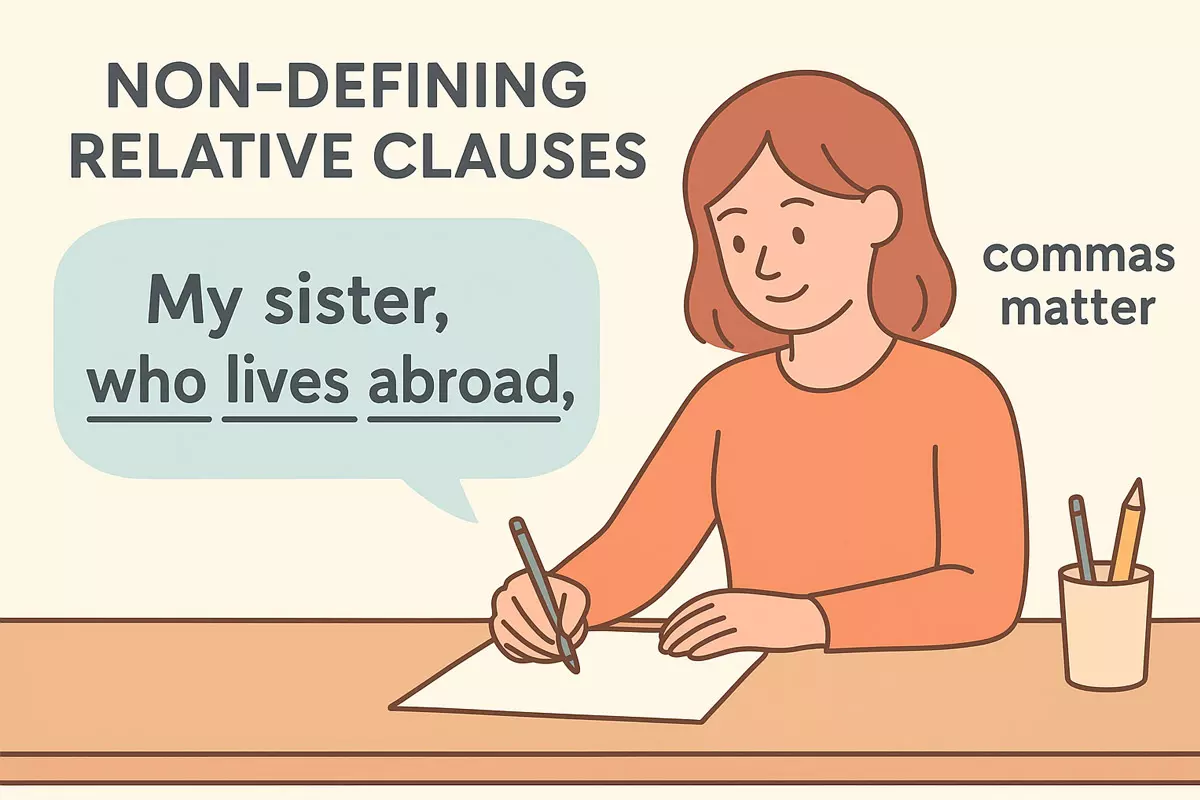 Here we the purpose of non-defining relative clauses, correct comma placement, and when to use who versus which. It also discusses essential versus non-essential information, common mistakes, overuse in academic writing, and offers comma practice.
Enriching your writing with additional details can enhance its clarity and engagement, but it is crucial to distinguish these elements effectively within your sentences. Mastering the use of descriptive clauses, along with their proper punctuation, allows you to create polished and fluid prose. By thoughtfully integrating extra information, you ensure that your ideas remain organized and easy to follow, helping your readers stay focused and interested throughout your work. Developing this skill not only improves readability but also elevates the overall quality of your writing.
Purpose of Non-Defining Relative Clauses
Writers use non-defining relative clauses to add extra information about a noun without limiting its meaning. These clauses give readers helpful background or details that are not essential for identifying the person or thing being discussed. Instead of narrowing down the noun, they simply provide more context, often making sentences richer and more informative. The main idea of the sentence remains clear and complete even if the additional clause is removed.
Why Include Non-Essential Information?
Adding supplementary details can make writing more engaging and precise. Non-defining relative clauses allow you to:
- Clarify relationships or characteristics
- Share interesting facts or background
- Provide commentary or personal observations
- Smoothly combine related ideas in one sentence
- Vary sentence structure for better flow
- Emphasize non-critical but useful information
- Show contrast or exception (e.g., “My brother, who hates chocolate, loved this cake.”)
- Highlight achievements or qualities (e.g., “Marie Curie, who won two Nobel Prizes, inspired many scientists.”)
- Give context to places or times (e.g., “Paris, where I studied art, is unforgettable.”)
- Add light humor or asides
How Non-Defining Clauses Affect Meaning
Unlike their defining counterparts, these clauses do not change the core identity of the noun. Instead, they offer optional, enriching details. Removing the clause leaves the main meaning intact, which can be useful for editing or for tailoring information to different audiences.
Common Functions and Examples
- Describing people: “My aunt, who lives in Canada, is visiting.”
- Adding historical or factual notes: “The Eiffel Tower, which was completed in 1889, is a famous landmark.”
- Explaining relationships: “Alice, whose brother is my friend, joined us for dinner.”
- Setting scenes: “The conference, which lasted three days, was a success.”
- Giving extra opinions: “That book, which I loved, is out of print.”
- Introducing exceptions: “The park, where dogs are usually allowed, is closed today.”
- Providing background: “His car, which he bought last year, already needs repairs.”
- Sharing reactions: “The concert, which everyone enjoyed, sold out quickly.”
- Comparing: “Her apartment, which is larger than mine, is downtown.”
- Connecting ideas: “The team, who were exhausted, celebrated their win.”
Comparing Non-Defining and Defining Clauses
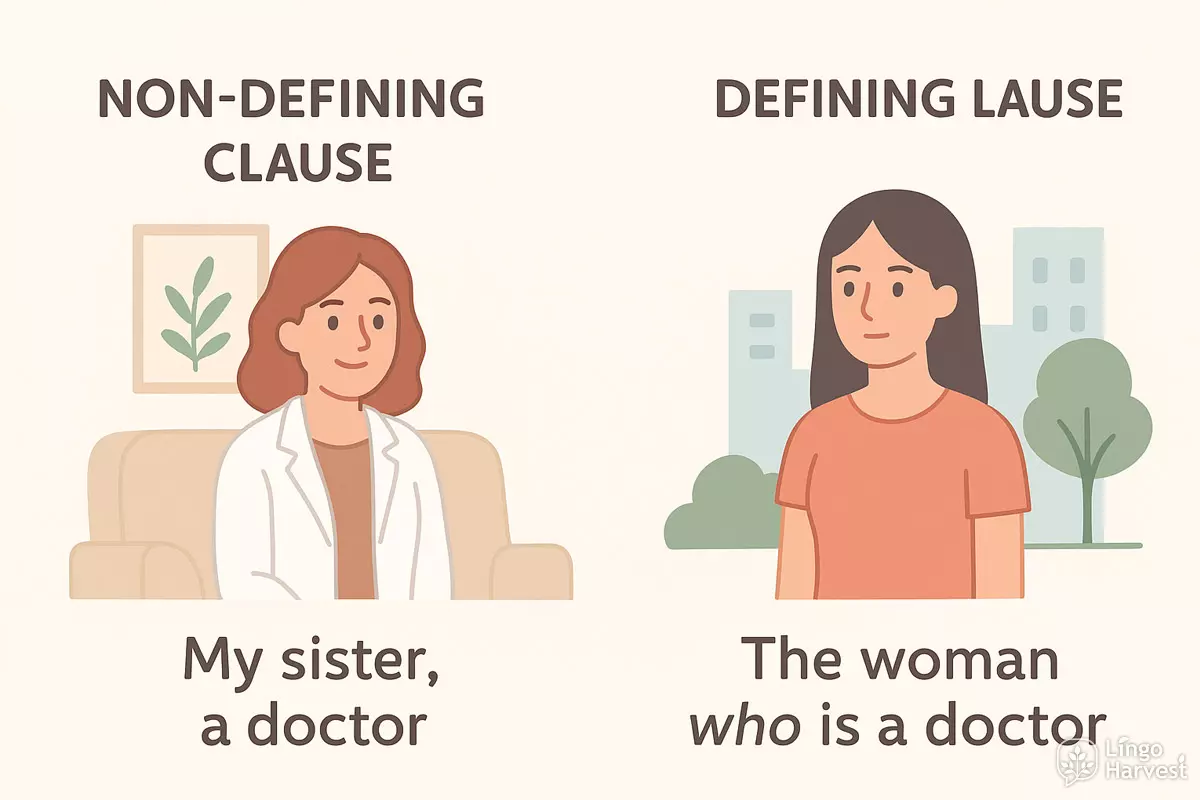
| Non-Defining Clause | Defining Clause |
|---|---|
| My sister, who is a doctor, lives in Berlin. (Adds extra info; commas used) |
The woman who is a doctor lives in Berlin. (Identifies which woman; no commas) |
| The laptop, which I bought last year, is fast. | The laptop that I bought last year is fast. |
| Mount Everest, which is the tallest mountain, attracts climbers worldwide. | The mountain that attracts climbers worldwide is Mount Everest. |
| Our house, where we grew up, has been renovated. | The house where we grew up has been renovated. |
In summary, using non-defining relative clauses is an effective way to add helpful, non-essential information, enrich descriptions, and make writing more interesting. Proper punctuation, especially commas, signals to readers that this information is extra and not crucial for understanding the main point.
Comma Placement Rules
Understanding where to place commas with non-defining relative clauses is essential for clear and polished writing. These clauses add extra information about a noun, but the sentence would still make sense without them. Because they are not essential to the core meaning, they are always separated from the rest of the sentence by commas.
When to Use Commas with Non-defining Relative Clauses
- Insert a comma before the clause begins, usually after the noun being described.
- Place another comma at the end of the clause if it appears in the middle of the sentence.
- If the clause is at the end, use a comma before it, but not after, since the sentence will end with a period.
Common Patterns and Examples
- My brother, who lives in Canada, is visiting next week.
- The conference, which was postponed last year, will be held in July.
- Our car, which we bought in 2010, still runs well.
- Emma, whose paintings you admire, has opened a gallery.
- My laptop, which I use for work, needs repairs.
- His father, who is a doctor, retired recently.
- The book, which I borrowed from the library, is overdue.
- London, where I studied English, is an exciting city.
- My neighbor, who just moved in, is very friendly.
- The team, which finished first last season, lost the final.
Comparing Defining and Non-defining Clauses
| Defining Clause (No commas) |
Non-defining Clause (With commas) |
|---|---|
| Students who study hard succeed. (Only those students) |
My friend, who studies hard, succeeded. (Extra info about "my friend") |
| The car that is parked outside is mine. | The car, which is parked outside, is mine. |
| People who speak Spanish are welcome. | My uncle, who speaks Spanish, visited us. |
| The house that Jack built is old. | The house, which Jack built, is old. |
Quick Tips
- Never use "that" for non-defining clauses—use "who," "which," or "whose."
- Always set off non-essential relative clauses with commas.
- Remove the clause to check if the sentence still makes sense; if it does, commas are needed.
- Read the sentence aloud; a natural pause often signals where a comma should go.
Who vs Which in Non-Defining Clauses
Understanding when to use who and which in non-defining relative clauses can help you write with greater clarity and polish. These clauses add extra information to a sentence, set off by commas, but do not change the core meaning. The choice between these two relative pronouns depends on whether you are referring to a person or a thing.
Choosing the Right Pronoun
Use who for people and which for things or animals (when they are not named individuals). This distinction keeps your writing precise and avoids awkward or incorrect constructions.
- My brother, who lives in Berlin, is visiting next week.
- The book, which I borrowed from the library, is fascinating.
- My cat, which is very old, sleeps most of the day. (correct if the cat is not referred to by name)
- Sarah, who won the award, is my colleague.
- The conference, which was held online, attracted many experts.
- Our teacher, who is from Canada, speaks three languages.
- The laptop, which I bought last year, still works well.
- The painting, which hangs in the hallway, is over 100 years old.
- My cousin, who just graduated, is looking for a job.
- The museum, which was renovated recently, reopened to the public.
- The actor, who starred in the movie, attended the event.
- Her phone, which she lost yesterday, was found in the park.
Common Mistakes to Avoid
Mixing up who and which is a frequent error in non-defining clauses. Remember:
- Do not use which for people.
- Do not use who for objects or non-specific animals.
Quick Reference Table
| Relative Pronoun | Used For | Example Sentence |
|---|---|---|
| who | People | My neighbor, who is a doctor, helped me. |
| which | Things/Objects | The car, which was parked outside, is gone. |
| which | Animals (not named) | The bird, which sings every morning, is back. |
| who | Named Animals (sometimes) | Charlie, who is my dog, loves to play. (if treated as a person) |
Summary
Selecting between who and which in non-defining clauses depends on whether you are describing people or things. This distinction not only improves accuracy but also adds polish to your writing. Remember to use commas to set off these clauses, and always match the pronoun to the noun it refers to for smooth, professional sentences.
Essential vs Non-Essential Information
When polishing your writing with relative clauses, it’s important to know whether the information you’re adding is necessary for understanding the sentence or simply adds extra details. This distinction determines both the structure of your sentence and your punctuation choices, especially the use of commas.
Defining (Restrictive) vs Non-Defining (Non-Restrictive) Clauses
A defining relative clause provides information that is crucial to identify the noun it describes. Without it, the meaning of the sentence would be incomplete or unclear. In contrast, a non-defining clause adds extra information about a noun that is already clear or specific. This extra content can be removed without changing the core meaning of the sentence.
- Defining example: The students who studied hardest passed the test. (Only those students passed.)
- Non-defining example: My brother, who lives in London, is visiting next week. (I have one brother; the clause just adds extra info.)
How to Recognize Each Type
Clues can help you decide whether the information is essential:
- Does removing the clause change the main meaning? ✅ Essential
- Does the sentence still make sense without it? ✅ Non-essential
- Is the noun specific or unique already? → Likely non-essential
- Is the clause set off by commas? ✅ Non-essential clauses always use commas
- Are you using that (essential) or which/who with commas (non-essential)?
Comparison: Key Differences
| Type | Main Features | Punctuation | Example |
|---|---|---|---|
| Defining (Essential) | Identifies which person or thing is meant | No commas | The book that I borrowed is on the table. |
| Non-Defining (Non-Essential) | Adds extra, non-crucial info | Commas required | My aunt, who is a doctor, loves to travel. |
Quick Guide: When to Use Commas
- Use commas to set off non-essential relative clauses.
- Do not use commas for clauses that are necessary to the meaning.
- Non-essential clauses often start with which or who, but never that.
- Essential clauses can use that, who, or which (in British English, but without commas).
Understanding the difference between information that is vital and information that simply adds detail helps you use relative clauses and commas correctly, resulting in clearer, more polished writing.
Typical Writing Mistakes
Writers often stumble when using non-defining relative clauses, especially regarding punctuation and clause placement. Omitting the necessary commas or confusing non-defining with defining clauses can lead to unclear or even misleading sentences. Paying attention to these details is crucial for polished, professional writing.
Common Pitfalls with Non-defining Clauses
- Forgetting to add commas before and after the clause.
- Using "that" instead of "which" or "who" in non-defining clauses.
- Combining information that should be in a separate sentence, making the text confusing.
- Placing the relative pronoun incorrectly, disrupting sentence flow.
- Applying non-defining clauses to nouns that are not specific or unique.
- Overusing non-defining clauses, resulting in overly complex sentences.
- Misplacing the clause so it attaches to the wrong noun or idea.
- Mixing up restrictive (defining) and non-restrictive (non-defining) structures.
- Failing to recognize when a clause adds extra, non-essential information.
- Inconsistency in comma usage throughout a piece of writing.
- Using non-defining clauses in places where defining clauses are needed for clarity.
- Omitting the second comma at the end of the clause, leaving the sentence unbalanced.
Comma Confusion: Examples and Corrections
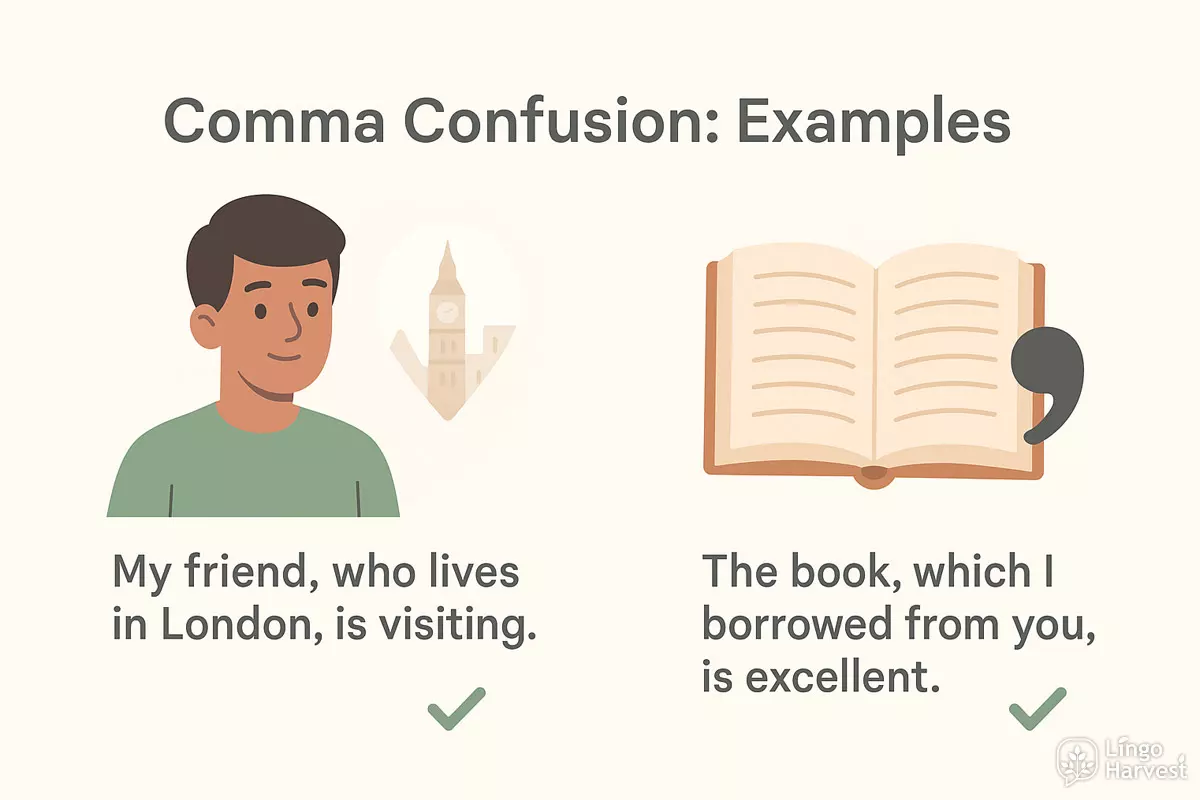
| Incorrect ❌ | Correct ✅ |
|---|---|
| My friend who lives in London is visiting. | My friend, who lives in London, is visiting. |
| The book, that I borrowed from you is excellent. | The book, which I borrowed from you, is excellent. |
| Julia who loves hiking joined us. | Julia, who loves hiking, joined us. |
| My brother, who is a doctor works in Paris. | My brother, who is a doctor, works in Paris. |
How to Avoid These Errors
- Always use commas to enclose extra information provided by a non-defining clause.
- Choose "who" or "which" for non-defining clauses, not "that".
- Read your sentence aloud: if the clause can be removed without changing the main meaning, commas are likely needed.
- Edit for clarity—if a sentence feels crowded, consider splitting it.
- Double-check for a second comma after the clause, not just before it.
Mastering these details helps ensure your writing is both precise and easy to understand, making your use of additional information seamless and professional.
Fixing Overuse in Academic Writing
Writers in academic settings often struggle with the excessive use of non-defining relative clauses. While these clauses—usually introduced by "which," "who," or "whose" and set off by commas—add detail and nuance, overusing them can make sentences cumbersome or distract from the main argument. Streamlining your writing often means knowing when to trim these elements for clarity and impact.
Recognizing Excessive Non-defining Relative Clauses
Look for sentences where additional information, set off by commas, interrupts the main point. If several such clauses appear in a single paragraph or repeatedly throughout a section, your prose might become convoluted. Academic readers appreciate conciseness; too many asides can obscure your thesis and weaken your analysis.
- Original: The experiment, which was conducted over six months, provided data, which were analyzed using SPSS, that supported the hypothesis, which had been previously untested.
- Revised: The six-month experiment provided data analyzed with SPSS, supporting the previously untested hypothesis.
Strategies to Minimize Overuse
- Combine details: Integrate extra information directly into the main clause when possible.
- Use appositives: Replace relative clauses with appositive phrases for brevity (e.g., "Einstein, a renowned physicist, developed...").
- Break up long sentences: Divide complex statements into two or more concise sentences.
- Prioritize essential information: Omit peripheral facts that do not directly support your argument.
- Vary your sentence structure: Mix simple, compound, and complex sentences to maintain reader interest.
- Replace with adjectives/adverbs: Use modifiers instead of full clauses where appropriate.
- Check for redundancy: Ensure each clause adds unique value.
- Edit for parallelism: Align sentence elements for smoother reading.
- Read aloud: Listening can reveal sentences that feel overloaded or awkward.
- Peer review: Ask colleagues to point out sentences that feel bogged down by detail.
Common Pitfalls and Alternatives
Writers sometimes default to non-defining clauses for every piece of background information. Instead, consider other structures that convey the same meaning more succinctly. The table below compares overused patterns with clearer alternatives.
| Overused Pattern | Concise Alternative |
|---|---|
| The survey, which was distributed online, reached 500 participants. | The online survey reached 500 participants. |
| Smith, who is a professor at Oxford, argues that... | Oxford professor Smith argues that... |
| The results, which were surprising, challenged previous assumptions. | The surprising results challenged previous assumptions. |
| The committee, which met last week, approved the proposal. | Last week, the committee approved the proposal. |
| The method, which is widely used, has limitations. | This widely used method has limitations. |
| The theory, which was developed in the 1990s, remains influential. | The theory developed in the 1990s remains influential. |
By consciously reducing unnecessary non-defining relative clauses and exploring more concise alternatives, your academic writing will become clearer, more engaging, and easier for readers to follow. Regular editing and feedback are key to maintaining balance and precision in your prose.
Practice: Insert Commas for Clarity
Non-defining relative clauses add extra information to a sentence, but they do not change its essential meaning. To ensure your writing is clear and polished, it's important to separate these clauses with commas. Let's work through some exercises to help you identify where commas are needed.
Exercise: Add Commas to These Sentences
Below are sentences containing non-defining relative clauses. Insert commas where necessary to improve clarity and punctuation.
- My brother who lives in Paris is visiting next week.
- The museum which was closed for renovations has reopened.
- Dr. Smith who wrote the article will be speaking tonight.
- Our new neighbors who moved in last month are very friendly.
- The cake which she baked yesterday was delicious.
- My laptop which is quite old still works perfectly.
- His car which he bought last year is already having problems.
- Our teacher who loves jazz gave us extra homework.
- London which is the capital of England attracts many tourists.
- The library which opens at nine is just around the corner.
Show answers
- My brother, who lives in Paris, is visiting next week.
- The museum, which was closed for renovations, has reopened.
- Dr. Smith, who wrote the article, will be speaking tonight.
- Our new neighbors, who moved in last month, are very friendly.
- The cake, which she baked yesterday, was delicious.
- My laptop, which is quite old, still works perfectly.
- His car, which he bought last year, is already having problems.
- Our teacher, who loves jazz, gave us extra homework.
- London, which is the capital of England, attracts many tourists.
- The library, which opens at nine, is just around the corner.
Quick Tips for Recognizing Non-Defining Clauses
- They provide additional but non-essential information.
- The sentence would still make sense if you removed the clause.
- They are always set off by commas.
- They often use which, who, or whose as relative pronouns.
- Never use that in non-defining relative clauses.
- Example: "My cat, who is very old, sleeps all day."
Spot the Difference: Defining vs. Non-Defining Clauses
Knowing when to use commas depends on the type of relative clause. Review the comparison below:
| Defining Clause (No Commas) | Non-Defining Clause (Commas Required) |
|---|---|
| The students who study hard get good grades. | The students, who study hard, get good grades. |
| The house that Jack built is for sale. | The house, which Jack built, is for sale. |
| People who speak two languages are bilingual. | My father, who speaks two languages, is bilingual. |
| Books that have colorful covers attract children. | This book, which has a colorful cover, attracts children. |
Challenge: Write Your Own Sentences
Try writing three sentences using non-defining relative clauses. Remember to use commas to set off the extra information. For example: "My friend, who is a talented musician, just released a new album."
Show answers
- My mother, who loves gardening, planted new roses.
- The restaurant, which opened last year, is already popular.
- Our dog, who is very playful, chased the ball for hours.