Prepositions in Business Emails: regarding and with reference to

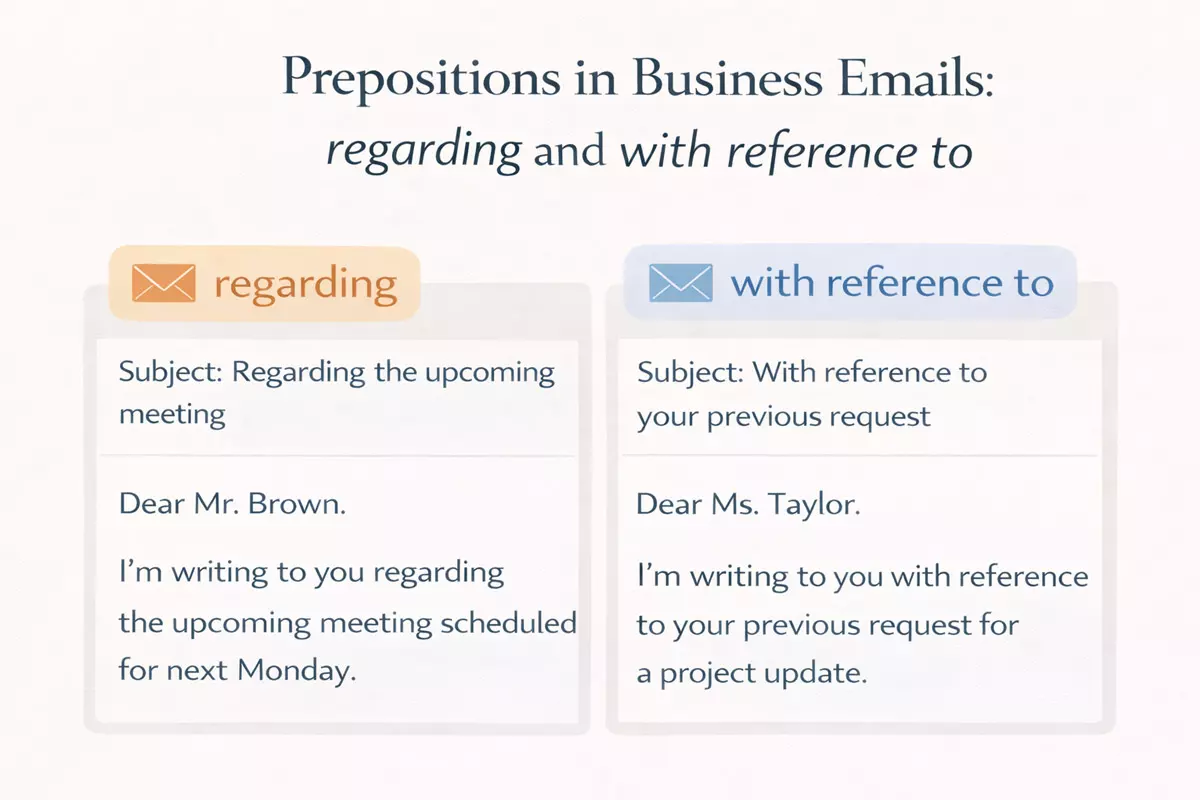 This article teaches how to select the right prepositions in business emails. It covers tone, reference markers, polite requests, action-oriented phrases, attachments, concise grammar, outdated phrases, subject lines, and includes practice for common email scenarios.
- The professional tone-scale: Choosing between 'regarding', 'concerning', and 'about'
- Reference markers: Using 'with reference to' and 'further to' for follow-up clarity
- Polite request structures: Mastering 'in connection with' and 'on behalf of'
- Action-oriented prepositions: 'per our agreement', 'as of [date]', and 'by the deadline'
- Attachments and enclosures: Correct usage of 'attached to' and 'included in' logic
- Grammar of brevity: Reducing wordiness without losing professional courtesy
- Avoiding 'Victorian' English: Identifying outdated phrases like 'as per your request'
- Subject line optimization: Using prepositions for concise and searchable headings
- Practice: Drafting emails for conflict resolution, scheduling, and formal inquiries
Writing clear, professional emails is crucial in the business world, and selecting appropriate connecting words significantly enhances communication. Here we how using specific prepositions can help reference topics or previous messages efficiently, ensuring that your correspondence remains organized and easy to follow. Mastering these subtle language choices not only improves clarity but also demonstrates attention to detail and professionalism, which are highly valued in any professional setting.
The professional tone-scale: Choosing between 'regarding', 'concerning', and 'about'
Selecting the right preposition in business emails can change the level of formality and impact. While all three—'regarding', 'concerning', and 'about'—can introduce a topic, they signal different degrees of professionalism. Knowing when to use each is key to aligning your message with your audience and the context.
When to choose 'regarding'
'Regarding' is the most formal and neutral of these options. It’s widely used in professional correspondence to introduce the subject of the email or a specific issue. This word is appropriate when you want to maintain a businesslike tone without sounding distant. For example, "Regarding your invoice dated June 10" is a clear, polite way to reference a document or topic.
How 'concerning' differs
'Concerning' is similar in formality to 'regarding' but can sometimes carry a subtle negative undertone, perhaps unintentionally suggesting a problem or issue. It is still acceptable in business writing, yet it’s less common in everyday emails. For instance, "Concerning your recent request" is correct, but some readers might sense a hint of worry or seriousness.
Using 'about' for a casual touch
'About' is the most informal of the three and fits best in friendly or less formal business communication. It’s straightforward and widely understood, but may be too relaxed for formal reports or first-time interactions with clients. For example, "About the meeting next week" works well in internal team emails but could feel too casual in official correspondence.
Quick comparison: Tone and context
| Expression | Typical Use & Tone |
|---|---|
| 'Regarding' | Formal, neutral; appropriate for most business contexts and documentation. |
| 'Concerning' | Formal, sometimes with a serious or slightly negative nuance; best for sensitive topics. |
| 'About' | Informal or semi-formal; suitable for everyday communication, less so for official documents. |
Examples of use in business emails
- Regarding your application for the project manager position
- Concerning the recent changes to the contract
- About tomorrow’s presentation
- Regarding your request for additional resources
- Concerning issues raised in the last meeting
- About our upcoming team event
- Regarding payment terms for the new agreement
- Concerning your feedback on the report
- About the client call scheduled for Friday
- Regarding shipment delays
- Concerning the attached invoice
- About your recent inquiry
Choosing the right preposition helps set the appropriate tone and ensures your message is received as intended. In summary, opt for 'regarding' when in doubt, use 'concerning' for formal or potentially serious matters, and keep 'about' for informal or internal exchanges.
Reference markers: Using 'with reference to' and 'further to' for follow-up clarity
When writing business emails, making clear connections to previous correspondence or documents is essential for efficiency and professionalism. Phrases like with reference to and further to serve as useful tools for tying your message to earlier discussions, ensuring that both sender and recipient understand the context.
How 'with reference to' functions in business emails
With reference to signals that your message relates to a particular topic, document, or previous email. It helps the reader quickly identify which issue or file you are addressing, reducing confusion. This phrase is often used at the beginning of a sentence for clarity.
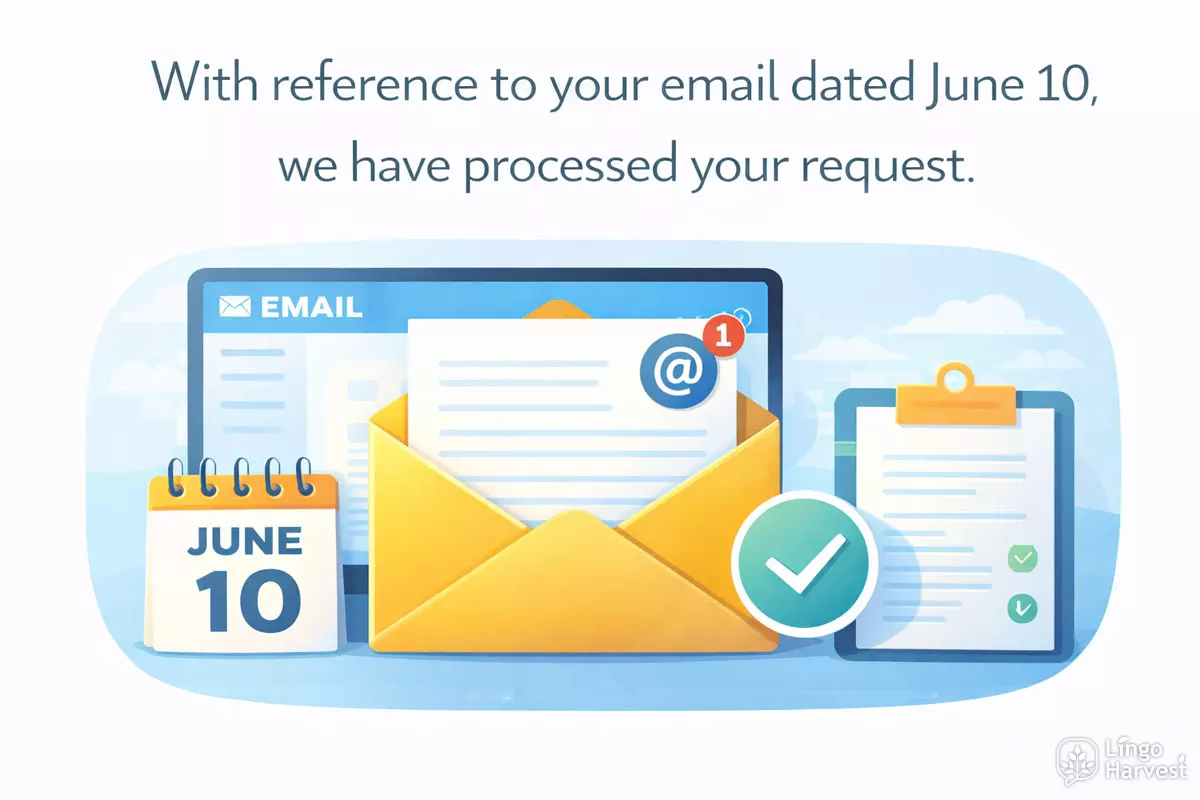
- With reference to your email dated June 10, we have processed your request.
- With reference to the attached invoice, please confirm receipt.
- With reference to our recent meeting, I am sending the requested documents.
- With reference to your application, we require additional information.
- With reference to the project timeline, some adjustments are necessary.
- With reference to your previous correspondence, we are happy to clarify the process.
- With reference to the sales report, several corrections are needed.
- With reference to your inquiry, please find our response below.
- With reference to the order number 12345, there is a delay in shipping.
- With reference to our contract, please review the attached amendment.
Using 'further to' for seamless follow-ups
Further to is typically used to connect a new message to a previous one, highlighting that your email is a continuation or a result of prior communication. It is especially common in follow-ups and ongoing discussions.
- Further to our conversation yesterday, I am sending the updated proposal.
- Further to your last email, here are the requested details.
- Further to the meeting on Monday, please find the minutes attached.
- Further to our telephone call, I have forwarded your concerns to the relevant department.
- Further to the agreement, the revised terms are in effect.
- Further to your feedback, we have made the necessary changes.
- Further to our discussion, I am confirming the appointment for Thursday.
- Further to your submission, we will be in touch with next steps.
- Further to the training session, please complete the attached survey.
- Further to your request, additional information is provided below.
Comparison: Choosing between 'with reference to' and 'further to'
| Phrase | Typical Use |
|---|---|
| With reference to | Refers to a specific document, point, or previous message; often used to cite or clarify a subject. |
| Further to | Links to a previous communication as a follow-up or continuation; signals ongoing discussion or action. |
| With reference to | Suitable for opening a message that introduces a related topic or responds to a specific query. |
| Further to | Ideal for referencing and building upon earlier agreements, meetings, or conversations. |
In summary, both phrases help organize business email threads and clarify how your message relates to previous communication. Choosing the right marker—whether to cite a topic or to follow up—improves understanding and keeps professional correspondence efficient.
Polite request structures: Mastering 'in connection with' and 'on behalf of'
When writing business emails, expressing requests or providing information with a courteous tone is essential. Using phrases like in connection with and on behalf of helps you communicate both clarity and professionalism, especially when referencing topics or acting as a representative. These structures are particularly useful when you wish to soften a direct request or clarify your role in an exchange.
Using "in connection with" for context
The phrase in connection with introduces the reason or subject of your email. It is a formal, diplomatic way to specify the matter at hand without sounding abrupt. Consider these patterns:
- I am writing in connection with the upcoming project deadline.
- We have a few questions in connection with your recent invoice.
- This email is in connection with your application for the open position.
- Please see the attached document in connection with our last meeting.
- I am contacting you in connection with the delivery schedule.
- We would like to discuss your feedback in connection with our services.
- Further to our conversation in connection with the contract renewal...
- Could you provide more information in connection with the payment terms?
These examples show how to naturally refer to topics, making your intent clear while maintaining a polite distance.
Employing "on behalf of" when representing others
When you act for another person or department, on behalf of is the standard expression. It signals to the recipient that you are not the principal party, which can help manage expectations and clarify responsibility.
- I am contacting you on behalf of our finance team.
- On behalf of Mr. Smith, I would like to request...
- Please find attached the documents on behalf of our legal department.
- We are writing on behalf of our partners in Europe.
- This message is sent on behalf of the HR office.
- Thank you for your inquiry on behalf of your organization.
- I am making this request on behalf of my supervisor.
- On behalf of the management, I would like to thank you for your cooperation.
This approach is especially relevant for administrative assistants, managers, or anyone communicating for another party.
Comparing request structures: "in connection with" vs "on behalf of"
The two expressions serve different functions in business correspondence. One introduces the subject, while the other clarifies the sender's role. Understanding when to use each can improve both the tone and clarity of your emails.
| Phrase | Typical Usage |
|---|---|
| in connection with | Used to specify the subject or reason for the email, inquiry, or action. |
| on behalf of | Indicates the sender is acting as a representative of another person or group. |
| Example: "I am writing in connection with..." | Introduces the topic or context for the communication. |
| Example: "On behalf of our department..." | Clarifies that the message is sent for someone else or a team. |
Tips for natural, polite requests
To sound both professional and approachable, combine these phrases with indirect language or modal verbs. For example:
- Could you please send the report in connection with last quarter's results?
- May I request, on behalf of my manager, an update on the shipment status?
- Would you be able to clarify this in connection with our recent discussion?
- We would appreciate your assistance on behalf of the project team.
Using such structures not only makes your emails more courteous but also helps avoid misunderstandings and fosters positive business relationships.
Action-oriented prepositions: 'per our agreement', 'as of [date]', and 'by the deadline'
In business correspondence, certain prepositional phrases help clarify timing, authority, and expectations. Expressions like “per our agreement,” “as of [date],” and “by the deadline” signal when actions should occur, which document is guiding a decision, or the exact point at which a change takes effect. Using these in emails reduces ambiguity and keeps communication direct and professional.
Usage and Nuances
“Per our agreement” refers back to a previous understanding or contract, establishing authority for a statement or request. “As of [date]” marks a specific moment when a new policy, status, or responsibility becomes effective. “By the deadline” specifies the latest possible time for completion, making it clear when a deliverable is due.
- Per our agreement — refers to previously established terms or decisions.
- As of [date] — indicates when something starts or changes.
- By the deadline — sets a non-negotiable completion point.
Common Patterns in Business Emails
Writers often use these phrases to introduce requests, confirm compliance, or explain changes. Here are some practical examples:
- Per our agreement, the next payment is due this Friday.
- As of June 1, our office hours will change to 9:00–17:00.
- Please submit your report by the deadline stated in the project timeline.
- Per our agreement, you are responsible for monthly updates.
- As of today, your new responsibilities include client communication.
- All invoices must be received by the deadline to ensure prompt payment.
- Per our agreement, we expect delivery within two weeks.
- As of next quarter, the pricing structure will be updated.
- All supporting documents should be uploaded by the deadline.
- Per our agreement, travel expenses will be reimbursed.
- As of January 15, the new policy will apply to all employees.
- Please confirm receipt by the deadline to avoid delays.
Comparing Functions
Each phrase plays a distinct role. “Per our agreement” emphasizes adherence to prior arrangements, “as of [date]” focuses on timing, and “by the deadline” stresses urgency or finality. Here’s a side-by-side comparison:
| Phrase | Function | Typical Context |
|---|---|---|
| Per our agreement | Refers to established terms/authority | Confirming obligations, referencing contracts |
| As of [date] | Specifies when a change starts | Announcing effective dates, updates |
| By the deadline | Sets a completion or submission time | Assigning tasks, requesting deliverables |
Summary
Strategic use of these prepositional phrases in business emails keeps communication clear and actionable. They help ensure everyone understands the timing, authority, and expectations underlying each message, which is essential for smooth professional interactions.
Attachments and enclosures: Correct usage of 'attached to' and 'included in' logic
Understanding how to refer to files or documents that accompany your business emails is essential for clarity and professionalism. Choosing the correct preposition—whether you say a document is "attached to" your email or "included in" the message—can help avoid misunderstandings and ensure your communication is precise.
When to use 'attached to'
Use "attached to" when you are referring to separate files sent alongside your email. This preposition emphasizes a physical or digital connection, suitable for files such as PDFs, Word documents, or images sent as attachments. Common phrases include:
- The invoice is attached to this email.
- Please see the report attached to my previous message.
- The signed contract is attached to this correspondence.
This construction helps the recipient know to look for separate files, not embedded content.
When to use 'included in'
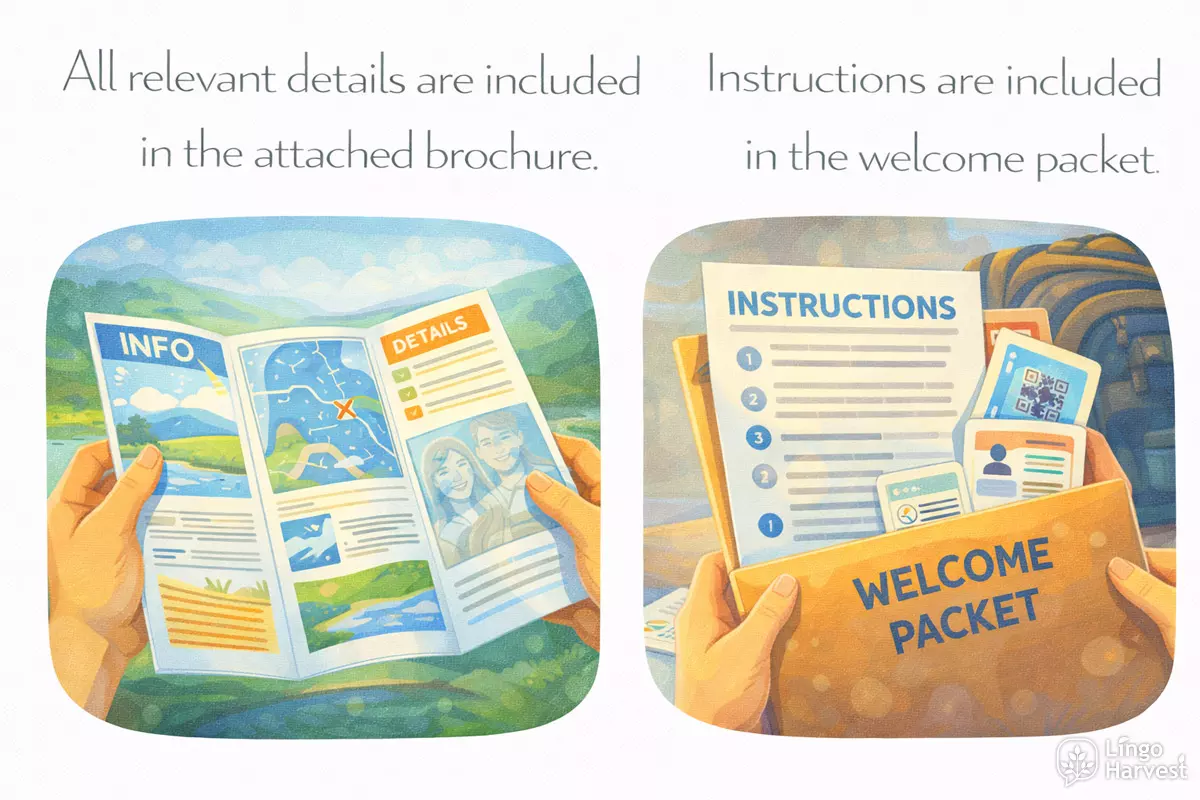
"Included in" is the preferred phrase when referring to materials that are part of the main body of the email, or content embedded within a document or package. It suggests that the item is contained inside something else, not separate. Typical uses:
- The agenda is included in the email below.
- All relevant details are included in the attached brochure.
- Instructions are included in the welcome packet.
This distinction is especially important when you want to direct the recipient’s attention to content within a document or message, rather than a file attachment.
Common patterns and examples
To further clarify these expressions in business correspondence, here’s a list of typical usage patterns:
- Minutes of the meeting are attached for your review.
- Find the application form attached to this message.
- Details are included in the main text below.
- Our terms and conditions are attached as a PDF.
- The schedule is included in the document you received.
- Please refer to the attached file for specifications.
- The summary is included in the body of this email.
- See the attached images for reference.
- Further instructions are included in the guide attached.
- Your receipt is attached for your records.
- All supporting materials are included in the package.
- The draft is attached as requested.
- Check the included table for more information.
- The signed agreement is attached herewith.
- Answers to your questions are included in the FAQ section.
Comparison: 'attached to' vs 'included in'
The table below summarizes the main differences and typical scenarios for each preposition:
| Expression | Best Used For |
|---|---|
| Attached to | Separate files sent with the email (e.g., PDFs, images, forms) |
| Included in | Content inside the email, document, or package (e.g., main text, embedded information) |
| Attached to | Referring to enclosures physically or digitally connected, but not part of the main content |
| Included in | Highlighting parts of a document or message, not a separate file |
Choosing the right phrase not only prevents confusion, but also demonstrates attention to detail in your business communications. Use these distinctions to make your emails clearer and more effective.
Grammar of brevity: Reducing wordiness without losing professional courtesy
Clear, efficient writing is essential for business emails, yet many professionals worry that concise phrasing might seem abrupt or impolite. Politeness and brevity can—and should—coexist, especially when using prepositions like "regarding" or "with reference to." Overly long phrases often cloud meaning and slow down communication. Instead, choosing precise language helps your message stand out while maintaining respect for the recipient.
Common pitfalls: Unnecessary length in standard phrases
Writers often default to lengthy expressions to sound formal or courteous. For example, "With reference to your previous email dated June 10th, I am writing to inform you that..." can usually be trimmed without loss of meaning or professionalism. Avoiding redundancy is key.
- Instead of: With reference to your request, I would like to inform you that...
- Try: Regarding your request, I would like to inform you that...
- Instead of: I am writing with reference to the meeting scheduled for Friday.
- Try: I am writing about the meeting scheduled for Friday.
Conciseness without sacrificing courtesy
Brevity does not require sacrificing professional tone. Polite openers, transitional phrases, and closings can be brief yet respectful. Here are several alternatives to verbose phrases commonly found in business correspondence:
- Regarding your inquiry, we would like to provide additional information to clarify the matter.
- With regard to the contract, all terms remain valid as outlined in the latest version.
- About your recent message, we have reviewed your request and will respond shortly.
- Following up on our conversation, I am sharing the next steps for your review.
- As discussed, the deadline has been extended until the end of the month.
- Per our agreement, the payment will be processed within five business days.
- In response to your question, the proposed changes do not affect the overall timeline.
- Thank you for your email about... we appreciate you bringing this issue to our attention.
- Please find attached... the requested documents for your reference.
- Let me know if you need further details. I will be happy to assist.
- Looking forward to your reply. Your feedback will help us proceed accordingly.
- Best regards, this message concludes the outlined update.
- Sincerely, we appreciate the opportunity to work with you.
- Thank you for your attention. We value your time and consideration.
- I appreciate your prompt response. It allowed us to move forward efficiently.
- I am happy to clarify further if needed. Please feel free to reach out at any time.
- Let me know if you have any questions. I am available to assist.
- We appreciate your cooperation. Your support is essential to the process.
- Thank you for your understanding. We recognize the importance of this matter.
- I look forward to your feedback. Your input will help finalize the decision.
Comparing verbose and concise forms
When choosing between similar phrases, select the one that delivers your message directly. Below is a comparison between common wordy expressions and their more succinct counterparts:
| Wordy Expression | Concise Alternative |
|---|---|
| With reference to your email dated... | Regarding your email... |
| I am writing this email in order to... | I am writing to... |
| I would like to take this opportunity to... | I would like to... |
| I am contacting you with reference to... | About... |
| For your kind information, please be informed that... | Please note that... |
| I am writing with reference to the subject mentioned above. | Regarding the subject above, |
Final tips for maintaining professionalism
Always review your email for unnecessary words or repetitive phrases. Use polite language, but favor clarity and directness. Being succinct shows respect for the reader’s time and attention, while still expressing courtesy and professionalism.
Avoiding 'Victorian' English: Identifying outdated phrases like 'as per your request'
Many business emails still contain expressions that sound overly formal or antiquated, a legacy from eras when letter writing followed strict social codes. These phrases, sometimes called "Victorian" English, can make your communication seem distant, unnecessarily formal, or even confusing to international colleagues. Common examples include “with reference to your email,” “enclosed herewith,” and the infamous “as per your request.” While not technically incorrect, such wording is rarely necessary in modern business correspondence.
Why Modernize Your Language?
Starting your messages with old-fashioned phrases can create barriers rather than build rapport. Today’s business writing values clarity, brevity, and a conversational tone. Using outdated constructions may make your emails feel stiff or impersonal, and may even distract from your main message.
Typical Outdated Phrases to Avoid
Here are some expressions that often appear in formal emails but are best replaced with simpler alternatives:
- As per your request, we have prepared the relevant documentation for your review.
- With reference to our conversation, I am providing a summary of the agreed points.
- Enclosed herewith you will find the signed copy of the agreement.
- I beg to inform you that the scheduled meeting has been postponed.
- Pursuant to your instructions, the changes have been implemented accordingly.
- Kindly be advised that processing times may vary during peak periods.
- We wish to draw your attention to the revised terms outlined below.
- Further to our previous correspondence, we are awaiting your confirmation.
- Please find attached herewith the files requested in your last message.
- I remain, yours faithfully, and look forward to continued cooperation.
- In compliance with your wishes, the report has been adjusted to reflect your feedback.
- We would like to take this opportunity to thank you for your continued support.
- We are in receipt of your letter dated March 12.
- Permit me to inform you that the review process has now been completed.
- At your earliest convenience, please provide the requested confirmation.
- For your perusal, the draft proposal is included below.
- Under separate cover the original documents will be sent by courier.
- It has come to my attention that additional clarification may be required.
- Notwithstanding the above, we remain committed to meeting the deadline.
- Should you require any further information, please do not hesitate to contact us.
Clearer Alternatives for Everyday Use
Instead of relying on stiff or elaborate wording, try these direct replacements for a more approachable style:
- As you requested → As you asked
- With reference to → About / Regarding
- Enclosed herewith → I’ve attached
- Please find attached → I’ve attached
- Kindly be advised that → Please note
- I am writing to inform you → I’m letting you know
- Should you require any further information → Let me know if you need more details
- At your earliest convenience → When you have a moment
- We are in receipt of → We received
- Notwithstanding the above → Even so / However
Outdated vs. Modern: Quick Comparison
| Outdated Phrase | Modern Alternative |
|---|---|
| As per your request | As you requested / As you asked |
| With reference to | Regarding / About |
| Enclosed herewith | I’ve attached |
| Further to our previous correspondence | Following up on our last email |
| Kindly be advised that | Please note |
| We are in receipt of | We received |
| Should you require any further information | Let me know if you need more details |
| At your earliest convenience | When you have a moment |
Modernizing your email style not only improves understanding but also builds stronger, more genuine business relationships. By swapping out overly formal phrases for clear, concise language, your emails will be easier to read and more effective.
Subject line optimization: Using prepositions for concise and searchable headings
Crafting effective subject lines in business emails relies heavily on clarity and brevity. Strategic use of prepositions such as "regarding" and "with reference to" helps create subject headings that are both informative and easy to locate in inbox searches. These prepositions signal the topic or purpose of the message, allowing recipients to quickly understand the context before opening the email.
Why prepositions enhance business subject lines
Prepositions provide direct context and establish relationships between the subject and content of an email. By starting with prepositions, subject lines become more specific and focused, reducing ambiguity. This approach also aids in organizing threads and improving searchability, especially when multiple emails cover related topics.
Common patterns for prepositional subject lines
Many professionals adopt set patterns for subject lines to streamline communication. Here are practical examples illustrating how prepositions can clarify intent:
- Regarding the Q2 Sales Report
- With reference to your recent inquiry
- About the upcoming project deadline
- In response to your application
- Concerning invoice #4562
- On the subject of annual leave
- For approval: marketing budget
- Regarding changes in policy
- With reference to last week's meeting
- About your account update
- Regarding training schedule
- Concerning your feedback
- With respect to contract terms
- On the matter of client complaints
- For your review: draft proposal
- Regarding IT support request
- About password reset process
- With reference to shipment delay
Comparison: "regarding" vs. "with reference to"
Choosing between "regarding" and "with reference to" depends on the formality and precision required in your message. The following table summarizes their typical usage and tone:
| Preposition | Common Usage & Tone |
|---|---|
| Regarding | Direct, concise, suitable for most business contexts. ✅ E.g., "Regarding your order status" |
| With reference to | More formal, often used in official correspondence or when referencing previous communication. ✅ E.g., "With reference to your email dated June 5" |
| About | Informal, appropriate for internal or less formal messages. E.g., "About tomorrow’s meeting" |
| Concerning | Formal but slightly less common; used for sensitive or important topics. E.g., "Concerning your complaint" |
Best practices for prepositional subject lines
- Place the preposition at the beginning for immediate clarity. - Keep the subject line under 60 characters when possible. - Use specific nouns after the preposition to improve searchability (e.g., "Regarding invoice #1234" instead of "Regarding your question"). - Avoid vague terms; be precise about the topic or action required. - Match the preposition’s formality to your audience and the context. Using prepositions thoughtfully in email headings helps recipients prioritize messages, streamlines communication, and supports efficient inbox management.
Practice: Drafting emails for conflict resolution, scheduling, and formal inquiries
Effective use of prepositions like regarding and with reference to can clarify the purpose and tone of business correspondence. Below, you'll find practical exercises and examples to help you compose emails for sensitive workplace scenarios such as resolving conflicts, arranging meetings, and making formal requests.
Common Email Starters Using "Regarding" and "With Reference To"
- Regarding your recent feedback, I would like to discuss possible solutions.
- With reference to the meeting scheduled last week, could we confirm the agenda?
- Regarding the issue you raised, our team is currently investigating.
- With reference to your inquiry, please find the requested documents attached.
- Regarding the project timeline, we anticipate some delays.
- With reference to our previous conversation, I am following up as agreed.
- Regarding your application, we require further information.
- With reference to your complaint, we apologize for the inconvenience caused.
- Regarding next week’s schedule, are there any conflicts we should address?
- With reference to your request for extension, we are reviewing the possibility.
- Regarding the upcoming audit, please confirm your availability.
- With reference to the attached invoice, kindly process the payment by Friday.
Practice Task: Identify and Rewrite
Below are sentences using prepositions. Identify whether regarding or with reference to is more appropriate. Then, rewrite the sentence for clarity and professionalism.
- (a) Regarding your complaint, we are investigating the matter.
(b) With reference to your complaint, we are investigating the matter. - (a) With reference to tomorrow's meeting, please confirm your attendance.
(b) Regarding tomorrow's meeting, please confirm your attendance. - (a) Regarding the attached file, let me know if you have questions.
(b) With reference to the attached file, let me know if you have questions. - (a) With reference to your recent email, we will respond shortly.
(b) Regarding your recent email, we will respond shortly. - (a) Regarding the proposed changes, we require further discussion.
(b) With reference to the proposed changes, we require further discussion. - (a) With reference to the contract terms, please review Section 4.
(b) Regarding the contract terms, please review Section 4. - (a) Regarding your request for an extension, it has been approved.
(b) With reference to your request for an extension, it has been approved. - (a) With reference to the scheduled delivery, there may be a short delay.
(b) Regarding the scheduled delivery, there may be a short delay. - (a) Regarding the invoice dated June 5, payment is still pending.
(b) With reference to the invoice dated June 5, payment is still pending. - (a) With reference to your feedback, we have updated the documentation.
(b) Regarding your feedback, we have updated the documentation.
Show answers
- Both forms are correct, but “With reference to” is more formal and suitable for official or legal contexts.
- Both work; “With reference to” sounds more formal, while “Regarding” fits semi-formal communication.
- Both are acceptable, but “Regarding” feels more natural in short or direct messages.
- Both are correct; “With reference to” clearly links to a prior message.
- Both work, though “Regarding” sounds slightly more conversational.
- “With reference to” is preferred in contractual or legal documents.
- Both are correct; “With reference to” sounds more official.
- Both are acceptable, with “Regarding” being more neutral in tone.
- “With reference to” is more common in formal payment reminders.
- Both forms are correct, but “Regarding” is more common in modern business English.
Drafting Example Phrases for Different Scenarios
Choose the most suitable phrase when writing emails for these situations:
- To address a misunderstanding: With reference to our recent discussion, I would like to clarify my previous point.
- When proposing a new meeting time: Regarding our upcoming meeting, could we reschedule to Thursday?
- Following up on a document: With reference to the document sent last week, have you had a chance to review it?
- Apologizing for a delay: Regarding the delay, we appreciate your patience and understanding.
- Responding to a formal inquiry: With reference to your inquiry, please find our detailed response below.
- Requesting confirmation: Regarding your availability, kindly confirm if the proposed time suits you.
- Clarifying instructions: With reference to your instructions, could you please elaborate on the next steps?
- Addressing a complaint: Regarding your recent complaint, we are taking immediate action.
- Providing an update: With reference to the ongoing project, here is the latest update.
- Seeking input: Regarding the draft proposal, do you have any suggestions?
Comparison Table: Tone and Usage
| Phrase | Typical Context |
|---|---|
| With reference to your request | Formal replies, official documents, external communication |
| Regarding your feedback | Internal emails, direct communication, informal business messages |
| With reference to the attached contract | Legal, contractual, or policy-related emails |
| Regarding tomorrow’s meeting | Scheduling, reminders, follow-ups |
| With reference to your complaint | Customer service responses, complaint resolution |
| Regarding the new project | Project updates, status checks, internal coordination |
Quick Practice: Fill-in-the-Blank
Insert either regarding or with reference to in each blank:
- ________ your application, we require further details.
- ________ the attached invoice, payment is due by Friday.
- ________ our conversation, I am sending the revised schedule.
- ________ your question, please see the answer below.
- ________ your recent email, we will respond shortly.
- ________ the contract terms, please review Clause 5.
- ________ the scheduled meeting, it has been postponed.
- ________ your request for clarification, additional information is provided.
- ________ the delivery timeline, minor delays may occur.
- ________ your feedback, the document has been updated.
Show answers
- With reference to
- With reference to
- Regarding
- Regarding
- With reference to
- With reference to
- Regarding
- With reference to
- Regarding
- Regarding